How to Write a Cold Email to a CEO That Gets a Reply in 2026
CEOs delete 90% of cold email in under three seconds. Here's the research, structure, timing, and send infrastructure that gets the other 10% read — with templates and a channel comparison table.
TL;DR
- A cold email to a CEO fails on deliverability and relevance long before it fails on copy. Fix the address and the inbox placement first, then worry about the subject line.
- CEOs at companies under ~200 people read their own inbox. Above that, you are usually writing to an EA, a filter, or nobody. Segment your list by headcount before you write a word.
- The winning structure is four sentences: proof you did homework, a specific business consequence, one number, one low-friction ask. Anything longer gets scrolled past.
- Never ask a CEO for a demo. Ask for a redirect ("is this Priya's call or yours?"). Redirect requests get 2–3x the reply rate of meeting requests.
- Verify before you send. A bounce on a CEO's address does more damage to your domain than ten ignored emails.
Cold emailing a CEO is not a harder version of cold emailing a manager. It is a different exercise. A VP of Ops will forgive a slightly generic opener because your product is adjacent to their job. A CEO will not, because your product is almost never adjacent to their job — it is three levels below it. The only reason a founder or chief executive replies to a stranger is that the email connects to something they are already losing sleep over.
This guide covers who to email, how to find and verify the address, what to write, when to send, and what the realistic numbers look like.
Should you even be emailing the CEO?#
Start here, because most of the time the answer is no.
The rule of thumb that holds up across thousands of sequences: email the CEO when the CEO is the buyer, or when the company is small enough that the CEO is every buyer.
- Under 50 employees. The CEO signs off on anything above roughly $5k/year. Email them directly. They probably run their own inbox and answer at odd hours.
- 50–200 employees. The CEO still approves budget but has delegated evaluation. Email them for a redirect, not a demo.
- 200–1,000 employees. You are writing to an executive assistant or an Outlook rule. Email the CEO only if your pitch is genuinely strategic — an acquisition, a partnership, a board-level risk.
- 1,000+ employees. Do not. Find the director who owns the problem. Gartner's research on the B2B buying journey shows enterprise deals involve 6–10 stakeholders, and the CEO is rarely one of the active ones.
Getting this wrong is the single most common failure. Reps blast the entire C-suite because the title looks impressive in the CRM, then wonder why the reply rate is 0.4%.
How do you actually find a CEO's email address?#
CEOs are simultaneously the most public and the most protected people at a company. Their name is on the About page. Their address is nowhere.
Four approaches, roughly in order of reliability:
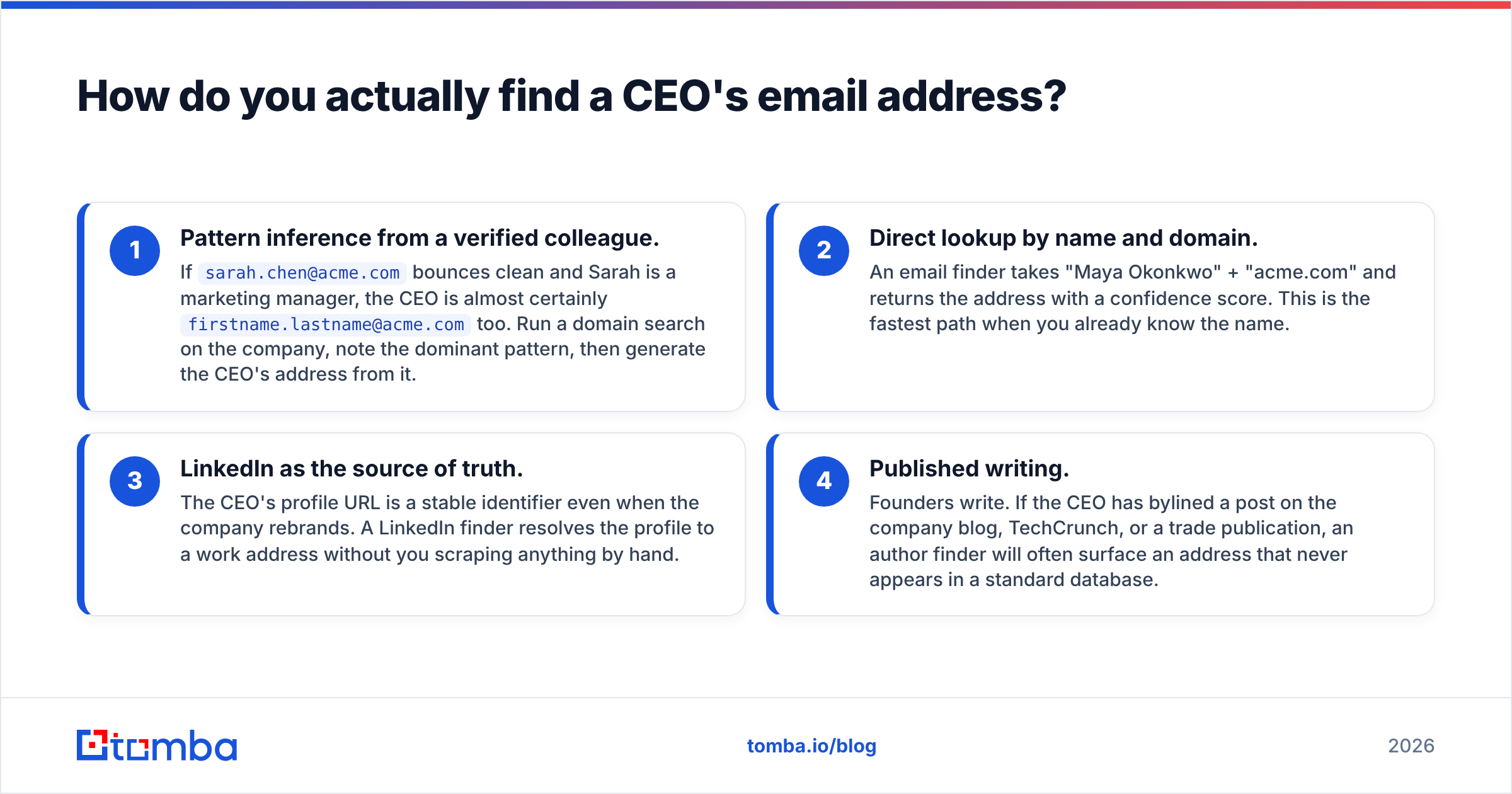
- Pattern inference from a verified colleague. If
sarah.chen@acme.combounces clean and Sarah is a marketing manager, the CEO is almost certainlyfirstname.lastname@acme.comtoo. Run a domain search on the company, note the dominant pattern, then generate the CEO's address from it. - Direct lookup by name and domain. An email finder takes "Maya Okonkwo" + "acme.com" and returns the address with a confidence score. This is the fastest path when you already know the name.
- LinkedIn as the source of truth. The CEO's profile URL is a stable identifier even when the company rebrands. A LinkedIn finder resolves the profile to a work address without you scraping anything by hand.
- Published writing. Founders write. If the CEO has bylined a post on the company blog, TechCrunch, or a trade publication, an author finder will often surface an address that never appears in a standard database.
Whatever you use, the non-negotiable step is verification. A CEO's mailbox is frequently protected by aggressive filtering, and a hard bounce against a high-authority domain hits your sender reputation harder than a bounce against a scrappy startup. Run the address through an email verifier before it enters any sequence. If the domain is catch-all — very common at companies that have been through a rebrand — you need catch-all verification, because a standard SMTP check will return "valid" for literally any string.
Two practical notes:
- Personal Gmail is a trap. You will sometimes find a founder's personal address. Using it reads as surveillance, not research. Stick to the work domain.
info@andhello@are not the CEO. At a 12-person company the CEO might read that inbox. Assume they don't.
What does a cold email to a CEO look like?#
Four sentences. Here is the skeleton, then two worked examples.
The structure:
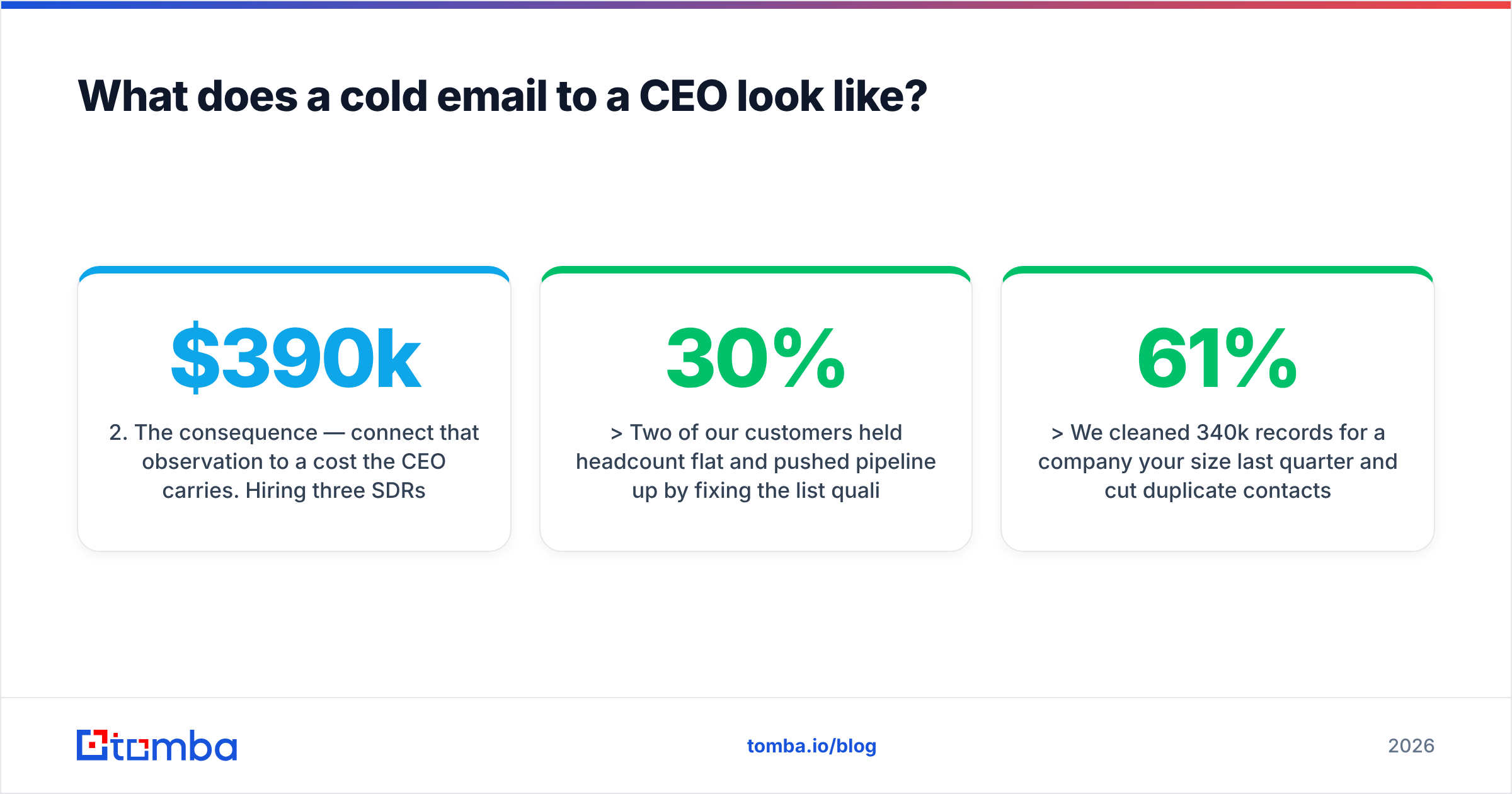
- Specific observation — something only someone who spent five minutes on their company could say. Not "I saw you raised a Series B" (everyone saw that). Something like "your careers page has three open SDR roles in Austin."
- The consequence — connect that observation to a cost the CEO carries. Hiring three SDRs means ~$390k fully loaded before a single meeting is booked.
- The number — one credible, specific figure. Not "increase revenue." "Cut list-building time from 6 hours a week to 40 minutes."
- The ask — small. A redirect, a yes/no, a one-line reply.
Example A — a founder-to-founder email at a 30-person company:
Subject: three SDR roles in Austin
Maya — you've got three SDR openings posted in Austin, which reads like you're solving pipeline with headcount.
Two of our customers held headcount flat and pushed pipeline up 30% by fixing the list quality upstream instead. Their reps were spending a third of the week hunting for contact data that turned out to be 40% stale.
Worth 15 minutes before you sign three offer letters?
— Ben
Example B — a redirect email at a 180-person company:
Subject: quick redirect?
Maya — not trying to sell you anything directly. Your team just moved to HubSpot (saw the job posting for a RevOps admin), and the messiest part of that migration is usually contact data hygiene.
We cleaned 340k records for a company your size last quarter and cut duplicate contacts by 61%.
Is this Priya's call, or should I stay out of your inbox entirely?
— Ben
Note what neither email does. No "hope you're well." No paragraph about your company's mission. No calendar link. No "just following up on my last email." A CEO reads the first line and makes a keep/kill decision in about two seconds; HubSpot's sales statistics put the average professional's daily email volume high enough that this triage is a survival mechanism, not rudeness.
The subject line does more work than the body. Lowercase, under five words, and specific. "three SDR roles in Austin" gets opened because it looks like internal mail. "Transform Your Sales Pipeline" gets deleted because it looks like everything else. If you need help generating variants worth testing, a subject line generator will give you a starting set — but the specificity has to come from your research, not from a template.
Which channel actually reaches a CEO?#
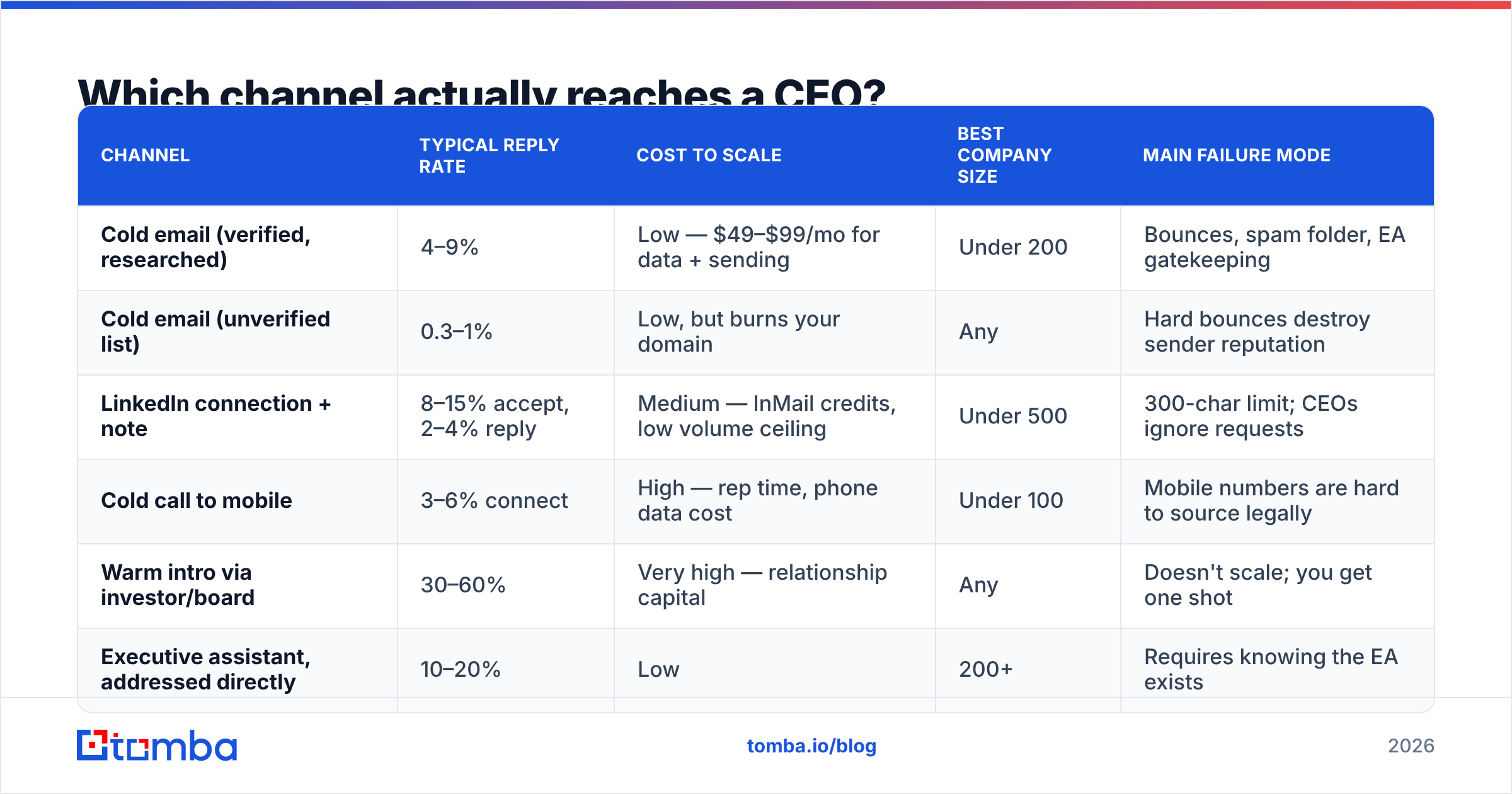
Email is not automatically the right vehicle. Here's how the realistic options compare for reaching a chief executive at a mid-market company.
| Channel | Typical reply rate | Cost to scale | Best company size | Main failure mode |
|---|---|---|---|---|
| Cold email (verified, researched) | 4–9% | Low — $49–$99/mo for data + sending | Under 200 | Bounces, spam folder, EA gatekeeping |
| Cold email (unverified list) | 0.3–1% | Low, but burns your domain | Any | Hard bounces destroy sender reputation |
| LinkedIn connection + note | 8–15% accept, 2–4% reply | Medium — InMail credits, low volume ceiling | Under 500 | 300-char limit; CEOs ignore requests |
| Cold call to mobile | 3–6% connect | High — rep time, phone data cost | Under 100 | Mobile numbers are hard to source legally |
| Warm intro via investor/board | 30–60% | Very high — relationship capital | Any | Doesn't scale; you get one shot |
| Executive assistant, addressed directly | 10–20% | Low | 200+ | Requires knowing the EA exists |
The table hides a compounding effect. Cold email and LinkedIn stack: a connection request seen three days before your email lands roughly doubles the email's reply rate, because your name is no longer entirely new. Cold email and phone stack too — a phone finder paired with a verified address lets you follow an unanswered email with a call that references it, which is the single highest-converting two-touch pattern in outbound.
What does not stack is volume. Sending the same email to 400 CEOs is not four times better than sending a researched email to 100. It's worse, because the generic version trains spam filters against your domain, and the damage carries into every future campaign.
Why do most cold emails to CEOs never get seen?#
Because they land in spam, and nobody tells you.
Reply rate gets all the attention, but inbox placement is upstream of it. An email that never renders cannot be a bad email — it can only be an invisible one. Three things kill placement before your copy gets a chance:
- Authentication. No SPF, no DKIM, no DMARC, and Google and Microsoft both treat you as untrusted by default as of their 2024 bulk-sender requirements. Check your SPF record before you send anything.
- Bounce rate. Above ~3% and mailbox providers throttle you. Above 5% and they start routing you to spam wholesale. This is why unverified lists are not a shortcut — they are a slow-motion domain fire.
- Content signals. Tracking pixels, link shorteners, five links in a four-sentence email, an image-heavy signature. Run a draft through a spam checker once and you'll usually find one obvious offender.
There is also a legal floor. In the US, the CAN-SPAM Act requires accurate headers, a non-deceptive subject, a physical address, and a working opt-out. In the EU and UK, GDPR's legitimate-interest basis is narrower than most outbound teams assume. A CEO who forwards your email to legal is a bad day for your company, not just for you.
When should you send it, and how often should you follow up?#
Timing. The conventional advice — Tuesday, 10am — is conventional because everyone follows it, which means Tuesday 10am is the most crowded moment in the CEO's week. Founders and chief executives disproportionately clear their inbox at the edges of the day: 6:30–7:30am and 8–10pm local time, plus Sunday evening. Send into those windows. The email sits at the top of a short queue rather than the middle of a long one.
Cadence. Three touches, then stop.
- Day 0 — the original four-sentence email.
- Day 4 — a new email, not a reply-to-thread bump. Different angle, different subject, still four sentences. "Following up on my last email" is a confession that the first one wasn't worth reading.
- Day 11 — the breakup. One line: "Assuming this isn't a priority — I'll close the loop. If it's Priya's call, happy to talk to her instead."
The breakup email consistently produces the highest reply rate of the three, which tells you something uncomfortable: CEOs respond to the removal of an obligation more readily than to the promise of value.
Do not send a fourth. There is no recorded case of a chief executive being won over on touch six.
How do you scale this without turning it into spam?#
The tension is real. Research is what makes the email work, and research is what makes it un-scalable. Three ways to resolve it:
- Tier your list. Top 50 accounts get fully hand-written emails. The next 200 get a template with two researched variables (the specific observation and the number). Everyone else gets a different, lower-effort channel entirely.
- Automate the data layer, not the writing. Contact discovery, verification, and enrichment should be zero human minutes. Use bulk lead generation to resolve and verify a whole account list at once, or wire the Tomba API into your CRM so records enrich on creation. That frees your hours for the observation sentence, which is the only part a machine can't fake.
- Cap your daily volume per inbox. 30–50 cold sends per mailbox per day, maximum. Beyond that, you are optimizing for deliverability damage.
A note on AI-written cold email: CEOs have now read enough of it to recognize the cadence instantly. The em-dash-heavy, three-part-rhythm, "not just X but Y" register is a tell. Use AI to draft, then cut every sentence that could have appeared in someone else's email.
What reply rates should you actually expect?#
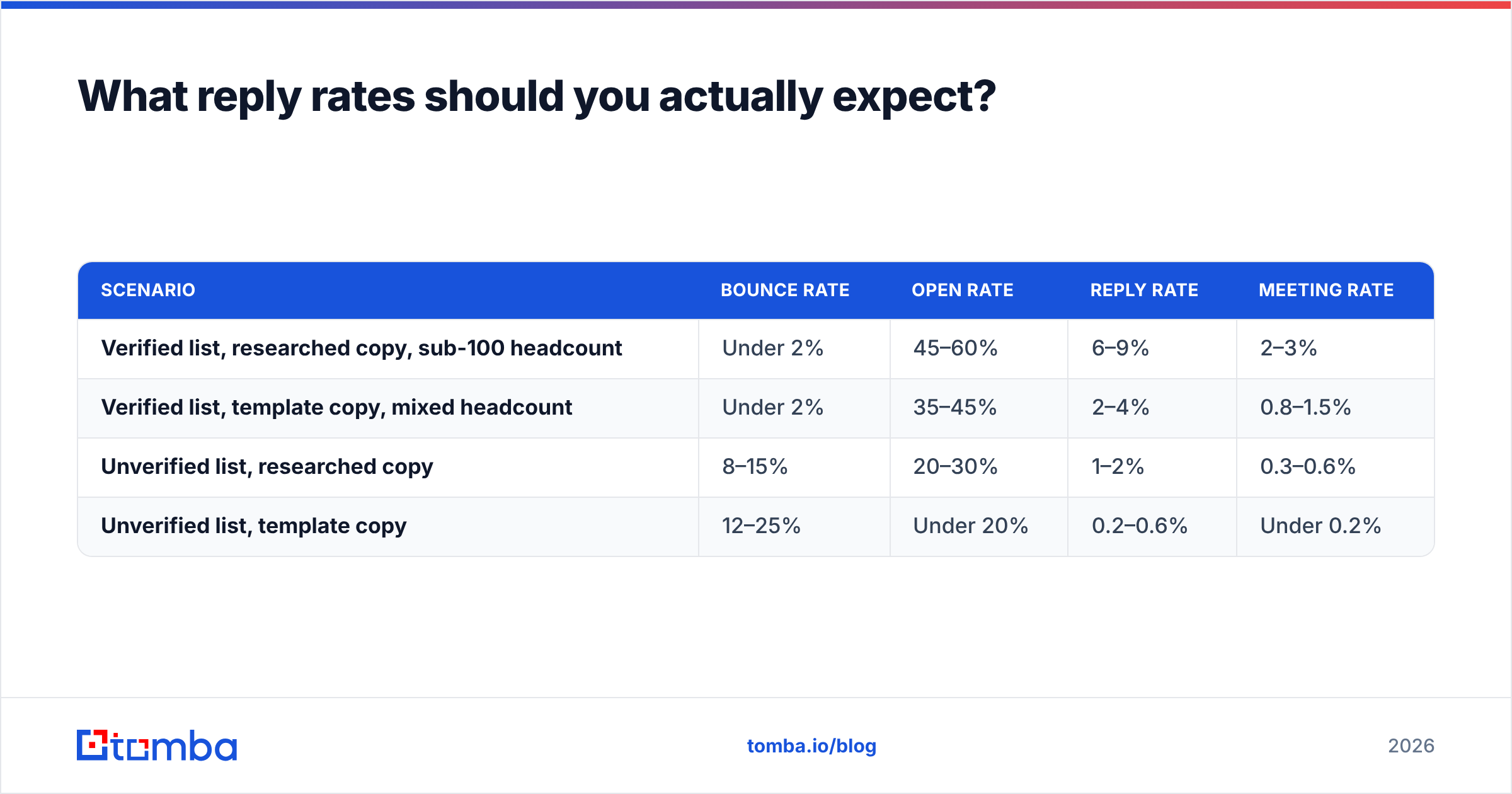
Set the benchmark honestly, or you will conclude the channel is broken when it's your list that's broken.
| Scenario | Bounce rate | Open rate | Reply rate | Meeting rate |
|---|---|---|---|---|
| Verified list, researched copy, sub-100 headcount | Under 2% | 45–60% | 6–9% | 2–3% |
| Verified list, template copy, mixed headcount | Under 2% | 35–45% | 2–4% | 0.8–1.5% |
| Unverified list, researched copy | 8–15% | 20–30% | 1–2% | 0.3–0.6% |
| Unverified list, template copy | 12–25% | Under 20% | 0.2–0.6% | Under 0.2% |
The lesson in that table is that data quality and copy quality are multiplicative, not additive. Great copy on a bad list underperforms mediocre copy on a clean one, because bad addresses don't just fail to deliver — they poison the deliverability of the good addresses sitting next to them in the same send.
If you only fix one thing this quarter, fix the list.
Where to start#
Pick ten companies under 100 employees where you can name the specific, observable thing the CEO is dealing with. Find each founder's address, verify it, and write ten genuinely different four-sentence emails. Send them at 6:45am local. Track replies, not opens.
If two or more come back, you have a repeatable motion and a data problem to solve at scale. If zero come back, your observation sentence isn't specific enough — rewrite it, not the pitch.
For the data half of that equation, Tomba's Email Finder resolves a name and domain to a verified work address with a confidence score, handles catch-all domains that break most SMTP checks, and starts free at 25 searches a month — enough to run the ten-company test above twice. Paid plans begin at $49/mo on Starter and $99/mo on Growth; full Tomba pricing is public, with no seat minimums. Find the address, verify it, then spend your time on the only sentence that matters: the first one.
Related guides#
// get started
Find, verify and enrich your first contacts today
Start on the free plan with 25 searches a month, then scale when your team is ready.
Free plan · No credit card required · GDPR & CCPA
// about the author