Cold Email vs Email Marketing: Key Differences in 2026
Cold email and email marketing use the same inbox and almost nothing else. Different consent rules, different infrastructure, different metrics — and mixing them is the fastest way to torch your domain.
TL;DR
- Cold email is 1:1 outbound to people who never opted in. Email marketing is 1:many broadcast to people who did. Same inbox, completely different rules.
- The dividing line isn't tone or length — it's consent. Consent determines your legal exposure, your sending infrastructure, and your acceptable bounce rate.
- Cold email lives on separate domains, separate inboxes, and low daily volume. Email marketing lives on your primary domain with an ESP and unsubscribe headers.
- Never send cold email from your marketing ESP. Mailchimp, Klaviyo, and HubSpot will suspend you, and a shared IP reputation hit affects every newsletter you send.
- Most B2B teams need both: cold email creates the relationship, email marketing keeps it alive. Run them on isolated infrastructure.
What is the actual difference between cold email and email marketing?#
The difference is consent, and everything else follows from it.
Email marketing sends to a list of people who gave you their address — a form fill, a webinar registration, a checkout, a newsletter signup. They know who you are. They expect mail from you. You have an audit trail proving it.
Cold email sends to people who have never heard of you. You found their address through research, a database, or an email finder, and you're initiating contact for the first time. There is no opt-in. There is no audit trail.
That single distinction cascades into every operational decision you make:
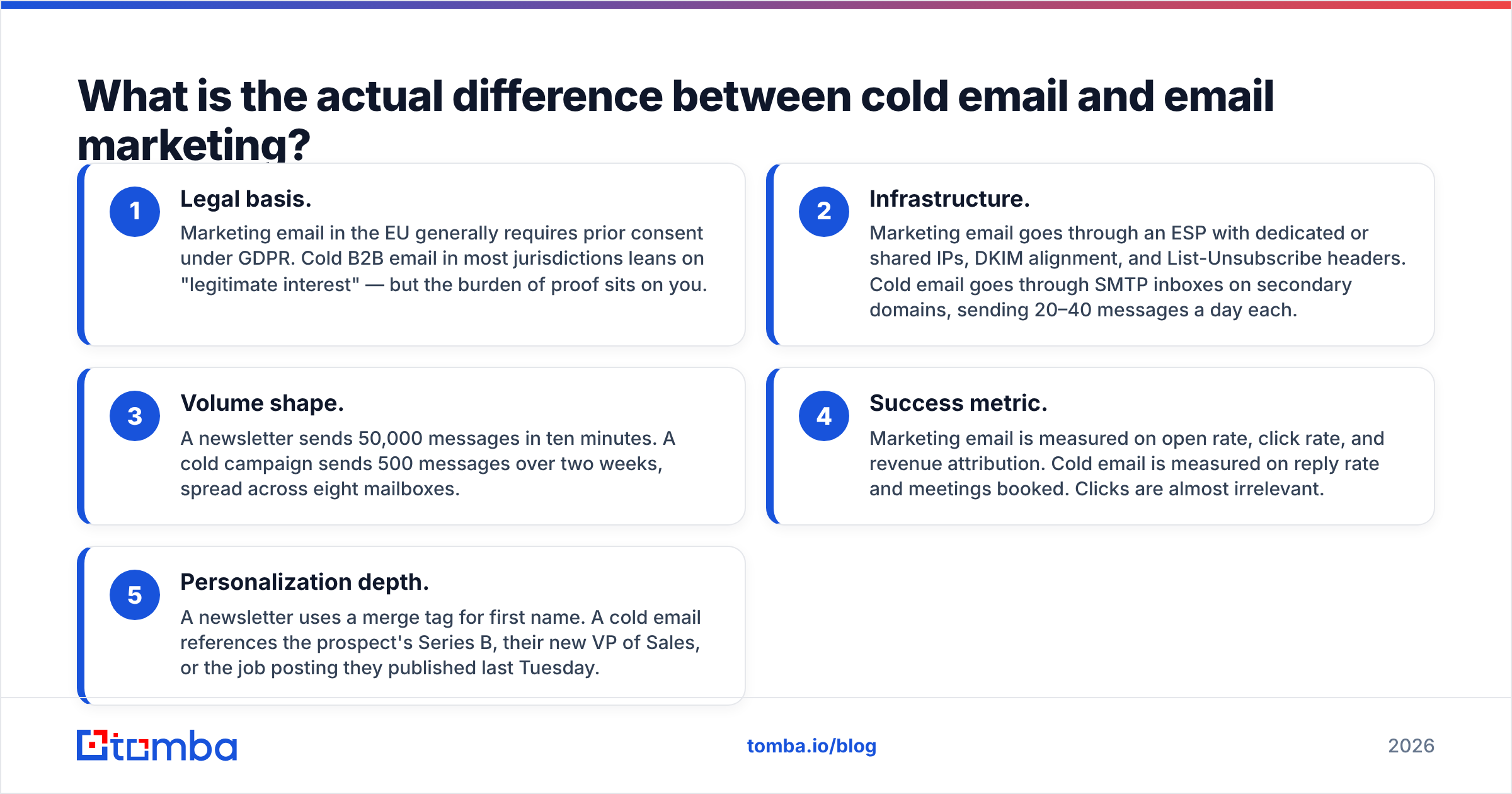
- Legal basis. Marketing email in the EU generally requires prior consent under GDPR. Cold B2B email in most jurisdictions leans on "legitimate interest" — but the burden of proof sits on you.
- Infrastructure. Marketing email goes through an ESP with dedicated or shared IPs, DKIM alignment, and List-Unsubscribe headers. Cold email goes through SMTP inboxes on secondary domains, sending 20–40 messages a day each.
- Volume shape. A newsletter sends 50,000 messages in ten minutes. A cold campaign sends 500 messages over two weeks, spread across eight mailboxes.
- Success metric. Marketing email is measured on open rate, click rate, and revenue attribution. Cold email is measured on reply rate and meetings booked. Clicks are almost irrelevant.
- Personalization depth. A newsletter uses a merge tag for first name. A cold email references the prospect's Series B, their new VP of Sales, or the job posting they published last Tuesday.
Confusing the two is how companies end up on Spamhaus. It happens more than you'd think — a founder exports 8,000 scraped contacts, drops them into the same Mailchimp account that sends the customer newsletter, and by Friday the newsletter is landing in Promotions for everyone.

Is cold email legal, or is it just spam?#
Cold email is legal in the United States, Canada, the UK, and most of the EU — provided you follow the specific rules of each. It is not the same as spam, which is unsolicited bulk mail sent with no regard for relevance or identity.
Here's the landscape as it stands in 2026:
United States (CAN-SPAM). No opt-in required. You must not use deceptive headers or subject lines, must include a physical postal address, must honor opt-out requests within 10 business days, and must identify the message as an advertisement if it is one. B2B cold email is explicitly permitted. See the CAN-SPAM Act for the statutory text.
European Union (GDPR + ePrivacy). Business-to-business cold email can be sent under the "legitimate interest" lawful basis, but you must document a Legitimate Interest Assessment, provide an easy opt-out, and disclose where you obtained the data on first contact. Some member states (Germany, Italy) apply stricter interpretations. Sending to personal addresses (gmail.com, @freelancer-name.com) is far riskier than sending to @company.com.
Canada (CASL). The strictest of the three. Implied consent exists for publicly published business addresses where the role is relevant to your message, but it expires. Penalties reach seven figures.
United Kingdom (PECR). Corporate subscribers (limited companies, LLPs) can be emailed without prior consent. Sole traders and partnerships cannot.
The practical takeaway: cold email to a role-relevant business address, with clear identification and a real opt-out, is legal almost everywhere. Cold email to 40,000 personal Gmail addresses harvested from a breach dump is not. The channel isn't the problem — the sourcing is.
How do the two channels compare head to head?#
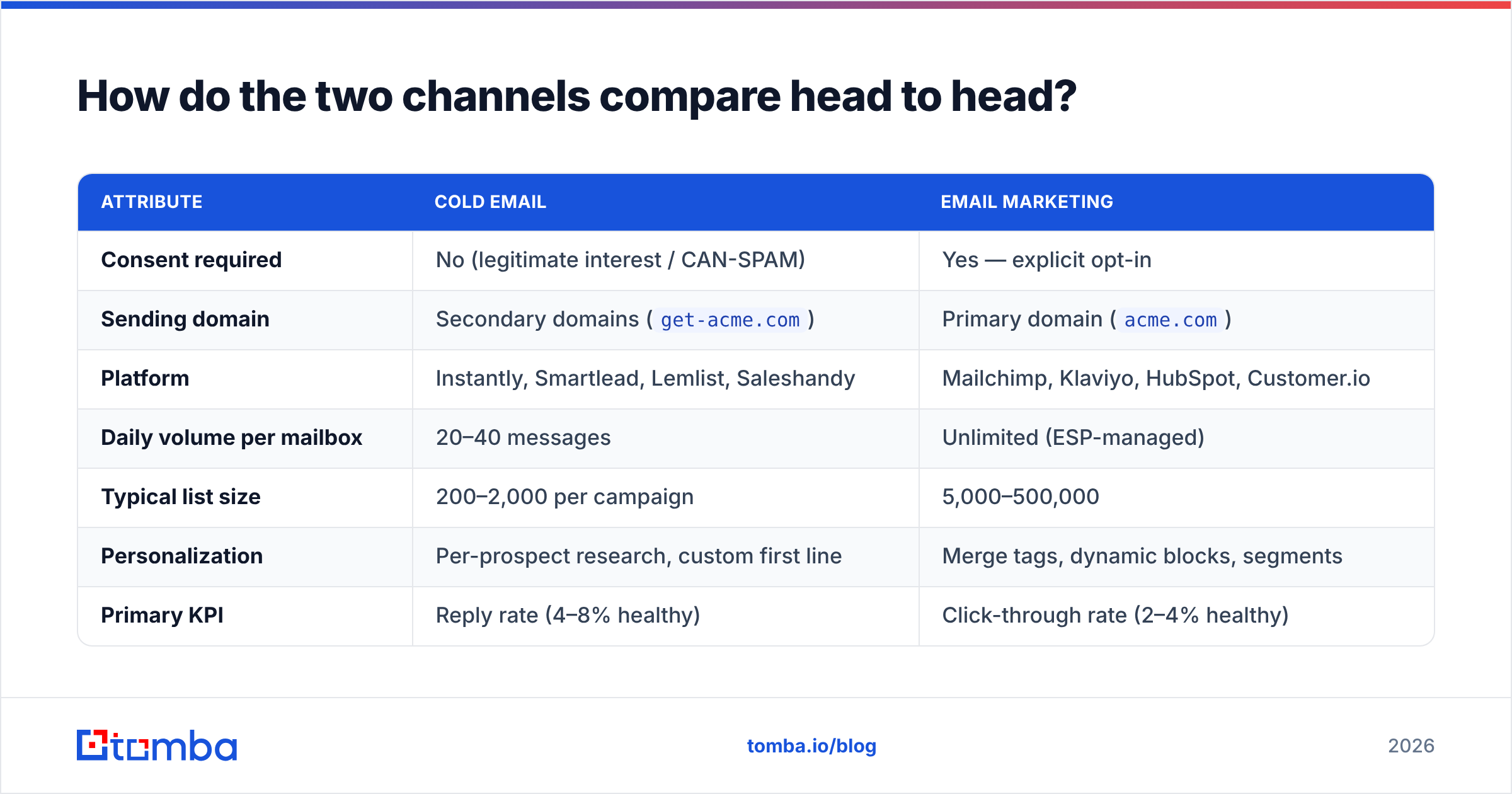
| Attribute | Cold Email | Email Marketing |
|---|---|---|
| Consent required | No (legitimate interest / CAN-SPAM) | Yes — explicit opt-in |
| Sending domain | Secondary domains (get-acme.com) |
Primary domain (acme.com) |
| Platform | Instantly, Smartlead, Lemlist, Saleshandy | Mailchimp, Klaviyo, HubSpot, Customer.io |
| Daily volume per mailbox | 20–40 messages | Unlimited (ESP-managed) |
| Typical list size | 200–2,000 per campaign | 5,000–500,000 |
| Personalization | Per-prospect research, custom first line | Merge tags, dynamic blocks, segments |
| Primary KPI | Reply rate (4–8% healthy) | Click-through rate (2–4% healthy) |
| Acceptable bounce rate | Under 2% (hard fail above 3%) | Under 0.5% |
| List-Unsubscribe header | Optional, plain-text opt-out preferred | Mandatory (Gmail/Yahoo bulk sender rules) |
| Images / HTML | None — plain text only | Rich HTML templates |
| Warmup required | Yes, 4–8 weeks before sending | No (established domain reputation) |
| Cost driver | Data + mailbox seats | Contacts under management |
| Time to first reply | 2–14 days | Immediate (existing relationship) |
| Fails when | Data is stale or generic messaging | List decays, sends become irrelevant |
The row that trips up most teams is volume per mailbox. Cold outreach at scale isn't achieved by sending more from one inbox — it's achieved by adding inboxes. Ten mailboxes at 30 sends a day is 300 daily touches, roughly 6,000 a month, which is enough to fill a two-rep pipeline. Push one mailbox to 300 a day and Google throttles you within a week.
Why can't you just send cold email from your marketing ESP?#
Because you'll get banned, and because you'll take your newsletter down with you.
Every major ESP — Mailchimp, Klaviyo, Constant Contact, Brevo, HubSpot Marketing Hub — explicitly prohibits sending to purchased, scraped, or non-opted-in lists in their acceptable use policy. This is not a gray area. HubSpot's own guidance is direct: their marketing email tool is for opted-in contacts only.
The enforcement mechanism is the complaint rate. ESPs share IP ranges across thousands of customers. When your cold list generates a 0.4% spam complaint rate — which is normal for cold outreach and catastrophic for marketing — that IP's reputation degrades for everyone sharing it. So the ESP suspends you first, asks questions later.
There's a second, quieter cost: domain reputation is not per-mailbox, it's per-domain. If you cold email 5,000 strangers from sales@acme.com, and 20 of them mark it as spam, Gmail's filters learn that acme.com sends unwanted mail. Your invoice emails, your password resets, your customer newsletter — all of them inherit that signal.
The fix is structural isolation:
- Primary domain (
acme.com) — transactional mail and opted-in marketing. Never cold outreach. - Secondary domains (
try-acme.com,acme-hq.com) — cold outreach only. Each redirects to the primary. Each has its own SPF, DKIM, and DMARC records. - Warmup — every new cold domain needs 4–8 weeks of gradual volume ramp before real campaigns. Run the numbers with an email warmup calculator before you commit to a launch date.
Check your DNS setup before the first send. A missing or misconfigured SPF record is the single most common reason a technically-legal cold email never reaches the inbox. Google and Yahoo's 2024 bulk-sender requirements made SPF, DKIM, and DMARC non-negotiable, and enforcement has only tightened since.
What does list quality mean for each channel?#
For email marketing, list quality means engagement recency. Someone who opted in three years ago and hasn't opened in eighteen months is a liability. Suppress them. Sunset policies — auto-removing contacts after 6–12 months of zero engagement — are the single highest-leverage deliverability fix for most marketing programs, and most teams never implement one.
For cold email, list quality means accuracy and fit. You have no engagement history to lean on. The only signals you control are:
- Is this address real? A 5% bounce rate on a cold campaign will get your domain flagged within two sends. Run every address through an email verifier before it enters a sequence. Non-negotiable.
- Is this person the right role? A VP of Engineering does not care about your sales enablement tool, no matter how good the subject line is.
- Is the company a real fit? Firmographic filters — headcount, funding stage, tech stack, hiring signals — do more for reply rate than any copywriting trick.
Where do cold lists come from? Broadly three paths:
- Database providers. Prebuilt B2B contact databases with firmographic filters. Providers like BookYourData and Tomba's own B2B database sell verified contact records at scale. Fast to start, but everyone else can buy the same records.
- Real-time discovery. You define an account list, then find the specific people at those accounts. This is where a domain search earns its keep — feed it
stripe.com, get back the naming pattern and the people who match your target role. Slower, far more differentiated. - Signal-based sourcing. You build lists from behavior: job postings, funding announcements, tech-stack changes, website visitors. Highest reply rates, smallest volumes.
Most functional outbound programs use (2) and (3) and treat (1) as a supplement. The reason is simple: a purchased list is a commodity, and commodity lists get commodity reply rates.
Which channel should you actually invest in?#
Depends on where your revenue comes from. Use this as a decision frame:
Invest in email marketing first if:
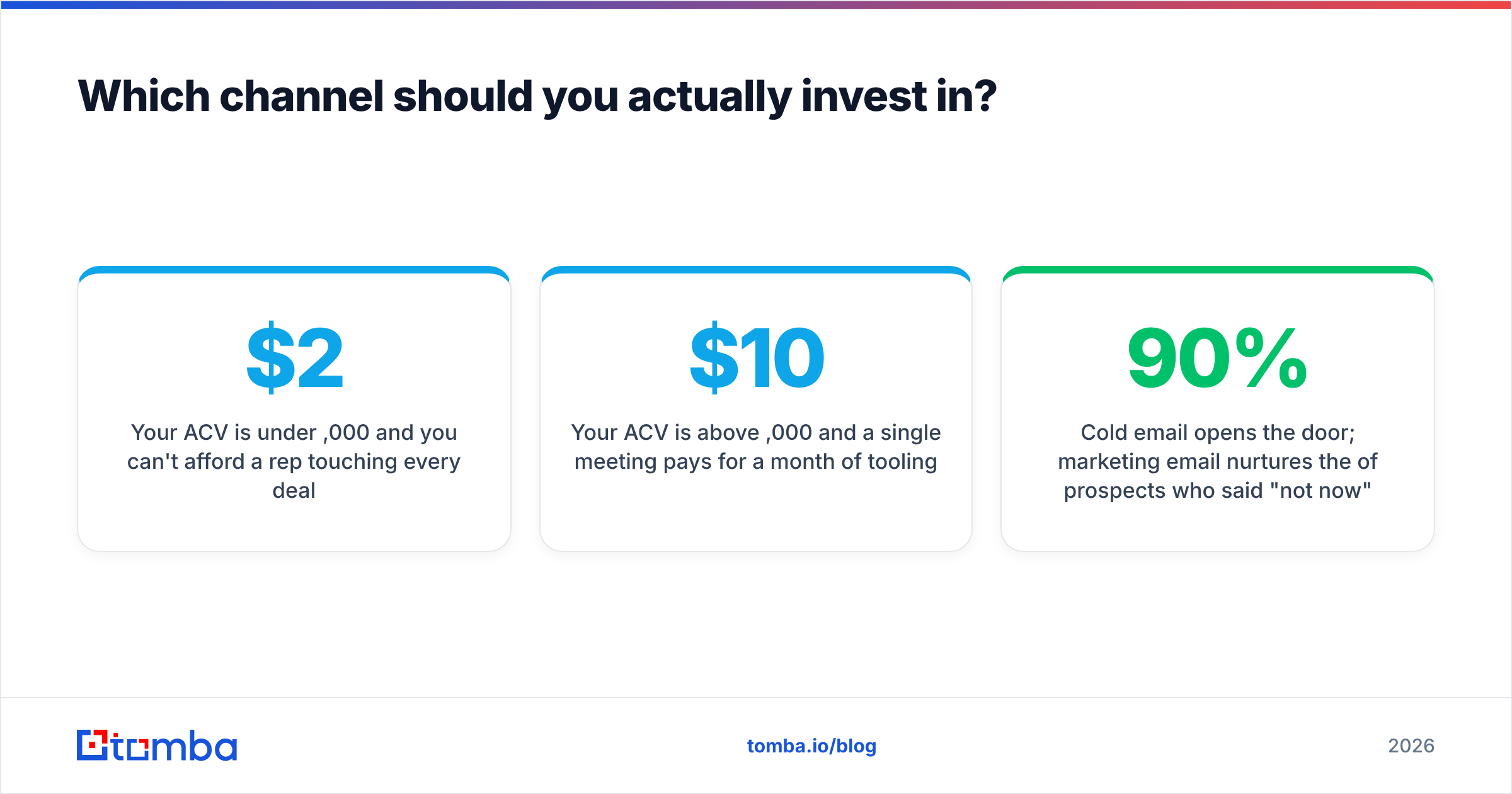
- Your ACV is under $2,000 and you can't afford a rep touching every deal
- You already get 2,000+ organic visitors a month and can capture emails
- Your product has a self-serve motion
- Your buyer researches before they buy
Invest in cold email first if:
- Your ACV is above $10,000 and a single meeting pays for a month of tooling
- Your total addressable market is under 20,000 companies
- Your buyers don't search for what you sell (category creation)
- You need pipeline in 60 days, not 6 months
Run both if:
- You have product-market fit and are scaling a repeatable motion
- Cold email opens the door; marketing email nurtures the 90% of prospects who said "not now"
That third scenario is where most B2B companies land, and it's where the infrastructure separation matters most. A prospect who replies "check back in Q3" should move from your cold sequence to your nurture list — but only after they've engaged, which gives you a legitimate basis to keep mailing them.
The handoff looks like this: cold email on a secondary domain generates a reply. The rep logs it in the CRM. The contact gets tagged as "engaged — nurture," and now receives your monthly newsletter from the primary domain, where they'll actually see it because your primary domain reputation is pristine.
How do you measure each channel without fooling yourself?#
Open rate is dead as a metric. Apple Mail Privacy Protection pre-fetches images for a large share of Apple Mail users, and iOS is the dominant mobile mail client. Every one of those opens is fake. If your cold email tool reports a 78% open rate, that number is noise.
Measure what survives:
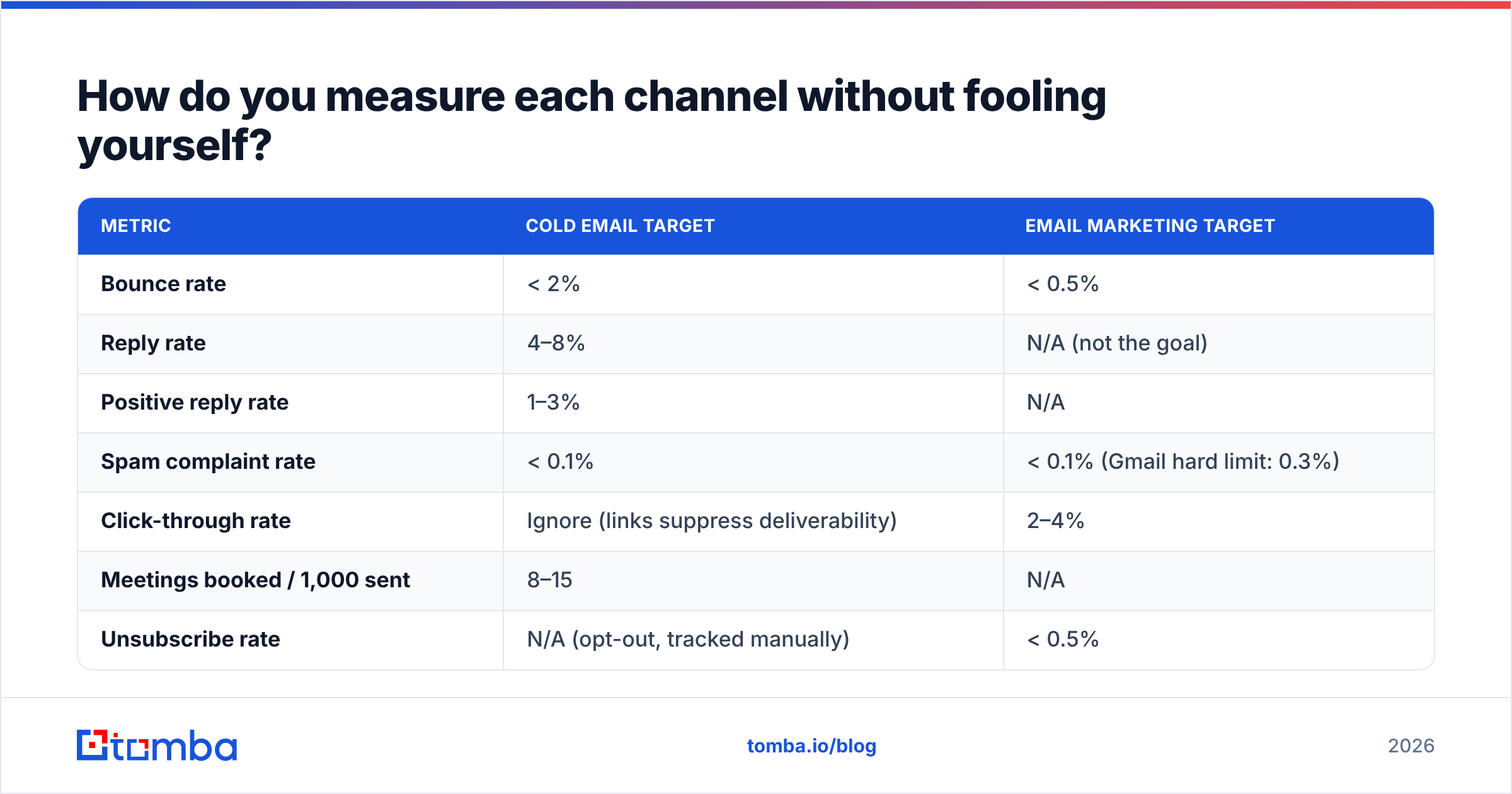
| Metric | Cold Email Target | Email Marketing Target |
|---|---|---|
| Bounce rate | < 2% | < 0.5% |
| Reply rate | 4–8% | N/A (not the goal) |
| Positive reply rate | 1–3% | N/A |
| Spam complaint rate | < 0.1% | < 0.1% (Gmail hard limit: 0.3%) |
| Click-through rate | Ignore (links suppress deliverability) | 2–4% |
| Meetings booked / 1,000 sent | 8–15 | N/A |
| Unsubscribe rate | N/A (opt-out, tracked manually) | < 0.5% |
| Revenue per 1,000 sent | Track by pipeline created | Track by attributed revenue |
Note the asymmetry. Cold email has one number that matters: positive reply rate. Everything else is diagnostic. If positive replies are below 1%, the problem is almost always the list, not the copy — you're talking to people who don't have the problem you solve. Fix targeting before you rewrite the subject line for the ninth time.
For email marketing, response rate matters less than sustained engagement. A list that opens consistently is a list that stays in the inbox. A list you blast quarterly is a list that decays.
Industry benchmark data from G2 and vendor reports varies wildly by sector, so treat public averages as directional only. Your own baseline from 90 days of clean sending beats any published benchmark.
What does a healthy dual-channel setup look like?#
Here's the minimum viable architecture for a B2B team running both:
- Primary domain, ESP-managed. Opted-in contacts. SPF, DKIM, DMARC at
p=quarantineminimum. List-Unsubscribe header on every send. Sunset policy at 9 months of non-engagement. - Two to four secondary domains, SMTP-based. Purchased 8+ weeks before first campaign. Warmed continuously. Three mailboxes per domain, 30 sends/day each.
- A verification layer between sourcing and sending. Every address verified before it enters any sequence. Catch-all domains routed to a catch-all verifier rather than guessed at.
- One CRM as the system of record. Replies, opt-outs, and engagement state live in one place. An unsubscribe from either channel suppresses across both. This is a legal requirement, not a nicety.
- Separate reporting. Never blend cold and marketing metrics into one dashboard. The averages will lie to you in both directions.
The step teams skip is #3, and it's the one that determines whether the other four matter. Sending verified addresses to warmed inboxes on isolated domains produces a 1–2% bounce rate and stable deliverability. Sending unverified addresses to the same setup produces a 7% bounce rate and a burned domain in three weeks. The infrastructure doesn't save you from bad data.
Where should you start?#
Pick the channel that matches your ACV and your timeline, build the infrastructure for it properly, and don't let the two touch.
If you're starting cold outreach, the sequence is: define the account list, find the right people at those accounts, verify every address, warm your domains, then write the copy. Most teams do it backwards — they write the copy first, buy a list to send it to, and wonder why nothing lands.
The finding-and-verifying step is where Tomba Email Finder fits. Search by domain, name, or company, get back the verified professional address with a confidence score, and push it straight to your sequencer or CRM. The free tier gives you 25 searches a month to test the data quality against a domain you already know; paid plans start at $49/mo on Starter and scale to Growth at $99/mo when your list-building outgrows manual work. Check the full Tomba pricing before you commit, and run a sample of 50 known-good contacts through it first — that's the only benchmark that reflects your actual market.
Verify before you send. Isolate before you scale. The channel isn't what gets you flagged — the shortcuts are.
Related guides#
// get started
Find, verify and enrich your first contacts today
Start on the free plan with 25 searches a month, then scale when your team is ready.
Free plan · No credit card required · GDPR & CCPA
// about the author