Cold Email vs Warm Email: Reply Rates, Risk, and When to Use Each
Cold email and warm email are not two settings on the same dial — they are different plays with different costs. Here are the real reply-rate ranges, the compliance risk, and a framework for choosing.
TL;DR#
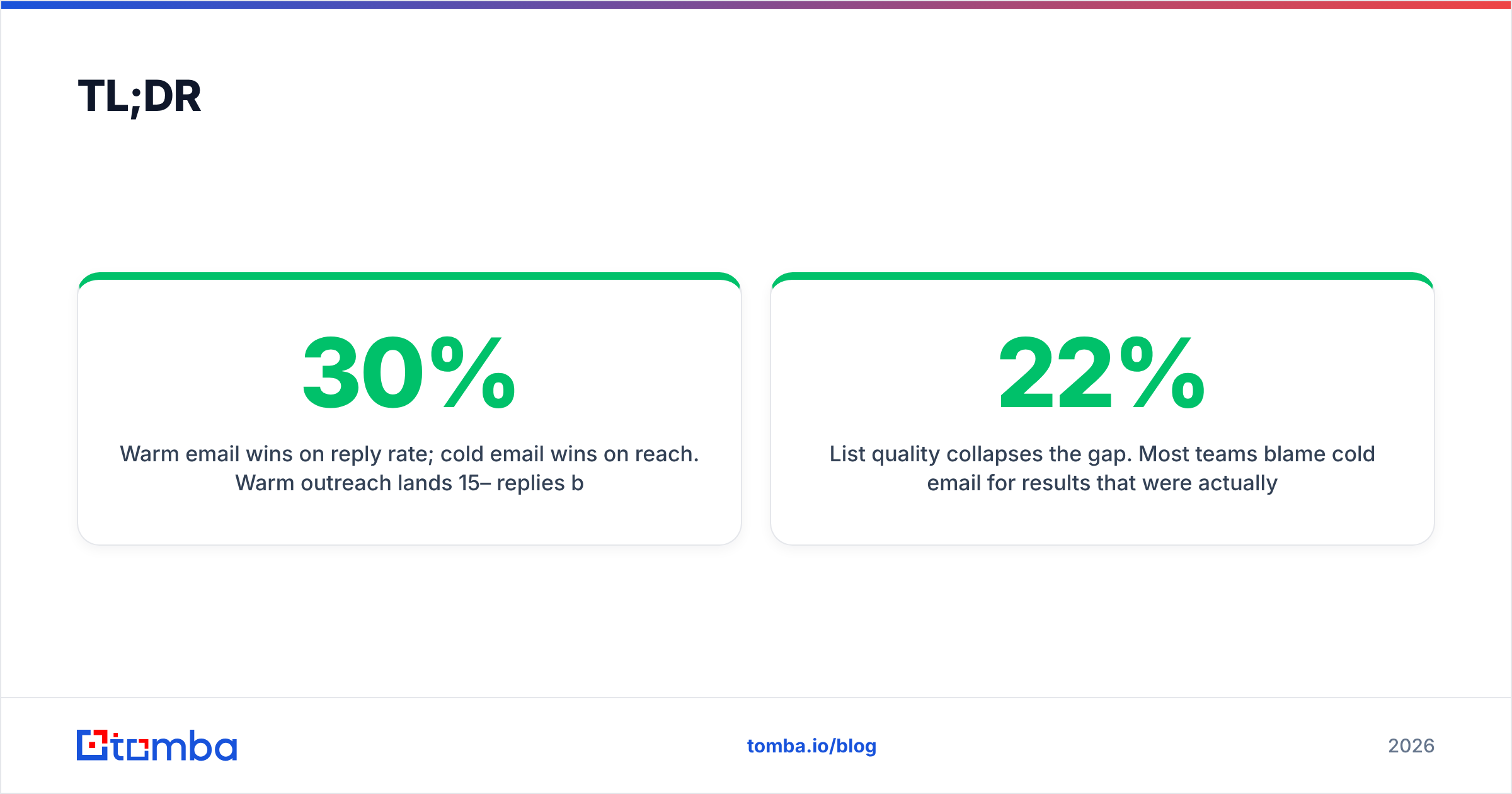
- Warm email wins on reply rate; cold email wins on reach. Warm outreach lands 15–30% replies because the recipient already knows you. Cold sits at 1–5% for most teams. Neither number means much without volume and pipeline math attached.
- The real difference is permission and prior context, not tone. A cold email to a stranger who fits your ICP is legal, ethical, and effective. A "warm" email to a lapsed lead who forgot you exist performs like a cold one.
- List quality collapses the gap. Most teams blame cold email for results that were actually caused by a 22% bounce rate and unverified addresses. Fix the data before you rewrite the copy.
- You don't choose one. Mature outbound uses cold email to create warmth, then converts warmth into meetings. The sequence matters more than the label.
- Compliance differs by geography, not by warmth. CAN-SPAM permits unsolicited B2B email with disclosures. GDPR requires legitimate interest. "Warm" is not a legal defense.
Most sales teams argue about cold email vs warm email as if it were a moral question. It isn't. It's a resource-allocation question with two very different cost structures, and the answer depends on how many accounts you have, how fast you need pipeline, and whether your list is clean enough to send anything at all.
This post gives you the actual mechanics: definitions that hold up, benchmark ranges you can sanity-check against your own CRM, a comparison table, the compliance line, and a decision framework you can apply this week.
What is a cold email, exactly?#
A cold email is a message sent to someone who has had no prior interaction with you or your company. They didn't download your whitepaper, didn't visit your pricing page, didn't meet you at a conference. You found them because they match a pattern — a title, a company size, a tech stack, a hiring signal — and you reached out.
The defining trait is not that the email is impersonal. Plenty of cold emails are hyper-researched and specific. The defining trait is zero prior relationship, which means you are borrowing attention rather than being granted it.
That has three consequences:
- You must earn the first three seconds. No brand recognition, no context, no reason to open beyond the subject line.
- You carry all deliverability risk. Unknown sender, unknown domain, no engagement history. Spam filters treat you accordingly.
- Your list is your product. A perfect email to a wrong person is a wasted send. A decent email to a right person converts.
What is a warm email, exactly?#
A warm email goes to someone with existing context. That context can come from many places, and they are not equally warm:
- Inbound intent — they filled a form, started a trial, requested a demo. Hottest.
- Content engagement — they downloaded a report, attended a webinar, replied to a newsletter.
- Referral or introduction — a mutual connection vouched for you. The strongest non-inbound signal.
- Prior relationship — a former customer, a past champion who changed jobs, an old conversation that stalled.
- Passive touchpoint — they visited your site, followed your company page, or opened three of your cold emails. Barely warm, but measurable.
Notice that the last category is where most "warm outreach" programs actually live — and it's where the term gets abused. If a lead downloaded an ebook fourteen months ago and never opened another message, your "warm" email is cold with a nostalgic subject line.

How do cold email and warm email actually compare?#
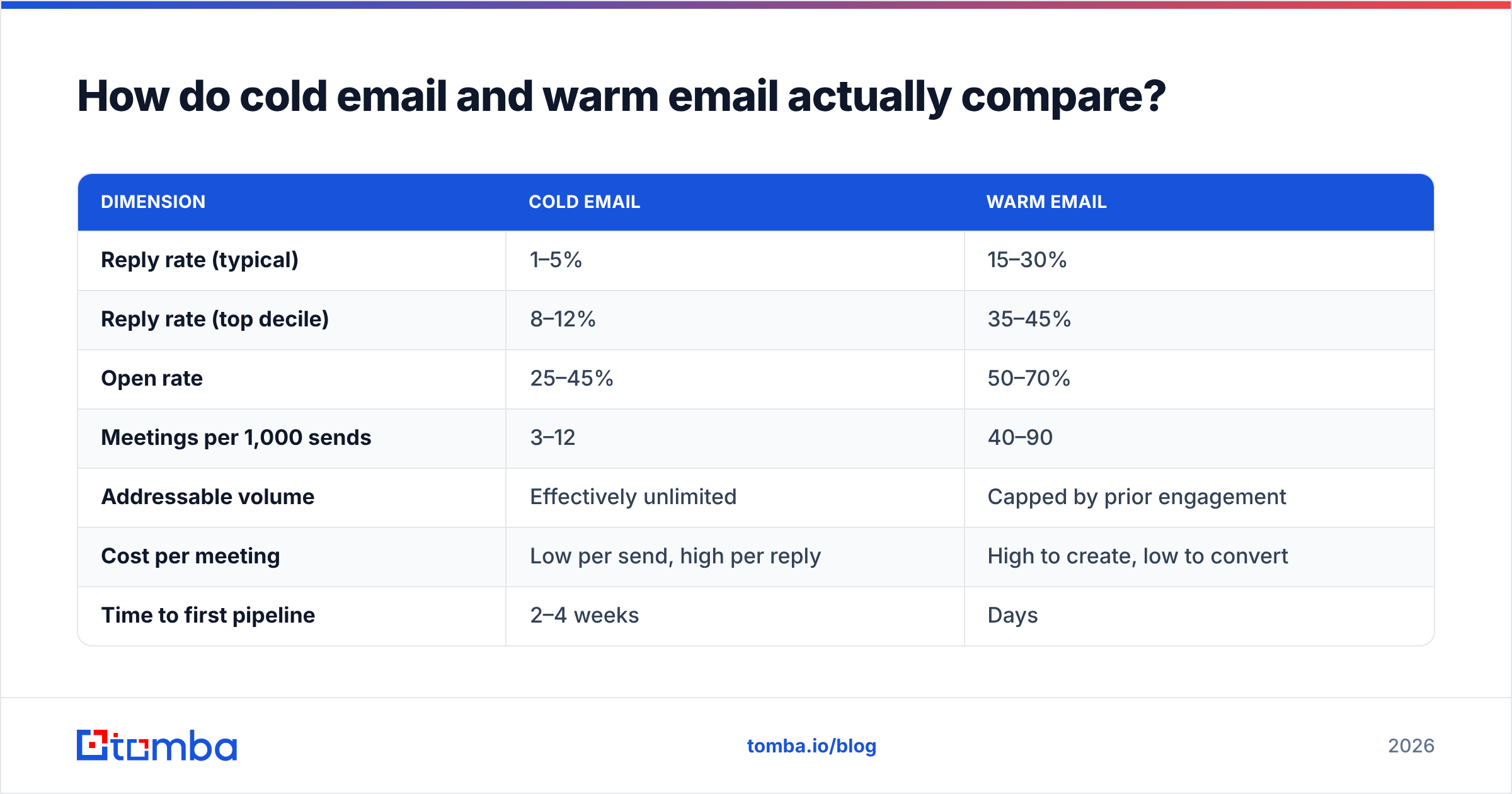
Here is the honest side-by-side. Ranges reflect typical B2B SaaS outbound; your mileage varies with ICP, offer, and list hygiene.
| Dimension | Cold Email | Warm Email |
|---|---|---|
| Reply rate (typical) | 1–5% | 15–30% |
| Reply rate (top decile) | 8–12% | 35–45% |
| Open rate | 25–45% | 50–70% |
| Meetings per 1,000 sends | 3–12 | 40–90 |
| Addressable volume | Effectively unlimited | Capped by prior engagement |
| Cost per meeting | Low per send, high per reply | High to create, low to convert |
| Time to first pipeline | 2–4 weeks | Days |
| Deliverability risk | High — needs warmup, SPF/DKIM/DMARC, verified list | Low — engaged recipients signal legitimacy |
| Primary failure mode | Bad data, generic copy, spam folder | Waiting too long; context goes stale |
| Compliance burden | CAN-SPAM / GDPR legitimate interest required | Consent usually already documented |
| Best for | New markets, new ICP, zero-brand startups | Existing brand, content engine, referral network |
| Scales via | Data infrastructure + sequencing | Marketing spend + community |
The table tells you why smart teams do not pick a side. Warm email has a five-to-ten-times better conversion rate and a hard volume ceiling. Cold email has a floor on conversion and no ceiling on volume. If you have 400 warm leads and a $2M target, warm email alone cannot get you there — the arithmetic simply doesn't close.
Which one gets better replies — and why the benchmark is misleading?#
Warm email gets better replies. That's not in dispute. What's misleading is treating the gap as fixed.
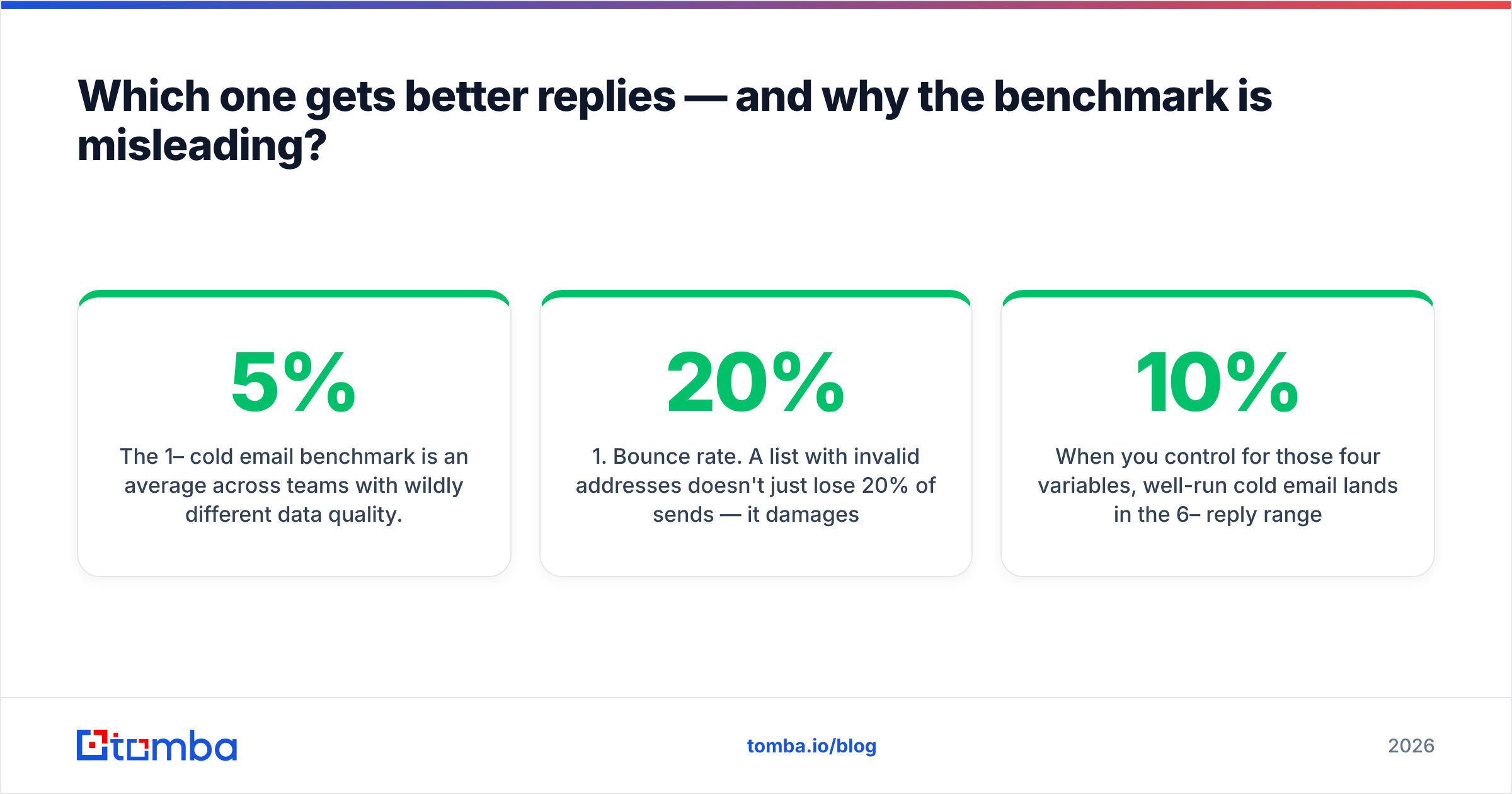
The 1–5% cold email benchmark is an average across teams with wildly different data quality. Break it apart:
- Bounce rate. A list with 20% invalid addresses doesn't just lose 20% of sends — it damages your sender reputation, which pushes the remaining 80% toward spam. Your "1.2% reply rate" is partly a deliverability failure masquerading as a copy failure.
- Targeting precision. A list of "VP Sales at companies with 50–200 employees" is a filter, not a reason. Teams that layer a trigger — new funding, a role change, a competitor's tool in the stack — routinely see 3–4x the baseline.
- Sequence depth. First-touch reply rates flatter cold email's detractors. Most cold replies arrive on touch two through four. Teams that send once and quit report the worst numbers.
- Sender infrastructure. Domains without proper authentication or warmup get filtered before copy matters. Check your SPF record and run a spam checker before you blame the subject line.
When you control for those four variables, well-run cold email lands in the 6–10% reply range. That's still below warm, but it's a completely different business case. And you can only control the first variable with an email verifier — no amount of writing fixes a dead mailbox.
Is cold email the same thing as spam?#
No, and conflating them costs teams real revenue.
Spam is unsolicited bulk mail sent indiscriminately, usually with deceptive headers, no opt-out, and no relevance filter. Cold email — done properly — is unsolicited but targeted, transparent about who you are, honest about why you're writing, and trivially easy to opt out of.
The legal line is jurisdictional:
- United States. The CAN-SPAM Act permits unsolicited commercial email. It requires accurate headers, a non-deceptive subject line, a physical postal address, and a functioning unsubscribe mechanism honored within ten business days. Prior consent is not required.
- European Union / UK. GDPR and PECR require a lawful basis. For B2B outreach to corporate addresses, legitimate interest is the usual basis — but it obliges you to document the assessment, keep the message relevant to the recipient's professional role, and honor objections immediately.
- Canada. CASL is stricter: implied or express consent is required in most cases. Assume you need it.
"Warm" gives you no legal shelter you didn't already have. A warm lead who never consented is, from a GDPR perspective, in the same bucket as a cold one. Conversely, a compliant cold email with a clear opt-out is lawful in the US whether or not the recipient has heard of you.

What does the pipeline math actually look like?#
Run the numbers before you argue about philosophy.
Suppose you need 20 qualified meetings a month.
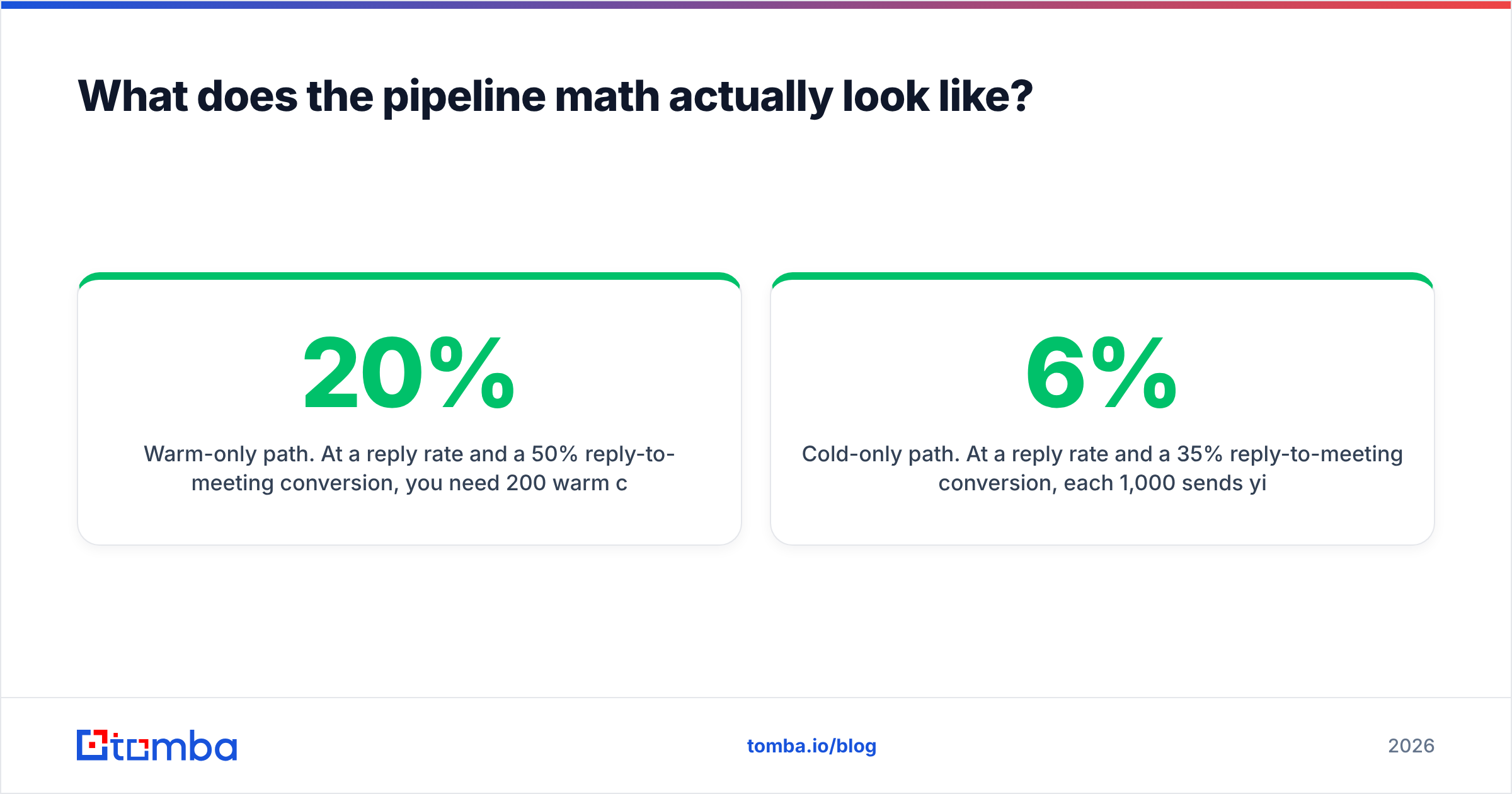
Warm-only path. At a 20% reply rate and a 50% reply-to-meeting conversion, you need 200 warm contacts per month. Do you have 200 genuinely warm contacts per month? Most Series A companies generate 30–80. If content and events produce fewer than 200, warm-only mathematically cannot hit the target — regardless of execution quality.
Cold-only path. At a 6% reply rate and a 35% reply-to-meeting conversion, each 1,000 sends yields roughly 21 meetings. You need about 1,000 verified contacts per month. That is achievable — but only if the contacts are real. At a 25% bounce rate you're actually sending 750 and burning your domain.
Blended path (what actually works). Use cold email to generate awareness and micro-engagement, then treat openers, clickers, and site visitors as warm. A prospect who opened three sequences and visited your pricing page is functionally warm even though they never replied. Tools like website visitor reveal exist precisely to surface that population.
The blended path is why the cold email vs warm email framing is a false binary in the first place. Cold email is the input to warm email. Kill the input and you starve the funnel in ninety days.
How do you decide which to lead with?#
Use this five-item test. Score each yes as one point.
- Do you have more than 150 genuinely engaged contacts (opened or clicked in the last 60 days)? If yes, warm-first is viable this quarter.
- Is your total addressable market under 2,000 accounts? Small TAM favors warm and account-based motion — you cannot afford to burn accounts with mediocre cold touches.
- Does your brand get organic inbound? If prospects already recognize the name, cold email performs closer to warm and warm performs exceptionally.
- Is your average contract value above $25,000? High ACV justifies the research cost of deeply personalized warm-style outreach at low volume.
- Is your data infrastructure solid — verified emails, enrichment, deduplication? If no, fix this before either motion. It is the single highest-leverage fix available.
Score 4–5: lead warm, use cold email surgically for named-account expansion. Score 2–3: run both. Cold for volume, warm for the accounts that raise a hand. Score 0–1: lead cold, and spend the first two weeks on data, not copy.
What separates a good cold email from a bad one?#
Since cold is where most teams struggle, here's what actually moves the number — ordered by impact.
- Verified, targeted list. Bounces above 3% are a red flag; above 5% you are actively damaging deliverability. Run every list through verification, and use a catch-all verifier for domains that accept everything — those are where naive tools quietly lie to you.
- A trigger, not a filter. "You're a VP of Engineering" is a filter. "You posted a job req for three platform engineers last week" is a trigger. Triggers explain why now, which is the question every cold recipient asks silently.
- One ask, small. Do not ask for 30 minutes in the first email. Ask a question that can be answered in one line. Replies compound.
- Short. Under 120 words. If it needs scrolling on mobile, it needs cutting.
- Sender infrastructure that isn't on fire. Authenticated domain, warmed inbox, sane send volume per mailbox, and no unsubscribe link buried in an image. Check sender reputation monthly.
- Sequence, not a single shot. Three to five touches over two to three weeks, each adding new information rather than "just bumping this up."
Vendors in this space vary in what they optimize for. Providers like BookYourData focus on pre-built, human-verified contact databases you can buy by the record — a strong fit when you want coverage without building enrichment infrastructure. Others, including Tomba, focus on real-time discovery and verification against live sources, which fits teams that want to build lists from their own ICP definitions rather than a marketplace. Both approaches work; the failure mode is using neither and scraping a CSV off LinkedIn.
For a broader view of how teams evaluate these platforms, G2's outbound category and HubSpot's sales statistics roundup are both useful reality checks against vendor claims.
How do you turn cold contacts into warm ones?#
This is the strategic answer to cold email vs warm email: stop treating them as separate populations and build a conveyor.
- Capture engagement signals. Opens are noisy post-Apple-MPP, but clicks, site visits, and reply sentiment are not. Score them.
- Move openers to a nurture track. A prospect who opened four emails but never replied is not a rejection. They're a warm lead who hasn't been given a reason.
- Use multi-channel to manufacture familiarity. A LinkedIn view before an email is not spam — it's the digital equivalent of being seen at the same conference. See LinkedIn outreach for the mechanics.
- Re-approach with new context. The second sequence to a previously cold contact converts meaningfully better than the first, because your name is now familiar. This is the compounding return most teams abandon before collecting.
- Enrich continuously. Job changes are the highest-value warm signal in B2B. A champion who moves companies is a warm lead at a cold account. Data enrichment catches this automatically; manual review never does.
Gartner's research on B2B buying behavior consistently finds that buyers spend only a small fraction of their journey with any single vendor's sellers — which means the job of cold email is not to close, it's to be present and credible when the buyer's internal timeline finally moves. Warm email is what you send when that timeline moves.
What's the verdict?#
Warm email is better. Cold email is necessary. If you have enough warm leads to hit your number, run warm. Almost nobody does. So the real question is not which channel wins, but how efficiently you convert cold contacts into warm ones — and that conversion is bounded almost entirely by your data quality, not by your writing.
Fix the list first. A 3% bounce rate and a mediocre email will outperform a brilliant email sent to 25% dead addresses, every single time.
Start with the input, not the copy. Before you rewrite another sequence, make sure the addresses behind it are real. Tomba Email Finder finds and verifies professional email addresses by domain, name, or company — with a free tier at 25 searches a month and paid plans starting at $49/mo on the Starter tier. Pair it with the email verifier to keep bounce rates under 3%, and the gap between your cold numbers and your warm numbers will narrow on its own. See full Tomba pricing to size a plan against your send volume.
Related guides#
Ready to find emails that actually work?
Join 150,000+ professionals who stopped guessing and started sending. Free credits on signup — no credit card required.
Get the Tomba newsletter
Practical outbound tactics and product updates — once every two weeks.
About the author