Cold Follow Up Email Template: 7 Sequences That Get Replies
Most cold email replies never come from the first send. Here are seven cold follow up email templates, the send-day math behind them, and the mistakes that quietly kill your reply rate.
TL;DR
- The majority of positive replies to cold outreach arrive on emails 2 through 5 — not on the first send. A cold follow up email template is not a nice-to-have; it's where the pipeline actually comes from.
- "Just bumping this up" is the single most common follow-up and the single weakest. Every follow-up needs a new reason to exist: a new angle, a new proof point, or a clean exit.
- Four to six touches over 14–21 business days is the sweet spot for most B2B teams. Beyond six, reply rate flattens and spam complaints climb.
- Follow-ups amplify whatever your list quality already is. Sending five emails to a bad address hits the same spam trap five times. Verify before you sequence.
- Use the seven templates below as skeletons, not scripts. Rewrite the first line of each so it references something only you could know about that prospect.
Why do cold follow up emails outperform the first email?#
Because the first email arrives when your prospect is doing something else.
Think of it like knocking on a door during dinner. The person is home, they heard you, and they still didn't get up. That's not rejection — it's timing. The second knock, at a better hour, is the one that opens the door.
The mechanics are boring but they matter. Your first cold email lands in a crowded inbox at a random moment in your prospect's week. It competes with a Slack notification, a customer escalation, and a calendar reminder. Even a genuinely interesting message loses that fight most of the time. The follow-up buys you a second and third and fourth roll of the dice — and each roll happens when the inbox context has changed.
There's a second effect that most people miss: repetition builds legitimacy. A single unfamiliar email from a stranger reads as noise. The third email from the same name, with the same signature, referencing the same specific thing about their business, reads as someone who actually meant it. Sales teams call this "earned attention." It's the reason a well-built cold follow up email template sequence out-earns a one-shot send by a wide margin, even when the copy is identical.
The catch is that the same repetition that builds legitimacy also builds annoyance — fast — if every follow-up says the same thing. Which brings us to the part almost everyone gets wrong.
What makes a cold follow up email template actually work?#
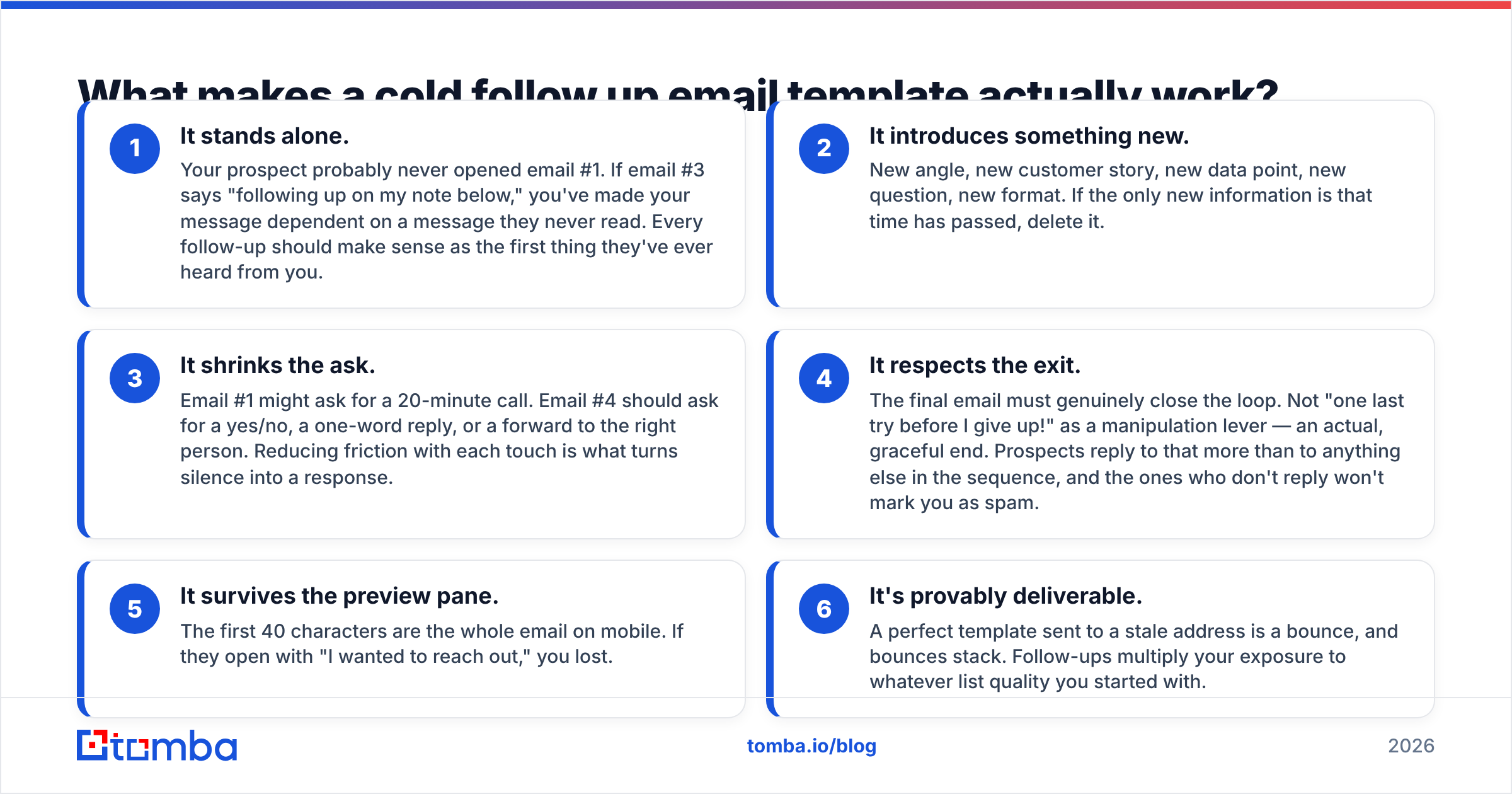
A good follow-up passes three tests. Miss any one of them and you're just adding volume.
- It stands alone. Your prospect probably never opened email #1. If email #3 says "following up on my note below," you've made your message dependent on a message they never read. Every follow-up should make sense as the first thing they've ever heard from you.
- It introduces something new. New angle, new customer story, new data point, new question, new format. If the only new information is that time has passed, delete it.
- It shrinks the ask. Email #1 might ask for a 20-minute call. Email #4 should ask for a yes/no, a one-word reply, or a forward to the right person. Reducing friction with each touch is what turns silence into a response.
- It respects the exit. The final email must genuinely close the loop. Not "one last try before I give up!" as a manipulation lever — an actual, graceful end. Prospects reply to that more than to anything else in the sequence, and the ones who don't reply won't mark you as spam.
- It survives the preview pane. The first 40 characters are the whole email on mobile. If they open with "I wanted to reach out," you lost.
- It's provably deliverable. A perfect template sent to a stale address is a bounce, and bounces stack. Follow-ups multiply your exposure to whatever list quality you started with.
That last point is where more sequences die than any copy problem. Hitting an invalid or catch-all address five times over three weeks is a much stronger negative signal to a mailbox provider than hitting it once. Run every list through an email verifier before the first send, and use a catch-all verifier on domains that swallow everything, so your follow-ups only land on addresses that actually exist.
What does a good cold follow-up cadence look like?#
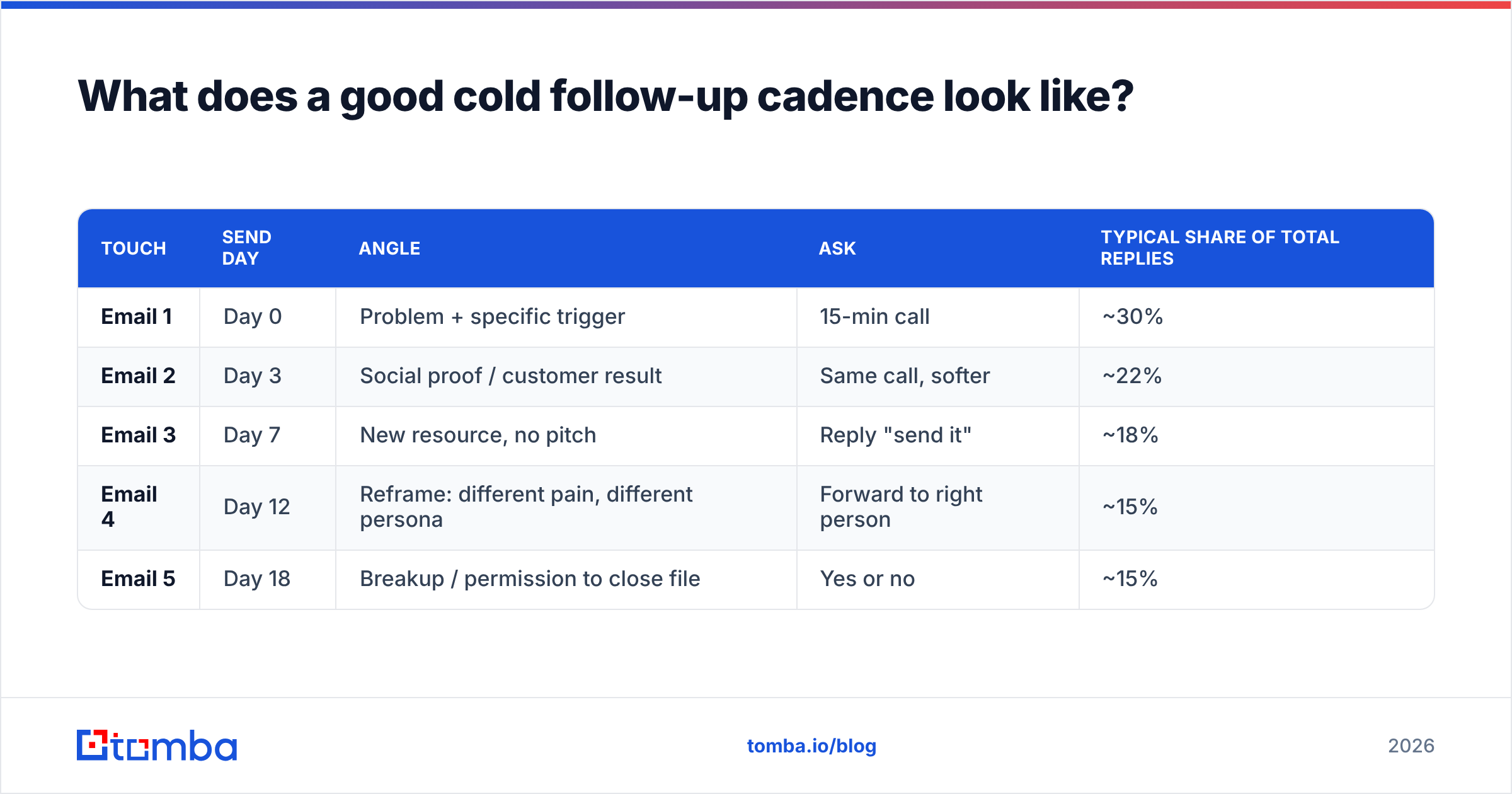
Here's the cadence that most B2B outbound teams converge on after a few quarters of testing. The days are business days from the initial send, not calendar days.
| Touch | Send day | Angle | Ask | Typical share of total replies |
|---|---|---|---|---|
| Email 1 | Day 0 | Problem + specific trigger | 15-min call | ~30% |
| Email 2 | Day 3 | Social proof / customer result | Same call, softer | ~22% |
| Email 3 | Day 7 | New resource, no pitch | Reply "send it" | ~18% |
| Email 4 | Day 12 | Reframe: different pain, different persona | Forward to right person | ~15% |
| Email 5 | Day 18 | Breakup / permission to close file | Yes or no | ~15% |
Two things to notice. First, roughly 70% of replies land after the first email — which is why "we tried cold email and it didn't work" almost always means "we sent one email." Second, the ask changes shape every single time. By touch five you are not asking for a meeting. You are asking for a one-word answer, which almost anyone will give.
A few cadence rules that hold up across industries:
- Never follow up in under 48 hours. It reads as automation, because it is.
- Stretch the gaps as you go. 3 days, then 4, then 5, then 6. Compressed cadences feel like pressure; expanding ones feel like persistence.
- Reply in the same thread for touches 2 and 3, break to a fresh thread for 4 and 5. A new subject line gives a cold thread one more chance at an open.
- Stop the sequence on any reply. Including out-of-office. Especially out-of-office — that's free intelligence about when they're back.
- Cap at five to six. Reply rate per touch collapses after that, while complaint rate does not.
What are the 7 cold follow up email templates?#
Copy the structure. Rewrite the specifics. Every template below has one bracketed variable that must be genuinely researched — if you can't fill it with something real, don't send that email.
1. The specific-trigger bump (Day 3)#
Subject: re: [their initiative]
[First name] — following the thread on [specific thing: their new office, a hire, a product launch, a post they wrote].
When [company] did the same thing last year, the thing that broke first was [specific operational pain]. We fixed that for them in about a week.
Worth 15 minutes to see if you're heading for the same wall?
[Your name]
Why it works: the "bump" is carried by a real observation, not by the passage of time.
2. The social-proof follow-up (Day 3–5)#
Subject: how [similar company] cut [metric] by [number]
[First name] — [Similar Company], same size and same market as you, was losing [X hours/week] to [process]. They moved it to [approach] and got [concrete result] inside a quarter.
I'm not assuming you have the same problem. But if you do, the fix is smaller than most people expect.
Want the two-paragraph version of how they did it?
[Your name]
Why it works: the ask is "want a summary," not "book a call." Almost zero friction.
3. The value-first, no-pitch email (Day 7)#
Subject: the [industry] benchmark data, no strings
[First name] — we pulled [data] across [N] companies in [their industry]. The median [metric] came in at [number], which surprised us.
No pitch attached. If it's useful, reply "send it" and I'll forward the PDF.
[Your name]
Why it works: it gives before it asks, and "reply with one word" is the lowest-effort CTA that exists.
4. The wrong-person reroute (Day 10–12)#
Subject: wrong person?
[First name] — I may have aimed this at the wrong desk.
If [problem] sits with someone else on your team, could you point me at them? If it sits with you and it's just not a priority right now, that's a completely fair answer too.
[Your name]
Why it works: it hands the prospect an easy, dignified way out — and a large share of them route you internally instead. Referrals from inside the account convert at multiples of cold.
5. The pattern-interrupt reframe (Day 12–14)#
Subject: a different angle
[First name] — my last few emails pitched [benefit A]. That may just not be your problem.
The other reason teams like yours talk to us is [benefit B, genuinely different]. [One sentence of proof.]
If neither is relevant, say the word and I'll close the file.
[Your name]
Why it works: it admits the earlier emails may have missed, which is disarming, and it tests a second hypothesis before you burn the account.
6. The single-question email (Day 15)#
Subject: one question
[First name] — is [specific problem] something your team is actively working on this quarter, or is it parked?
Either answer is useful to me.
[Your name]
Why it works: it is answerable in four words while walking to a meeting. That's the whole design.
7. The breakup (Day 18–21)#
Subject: closing the file
[First name] — I've sent a few notes about [problem] and haven't heard back, which almost always means it isn't a priority. Totally reasonable.
I'll stop here. If [trigger event] changes that in the next few months, you know where to find me — and here's [the one resource] in case it's ever useful.
Good luck with [specific thing they're working on].
[Your name]
Why it works: it's the highest-reply email in most sequences, precisely because it isn't a trick. Write it as if you mean it, because you should.

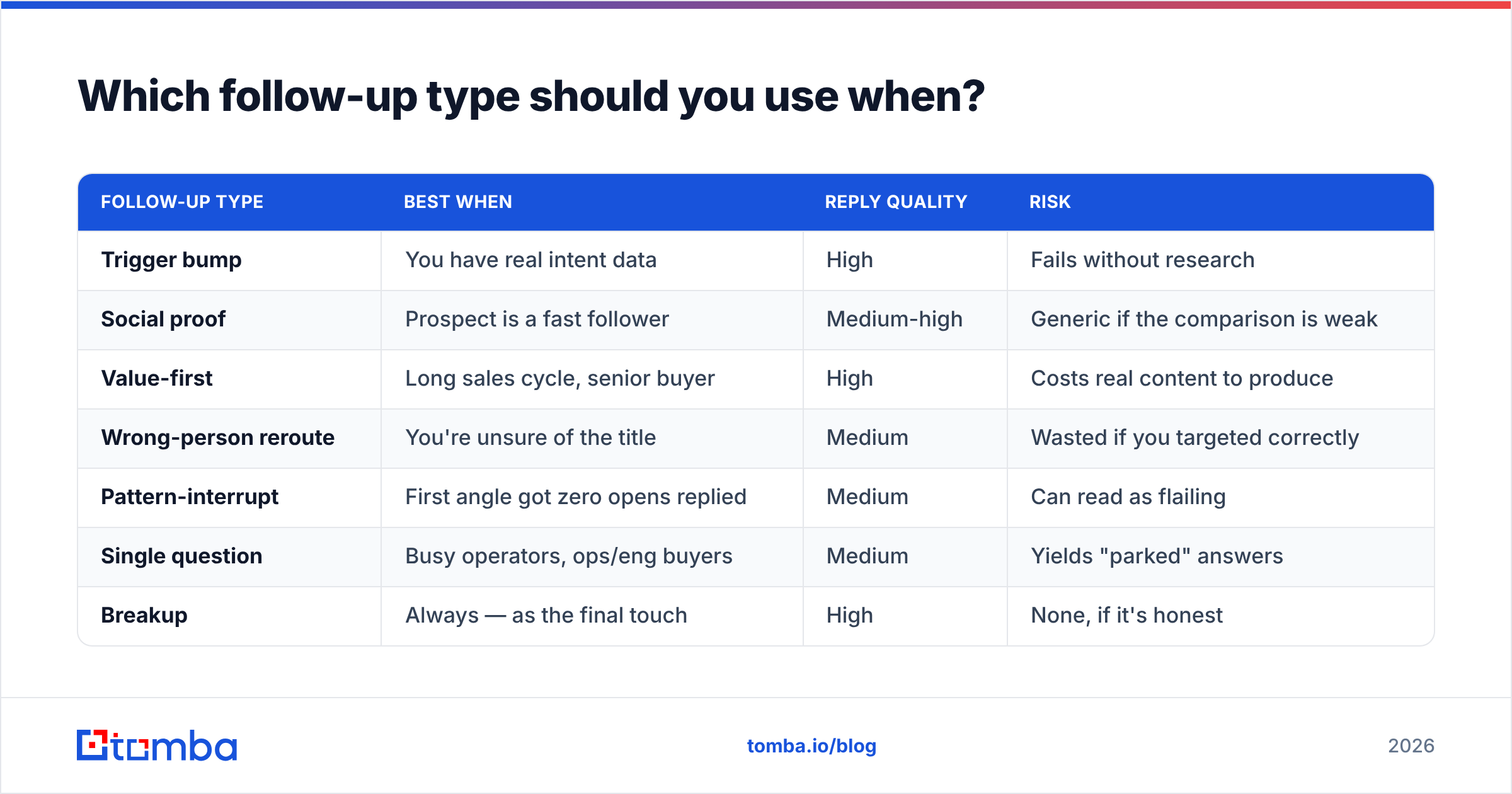
Which follow-up type should you use when?#
Not every sequence needs all seven. Match the type to what you're actually missing.
| Follow-up type | Best when | Reply quality | Risk |
|---|---|---|---|
| Trigger bump | You have real intent data | High | Fails without research |
| Social proof | Prospect is a fast follower | Medium-high | Generic if the comparison is weak |
| Value-first | Long sales cycle, senior buyer | High | Costs real content to produce |
| Wrong-person reroute | You're unsure of the title | Medium | Wasted if you targeted correctly |
| Pattern-interrupt | First angle got zero opens replied | Medium | Can read as flailing |
| Single question | Busy operators, ops/eng buyers | Medium | Yields "parked" answers |
| Breakup | Always — as the final touch | High | None, if it's honest |
The practical rule: value-first and breakup should be in every sequence. Pick two of the other five based on what you know about the account. A four-to-six-touch sequence built this way beats a ten-touch sequence of bumps every time, and it costs your reputation far less.
What kills cold follow-up reply rates?#
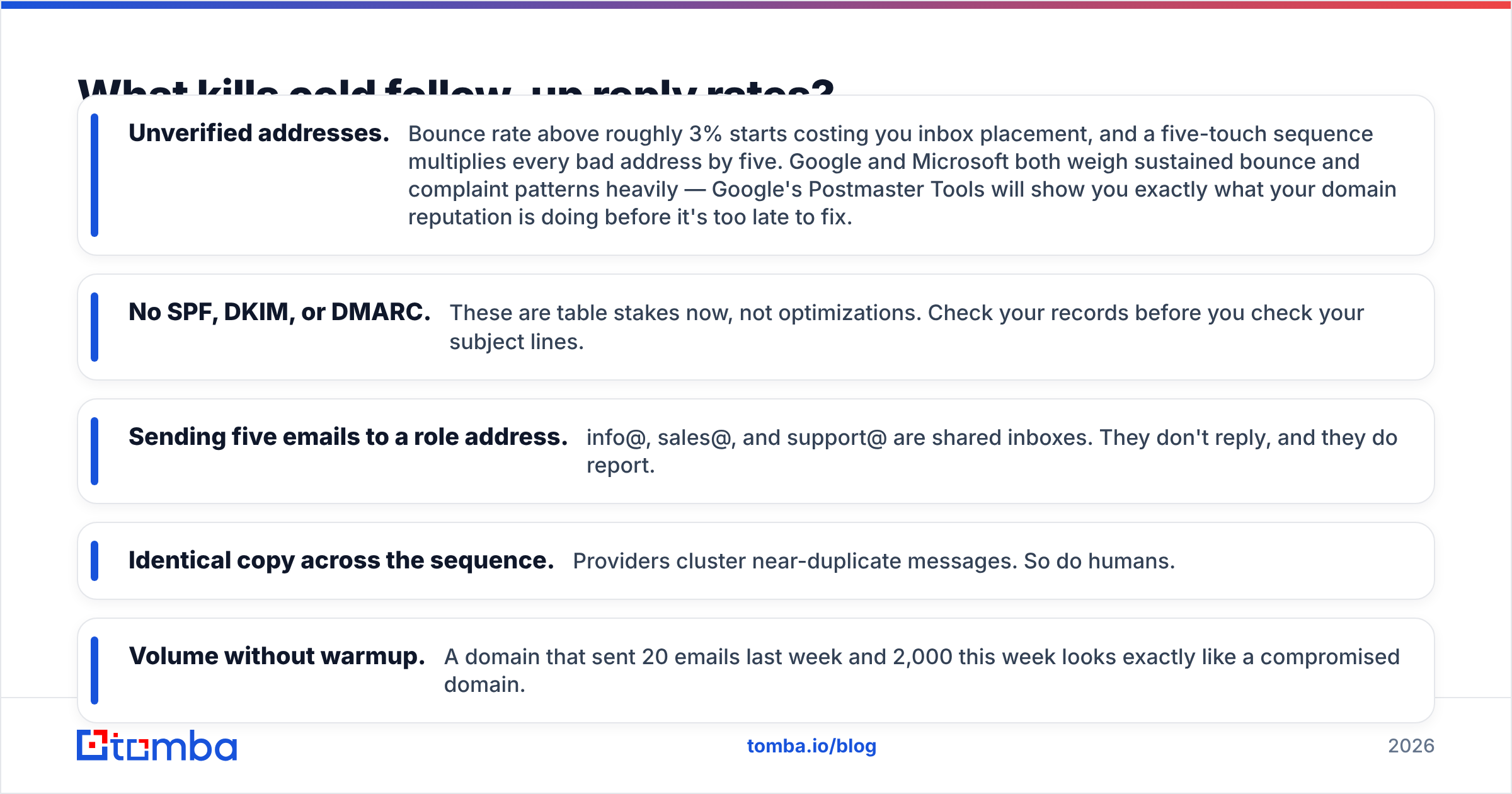
Copy problems are the ones people obsess over. Infrastructure problems are the ones that actually sink campaigns.
- Unverified addresses. Bounce rate above roughly 3% starts costing you inbox placement, and a five-touch sequence multiplies every bad address by five. Google and Microsoft both weigh sustained bounce and complaint patterns heavily — Google's Postmaster Tools will show you exactly what your domain reputation is doing before it's too late to fix.
- No SPF, DKIM, or DMARC. These are table stakes now, not optimizations. Check your records before you check your subject lines.
- Sending five emails to a role address. info@, sales@, and support@ are shared inboxes. They don't reply, and they do report.
- Identical copy across the sequence. Providers cluster near-duplicate messages. So do humans.
- Volume without warmup. A domain that sent 20 emails last week and 2,000 this week looks exactly like a compromised domain.
None of that is exotic. It's the same reason experienced teams treat email deliverability as a prerequisite to copywriting rather than a fix applied after the campaign underperforms. The industry data on this is consistent — G2's review categories for outbound tooling are dominated by deliverability complaints, not creative ones, and HubSpot's sales research has been making the same point about follow-up persistence for a decade.
The other quiet killer is targeting. A perfect follow-up sequence aimed at the wrong 500 people produces the same result as no sequence at all. Before you write a single template, make sure the list is built from real, current, role-matched contacts — pulled by domain, verified, and deduplicated. A domain search across your target accounts gives you the actual people behind a company rather than a guessed pattern, which is the difference between a sequence that lands and a sequence that bounces its way into a blocklist.
How do you personalize follow-ups at scale without sounding like a robot?#
Pick one variable per email and make it real.
The failure mode of scaled personalization is the mail-merge field that could apply to anyone: "I saw [Company] is growing fast." Everyone is growing fast. Nobody believes you looked.
What works instead is a single, verifiable, specific detail per touch:
- Touch 2: a hire they made (title + team).
- Touch 3: a change on their site — new pricing page, new integration listed, a tool added to their stack.
- Touch 4: something a peer company did that they'd care about.
- Touch 5: nothing. The breakup email needs no personalization beyond their name and the specific problem you've been writing about.
That's four researched facts per prospect, not forty. It's achievable at a few hundred accounts a month with a tight process, and it's what separates a sequence with a 12% reply rate from one with a 2% reply rate.
Build the list once, verify it once, and then spend your time on those four facts instead of on rewriting "I wanted to reach out."
Start with a list that survives five emails#
Templates are the cheap part. You can rewrite a subject line in ninety seconds. What you cannot fix after the fact is a sequence that spent three weeks hammering addresses that were never valid — because by then the damage is to your domain, not to your campaign.
Build the sequence on contacts that are real. Use the Tomba Email Finder to pull verified professional addresses by name, company, or domain, confirm them before touch one, and let your follow-ups do what they're supposed to do: land, repeat, and earn the reply. The free tier covers 25 searches a month if you want to test the workflow first; Tomba pricing starts at $49/mo on Starter when you're ready to run real volume.
Write fewer emails. Send them to the right people. Follow up five times, and mean the fifth one.
Related guides#
Ready to find emails that actually work?
Join 150,000+ professionals who stopped guessing and started sending. Free credits on signup — no credit card required.
Get the Tomba newsletter
Practical outbound tactics and product updates — once every two weeks.
About the author