Cold Lead Generation in 2026: A Complete Playbook That Works
Cold lead generation still works in 2026 — but only if the list is clean, the channel fits the buyer, and the math holds. Here's the full playbook, with real cost benchmarks and a stack comparison.
Cold lead generation is the process of identifying and contacting prospects who have never engaged with you, using research and targeting rather than inbound intent signals. It still works in 2026 — but the failure rate has climbed, and almost all of that failure happens before a single message is sent.
TL;DR#
- Cold lead generation dies at the data layer, not the copy layer. A 22% bounce rate destroys a domain faster than any bad subject line.
- Cost per cold lead ranges from $8 to $180 depending on channel and ACV. Know your number before you scale anything.
- Verify every address before send. Google and Microsoft's 2024 bulk-sender rules made a sub-0.3% spam complaint rate mandatory — bounces feed straight into that.
- Multi-channel beats email-only by roughly 2x on reply rate, but only when the sequencing is deliberate, not just "email plus LinkedIn plus call."
- Buying a list is not automatically worse than building one. It depends entirely on whether the vendor verifies at time of export or at time of scrape.
What is cold lead generation?#
Cold lead generation means generating qualified pipeline from people who have not raised their hand. No demo request, no whitepaper download, no webinar registration. You found them, you decided they fit, and you reached out first.
That distinction matters because the entire economics differ from inbound. With inbound, the buyer paid the attention cost of finding you. With cold, you pay it — in list-building time, in data spend, in domain reputation, and in the emotional tax of a 2% reply rate.
The four components, in the order they determine success:
- Ideal customer profile (ICP) — the firmographic and technographic filters that define who is worth contacting at all. Company size, industry, tech stack, funding stage, headcount growth.
- Contact data — the actual names, verified email addresses, phone numbers, and LinkedIn URLs of the humans inside those companies. This is where most programs quietly break.
- Channel and sequence — email, phone, LinkedIn, direct mail, or some ordered combination, with defined touch counts and intervals.
- Message — the relevance argument. Why this person, why now, why you.
Notice that message is last. Teams obsess over it and neglect the first two, which is exactly backwards. A perfect email sent to a role that doesn't own the problem is worse than a mediocre email sent to the person who does — because the mediocre email at least gets forwarded.
Why do most cold lead generation programs fail?#
Because they scale a broken unit before checking whether the unit works.
Here is the sequence of a typical failure. A team exports 5,000 contacts from a database. Roughly 18–25% of those addresses are stale — people changed jobs, companies rebranded, catch-all domains hid the truth. The team sends anyway. Bounces spike above 5%. Their sending domain's sender reputation craters. Now even the 75% of addresses that were valid land in spam. Reply rate reads 0.4%. Leadership concludes "cold email is dead" and reallocates budget.
Nothing about the copy was tested. Nothing about the ICP was tested. The data killed it.
The second-most-common failure is role mismatch. You sold to a VP of Engineering at your first ten customers, so you build a list of VPs of Engineering — at companies of 40 people, where there is no VP of Engineering, and the CTO does the buying. Your list-building filter matched a title string, not a job function.
The third is sequence fatigue. A 14-touch, 6-week cadence sent to 3,000 people produces 42,000 touches. Even at a 0.1% complaint rate, that's 42 complaints. Gmail's threshold is 0.3%. You are two bad segments away from a suspension.

What does a cold lead generation stack look like in 2026?#
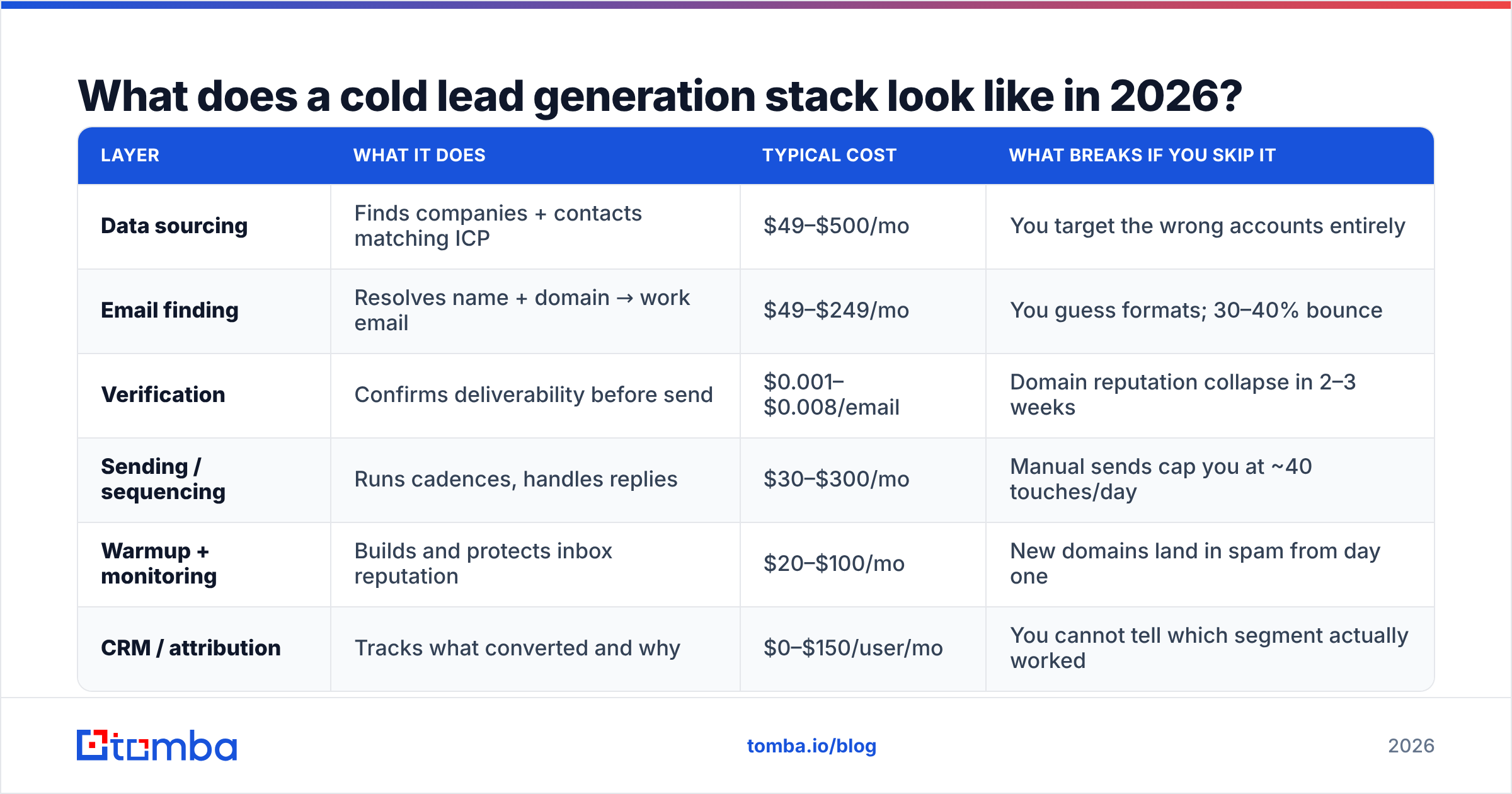
Four layers, and you need something in each. Skipping one doesn't save money — it moves the cost somewhere less visible.
| Layer | What it does | Typical cost | What breaks if you skip it |
|---|---|---|---|
| Data sourcing | Finds companies + contacts matching ICP | $49–$500/mo | You target the wrong accounts entirely |
| Email finding | Resolves name + domain → work email | $49–$249/mo | You guess formats; 30–40% bounce |
| Verification | Confirms deliverability before send | $0.001–$0.008/email | Domain reputation collapse in 2–3 weeks |
| Sending / sequencing | Runs cadences, handles replies | $30–$300/mo | Manual sends cap you at ~40 touches/day |
| Warmup + monitoring | Builds and protects inbox reputation | $20–$100/mo | New domains land in spam from day one |
| CRM / attribution | Tracks what converted and why | $0–$150/user/mo | You cannot tell which segment actually worked |
Two things worth flagging. First, verification is priced per-email, not per-seat — it's the cheapest insurance in the stack and the most frequently cut. Second, the warmup layer only became mandatory after the 2024 Gmail and Yahoo bulk sender requirements; teams running playbooks written before then are operating on stale assumptions.
You do not need six vendors. Consolidation is real: an email finder that also verifies at the point of discovery collapses two layers into one call, and most sequencing tools now bundle warmup.
How much does a cold lead actually cost?#
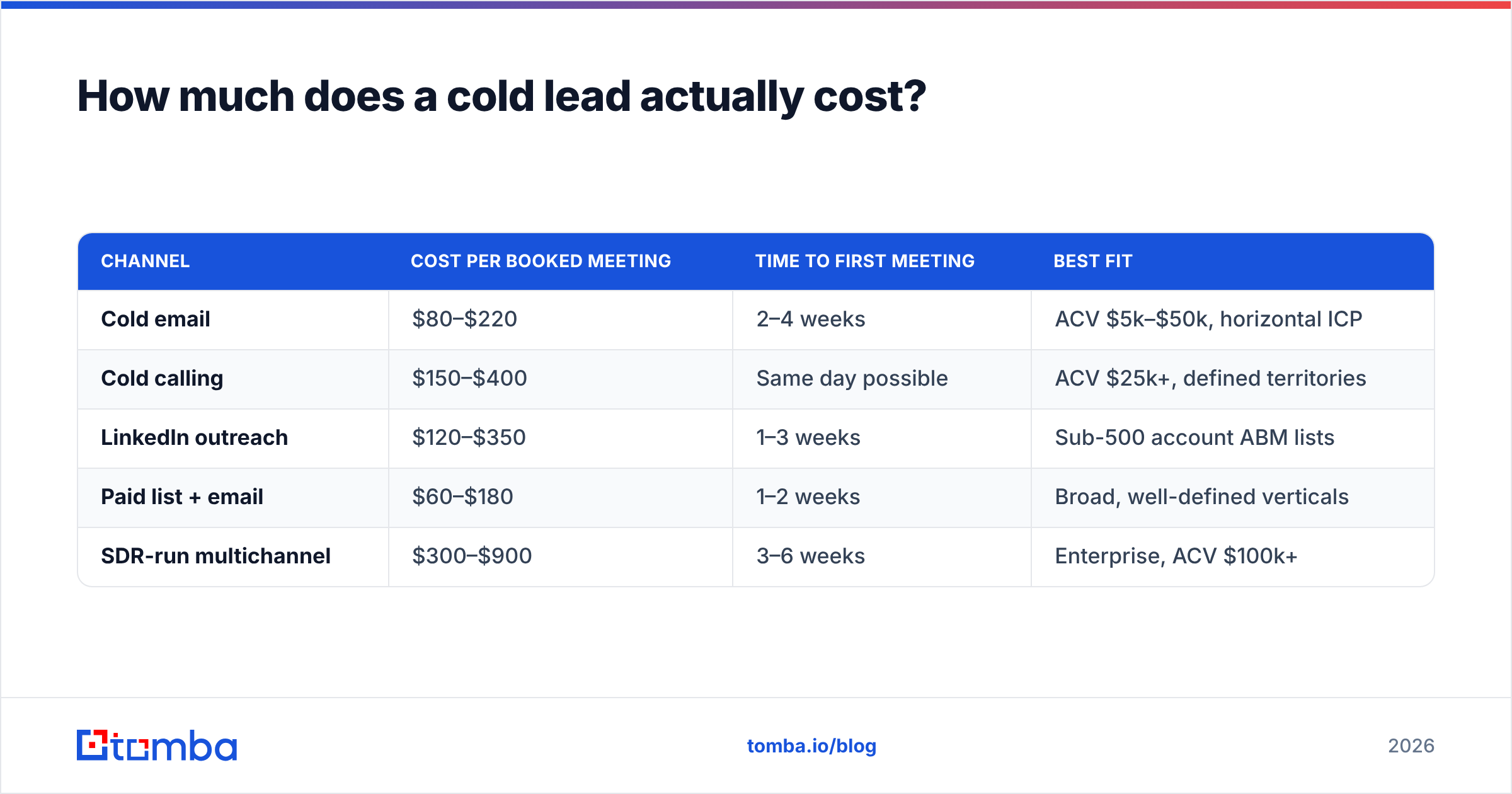
The honest answer is that "cost per lead" is nearly meaningless without specifying what a lead is. Here are benchmarks by channel, using booked meeting as the unit — because that's the only definition that survives contact with a CFO.
| Channel | Cost per booked meeting | Time to first meeting | Best fit |
|---|---|---|---|
| Cold email | $80–$220 | 2–4 weeks | ACV $5k–$50k, horizontal ICP |
| Cold calling | $150–$400 | Same day possible | ACV $25k+, defined territories |
| LinkedIn outreach | $120–$350 | 1–3 weeks | Sub-500 account ABM lists |
| Paid list + email | $60–$180 | 1–2 weeks | Broad, well-defined verticals |
| SDR-run multichannel | $300–$900 | 3–6 weeks | Enterprise, ACV $100k+ |
Cold email looks cheapest per meeting, which is why everyone starts there and why every inbox is full. The arbitrage has moved. In 2026, the teams winning on cost-per-meeting are the ones running narrower lists with deeper research — 200 accounts with real triggers, not 5,000 accounts with a title filter.
Run the math backwards. If your ACV is $12,000, your win rate from meeting is 20%, and your target CAC payback is under 12 months, you can afford roughly $480 per booked meeting before things get uncomfortable. That number, not a blog post, tells you which channel you're allowed to use.
How do you build a cold list that doesn't burn your domain?#
Five steps, in order. Do not reorder them.
- Define the account list before the contact list. Filter on firmographics and a trigger — hiring for a role your product supports, recent funding, a competitor in their tech stack. Triggers are what separate "cold" from "cold and irrelevant."
- Identify the right function, not the right title. For each account, decide who owns the pain. Then find that person's title at that company size, which varies.
- Resolve contact data at the account level. A domain search returns every discoverable address at a company plus the dominant email pattern, which lets you sanity-check individual finds.
- Verify before you export, not after you bounce. Run every address through an email verifier. Drop anything that returns invalid. Segment catch-all addresses separately — they are neither valid nor invalid, and sending to them blind is how good domains die.
- Cap volume per domain, per day. 30–50 sends per mailbox per day, ramping over four weeks. More mailboxes, not more sends per mailbox.
Step 4 deserves elaboration because catch-all domains are the single most misunderstood category in cold lead generation. A catch-all server accepts mail for any address at the domain — ceo@, notarealperson@, all of it — so a standard SMTP check returns "accepted" regardless of whether the mailbox exists. Roughly 20% of B2B domains are configured this way. Treating those as valid inflates your list and your bounce rate simultaneously. A dedicated catch-all verifier uses pattern confidence and secondary signals to sort them, and if you can't sort them, send to them last and in small batches.
For volume work, batch the whole thing. A bulk email finder that takes a CSV of names and domains and returns verified addresses turns a two-day manual task into a coffee break.
Which channels still work for cold outreach in 2026?#
Email still works, but the definition of "works" has shifted. A 1–3% positive reply rate on a well-targeted 500-person list is a healthy program. If someone quotes you 8%, ask about list size — small numbers make big percentages.
Phone has quietly recovered. Connect rates on mobile numbers run 12–18% versus 3–5% on office lines, and post-pandemic, mobile is where decision-makers actually are. Sourcing accurate mobile numbers is the constraint; a phone finder is the fastest path to a callable list.
LinkedIn works for the top of the sequence — a profile view and a follow before an email lands measurably lifts reply rates. It does not work as a volume channel. Connection request limits are enforced, and automation that ignores them gets accounts restricted.
Direct mail is having a moment specifically because it's expensive. A $40 package to 100 named accounts, followed by an email referencing it, converts at rates that would look fabricated on any other channel. It does not scale, and that's the point.
The sequencing rule that matters: each channel should reference the previous one. "I sent you a note last week about your Series B" is a different message than a cold call with no context. Multi-channel isn't three parallel monologues — it's one conversation across three surfaces.
Is buying a lead list better than building one?#
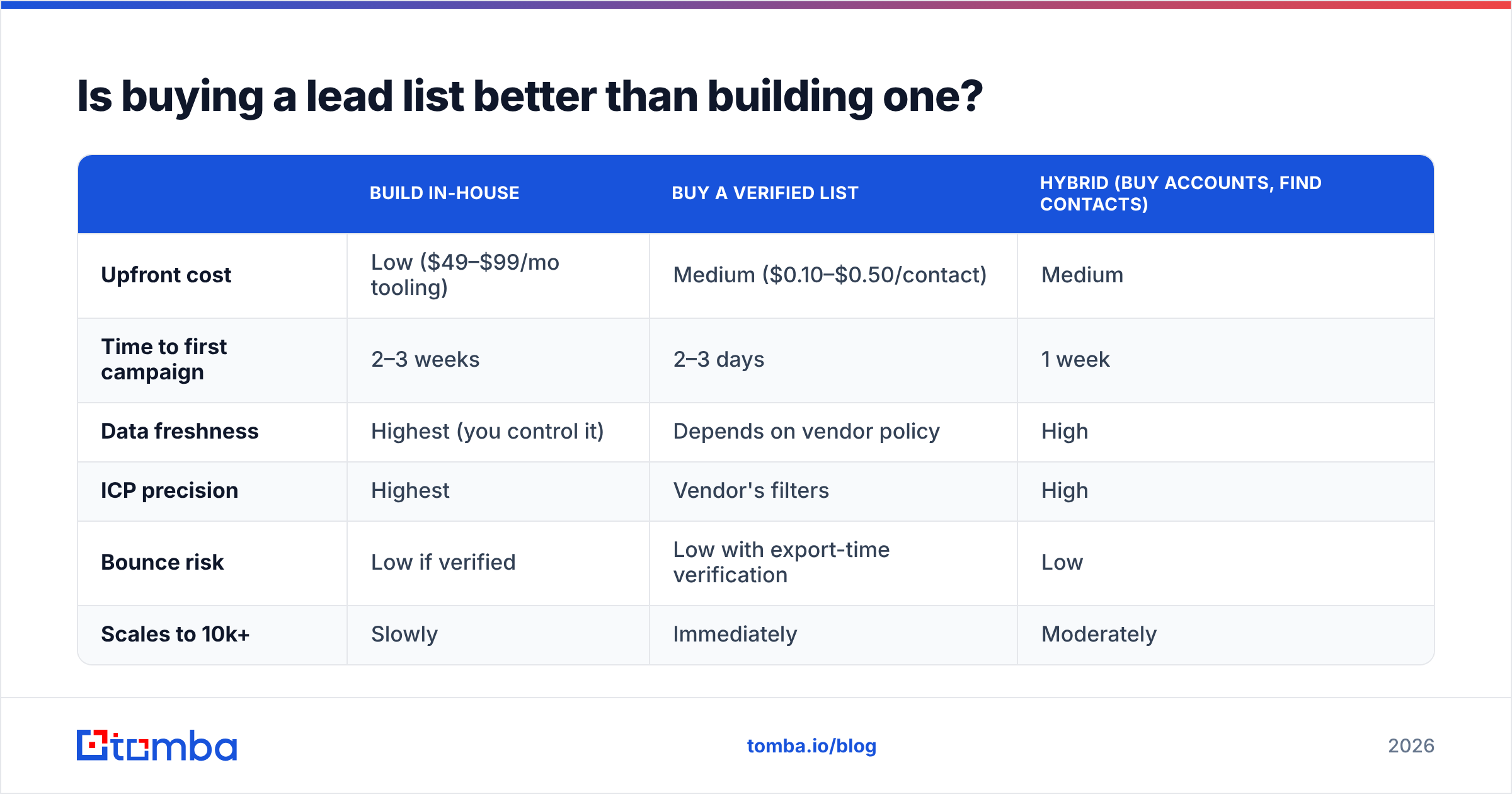
It depends on one variable: when the vendor verified the data.
A list verified at the moment of export is a fundamentally different product than a list scraped in 2023 and sold in 2026. The second one is a liability with an invoice attached. Ask any vendor directly: "Is this verified at export or at ingestion?" The good ones answer immediately.
| Build in-house | Buy a verified list | Hybrid (buy accounts, find contacts) | |
|---|---|---|---|
| Upfront cost | Low ($49–$99/mo tooling) | Medium ($0.10–$0.50/contact) | Medium |
| Time to first campaign | 2–3 weeks | 2–3 days | 1 week |
| Data freshness | Highest (you control it) | Depends on vendor policy | High |
| ICP precision | Highest | Vendor's filters | High |
| Bounce risk | Low if verified | Low with export-time verification | Low |
| Scales to 10k+ | Slowly | Immediately | Moderately |
Reputable list vendors exist and serve a real need. BookYourData, for instance, verifies at the point of purchase rather than shipping a stale snapshot — which is the distinction that actually determines whether a purchased list helps or hurts you. Vendors that won't discuss verification timing are telling you something.
The hybrid approach is what most efficient teams land on: buy or build the account list cheaply, then resolve contacts yourself with an email finder plus verifier. You get the vendor's coverage on firmographics and your own freshness on the addresses that touch your sending domain. Compare Tomba pricing against per-contact list costs and the math usually favors the hybrid past a few thousand contacts.
How do you measure cold lead generation without lying to yourself?#
Track these, in this order, and treat any metric above the one that's broken as noise:
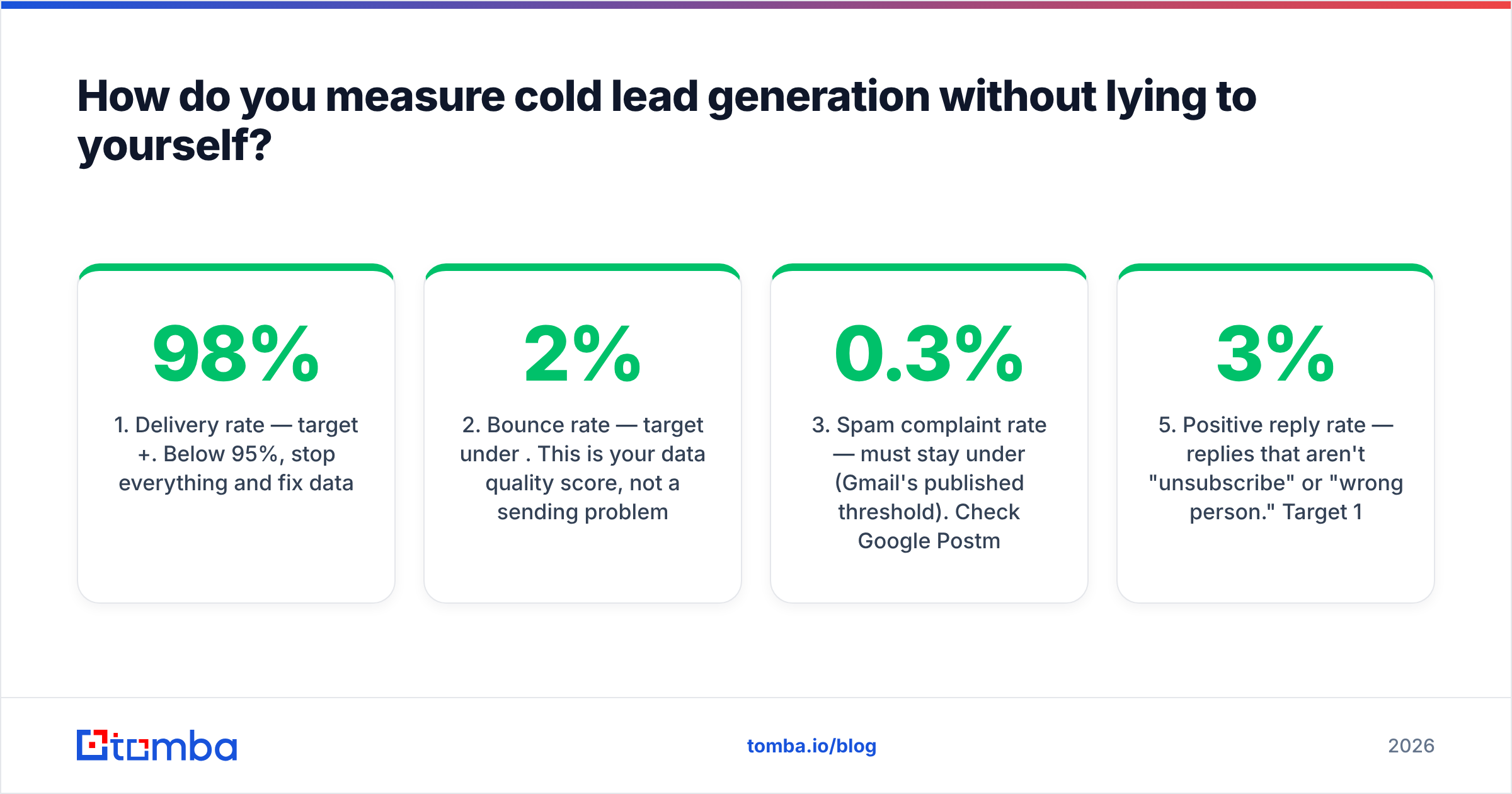
- Delivery rate — target 98%+. Below 95%, stop everything and fix data.
- Bounce rate — target under 2%. This is your data quality score, not a sending problem.
- Spam complaint rate — must stay under 0.3% (Gmail's published threshold). Check Google Postmaster Tools weekly.
- Open rate — increasingly unreliable post-MPP, but useful directionally within a single segment.
- Positive reply rate — replies that aren't "unsubscribe" or "wrong person." Target 1–3%.
- Meeting booked rate — the only number worth reporting upward.
- Meeting-to-opportunity — tells you whether your ICP filter is real or aspirational.
The trap: optimizing reply rate while delivery quietly degrades. Reply rate is calculated on delivered mail. If your delivery drops from 97% to 78% while replies-per-delivered stays flat, your reply rate looks stable and your pipeline halves. Watch absolute numbers, not just ratios.
For the deliverability side of this, the email deliverability fundamentals — SPF, DKIM, DMARC, dedicated sending domains, gradual ramp — are table stakes now, not optimizations. HubSpot's sales statistics research and vendor reviews on G2 are useful for benchmarking your numbers against the market rather than against last quarter.
What should you do in your first 30 days?#
If you are starting cold lead generation from zero:
- Week 1 — Define ICP with three hard filters and one trigger. Build a 200-account list manually. Buy a fresh sending domain and start warmup.
- Week 2 — Resolve contacts. Find, verify, segment catch-alls separately. Write three message variants against the trigger, not against your feature list.
- Week 3 — Send to 50 contacts across two variants. Watch delivery and bounce before you look at replies.
- Week 4 — Read the data honestly. If bounce is above 3%, your problem is data. If delivery is fine and replies are zero, your problem is targeting. Only after both are clean does copy matter.
Most teams reverse this and spend week one arguing about subject lines.
Where to start#
Cold lead generation in 2026 rewards the boring parts: a narrow list, verified addresses, a protected domain, and honest measurement. The creative work only pays off after the plumbing holds.
If the plumbing is where you're stuck, start there. Tomba Email Finder resolves work emails from a name and domain, checks them against live sources, and flags catch-all domains before they touch your sender reputation — with a free tier at 25 searches a month to test on a real segment, and Starter at $49/mo when you're ready to run volume. Build the list right, and the rest of the playbook actually gets a chance to work.
Related guides#
Ready to find emails that actually work?
Join 150,000+ professionals who stopped guessing and started sending. Free credits on signup — no credit card required.
Get the Tomba newsletter
Practical outbound tactics and product updates — once every two weeks.
About the author