Cold Leads in 2026: How to Find, Warm, and Convert Them
Cold leads are not dead leads — they are leads you have not earned a reason to talk to yet. Here is the 2026 playbook: sourcing, verification, channel mix, warming sequences, and the metrics that tell you it is working.
TL;DR
- A cold lead is a person who fits your ICP but has never engaged with you. That is a relationship problem, not a data problem — and the two get confused constantly.
- Roughly 95% of cold outbound fails at one of three points: bad data, wrong channel, or no reason to reply. Fix them in that order.
- Verification before send is the highest-ROI step in the entire funnel. A 3% bounce rate is the line between "inbox" and "spam folder."
- Multi-touch, multi-channel sequences (email + LinkedIn + phone) outperform email-only by a wide margin, but only after your list is clean.
- Cold leads convert on a 30–90 day horizon, not a 3-day one. Measure reply rate and meeting rate, not open rate.
What is a cold lead, exactly?#
A cold lead is a contact who matches your ideal customer profile but has had zero prior interaction with your company. No demo request, no webinar, no pricing-page visit, no reply to a previous email. You know who they are. They do not know who you are.
That definition matters because teams routinely mislabel three different things as "cold":
- A cold lead — right person, right company, zero relationship. Reachable, but you must earn the first reply.
- A dead lead — wrong person, wrong company, or a role that changed nine months ago. No amount of sequencing fixes this.
- A stalled lead — someone who did engage, then went quiet. This is a re-engagement problem, and it plays by completely different rules.
Confusing cold with dead is what makes outbound feel hopeless. Confusing cold with stalled is what makes your follow-up read as tone-deaf ("Just circling back on our conversation!" — you never had one).
The practical test: if a stranger with your exact offer emailed this person tomorrow, is there a plausible business reason they'd read it? If yes, they are cold. If no, they are dead, and they should never have entered your list.
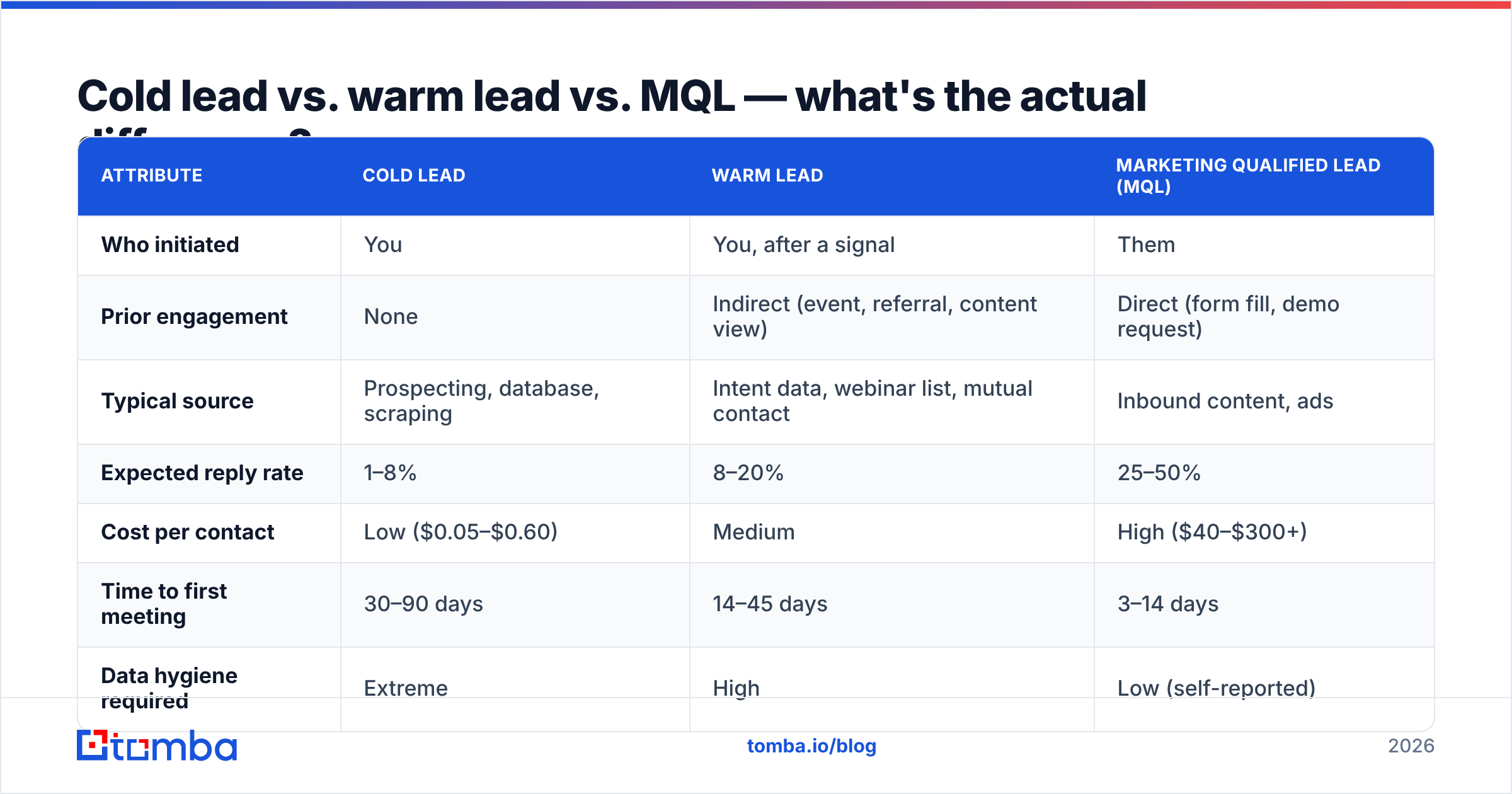
Cold lead vs. warm lead vs. MQL — what's the actual difference?#
The distinction is not temperature vibes. It is who initiated contact and what signal exists.
| Attribute | Cold lead | Warm lead | Marketing qualified lead (MQL) |
|---|---|---|---|
| Who initiated | You | You, after a signal | Them |
| Prior engagement | None | Indirect (event, referral, content view) | Direct (form fill, demo request) |
| Typical source | Prospecting, database, scraping | Intent data, webinar list, mutual contact | Inbound content, ads |
| Expected reply rate | 1–8% | 8–20% | 25–50% |
| Cost per contact | Low ($0.05–$0.60) | Medium | High ($40–$300+) |
| Time to first meeting | 30–90 days | 14–45 days | 3–14 days |
| Data hygiene required | Extreme | High | Low (self-reported) |
| Who owns it | SDR / outbound | SDR + marketing | Marketing → AE |
Read that "data hygiene required" row again. It is the entire reason cold leads have a bad reputation. An MQL hands you a verified email because they typed it in themselves. A cold lead hands you nothing — you have to construct the contact record from scratch, and every error compounds downstream.
Cold leads are cheaper per contact by roughly two orders of magnitude. They are also the only lead type that scales when your content engine is small or your category doesn't have search volume yet. That trade is exactly why outbound refuses to die.
Why do most cold leads never convert?#
Three failure points, in the order they kill deals.
1. The data is wrong. Bad emails bounce. Bounces above 3–5% get your domain throttled by Google and Microsoft, which means even your good emails stop landing. According to Google's bulk sender guidelines, keeping spam complaints under 0.3% is now a hard requirement, not a suggestion. One dirty list poisons every subsequent campaign from that domain.
2. The channel is wrong. A VP of Engineering does not read cold email at 9am on Monday. A CFO does not accept LinkedIn connection requests from strangers. Channel-fit is role-specific and industry-specific, and most teams pick one channel because that's what their tool does.
3. There is no reason to reply. "I'd love to show you our platform" is a request for the prospect's time with nothing offered in return. The reply rate on that message is functionally zero, regardless of how clean your data is.
Fix them in that order. There is no point A/B testing subject lines on a list where 22% of the addresses do not exist.

How do you source cold leads without burning your domain?#
Sourcing is where the whole thing is won or lost. Five approaches, ranked by the quality-to-effort ratio you should actually expect:
Domain-first discovery. Start with a target account list, then find the people. Use a domain search to pull every discoverable address at a company, filter by department and seniority, and you get a contact set that maps to real accounts rather than a random slice of a database. This is the highest-precision method because you control the account list yourself.
Name-and-domain resolution. You already know who you want (from LinkedIn, a conference attendee list, a podcast guest roster). Feed the name plus company domain into an email finder and get the address. Precision is high because the human is already qualified before enrichment runs.
Purchased or licensed databases. Fast and legitimate when the provider is transparent about sourcing and refresh cadence. Vendors like BookYourData built their reputation on pay-as-you-go, verified B2B records with clear guarantees, which makes them a reasonable choice when you need volume immediately and don't want to build a scraping stack. The trade-off with any database is recency: contact data decays at roughly 2–3% per month as people change jobs, so re-verify before every send regardless of what the vendor promises.
Intent and signal layering. Job postings, funding announcements, tech-stack changes, hiring surges. These don't produce contacts — they produce timing. Layer them on top of methods 1–3 to decide who gets contacted this week versus next quarter.
Scraped lists with no verification. Cheap, fast, and the reason your domain gets blacklisted. Skip.
Whatever route you take, verification is non-negotiable. Run the final list through an email verifier before a single message leaves your sending domain. Catch-all domains — where the mail server accepts everything and rejects nothing — need a dedicated catch-all verifier, because standard SMTP checks return a meaningless "valid" for every address on them.
A reasonable pre-send checklist:
- Bounce risk under 2% (verified, not estimated)
- Catch-all domains isolated into a separate, lower-volume segment
- Role accounts (info@, sales@, support@) stripped out
- Duplicates removed across all sequences, not just this one
- Suppression list applied (existing customers, active opps, past opt-outs)
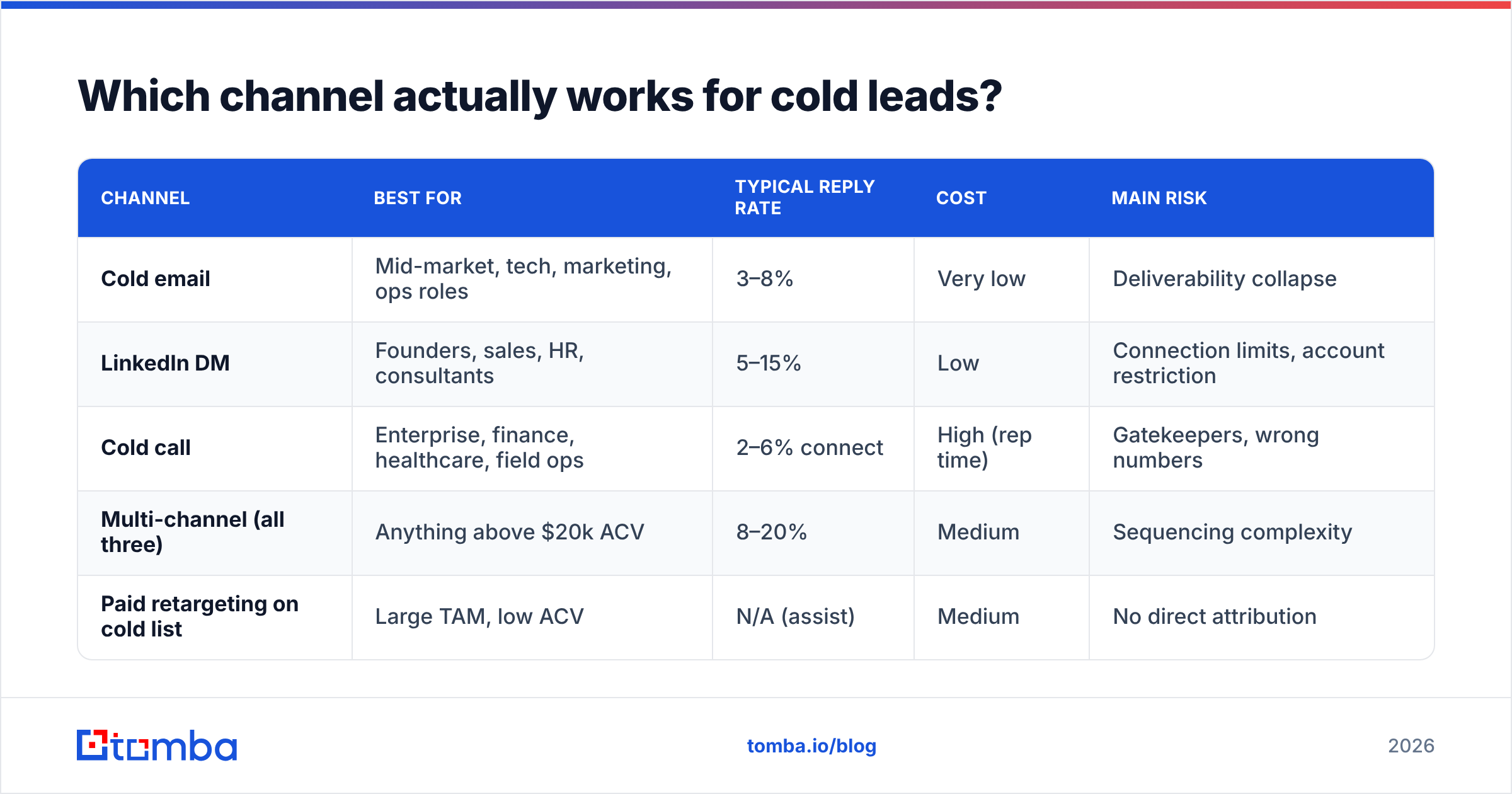
Which channel actually works for cold leads?#
There is no universal answer, but there are strong defaults by role and company size.
| Channel | Best for | Typical reply rate | Cost | Main risk |
|---|---|---|---|---|
| Cold email | Mid-market, tech, marketing, ops roles | 3–8% | Very low | Deliverability collapse |
| LinkedIn DM | Founders, sales, HR, consultants | 5–15% | Low | Connection limits, account restriction |
| Cold call | Enterprise, finance, healthcare, field ops | 2–6% connect | High (rep time) | Gatekeepers, wrong numbers |
| Multi-channel (all three) | Anything above $20k ACV | 8–20% | Medium | Sequencing complexity |
| Paid retargeting on cold list | Large TAM, low ACV | N/A (assist) | Medium | No direct attribution |
The consistent finding across sales-methodology research — HubSpot's sales data and G2's buyer reports both point the same direction — is that touch count matters more than touch channel. Five to eight touches across two or more channels reliably beats twelve emails from one inbox.
Phone is the most under-used channel in 2026 precisely because it's the least automatable. If you're pairing calls with email, pull direct dials with a phone finder rather than dialing switchboards — connect rates on a direct line run 4–6x a main number.
How do you warm a cold lead?#
Warming is the process of converting "who is this person" into "I know why they're emailing me." It happens across a sequence, not a message.
A structure that works, over roughly 21 days:
Touch 1 — Relevance, not pitch. One observation specific to their company. Not their industry. Their company. Two sentences, one soft question. No calendar link, no attachment, no "circling back."
Touch 2 (day 3) — LinkedIn view + connect, no message. Passive presence. They see your name in a second context, which is the entire point.
Touch 3 (day 5) — Value asset. A benchmark, a teardown, a single relevant number. Something they can use whether or not they ever reply to you.
Touch 4 (day 9) — Call. Reference the email by subject line in the first ten seconds. "I sent you a note about X, wanted to give you the thirty-second version."
Touch 5 (day 14) — Reframe. Same problem, different angle. If touch 1 was about cost, touch 5 is about risk. People ignore messages, not problems.
Touch 6 (day 21) — Permission close. "Should I close the loop on this?" This gets a disproportionate number of replies, including "no, keep me posted" — which is a qualified lead you would otherwise have dropped.
Then stop. A seventh, eighth, and ninth touch generate complaints faster than meetings, and complaints are what sender reputation is made of.

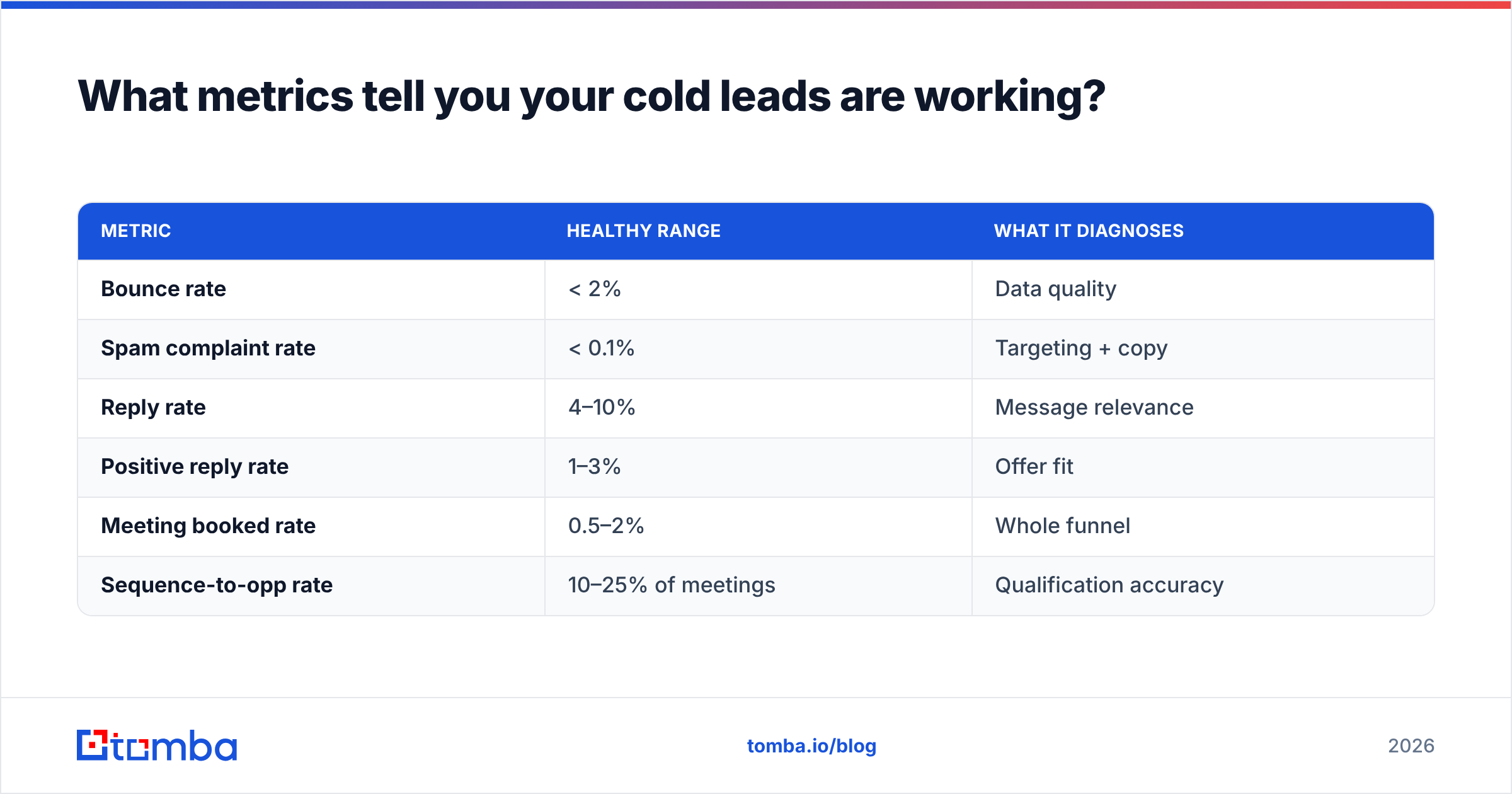
What metrics tell you your cold leads are working?#
Open rate is dead as a metric — Apple Mail Privacy Protection has inflated it beyond usefulness since 2021, and by 2026 a "62% open rate" tells you approximately nothing. Track these instead:
| Metric | Healthy range | What it diagnoses |
|---|---|---|
| Bounce rate | < 2% | Data quality |
| Spam complaint rate | < 0.1% | Targeting + copy |
| Reply rate | 4–10% | Message relevance |
| Positive reply rate | 1–3% | Offer fit |
| Meeting booked rate | 0.5–2% | Whole funnel |
| Sequence-to-opp rate | 10–25% of meetings | Qualification accuracy |
Two rules for reading this table. First, diagnose top-down: a low reply rate with a 9% bounce rate is a data problem masquerading as a copy problem. Second, positive reply rate is the only number that correlates with revenue. Total reply rate goes up when you write provocative garbage; positive reply rate does not.
If your bounce rate is fine but replies are flat, the problem is upstream of the message — you targeted the wrong segment. Rebuild the ICP before rewriting the email.
What are the most expensive cold-lead mistakes?#
- Sending from your primary domain. Use a separate sending domain. When a campaign goes wrong — and one will — you want the blast radius contained away from
yourcompany.com. - Skipping warmup. A brand-new domain sending 400 emails on day one is a spam signal. Email deliverability is earned over weeks.
- Personalization theater. "I loved your recent post!" with no evidence you read it is worse than no personalization. Prospects pattern-match on it instantly.
- Treating catch-all as valid. Catch-all domains accept everything at the SMTP layer. Sending to them unverified is how a "clean" list produces a 15% bounce rate.
- Never sunsetting. A contact who ignored eight touches across two sequences is not cold. They are dead. Suppress them and reclaim the credits.
- One-and-done data. Contact records decay. A list built in January is materially wrong by July. Re-verify or re-enrich on a rolling basis with data enrichment rather than treating your CRM as a permanent record.
Are cold leads still worth it in 2026?#
Yes, with a caveat that matters more every year.
The caveat: volume-based cold outreach is finished. Mailbox providers have gotten aggressive, buyers have gotten faster at pattern-matching AI-generated copy, and the marginal cost of sending has fallen to near zero for everyone — which means send volume is no longer a moat. Anyone can send 10,000 emails. Almost nobody can send 300 that land in the primary inbox, reach a person who exists, and reference something true about their business.
That last sentence is the whole opportunity. Precision is now the scarce resource, and precision starts with the contact record. Get the person right, get the address right, get the timing right, and a cold lead converts at rates that make inbound look expensive.
The teams still winning at outbound in 2026 are not sending more. They are sending to fewer, better-verified people, across more than one channel, over a longer horizon, with a message that would survive being forwarded to the prospect's boss.
Start with the data layer. Every warming sequence, channel mix, and copy test in this post is downstream of one question: is this a real person at a real company with a real address? Tomba's Email Finder resolves names and domains into verified professional emails, with a free tier at 25 searches per month and paid plans starting at $49/mo (see Tomba pricing for Growth at $99/mo and Pro at $249/mo). Build the list right, and the rest of the funnel stops fighting you.
Related guides#
Ready to find emails that actually work?
Join 150,000+ professionals who stopped guessing and started sending. Free credits on signup — no credit card required.
Get the Tomba newsletter
Practical outbound tactics and product updates — once every two weeks.
About the author