How to Write a Cold Message That Actually Gets Replies
Most cold messages get ignored in under three seconds. This guide breaks down the structure, timing, channels, and data behind cold messages that actually earn a reply.
A cold message is the first, uninvited touch you send to someone who has never heard of you — an email, a LinkedIn note, a text. It has one job: earn a reply. Yet most cold messages die in the preview pane because they lead with the sender, not the reader. This guide fixes that with structure, timing, and the data that decides whether you ever get read.
TL;DR#
- A cold message is unsolicited outreach whose only success metric is a reply, not an open.
- The message body matters less than most people think — deliverability and list quality decide 60–70% of the outcome before anyone reads a word.
- Winning cold messages are short (under 90 words), lead with the reader's world, and ask for one small next step.
- Personalization beats volume: a relevant one-liner tied to the prospect outperforms mail-merge tokens.
- Channel choice (email, LinkedIn, phone) should match where your buyer actually pays attention — and you should sequence, not spam.
What is a cold message, exactly?#
A cold message is any first-contact outreach sent to a person who has no prior relationship with you or your company. "Cold" means no warm intro, no inbound request, no existing thread — you are interrupting someone's day and asking for attention you have not yet earned.
Think of it like knocking on a stranger's door. If you open with "Let me tell you about my company's 12 award-winning features," the door closes. If you open with "I noticed your team just posted three SDR roles — are you handling outbound tooling in-house?" you have given them a reason to keep listening because the message is about them.
Cold messages live across three main channels — cold email, LinkedIn DMs, and cold calls — but the psychology is identical everywhere: relevance first, brevity second, ask third. The channel just changes the format constraints.
Why do most cold messages get ignored?#
Because most of them never get the chance to be judged on their words. Three silent filters kill a cold message before the copy ever matters:
- Deliverability — If your email lands in spam or bounces off an invalid address, your open rate is zero no matter how good the writing is. This is why email deliverability is the foundation, not an afterthought.
- List quality — Sending to stale, guessed, or role-based addresses (info@, sales@) tanks your sender reputation and your reply rate. A clean list built with an email verifier protects both.
- Relevance — Even a delivered, opened message dies if the first line is about you. Buyers scan the preview text in under three seconds and decide.
Only after those three pass does your actual message get read. That is the uncomfortable truth: you can write the best cold message on earth and still get ignored if the plumbing behind it leaks. According to HubSpot's sales research, the average cold email reply rate sits in the low single digits — and the gap between top and bottom performers is mostly infrastructure, not prose.
What does the anatomy of a great cold message look like?#
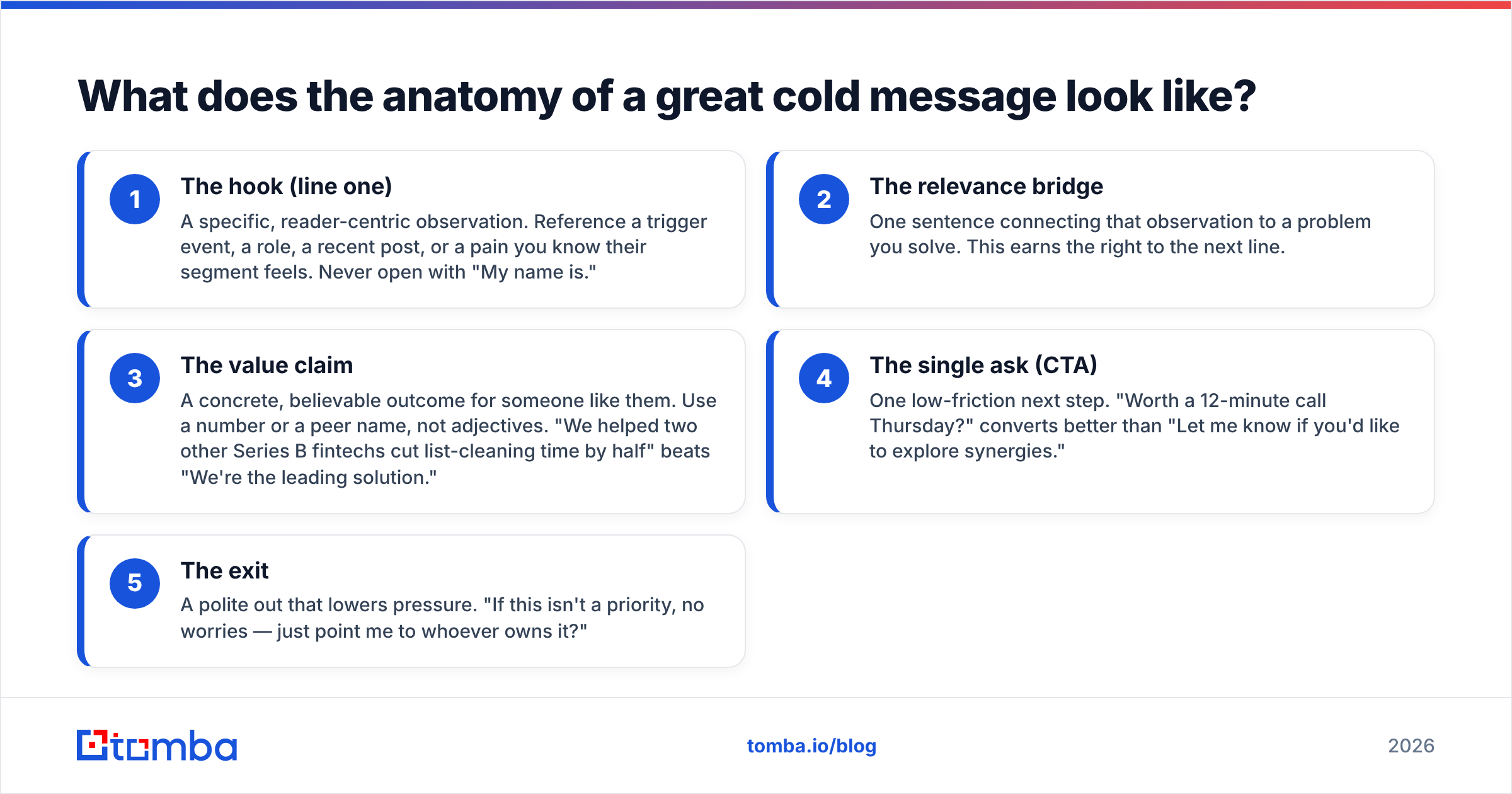
Every high-reply cold message follows the same five-part skeleton. Keep each part short and the whole thing under 90 words.
- The hook (line one) — A specific, reader-centric observation. Reference a trigger event, a role, a recent post, or a pain you know their segment feels. Never open with "My name is."
- The relevance bridge — One sentence connecting that observation to a problem you solve. This earns the right to the next line.
- The value claim — A concrete, believable outcome for someone like them. Use a number or a peer name, not adjectives. "We helped two other Series B fintechs cut list-cleaning time by half" beats "We're the leading solution."
- The single ask (CTA) — One low-friction next step. "Worth a 12-minute call Thursday?" converts better than "Let me know if you'd like to explore synergies."
- The exit — A polite out that lowers pressure. "If this isn't a priority, no worries — just point me to whoever owns it?"
That structure works because it mirrors how the reader actually thinks: Is this about me? → Do I have that problem? → Can they really help? → What do you want? → Is this safe to say yes to?
Which channel should you send a cold message on?#
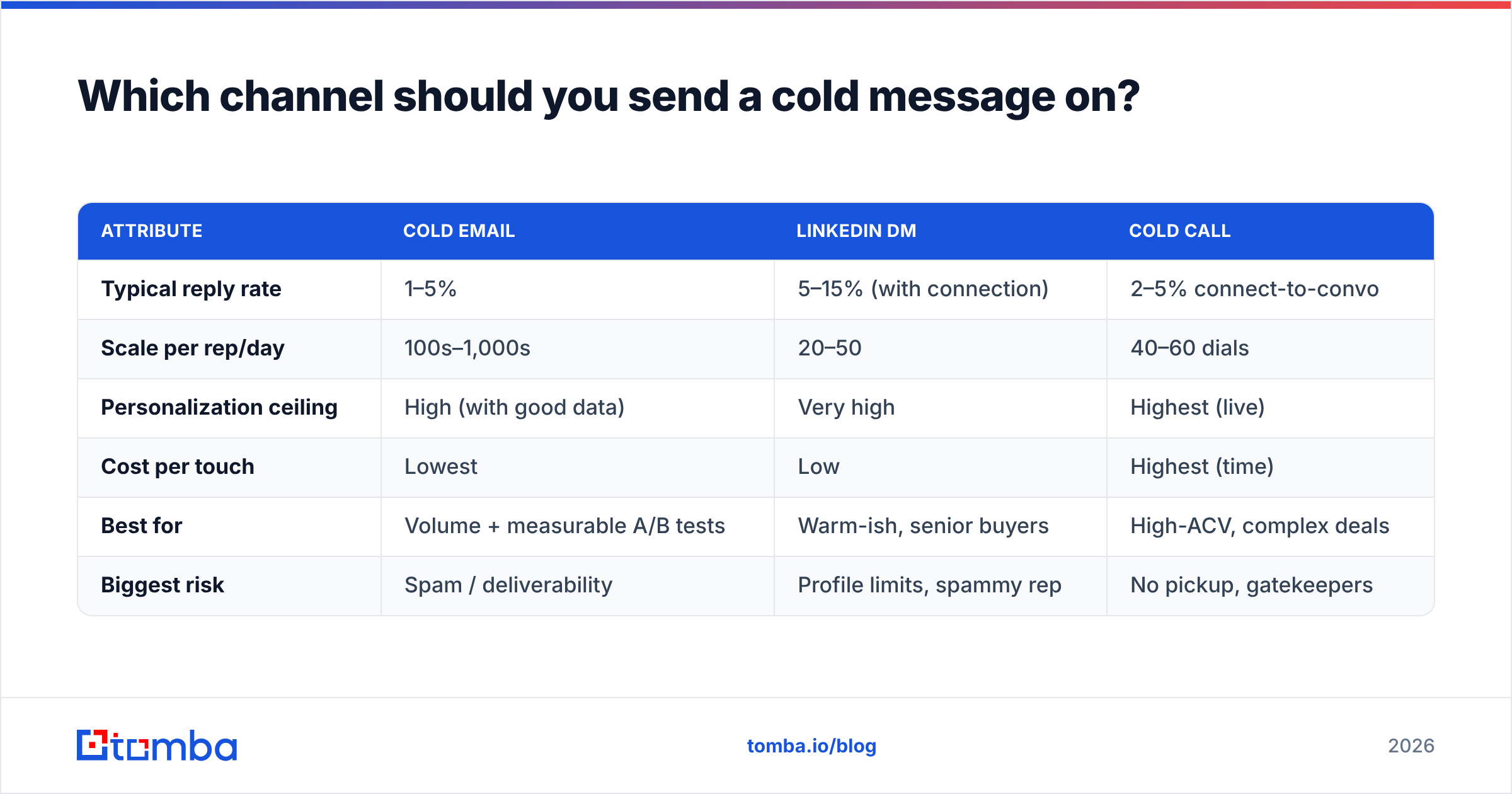
The best channel is wherever your specific buyer pays attention — but each has trade-offs worth knowing before you commit budget. Here is how the three primary cold-message channels compare.
| Attribute | Cold Email | LinkedIn DM | Cold Call |
|---|---|---|---|
| Typical reply rate | 1–5% | 5–15% (with connection) | 2–5% connect-to-convo |
| Scale per rep/day | 100s–1,000s | 20–50 | 40–60 dials |
| Personalization ceiling | High (with good data) | Very high | Highest (live) |
| Cost per touch | Lowest | Low | Highest (time) |
| Best for | Volume + measurable A/B tests | Warm-ish, senior buyers | High-ACV, complex deals |
| Biggest risk | Spam / deliverability | Profile limits, spammy rep | No pickup, gatekeepers |
The pragmatic move for most teams is a multi-channel sequence: open with a personalized email, follow with a LinkedIn touch two days later, then a call. Each channel reinforces the others so you stay top-of-mind without hammering one inbox. If you run outbound at scale, tools like Instantly and native sequencers handle the cadence, but they are only as good as the contact data feeding them.
How do you personalize a cold message at scale?#
Personalization does not mean writing every message by hand — it means every message carries one true, specific detail that could only apply to that prospect. The trick is layering three tiers:
- Tier 1 — Segment-level: Copy tailored to a role, industry, or trigger event (e.g., "Since you're hiring SDRs..."). Reusable across a whole list.
- Tier 2 — Company-level: A detail about their company — funding, tech stack, a product launch. Pulled at scale with data enrichment.
- Tier 3 — Person-level: A genuine observation about the individual — a post they wrote, a talk they gave. Reserved for high-value accounts.
Most teams over-invest in Tier 3 for every prospect and burn out. The efficient pattern is Tier 1 for the bulk of your list, Tier 2 for your priority accounts, and Tier 3 only for named targets. To do any of this, you first need accurate contact data — the right person, the right verified address, the right company. Guessing wrecks both deliverability and trust.
What should you never do in a cold message?#
A few reliable ways to guarantee silence:
- Open with your company bio. Nobody cares who you are until they know why you're relevant.
- Ask for 30 minutes up front. The bigger the ask, the lower the yes. Start micro.
- Use ten personalization tokens badly. A broken
{{first_name}}is worse than no name at all. - Send to unverified emails. Bounces destroy sender reputation and get whole domains blocked.
- Write a wall of text. If it needs scrolling on mobile, it's too long.
- Fake familiarity. "Great catching up!" when you've never spoken reads as manipulation.
The subject line deserves its own warning: keep it short, lowercase-natural, and curiosity-driven without being clickbait. A free subject line generator can help you test variations, but the body still has to deliver on the promise or your response rate collapses on the second send.
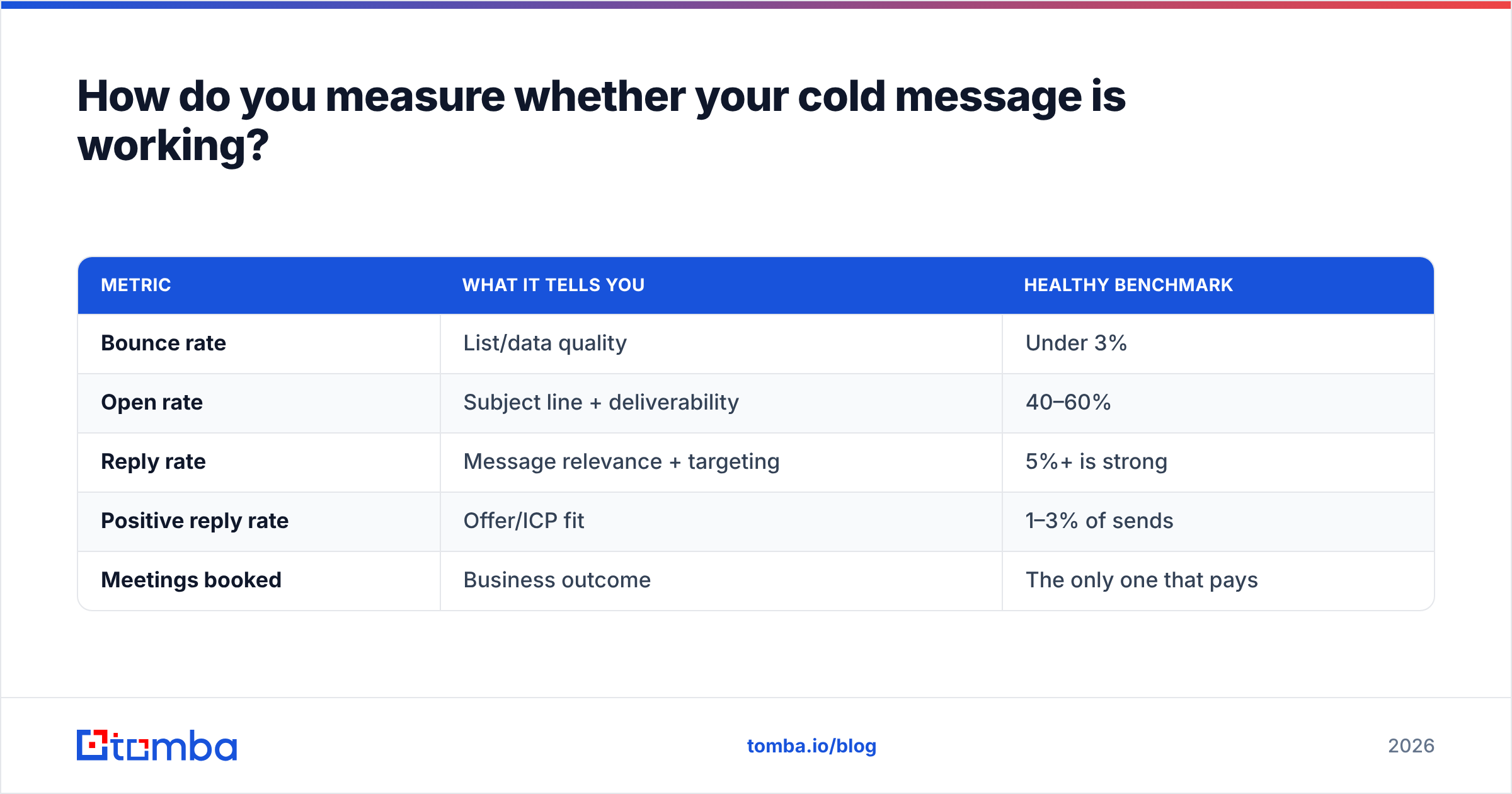
How do you measure whether your cold message is working?#
Reply rate is the north star — not opens, not clicks. A cold message that gets a 40% open rate and 0% replies is a failure; one with a 15% open rate and 8% replies is a machine. Track these in order:
| Metric | What it tells you | Healthy benchmark |
|---|---|---|
| Bounce rate | List/data quality | Under 3% |
| Open rate | Subject line + deliverability | 40–60% |
| Reply rate | Message relevance + targeting | 5%+ is strong |
| Positive reply rate | Offer/ICP fit | 1–3% of sends |
| Meetings booked | Business outcome | The only one that pays |
If bounce rate is high, fix your data before you touch the copy. If opens are fine but replies are flat, your targeting or offer is off. If replies come but they're all "not interested," your ICP is wrong. Diagnose in that order — most people rewrite copy when the real problem was the list. It usually is.
How does better data make cold messages convert?#
Because the fastest way to lift reply rate is to send fewer, more accurate messages to the right people. A cold message to a verified decision-maker at a company that actually fits your ICP outperforms fifty messages sprayed at guessed addresses.
That is where sourcing and verifying contacts up front changes the math. Instead of buying a stale list, you can build a fresh one: use a domain search to pull the right contacts at a target company, confirm each address, and only then load them into your sequence. Independent reviews on G2 consistently show that verification-first workflows cut bounce rates and protect the sender reputation your whole program depends on.
Clean data also unlocks honest personalization — you can enrich each contact with title, company, and role so your Tier 1 and Tier 2 lines are actually true. The message writes itself when the data underneath it is right.
Cold message example that earns a reply#
Here is the five-part skeleton in action, under 80 words:
Subject: SDR ramp at [Company]
Hi Dana — saw [Company] just opened three SDR roles. Teams scaling outbound that fast usually hit the same wall: reps burning hours hunting and verifying contact info instead of selling.
We help RevOps teams cut that prep time roughly in half with clean, verified data at the source.
Worth a 12-minute call Thursday to see if it'd help your new hires ramp faster?
If it's not a priority, just point me to whoever owns tooling?
Notice: reader-first hook, one specific pain, a believable number, one small ask, and a graceful exit. No bio, no fluff, no thirty-minute demand.
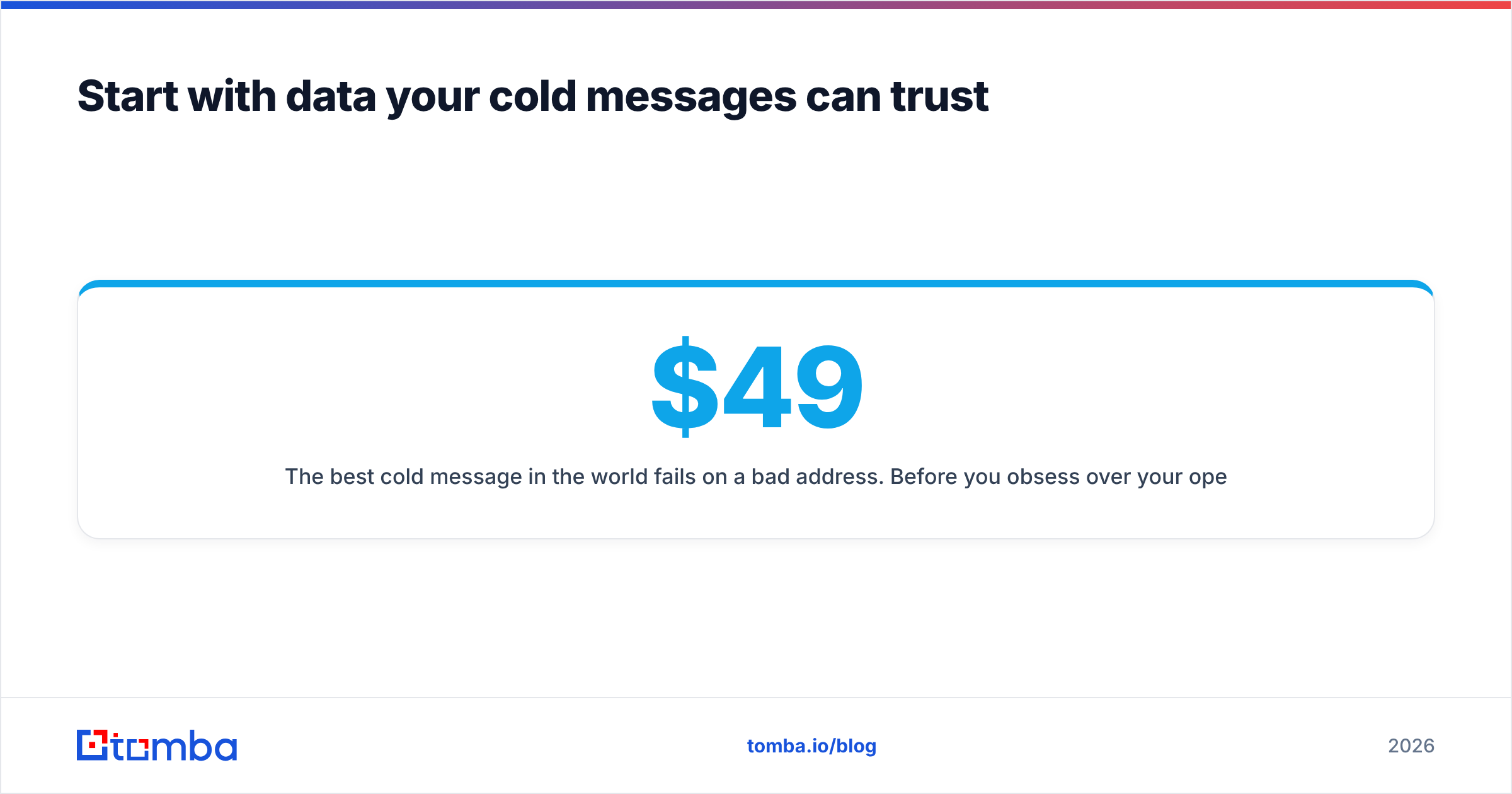
Start with data your cold messages can trust#
The best cold message in the world fails on a bad address. Before you obsess over your opening line, make sure it reaches a real, verified inbox. Use the Tomba Email Finder to source accurate professional emails by name, company, or domain, verify them in the same workflow, and load a clean list into your sequencer. Plans start with a free tier (25 searches/mo), then $49/mo Starter, $99/mo Growth, and $249/mo Pro — see full Tomba pricing for details. Get the data right first, and your cold messages finally get the reply they were written to earn.
Related guides#
Ready to find emails that actually work?
Join 150,000+ professionals who stopped guessing and started sending. Free credits on signup — no credit card required.
Get the Tomba newsletter
Practical outbound tactics and product updates — once every two weeks.
About the author