Cold Outreach Email Templates That Actually Get Replies in 2026
Nine cold outreach email templates proven to book meetings, plus the personalization, subject-line, and follow-up rules that make them convert instead of getting ignored.
Cold email still works in 2026 — but only if the message reads like a human wrote it to one specific person. The templates below are the frameworks top reps actually use, stripped of fluff and built to earn a reply.
TL;DR#
- Templates are scaffolding, not scripts. Use the structure, swap in real research, and never send the same sentence to 500 people.
- The three levers that decide replies: a specific subject line, a first line about them (not you), and one clear ask.
- Nine copy-paste templates below cover pain-point, referral, trigger-event, competitor-switch, and follow-up angles.
- Deliverability beats copy. A clean, verified list and a warmed domain matter more than any clever hook.
- Follow-ups drive most meetings. Roughly half of replies come after the first email, so plan a 4–5 touch sequence.
What makes a cold outreach email actually get replies?#
The short answer: relevance the prospect can feel in under three seconds. Cold email is like knocking on a stranger's door — if the first thing out of your mouth is about you, the door closes. If it's about them, you get a moment to talk.
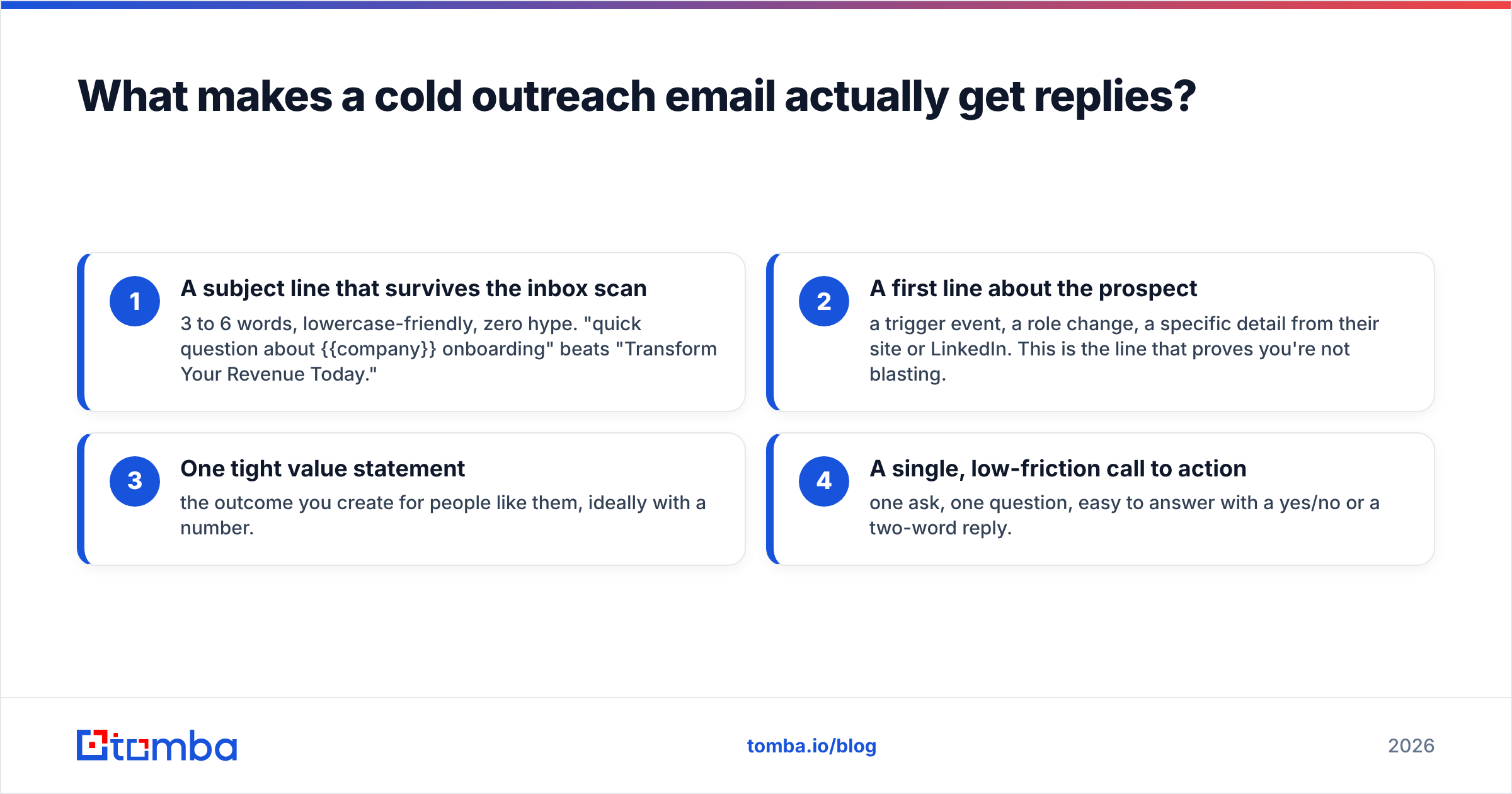
Every high-performing cold email shares four parts:
- A subject line that survives the inbox scan — 3 to 6 words, lowercase-friendly, zero hype. "quick question about {{company}} onboarding" beats "Transform Your Revenue Today."
- A first line about the prospect — a trigger event, a role change, a specific detail from their site or LinkedIn. This is the line that proves you're not blasting.
- One tight value statement — the outcome you create for people like them, ideally with a number.
- A single, low-friction call to action — one ask, one question, easy to answer with a yes/no or a two-word reply.
Miss any one and reply rates collapse. According to HubSpot's sales research, personalization and relevance consistently outrank volume as predictors of response — the reps who win aren't sending more, they're sending sharper.
The 3-part anatomy every cold outreach template follows#
Before the templates, internalize the skeleton. Once you see it, you can write your own forever.
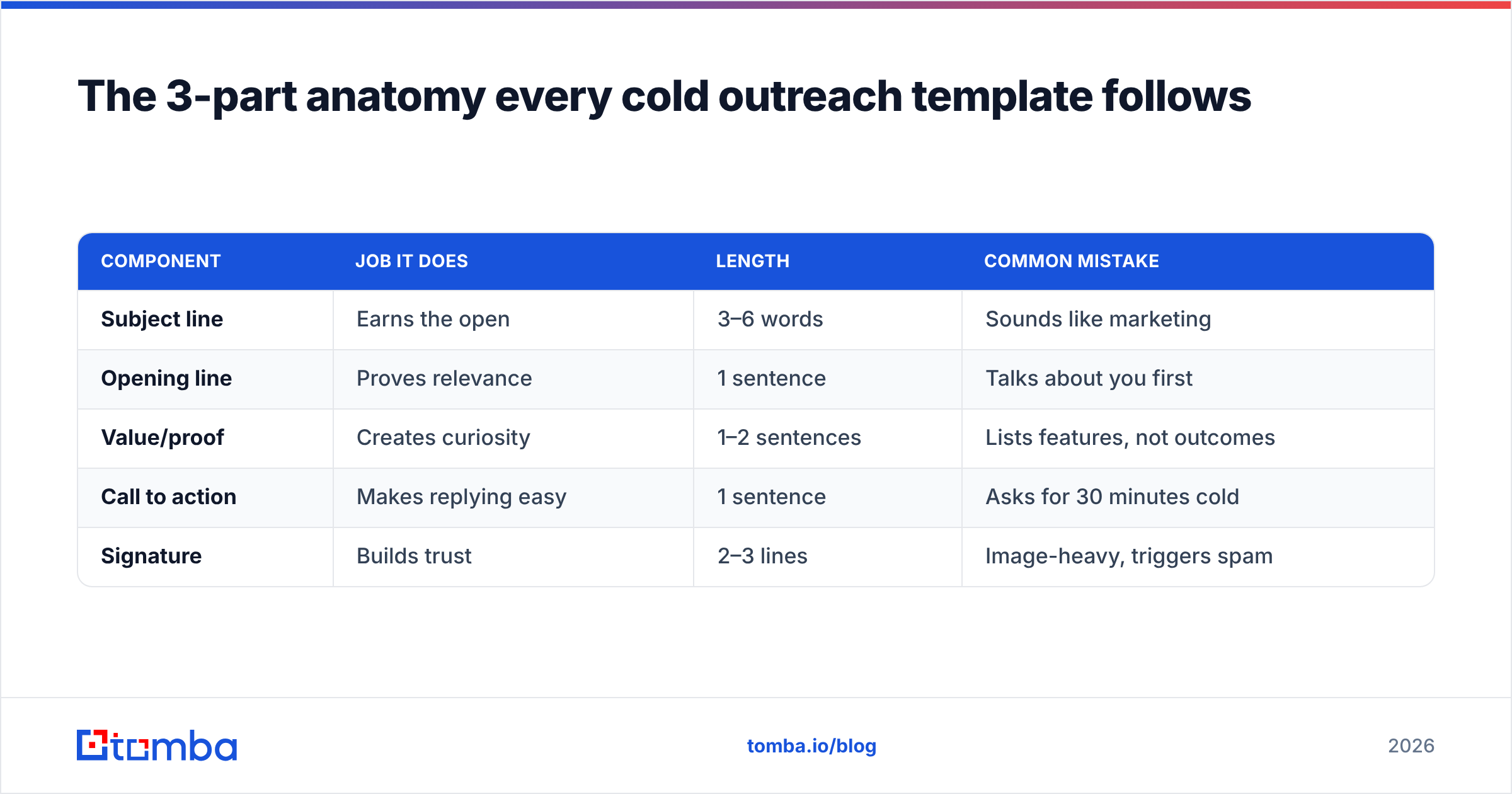
| Component | Job it does | Length | Common mistake |
|---|---|---|---|
| Subject line | Earns the open | 3–6 words | Sounds like marketing |
| Opening line | Proves relevance | 1 sentence | Talks about you first |
| Value/proof | Creates curiosity | 1–2 sentences | Lists features, not outcomes |
| Call to action | Makes replying easy | 1 sentence | Asks for 30 minutes cold |
| Signature | Builds trust | 2–3 lines | Image-heavy, triggers spam |
Notice the ratio: four-fifths of the email is about the prospect, and only one line is your ask. That imbalance is the whole game. If you want a head start on wording, Tomba's free cold email templates library and subject line generator give you tested starting points you can adapt per persona.
What are the best cold outreach email templates for 2026?#
Here are nine frameworks. Replace every {{bracket}} with real research — the templates give you structure, not an excuse to skip homework.
1. The pain-point opener#
Subject: {{problem}} at {{company}}?
Hi {{first_name}},
Noticed {{company}} is {{specific trigger — hiring 5 SDRs / expanding into EMEA}}. Teams doing that usually hit {{specific problem}} fast.
We help {{similar companies}} fix that — {{customer}} cut {{metric}} by {{number}} in {{timeframe}}.
Worth a quick look, or is this off your radar right now?
{{signature}}
2. The referral / name-drop#
Subject: {{mutual contact}} suggested I reach out
Hi {{first_name}},
{{mutual contact}} mentioned you own {{area}} at {{company}} and thought this might be relevant.
We just helped {{their team / a peer}} {{achieve outcome}}. Happy to share the two things that made the difference.
Open to a short reply this week?
3. The trigger-event email#
Subject: congrats on {{funding / launch / role}}
Hi {{first_name}},
Saw {{trigger event}} — congrats. Growth like that usually turns {{process}} into a bottleneck.
{{Company}} clients typically {{outcome}} within {{timeframe}}. Want the one-pager?
4. The competitor-switch#
Subject: switching from {{competitor}}?
Hi {{first_name}},
A lot of teams on {{competitor}} come to us when {{pain}} starts costing them. We close that gap by {{differentiator}}.
Curious whether {{company}} has run into the same. Yes or no is fine.
5–9 (short-form angles)#
- The one-line email — just a subject and a single sentence question. Absurdly high reply rates because it demands almost no effort to answer.
- The "wrong person" email — "Are you the right person for {{topic}}, or should I reach out to someone else?" This gets routed internally and feels helpful.
- The value-first email — lead with a free resource, teardown, or benchmark. No ask at all in email one.
- The break-up email — "Assuming this isn't a priority, I'll close the loop." Loss aversion pulls replies from silent prospects.
- The social-proof email — open with a peer result in their exact industry, then ask if they want the playbook.

How do you personalize templates at scale without sounding like a robot?#
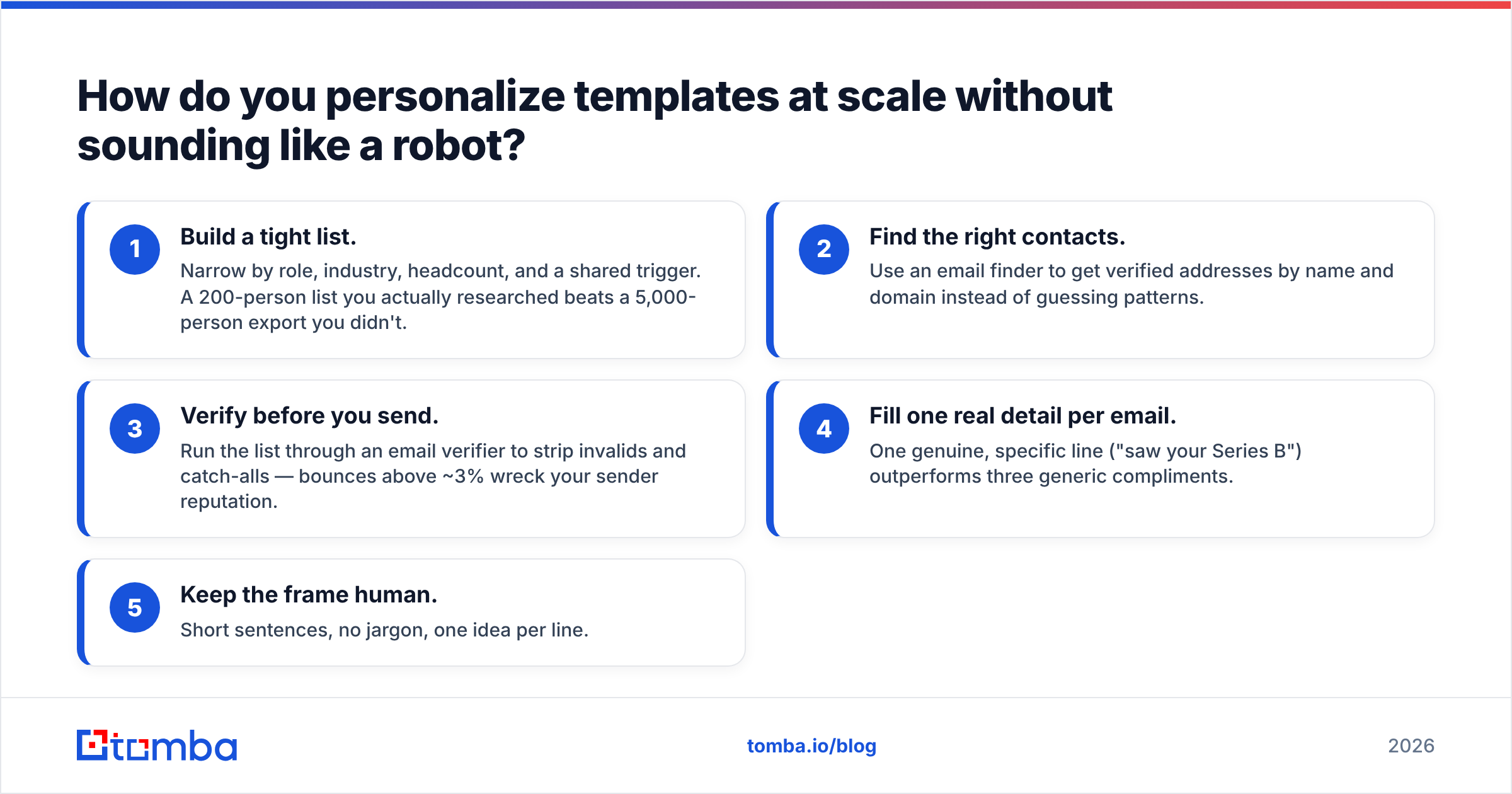
Personalization scales through research variables, not rewritten prose. You don't rewrite each email from scratch — you define 2–3 dynamic slots (trigger event, specific pain, peer proof) and fill only those per prospect.
A practical workflow:
- Build a tight list. Narrow by role, industry, headcount, and a shared trigger. A 200-person list you actually researched beats a 5,000-person export you didn't.
- Find the right contacts. Use an email finder to get verified addresses by name and domain instead of guessing patterns.
- Verify before you send. Run the list through an email verifier to strip invalids and catch-alls — bounces above ~3% wreck your sender reputation.
- Fill one real detail per email. One genuine, specific line ("saw your Series B") outperforms three generic compliments.
- Keep the frame human. Short sentences, no jargon, one idea per line.
The trap reps fall into is faking personalization — "I loved your recent post" with no post named. Prospects smell it instantly. One true detail beats ten fake ones.
Which cold outreach approach works best? A quick comparison#
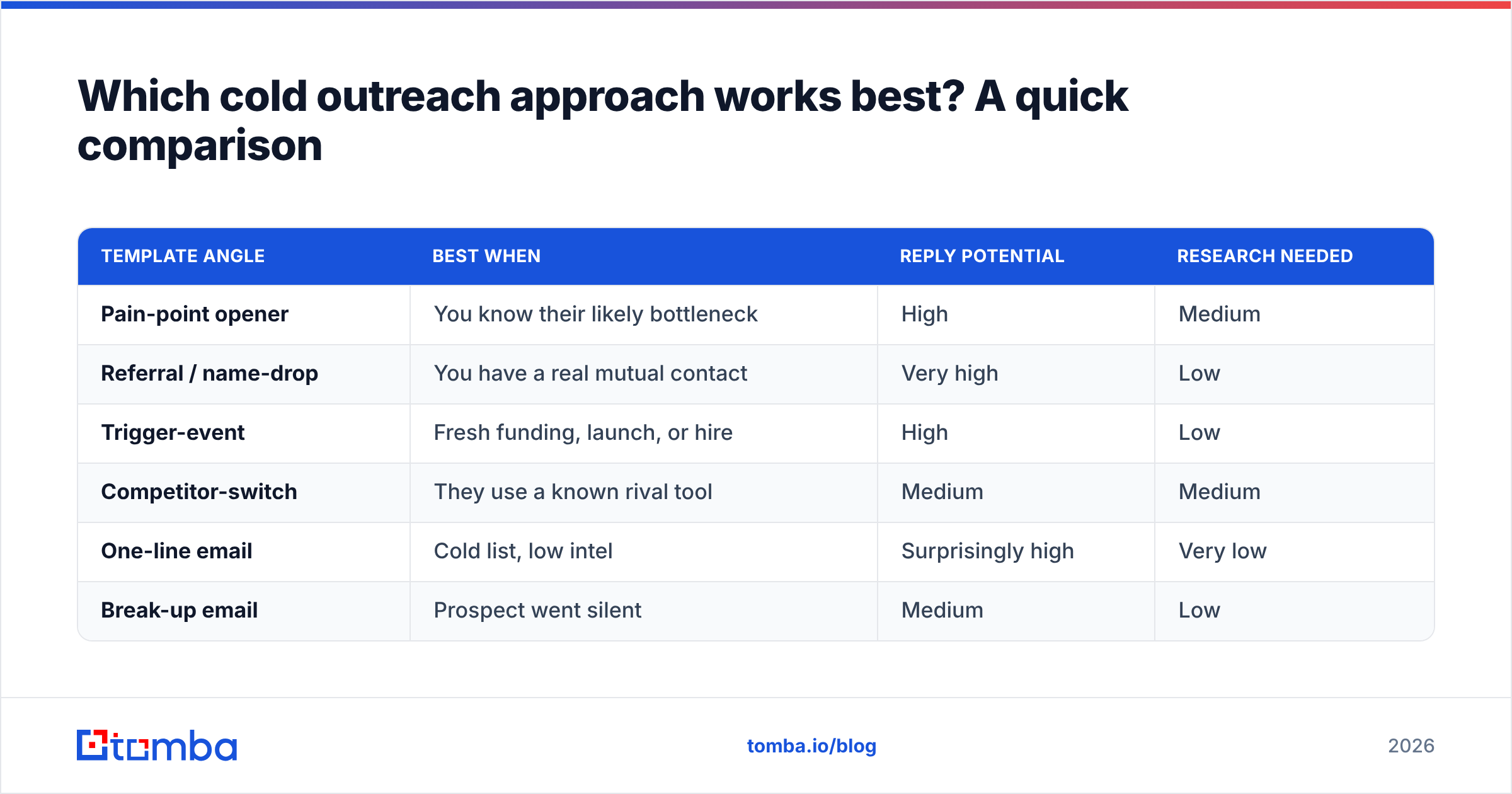
Different situations call for different templates. Match the angle to what you actually know about the prospect.
| Template angle | Best when | Reply potential | Research needed |
|---|---|---|---|
| Pain-point opener | You know their likely bottleneck | High | Medium |
| Referral / name-drop | You have a real mutual contact | Very high | Low |
| Trigger-event | Fresh funding, launch, or hire | High | Low |
| Competitor-switch | They use a known rival tool | Medium | Medium |
| One-line email | Cold list, low intel | Surprisingly high | Very low |
| Break-up email | Prospect went silent | Medium | Low |
There's no single "best" template — the referral wins on reply rate but needs a warm connection, while the one-line email needs almost no research and still performs. Rotate based on what you know.
Why do most cold emails fail before the copy even matters?#
Deliverability. You can write the best cold outreach email templates in your industry and still get zero replies if your messages land in spam. This is the part reps skip and then blame the copy.
Fix the foundation first:
- Authenticate your domain. Set up SPF, DKIM, and DMARC. Google and Yahoo now enforce these for bulk senders — Google's Postmaster guidelines spell out the requirements.
- Warm up new domains and inboxes. Ramp volume slowly over 2–4 weeks before real sending.
- Keep bounce rates low. This is where list verification pays off — a verified list protects the reputation you spent weeks building.
- Avoid spam triggers. No image-only emails, no link-stuffing, no "FREE!!!" energy, and keep signatures lean.
- Send from a separate domain. Use a lookalike sending domain so cold volume never risks your primary corporate domain.
Think of it like a restaurant: your copy is the meal, but deliverability is the kitchen passing health inspection. Best dish in town doesn't matter if the doors are shut. For the mechanics of authentication and reputation, G2's deliverability category rounds up the tooling worth knowing.
How many follow-ups should a cold outreach sequence have?#
Four to five touches over roughly two weeks, then stop. Most positive replies arrive after the first email — a single-send campaign leaves the majority of your meetings on the table.
A reliable cadence:
- Day 1 — Template 1 (main value email)
- Day 3 — Short bump: "Floating this back up — worth a look?"
- Day 6 — New angle or fresh proof point (don't just re-send)
- Day 10 — Value-first: share a resource, no ask
- Day 14 — Break-up email to close the loop
Rules that keep follow-ups from feeling like nagging: change the angle each time (never paste the same email), keep them shorter than the first, and always make the reply effortless. And when someone says no, thank them and move on — a graceful exit keeps the door open for later.
Common mistakes that kill reply rates#
- Talking about yourself first. If your opening sentence starts with "I" or "We," rewrite it.
- Asking for 30 minutes in email one. Ask for interest, not calendar time.
- Sending to unverified lists. Bounces tank deliverability and every future send suffers.
- One-and-done sending. No follow-up means leaving most replies unclaimed.
- Over-designing the email. Plain text outperforms heavily formatted, image-laden HTML in cold outreach.
- Vague CTAs. "Let me know your thoughts" gives the reader nothing to do. Ask one clear question.
Turn these templates into booked meetings#
Great cold outreach email templates only work when they reach a real person's inbox. Start by building a targeted, verified list: use the Tomba Email Finder to pull accurate professional emails by name, company, or domain, then verify them so your carefully written templates never bounce. Pair a clean list with the frameworks above and a disciplined 4–5 touch sequence, and you'll spend less time guessing addresses and more time answering replies.
Pick one template, research ten prospects properly, and send today. Then follow up. The reps who win at cold email in 2026 aren't the ones sending the most — they're the ones sending the most relevant message to the right inbox.
Related guides#
Ready to find emails that actually work?
Join 150,000+ professionals who stopped guessing and started sending. Free credits on signup — no credit card required.
Get the Tomba newsletter
Practical outbound tactics and product updates — once every two weeks.
About the author