Cold Outreach Examples That Actually Get Replies in 2026
Nine real cold outreach examples—email, LinkedIn, and cold call scripts—broken down line by line so you can copy what works and skip the spam that gets ignored.
Most cold outreach fails for the same boring reason: it's about the sender, not the buyer. This guide fixes that with nine real cold outreach examples you can copy today—across email, LinkedIn, and the phone—plus a line-by-line breakdown of why each one earns a reply instead of a delete.
TL;DR#
- Great cold outreach is short, specific, and about the prospect—not a feature dump about you.
- Personalization beats volume. One relevant line about the prospect's world outperforms a "Hi {{first_name}}" mail merge every time.
- The nine examples below cover cold email, LinkedIn DMs, and cold call openers—each with the reasoning that makes it work.
- A single clear ask ("open to a 15-min chat Thursday?") converts better than a vague "let me know your thoughts."
- Deliverability decides your reply rate before copy does—verify addresses and warm your domain, or your best script never lands.
What makes a cold outreach example actually work?#
The short answer: relevance, brevity, and one clear next step. Everything else is decoration.
Think of cold outreach like knocking on a stranger's door. If you open with a five-minute monologue about your company's mission, the door closes. If you say "I noticed your gate is broken and I fix gates—want a quote?", you get a conversation. The best cold outreach examples all follow that second pattern: they lead with the prospect's situation, prove you did five seconds of homework, and make saying "yes" effortless.
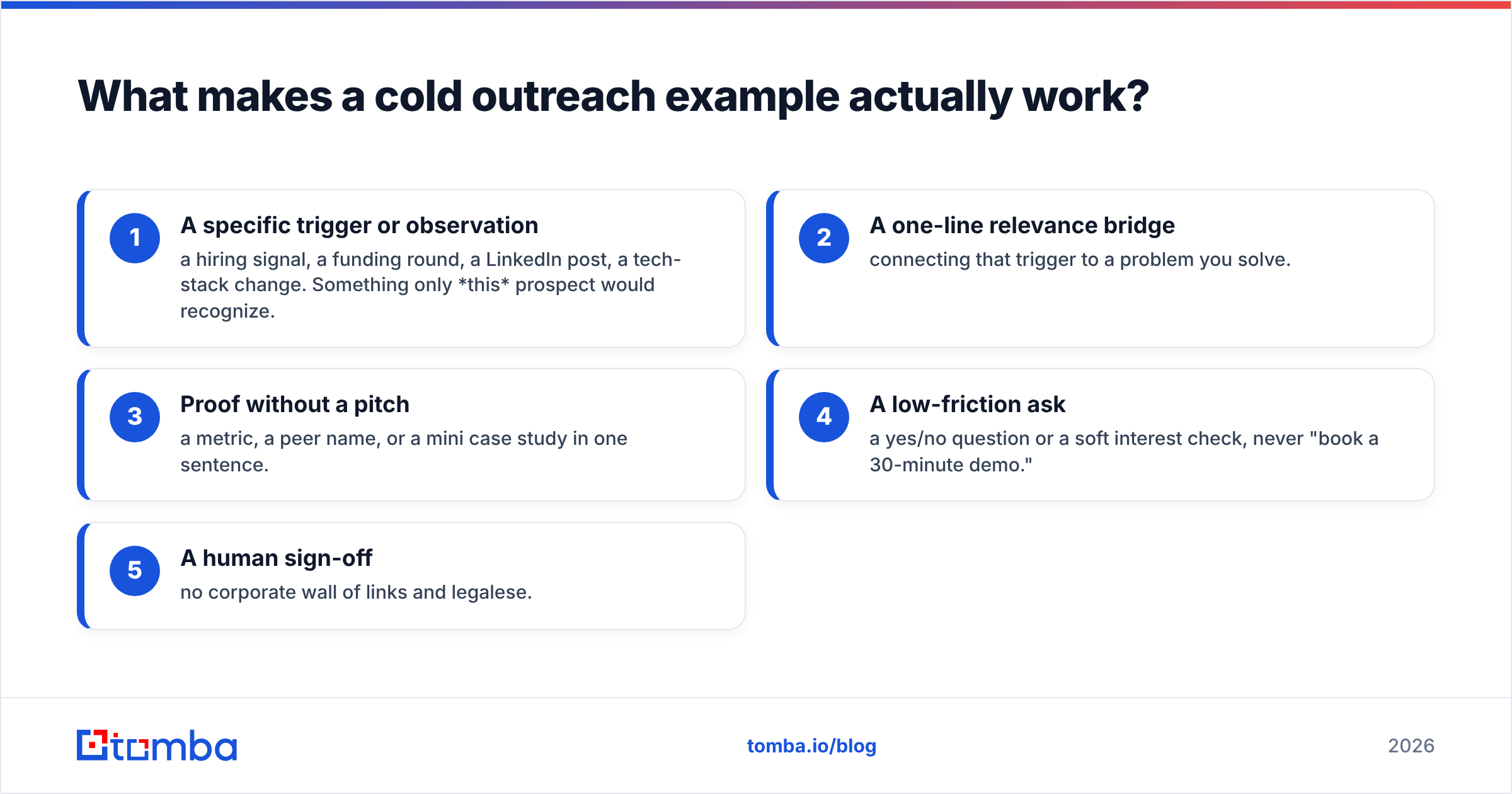
Here's the anatomy every example in this post shares:
- A specific trigger or observation — a hiring signal, a funding round, a LinkedIn post, a tech-stack change. Something only this prospect would recognize.
- A one-line relevance bridge — connecting that trigger to a problem you solve.
- Proof without a pitch — a metric, a peer name, or a mini case study in one sentence.
- A low-friction ask — a yes/no question or a soft interest check, never "book a 30-minute demo."
- A human sign-off — no corporate wall of links and legalese.
Miss the first ingredient and the rest doesn't matter. Personalization is the difference between outreach and spam.
What are the best cold email examples?#
Cold email is still the highest-leverage channel because it scales and it's measurable. Below are four cold email examples for different scenarios. Notice how each stays under 90 words.
Example 1 — The trigger-event email#
Subject: your Q3 SDR hiring
Hi Dana,
Saw you're hiring three SDRs this quarter—usually that means pipeline targets went up faster than your list-building can keep pace.
We help RevOps teams hand new reps a pre-verified prospect list on day one, so ramp time drops instead of stretching.
Worth a 15-minute look before the new hires start?
— Marco
Why it works: The hiring signal proves relevance instantly, the bridge ties it to a real pain (ramp time), and the ask is time-boxed and logical.
Example 2 — The peer-proof email#
Subject: how Loom cut bounce rates
Hi Priya,
Two marketing teams your size—Loom and Ashby—were losing 12–18% of campaigns to bad email data before they cleaned their lists.
We fixed that with automated verification inside their existing workflow. Bounce rates dropped under 2%.
Open to seeing the before/after? Happy to send a short teardown.
— Sam
Why it works: Named peers create instant credibility, and the offer ("send a teardown") is lower-friction than a meeting.
Example 3 — The problem-agitate email#
Subject: the 30% you're not emailing
Hi Tom,
Most B2B lists have a silent 30% of contacts that are catch-all or outdated. You never see the bounces—your emails just quietly don't land.
We flag those before you hit send. Takes one upload.
Want me to run your current list through it, free?
— Lena
Why it works: It names an invisible problem, then removes all risk with a free, concrete offer.
Example 4 — The short-and-blunt email#
Subject: quick one, Alex
Alex—do you own lead data quality at Ramp, or should I be talking to someone else?
— Nadia
Why it works: Under 20 words, it respects the reader's time and is almost impossible not to answer. Routing questions get replies because they're easy.
Before you send any of these at scale, run your list through an email verifier so your carefully written copy doesn't die in a spam folder. A brilliant script with a 25% bounce rate still fails.
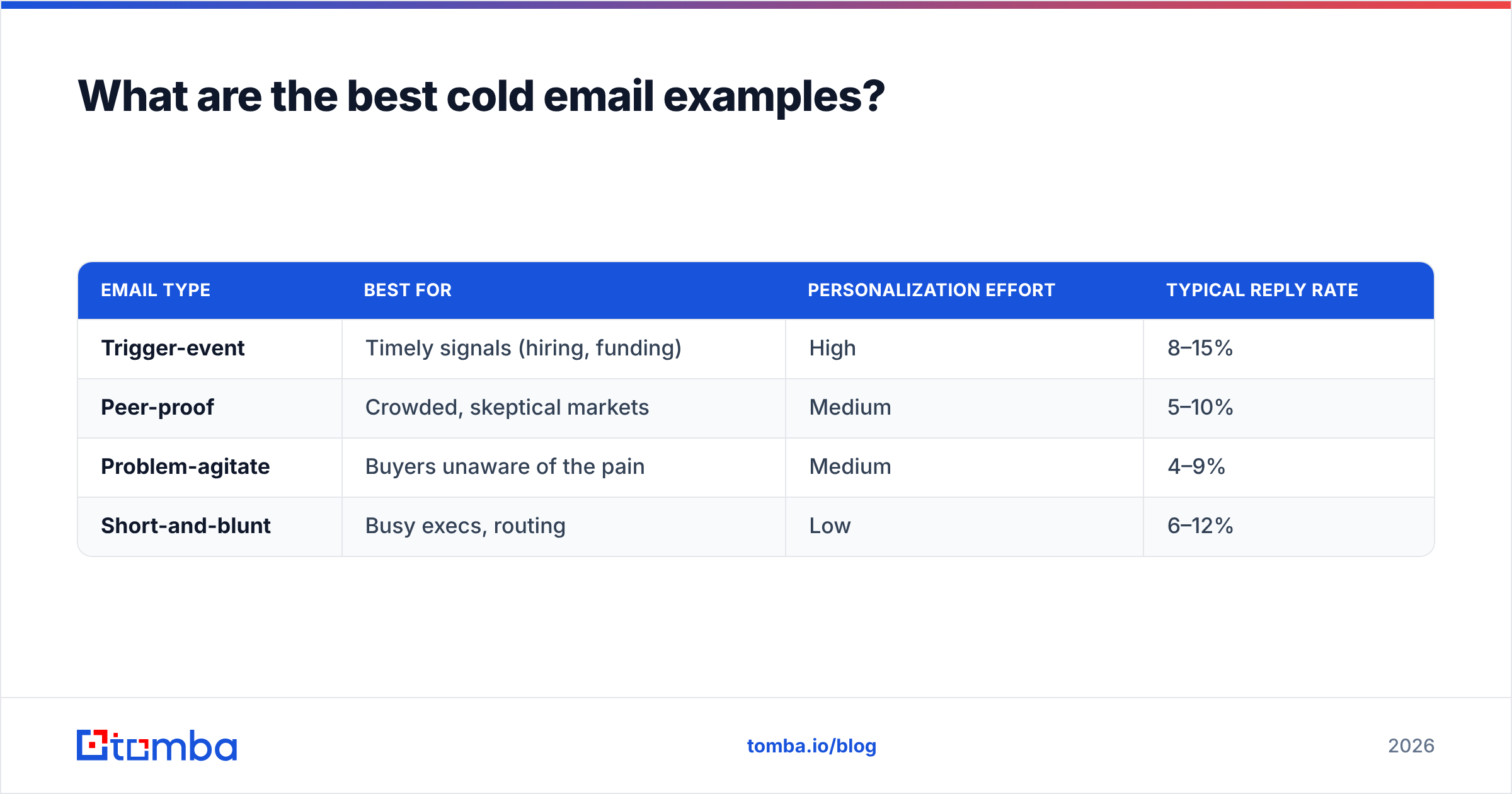
Here's how the four archetypes compare:
| Email type | Best for | Personalization effort | Typical reply rate |
|---|---|---|---|
| Trigger-event | Timely signals (hiring, funding) | High | 8–15% |
| Peer-proof | Crowded, skeptical markets | Medium | 5–10% |
| Problem-agitate | Buyers unaware of the pain | Medium | 4–9% |
| Short-and-blunt | Busy execs, routing | Low | 6–12% |
Reply rates assume verified data and a warmed sending domain. Numbers collapse without both.
How do LinkedIn cold outreach examples differ?#
LinkedIn is a conversation channel, not a broadcast one—so the examples are shorter, softer, and never open with a pitch.
The mistake most reps make is treating a connection request like a cold email. It isn't. On LinkedIn you're standing next to the person at a networking event, not slipping a letter under their door. Lead with curiosity, earn the reply, then introduce what you do.
Example 5 — The no-pitch connection request#
Hi Rob—came across your post on outbound attribution and it mirrored a debate my team's been having. Would love to follow your work. No pitch, promise.
Why it works: It references specific content and explicitly disarms the "here comes a sales pitch" reflex.
Example 6 — The value-first follow-up (after they accept)#
Thanks for connecting, Rob. Since attribution's on your mind—we put together a one-pager on how three teams solved outbound tracking without a full RevOps rebuild. Want me to send it over? No strings.
Why it works: It delivers value before asking for anything and keeps the ask to a simple "want me to send it?"
Example 7 — The mutual-context DM#
Hi Ana—noticed we're both in the Pavilion community and you lead demand gen at Vanta. I'm mapping how Series-B teams staff pipeline generation this year. Would you be open to a 15-min swap of notes?
Why it works: Shared context (a community) plus a peer-to-peer framing ("swap of notes") beats a vendor-to-buyer framing.
For a deeper playbook on cadence and messaging across the platform, this breakdown of LinkedIn outreach pairs well with the email examples above. The winning motion is usually multi-channel: email plus LinkedIn plus a well-timed call.

What do good cold call scripts look like?#
The best cold call openers ask permission and name the reason for calling in the first ten seconds—before the prospect's guard fully goes up.
Cold calling isn't dead; bad cold calling is. The scripts below work because they're honest about the interruption and give the prospect an easy exit, which paradoxically keeps them on the line.
Example 8 — The permission-based opener#
"Hi Jordan, it's Chris from Tomba. I know I'm an interruption—can I have 30 seconds to tell you why I called, and you can decide if it's worth continuing?"
Nearly everyone grants 30 seconds because you've been upfront and handed them control. Then you deliver a single, specific value line and ask one question.
Example 9 — The referral-style opener#
"Hi Jordan, I was on your engineering team's page and noticed you just shipped a new API—usually that means the data feeding it needs to stay clean at scale. Is that something on your plate, or am I off base?"
Why it works: The "or am I off base?" softener invites an honest answer instead of a defensive brush-off, and the trigger (a shipped API) proves you didn't dial at random.
Pair calls with data enrichment so you're dialing the right person with the right context. A verified phone finder number and a quick note on the account beats a spray-and-pray dialer list every time.
How do you personalize cold outreach at scale?#
You don't personalize every line by hand—you personalize the variable that matters and templatize the rest. That's the whole trick.
Volume and relevance feel like opposites, but they aren't. The move is to build tight segments (say, "Series-B fintech RevOps leaders who hired an SDR in the last 30 days"), then write one strong template with a single dynamic hook per segment. You get the reply rate of personalization at close to the speed of automation.
A repeatable workflow looks like this:
- Define a narrow segment — the tighter, the better. "SaaS marketing directors" is too broad; "SaaS marketing directors at companies that just launched a free trial" is a hook.
- Find and verify contacts — pull them with a tool like the Tomba Email Finder and confirm each address before sending.
- Enrich with one trigger — a funding round, a job change, a tech-stack signal. This becomes your dynamic opening line.
- Write one template per segment — static value prop, dynamic first line.
- Warm your domain and stagger sends — protect email deliverability so your volume doesn't tank your reputation.
- Measure reply rate, not open rate — opens lie in a post-privacy world; replies don't.
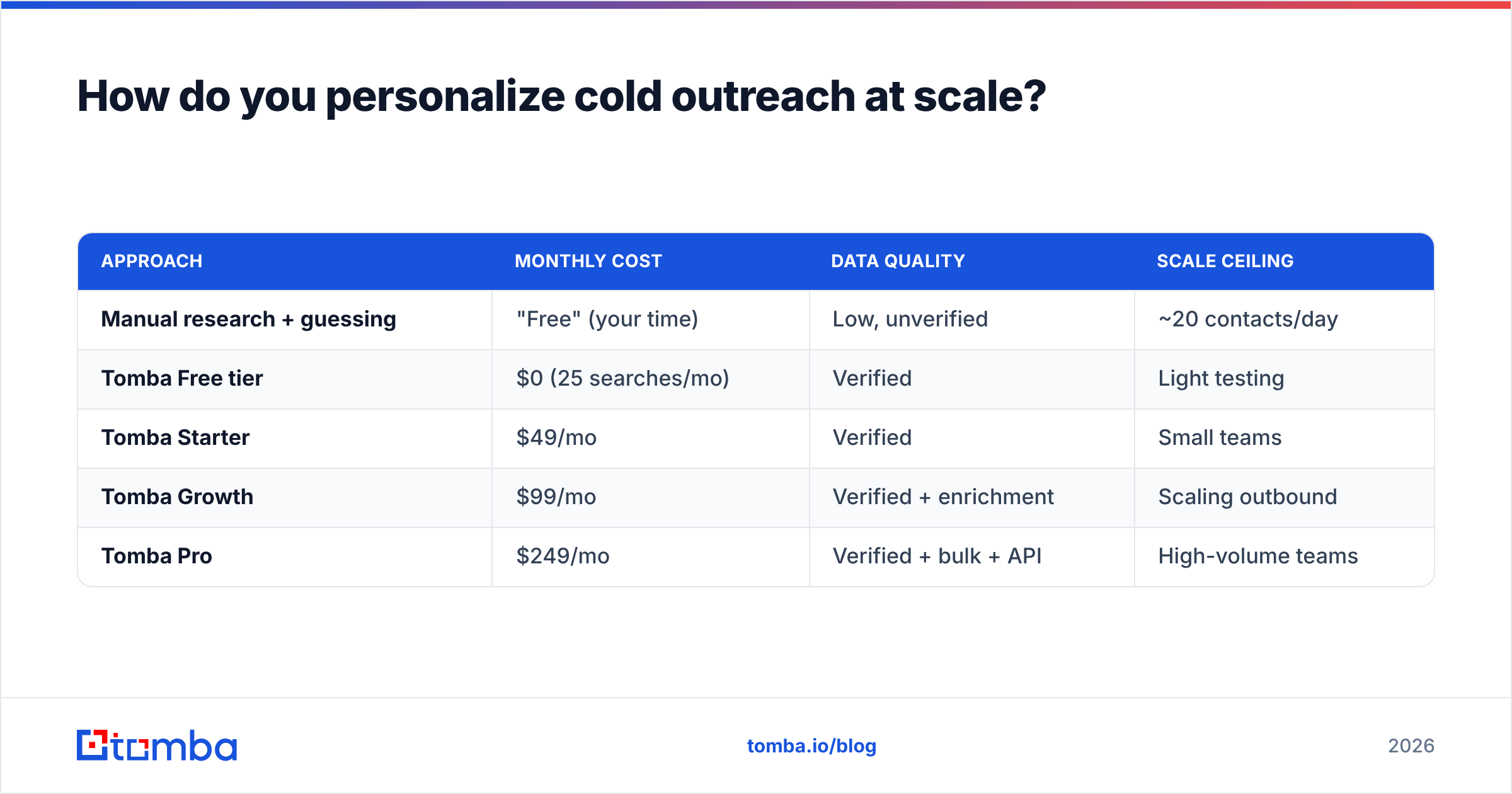
The economics are why teams standardize on a data platform first. Here's a rough comparison of Tomba plans against the manual alternative:
| Approach | Monthly cost | Data quality | Scale ceiling |
|---|---|---|---|
| Manual research + guessing | "Free" (your time) | Low, unverified | ~20 contacts/day |
| Tomba Free tier | $0 (25 searches/mo) | Verified | Light testing |
| Tomba Starter | $49/mo | Verified | Small teams |
| Tomba Growth | $99/mo | Verified + enrichment | Scaling outbound |
| Tomba Pro | $249/mo | Verified + bulk + API | High-volume teams |
You can see full Tomba pricing for credit limits per tier. The point isn't the exact number—it's that clean, verified data is the input that makes every example above actually convert.
What are the most common cold outreach mistakes?#
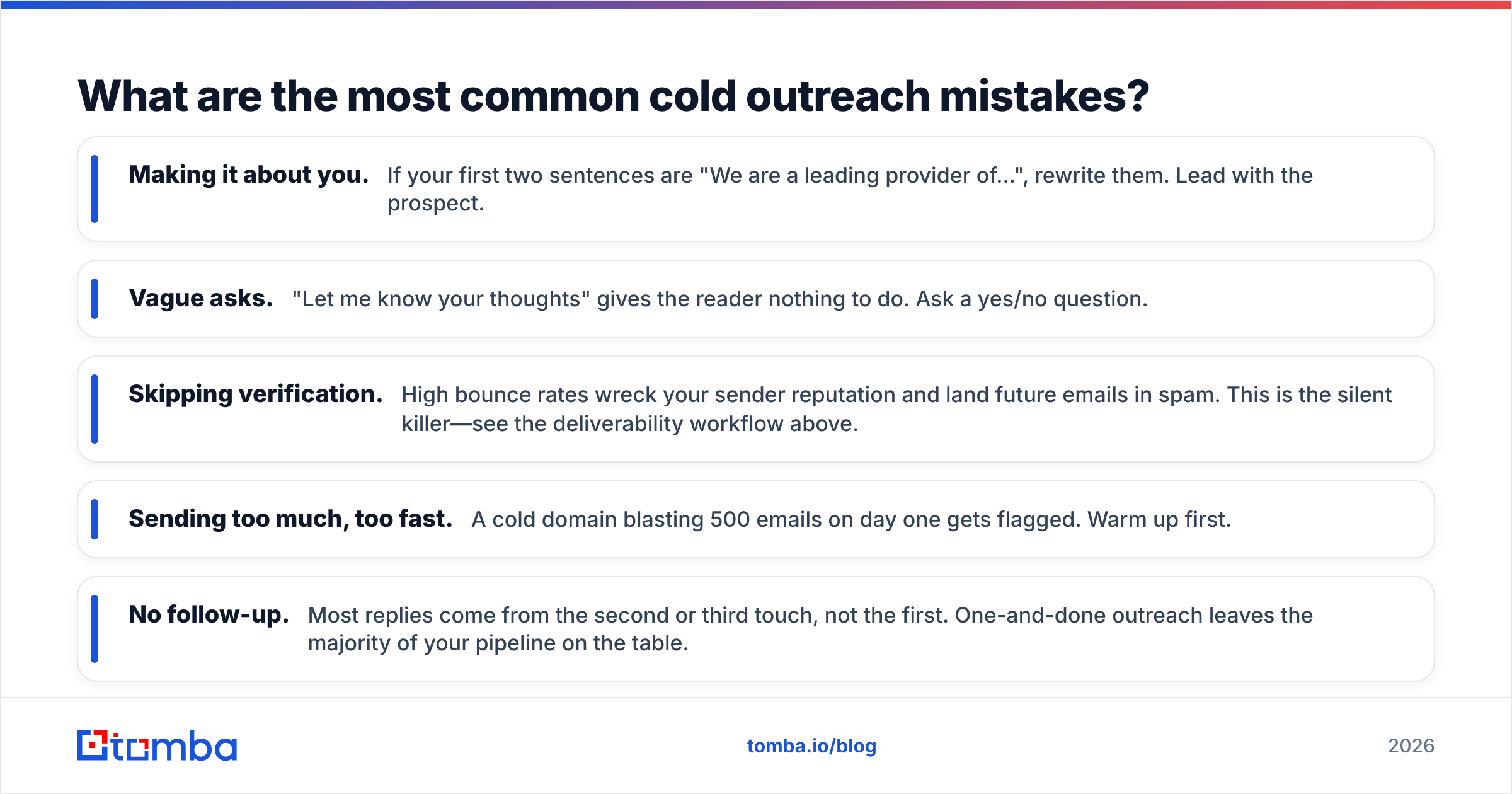
The biggest killers are all self-inflicted, and all fixable before you send a single message.
- Making it about you. If your first two sentences are "We are a leading provider of…", rewrite them. Lead with the prospect.
- Vague asks. "Let me know your thoughts" gives the reader nothing to do. Ask a yes/no question.
- Skipping verification. High bounce rates wreck your sender reputation and land future emails in spam. This is the silent killer—see the deliverability workflow above.
- Sending too much, too fast. A cold domain blasting 500 emails on day one gets flagged. Warm up first.
- No follow-up. Most replies come from the second or third touch, not the first. One-and-done outreach leaves the majority of your pipeline on the table.
Industry data backs this up: HubSpot's research on sales outreach consistently shows that persistence and personalization, not volume alone, separate top performers. Peer reviews on G2 tell the same story—teams rate data accuracy and deliverability as the features that actually move reply rates.
Which cold outreach example should you start with?#
Start with the trigger-event email (Example 1). It has the highest ceiling because relevance is baked in—but it only works if your data is right.
That's the thread running through every example here: the copy is the easy part. The reply rate is decided upstream, by whether you're emailing a real, verified person with a reason to care. Nail the targeting and the data, and even a plain-text three-line email outperforms a beautifully designed template sent to a stale, unverified list.
So before you obsess over subject lines, fix the foundation. Use the Tomba Email Finder to build a verified, enriched prospect list, warm your sending domain, then plug in the examples above segment by segment. Copy is a multiplier—but it only multiplies real, deliverable contacts. Get the data right first, and every one of these nine examples starts working harder for you. Start free with 25 searches a month, and scale to Starter at $49/mo once your reply rates prove the model.
Related guides#
Ready to find emails that actually work?
Join 150,000+ professionals who stopped guessing and started sending. Free credits on signup — no credit card required.
Get the Tomba newsletter
Practical outbound tactics and product updates — once every two weeks.
About the author