Cold Outreach Lead Generation: A 2026 Playbook That Works
Cold outreach still books meetings in 2026 — but only when targeting, verified data, and sequencing work together. Here's the full system, minus the fluff.
Cold outreach isn't dead — but the lazy version of it is. If your idea of lead generation is buying a list, blasting 5,000 identical emails, and hoping three people reply, 2026 will punish you: spam filters are stricter, buyers are more skeptical, and one bad send can torch your domain reputation for weeks.
The good news is that a disciplined cold outreach lead generation system still produces pipeline more predictably than almost any other channel. This guide walks through the whole thing — targeting, data, messaging, sequencing, and measurement — so you can build a repeatable engine instead of a one-off campaign.
TL;DR#
- Cold outreach lead generation is the process of identifying strangers who fit your ideal customer profile, reaching them with relevant messaging, and converting interest into booked meetings.
- Data quality beats volume. A 500-contact list with verified emails outperforms a 5,000-contact list with 30% bounces.
- Multichannel wins. Email + LinkedIn + phone gets 2-3x the response rate of email alone.
- Sequencing matters more than any single message. Most replies come on touches 3-7, not touch 1.
- Protect your domain. Warm up sending accounts, verify every address, and keep daily volume sane to stay out of spam.
What is cold outreach lead generation?#
Cold outreach lead generation is contacting prospects who have no prior relationship with you — no demo request, no newsletter signup, no inbound trigger — and turning a subset of them into qualified sales conversations.
Think of it like planting a garden versus foraging. Inbound marketing is foraging: you wander until something edible appears. Cold outreach is planting: you choose the plot (your ICP), prepare the soil (clean data), sow deliberately (personalized sequences), and harvest what grows (booked meetings). It's slower to feel "magical," but you control the yield.
The channel spans three motions that increasingly work together:
- Cold email — scalable, cheap, and the backbone of most outbound programs.
- LinkedIn outreach — higher trust, lower volume, great for warming a prospect before or alongside email.
- Cold calling — the highest-friction, highest-intent channel; still unmatched for booking meetings when the list is right.
The mistake most teams make is treating these as separate campaigns. In 2026 the winners run them as one coordinated sequence against the same tightly-scoped list.
Why does cold outreach still work in 2026?#
Because buyers still have problems they haven't solved, and most of them aren't actively searching for a vendor. Inbound only captures demand that already exists. Cold outreach creates demand by putting a relevant idea in front of someone who wasn't looking.
What's changed is the tolerance for spam. According to HubSpot's sales research, personalization and relevance now drive the gap between campaigns that book meetings and campaigns that get marked as spam. The tactic hasn't died — the sloppy execution has.
Here's the uncomfortable truth: the reason cold outreach "stopped working" for a lot of teams is that deliverability caught up with bad behavior. Google and Microsoft tightened bulk-sender rules, and blasting unverified lists now gets you filtered before a human ever sees the message. Fix the fundamentals and the channel works fine.
What does a cold outreach system actually look like?#
A functioning system has five layers. Skip any one and the whole thing leaks.
- Targeting — a written ideal customer profile (ICP) and buyer persona, so every contact you add earns its spot.
- Data — accurate contact details: verified work emails, direct phone numbers, LinkedIn URLs, and enrichment fields for personalization.
- Messaging — short, relevant, prospect-centered copy that leads with their problem, not your product.
- Sequencing — a multi-touch, multichannel cadence spread over 2-4 weeks.
- Measurement — reply rate, positive reply rate, and meetings booked, tracked per segment so you can iterate.
Notice that "write a clever email" is one piece of one layer. Teams obsess over subject lines while sending to a list that's 40% invalid. Reverse the priorities.
How do you build a targeted lead list?#
Start narrow. A common failure is defining your ICP as "SaaS companies" — that's a market, not a target. Tighten it to something like: "Series A-B B2B SaaS companies, 50-200 employees, using HubSpot, with a VP of Sales in seat under 12 months." Now every contact is either in or out, and your messaging can speak to a specific situation.
Once the ICP is written, sourcing contacts follows three steps:
- Find the companies that match your firmographic filters (industry, size, tech stack, funding).
- Identify the right people at those companies — the economic buyer and the champion, not just whoever's easy to find.
- Get verified contact details — this is where most lists rot. A name and a guessed email pattern isn't a lead.
For step three, a domain-first workflow is the most reliable. Run a domain search to pull every known email pattern and contact at a target company, then use an email finder to resolve specific decision-makers by name. When you need direct dials to layer in calls, a dedicated phone finder fills the gap that email-only tools leave.
Do not skip verification. Every address should pass an email verifier before it enters a sequence — this is the single highest-ROI step in the entire process, and we'll cover why in the deliverability section.
What makes cold outreach copy convert?#
Relevance, brevity, and a single clear ask. That's it. The best-performing cold emails in 2026 look almost boring: two or three sentences, one specific observation about the prospect, and a low-friction call to action.
A simple framework that holds up:
- Trigger — why you're reaching out now (they hired a VP of Sales, launched a product, raised a round).
- Problem — the specific pain that trigger usually creates.
- Proof — one sentence of relevant evidence, ideally a comparable customer.
- Ask — a small, specific next step ("worth a 15-minute look next week?").
Kill the paragraph about your company's mission. Kill the five bullet points of features. Kill "I hope this email finds you well." Every word the prospect reads should be about them until the very last line.
For subject lines, plain and curiosity-driven beats clever and salesy. "Quick question about {company}'s onboarding" outperforms "🚀 10x Your Revenue Today" every single time — and the latter gets you flagged.
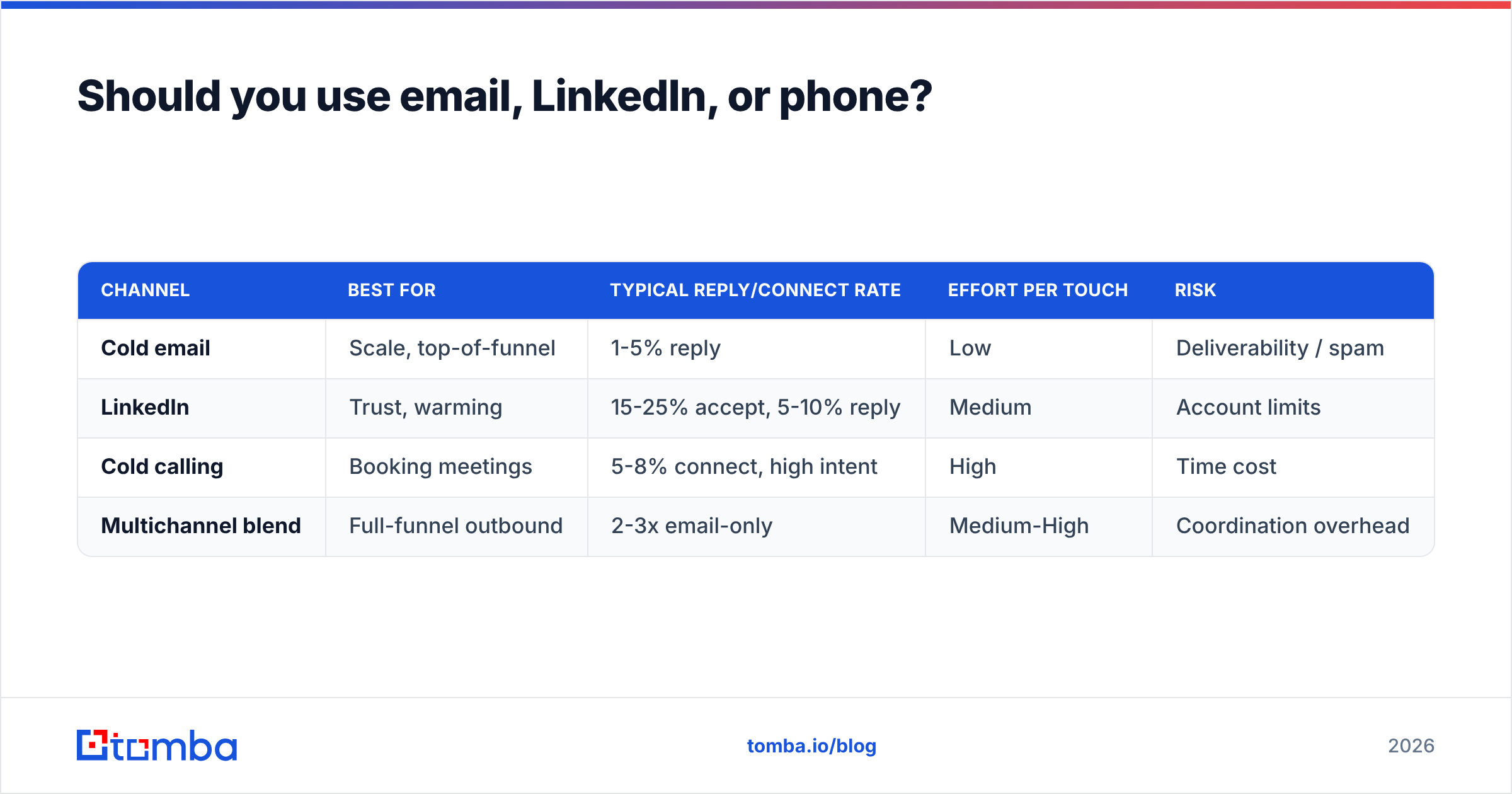
Should you use email, LinkedIn, or phone?#
All three — sequenced together. Each channel covers the others' weaknesses.
| Channel | Best for | Typical reply/connect rate | Effort per touch | Risk |
|---|---|---|---|---|
| Cold email | Scale, top-of-funnel | 1-5% reply | Low | Deliverability / spam |
| Trust, warming | 15-25% accept, 5-10% reply | Medium | Account limits | |
| Cold calling | Booking meetings | 5-8% connect, high intent | High | Time cost |
| Multichannel blend | Full-funnel outbound | 2-3x email-only | Medium-High | Coordination overhead |
The pattern that works: soft LinkedIn connect on day 1, first email day 2, LinkedIn engagement day 4, follow-up email day 6, phone call day 8, and so on. The prospect sees you in three places, which reads as a serious, credible vendor rather than one more email in a crowded inbox. If you're new to the LinkedIn side, study a repeatable LinkedIn outreach motion before you scale it, because account restrictions punish sloppy automation fast.
How many follow-ups should a sequence have?#
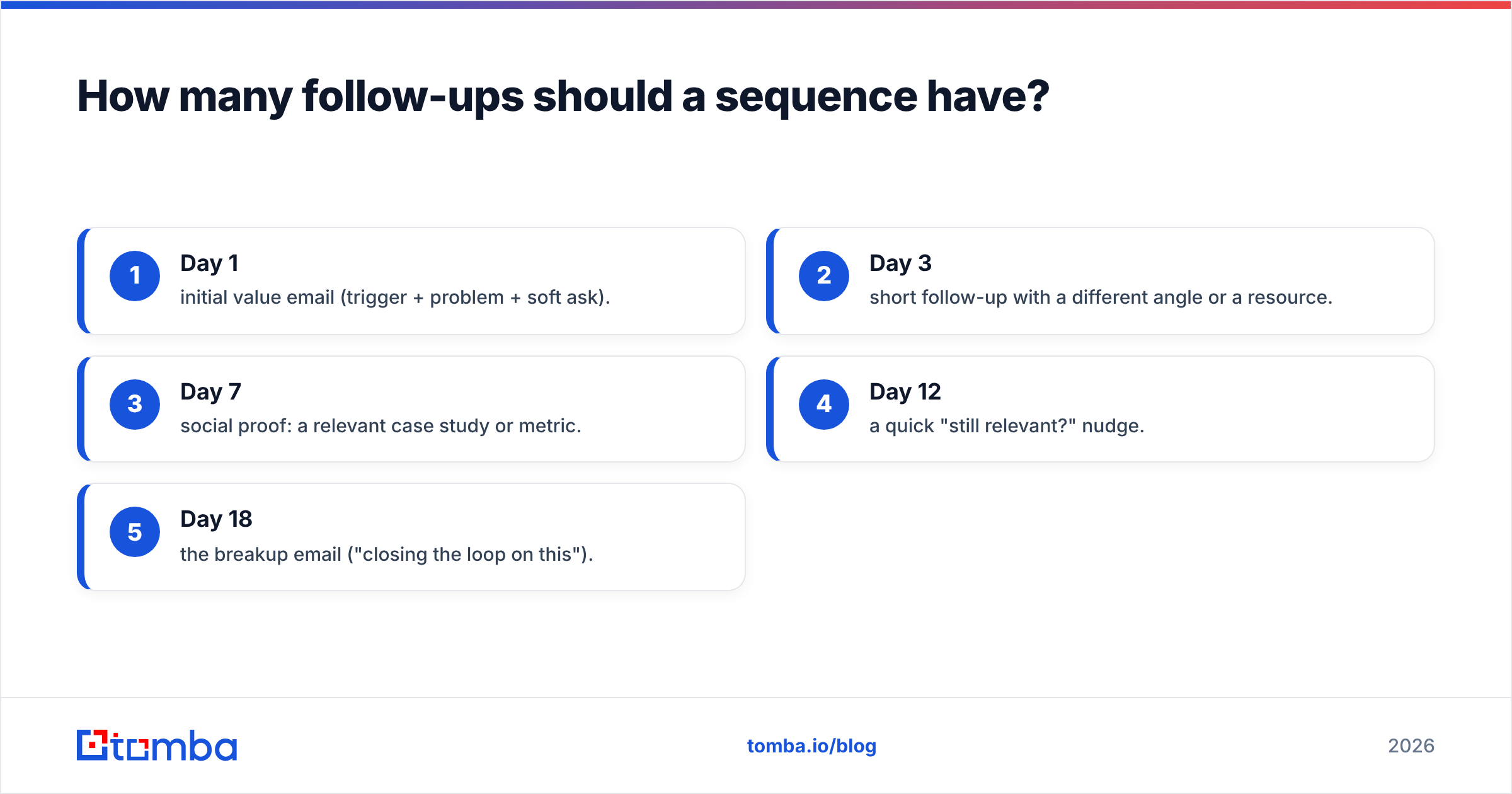
Between five and eight touches over two to four weeks. Most replies — often the majority — land on the third touch or later, yet most reps quit after one or two. Persistence, done politely, is where the pipeline hides.
A workable email cadence looks like:
- Day 1 — initial value email (trigger + problem + soft ask).
- Day 3 — short follow-up with a different angle or a resource.
- Day 7 — social proof: a relevant case study or metric.
- Day 12 — a quick "still relevant?" nudge.
- Day 18 — the breakup email ("closing the loop on this").
Rotate the angle each touch — never just "bumping this to the top of your inbox." And keep the whole thread on one clean sending domain with verified recipients, because a sequence that lands in spam on touch 1 is dead for all five.
How do you protect deliverability and sender reputation?#
This is the layer that quietly decides whether any of the above matters. You can have perfect copy and a perfect list, but if you land in spam, your reply rate is zero.
Protecting email deliverability comes down to a few non-negotiables:
- Authenticate your domain. Set up SPF, DKIM, and DMARC correctly. Google and Microsoft now require this for bulk senders.
- Warm up new sending accounts. Ramp volume gradually over 2-4 weeks before sending at scale.
- Verify every address. Bounces above ~3% signal spammy behavior to inbox providers and tank your sender reputation.
- Cap daily volume per inbox. Spread sends across multiple domains/inboxes rather than blasting from one.
- Watch catch-all domains. They accept everything and then silently bounce — verify them separately before trusting them.
Verification is worth repeating because the math is brutal. Send 1,000 emails to a list with a 30% invalid rate and you generate 300 bounces — enough to get throttled or blacklisted. Run that same list through a bulk email finder and verifier first, and you protect both your reputation and your reply rate. For catch-all-heavy industries, a dedicated catch-all verifier removes the biggest source of hidden bounces.
What tools do you need — and what should they cost?#
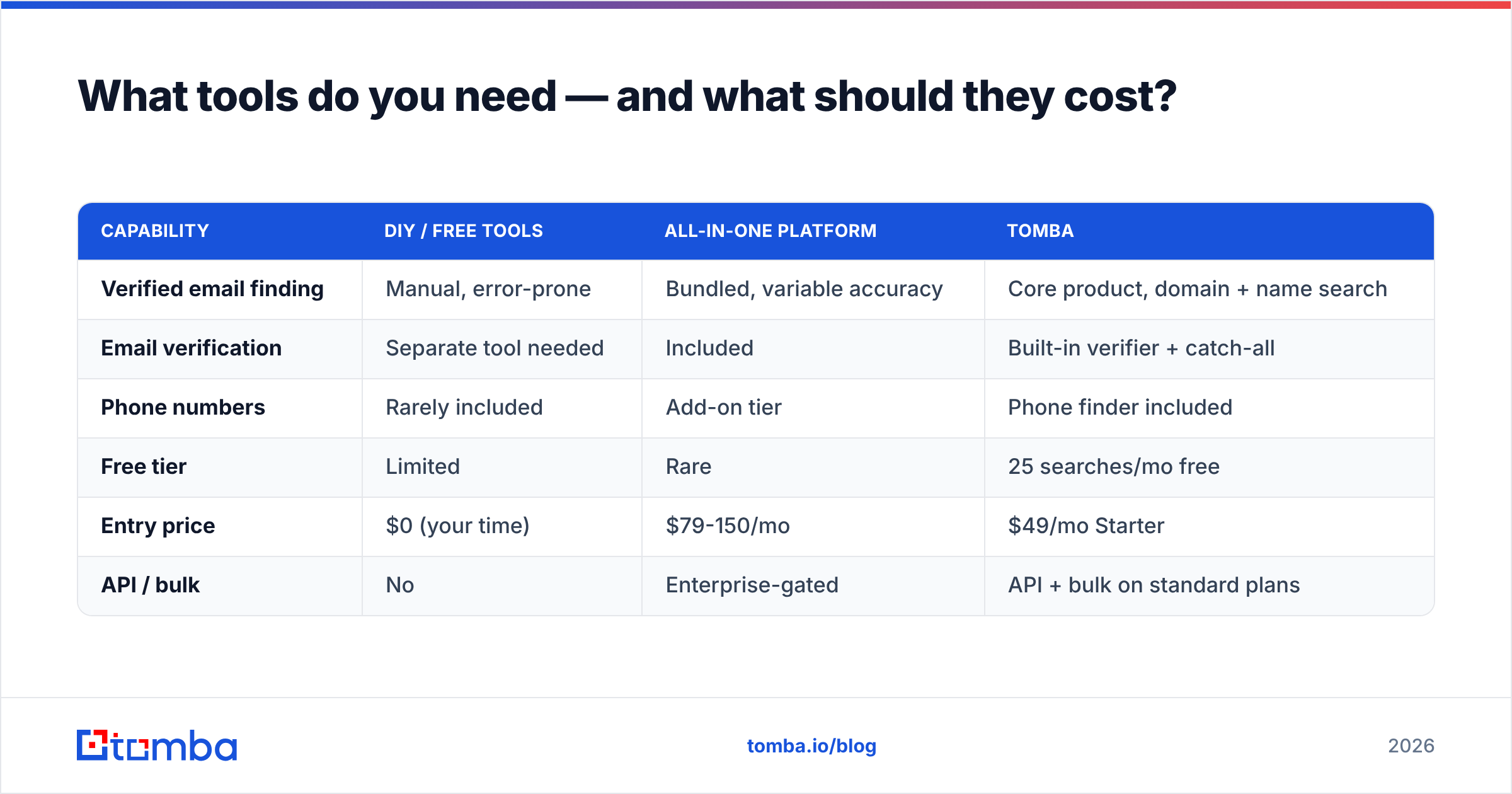
You don't need a twelve-tool stack. You need reliable data, a sequencer, and a way to verify. Here's how a lean outbound stack compares on the piece that matters most — accurate, verified contact data.
| Capability | DIY / free tools | All-in-one platform | Tomba |
|---|---|---|---|
| Verified email finding | Manual, error-prone | Bundled, variable accuracy | Core product, domain + name search |
| Email verification | Separate tool needed | Included | Built-in verifier + catch-all |
| Phone numbers | Rarely included | Add-on tier | Phone finder included |
| Free tier | Limited | Rare | 25 searches/mo free |
| Entry price | $0 (your time) | $79-150/mo | $49/mo Starter |
| API / bulk | No | Enterprise-gated | API + bulk on standard plans |
The point isn't that you need the most expensive platform — it's that the data layer is the one place you shouldn't cheap out. A list with a 5% bounce rate versus 30% is the difference between a working channel and a burned domain. You can compare vendors independently on G2 before committing, but weigh accuracy and verification depth over raw credit counts.
Tomba's own pricing runs from a free tier (25 searches/mo) through Starter at $49/mo, Growth at $99/mo, and Pro at $249/mo — full Tomba pricing is on the site if you want to map it to your send volume.
How do you measure whether it's working?#
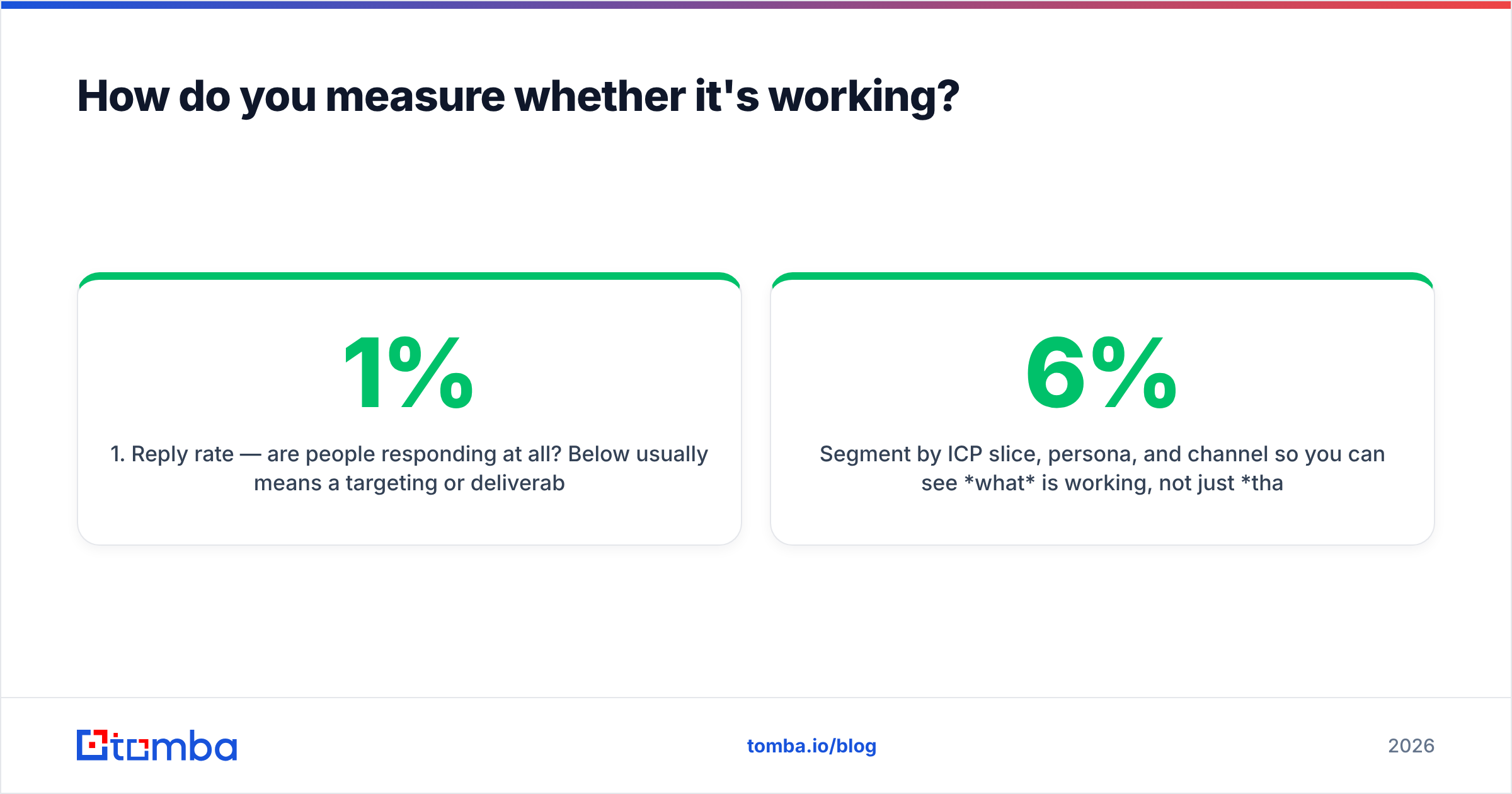
Track three numbers per segment, not just aggregate opens:
- Reply rate — are people responding at all? Below 1% usually means a targeting or deliverability problem, not a copy problem.
- Positive reply rate — of those replies, how many are interested? This isolates message-market fit.
- Meetings booked — the only metric that pays rent.
Segment by ICP slice, persona, and channel so you can see what is working, not just that something is. If your VP-of-Sales segment replies at 6% and your CFO segment at 0.5%, that's a signal to either fix the CFO messaging or cut that segment entirely. As Salesforce notes in its State of Sales research, the teams that consistently hit quota are the ones treating outbound as a measured system, not a volume gamble.
Open rate is increasingly unreliable thanks to privacy features that auto-load images, so anchor on replies and meetings. Vanity metrics feel good and predict nothing.
Common mistakes that kill cold outreach#
- Buying unverified lists. The fastest way to burn a domain. Verify or don't send.
- Sending from your primary domain. Use dedicated sending domains so a mistake doesn't hurt your main email.
- One-and-done outreach. Quitting after one touch leaves the majority of your pipeline on the table.
- Product-first copy. Nobody cares about your features in email one. Lead with their problem.
- Ignoring the ICP. A broad list is a weak list. Narrow until every contact clearly fits.
- Automating LinkedIn recklessly. Aggressive automation gets accounts restricted; keep it human-paced.
Avoid these six and you're already ahead of most outbound teams — not because they're secrets, but because discipline is rarer than knowledge.
Start with data you can trust#
Cold outreach lead generation in 2026 is a system, not a hack. Targeting narrows your list, verified data protects your reputation, multichannel sequencing earns the reply, and measurement tells you what to double down on. Every layer depends on the one beneath it — and all of them depend on accurate contact data at the base.
That's where to start. Before you write a single subject line, make sure the addresses you're sending to are real. Use the Tomba Email Finder to source and verify decision-maker emails by domain, name, or company — start on the free tier, confirm your list is clean, and let the rest of the system compound from a foundation that actually delivers. Build on verified data, and cold outreach stops being a gamble and starts being pipeline.
Related guides#
Ready to find emails that actually work?
Join 150,000+ professionals who stopped guessing and started sending. Free credits on signup — no credit card required.
Get the Tomba newsletter
Practical outbound tactics and product updates — once every two weeks.
About the author