How to Write a Cold Outreach Message That Gets Replies
Most cold outreach messages get ignored because they lead with the sender, not the prospect. Here's how to flip that structure and actually earn replies in 2026.
Most cold outreach fails for one boring reason: the message is about the sender, not the reader. You open with your company, your product, your "quick question," and the prospect deletes it before the second line. A cold outreach message that works flips that order — it earns attention in the first sentence, proves relevance in the second, and asks for something small in the third.
This guide breaks down exactly how to structure that message across email, LinkedIn, and phone, with templates you can steal and a checklist to pressure-test every send.
TL;DR#
- A cold outreach message has one job: earn a reply, not close a deal. Optimize the first two lines, not the pitch.
- Relevance beats personalization tokens. A
{{first_name}}merge tag is not research — tie your message to something the prospect actually cares about. - Keep it under 120 words. Short, specific, and one clear call to action outperforms the long "value-stacked" email every time.
- Deliverability is half the battle. The best-written message never gets read if it lands in spam or hits a dead inbox.
- Verified contact data is the multiplier. Accurate emails and phone numbers turn a good message into booked meetings — start with the email finder and verify before you send.
What is a cold outreach message?#
A cold outreach message is the first contact you make with a prospect who has no prior relationship with you or your company. Think of it like knocking on a stranger's door: you have about three seconds before they decide whether to keep listening or shut it. Everything you say has to justify the interruption.
Technically, it spans channels — cold email, LinkedIn connection notes and DMs, cold calls, and even SMS. The medium changes the length and tone, but the underlying job stays identical: be relevant fast, be brief, and make the next step easy.
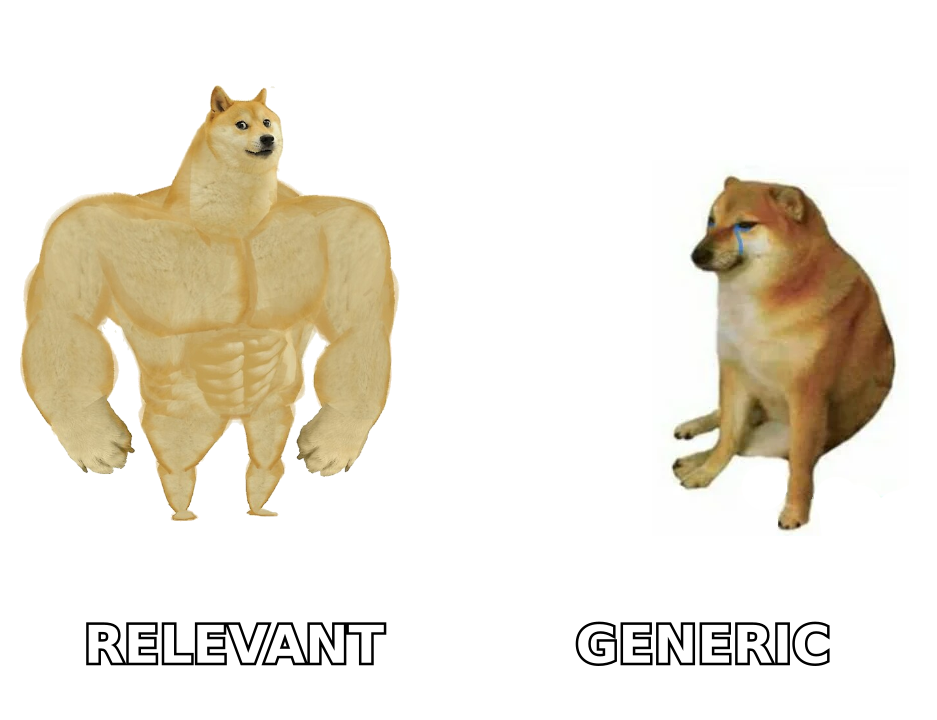
The mistake most reps make is treating "cold" as an excuse to be generic. Cold does not mean impersonal. It means the prospect hasn't opted in yet — which raises the bar for how sharp your relevance has to be, not lowers it.
Why do most cold outreach messages get ignored?#
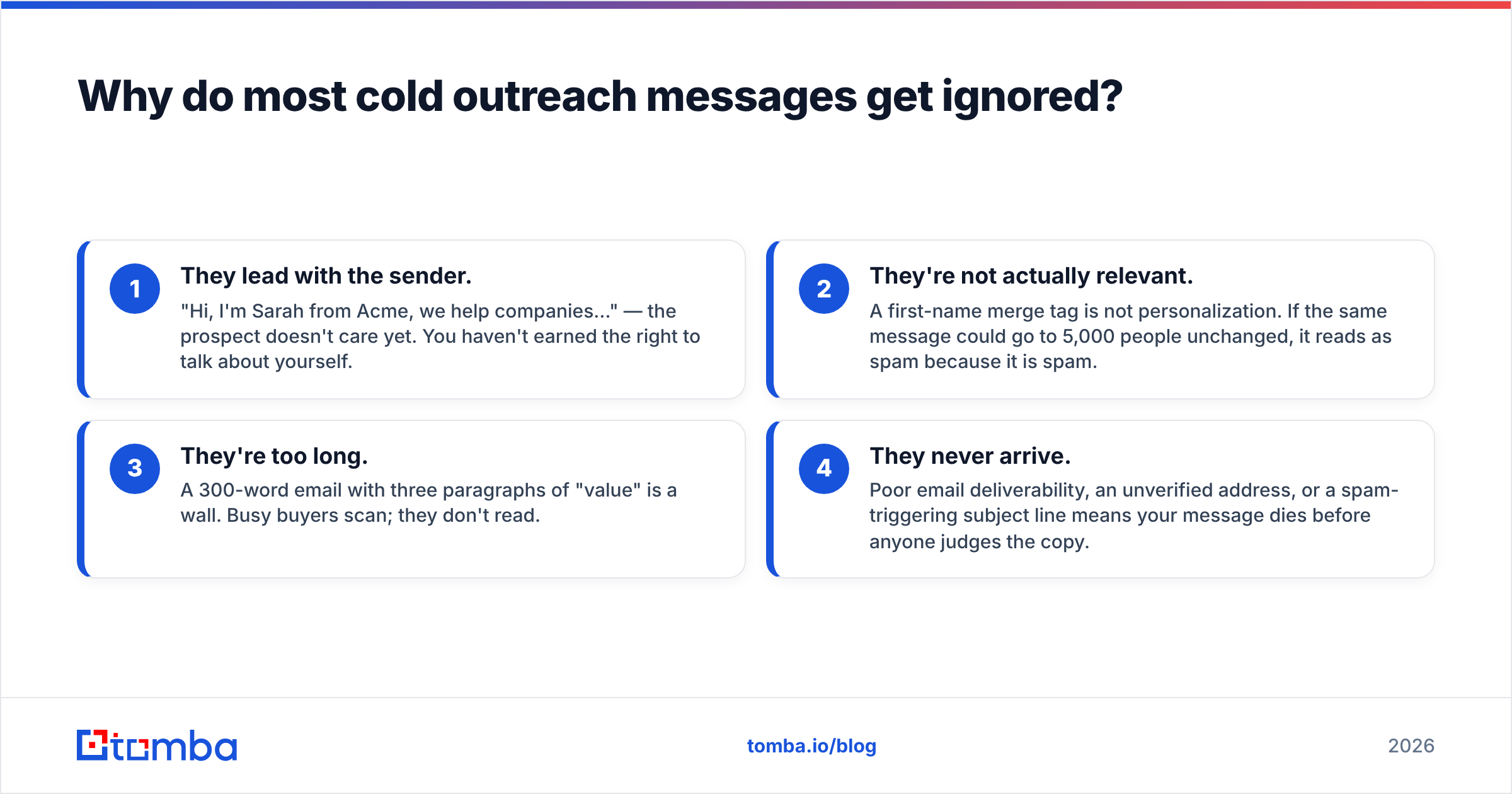
Because they break at least one of four rules. Here are the failure modes, ranked by how often they kill a reply:
- They lead with the sender. "Hi, I'm Sarah from Acme, we help companies…" — the prospect doesn't care yet. You haven't earned the right to talk about yourself.
- They're not actually relevant. A first-name merge tag is not personalization. If the same message could go to 5,000 people unchanged, it reads as spam because it is spam.
- They're too long. A 300-word email with three paragraphs of "value" is a wall. Busy buyers scan; they don't read.
- They never arrive. Poor email deliverability, an unverified address, or a spam-triggering subject line means your message dies before anyone judges the copy.
That last one is invisible and lethal. You can write the best cold outreach message of your career, but if it bounces off a catch-all domain or lands in the promotions tab, your response rate is zero. This is why serious outbound teams verify contacts before sending — a dead address burns your sender reputation and your time.
What makes a cold outreach message actually work?#
Four elements, in this order: a relevant hook, a credible reason, a specific value line, and a low-friction ask.
Here's the anatomy on a single email:
Subject: quick idea for [specific problem]
Hi [Name],
Saw [specific trigger — new role, funding round, product launch, LinkedIn post]. Usually when [company type] hits that stage, [specific pain] becomes a bottleneck.
We helped [similar company] cut [metric] by [number] in [timeframe]. Happy to share how in a 10-minute call — worth a look?
[Your name]
Notice what's missing: no company boilerplate, no feature list, no "I'd love to hop on a call to explore synergies." Every sentence does one job. The whole thing is under 70 words.
The single biggest lever is the trigger. A trigger is a real, recent, specific event that makes your outreach timely — a hiring spree, a funding announcement, a tech-stack change, a competitor mention. Triggers turn "cold" into "warm-ish" because the prospect thinks: how did they know that's exactly what I'm dealing with right now?
How do the channels compare?#
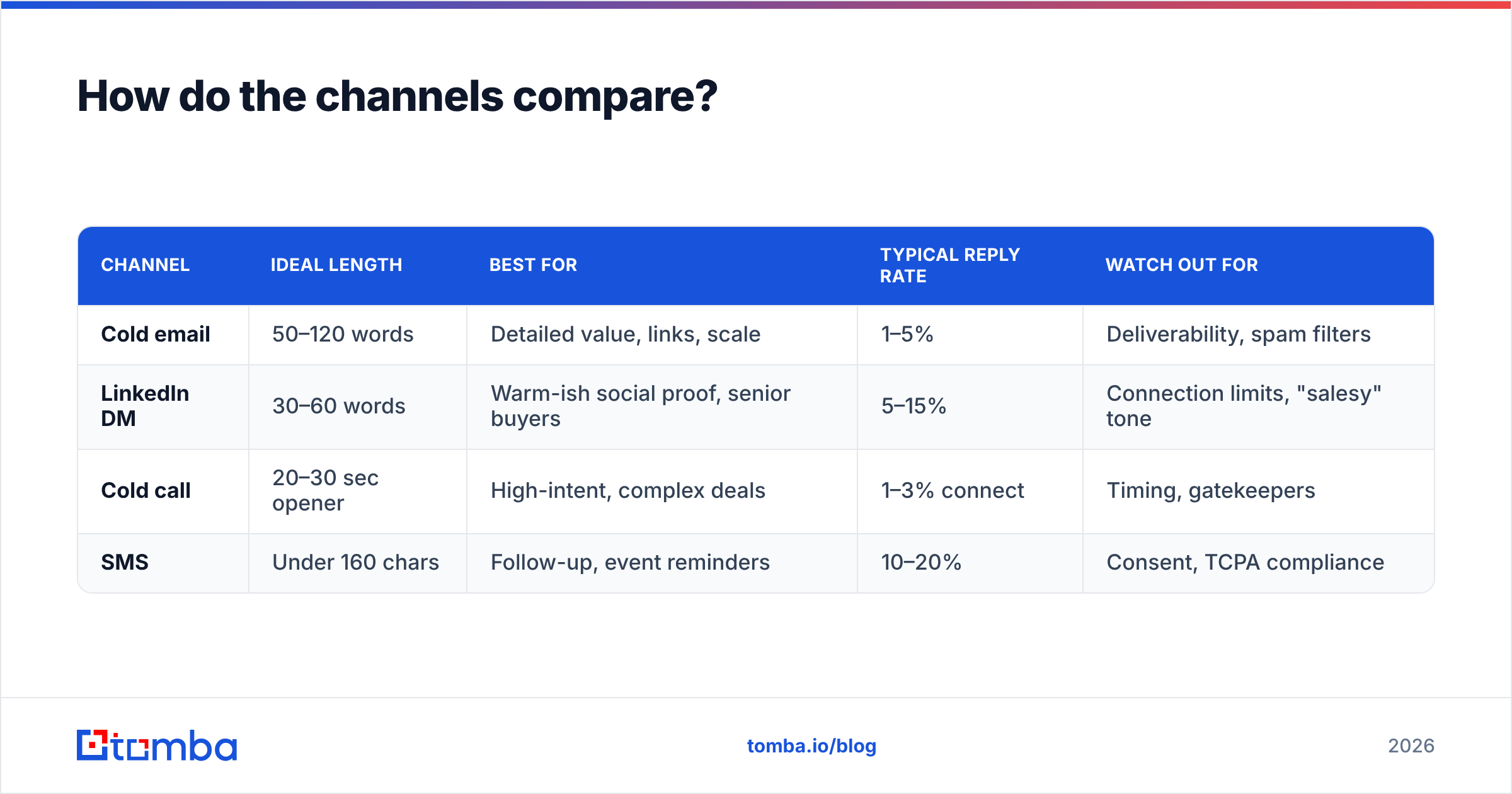
Different channels carry different expectations for length, tone, and response speed. Here's how to match your message to the medium:
| Channel | Ideal length | Best for | Typical reply rate | Watch out for |
|---|---|---|---|---|
| Cold email | 50–120 words | Detailed value, links, scale | 1–5% | Deliverability, spam filters |
| LinkedIn DM | 30–60 words | Warm-ish social proof, senior buyers | 5–15% | Connection limits, "salesy" tone |
| Cold call | 20–30 sec opener | High-intent, complex deals | 1–3% connect | Timing, gatekeepers |
| SMS | Under 160 chars | Follow-up, event reminders | 10–20% | Consent, TCPA compliance |
The winning play in 2026 isn't picking one channel — it's sequencing them. A LinkedIn view, then an email referencing something specific, then a call two days later, all tied to the same relevance thread. Each touch reinforces the last instead of repeating it.
What does a good cold outreach message look like across channels?#
Cold email (problem-first):
Subject: [Competitor] switch at [Company]?
Hi Jordan — noticed [Company] is scaling the SDR team fast. The usual side effect is reps burning hours on manual contact research instead of selling.
We cut that research time ~60% for [similar company]. Want the 2-line breakdown?
LinkedIn connection note:
Hi Jordan — following [Company]'s expansion into EMEA. I work with RevOps leaders on outbound data quality and had a specific idea for your team's ramp. Open to connecting?
Cold call opener:
"Hi Jordan, this is Sam — I know I'm an interruption. I'll be quick. I called because [Company] just doubled the SDR team, and I have one specific idea about keeping their pipeline clean. Worth 30 seconds?"
Each version carries the same relevance thread — the SDR expansion — adapted to the channel's norms. That consistency is what separates a real sequence from three disconnected spam messages.
How long should a cold outreach message be?#
Shorter than you think. For cold email, aim for 50 to 120 words. For LinkedIn, 30 to 60. The goal of the first message is a reply, not a decision, so you only need enough to earn the next 30 seconds of attention.
A useful test: read your draft and delete every sentence that doesn't either (a) prove relevance or (b) make the ask easier. What's left is usually half the length and twice as effective. If you're staring at a long draft, run it through a subject line tester and trim the body until a stranger could grasp the point in one scan.
How do you personalize at scale without sounding like a robot?#
Separate personalization from relevance. Personalization is surface-level (name, company, title). Relevance is why-now (trigger events, shared context, specific pain). You can automate the first; you have to research the second — but you can research it efficiently.
The workflow that scales:
- Build a tight list. Narrow ICP beats broad reach. 200 well-matched prospects convert better than 2,000 random ones.
- Enrich each contact. Pull role, company data, and recent signals so you have raw material for a relevant hook. Data enrichment turns a bare email into a full profile.
- Group by trigger, not by name. Write one strong template per trigger type (new funding, new hire, tech change), then slot in the specifics. This is how you personalize 500 messages in an afternoon without writing 500 from scratch.
- Verify before you send. Run the list through an email verifier so you're not torching deliverability on invalid addresses.
This "template per trigger" approach is the honest middle ground between fully manual (too slow) and fully automated merge-tag spam (too obvious). For a deeper library of starting points, Tomba's cold email templates give you structures to adapt per trigger.
What are the biggest cold outreach mistakes to avoid?#
- Pitching in message one. Your first message sells the reply, not the product. Save the demo pitch for after they raise their hand.
- Fake personalization. "I loved your recent post!" with no specifics is worse than no compliment — it signals automation.
- Multiple CTAs. "Book a call, or check our site, or reply, or…" Confusion kills action. One ask.
- Ignoring follow-up. Most replies come from touches 2–4. A single message is a coin flip you'll lose. Plan a 4–6 touch sequence.
- Skipping data hygiene. Sending to unverified, stale, or catch-all addresses tanks your sender reputation and hides your good messages in spam.
On the mistakes to avoid, external research backs this up: HubSpot's sales data consistently shows that concise, relevant, well-timed follow-up drives the majority of booked meetings, and that buyers rank relevance far above polish. Vendor benchmarks on G2 tell the same story across outreach categories — reply rates track relevance and deliverability, not word count or clever copy.
How do you follow up without being annoying?#
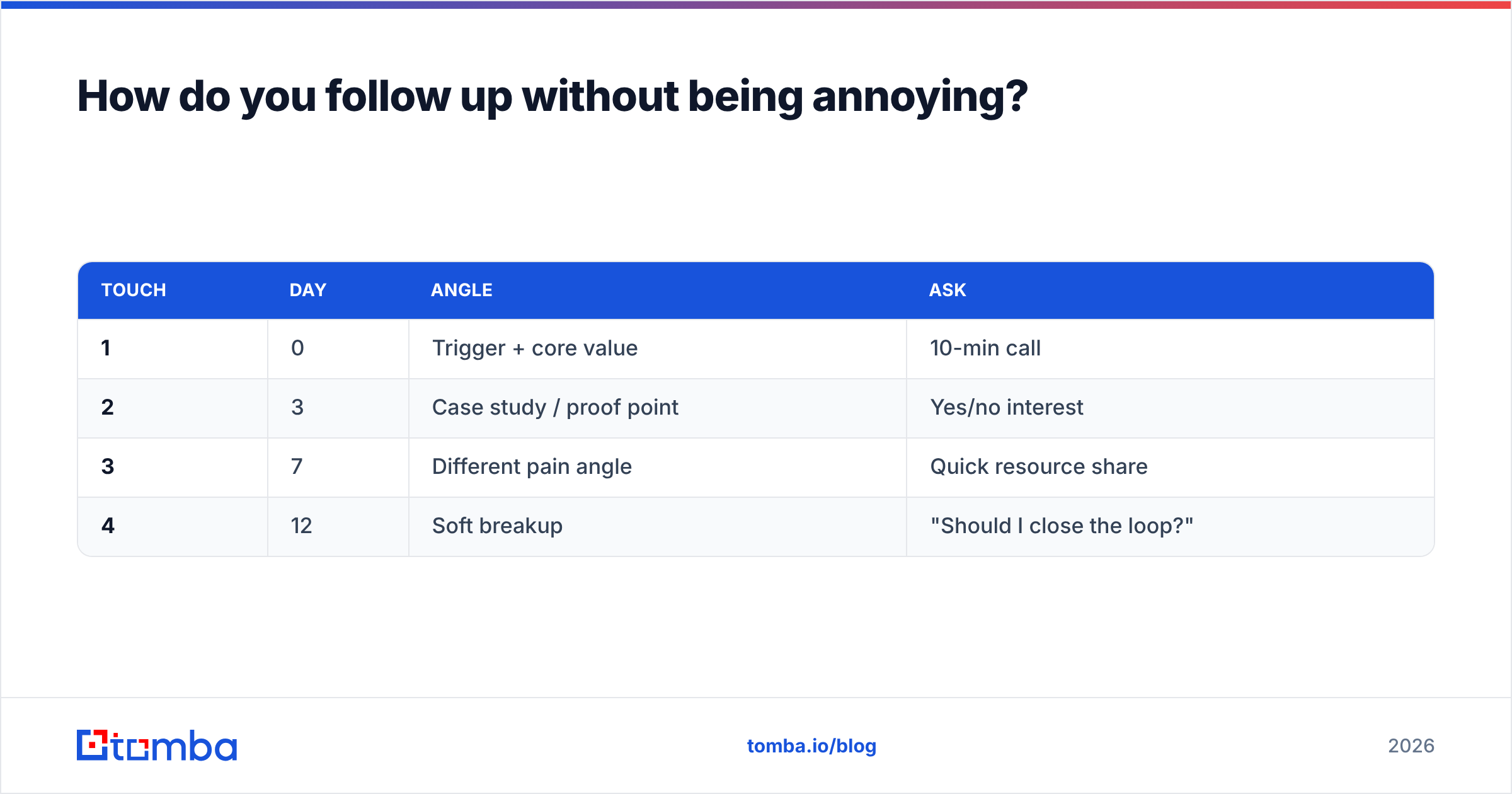
Follow up on new value, not on guilt. "Just bumping this to the top of your inbox" adds nothing. Instead, each follow-up should carry a fresh angle: a new data point, a relevant case study, a different pain, or a genuinely lighter ask.
A simple, effective cadence:
| Touch | Day | Angle | Ask |
|---|---|---|---|
| 1 | 0 | Trigger + core value | 10-min call |
| 2 | 3 | Case study / proof point | Yes/no interest |
| 3 | 7 | Different pain angle | Quick resource share |
| 4 | 12 | Soft breakup | "Should I close the loop?" |
The breakup message is quietly the highest-converting touch in most sequences. "I'll assume the timing isn't right and stop reaching out — just reply if that changes" often pulls a reply precisely because it removes the pressure and signals you respect their time.
Which tools help you send better cold outreach messages?#
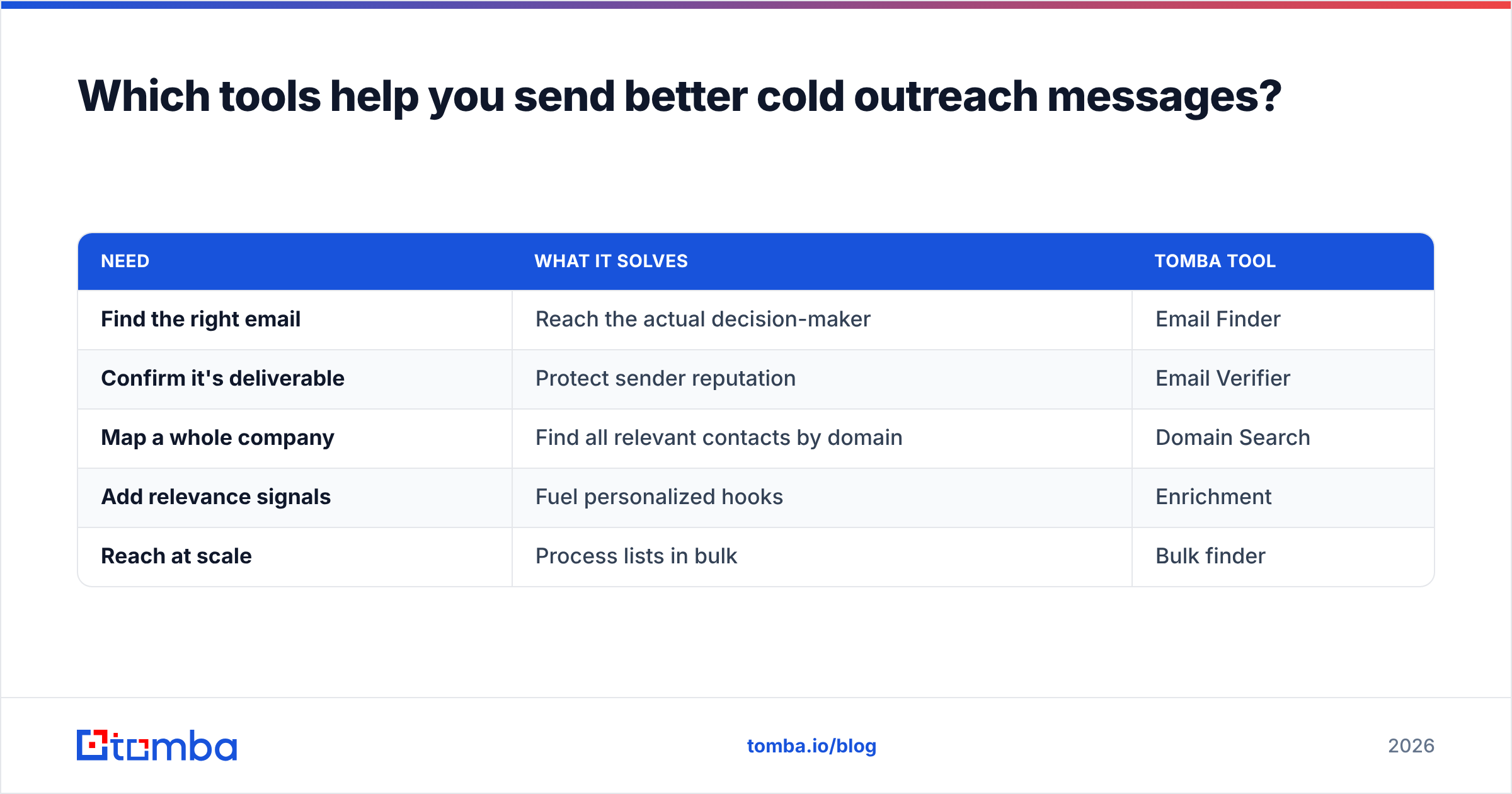
The message is the art; the data and deliverability are the science. You need three things working together: accurate contact data, verified deliverability, and enrichment for relevance. Here's how the pieces map to the job:
| Need | What it solves | Tomba tool |
|---|---|---|
| Find the right email | Reach the actual decision-maker | Email Finder |
| Confirm it's deliverable | Protect sender reputation | Email Verifier |
| Map a whole company | Find all relevant contacts by domain | Domain Search |
| Add relevance signals | Fuel personalized hooks | Enrichment |
| Reach at scale | Process lists in bulk | Bulk finder |
No tool writes relevance for you — that's still your job. But the best copy in the world can't survive a bounced send or a wrong contact. Get the data layer right and every message you write gets a fair hearing.
Cold outreach message checklist#
Before you hit send, run this five-point check:
- Relevance: Would this message make sense sent to only this person? If it could go to 1,000 people unchanged, rewrite it.
- Length: Under 120 words for email, under 60 for LinkedIn? Cut until it is.
- One CTA: Exactly one clear, low-friction ask?
- Deliverability: Address verified, subject line non-spammy, no risky attachments or link dumps?
- Follow-up planned: Do you have touches 2–4 ready with fresh angles?
If you can check all five, you're ahead of roughly 95% of the cold outreach hitting your prospects' inboxes.
Start with data that actually reaches the inbox#
A great cold outreach message is worthless if it lands on a wrong or dead address. Before you obsess over copy, fix the foundation: find the right person and confirm the email is real. Tomba's Email Finder locates verified professional emails by name, company, or domain — with a free tier of 25 searches to test it, then paid Tomba plans from $49/mo when you scale. Pair it with the verifier, write messages that earn the reply, and let clean data do the quiet work of getting you read.
Related guides#
Ready to find emails that actually work?
Join 150,000+ professionals who stopped guessing and started sending. Free credits on signup — no credit card required.
Get the Tomba newsletter
Practical outbound tactics and product updates — once every two weeks.
About the author