How to Improve Your Cold Outreach Response Rate in 2026
A weak cold outreach response rate is rarely a copy problem. See the real benchmarks, the biggest reply-killers, and a step-by-step fix to lift replies in 2026.
Your cold outreach response rate is the clearest scoreboard in outbound sales. It tells you, in one number, whether the right people are getting a relevant message in a deliverable inbox. When it drops, most teams rewrite the email. That's usually the wrong lever.
This guide breaks down what a healthy reply rate looks like in 2026, the four things that quietly destroy it, and a repeatable process to fix it — starting with the part almost nobody audits: the list itself.
TL;DR#
- A "good" cold outreach response rate is 5–15% for a targeted B2B campaign; anything under 3% signals a data, targeting, or deliverability problem — not a copy problem.
- Bad contact data is the #1 killer. Bounces wreck sender reputation, which caps every future send. Verify before you send.
- Targeting beats wording. A mediocre email to the right 200 people outperforms a brilliant email to the wrong 2,000.
- Deliverability is invisible but decisive — warmup, SPF/DKIM, and volume pacing decide whether your message is even seen.
- Measure reply rate, positive reply rate, and bounce rate separately. A single blended "response" number hides the real issue.
What counts as a good cold outreach response rate?#
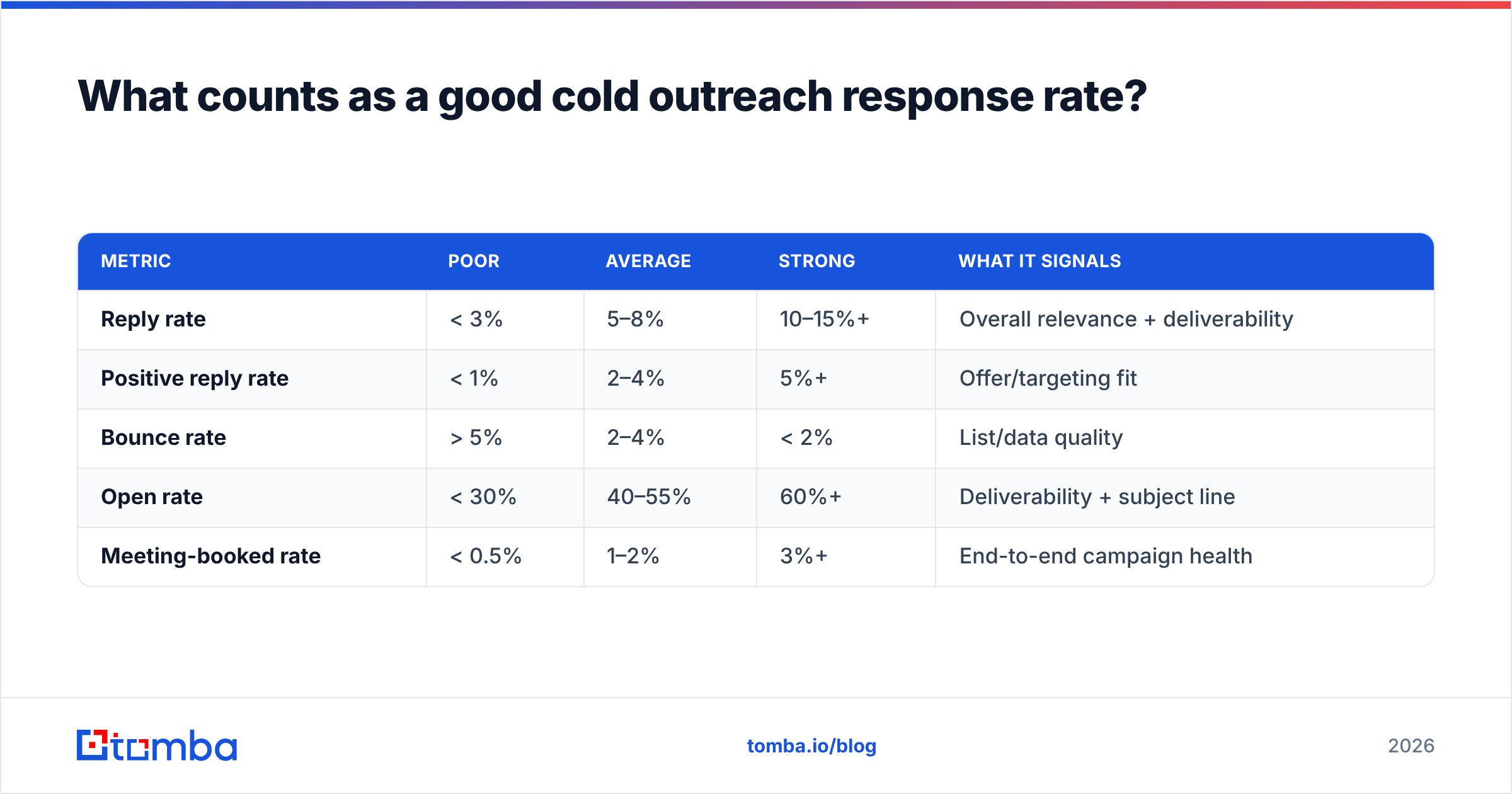
A strong targeted B2B campaign lands between 5% and 15% replies; broad, unsegmented blasts often sit at 1–3%. The honest answer is that "good" depends on list quality, seniority of the target, and offer relevance — but the ranges below are what most outbound teams see in practice.
| Metric | Poor | Average | Strong | What it signals |
|---|---|---|---|---|
| Reply rate | < 3% | 5–8% | 10–15%+ | Overall relevance + deliverability |
| Positive reply rate | < 1% | 2–4% | 5%+ | Offer/targeting fit |
| Bounce rate | > 5% | 2–4% | < 2% | List/data quality |
| Open rate | < 30% | 40–55% | 60%+ | Deliverability + subject line |
| Meeting-booked rate | < 0.5% | 1–2% | 3%+ | End-to-end campaign health |
Two caveats. First, open rate is increasingly unreliable thanks to privacy features that pre-load images, so treat it as a rough directional signal, not truth. Second, benchmarks vary by industry — HubSpot's sales statistics are a useful sanity check, but your own baseline from the last 90 days matters more than any published average.
The point of benchmarking isn't to hit a magic number. It's to know whether your problem is reach (nobody's seeing it), relevance (they see it and don't care), or data (it never arrived).
Why is your cold outreach response rate so low?#
Four issues account for the overwhelming majority of weak campaigns. Work through them in this order, because each one caps the ones below it.
- Bad data. Invalid addresses bounce, and bounces destroy sender reputation. A 12% bounce rate doesn't just waste 12% of your list — it drags deliverability down for the other 88%. This is the single highest-leverage fix and the most ignored.
- Wrong targeting. If your list is full of people who can't buy or don't have the problem you solve, no subject line saves you. Persona and trigger relevance dwarf wording.
- Deliverability failures. Missing SPF/DKIM records, a cold domain sending 500 emails on day one, or spammy formatting route you straight to spam. The prospect never sees the email, so the reply rate is structurally zero.
- Weak, generic copy. This matters — but it's fourth, not first. A tight message can't rescue a campaign that fails the three checks above.
Notice the pattern: three of the four biggest reply-killers have nothing to do with what you wrote. They're about who you reached and whether it arrived. That's why teams that only A/B test copy plateau — they're optimizing the smallest variable.
How does data quality affect reply rates?#
Every invalid email you send makes your next valid email less likely to land. Mailbox providers watch your bounce and complaint rates as trust signals. Cross a threshold and even your perfectly-crafted messages to real prospects start hitting spam or getting throttled.
The fix is boring and effective: clean your list before every campaign.
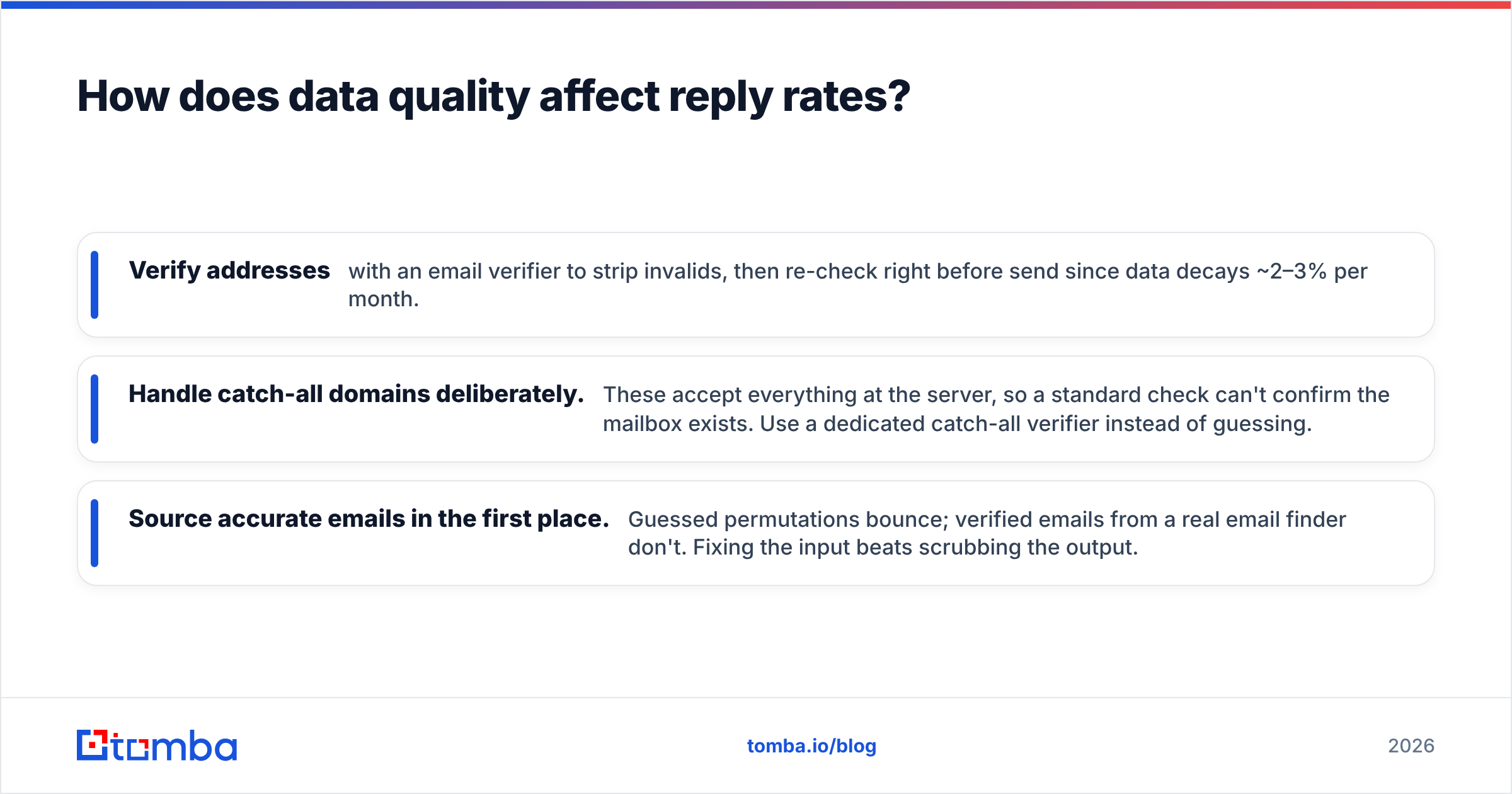
- Verify addresses with an email verifier to strip invalids, then re-check right before send since data decays ~2–3% per month.
- Handle catch-all domains deliberately. These accept everything at the server, so a standard check can't confirm the mailbox exists. Use a dedicated catch-all verifier instead of guessing.
- Source accurate emails in the first place. Guessed permutations bounce; verified emails from a real email finder don't. Fixing the input beats scrubbing the output.
A practical target: keep bounce rate under 2% and you protect the reputation that everything else depends on. Skip verification and you're effectively lighting your domain on fire one campaign at a time.
Does targeting matter more than the message?#
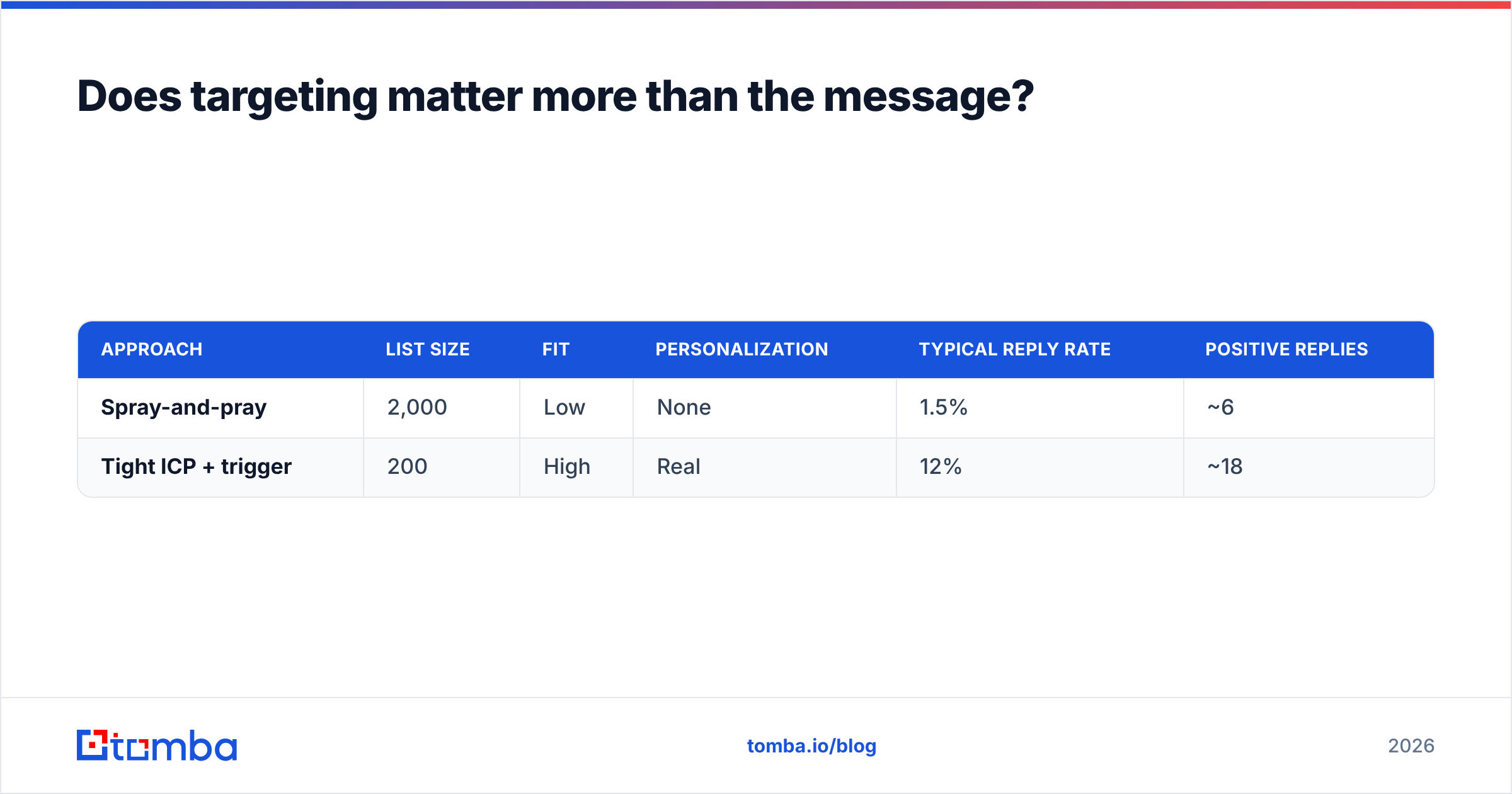
Yes — targeting is the highest-ROI variable after data quality. The reason is simple math: relevance scales the response of your entire list, while a better sentence only helps at the margin.
Compare two approaches to the same 2,000-contact budget:
| Approach | List size | Fit | Personalization | Typical reply rate | Positive replies |
|---|---|---|---|---|---|
| Spray-and-pray | 2,000 | Low | None | 1.5% | ~6 |
| Tight ICP + trigger | 200 | High | Real | 12% | ~18 |
The smaller, sharper campaign produces three times the positive replies with one-tenth the sends — and it protects deliverability because engaged recipients reply, star, and don't mark spam. Narrow your ideal customer profile, attach a real trigger (funding, hiring, a tech-stack change, a role switch), and personalize the first line around that trigger. That's what separates a 12% campaign from a 2% one.
What actually lifts a cold outreach response rate?#
Fix the pipeline in order — data, deliverability, targeting, then copy — and measure each layer separately. Here's the sequence that works.
1. Clean and verify the list. Non-negotiable first step. Aim for < 2% bounce. If you're pulling contacts at scale, run them through bulk verify before they ever touch your sending tool.
2. Warm the sending domain and set authentication. New or dormant domains need a ramp — start low and increase volume gradually. A warmup calculator gives you a realistic schedule instead of a guess. Confirm SPF, DKIM, and DMARC are all passing; these are the difference between the inbox and the spam folder. If you send from the US, stay compliant with the CAN-SPAM Act — a real unsubscribe path and a physical address are table stakes.
3. Segment tightly and personalize on a trigger. One clear reason you're reaching out now, tied to something specific about them. Not "I saw your company is growing" — an actual event.
4. Write for a reply, not a read. Short (under 90 words), one ask, a low-friction question. End with a question that's easy to answer in one line. Test subject lines with a subject line generator, but remember subject lines move opens, not replies.
5. Follow up 3–4 times. Most replies come from follow-ups, not the first touch. Space them a few days apart and add a new angle each time rather than "just bumping this."
6. Measure the three numbers. Reply rate, positive reply rate, and bounce rate — tracked per campaign. A blended metric hides whether you have a data problem or a message problem.
How should you measure and improve over time?#
Track a small, honest set of metrics per campaign and change one variable at a time. Improvement is a loop, not a launch.
- Bounce rate first. If it's above 2%, stop optimizing copy and fix your data. Everything downstream is contaminated until this is clean.
- Positive reply rate is your north star. Total replies include "not interested" and "remove me." Positive replies — genuine interest — tell you if targeting and offer actually fit.
- Isolate variables. Change subject line or first line or the segment, not all three. Otherwise you can't attribute the lift.
- Watch reply rate by segment. Often one persona carries the whole campaign. Double down on it and cut the dead segments.
Set a 90-day baseline from your own data using tools like G2's software reviews to benchmark platforms if you're evaluating your stack. Then move one number at a time. Teams that treat outreach as a measured system — rather than a creative writing exercise — compound their results quarter over quarter.
Cold outreach response rate: the honest summary#
Your reply rate is a diagnostic, not a vanity stat. When it's low, resist the urge to rewrite the email first. Audit in this order: Is the data verified? Is the domain warm and authenticated? Is the list actually your ICP with a real trigger? Then sharpen the copy.
Do that, and 5–15% is realistic — not because you found a clever hook, but because the right message reached the right person in a real inbox. Most teams never get past step one, which is exactly why the teams that do stand out.
The fastest lever you control today is the quality of your contact data. Start there.
Ready to fix the root cause? Bad emails bounce, bounces kill your reputation, and a wrecked reputation caps every campaign you'll ever run. Use the Tomba Email Finder to source verified, deliverable professional emails by name, domain, or company — so your outreach lands in inboxes and your response rate reflects your message, not your list. Try it free (25 searches/month), or see Tomba pricing for higher-volume plans starting at $49/mo.
Related guides#
// get started
Find, verify and enrich your first contacts today
Start on the free plan with 25 searches a month, then scale when your team is ready.
Free plan · No credit card required · GDPR & CCPA
// about the author