How to Build a Cold Outreach Sequence That Books Meetings
A single cold email almost never lands a reply. Here's how to build a multi-touch cold outreach sequence — timing, channels, and copy — that turns cold contacts into booked meetings in 2026.
Most reps send one cold email, hear nothing back, and quietly conclude that cold outreach is dead. It isn't. What's dead is the single-touch email blast. A cold outreach sequence — a planned series of messages across email, phone, and social, spaced over days — is what actually turns a cold list into a full calendar.
This guide breaks down how to build one from scratch: how many touches you need, how far apart to space them, what each message should say, and the data-quality steps that decide whether any of it lands.
TL;DR#
- A cold outreach sequence is a multi-touch, multi-channel campaign — not a one-off email. Expect 5–8 touches over 2–3 weeks.
- Roughly 80% of conversions happen after the first message, yet most reps stop after touch one or two. The follow-up is where the meetings are.
- Sequence design has three levers: timing (spacing), channel mix (email + phone + LinkedIn), and relevance (personalization tied to a trigger).
- Deliverability beats volume. Verified emails and a warmed domain protect your reply rate more than any clever subject line.
- Start with clean contact data. Bad emails bounce, tank your sender reputation, and poison the whole sequence.
What is a cold outreach sequence?#
A cold outreach sequence is a pre-planned set of touchpoints you send to a prospect who has no prior relationship with you, arranged in a deliberate order and cadence to move them from "never heard of you" to "let's talk."
Think of it like watering a seed. One splash of water on day one does nothing — the seed needs consistent, spaced watering before anything sprouts. A single cold email is that one splash. A sequence is the schedule that actually grows a reply.
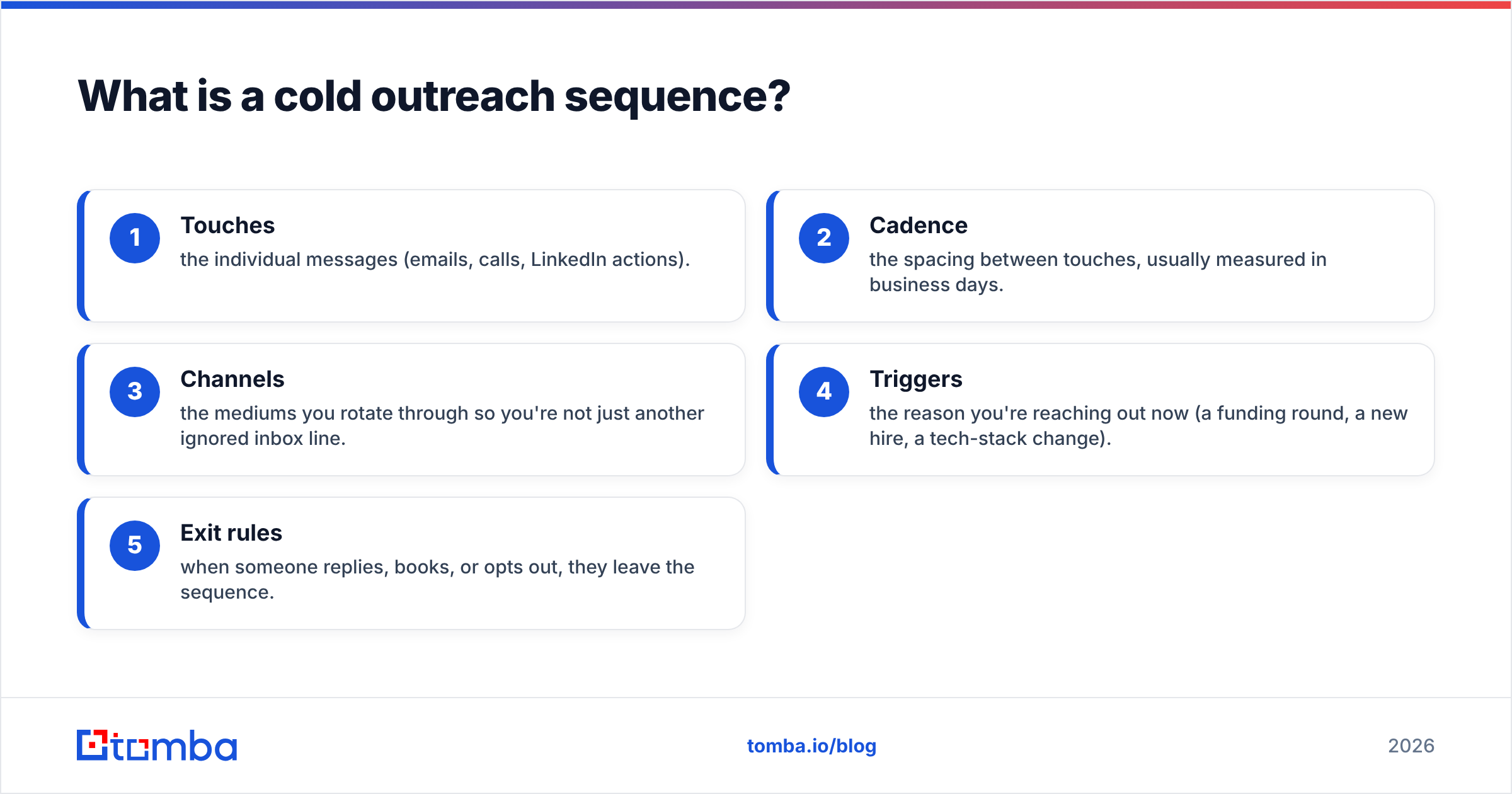
Each sequence has a few moving parts:
- Touches — the individual messages (emails, calls, LinkedIn actions).
- Cadence — the spacing between touches, usually measured in business days.
- Channels — the mediums you rotate through so you're not just another ignored inbox line.
- Triggers — the reason you're reaching out now (a funding round, a new hire, a tech-stack change).
- Exit rules — when someone replies, books, or opts out, they leave the sequence.
The mistake isn't sending cold email. The mistake is treating it as a single event instead of a system.
How many touches does a cold outreach sequence need?#
Between 5 and 8 touches over 2 to 3 weeks is the range that consistently works for B2B. Fewer and you quit before most prospects are ready; more and you start irritating people who were never going to convert.
The reason follow-up matters so much: the majority of replies and booked meetings come after the first message, but a large share of reps never send a second or third touch. That gap is the single biggest wasted opportunity in outbound. According to HubSpot's sales research, persistence across multiple touches — not a single perfect email — is what separates reps who hit quota from those who don't.
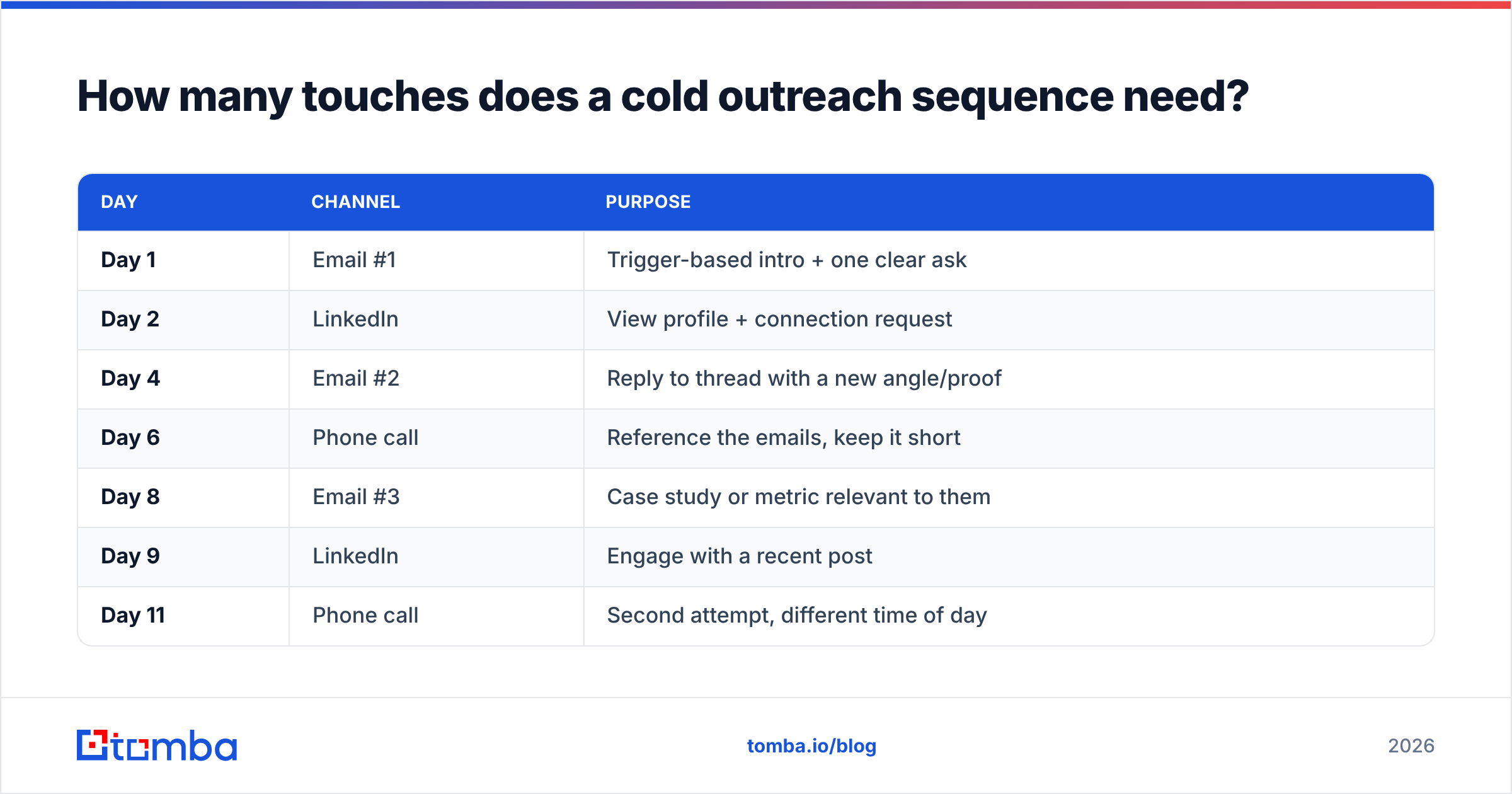
Here's a battle-tested 8-touch structure over 12 business days:
| Day | Channel | Purpose |
|---|---|---|
| Day 1 | Email #1 | Trigger-based intro + one clear ask |
| Day 2 | View profile + connection request | |
| Day 4 | Email #2 | Reply to thread with a new angle/proof |
| Day 6 | Phone call | Reference the emails, keep it short |
| Day 8 | Email #3 | Case study or metric relevant to them |
| Day 9 | Engage with a recent post | |
| Day 11 | Phone call | Second attempt, different time of day |
| Day 12 | Email #4 | Break-up email — clear, low-pressure exit |
Notice the pattern: no two consecutive touches use the same channel back-to-back where it can be avoided, and every touch has a distinct job. You're not resending "just following up" four times — each message adds something new.
Which channels belong in the sequence?#
Email carries the sequence, but phone and LinkedIn are what make it break through. A multi-channel cadence consistently outperforms email-only because you're meeting the prospect where they actually pay attention.
- Email is your backbone — scalable, trackable, and where your main pitch lives. It does the heavy lifting on volume.
- Phone is your accelerant. A voicemail or a live conversation cuts through inbox noise and often triggers a reply to an email the prospect had ignored. You'll need accurate direct-dial numbers, which is where a B2B phone numbers lookup earns its keep.
- LinkedIn is your warm-up. A profile view, a thoughtful comment, or a connection request makes your name familiar before your next email lands, so you're no longer a total stranger.
Rotating channels also protects you from a single point of failure. If your email gets buried, the call or the LinkedIn touch can still open the door. Relying on email alone is like fishing with one line — adding channels is casting several.
What should each message in the sequence say?#
Every touch should be short, relevant to a specific trigger, and built around one ask. The single most common killer of cold sequences is messages that are all about you and zero about them.
A reliable framework for each email:
- Opener (1 line): a trigger tied to them — "Saw you're hiring three SDRs this quarter."
- Relevance (1–2 lines): why that trigger connects to a problem you solve.
- Proof (1 line): a specific, credible metric or a comparable customer.
- Ask (1 line): one low-friction next step — "Worth a 15-minute look next week?"
Keep the whole thing under 90 words. Nobody reads a wall of text from a stranger. If you're staring at a blank page, a library of cold email templates gives you proven skeletons you can adapt to the trigger instead of starting cold every time.
And vary the angle across touches. Email #1 leads with the trigger. Email #2 replies with social proof. Email #3 offers a resource. The break-up email gives them an easy out — which, counterintuitively, is one of the highest-reply messages in the whole sequence because it creates urgency without pressure.
Why does data quality make or break the sequence?#
Because a sequence built on bad email addresses doesn't just underperform — it actively damages your ability to send anything at all. This is the part reps discover the hard way.
When you send to invalid addresses, they bounce. A high bounce rate signals to mailbox providers that you're a careless or spammy sender, which drags down your sender reputation and quietly routes even your good emails into spam folders. One dirty list can sabotage a perfectly good sequence for every prospect on it.
Three data hygiene steps protect the whole operation:
- Find the right contact. Use an email finder to source verified professional addresses by name and company instead of guessing at
firstname@company.compatterns. - Verify before you send. Run every address through an email verifier to strip out invalids, catch-alls, and role accounts before they ever hit your outbound tool.
- Warm your domain. New or cold sending domains need a ramp-up period before high-volume sending. Skipping this is the fastest route to the spam folder.
Independent reviews on G2 consistently show that verification-first senders see materially lower bounce rates and higher inbox placement. It's not glamorous work, but it's the foundation everything else sits on.
Single email vs. a full sequence: what's the real difference?#
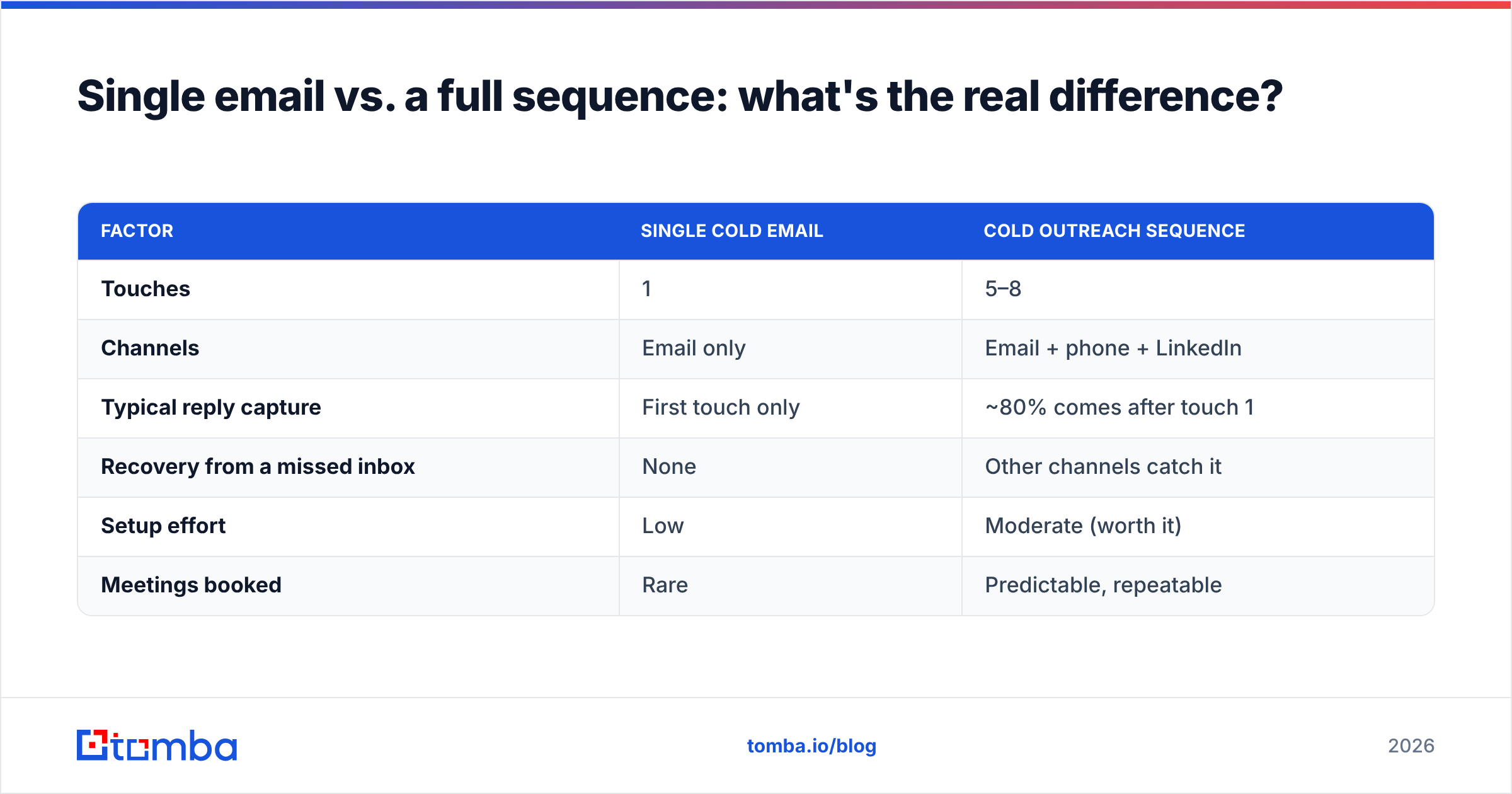
The gap isn't subtle. A single cold email is a coin flip that usually lands on "ignored." A sequence compounds attention across touches and channels until the timing finally lines up with the prospect's need.
| Factor | Single cold email | Cold outreach sequence |
|---|---|---|
| Touches | 1 | 5–8 |
| Channels | Email only | Email + phone + LinkedIn |
| Typical reply capture | First touch only | ~80% comes after touch 1 |
| Recovery from a missed inbox | None | Other channels catch it |
| Setup effort | Low | Moderate (worth it) |
| Meetings booked | Rare | Predictable, repeatable |
The single email feels efficient because it's less work. But "less work that produces nothing" is the most expensive outreach there is. The sequence costs more upfront and returns far more on the back end.
How do you build and scale a sequence without burning out?#
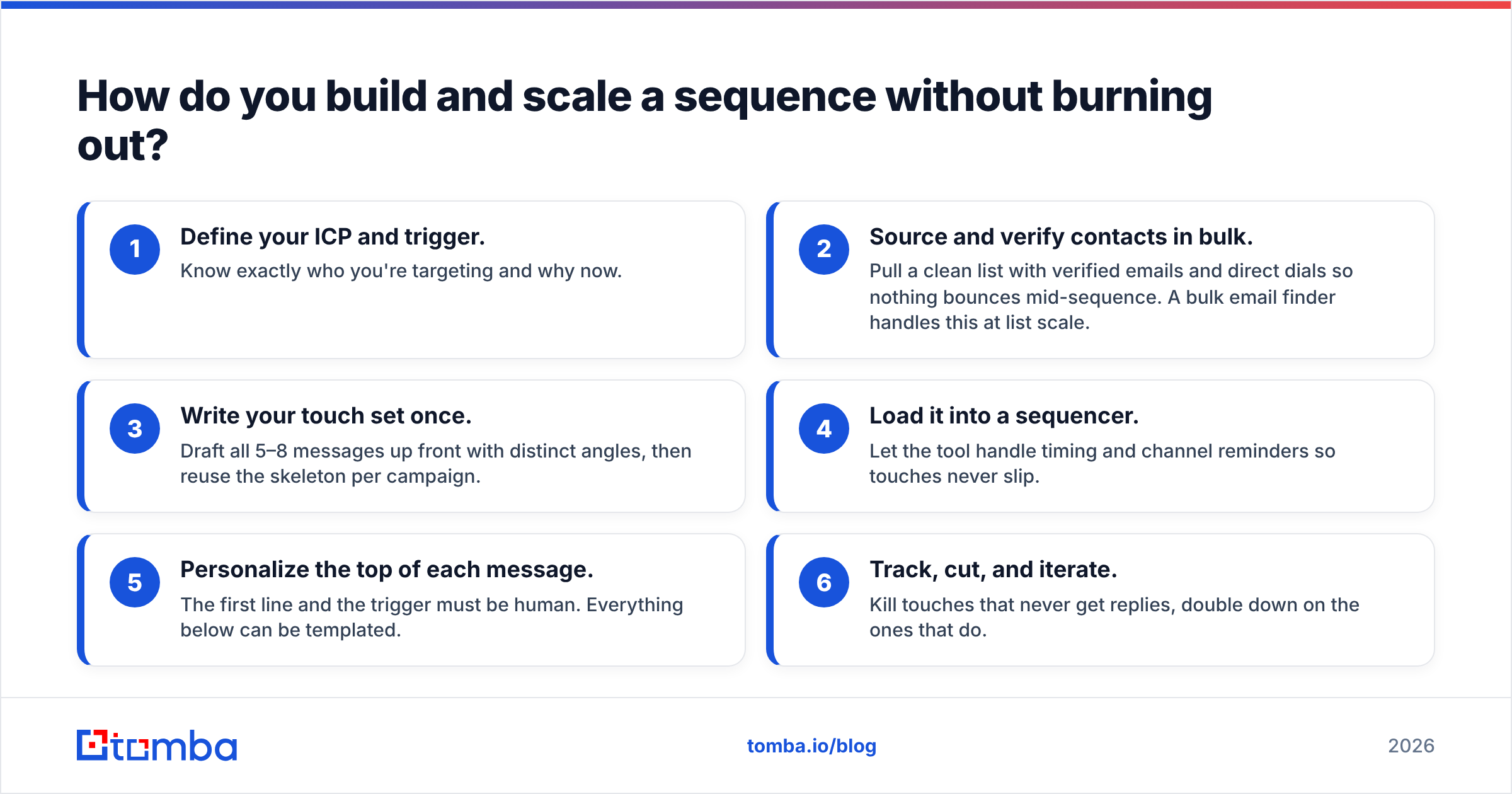
Automate the mechanics, personalize the substance. The goal is to spend your human effort on relevance and triggers — not on remembering who's due for touch four on Thursday.
A practical build order:
- Define your ICP and trigger. Know exactly who you're targeting and why now.
- Source and verify contacts in bulk. Pull a clean list with verified emails and direct dials so nothing bounces mid-sequence. A bulk email finder handles this at list scale.
- Write your touch set once. Draft all 5–8 messages up front with distinct angles, then reuse the skeleton per campaign.
- Load it into a sequencer. Let the tool handle timing and channel reminders so touches never slip.
- Personalize the top of each message. The first line and the trigger must be human. Everything below can be templated.
- Track, cut, and iterate. Kill touches that never get replies, double down on the ones that do.
Sequencing platforms like Salesloft or Outreach handle the workflow, but they're only as good as the data you feed them. Garbage contacts in, garbage results out — no matter how slick the automation. That's why the sourcing and verification step comes before you ever touch the sequencer.
If you're weighing what all this costs to run properly, the Tomba pricing tiers scale from a free plan for testing your first list up to volume plans for full outbound operations — so you can start small and grow the data layer as your sequence proves out.
Common cold outreach sequence mistakes to avoid#
- Quitting after touch two. The meetings are in touches three through eight. Persistence is the whole game.
- Same channel every time. Four identical "just following up" emails is noise. Rotate channels and change the angle.
- Skipping verification. Bounces destroy your sender reputation and take your good emails down with them.
- Personalizing nothing — or everything. Personalize the trigger and opener; template the rest so you can actually scale.
- No exit rules. When someone replies or opts out, they must leave the sequence immediately. Nothing kills trust like a "follow-up" after a "no thanks."
- Ignoring send timing. A warmed domain and reasonable daily volume matter more than the exact minute you hit send.
Frequently asked questions#
How long should a cold outreach sequence run? Most effective B2B sequences run 5–8 touches over 2–3 weeks. Long enough to catch prospects at the right moment, short enough to avoid annoying the ones who'll never convert.
How many follow-ups is too many? Beyond 8–9 touches you hit diminishing returns and rising irritation. End with a clear break-up email rather than dragging out endless "checking in" messages.
Do I really need phone and LinkedIn, or is email enough? Email alone works, but multi-channel sequences consistently book more meetings. Phone and LinkedIn catch the prospects who never open your email.
What's the fastest way to improve reply rates? Fix your data first. Verified emails and a warmed domain protect deliverability, which lifts every message in the sequence — usually more than any copy tweak.
Build sequences on data that actually reaches the inbox#
A great sequence starts with contacts that exist and addresses that don't bounce. Tomba's Email Finder gives you verified professional emails by name, domain, or company — so every touch in your cold outreach sequence lands in a real inbox instead of a bounce log. Pair it with the built-in verifier, source your list clean, and let the sequence do what a single email never could: turn cold contacts into booked meetings. Start free and build your first sequence on data you can trust.
Related guides#
Ready to find emails that actually work?
Join 150,000+ professionals who stopped guessing and started sending. Free credits on signup — no credit card required.
Get the Tomba newsletter
Practical outbound tactics and product updates — once every two weeks.
About the author