How to Write a Cold Pitch Email That Gets Replies in 2026
Most cold pitch emails get ignored because they lead with the sender, not the buyer. Here's the exact structure, templates, and pre-send checklist that turn a cold pitch email into booked meetings in 2026.
TL;DR
- A cold pitch email is a first-touch message to someone who has never heard of you — its only job is to earn a reply, not close a deal.
- The winning structure is short: relevant trigger, one specific value claim, light proof, and a single low-friction ask.
- Personalization beats volume, but only if the data behind it is accurate — a wrong name or dead address kills the pitch before it's read.
- Reply rates of 5–15% are realistic for a well-built cold pitch email; anything promising 40% is selling you a fantasy.
- Deliverability and list quality matter as much as copy. A great pitch to an unverified list still lands in spam.
What is a cold pitch email?#
A cold pitch email is the first message you send to a prospect who has no prior relationship with you or your company. Think of it like knocking on a stranger's door: you have about three seconds before they decide whether to keep listening or shut it. The email version of that door is the subject line and first sentence.
The mistake most people make is treating a cold pitch like a brochure. They open with "We are a leading provider of..." — which is the email equivalent of the stranger launching into their life story before you've even said hello. A cold pitch email is not about you. It's about a specific problem the reader recognizes, framed so tightly that ignoring it feels like a small mistake.
Technically, a cold pitch email sits inside the broader practice of cold email outreach, but it has a narrower goal than a nurture sequence or a newsletter. It exists to start a conversation. That's it. Every word should be measured against one question: does this make a reply more likely?
Why do most cold pitch emails fail?#
Most cold pitch emails fail for reasons that have nothing to do with the offer itself. The product might be excellent. The failure happens upstream.
Here are the four failure points, ranked by how often they quietly sink campaigns:
- Bad data. The email bounces, hits the wrong person, or greets "Hi {FirstName}" because a merge field broke. Nothing else matters if the message never reaches a real inbox.
- Sender-centric copy. The pitch leads with the company, the funding round, or the feature list instead of the reader's situation.
- No clear trigger. There's no reason this person is getting this email today. Generic blasts read as generic.
- Weak or heavy ask. "Do you have 30 minutes for a demo next week?" asks a stranger for a meeting before you've earned a single second of trust.
The uncomfortable truth is that copy is usually the third or fourth thing to fix, not the first. You can A/B test subject lines all month, but if 30% of your list is invalid, you're optimizing the paint job on a car with no engine. That's why serious senders start with list hygiene — running addresses through an email verifier before a single message goes out.
What does a high-performing cold pitch email look like?#
A strong cold pitch email has five parts, and each one does exactly one job. Keep the whole thing under 120 words.
- Subject line — Specific and human, not clickbait. "Question about your Q3 onboarding flow" beats "Boost your revenue 300%."
- Opening trigger — One sentence proving you did your homework: a recent hire, a product launch, a LinkedIn post, a job posting.
- Value claim — One sentence on the outcome you help create, tied to the trigger. Not features. Outcomes.
- Proof — A single, concrete, credible detail: a comparable customer, a specific number, a named result.
- The ask — One low-friction question. Interest-based ("Worth a quick look?") beats calendar-based for a first touch.
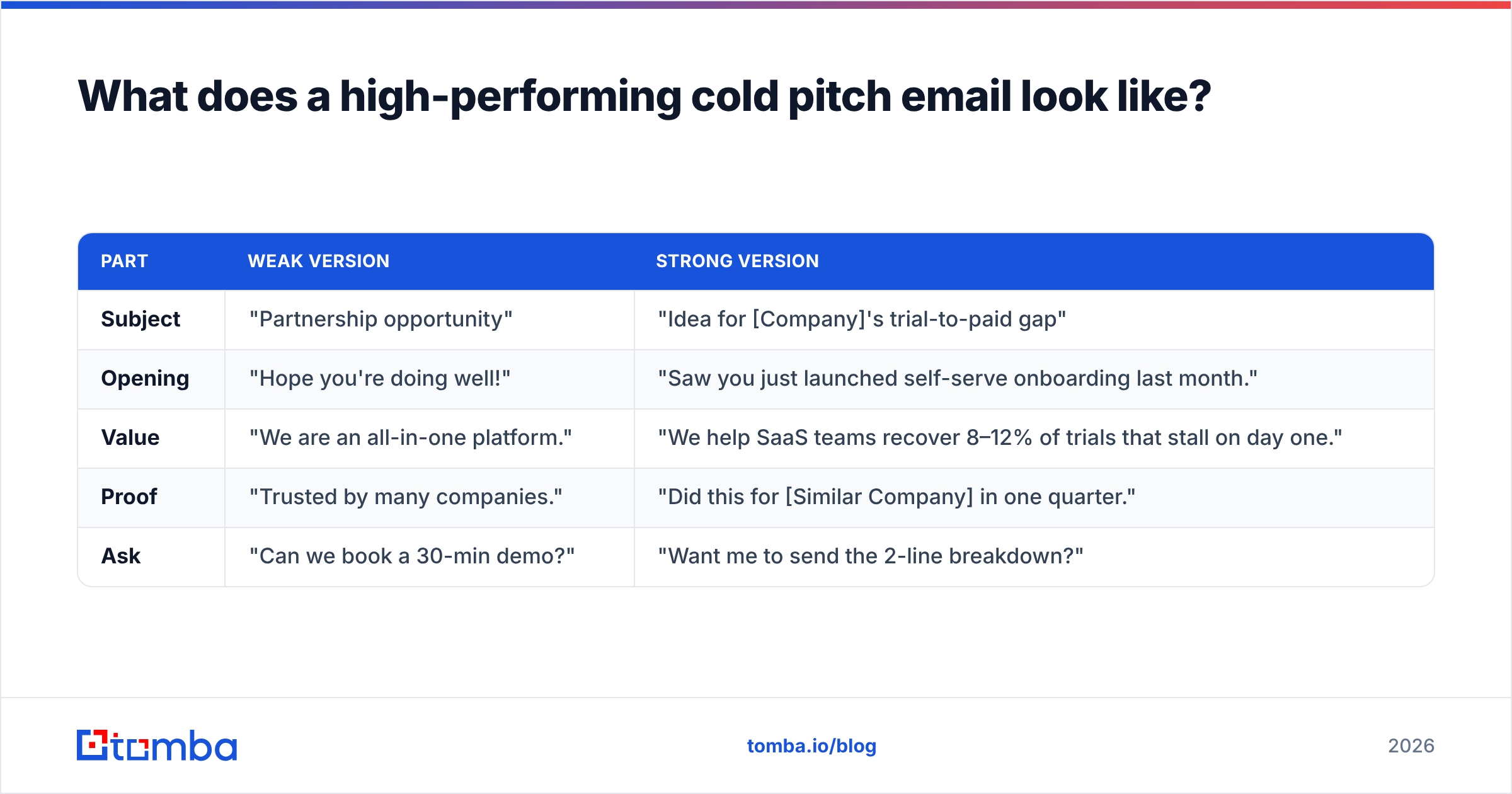
Here's how those parts map to a real message:
| Part | Weak version | Strong version |
|---|---|---|
| Subject | "Partnership opportunity" | "Idea for [Company]'s trial-to-paid gap" |
| Opening | "Hope you're doing well!" | "Saw you just launched self-serve onboarding last month." |
| Value | "We are an all-in-one platform." | "We help SaaS teams recover 8–12% of trials that stall on day one." |
| Proof | "Trusted by many companies." | "Did this for [Similar Company] in one quarter." |
| Ask | "Can we book a 30-min demo?" | "Want me to send the 2-line breakdown?" |
Notice the strong version never mentions how the product works. That's deliberate. The pitch sells the reply, and the reply sells the conversation. For more ready-to-adapt frameworks, Tomba's cold email templates library is a useful starting point rather than writing from a blank page.
How is a cold pitch email different from a warm pitch or a follow-up?#
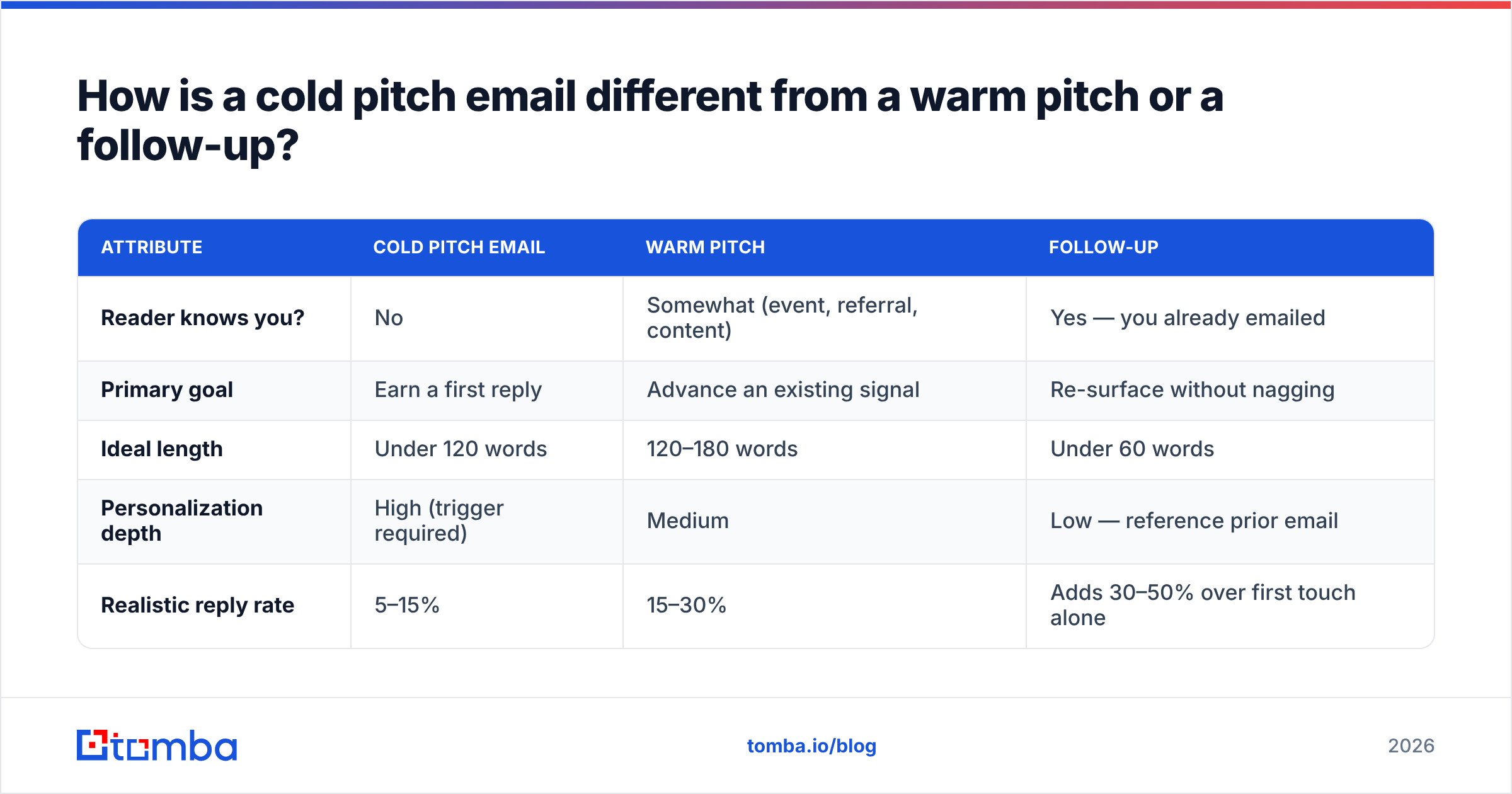
People blur these three, and it costs them responses. Each has a different reader state and a different job.
| Attribute | Cold pitch email | Warm pitch | Follow-up |
|---|---|---|---|
| Reader knows you? | No | Somewhat (event, referral, content) | Yes — you already emailed |
| Primary goal | Earn a first reply | Advance an existing signal | Re-surface without nagging |
| Ideal length | Under 120 words | 120–180 words | Under 60 words |
| Personalization depth | High (trigger required) | Medium | Low — reference prior email |
| Realistic reply rate | 5–15% | 15–30% | Adds 30–50% over first touch alone |
The takeaway: a cold pitch email carries the heaviest personalization burden because you're starting from zero trust. A warm pitch can lean on a shared context. A follow-up leans on the thread itself. Confusing them — sending a warm-length essay cold, or a cold-level pitch to a warm lead — is a common, avoidable leak.
What subject lines actually get cold pitch emails opened?#
Your subject line is a gatekeeper, not a sales pitch. Its only job is to earn the open, and the best ones look like something a colleague would send.
Patterns that consistently perform on cold pitch email campaigns:
- The specific question: "Question about [specific process] at [Company]"
- The observation: "Noticed [Company] is hiring 3 SDRs"
- The peer reference: "How [Competitor] handled [problem]"
- The short and plain: "quick idea" (lowercase, 2 words — reads personal, not blasted)
Avoid anything with a dollar sign, ALL CAPS, "free," exclamation points, or a promise you can't back up in the body. These trip spam filters and, worse, trip the reader's skepticism. If you want to pressure-test options before sending, run them through a subject line tester to catch spammy phrasing and length issues early.
One rule that survives every trend: match the subject to the body. A subject line that overpromises gets the open and then loses the reply the moment the body underdelivers.
A cold pitch email template you can steal#
Here's a complete cold pitch email built on the structure above. Swap the brackets for real, researched details — never send it with the placeholders intact.
Subject: Idea for [Company]'s trial-to-paid gap
Hi [First name],
Saw [Company] rolled out self-serve onboarding last month — congrats on the launch.
Most teams that ship self-serve see 8–12% of trials stall on day one before they hit an "aha" moment. We help close that gap with in-app nudges triggered by drop-off. Did this for [Similar Company] and they recovered ~10% of stalled trials in a quarter.
Want me to send the 2-line breakdown of how it'd map to your flow? No deck, no call.
[Your name]
Why it works: it's under 90 words, it opens with a real trigger, the proof is specific, and the ask costs the reader nothing. The "no deck, no call" line removes the biggest objection to replying — the fear of being dragged into a demo.
The version that fails looks almost identical but breaks three rules: it opens with "Hope you're well," describes the product for two paragraphs, and ends with "Are you free Tuesday at 2 for a demo?" Same offer, near-zero replies — because it asks a stranger to spend 30 minutes before spending 30 seconds.
How do you personalize cold pitch emails at scale without sounding like a robot?#
The tension in cold outreach is real: deep personalization drives replies, but hand-researching every prospect doesn't scale past a few dozen. The resolution is tiered personalization.
- Tier 1 — Company-level: A trigger true for a whole segment (recent funding, a hiring spree, a specific tech in their stack). Scales to hundreds, still feels relevant.
- Tier 2 — Role-level: A pain specific to the reader's job title. One line, reusable across everyone with that title.
- Tier 3 — Person-level: A genuinely individual detail (a podcast they were on, a post they wrote). Reserve this for your 20–50 highest-value accounts.
The engine underneath all three tiers is data. Personalization only works when the underlying fields — name, title, company, email — are correct. That means starting from an accurate source: pulling verified contacts with an email finder or domain search, then enriching them with role and company signals so your merge fields never embarrass you. A single "Hi [FirstName]," in the wild undoes a hundred perfect sends.
According to research compiled by HubSpot, personalized, segmented outreach consistently outperforms generic blasts on both open and reply rates — but the gains evaporate the moment the personalization is wrong. Accuracy is the whole game.
What's the pre-send checklist for a cold pitch email?#
Before any cold pitch email leaves your outbox, run it through this list. It catches the leaks that copy edits never will.
- Verify the address. Confirm it's valid and not a catch-all guess. Bounces damage your sender reputation for every future send.
- Check the merge fields. Manually read the first three rows of your merge preview. Broken fields are the #1 embarrassment in cold outreach.
- Confirm the trigger is real and recent. "Congrats on the launch" is worthless if the launch was 2019.
- Read the ask aloud. If it feels heavy to you, it feels heavier to a stranger.
- Test deliverability. Warm the domain, set up authentication, and keep daily volume sane. A perfect pitch in spam is a tree falling in an empty forest.
- Cut 20% of the words. Almost every cold pitch email is too long. Ruthlessly trim.
Deliverability deserves special attention. You can research authentication basics through Google's Postmaster and sender guidelines — proper SPF, DKIM, and DMARC records are non-negotiable in 2026. Third-party review sites like G2 are also useful for vetting the sending and verification tools you'll rely on.
How many cold pitch emails and follow-ups should you send?#
A single cold pitch email is a coin flip you'll mostly lose. The reply usually comes from the sequence, not the opener.
A sane cadence for 2026:
- Email 1 — The cold pitch. Full trigger + value + ask.
- Email 2 (day 3–4) — Short bump. New angle or a different proof point, not "just following up."
- Email 3 (day 7–8) — A resource with no ask. Give value, build credibility.
- Email 4 (day 12–14) — The polite breakup. "Should I close the loop?" often pulls replies that silence didn't.
Keep follow-ups shorter than the original and never guilt-trip. "Bumping this in case it's useful" respects the reader; "I haven't heard back from you" does not. When you need to scale this across hundreds of verified contacts at once, a bulk email finder keeps your list clean so the whole sequence stays deliverable.
What reply rate should you actually expect?#
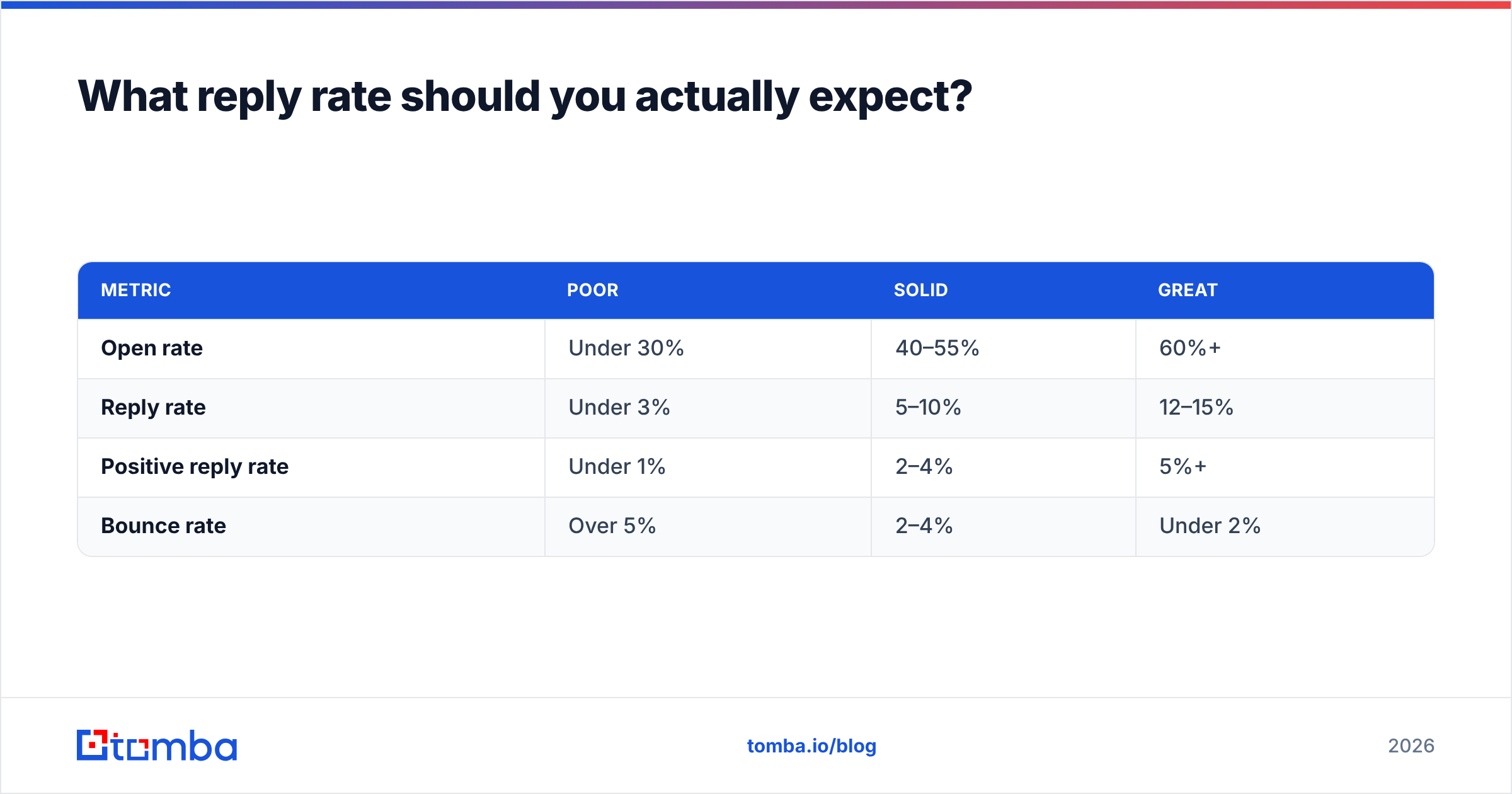
Set expectations honestly, because inflated benchmarks lead to bad decisions. For a well-targeted, well-verified cold pitch email campaign:
| Metric | Poor | Solid | Great |
|---|---|---|---|
| Open rate | Under 30% | 40–55% | 60%+ |
| Reply rate | Under 3% | 5–10% | 12–15% |
| Positive reply rate | Under 1% | 2–4% | 5%+ |
| Bounce rate | Over 5% | 2–4% | Under 2% |
If a tool or agency promises a 40% reply rate, walk away. Those numbers come from tiny, hyper-warm lists or creative math. The realistic lever is compounding: better data plus tighter copy plus disciplined follow-up, improving each element by a few points until the whole funnel moves.
Start with data, then write the pitch#
The best cold pitch email in the world fails if it lands in the wrong inbox or greets the wrong name. Great copy is the second half of the job — accurate, verified contact data is the first. Build your list on a foundation you can trust, verify every address before you send, and only then obsess over the words.
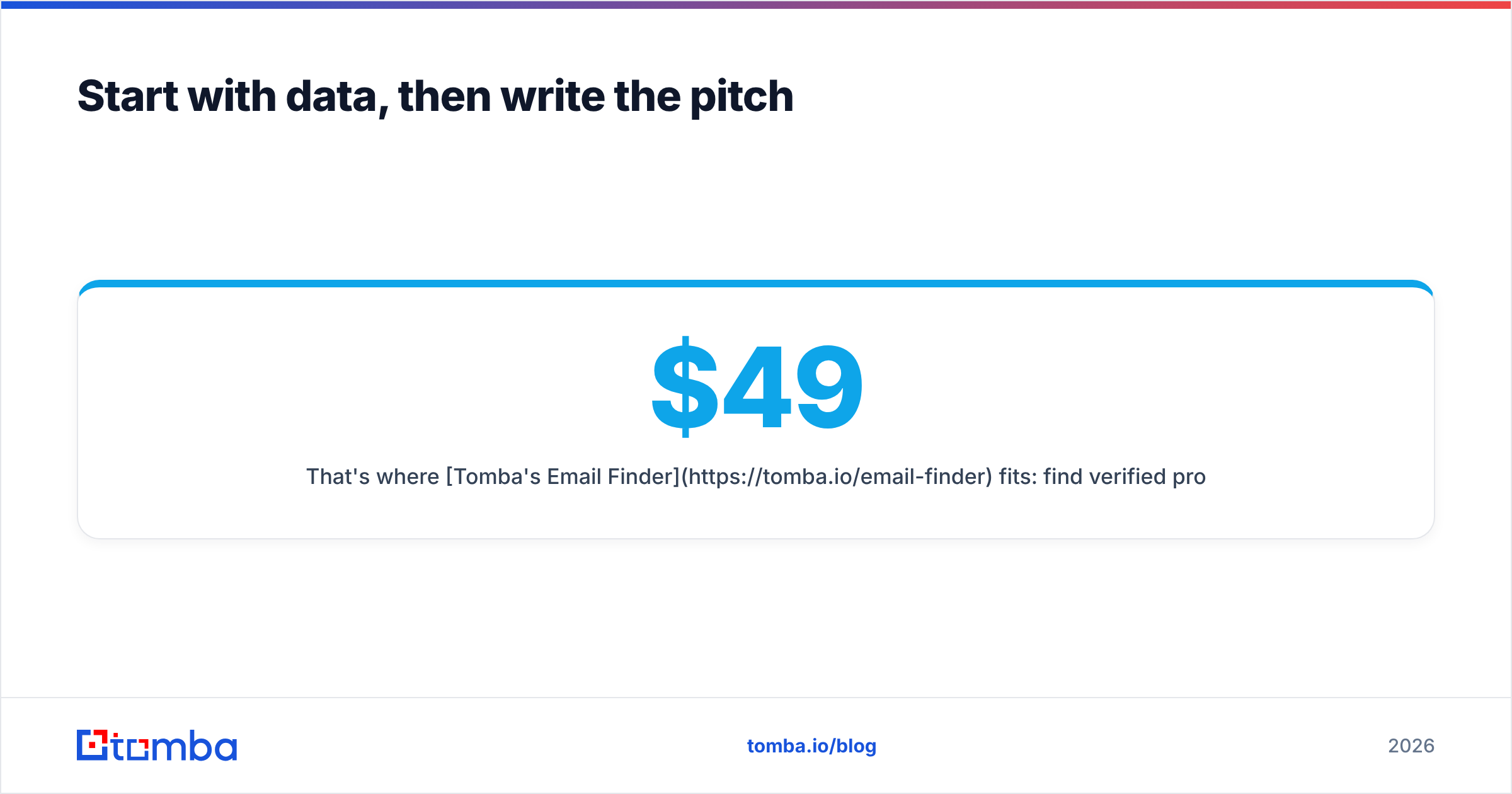
That's where Tomba's Email Finder fits: find verified professional emails by name, company, or domain, confirm they're deliverable, and export a clean list your cold pitch email can actually reach. Start free with 25 searches a month, and when you're ready to scale, Tomba pricing runs from $49/mo Starter to $99/mo Growth and $249/mo Pro — no per-seat surprises. Get the data right, and your pitch finally has a chance to be read.
Related guides#
Ready to find emails that actually work?
Join 150,000+ professionals who stopped guessing and started sending. Free credits on signup — no credit card required.
Get the Tomba newsletter
Practical outbound tactics and product updates — once every two weeks.
About the author