Cold Recruiting Email Template: 7 Examples That Get Replies
A cold recruiting email lives or dies on the first two lines. Here are 7 proven templates, a structure breakdown, and the mistakes that quietly kill your response rate.
Recruiting is outbound sales with a smaller candidate pool and a pickier buyer. The person you're emailing already has a job, probably ignores recruiters on reflex, and reads your first line in a notification preview before deciding whether you're worth a tap. A good cold recruiting email template doesn't fix that with clever words — it fixes it with structure, relevance, and respect for their time.
This guide gives you seven templates you can copy today, a breakdown of why they work, and the specific mistakes that push your reply rate toward zero.
TL;DR#
- Personalization beats volume. A relevant first line to 50 candidates outperforms a generic blast to 500.
- Lead with the candidate, not the job. Your opening sentence should be about them, not your open role.
- Keep it under 120 words. Passive candidates skim on mobile; long emails get archived.
- One clear ask. "Open to a 15-minute call Thursday?" converts better than "let me know your thoughts."
- Reach the right inbox. A perfect template sent to a bounced or guessed address never gets read — verify addresses first.
What makes a cold recruiting email actually get a reply?#
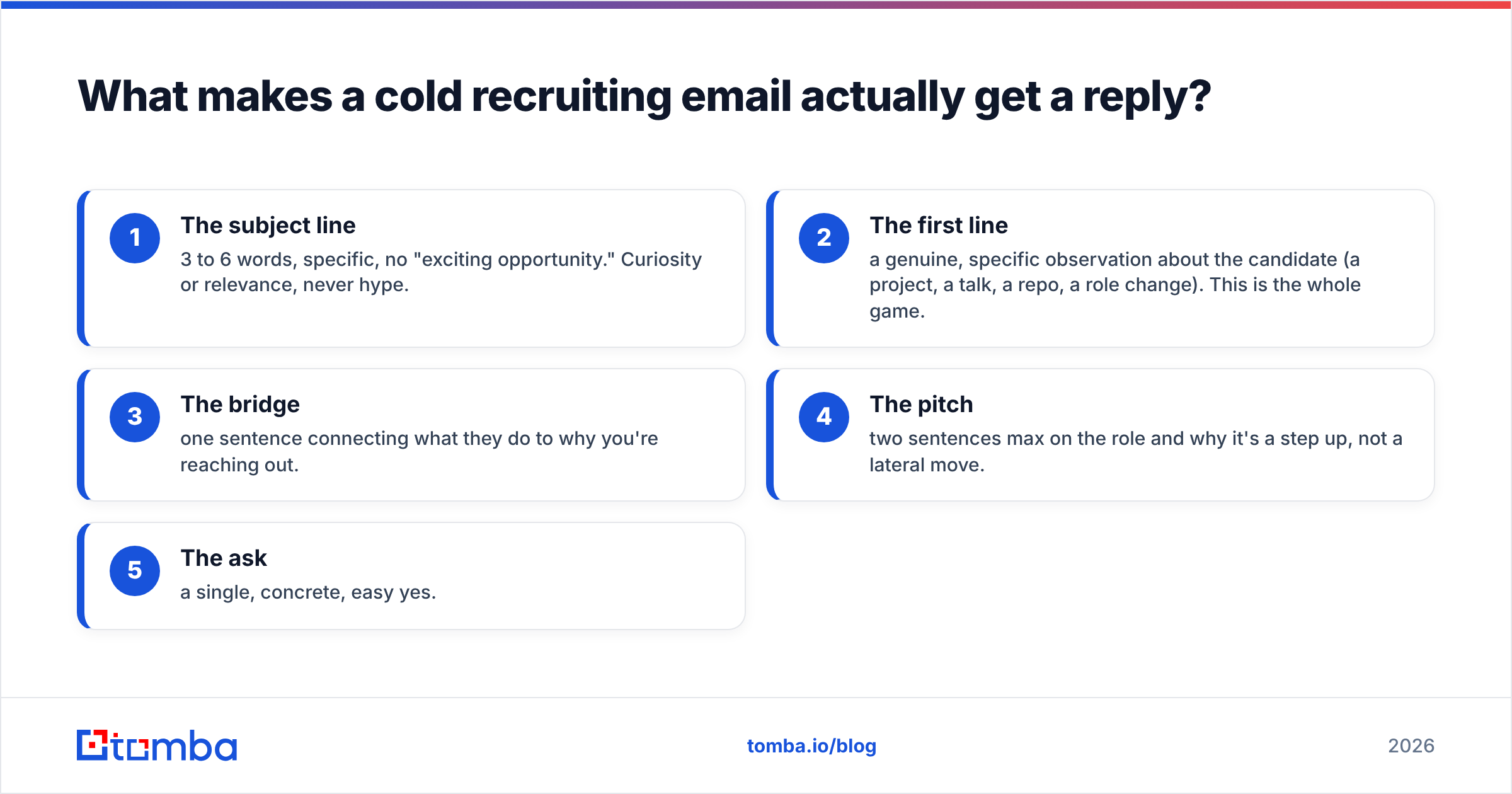
The reply comes from four things working together, in order: the right recipient, a subject line that survives the preview pane, a first line that proves you did your homework, and a single low-friction ask.
Most recruiters obsess over the third one — the pitch — and neglect the other three. That's backwards. According to LinkedIn's Talent Solutions research, personalized recruiter outreach consistently outperforms templated blasts, and the gap widens as candidates get more senior. Seniority correlates with inbox fatigue.
Here's the anatomy of a message that works:
- The subject line — 3 to 6 words, specific, no "exciting opportunity." Curiosity or relevance, never hype.
- The first line — a genuine, specific observation about the candidate (a project, a talk, a repo, a role change). This is the whole game.
- The bridge — one sentence connecting what they do to why you're reaching out.
- The pitch — two sentences max on the role and why it's a step up, not a lateral move.
- The ask — a single, concrete, easy yes.
What's the ideal cold recruiting email structure?#
Think of your email like a good first date, not a job interview. You lead with interest in them, you're brief, and you propose one specific next step instead of asking them to plan the whole relationship.
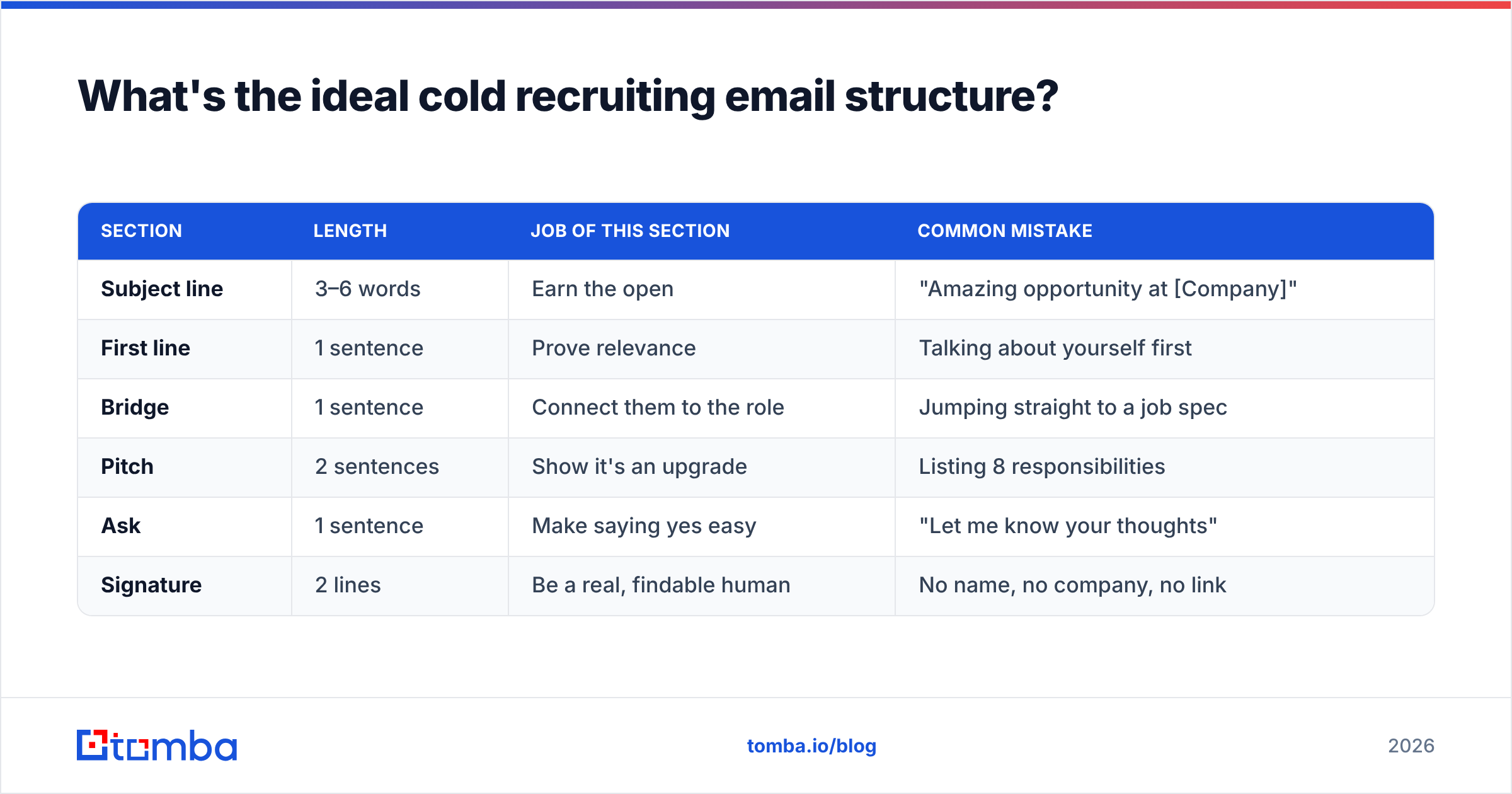
Here's how the pieces map to word counts and intent:
| Section | Length | Job of this section | Common mistake |
|---|---|---|---|
| Subject line | 3–6 words | Earn the open | "Amazing opportunity at [Company]" |
| First line | 1 sentence | Prove relevance | Talking about yourself first |
| Bridge | 1 sentence | Connect them to the role | Jumping straight to a job spec |
| Pitch | 2 sentences | Show it's an upgrade | Listing 8 responsibilities |
| Ask | 1 sentence | Make saying yes easy | "Let me know your thoughts" |
| Signature | 2 lines | Be a real, findable human | No name, no company, no link |
Notice the pitch is the shortest substantive block. Candidates decide whether to reply based on relevance and effort, not on how thoroughly you described the role. Save the details for the call.
7 cold recruiting email templates you can copy#
Swap the bracketed fields, keep the structure. Each is under 120 words on purpose.
1. The specific-work opener (engineers, designers, builders)#
Subject: your work on [project]
Hi [First name],
I came across [specific project/repo/post] — the way you handled [specific detail] stood out, especially [why].
I'm hiring a [role] at [Company], where you'd own [scope]. It's a step up from [their current likely scope] with [concrete differentiator: equity, team, ownership].
Worth a 15-minute call Thursday or Friday to see if it's a fit?
[Name] · [Company] · [link]
2. The warm-referral angle#
Subject: [mutual name] suggested I reach out
Hi [First name],
[Mutual connection] mentioned you're one of the sharpest [role] they've worked with, so you were the first person I thought of for [role] at [Company].
Quick version: [one-line mission], and this role owns [scope]. Happy to share more if you're even mildly curious.
Open to a short call next week?
[Name]
3. The passive-candidate soft touch#
Subject: not a pitch — a question
Hi [First name],
I know you're probably happy at [Company] — this isn't a hard sell. I'm building out the [team] at [Company] and would value your read on the market, even if you're not looking.
If it turns into something, great. If not, I'll owe you a coffee. Worth 15 minutes?
[Name]
4. The role-change trigger#
Subject: congrats on the [new role/promotion]
Hi [First name],
Saw you recently moved into [new role] — congrats. Transitions are usually when people reassess what's next, so the timing felt right to reach out.
We're hiring a [role] at [Company] that would let you [specific growth angle]. No pressure at all.
Would a quick chat be useful?
[Name]
5. The compensation-forward (for hard-to-move senior talent)#
Subject: [role] — [comp band] + equity
Hi [First name],
I'll be direct since your time is tight: [Company] is hiring a [role] at [comp band] plus meaningful equity, remote-first.
Your background in [specialty] is exactly what the team needs. Even if you're not moving now, I'd like to be on your radar.
15 minutes this week?
[Name]
6. The event / content follow-up#
Subject: your talk at [event]
Hi [First name],
Your [talk/article] on [topic] was one of the clearest takes I've seen on [subject] — the point about [detail] stuck with me.
That kind of thinking is exactly what we need for [role] at [Company]. Would you be open to hearing about it?
[Name]
7. The short second-touch (follow-up)#
Subject: re: [role]
Hi [First name],
Floating this back up in case it got buried. Totally fine if the timing's off — just reply "not now" and I'll check back in a few months.
Still happy to share details whenever it's useful.
[Name]
For more reusable frameworks across outreach types, Tomba's cold email templates library is a good place to keep building your swipe file.
What are the biggest cold recruiting email mistakes?#
The templates above only work if you avoid the errors that override good structure. These are the ones that quietly tank campaigns.
- Sending to the wrong or guessed address. Bounces hurt your sender reputation and mean your best-written email is never read. Find and confirm the address with an email finder before you send.
- Fake personalization. "I love your work" with no specifics reads worse than no personalization at all — it signals a mail merge.
- Burying the ask. If the reader has to guess what you want, they won't reply.
- Writing a job description. Nobody replies to a bulleted responsibilities list. Sell the upgrade, not the spec.
- No follow-up. A large share of replies come from the second or third touch. One-and-done leaves most of your response rate on the table — track your response rate and you'll see it.
- Corporate tone. Write like a human texting a smart peer, not like an HR portal.
How do you personalize at scale without sounding like a robot?#
Personalize the first line only, and keep everything else templated. That single sentence carries 80% of the perceived effort, so that's where your research time should go.
A practical workflow:
- Build the list — pull candidates from LinkedIn, GitHub, conference speaker pages, or a community.
- Find and verify contact info — use a domain search or email finder to get work or personal addresses, then verify to avoid bounces.
- Write one custom first line per candidate — reference a real, specific thing. Budget two minutes each.
- Drop it into the template — keep the bridge, pitch, and ask identical.
- Sequence follow-ups — two or three touches, spaced 3–5 business days apart.
This is the same principle top outbound teams use, and it's why tools that separate finding the contact from writing the message tend to win. Reputable review sites like G2 rank email-finding and outreach tools separately for exactly this reason — they're different jobs.
Cold recruiting email vs. LinkedIn InMail: which converts?#
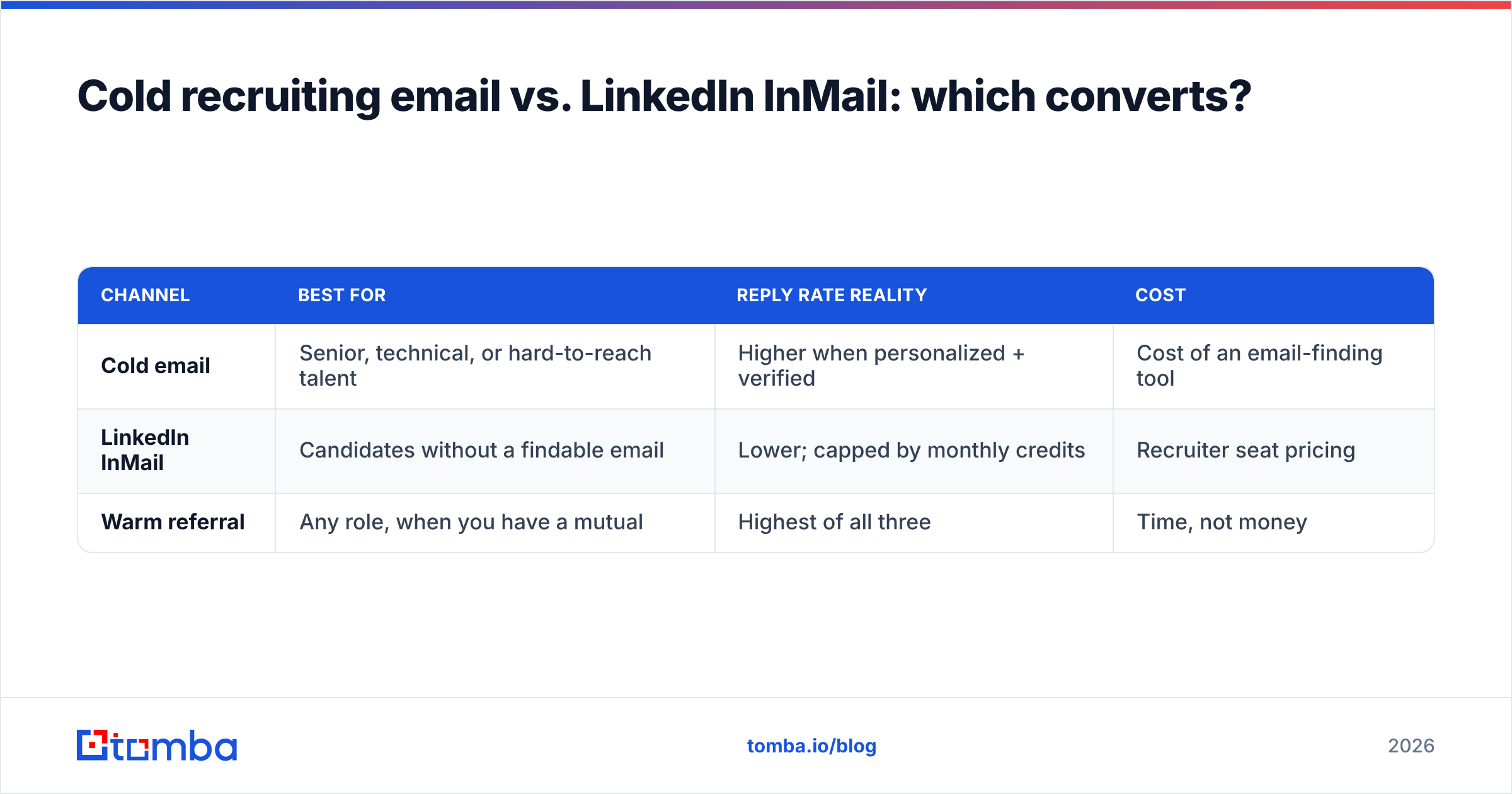
Both have a place, and the honest answer depends on seniority and inbox habits. Email tends to win on reply rate for senior candidates who live in their inbox; InMail wins on discoverability for candidates whose email you can't find.
| Channel | Best for | Reply rate reality | Cost |
|---|---|---|---|
| Cold email | Senior, technical, or hard-to-reach talent | Higher when personalized + verified | Cost of an email-finding tool |
| LinkedIn InMail | Candidates without a findable email | Lower; capped by monthly credits | Recruiter seat pricing |
| Warm referral | Any role, when you have a mutual | Highest of all three | Time, not money |
The strongest recruiters run all three, but email is the one you fully control — no platform credit limits, no algorithm deciding who sees you. That control is why a verified email list plus a tight template is still the backbone of most outbound recruiting. For a benchmark on outbound cadence and messaging, HubSpot's sales resources are a solid neutral reference.
How do you measure if your recruiting emails are working?#
Track three numbers per campaign and you'll know exactly what to fix:
- Bounce rate — over 3% means your list or verification is broken, not your copy. Fix deliverability before anything else.
- Open rate — low opens point at your subject line and sender reputation.
- Reply rate — the number that matters. Low replies with good opens means your first line or ask needs work.
Diagnose in that order. There's no point A/B testing subject lines if a third of your emails are bouncing — you're optimizing a leak.
The bottom line#
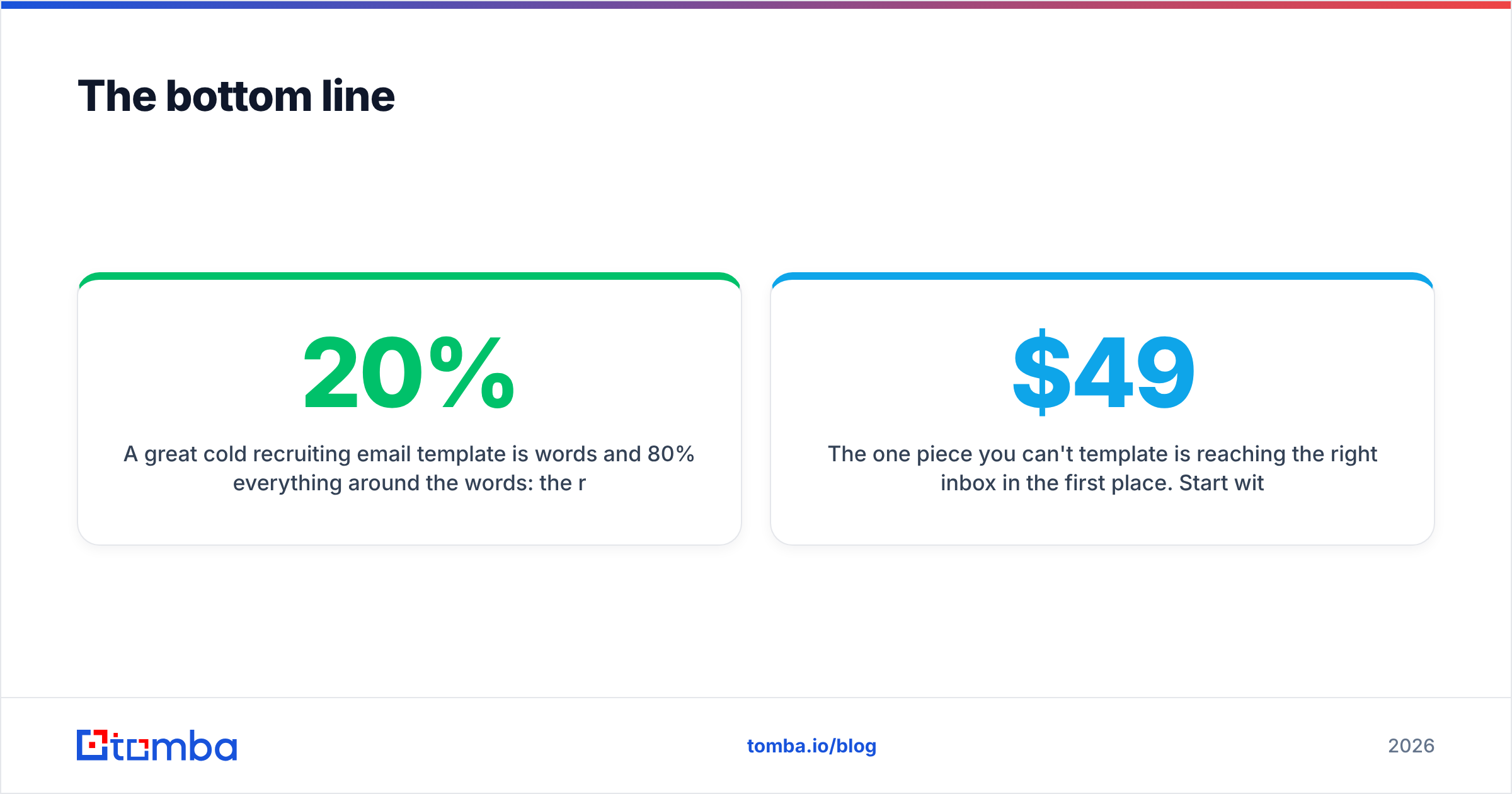
A great cold recruiting email template is 20% words and 80% everything around the words: the right recipient, a verified address, a relevant first line, and a single easy ask. Copy the seven templates here, personalize only the opener, follow up two or three times, and measure bounce, open, and reply rate in that order.
The one piece you can't template is reaching the right inbox in the first place. Start with Tomba's Email Finder to locate and verify candidate addresses by name or company, then send. Plans start free with 25 searches a month, and paid tiers begin at $49/mo — see Tomba pricing for the full breakdown. Get the address right, and your templates finally get the replies they deserve.
Related guides#
Ready to find emails that actually work?
Join 150,000+ professionals who stopped guessing and started sending. Free credits on signup — no credit card required.
Get the Tomba newsletter
Practical outbound tactics and product updates — once every two weeks.
About the author