Cold Reply Examples: 12 Real Responses That Book Meetings
Swipe 12 proven cold replies examples for the objections, brush-offs, and green lights you actually get — plus a framework to write your own that book meetings.
When a prospect finally replies to your cold email, the deal is not won — it is on the clock. The reply is where most reps freeze, send a generic "Great, when works for you?", and watch the thread go cold. This guide gives you cold replies examples for the responses you actually get: the brush-off, the price objection, the "send me info," the referral, and the rare enthusiastic yes.
TL;DR#
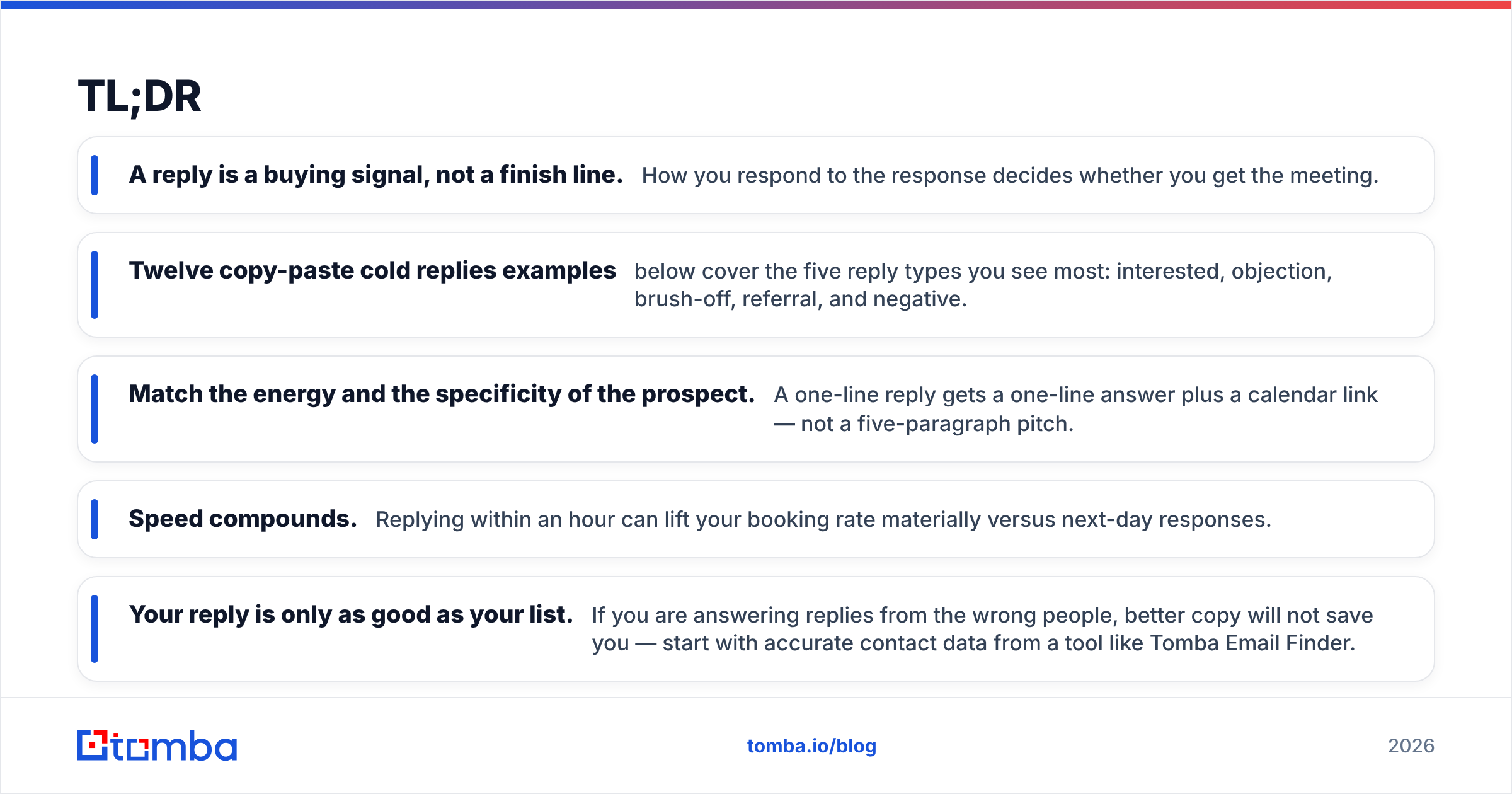
- A reply is a buying signal, not a finish line. How you respond to the response decides whether you get the meeting.
- Twelve copy-paste cold replies examples below cover the five reply types you see most: interested, objection, brush-off, referral, and negative.
- Match the energy and the specificity of the prospect. A one-line reply gets a one-line answer plus a calendar link — not a five-paragraph pitch.
- Speed compounds. Replying within an hour can lift your booking rate materially versus next-day responses.
- Your reply is only as good as your list. If you are answering replies from the wrong people, better copy will not save you — start with accurate contact data from a tool like Tomba Email Finder.
Why do your replies matter more than your first email?#
Here is the counterintuitive part: your opening cold email is a lottery ticket, but your reply is the actual sale. The first email only has to earn a response. The reply has to earn a calendar slot, and that is a much higher bar.
Think of it like fishing. The cold email is the cast — you are just trying to get a bite. The reply is reeling in. Yank too hard (a wall of text and three CTAs) and the line snaps. Go slack (a lazy "let me know!") and the fish swims off. Most reps obsess over the cast and completely fumble the reel.
The data backs this up. Response handling is where pipeline is made or lost, and it is almost entirely within your control — unlike open rates, which depend on email deliverability and inbox placement you only partly influence.
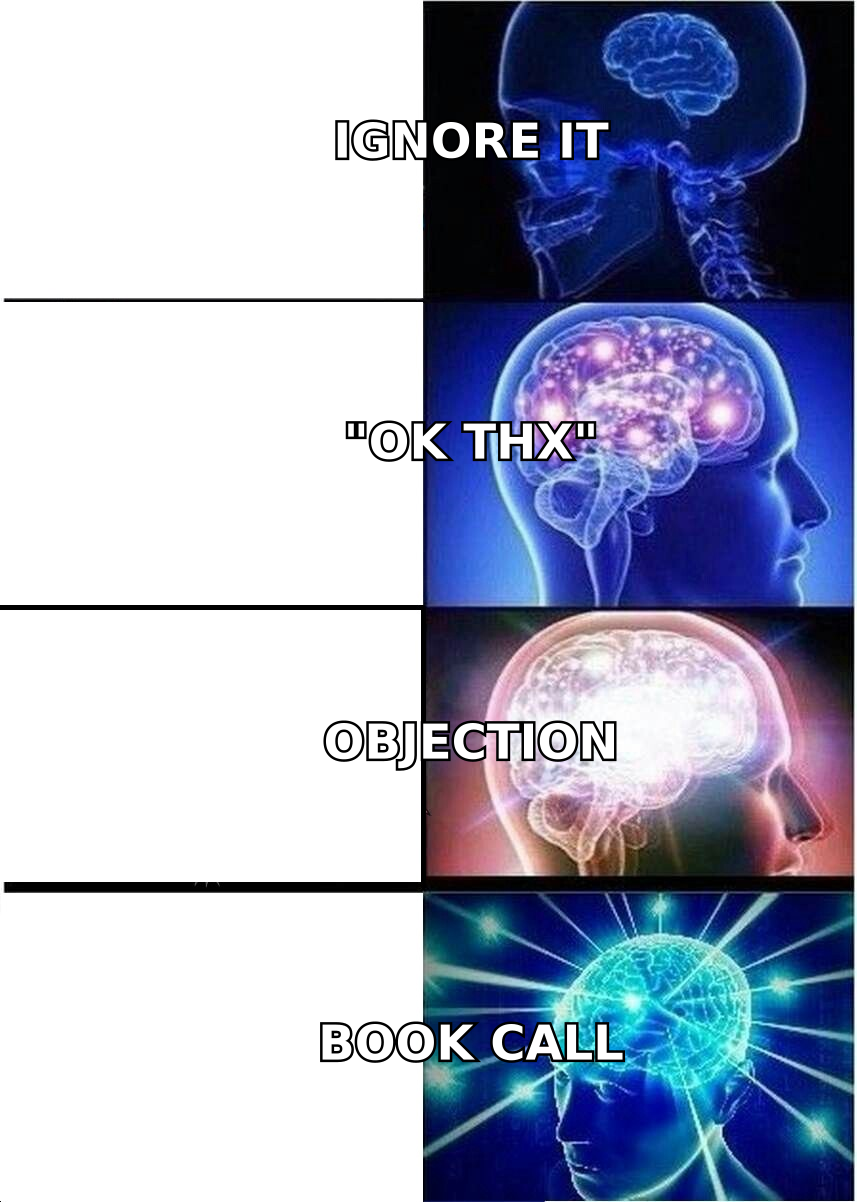
Wait — that image slot is a meme. Here it is:
What are the five types of cold email replies?#
Before you can write a good reply, you have to diagnose what kind of reply you received. Almost every response falls into one of five buckets. Match your reaction to the bucket and you will never freeze again.
- The green light — "Sounds interesting, tell me more." Rare and precious. Do not over-sell; just book the call.
- The objection — "We already use X" or "No budget right now." A door that is ajar, not closed.
- The brush-off — "Send me some info" or "Circle back in Q3." Polite deflection that needs re-engaging.
- The referral — "That's not me, talk to Sarah." Pure gold; you just got warm-transferred.
- The negative — "Not interested" or "Unsubscribe." Respect it, but there is one clean save worth trying.
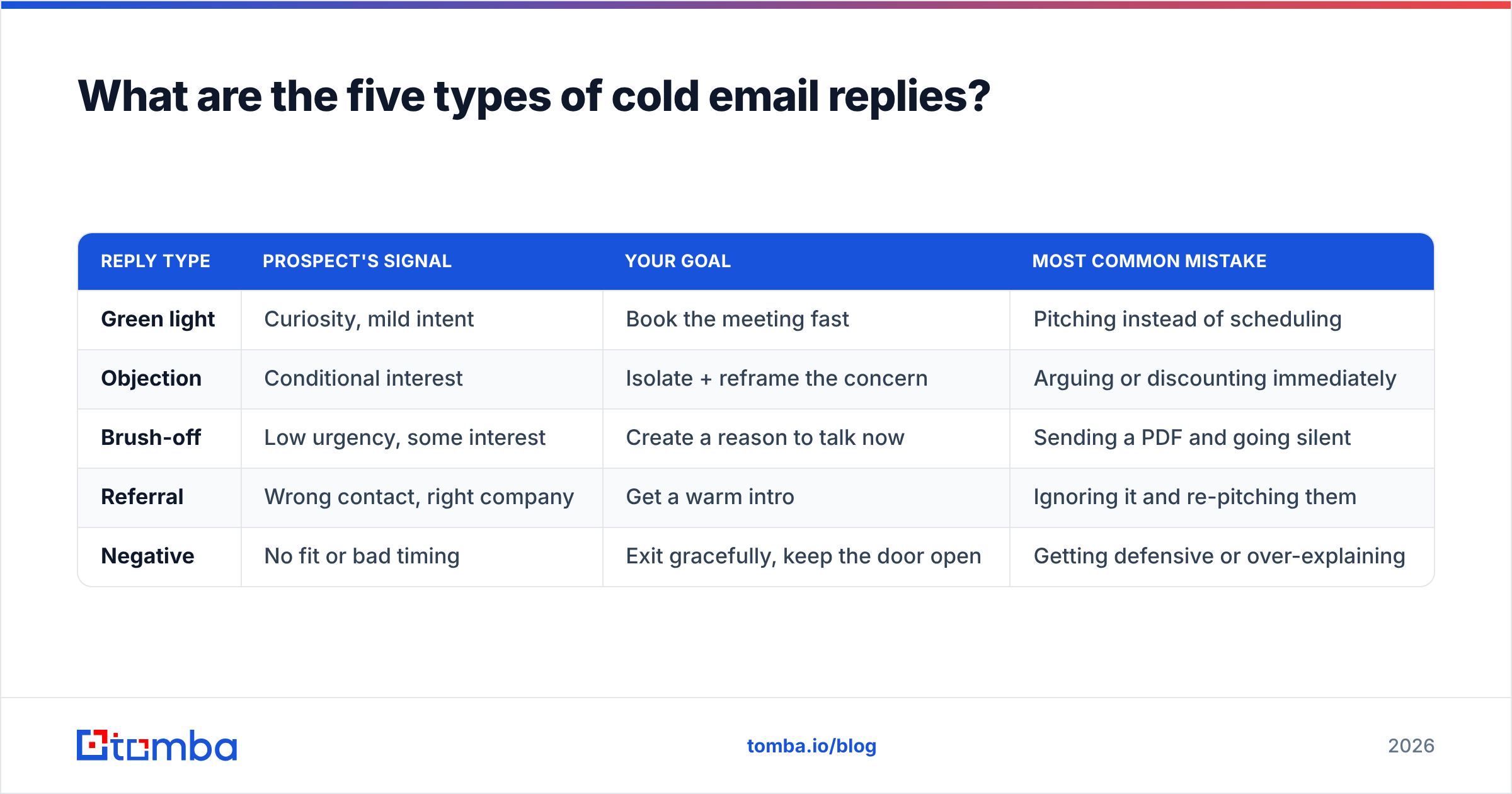
The table below maps each reply type to the goal of your response and the single biggest mistake reps make.
| Reply type | Prospect's signal | Your goal | Most common mistake |
|---|---|---|---|
| Green light | Curiosity, mild intent | Book the meeting fast | Pitching instead of scheduling |
| Objection | Conditional interest | Isolate + reframe the concern | Arguing or discounting immediately |
| Brush-off | Low urgency, some interest | Create a reason to talk now | Sending a PDF and going silent |
| Referral | Wrong contact, right company | Get a warm intro | Ignoring it and re-pitching them |
| Negative | No fit or bad timing | Exit gracefully, keep the door open | Getting defensive or over-explaining |
Cold replies examples: the "interested" green light#
When someone says "This sounds interesting," your only job is to remove friction between now and a booked call. Do not re-explain your product. Do not attach a deck. Book the time.
Example 1 — the interested prospect
Hi Marcus,
Love it — glad it landed. The fastest way to see if this is a fit for [Company] is a focused 15 minutes where I walk through exactly how [similar company] cut their prospecting time in half.
Here's my calendar: [link]. Grab whatever slot is least annoying.
— Ben
Example 2 — interested but "how much?"
Hi Priya,
Happy to share pricing — it scales with team size, and for a team your size you'd likely be on our Growth plan. Rather than guess, let me confirm the two variables that move the number on a quick call so I don't quote you wrong: [link].
If you'd prefer the ballpark in writing first, just say the word.
Notice the second example does not dodge the pricing question — dodging kills trust. It gives a real anchor ("Growth plan") and offers the written option. Transparency is a conversion tool, which is why publishing clear Tomba pricing beats "contact us for a quote."
Cold replies examples: handling objections#
Objections are not rejections. "We already use a competitor" means they have budget, a use case, and internal buy-in for the category — they have done 80% of your job for you.
Example 3 — "We already use [competitor]"
Hi Dana,
Makes sense — [competitor] is solid. Most teams that switch to us don't do it because [competitor] is bad; they do it because their accuracy on catch-all domains was costing them bounces. If that's a non-issue for you, honestly stick with what works.
If it is a quiet annoyance, I'll show you a 3-minute side-by-side. Worth it? [link]
Example 4 — "No budget right now"
Hi Tom,
Totally fair — budget cycles are what they are. Two options: I can send a one-pager you can park until planning season, or we do a 15-minute call now so that when budget frees up you already know the ROI math. Which is more useful?
Example 5 — "Now's not a good time"
Hi Alex,
No problem. Rather than a vague "circle back later," when does [initiative] actually kick off? I'll set a reminder and reach out then with something relevant instead of a generic nudge.
The pattern across all three: agree, isolate the real concern, then offer a low-commitment next step. You are never arguing. Arguing with an objection makes the prospect defend it harder.
Cold replies examples: the brush-off#
"Send me some info" is the most dangerous reply because it feels like progress. It usually is not. If you send a PDF and wait, you will wait forever. Re-engage instead.
Example 6 — "Just send me info"
Hi Rachel,
I could send a deck, but you'd have to reverse-engineer which 3 slides apply to [Company] out of 30. Give me one line on your biggest headache with [problem area] and I'll send back only the part that matters — or a 10-minute call and I'll just show you. Your call.
Example 7 — "Circle back next quarter"
Hi Sam,
Will do. Quick thing so next quarter isn't a cold start: are you evaluating this to fix [pain A] or [pain B]? Knowing that, I'll come back with a tailored example instead of "just checking in."
Example 8 — the silent re-engage (no reply to your reply)
Hi Jordan,
Floating this back up in case it slipped. Still worth a look, or should I close the loop and stop cluttering your inbox?
That last line — the permission-to-close — has an almost unfair reply rate. People hate loose threads and will often respond just to resolve it. This is a proven response rate tactic, not a gimmick.
Cold replies examples: the referral#
When a prospect points you to someone else, you have been handed a warm introduction. Treat it with care.
Example 9 — "That's not my department"
Hi Chris,
Appreciate you pointing me the right way. Two quick asks: (1) mind if I mention you suggested I reach out to [name]? (2) is [name] the right person for [specific responsibility], or is there someone else who owns the final call? Thanks for the steer.
Example 10 — reaching the referred contact
Hi Sarah,
Chris over in Ops suggested you're the right person for [topic]. He mentioned [specific detail]. I'll keep this short: [one-sentence value]. Worth 15 minutes, or should I send the short version in writing first? [link]
The referral only works if you can actually reach the new person. When someone says "talk to the VP of Marketing," you need that VP's real address — that is where a domain search across the company saves you an hour of guessing formats.
Cold replies examples: the graceful negative#
Most "not interested" replies deserve a clean exit. But one save is worth trying, because a fast, low-ego response occasionally flips a reflexive no.
Example 11 — "Not interested"
Hi Lee,
Understood — I'll take you off my list. If it was the timing rather than the idea, reply "later" and I'll check back in six months. Either way, thanks for the honest reply.
Example 12 — "Unsubscribe / stop emailing me"
Done — you're off the list, effective now. Apologies for the interruption, and good luck with [initiative].
No pitch. No guilt trip. Honoring an opt-out immediately also protects your sender reputation — ignored unsubscribes are how domains land on blocklists.
How fast should you reply to a cold email response?#
Fast. Within an hour if you can, same business day at the latest. A reply is a window of attention, and attention decays by the minute. The prospect who wrote "sounds interesting" at 9:14 a.m. is in a meeting by 9:45 and has forgotten you by lunch.
Speed does not mean sloppy. It means having these templates ready so you can personalize the top line, drop in a calendar link, and send in under two minutes. Save each of the five reply types as a snippet in your inbox or CRM.
| Response time | Relative booking outcome | Why |
|---|---|---|
| Under 1 hour | Best | You catch them still thinking about it |
| 1–4 hours | Strong | Same context, mild decay |
| Same day | Acceptable | Requires a stronger re-hook |
| Next day+ | Weak | You're now re-selling the original email |
How do you write your own cold replies that convert?#
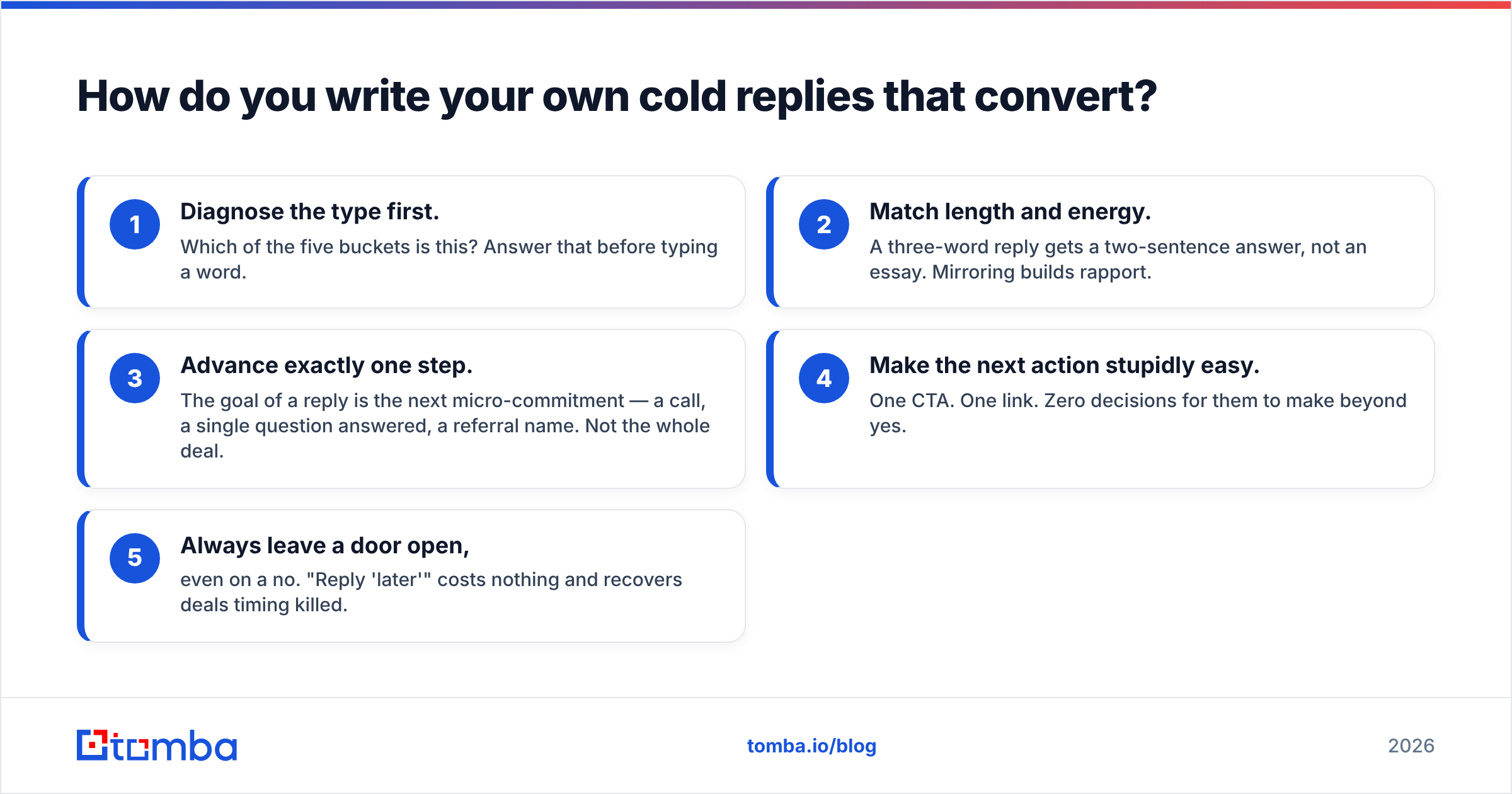
Templates are a starting point, not a script. Run every reply you write through this five-point checklist:
- Diagnose the type first. Which of the five buckets is this? Answer that before typing a word.
- Match length and energy. A three-word reply gets a two-sentence answer, not an essay. Mirroring builds rapport.
- Advance exactly one step. The goal of a reply is the next micro-commitment — a call, a single question answered, a referral name. Not the whole deal.
- Make the next action stupidly easy. One CTA. One link. Zero decisions for them to make beyond yes.
- Always leave a door open, even on a no. "Reply 'later'" costs nothing and recovers deals timing killed.
If you want a running start on the opener that earns these replies in the first place, browse Tomba's cold email templates and adapt the tone to your market.
For deeper study of what makes outbound sequences reply-worthy, HubSpot's sales blog and the peer reviews on G2's sales engagement category are both worth an afternoon.
The reply strategy only works if you're emailing the right people#
You can memorize all twelve of these cold replies examples and still generate zero pipeline — if the replies are coming from unqualified contacts, wrong-role inboxes, or addresses that bounced before anyone read them.
Great reply handling multiplies a good list. It cannot fix a bad one. Before you optimize what you say after the reply, make sure the person on the other end is the decision-maker you meant to reach and their address is verified. That is exactly what Tomba Email Finder is built for: find the right professional's email by name, company, or domain, verify it before you send, and start every thread with someone who can actually say yes. Pair it with the email verifier to keep bounces down and your sender reputation intact — then let these replies do the closing.
Start on the free tier (25 searches a month), and when your reply-handling turns those searches into meetings, scale up. The templates are free. The right list is what makes them work.
Related guides#
Ready to find emails that actually work?
Join 150,000+ professionals who stopped guessing and started sending. Free credits on signup — no credit card required.
Get the Tomba newsletter
Practical outbound tactics and product updates — once every two weeks.
About the author