Cold Reply Mastery: How to Get More Replies to Cold Emails in 2026
Most cold emails die in silence. This 2026 guide breaks down why your cold reply rate is low, how to fix it, and how to handle every reply type — from objections to instant yeses.
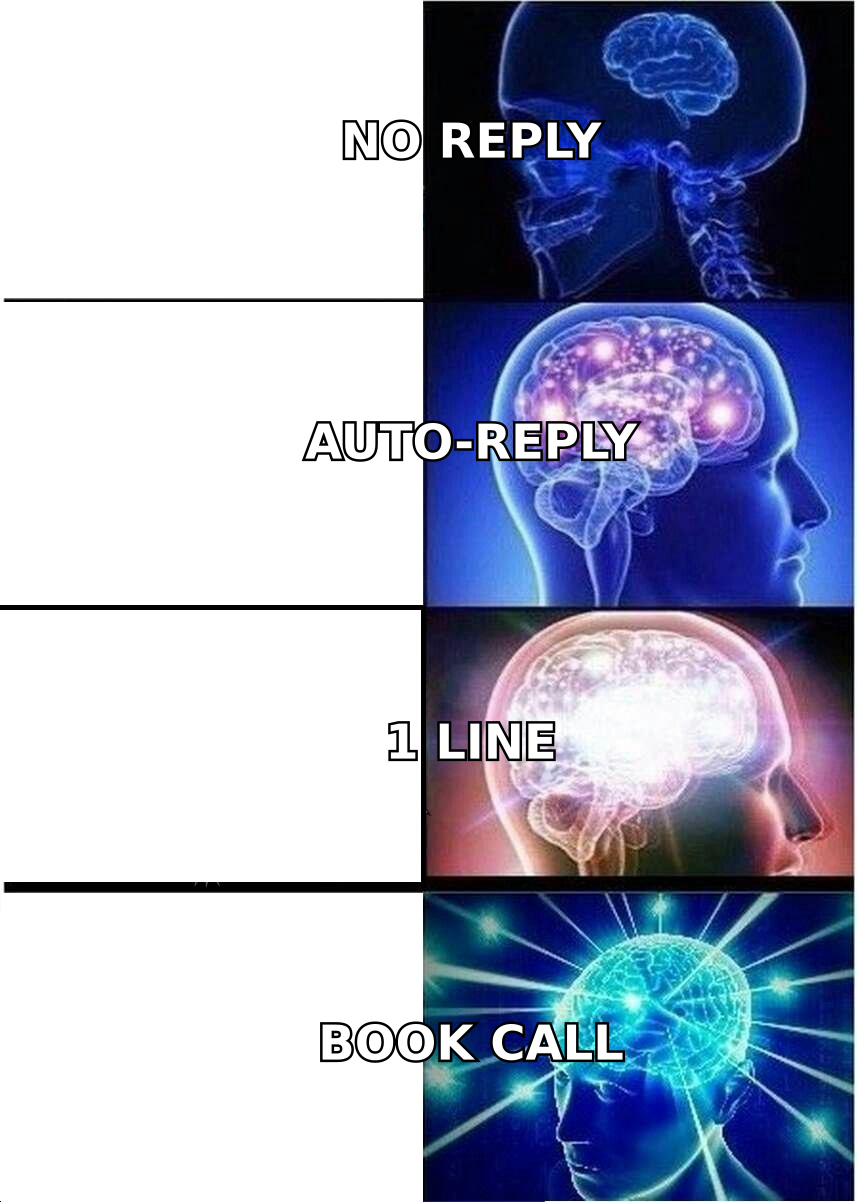
Sending 500 cold emails and hearing nothing back is not bad luck. It is a feedback signal. A low cold reply rate almost always traces to a handful of fixable causes — bad data, weak targeting, generic copy, or replies you never actually see because they landed in spam. Fix those, and the same list that produced silence starts producing conversations.
This guide is about the cold reply: the metric, the mechanics, and the muscle. You will learn what a healthy reply rate looks like in 2026, the exact levers that move it, and how to respond to every kind of reply you get — including the awkward ones.
TL;DR#
- A "cold reply" is any response to an unsolicited outbound email — positive, negative, or neutral. Reply rate, not open rate, is the metric that predicts pipeline.
- Benchmark: 1–5% is average, 8–15% is strong for a well-targeted B2B list. If you are under 1%, the problem is almost always list quality or deliverability, not copy.
- The four levers that move reply rate: verified data, tight targeting, relevance in the first two lines, and a single low-friction ask.
- Reply handling is half the game. A fast, specific response to a "not now" or "send me info" reply converts far more than most reps expect.
- Tools matter. Clean data from a real email verifier and accurate contacts from an email finder protect the sender reputation that makes replies possible at all.
What Is a Cold Reply and Why Does It Matter More Than Opens?#
A cold reply is any answer a prospect sends to an email they never asked to receive. It is the first real signal that a human read your message and decided you were worth thirty seconds of their time.
Think of open rate as someone glancing at your storefront window and reply rate as someone walking in and asking a question. The glance feels good, but only the second one can become a sale. Since Apple Mail Privacy Protection and similar features started pre-loading images, open tracking has become noisy and often inflated — a pixel can fire without a human ever seeing the email. Replies cannot be faked by a privacy proxy. When someone types words back to you, that is real intent.
That is why serious outbound teams now optimize for reply rate as the north-star metric of a campaign, and treat opens as a rough diagnostic at best. If you want a deeper primer on the surrounding terms, HubSpot's sales glossary is a solid neutral reference.
What Is a Good Cold Reply Rate in 2026?#
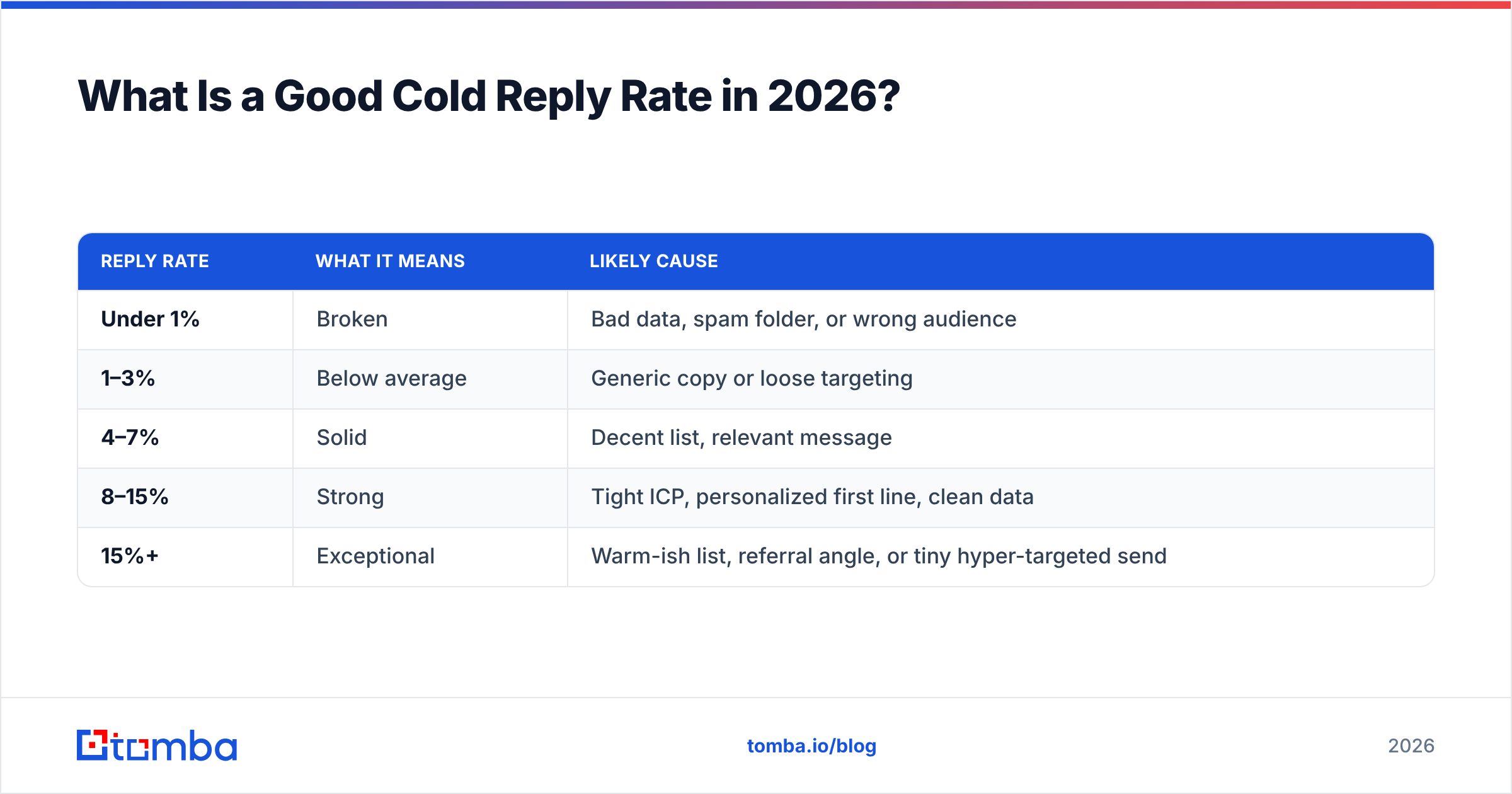
Short answer: it depends on your list quality and how narrow your targeting is, but here are the honest ranges most B2B teams see.
| Reply rate | What it means | Likely cause |
|---|---|---|
| Under 1% | Broken | Bad data, spam folder, or wrong audience |
| 1–3% | Below average | Generic copy or loose targeting |
| 4–7% | Solid | Decent list, relevant message |
| 8–15% | Strong | Tight ICP, personalized first line, clean data |
| 15%+ | Exceptional | Warm-ish list, referral angle, or tiny hyper-targeted send |
Two caveats. First, smaller and more targeted sends almost always beat large blasts on reply rate — a 40-person list to exact-fit prospects can hit 20% while a 5,000-person blast struggles to clear 2%. Second, "reply rate" includes negative replies. A campaign with a 10% reply rate where most responses are "unsubscribe" is worse than a 5% rate that is mostly "tell me more." Track positive reply rate separately.
Why Is My Cold Reply Rate So Low?#
If you are stuck under 2%, work down this list in order. The causes are ranked by how often they are the real culprit.
- Your emails are in spam. This is the number one silent killer. If a message never reaches the inbox, copy quality is irrelevant. Check your SPF, DKIM, and DMARC records, warm up new sending domains, and keep volume per inbox low. You can spot-check reputation with a free sender reputation checker before you scale a campaign.
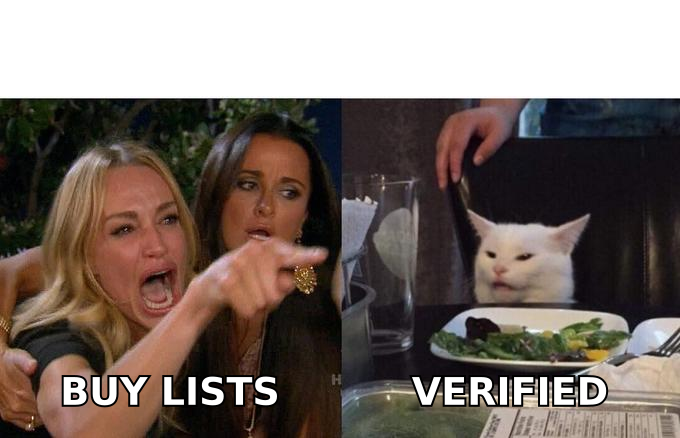
- Your data is stale or unverified. Bounces wreck sender reputation, which pushes future emails to spam — a doom loop. Every list should pass through an email verifier before send, ideally keeping bounce rate under 2%.
- You are emailing the wrong people. A perfect message to someone with no budget or authority still gets silence. Tighten your ICP and use accurate targeting instead of scraped bulk lists.
- Your first two lines are about you. "I'm reaching out because we help companies like yours..." is an instant delete. The opening must be about the prospect.
- Your ask is too big. "Do you have 30 minutes this week for a demo?" is a heavy first request. Lower the friction.
How Do You Actually Increase Cold Replies?#
Fixing deliverability gets you into the inbox. These four levers get you the reply once you are there.
1. Start With Verified, Accurate Data#
Reply rate is capped by the quality of the addresses you send to. Guessed or scraped emails bounce, and bounces destroy the reputation that lands you in the inbox in the first place. Build lists from a real source: find the right contact with the Tomba Email Finder, then confirm it is deliverable before it ever enters a sequence. Where you get your data matters as much as what you write — a point worth checking against any vendor's own data sources documentation.
If you are buying a list instead of building one, treat provider accuracy claims skeptically and cross-check reviews on a neutral site like G2. Established data vendors such as BookYourData can be a reasonable starting point, but you should still verify every address before you send — no provider is 100% accurate, and unverified imports are the fastest way to torch a sending domain.
2. Personalize the First Line, Not the Whole Email#
You do not need a hand-written novel for each prospect. You need the first one or two lines to prove you know who they are. Reference a recent hire, a product launch, a specific line from their careers page, or a trigger event. Everything after the opening can be a strong shared template.
3. Make One Low-Friction Ask#
The goal of a first cold email is a reply, not a signed contract. Ask a question that is easy to answer with one sentence. "Is reducing onboarding time a priority this quarter, or is that already handled?" invites a yes or no. "Book a 30-minute demo" invites nothing.
4. Follow Up — Most Replies Come From Email 2, 3, or 4#
The majority of positive replies arrive on follow-ups, not the first touch. A sequence of three to five spaced, value-adding messages will typically double or triple the reply rate of a single send. Each follow-up should add a new angle, not just "bumping this to the top of your inbox." If you need a starting point, grab proven cold email templates and adapt them to your ICP.
How Should You Respond to Each Type of Cold Reply?#
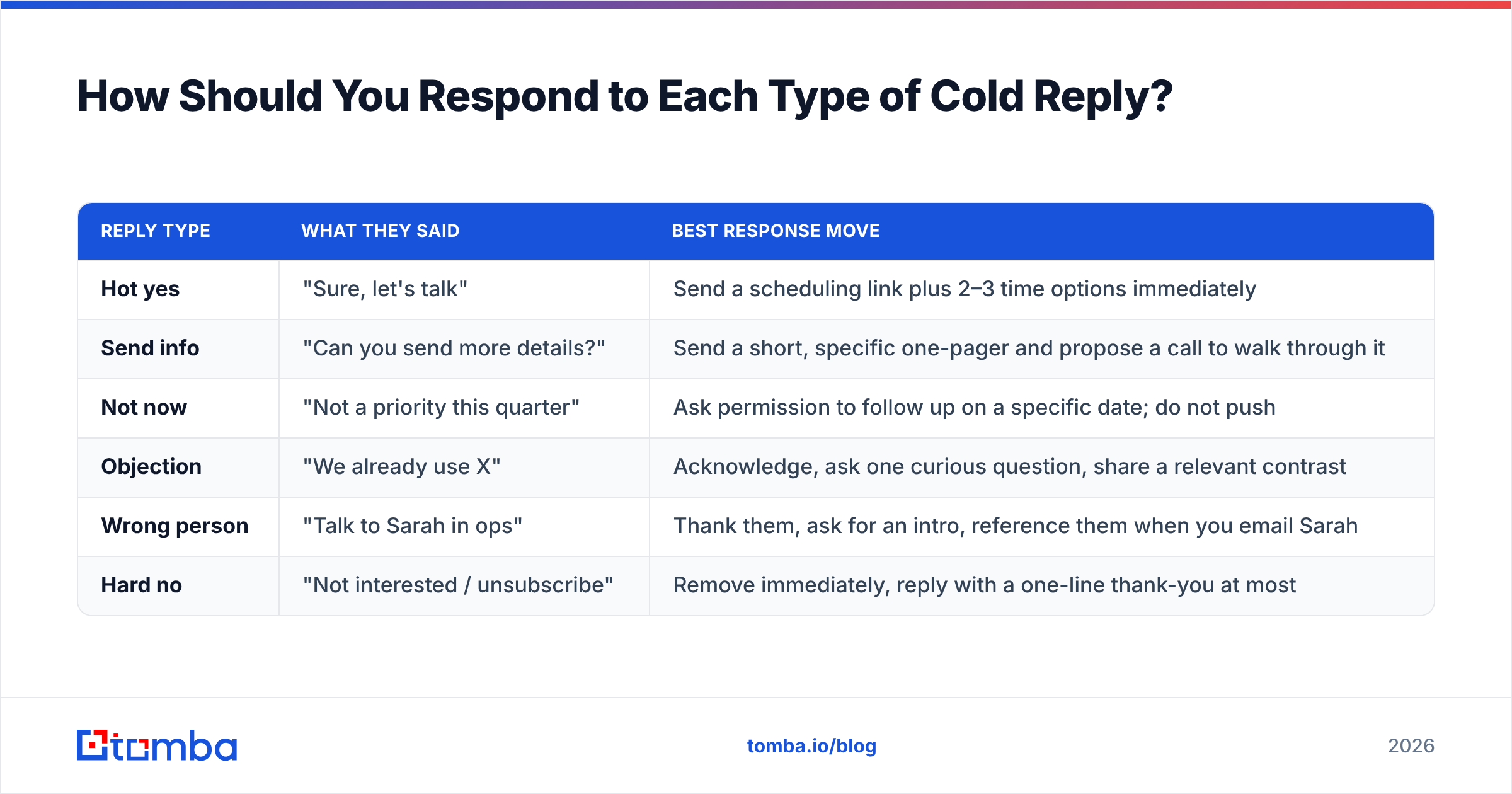
Getting the reply is only half the win. How you respond in the next hour decides whether it becomes a meeting. Speed matters enormously — responding within an hour dramatically outperforms next-day replies.
| Reply type | What they said | Best response move |
|---|---|---|
| Hot yes | "Sure, let's talk" | Send a scheduling link plus 2–3 time options immediately |
| Send info | "Can you send more details?" | Send a short, specific one-pager and propose a call to walk through it |
| Not now | "Not a priority this quarter" | Ask permission to follow up on a specific date; do not push |
| Objection | "We already use X" | Acknowledge, ask one curious question, share a relevant contrast |
| Wrong person | "Talk to Sarah in ops" | Thank them, ask for an intro, reference them when you email Sarah |
| Hard no | "Not interested / unsubscribe" | Remove immediately, reply with a one-line thank-you at most |
A few rules that apply across every row. Match their energy and length — a two-word reply does not warrant a five-paragraph response. Never argue with an objection; get curious instead. And treat a referral to another person as a gift: a warm-ish intro from a colleague converts far better than a fresh cold email.
For the "wrong person" case, this is where a good workflow pays off. When someone points you to a colleague, use domain search to find that colleague's verified address in seconds instead of guessing the format and risking a bounce.
What Tools Actually Move the Needle on Cold Replies?#
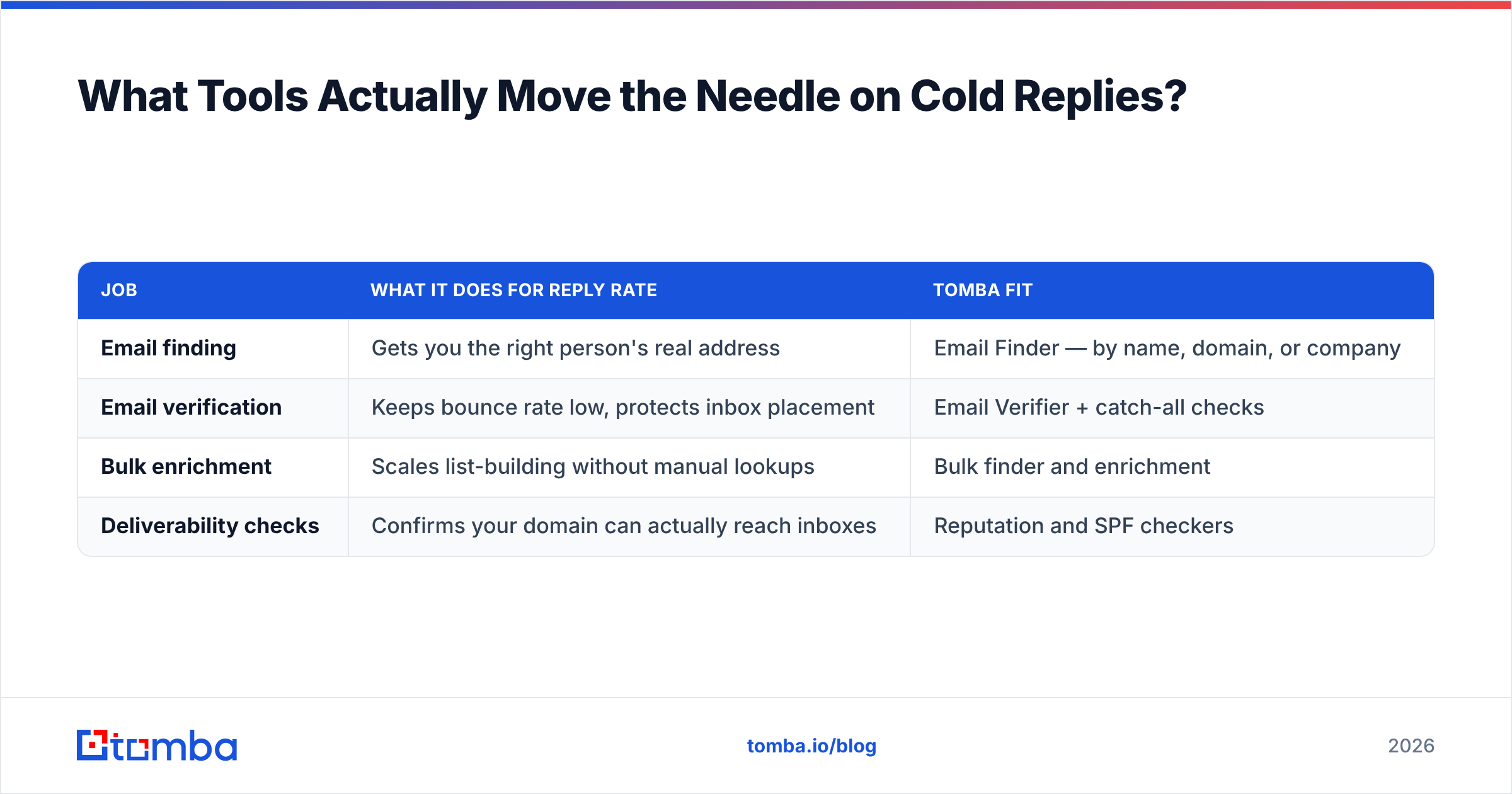
You do not need a bloated stack. You need three things working well: accurate contact data, verification before send, and a way to sequence and track replies. Here is how the core categories compare.
| Job | What it does for reply rate | Tomba fit |
|---|---|---|
| Email finding | Gets you the right person's real address | Email Finder — by name, domain, or company |
| Email verification | Keeps bounce rate low, protects inbox placement | Email Verifier + catch-all checks |
| Bulk enrichment | Scales list-building without manual lookups | Bulk finder and enrichment |
| Deliverability checks | Confirms your domain can actually reach inboxes | Reputation and SPF checkers |
On budget: you can start validating this workflow for free. Tomba's free tier includes 25 searches a month, and paid plans begin at $49/mo for Starter, $99/mo for Growth, and $249/mo for Pro. Full Tomba pricing is public, so you can size a plan against your monthly send volume without a sales call.
The point of the stack is not features — it is protecting the two things that make replies possible: a clean list and a healthy sending reputation. Every bounced email from an unverified address quietly lowers the ceiling on your next campaign's reply rate.
How Do You Measure and Improve Cold Reply Rate Over Time?#
Treat every campaign as an experiment with one variable. If you change the subject line, the first line, and the ask all at once, you will never know which one moved the number.
- Track positive reply rate, not just total replies. Tag responses as positive, neutral, or negative so a wave of "unsubscribes" does not masquerade as success.
- A/B test one element at a time. Subject line first, then first line, then the ask, then send time. Run each test to at least a few hundred sends before drawing conclusions.
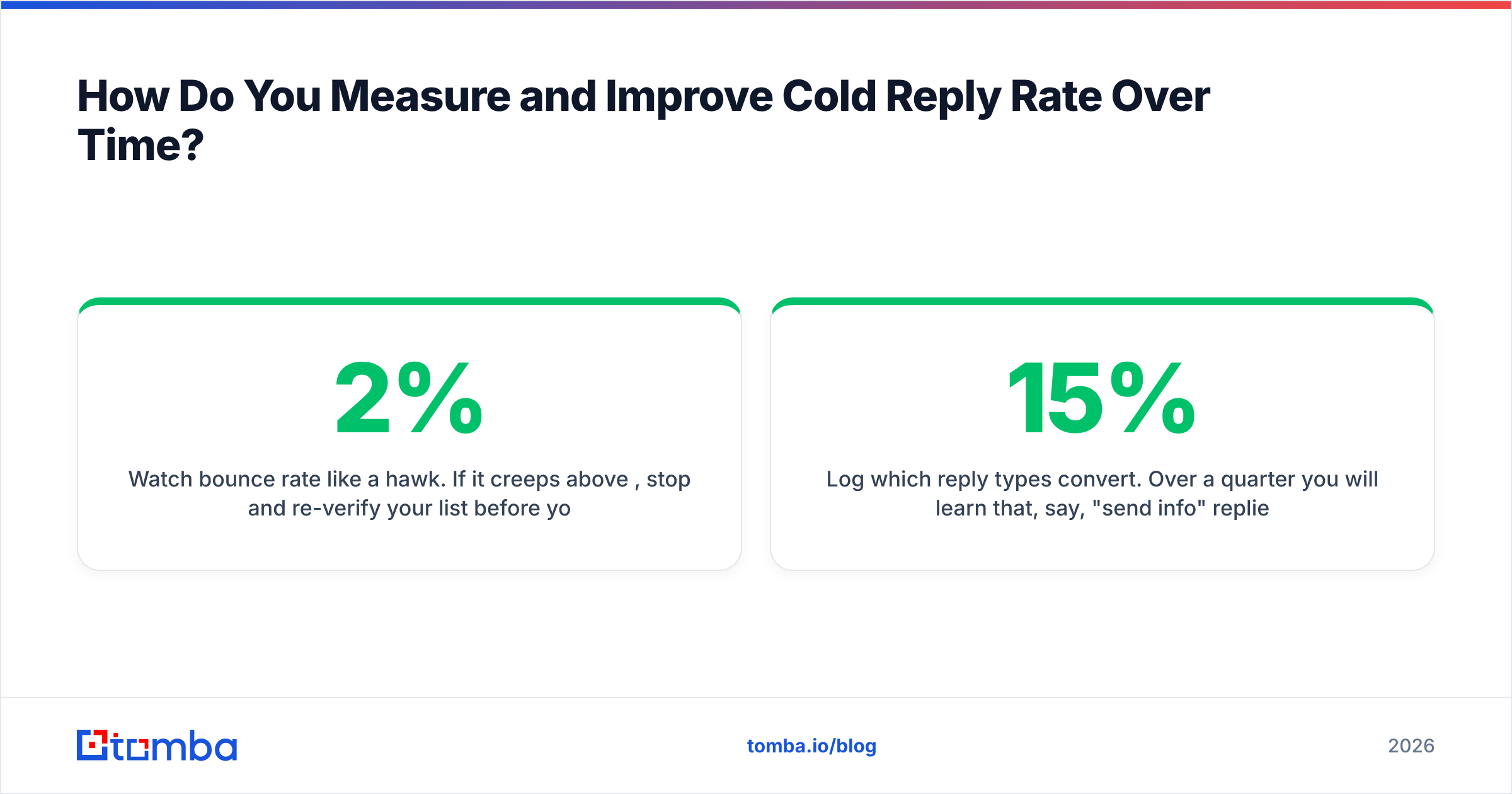
- Watch bounce rate like a hawk. If it creeps above 2%, stop and re-verify your list before you damage your domain.
- Review negative replies for patterns. Ten "wrong person" responses mean your targeting or job-title filter is off, not your copy.
- Log which reply types convert. Over a quarter you will learn that, say, "send info" replies close at 15% while "not now" replies close at 40% when nurtured — and you can prioritize accordingly.
If you want the textbook framing of the sales metrics behind this, the concept of a reply rate sits inside the broader email-marketing discipline, and the fundamentals there apply directly to outbound.
Frequently Asked Questions#
What counts as a cold reply? Any response to an email the recipient did not ask for — positive, negative, or a referral. Even "unsubscribe" is a reply, though not the kind you want.
Is reply rate better than open rate? Yes, for measuring campaign health. Open tracking is unreliable after mail-privacy features, while a reply is unambiguous proof a human engaged.
How fast should I respond to a cold reply? Within the hour if you can. Response speed is one of the strongest predictors of whether a positive reply becomes a booked meeting.
Why do I get opens but no replies? Usually a mismatch between the promise of the subject line and the relevance of the body, or an ask that is too heavy for a first touch. Lower the friction and make the first line about them.
Will better data really change my reply rate? Directly and indirectly. Directly, you reach real people. Indirectly, low bounces keep you out of spam, which is the single biggest hidden cause of silent campaigns.
The Bottom Line#
A low cold reply rate is a diagnosis, not a verdict. Get into the inbox, send to verified people who actually fit your ICP, make the first line about them and the ask small, then follow up and respond fast. Do those five things and the same audience that ignored you starts booking calls.
The foundation under all of it is data you can trust. Before your next campaign, run your list through a real finder-and-verifier workflow so every send lands on a real person with a real inbox. Start with the Tomba Email Finder — find the right contacts, verify them, and give your copy a fighting chance to earn the reply.
Related guides#
Ready to find emails that actually work?
Join 150,000+ professionals who stopped guessing and started sending. Free credits on signup — no credit card required.
Get the Tomba newsletter
Practical outbound tactics and product updates — once every two weeks.
About the author