Cold, Warm, and Hot Leads: How to Score and Convert Each
Not every lead deserves the same email. Here's how to tell cold, warm, and hot leads apart, score each one, and match your outreach to real buying intent in 2026.
Every rep has done it: fired the same "quick question" email at a stone-cold contact and a buyer who just requested a demo. One ignored you. One was already reaching for a credit card. Treating those two people the same is the fastest way to burn a pipeline.
The fix is simple to say and harder to do: sort your leads into cold, warm, and hot, then match your outreach to where each one actually sits. This guide breaks down what each stage means, how to score them, and exactly what to send.
TL;DR#
- Cold leads don't know you and haven't shown intent. Your job is a relevant first touch, not a hard pitch.
- Warm leads have engaged — opened, clicked, visited pricing, replied once. Your job is to nurture and qualify.
- Hot leads are actively evaluating and ready to talk. Your job is to remove friction and book the meeting fast.
- Lead scoring turns these labels into numbers so routing and follow-up stop being guesswork.
- Accurate contact data is the foundation — a "hot" lead is worthless if the email bounces.
What are cold, warm, and hot leads?#
The short version: the three labels describe how much a lead knows about you and how much buying intent they've shown. Temperature is a proxy for readiness to buy.
Think of it like dating. A cold lead is a stranger across the room — no context, no relationship. A warm lead is someone you've chatted with a few times who seems interested. A hot lead is already asking what you're doing Friday night. You wouldn't propose to the stranger, and you wouldn't make the interested person sit through three more small-talk emails before asking them out.
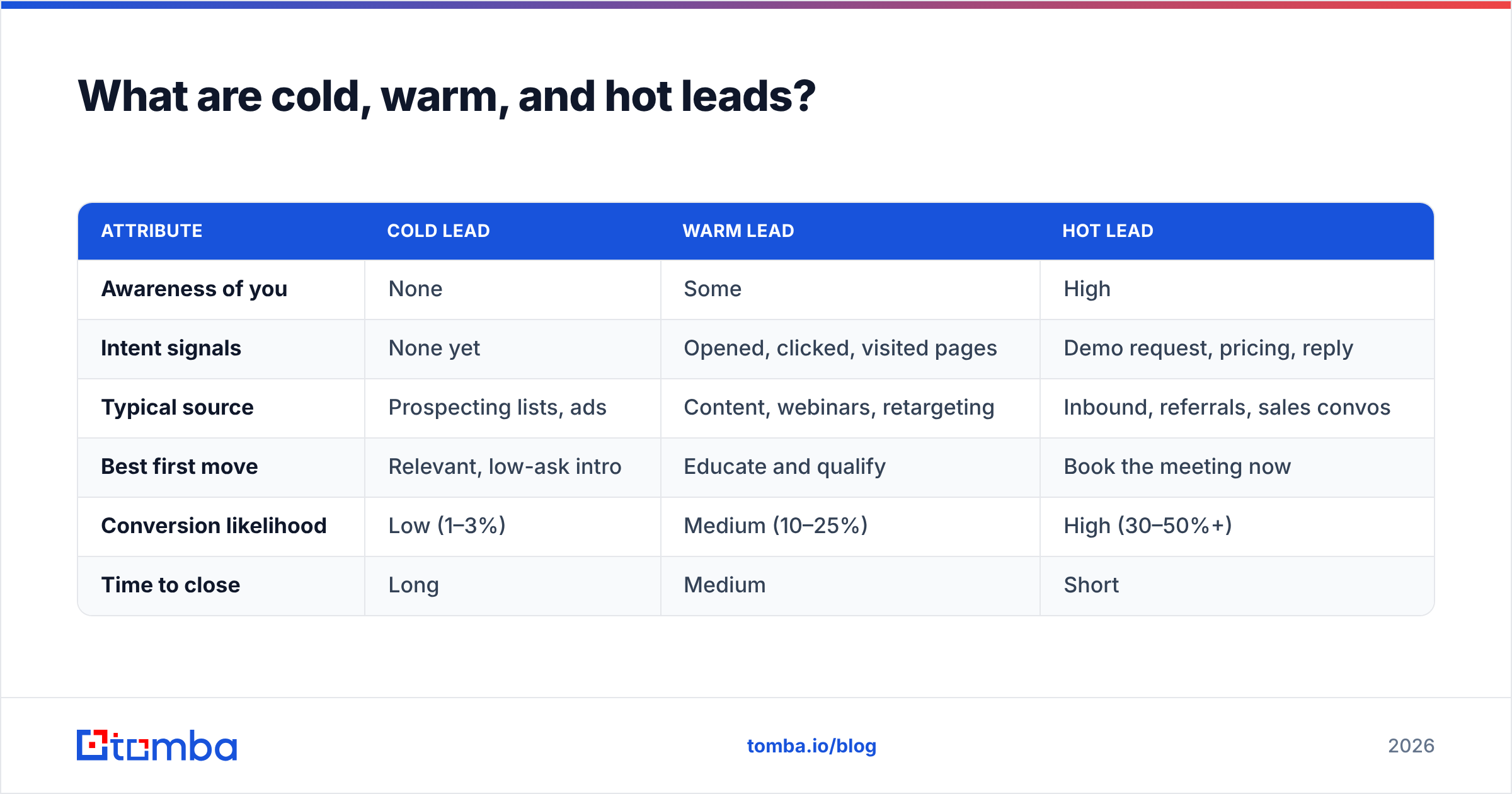
Here's how the three stages compare across the attributes that actually change your next move:
| Attribute | Cold Lead | Warm Lead | Hot Lead |
|---|---|---|---|
| Awareness of you | None | Some | High |
| Intent signals | None yet | Opened, clicked, visited pages | Demo request, pricing, reply |
| Typical source | Prospecting lists, ads | Content, webinars, retargeting | Inbound, referrals, sales convos |
| Best first move | Relevant, low-ask intro | Educate and qualify | Book the meeting now |
| Conversion likelihood | Low (1–3%) | Medium (10–25%) | High (30–50%+) |
| Time to close | Long | Medium | Short |
Those conversion ranges vary by industry and price point, but the ordering never changes: intent beats volume. A smaller list of warm and hot leads will out-convert a giant pile of cold ones almost every time.

How do you identify each type of lead?#
You identify lead temperature by combining who someone is (fit) with what they've done (behavior). Fit tells you whether they're the right buyer; behavior tells you how ready they are.
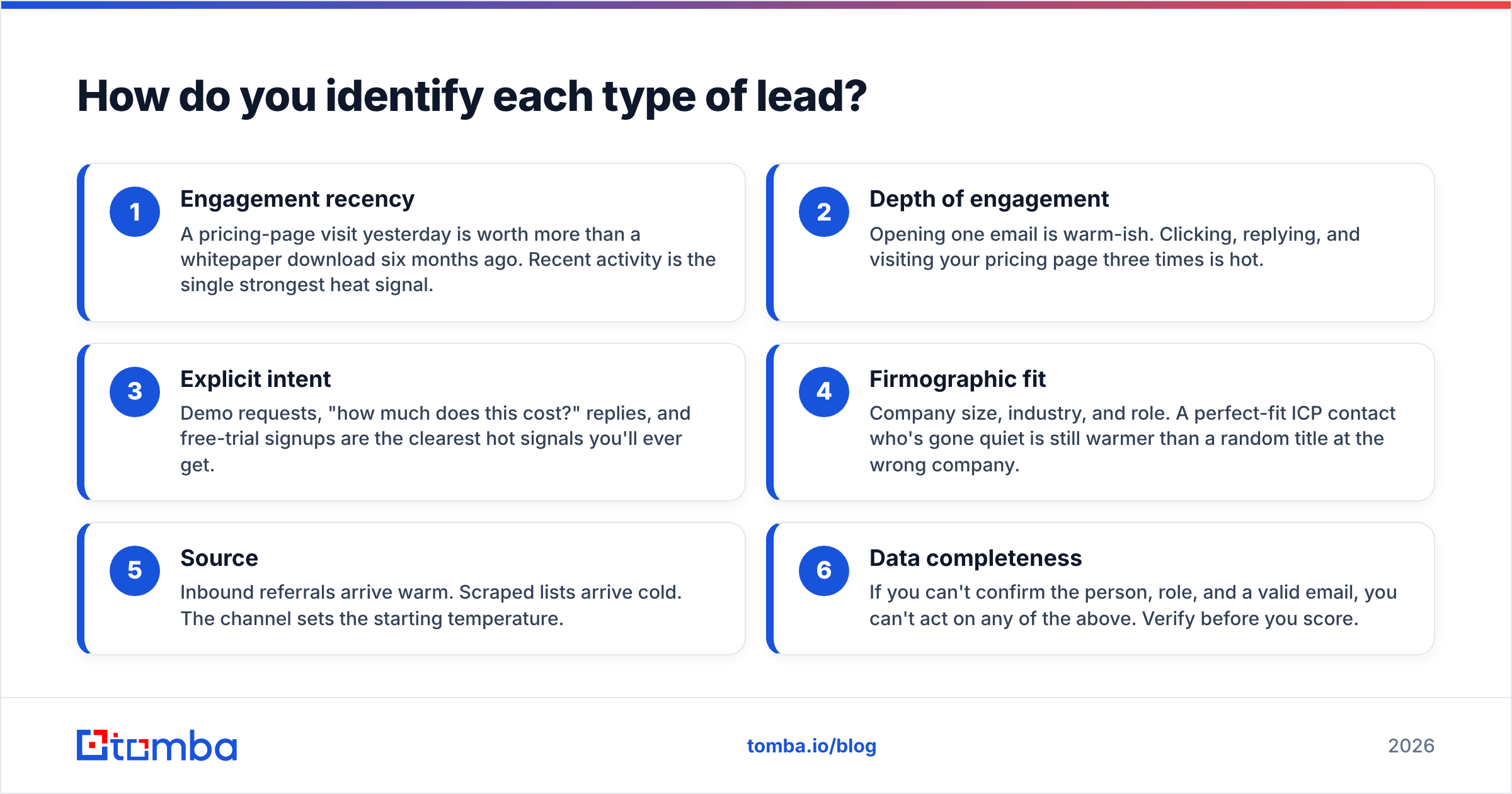
Use these six signals to sort any lead:
- Engagement recency — A pricing-page visit yesterday is worth more than a whitepaper download six months ago. Recent activity is the single strongest heat signal.
- Depth of engagement — Opening one email is warm-ish. Clicking, replying, and visiting your pricing page three times is hot.
- Explicit intent — Demo requests, "how much does this cost?" replies, and free-trial signups are the clearest hot signals you'll ever get.
- Firmographic fit — Company size, industry, and role. A perfect-fit ICP contact who's gone quiet is still warmer than a random title at the wrong company.
- Source — Inbound referrals arrive warm. Scraped lists arrive cold. The channel sets the starting temperature.
- Data completeness — If you can't confirm the person, role, and a valid email, you can't act on any of the above. Verify before you score.
That last point trips up more teams than any other. A marketing qualified lead with a dead inbox is a false positive. Before a lead enters your scoring model, run it through an email verifier so a stale or mistyped address doesn't get promoted to "hot" and waste a rep's morning.
What is lead scoring and why does it matter?#
Lead scoring assigns points to fit and behavior so software — not gut feel — decides which leads are cold, warm, or hot. It converts fuzzy labels into a repeatable, routable number.
A basic model adds points for positive signals and subtracts for negative ones:
| Signal | Points |
|---|---|
| Matches target industry | +15 |
| Director-level or above | +10 |
| Visited pricing page | +20 |
| Opened 3+ emails in 30 days | +10 |
| Requested a demo | +30 |
| Free personal email domain | −10 |
| No activity in 60 days | −15 |
Then you set thresholds: 0–20 is cold, 21–50 is warm, 51+ is hot. The exact numbers matter less than picking them, watching what converts, and adjusting. Most teams over-weight demographic fit and under-weight recent behavior — resist that, because intent is the better predictor. Salesforce's research on lead management and HubSpot's lead scoring guides both land on the same principle: behavior should drive the top of your score.
Scoring matters because it protects your most expensive resource — rep time. When a hot lead is obvious in the CRM, reps stop wasting sequences on people who'll never buy and stop letting ready-to-buy prospects go cold in a queue.

How should you approach cold vs warm vs hot leads?#
Match the ask to the temperature. The mistake is using one playbook for all three.
Cold leads: earn attention, don't demand it#
Cold outreach lives or dies on relevance. The prospect owes you nothing, so lead with something about them — a trigger event, a shared connection, a specific problem their role owns. Keep the ask tiny: a reply, not a 30-minute call.
The mechanics matter as much as the message. Cold email only works if it lands in the inbox, which means clean data and sender reputation come first. Before you send, make sure you're reaching real people at real addresses — use an accurate email finder to build the list, then verify it. A cold campaign to a 20% bounce-rate list will torch your sender reputation before it ever gets read.
Warm leads: nurture and qualify#
Warm leads have raised a hand, even slightly. Reward that. Send the case study for their industry, invite them to the webinar, answer the question they hinted at. Every touch should move them toward a qualifying conversation without pressuring them into one.
This is also where enrichment pays off. When someone engages, pull their full context — company, role, tech stack, team size — so your follow-up is specific. Contact enrichment turns a bare email into a profile you can personalize against, which is the difference between "just following up" and "I saw your team just adopted X."
Hot leads: remove friction, move fast#
Hot leads punish delay. Studies on lead response time consistently show that contacting an inbound lead within five minutes dramatically raises connect rates versus even an hour later. Don't nurture a hot lead — book them. Send a calendar link, offer two time slots, get a human on the phone. Every extra step you add is a chance for them to cool off or call a competitor.
How do leads move between stages?#
Temperature isn't permanent — leads warm up, and they cool down. Your job is to notice the movement and react.
Warming triggers: a burst of email opens, a return visit to your site, a reply, a pricing-page view, a job change into a buying role. When you see these, the lead should climb your score and change sequences automatically.
Cooling triggers: 30–60 days of silence, an unsubscribe from one list, a bounce, or a role change out of the buying center. These should drop the score so you stop over-investing.
The teams that win treat this as a loop, not a one-time sort. A CRM with automated scoring re-evaluates every lead as new signals arrive, so a lead that went cold in March but reappears on your pricing page in July gets flagged hot the same day. Manual sorting can't keep up with that; a scoring model can.
Cold, warm, and hot leads: a quick reference#
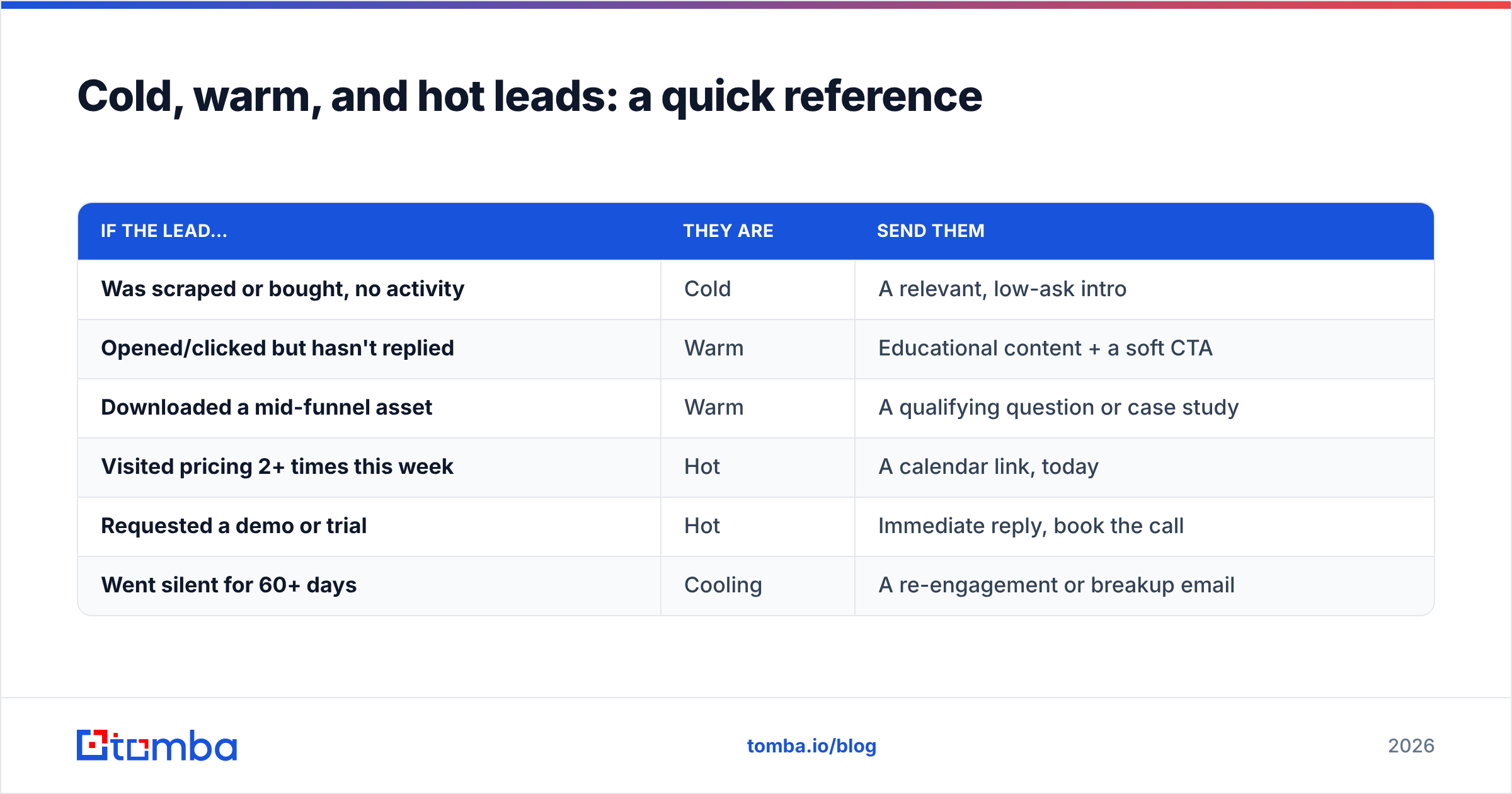
Use this as a cheat sheet when you're staring at a list and deciding what to do next:
| If the lead… | They are | Send them |
|---|---|---|
| Was scraped or bought, no activity | Cold | A relevant, low-ask intro |
| Opened/clicked but hasn't replied | Warm | Educational content + a soft CTA |
| Downloaded a mid-funnel asset | Warm | A qualifying question or case study |
| Visited pricing 2+ times this week | Hot | A calendar link, today |
| Requested a demo or trial | Hot | Immediate reply, book the call |
| Went silent for 60+ days | Cooling | A re-engagement or breakup email |
The point isn't to memorize thresholds. It's to build the reflex of asking "how much intent has this person actually shown?" before you write a single line.
What tools do you need to run this well?#
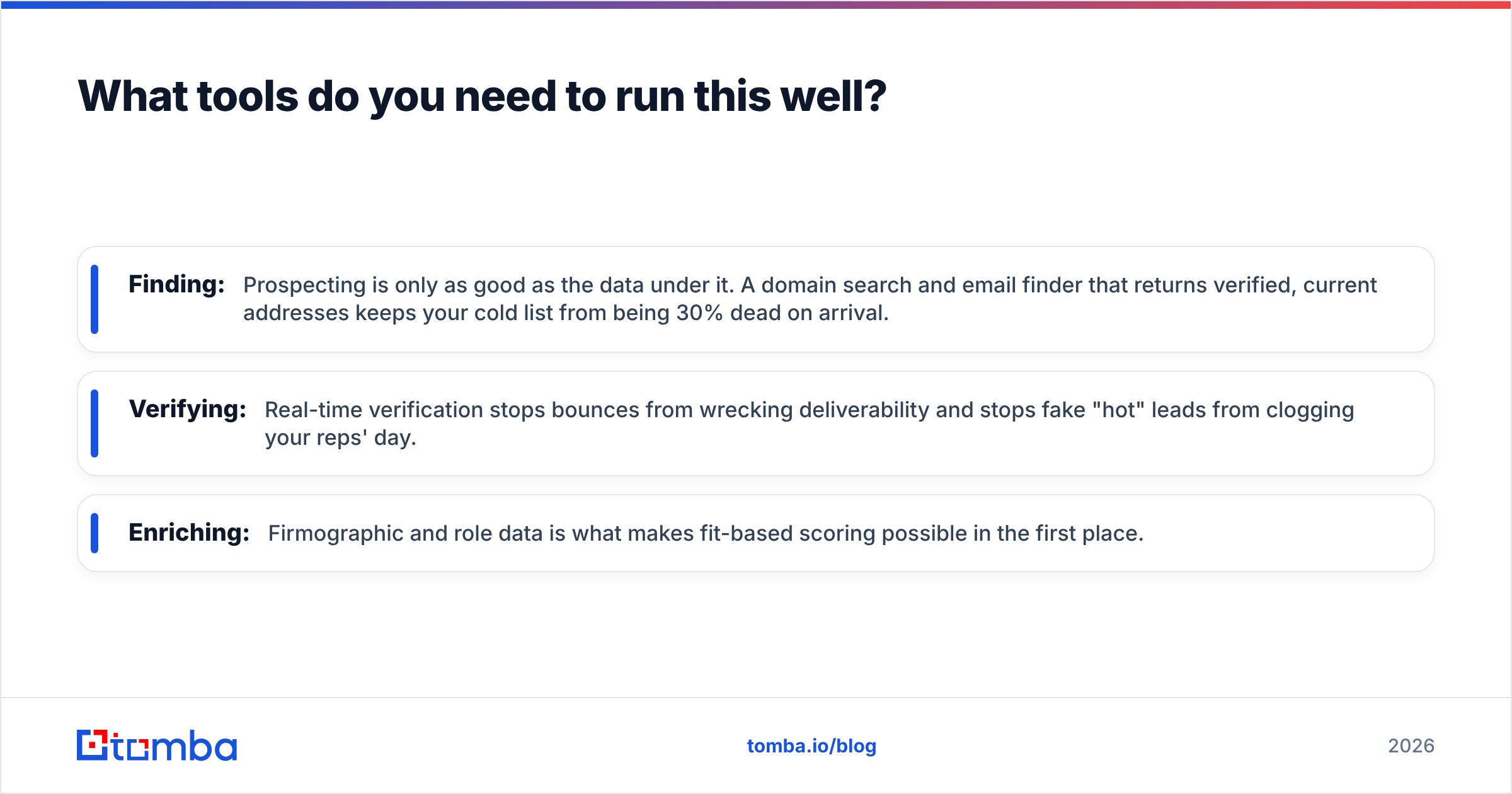
You need three capabilities working together: find accurate contacts, verify they're real, and enrich them so scoring has something to score.
- Finding: Prospecting is only as good as the data under it. A domain search and email finder that returns verified, current addresses keeps your cold list from being 30% dead on arrival.
- Verifying: Real-time verification stops bounces from wrecking deliverability and stops fake "hot" leads from clogging your reps' day.
- Enriching: Firmographic and role data is what makes fit-based scoring possible in the first place.
You don't need a bloated all-in-one suite to do this. You need clean, accurate data feeding a simple scoring model and a CRM that can route on it. Compared with the enterprise platforms that charge for seats you won't use, a focused data tool is cheaper and easier to trust — check the Tomba pricing tiers (free tier at 25 searches/month, Starter at $49/mo) against what you're paying now, and you'll often find the data quality is better for a fraction of the cost.
Frequently asked questions#
What's the difference between a warm lead and a hot lead? A warm lead has engaged but hasn't signaled they're ready to buy. A hot lead has shown explicit purchase intent — a demo request, pricing questions, or a trial signup. Warm leads need nurturing; hot leads need a meeting booked immediately.
Can a cold lead become hot without going through warm? Yes. A cold prospect can jump straight to hot after a major trigger — a funding round, a new executive hire, or an urgent problem. That's why continuous re-scoring beats a one-time sort.
How often should I re-score my leads? Continuously if your tools allow it. At minimum, re-score whenever a lead takes a meaningful action and run a cooling sweep every 30–60 days to demote inactive contacts.
Does lead temperature replace BANT or MEDDIC qualification? No. Temperature tells you when and how to reach out. Qualification frameworks tell you whether a lead is worth pursuing. Use them together — temperature to prioritize, qualification to confirm.
Turn temperature into pipeline#
Sorting leads into cold, warm, and hot only pays off when the data underneath is accurate — a mislabeled or dead contact quietly poisons every downstream decision. Start at the source: build lists you can actually trust.
The Tomba Email Finder gives you verified professional emails by name, company, or domain, so every lead that enters your scoring model is real and reachable. Pair it with verification and enrichment, and you'll spend your outreach hours on the leads that are ready to buy — not on guesses. Start free with 25 searches a month and see how much cleaner your pipeline gets when the data is right.
Related guides#
Ready to find emails that actually work?
Join 150,000+ professionals who stopped guessing and started sending. Free credits on signup — no credit card required.
Get the Tomba newsletter
Practical outbound tactics and product updates — once every two weeks.
About the author