Coldlytics vs DiscoverOrg (2026): Which B2B Data Tool Wins?
Coldlytics builds manual, made-to-order prospect lists; DiscoverOrg (now ZoomInfo) sells a massive prewired database. Here's which fits your outbound motion — and where a leaner tool beats both on cost.
Choosing between Coldlytics and DiscoverOrg is really a choice between two philosophies of B2B data: pay a human team to research a small, exact list, or pay for access to a giant prewired database and filter it yourself. They rarely compete on the same shortlist by accident — and picking the wrong one wastes either your money or your reps' time.
This is a neutral, side-by-side breakdown of how the two stack up on pricing, data quality, workflow fit, and total cost — plus where a lighter, API-first tool covers most of what you actually need for a fraction of the spend.
TL;DR: Coldlytics vs DiscoverOrg at a glance#
- Coldlytics is a done-for-you, manual research service. You submit a request, a human team builds a targeted prospect list to spec, and you get verified contacts back. Great for precision, slow for volume.
- DiscoverOrg (merged into ZoomInfo years ago) is an enterprise sales-intelligence database: millions of contacts, org charts, intent data, and filters. Great for scale, priced for large teams.
- Cost gap is huge. Coldlytics runs on credits/subscriptions in the low hundreds per month; ZoomInfo/DiscoverOrg contracts commonly land in the five figures per year.
- Accuracy trade-off: Coldlytics wins on freshness for niche lists because a human verifies each row; DiscoverOrg wins on breadth but data decays fast at scale.
- If you mostly need verified emails and enrichment via API, neither may be the economical pick — a self-serve tool like Tomba covers finding and verifying contacts without a manual queue or an enterprise contract.
What is Coldlytics?#
Coldlytics is a managed prospecting service. Instead of giving you a search bar, it gives you a research team. You describe your ideal customer — titles, industries, company size, geography, sometimes a specific account list — and analysts hand-build the list, source contact details, and verify them before delivery.
The model is "quality over quantity." Because a person touches each record, list accuracy on tight, unusual segments tends to be high. The obvious cost is throughput: you can't pull 10,000 contacts this afternoon. You're bounded by turnaround time and the credits you've purchased.
Coldlytics fits teams that run precise, low-volume outbound — think agencies, founders doing founder-led sales, or account-based plays where 200 exactly-right contacts beat 20,000 loosely-right ones. You can see their positioning on the official Coldlytics site.
What is DiscoverOrg (now ZoomInfo)?#
DiscoverOrg was a premium B2B sales-intelligence platform known for deep org charts, technographics, and human-verified account data. It merged with ZoomInfo, and today its capabilities live inside the ZoomInfo product. When people shop "DiscoverOrg" in 2026, they're evaluating ZoomInfo's enterprise tier.
The value proposition is breadth and depth in one database: millions of companies and contacts, buying-intent signals, hierarchy mapping, integrations into every major CRM, and filtering that lets a RevOps team slice a total addressable market in minutes. It's built for large sales orgs that need coverage across whole markets, not a handful of accounts.
That power comes with enterprise pricing, annual commitments, and seat-based licensing. It's an infrastructure decision, not an impulse buy.
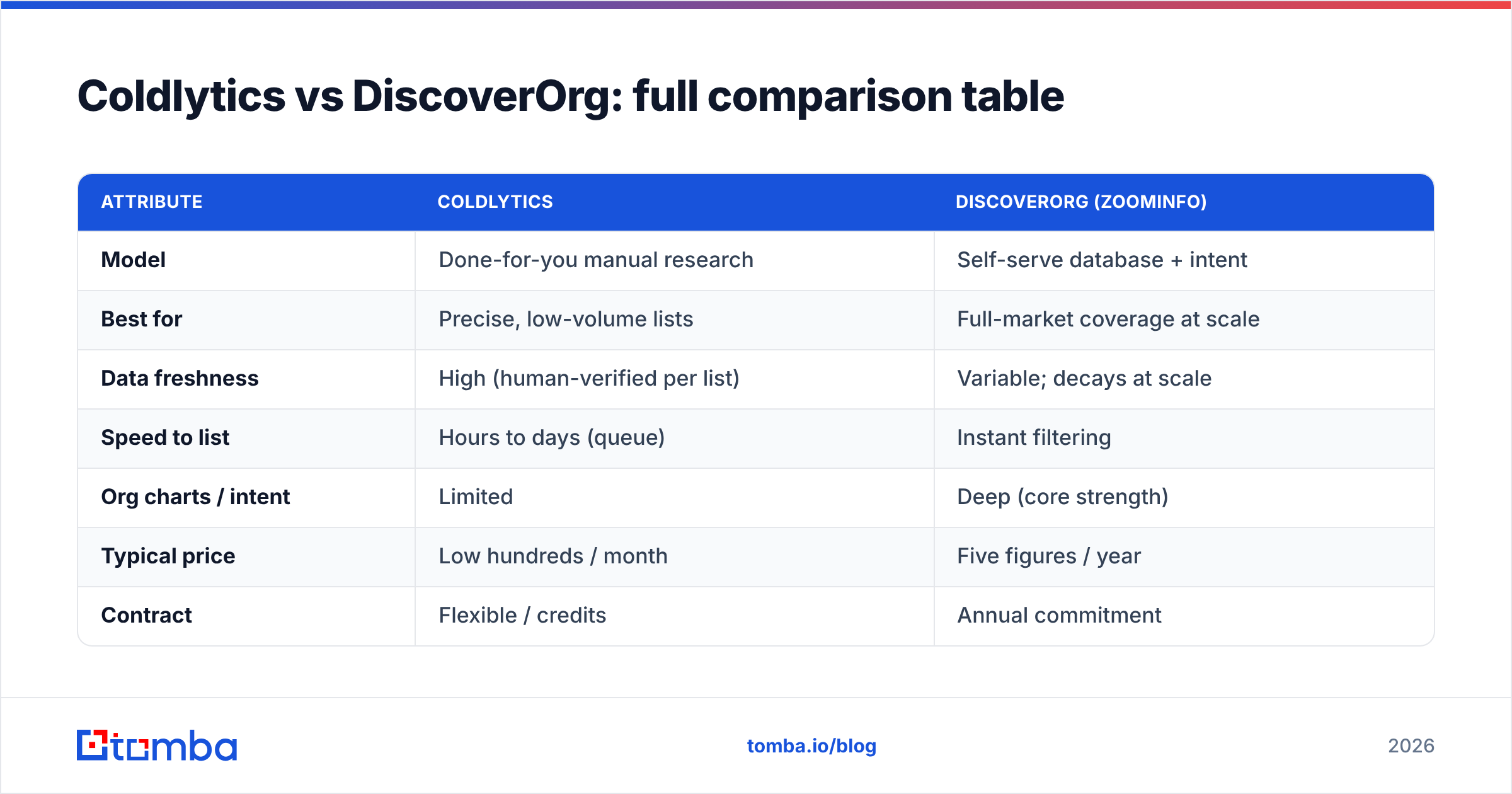
Coldlytics vs DiscoverOrg: full comparison table#
| Attribute | Coldlytics | DiscoverOrg (ZoomInfo) |
|---|---|---|
| Model | Done-for-you manual research | Self-serve database + intent |
| Best for | Precise, low-volume lists | Full-market coverage at scale |
| Data freshness | High (human-verified per list) | Variable; decays at scale |
| Speed to list | Hours to days (queue) | Instant filtering |
| Org charts / intent | Limited | Deep (core strength) |
| Typical price | Low hundreds / month | Five figures / year |
| Contract | Flexible / credits | Annual commitment |
| Volume ceiling | Low–medium | Very high |
| CRM integrations | Basic export | Native, extensive |
Read the caveats below the table — "instant filtering" and "human-verified" are both true and both come with strings attached.
Is Coldlytics more accurate than DiscoverOrg?#
For narrow, unusual segments, usually yes — with an asterisk. Because Coldlytics verifies each record by hand at the time of build, a freshly delivered list of, say, "heads of clinical operations at Series B biotechs in the EU" will typically be cleaner than the same slice pulled cold from a giant database, where records may be months old.
DiscoverOrg/ZoomInfo isn't inaccurate — its verified data is strong — but any database of that size fights data decay: people change jobs, companies restructure, emails deprecate. At B2B contact volumes, a meaningful share of records go stale every year no matter the vendor. The bigger the pull, the more decay you inherit, which is why smart teams re-verify before sending.
That re-verification step is where a dedicated email verifier earns its keep regardless of which platform you buy from. Even a pristine list is worth re-checking right before a campaign, and catch-all domains especially need a second look with a catch-all verifier.
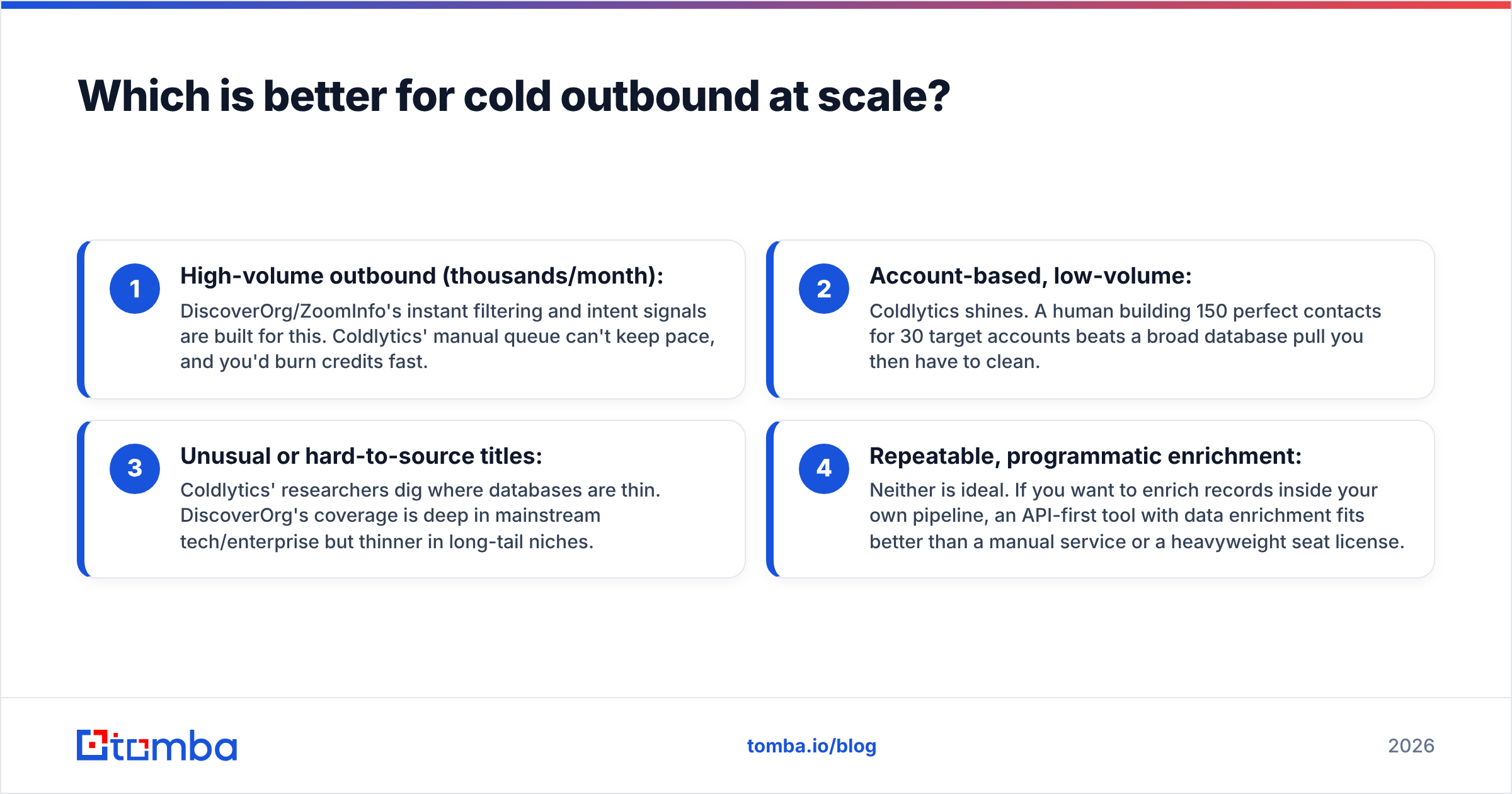
Which is better for cold outbound at scale?#
DiscoverOrg wins on raw scale; Coldlytics wins on precision. The right answer depends on your motion.
- High-volume outbound (thousands/month): DiscoverOrg/ZoomInfo's instant filtering and intent signals are built for this. Coldlytics' manual queue can't keep pace, and you'd burn credits fast.
- Account-based, low-volume: Coldlytics shines. A human building 150 perfect contacts for 30 target accounts beats a broad database pull you then have to clean.
- Unusual or hard-to-source titles: Coldlytics' researchers dig where databases are thin. DiscoverOrg's coverage is deep in mainstream tech/enterprise but thinner in long-tail niches.
- Repeatable, programmatic enrichment: Neither is ideal. If you want to enrich records inside your own pipeline, an API-first tool with data enrichment fits better than a manual service or a heavyweight seat license.

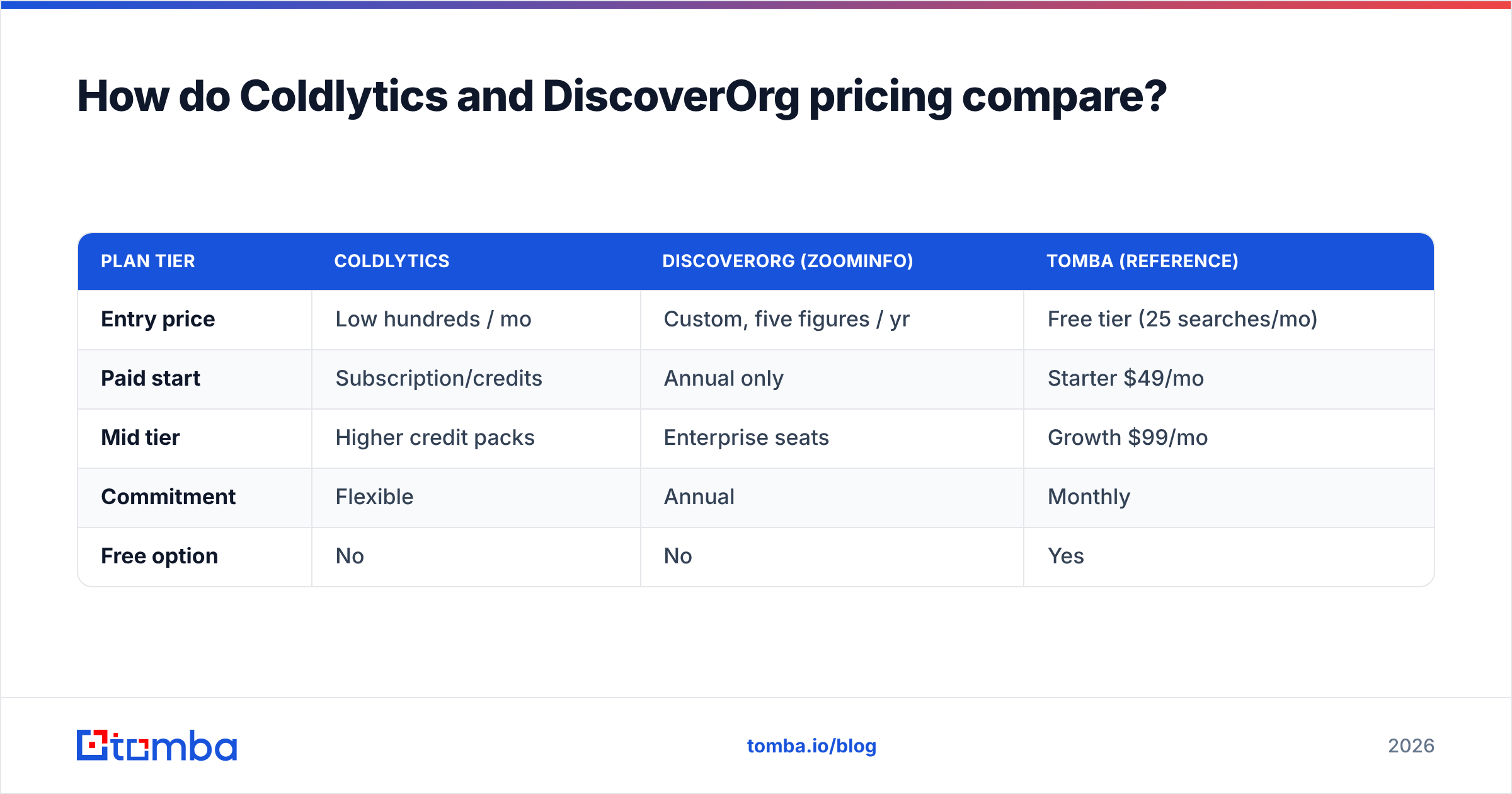
How do Coldlytics and DiscoverOrg pricing compare?#
This is the sharpest divide between them.
Coldlytics uses accessible, subscription/credit pricing — typically low hundreds of dollars per month depending on list volume. There's no five-figure gate to get started, which is why solo founders and small agencies gravitate to it.
DiscoverOrg (via ZoomInfo) is enterprise-priced. Public reports and buyer reviews on G2 consistently describe annual contracts in the tens of thousands, with cost scaling by seats, credits, and add-on modules like intent and enrich. For a large sales org, that can be justified; for a small team, it's often overkill.
| Plan tier | Coldlytics | DiscoverOrg (ZoomInfo) | Tomba (reference) |
|---|---|---|---|
| Entry price | Low hundreds / mo | Custom, five figures / yr | Free tier (25 searches/mo) |
| Paid start | Subscription/credits | Annual only | Starter $49/mo |
| Mid tier | Higher credit packs | Enterprise seats | Growth $99/mo |
| Commitment | Flexible | Annual | Monthly |
| Free option | No | No | Yes |
The Tomba column is there for context, not as a like-for-like swap — see the Tomba pricing page for exact numbers. The point: your data budget can range from $49/month to $30k/year depending on which philosophy you buy into.
Where does a self-serve tool like Tomba fit?#
Between "hire a research team" and "sign an enterprise contract" sits a third option most comparisons skip: do the finding and verifying yourself, programmatically, at self-serve prices.
A lot of what buyers actually want from Coldlytics or DiscoverOrg boils down to two jobs: get me valid contact emails for these people/companies, and keep that data clean. Those are exactly the jobs a focused tool handles without a queue or a committee.
- Need emails for a known list of domains? Use domain search to pull every professional email pattern for a company, then verify.
- Have names and companies but no emails? An email finder resolves them on demand.
- Working from a spreadsheet of thousands? A bulk email finder processes the list in one pass.
- Building this into your own app or CRM sync? The Tomba API does finding, verifying, and enrichment programmatically.
This won't replace DiscoverOrg's intent data or org charts — if you need buying signals across a whole market, that's a genuine reason to pay enterprise. And it won't replace Coldlytics if you specifically want humans researching obscure segments. But for the common case — "I know who I want to reach, I just need accurate contact data" — a self-serve finder-plus-verifier stack is faster and dramatically cheaper than either.
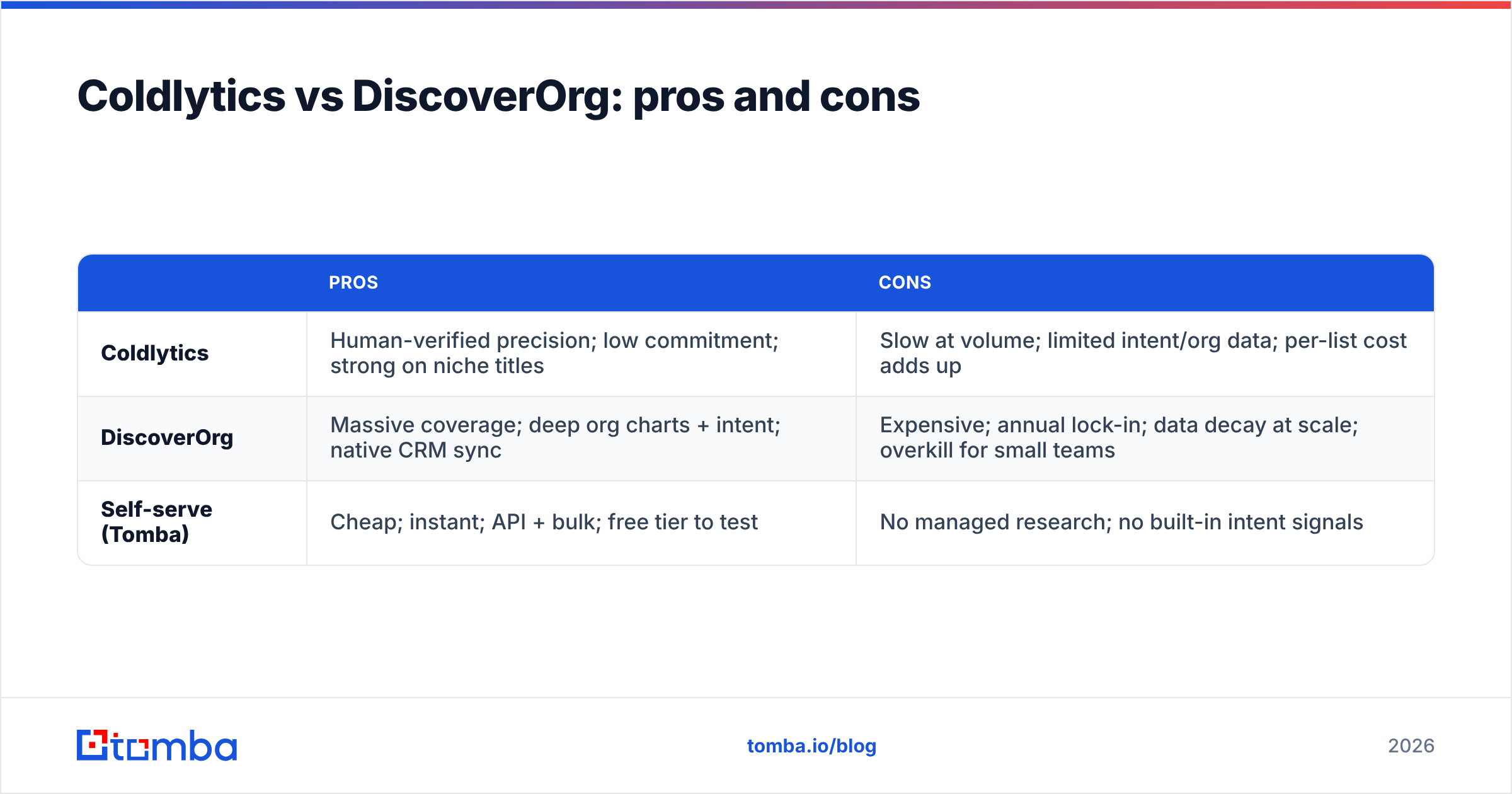
Coldlytics vs DiscoverOrg: pros and cons#
| Pros | Cons | |
|---|---|---|
| Coldlytics | Human-verified precision; low commitment; strong on niche titles | Slow at volume; limited intent/org data; per-list cost adds up |
| DiscoverOrg | Massive coverage; deep org charts + intent; native CRM sync | Expensive; annual lock-in; data decay at scale; overkill for small teams |
| Self-serve (Tomba) | Cheap; instant; API + bulk; free tier to test | No managed research; no built-in intent signals |
Which one should you choose?#
Pick Coldlytics if your outbound is precise and low-volume, you value a human verifying every record, and you'd rather pay per targeted list than sign a contract. It's the pragmatic choice for founders, agencies, and tight ABM plays.
Pick DiscoverOrg/ZoomInfo if you're a larger sales org that needs full-market coverage, org-chart mapping, and intent data in one place, and you can justify a five-figure annual spend against pipeline. It's infrastructure for scale.
Pick a self-serve finder if your real need is accurate emails and enrichment you can pull on demand or via API, and you don't want to pay a research team or an enterprise seat license to get them. Many teams run this as their default and only reach for a managed service or a big database on specific, high-value campaigns.
There's no universal winner here — there's a winner for your motion and budget. Map your actual monthly contact volume and how programmatic you need the data to be, and the choice usually makes itself.
Start finding verified contacts today#
If your bottleneck is simply getting accurate, verified B2B emails without a queue or a contract, start with the Tomba Email Finder. Test it on the free tier (25 searches a month), find emails by name or domain, verify them before you send, and scale up to bulk or the API only when you need to. It's the fastest way to see how much of your Coldlytics-or-DiscoverOrg problem is really just a "find and verify" problem — solvable today, at self-serve pricing.
Related guides#
Ready to find emails that actually work?
Join 150,000+ professionals who stopped guessing and started sending. Free credits on signup — no credit card required.
Get the Tomba newsletter
Practical outbound tactics and product updates — once every two weeks.
About the author