Coldlytics vs Generect: Which B2B Prospecting Tool Wins in 2026?
Coldlytics sells human-researched lead lists; Generect runs a self-serve B2B database. We compare accuracy, pricing, speed, and fit so you can pick the right prospecting engine.
Picking a prospecting data source is really a bet on how your team wants to work: hand the research to someone else, or run the searches yourself. Coldlytics and Generect sit on opposite ends of that spectrum, which is exactly why teams keep putting them head-to-head. This comparison breaks down where each one wins, where each one costs you, and when a self-serve tool like Tomba beats both.
TL;DR — Coldlytics vs Generect at a glance#
- Coldlytics is a done-for-you prospecting service: human researchers build custom, verified lead lists to your exact spec. Great accuracy, slower turnaround, priced per list/credit.
- Generect is a self-serve B2B data platform with a large contact database, filters, and API/integrations. Faster and cheaper per lead, but you do the targeting and quality-checking.
- Speed: Generect is instant; Coldlytics takes hours to days per request.
- Accuracy: Coldlytics wins on hard-to-find niche roles; Generect wins on volume.
- Budget pick: if you mostly need verified emails on demand with an API, a pay-as-you-scale finder like the Tomba Email Finder often beats both on cost per usable contact.
What is Coldlytics and who is it for?#
Coldlytics is a managed lead-research service. You submit a target profile — industry, company size, geography, job titles, tech stack, whatever criteria matter — and a team of researchers manually builds a list of matching contacts with verified email addresses. Think of it less like a database subscription and more like hiring a research analyst who returns a clean spreadsheet.
That model has a clear strength: precision on requests a database can't answer well. "Heads of facilities at manufacturers running SAP in the Midwest with 200–500 employees" is the kind of brief where automated filters produce noise, and human researchers earn their fee. Because a person verifies each row, bounce rates on Coldlytics lists tend to run low.
The trade-offs are speed and unit economics. A human-built list is not instant — turnaround is measured in hours or days — and you pay per lead or per credit, so cost scales linearly with volume. For a boutique outbound team sending 200 hyper-targeted emails a week, that's fine. For a team that wants 10,000 contacts by Friday, it gets expensive fast. You can read real user experiences on G2 before committing.

What is Generect and who is it for?#
Generect is a self-serve B2B lead-generation platform. Instead of asking a human to research your list, you use search filters against a large contact and company database, then export or push results into your CRM or sequencer. It also offers real-time email lookup and an API, so developers can wire it into automated workflows.
The self-serve model flips Coldlytics' trade-offs. You get speed and scale — build a list in minutes, not days — and lower cost per contact because no human labor sits between you and the data. The catch is that quality control moves to you. Database records drift out of date, catch-all domains muddy verification, and broad filters can surface contacts who don't actually match your ICP. If you don't run your own email verification pass, some of that risk lands in your bounce rate.
Generect suits teams that already know their targeting, want volume, and have the discipline to verify and enrich data themselves. If your motion is "pull a list, clean it, sequence it," a self-serve platform is a natural fit — see the official Generect site for its current feature set.
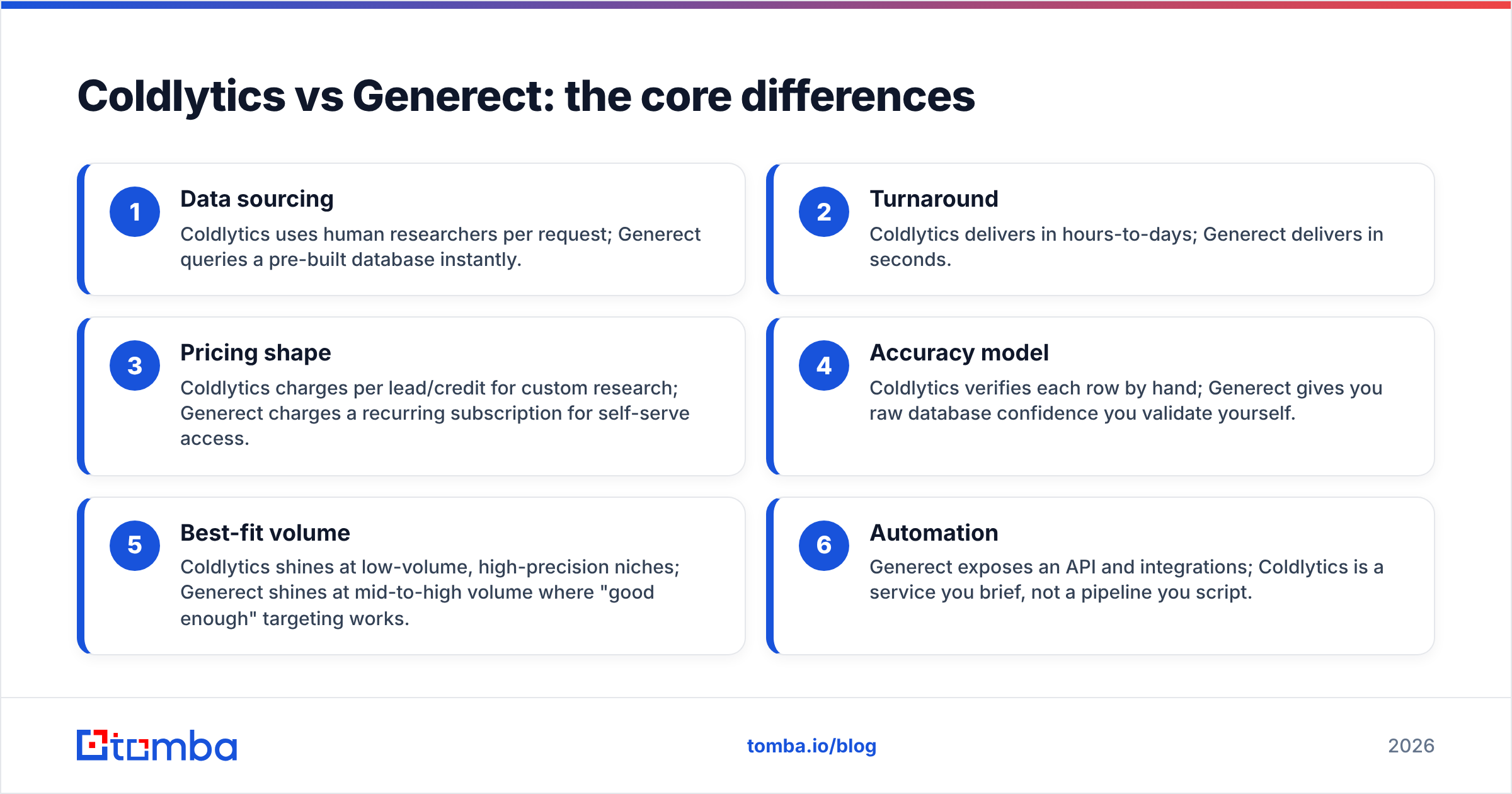
Coldlytics vs Generect: the core differences#
Here's the fastest way to understand the two — it comes down to who does the work and how you pay for it:
- Data sourcing — Coldlytics uses human researchers per request; Generect queries a pre-built database instantly.
- Turnaround — Coldlytics delivers in hours-to-days; Generect delivers in seconds.
- Pricing shape — Coldlytics charges per lead/credit for custom research; Generect charges a recurring subscription for self-serve access.
- Accuracy model — Coldlytics verifies each row by hand; Generect gives you raw database confidence you validate yourself.
- Best-fit volume — Coldlytics shines at low-volume, high-precision niches; Generect shines at mid-to-high volume where "good enough" targeting works.
- Automation — Generect exposes an API and integrations; Coldlytics is a service you brief, not a pipeline you script.
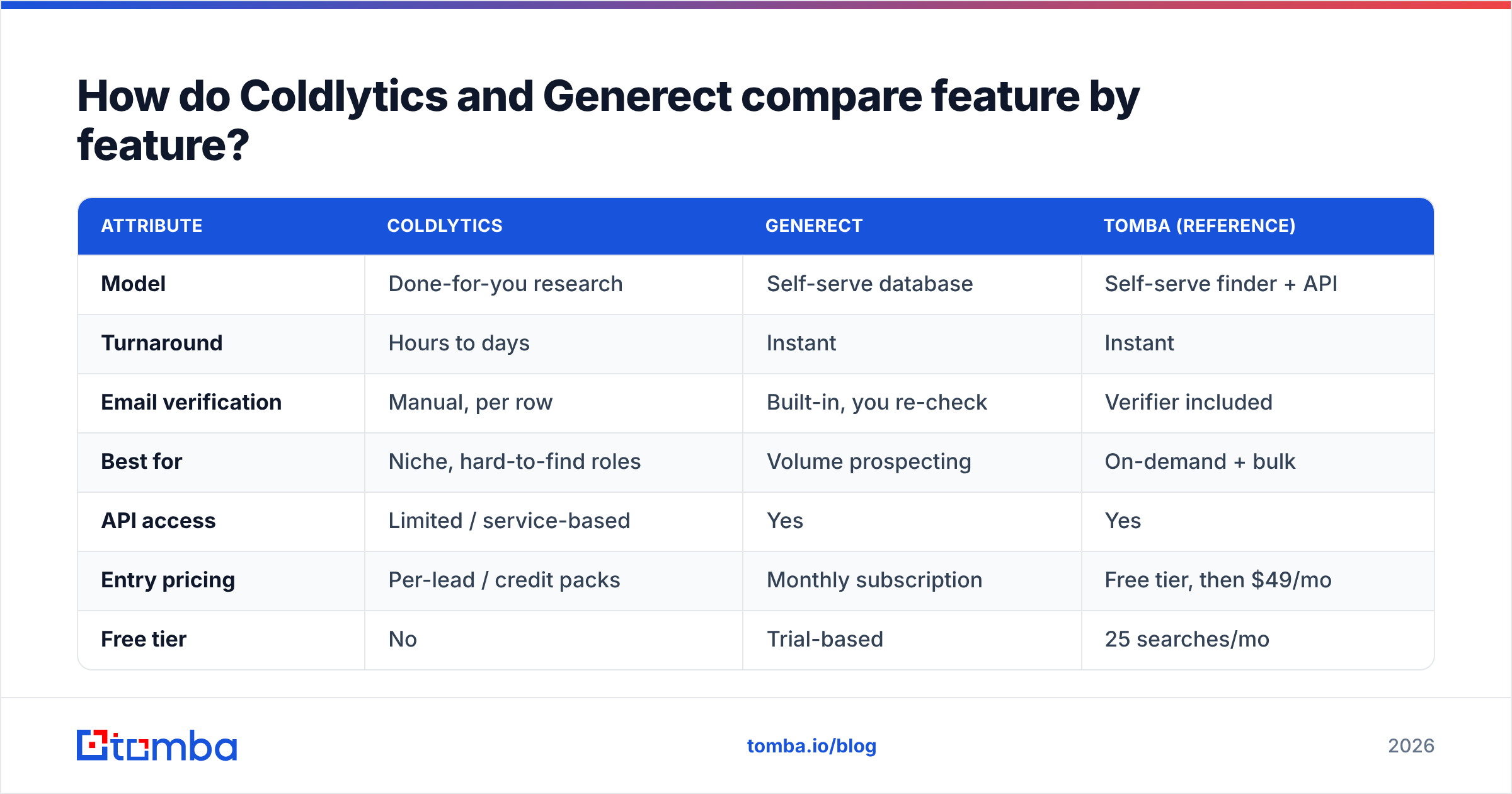
How do Coldlytics and Generect compare feature by feature?#
| Attribute | Coldlytics | Generect | Tomba (reference) |
|---|---|---|---|
| Model | Done-for-you research | Self-serve database | Self-serve finder + API |
| Turnaround | Hours to days | Instant | Instant |
| Email verification | Manual, per row | Built-in, you re-check | Verifier included |
| Best for | Niche, hard-to-find roles | Volume prospecting | On-demand + bulk |
| API access | Limited / service-based | Yes | Yes |
| Entry pricing | Per-lead / credit packs | Monthly subscription | Free tier, then $49/mo |
| Free tier | No | Trial-based | 25 searches/mo |
| Bulk workflows | Handled for you | Export + filters | Bulk email finder |
Use this as a starting map, not gospel — vendor pricing and features change, so confirm current terms on each provider's own site before you buy.
Which one is more accurate?#
Coldlytics generally wins on accuracy for narrow, difficult briefs; Generect wins on breadth. A human who manually confirms each contact will out-perform any database on obscure titles, small companies, or fast-changing org charts. If a wrong contact costs you a whole outreach cycle, that manual verification is worth paying for.
But "accurate" is contextual. For high-volume outbound into well-covered segments — SaaS, agencies, common decision-maker titles at mid-market companies — a good database plus your own verification pass reaches similar deliverability at a fraction of the cost per contact. The variable that actually protects your sender reputation isn't the source; it's whether every address gets verified before send. Catch-all domains are where lists quietly rot, so a catch-all verifier matters more than the logo on the invoice.
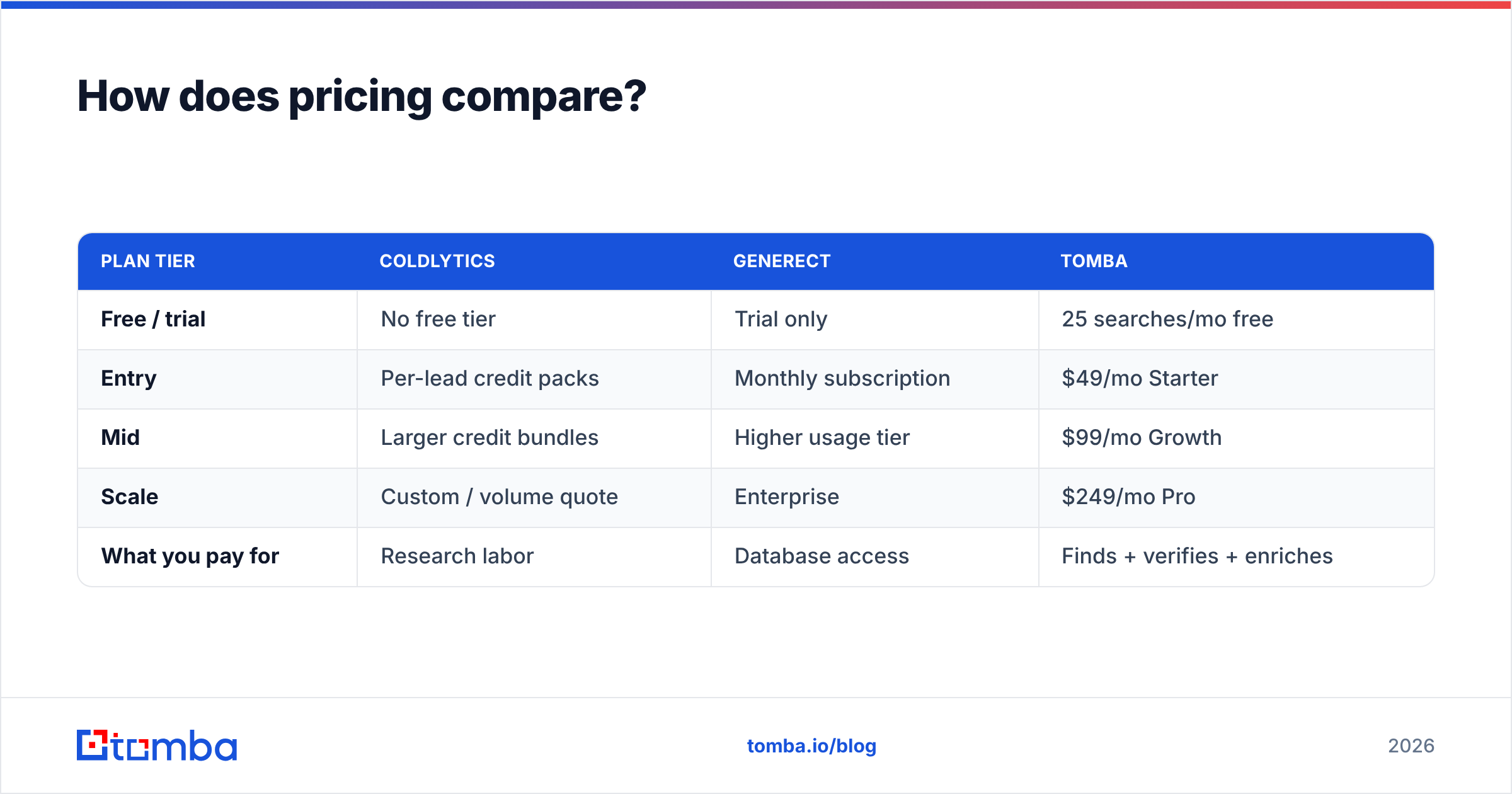
How does pricing compare?#
The pricing philosophies are different enough that a straight per-seat comparison misleads.
Coldlytics prices around custom research output — you're buying researcher hours expressed as leads or credits. That's predictable per list but climbs steeply with volume, because every extra lead is more human work.
Generect prices around access — a recurring subscription to query the database, usually with usage tiers. Cost per lead drops sharply at scale, but you carry the verification and enrichment burden yourself, which is a real (if hidden) cost in tooling and time.
For teams weighing both against a middle path, a transparent finder subscription is worth modeling. Tomba pricing runs a free tier (25 searches/mo), then Starter at $49/mo, Growth at $99/mo, and Pro at $249/mo — with email finding, verification, and enrichment bundled rather than sold as separate line items. When you divide by usable, verified contacts, the "cheapest sticker" and the "cheapest per lead" are rarely the same tool.
| Plan tier | Coldlytics | Generect | Tomba |
|---|---|---|---|
| Free / trial | No free tier | Trial only | 25 searches/mo free |
| Entry | Per-lead credit packs | Monthly subscription | $49/mo Starter |
| Mid | Larger credit bundles | Higher usage tier | $99/mo Growth |
| Scale | Custom / volume quote | Enterprise | $249/mo Pro |
| What you pay for | Research labor | Database access | Finds + verifies + enriches |
When should you choose a self-serve email finder instead?#
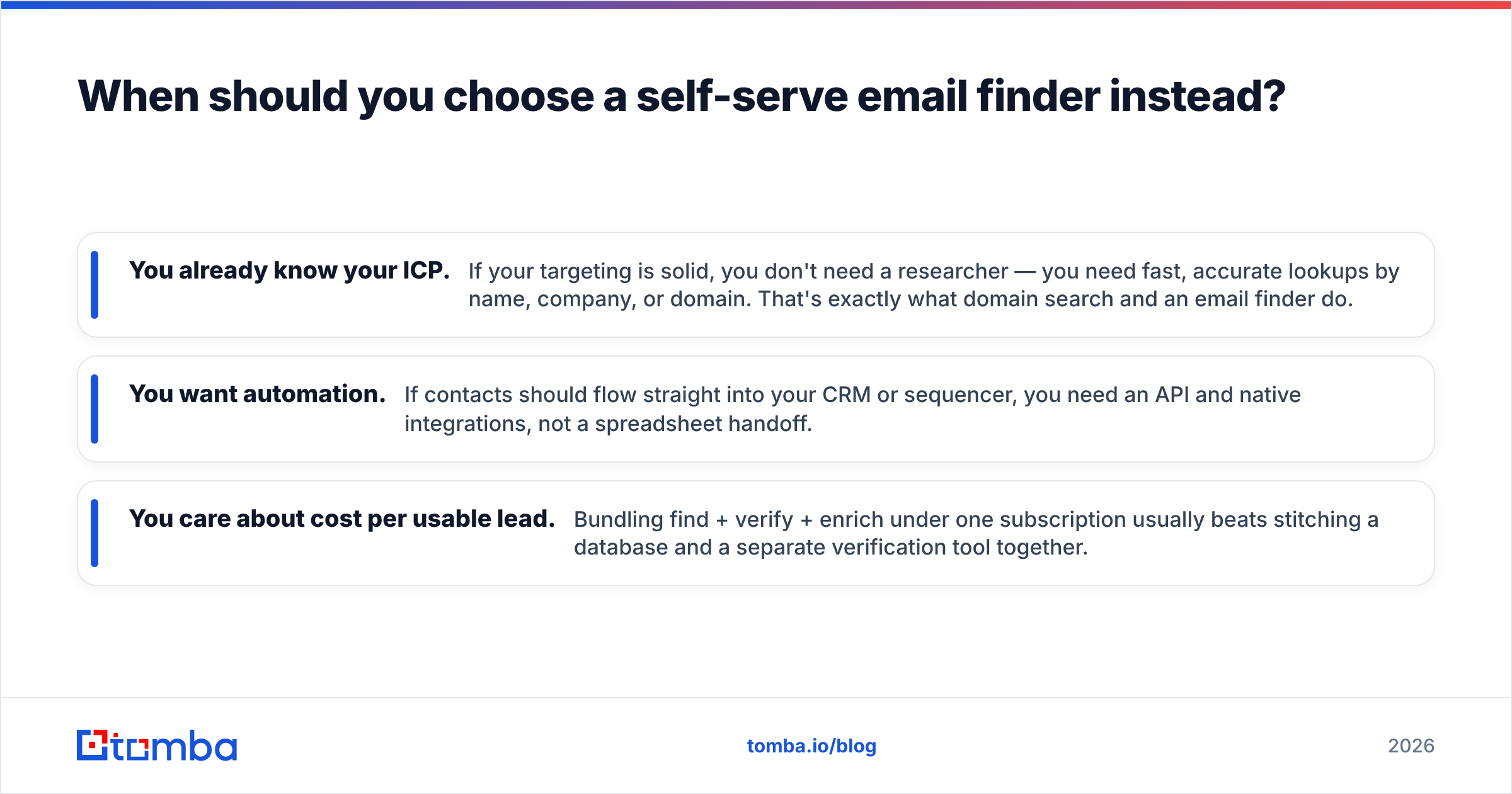
Choose a self-serve finder when your bottleneck is verified contact data on demand, not full-service research. Three signals point this way:
- You already know your ICP. If your targeting is solid, you don't need a researcher — you need fast, accurate lookups by name, company, or domain. That's exactly what domain search and an email finder do.
- You want automation. If contacts should flow straight into your CRM or sequencer, you need an API and native integrations, not a spreadsheet handoff.
- You care about cost per usable lead. Bundling find + verify + enrich under one subscription usually beats stitching a database and a separate verification tool together.
This is the lane Tomba occupies. It won't hand-research a 50-lead niche list the way Coldlytics does, and that's the honest limit — but for teams that want to find, verify, and enrich contacts themselves at predictable cost, it's a cleaner fit than either a managed service or a raw database. You can also pull company-wide contacts, run data enrichment on existing records, and tap the Tomba API for automated pipelines.
Coldlytics vs Generect: the verdict#
There's no universal winner — the right pick tracks your motion.
- Choose Coldlytics if you run low-volume, high-precision outbound into niches where a wrong contact is expensive, and you'd rather outsource research than build lists. You're paying for human accuracy, and for the right team that's the best money you'll spend.
- Choose Generect if you need volume fast, already know your targeting, and have the discipline to verify data yourself. Cost per lead is low and the platform gets out of your way.
- Choose a self-serve finder like Tomba if your real need is verified emails on demand — bundled with verification and enrichment, backed by an API, at pricing that scales predictably rather than per-lead.
The mistake to avoid is picking on sticker price alone. The number that matters is cost per contact that lands in an inbox and matches your ICP. Whichever tool wins that math for your team is the right one — and for a lot of teams, the honest answer is a fast, verifiable finder rather than either extreme.
Ready to test a self-serve option?#
If you want to see whether on-demand finding beats a managed list or a raw database for your workflow, start with the Tomba Email Finder. Search by name, company, or domain, verify every address before you send, and enrich the results — all on a free tier of 25 searches a month, no per-lead invoice. Run 50 of your real target contacts through it, check the bounce rate against your last purchased list, and let the numbers pick your winner.
Related guides#
Ready to find emails that actually work?
Join 150,000+ professionals who stopped guessing and started sending. Free credits on signup — no credit card required.
Get the Tomba newsletter
Practical outbound tactics and product updates — once every two weeks.
About the author