Coldlytics vs Leadsforge: Which B2B Lead Tool Wins in 2026?
Coldlytics does the prospecting for you; Leadsforge builds lists with AI. We compare accuracy, pricing, speed, and data quality to help you pick the right B2B lead source in 2026.
Choosing a B2B lead source usually comes down to a trade-off: do you pay people to build lists by hand, or trust software to do it in seconds? Coldlytics and Leadsforge sit on opposite ends of that spectrum, and picking the wrong one wastes both money and sender reputation.
This guide compares them the way a RevOps lead actually evaluates tools — on data accuracy, cost per usable contact, turnaround time, and how well each fits an outbound motion in 2026.
TL;DR — Coldlytics vs Leadsforge#
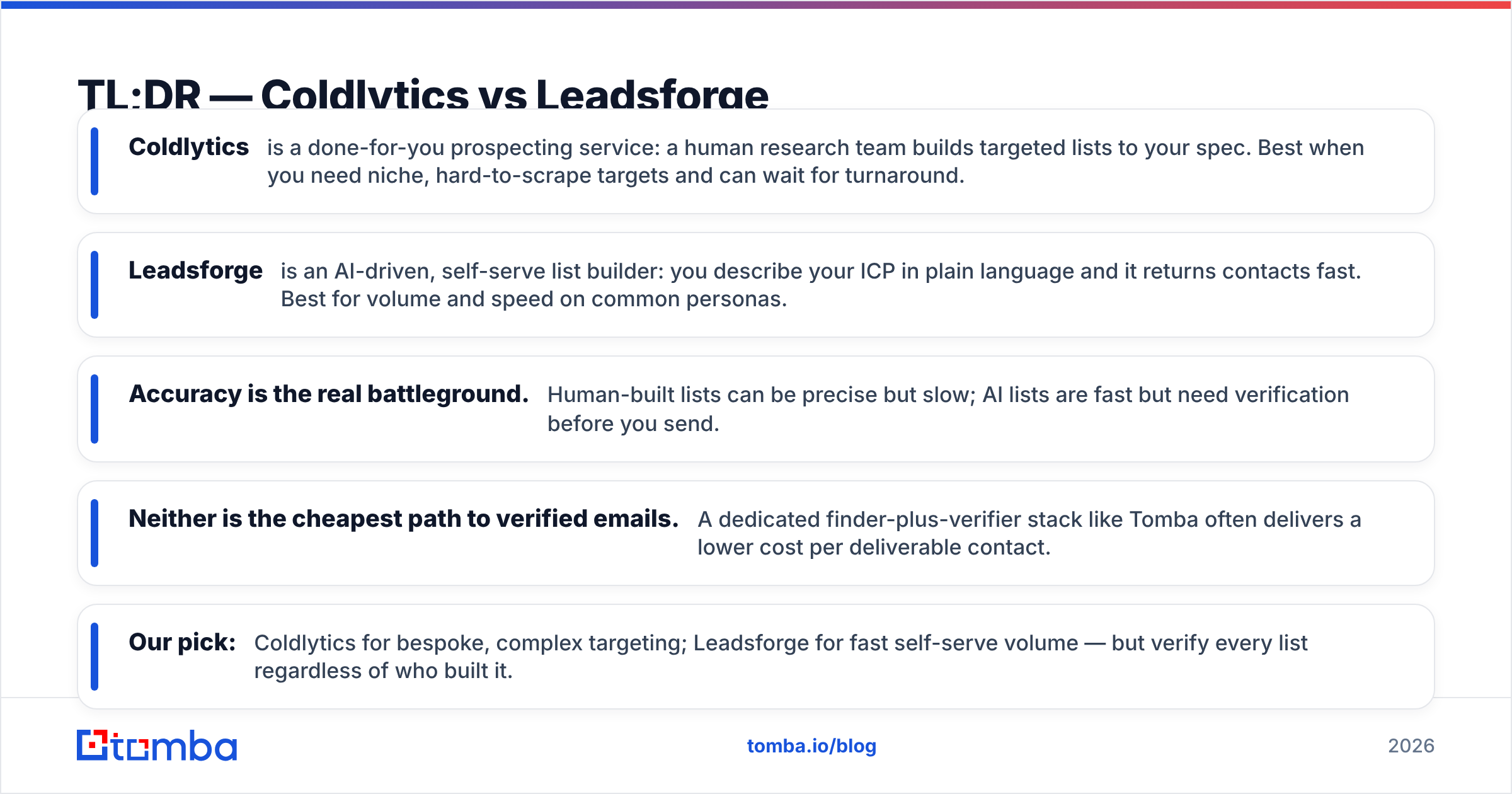
- Coldlytics is a done-for-you prospecting service: a human research team builds targeted lists to your spec. Best when you need niche, hard-to-scrape targets and can wait for turnaround.
- Leadsforge is an AI-driven, self-serve list builder: you describe your ICP in plain language and it returns contacts fast. Best for volume and speed on common personas.
- Accuracy is the real battleground. Human-built lists can be precise but slow; AI lists are fast but need verification before you send.
- Neither is the cheapest path to verified emails. A dedicated finder-plus-verifier stack like Tomba often delivers a lower cost per deliverable contact.
- Our pick: Coldlytics for bespoke, complex targeting; Leadsforge for fast self-serve volume — but verify every list regardless of who built it.
What is Coldlytics?#
Coldlytics is a managed prospecting service. Instead of handing you software, it hands you a team. You define the ideal customer profile — industry, title, company size, geography, tech stack — and human researchers assemble a custom list, often pulling from sources that automated scrapers miss.
The pitch is precision. When your targets are obscure (independent clinics, regional manufacturers, a specific job title that job-board scrapers mislabel), a human can interpret intent better than a keyword filter. The trade-off is turnaround: you submit a request and wait, rather than exporting on demand.
Coldlytics suits teams running low-volume, high-value outbound where a mis-targeted contact is expensive. It's less suited to teams that need thousands of contacts today.
What is Leadsforge?#
Leadsforge is an AI-first, self-serve lead generation tool. You describe your target audience conversationally — "marketing directors at Series B SaaS companies in the US" — and the platform returns a list of matching contacts in seconds. It leans on a large underlying database plus AI matching to interpret loose ICP descriptions.
The appeal is speed and independence. No request queue, no back-and-forth — you build, export, and load into your sequencer the same afternoon. The catch, common to every AI list builder, is that speed can outrun quality: contacts get returned before they're re-verified, so a slice of any export will bounce unless you clean it first.

Coldlytics vs Leadsforge: side-by-side comparison#
Here's how the two stack up on the attributes that actually affect pipeline.
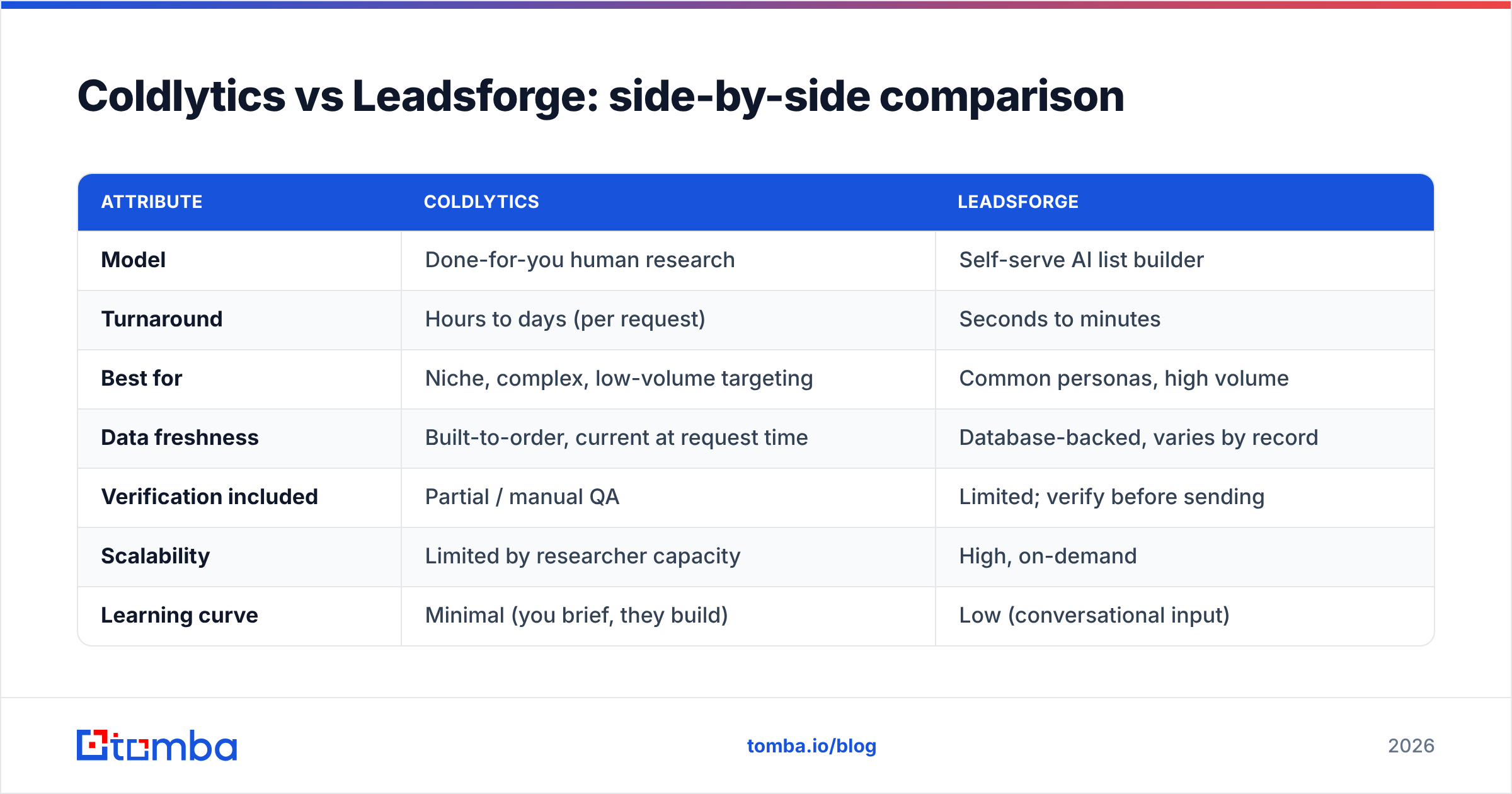
| Attribute | Coldlytics | Leadsforge |
|---|---|---|
| Model | Done-for-you human research | Self-serve AI list builder |
| Turnaround | Hours to days (per request) | Seconds to minutes |
| Best for | Niche, complex, low-volume targeting | Common personas, high volume |
| Data freshness | Built-to-order, current at request time | Database-backed, varies by record |
| Verification included | Partial / manual QA | Limited; verify before sending |
| Scalability | Limited by researcher capacity | High, on-demand |
| Learning curve | Minimal (you brief, they build) | Low (conversational input) |
| Typical cost driver | Per-list / retainer | Per-credit / subscription |
The honest read: these tools aren't really competing for the same buyer. Coldlytics competes with hiring a junior SDR to build lists. Leadsforge competes with other database tools like Apollo or Clearbit alternatives. Your choice depends on whether your bottleneck is targeting precision or volume and speed.
Which tool has better data accuracy?#
Accuracy is where most outbound programs quietly bleed money, and it splits into two questions: is the right person on the list, and is their email valid?
Coldlytics tends to win on the first — a human researcher is better at "is this actually a decision-maker for our product?" than an AI parsing a title string. Leadsforge tends to win on the second at scale, because it can return volume, but AI-matched records still include role changes, stale addresses, and catch-all domains that inflate your bounce rate.
Whichever you pick, treat the output as a candidate list, not a clean list. Running any export through a dedicated email verifier before your first send is the single highest-ROI step in the whole process. Bounces above 2-3% drag down sender reputation, and once that slides, even your perfectly-targeted contacts land in spam.

Independent accuracy testing across email data tools consistently shows a wide spread between vendors — which is exactly why verifying before you send matters more than trusting any single provider's marketing number. You can cross-check vendor claims against third-party reviews on G2 rather than taking accuracy stats at face value.
How do Coldlytics and Leadsforge price out?#
Pricing models differ enough that a head-to-head "who's cheaper" is misleading — you have to normalize to cost per usable (verified) contact.
Coldlytics prices around bespoke research: expect list-based or retainer pricing that reflects human labor. The per-contact cost is higher, but so is the hit rate on niche targets, so the effective cost on hard-to-find personas can be competitive.
Leadsforge uses a credit/subscription model typical of self-serve tools. The sticker price per contact looks low, but you have to factor in the credits burned on records that turn out to be invalid or off-ICP — those are sunk costs.
Here's a simplified way to think about it:
- Coldlytics — Higher upfront cost, high precision, low volume. Cost per usable contact stays reasonable because fewer contacts are wasted.
- Leadsforge — Lower sticker price, high volume, variable precision. Cost per usable contact depends entirely on how much of the list survives verification.
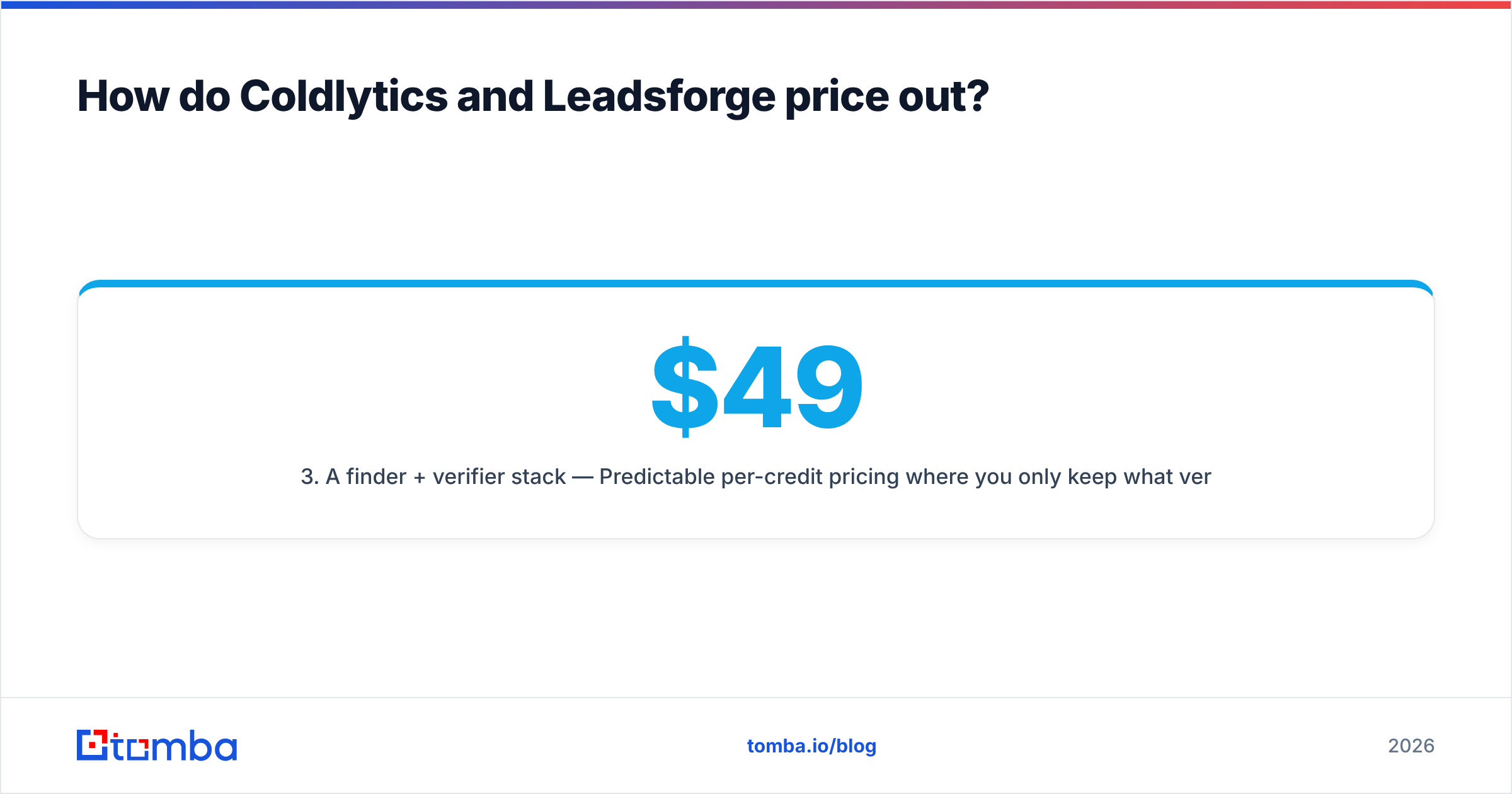
- A finder + verifier stack — Predictable per-credit pricing where you only keep what verifies. See Tomba pricing for a reference point: Free tier (25 searches/mo), Starter at $49/mo, Growth at $99/mo, and Pro at $249/mo.
- The hidden line item — Deliverability damage from unverified sends. This never shows on an invoice but shows up in your reply rate.
Is there a cheaper, more accurate alternative?#
Yes — and it's worth naming plainly. If your core need is finding and verifying business emails at a predictable cost, a purpose-built finder is usually cheaper per deliverable contact than either a done-for-you service or an AI list builder.
Tomba is built for exactly this. You can find email addresses by name and domain, run a domain search to pull every reachable contact at a target company, and verify the results in the same workflow. For catch-all domains — the ones that quietly wreck AI-built lists — the catch-all verifier tells you whether an address is actually reachable instead of guessing.

The point isn't that Tomba replaces every use case. Coldlytics still wins when you genuinely need a human to interpret a messy, niche ICP. But for the 80% of outbound that's "find verified emails for a known list of companies and roles," a finder-plus-verifier stack is the leaner path — and it plugs into your CRM through native integrations so the data lands where your reps already work.
How to choose between them#
Match the tool to your actual bottleneck, not the demo that impressed you.
| Your situation | Best fit |
|---|---|
| Niche targets scrapers can't find | Coldlytics |
| Need volume fast, common personas | Leadsforge |
| Low budget, want verified emails | Tomba finder + verifier |
| High-value ABM, few accounts | Coldlytics (precision) |
| Self-serve, technical team, API access | Tomba API / Leadsforge |
| Cost per deliverable is the KPI | Tomba (verify-what-you-keep) |
A practical hybrid many teams land on: use Coldlytics or Leadsforge to source candidate contacts, then run everything through a verifier before it touches your sequencer. That way you get each tool's strength — Coldlytics precision or Leadsforge speed — without inheriting the deliverability risk of sending to unverified data.
What about deliverability, not just data?#
Even a perfect list fails if your sending setup is weak. Before you scale any outbound built on Coldlytics or Leadsforge data, confirm the fundamentals: authenticated domain (SPF, DKIM, DMARC), a warmed inbox, and a bounce rate held under 3%. Google and Microsoft's 2024 bulk-sender rules made this non-negotiable — you can read the sender guidelines from Google directly rather than rely on secondhand summaries.
The chain of causation is simple: bad data → high bounces → damaged email deliverability → good contacts landing in spam. That's why verification isn't a nice-to-have bolted onto list building — it's the thing that protects the value of every other tool in your stack.
The verdict: Coldlytics vs Leadsforge in 2026#
Choose Coldlytics if your targets are genuinely hard to find and precision beats volume — bespoke human research earns its premium on complex, low-volume, high-value outbound.
Choose Leadsforge if you need self-serve speed and volume on common personas, and you're disciplined about verifying before you send.
But recognize what both share: neither guarantees deliverable emails out of the box, and both cost more per usable contact than a dedicated finder once you account for waste.
If your real goal is verified B2B emails at a predictable price, start with the Tomba Email Finder. Find and verify contacts in one workflow, keep only what's deliverable, and protect your sender reputation before you scale. The free tier gives you 25 searches a month to test accuracy on your own target accounts — run it against a list you already trust and let the bounce rate decide.
Related guides#
Ready to find emails that actually work?
Join 150,000+ professionals who stopped guessing and started sending. Free credits on signup — no credit card required.
Get the Tomba newsletter
Practical outbound tactics and product updates — once every two weeks.
About the author