Coldlytics vs Leadzenai: Which Lead Tool Wins in 2026?
Coldlytics sells done-for-you prospect lists; Leadzen.ai leans on AI data intelligence. Here's how they stack up on price, accuracy, and speed—and when a self-serve email finder beats both.
Choosing between Coldlytics and Leadzen.ai comes down to one question: do you want a team to build your prospect lists for you, or a platform that hands you the data and lets you self-serve? They solve the same problem—getting verified B2B contacts into your pipeline—from opposite ends.
This guide breaks down pricing, data accuracy, turnaround, and fit so you can pick without a three-week trial. And because "buy leads" and "find leads" are different budgets, we'll also show where a self-serve tool undercuts both.
TL;DR — Coldlytics vs Leadzenai at a glance#
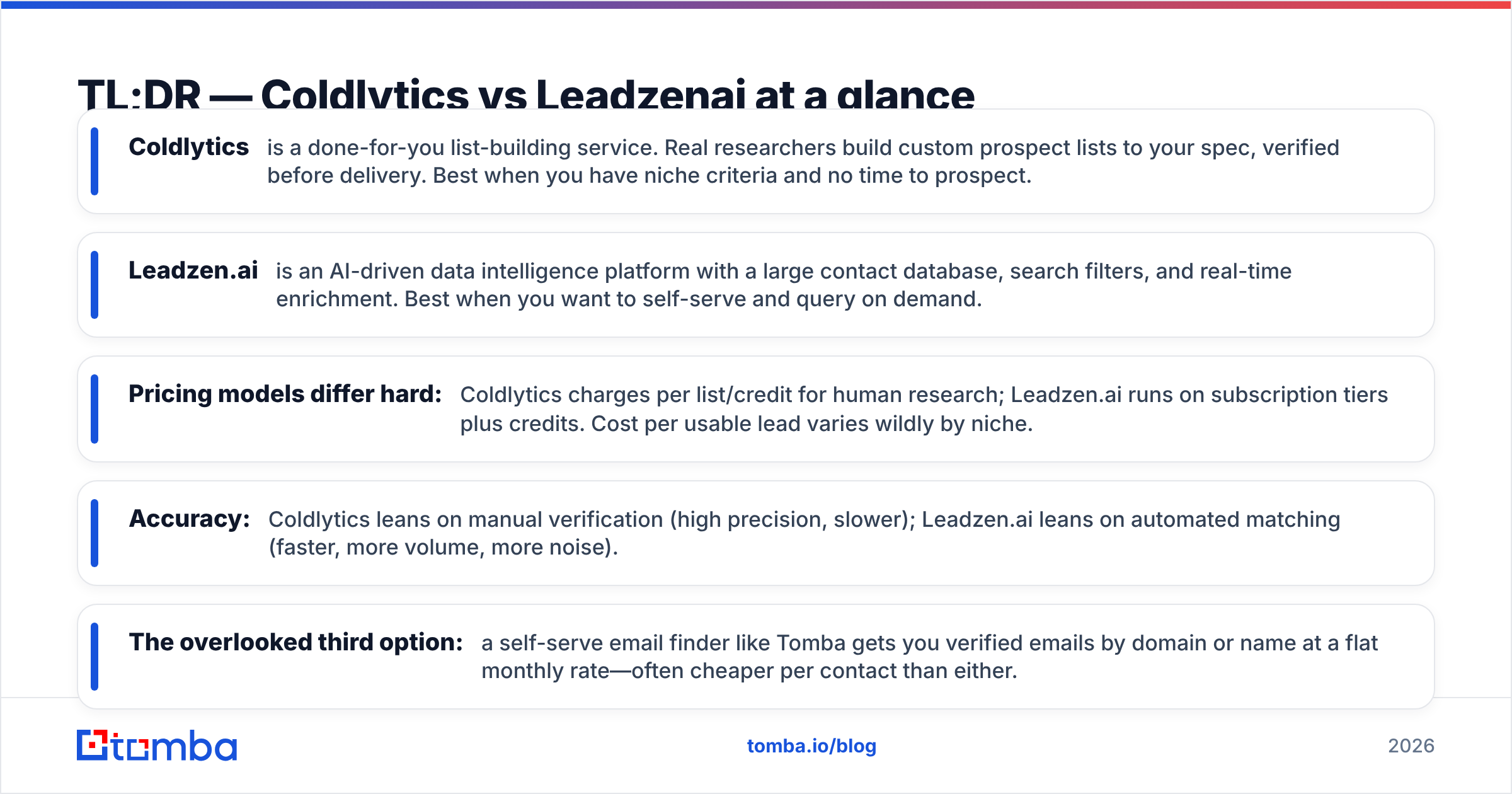
- Coldlytics is a done-for-you list-building service. Real researchers build custom prospect lists to your spec, verified before delivery. Best when you have niche criteria and no time to prospect.
- Leadzen.ai is an AI-driven data intelligence platform with a large contact database, search filters, and real-time enrichment. Best when you want to self-serve and query on demand.
- Pricing models differ hard: Coldlytics charges per list/credit for human research; Leadzen.ai runs on subscription tiers plus credits. Cost per usable lead varies wildly by niche.
- Accuracy: Coldlytics leans on manual verification (high precision, slower); Leadzen.ai leans on automated matching (faster, more volume, more noise).
- The overlooked third option: a self-serve email finder like Tomba gets you verified emails by domain or name at a flat monthly rate—often cheaper per contact than either.
What is Coldlytics?#
Coldlytics is a managed prospecting service. You define your ideal customer—industry, title, geography, tech stack, company size—and a team of researchers manually builds and verifies a targeted list, then delivers it as a CSV or pushes it into your workflow.
The pitch is precision over volume. Because humans (backed by tooling) assemble each list, Coldlytics handles the messy criteria that database filters miss: "founders of Shopify stores in the UK doing over $1M who posted about hiring in the last 90 days." That's hard to express as a filter and easy to describe to a researcher.
The trade-off is turnaround and unit economics. You wait for delivery (typically days, not seconds), and you pay for human time. For low-volume, high-value outbound—agencies, consultants, ABM plays—that math works. For high-volume spray-and-pray, it doesn't.
What is Leadzen.ai?#
Leadzen.ai is a self-serve B2B data platform out of India with a large contact and company database, layered with AI-based search and real-time enrichment. You log in, apply filters, and pull contacts on demand—emails, phone numbers, and firmographics.
The pitch is speed and scale. Instead of briefing a researcher and waiting, you query the database yourself and export in minutes. It also offers enrichment (feed it a name or company, get back contact details) and browser-based lookups, which suits sales reps who want to prospect inside their own workflow.
The trade-off is the classic self-serve database problem: coverage and freshness vary by region and role. Automated matching produces more volume, but you'll want to run exports through an email verifier before you send, because bounce rates on any large database tool are non-trivial.
Coldlytics vs Leadzenai: the core comparison#
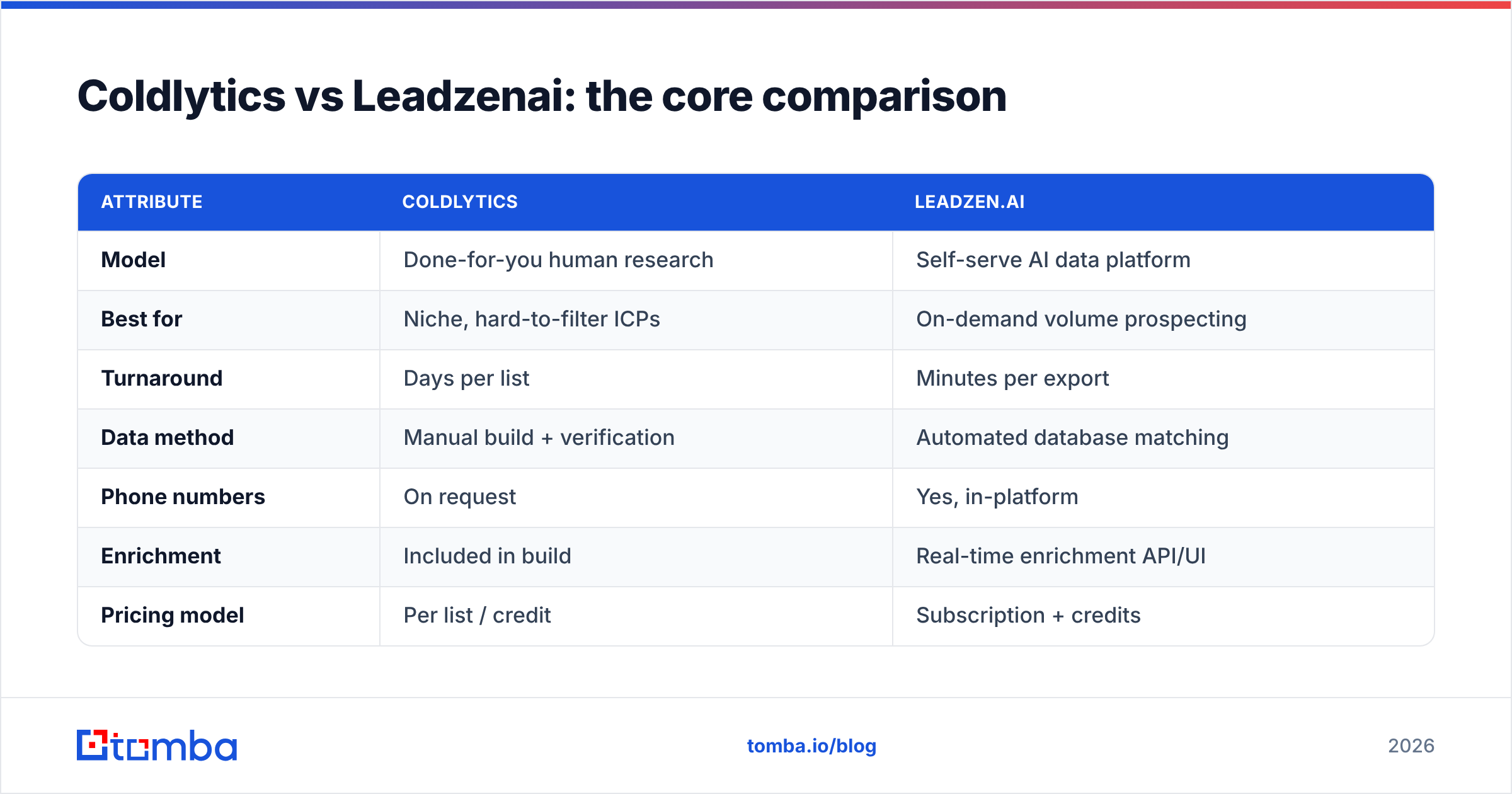
Here's the head-to-head on the attributes that actually change your decision.
| Attribute | Coldlytics | Leadzen.ai |
|---|---|---|
| Model | Done-for-you human research | Self-serve AI data platform |
| Best for | Niche, hard-to-filter ICPs | On-demand volume prospecting |
| Turnaround | Days per list | Minutes per export |
| Data method | Manual build + verification | Automated database matching |
| Phone numbers | On request | Yes, in-platform |
| Enrichment | Included in build | Real-time enrichment API/UI |
| Pricing model | Per list / credit | Subscription + credits |
| Free option | Limited / trial | Trial available |
| Scaling cost | Rises with volume (human time) | Flatter (database access) |
| Verification burden | Low (pre-verified) | Moderate (verify before send) |
Read the table by your constraint. If your bottleneck is time and targeting, Coldlytics removes the work. If your bottleneck is cost-per-lead at volume, Leadzen.ai's self-serve model scales flatter—provided your ICP sits inside its coverage.
Which is more accurate, Coldlytics or Leadzenai?#
Accuracy depends on what you mean by it—and the honest answer is that they optimize for different failure modes.
Coldlytics optimizes for precision. A human confirms the person matches your criteria and the email is deliverable before it ships. You get fewer records, but a higher share of them are the right person with a working address. That's why it wins for expensive outbound where one wrong contact wastes a personalized sequence.
Leadzen.ai optimizes for recall. Automated matching surfaces far more contacts, faster, so you rarely come up empty on a search. The cost is variance: some records are stale, some emails bounce, some titles are outdated. None of that is unique to Leadzen—it's true of every large self-serve database, from Apollo to ZoomInfo.
The practical rule: whichever automated tool you use, treat its export as raw material, not gospel. Running a bulk email finder and verification pass over any database export is the single highest-ROI habit in outbound. It's the difference between a 2% bounce rate and a 15% one—and bounce rate is what gets your domain flagged.
How do Coldlytics and Leadzenai price out?#
This is where the two diverge most, and where a lot of buyers get surprised.
Coldlytics prices around human research output—you're buying lists or credits that map to researcher time. Cost per lead is higher, but every lead is targeted and verified, so your usable cost per lead can actually be competitive for niche work. The catch: costs climb linearly with volume, because more leads means more hours.
Leadzen.ai prices around platform access—subscription tiers with credit allotments for exports and enrichment. Cost per lead drops as you use more of your allotment, which rewards high-volume teams. The catch: you pay for records you may still need to verify and discard.
Neither publishes a single flat number that fits every use case, so model it against your volume:
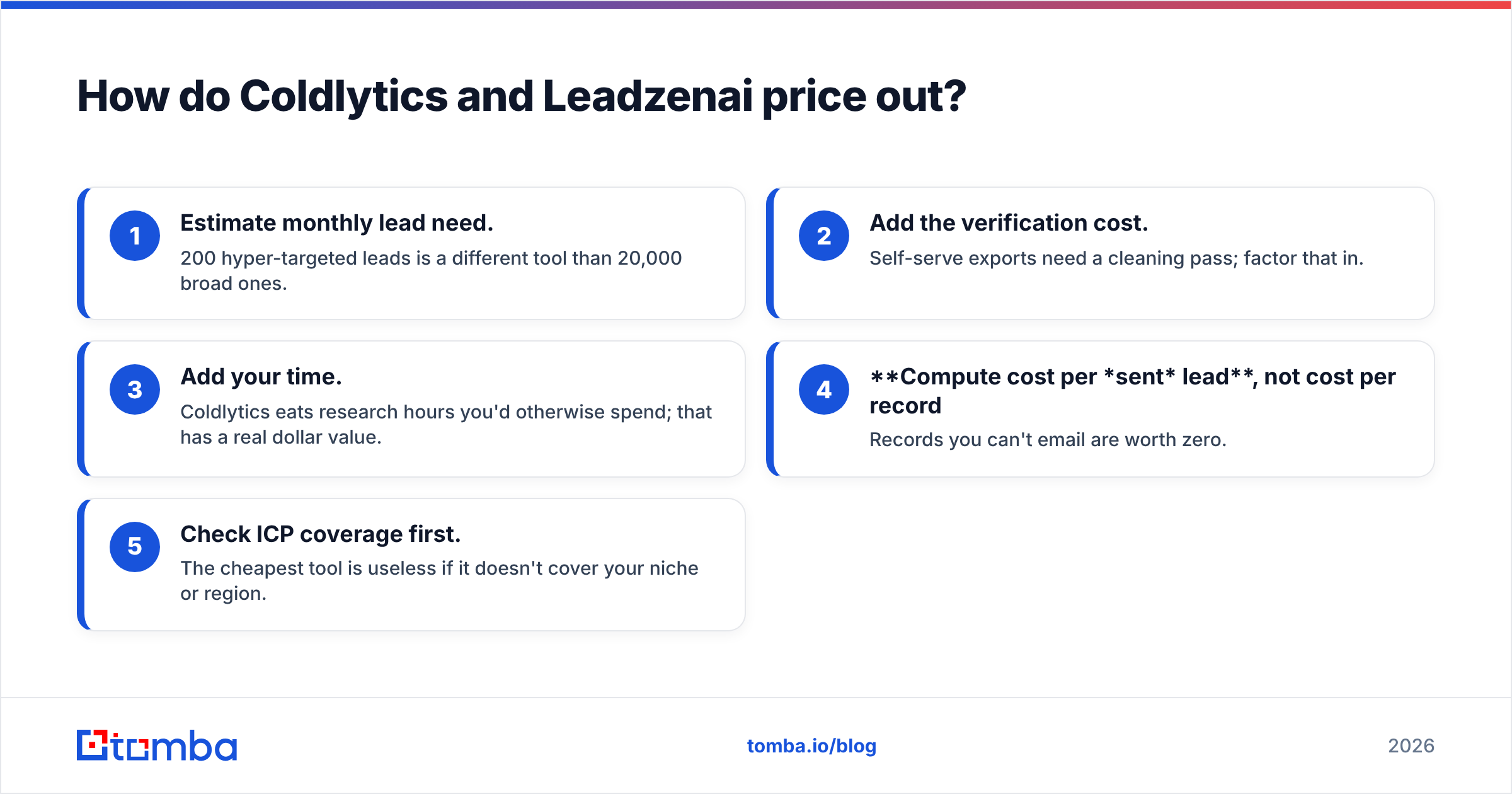
- Estimate monthly lead need. 200 hyper-targeted leads is a different tool than 20,000 broad ones.
- Add the verification cost. Self-serve exports need a cleaning pass; factor that in.
- Add your time. Coldlytics eats research hours you'd otherwise spend; that has a real dollar value.
- Compute cost per sent lead, not cost per record. Records you can't email are worth zero.
- Check ICP coverage first. The cheapest tool is useless if it doesn't cover your niche or region.
When you run that math, a lot of teams find the "cheap" database is expensive after cleaning, and the "expensive" done-for-you service is fair once you price your own time.

When should you use a self-serve email finder instead?#
Reach for a dedicated email finder when your real need is simpler than either platform assumes: you already know who you want, you just need their verified email.
That's more common than the "buy a giant list" pitch suggests. If you're working from a conference attendee list, a LinkedIn export, a list of target companies, or authors you want to reach, you don't need a research team or a sprawling database—you need name-and-domain to verified-email, fast and cheap.
This is where Tomba fits between Coldlytics and Leadzen.ai:
- Domain search returns every discoverable email at a company, with roles and confidence scores.
- Email finder takes a name plus a domain and returns the verified address.
- Built-in verification means you send, not guess—no separate cleaning tool.
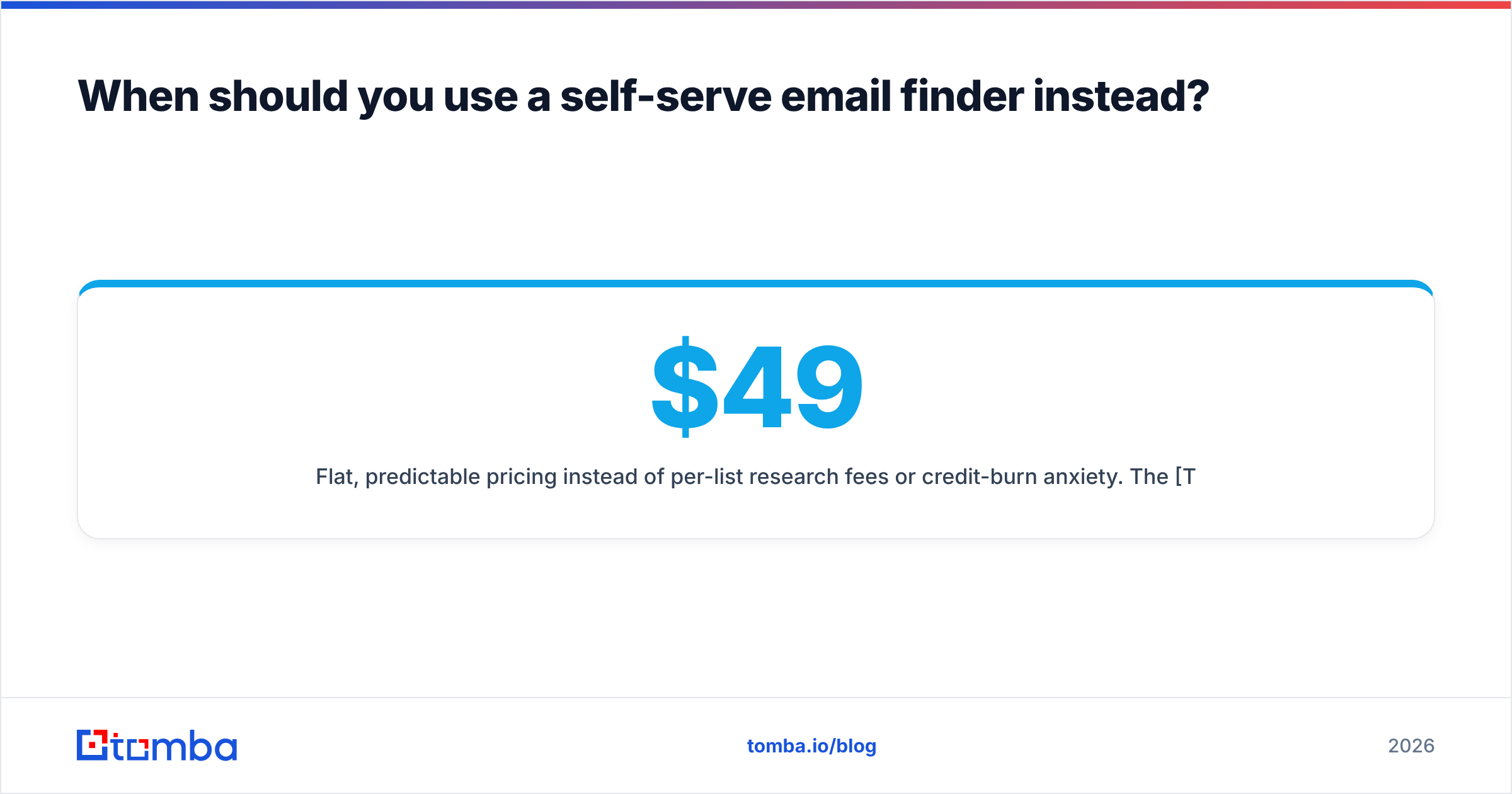
- Flat, predictable pricing instead of per-list research fees or credit-burn anxiety. The Tomba pricing runs Free (25 searches/mo), Starter at $49/mo, Growth at $99/mo, and Pro at $249/mo.
You lose the "someone else does the targeting" magic of Coldlytics and the giant browsable database of Leadzen.ai. You gain speed, control, and a lower cost per verified contact when you already know your targets.
Coldlytics vs Leadzenai vs a self-serve finder: quick decision guide#
| Your situation | Best fit |
|---|---|
| Niche ICP you can't express as filters | Coldlytics |
| No time to prospect, high-value deals | Coldlytics |
| Want to query and export on demand | Leadzen.ai |
| High volume, coverage in your region | Leadzen.ai |
| You already know your targets | Self-serve email finder (Tomba) |
| Tight, predictable budget per contact | Self-serve email finder (Tomba) |
| Cleaning a list you already have | Email verifier + finder |
Notice these aren't mutually exclusive. A common stack is Leadzen.ai or Coldlytics for discovery, then a finder-plus-verifier layer to fill gaps and clean everything before it hits your sequencer. The tools compete less than the marketing implies.
What are the risks with each tool?#
Coldlytics risk: turnaround and throughput. If your motion needs 5,000 fresh leads a week, human research either can't keep pace or gets expensive fast. It also concentrates dependency—you're briefing a team, so vague briefs get vague lists.
Leadzen.ai risk: coverage and freshness. Its strength is the Indian and broader APAC market; validate coverage for your specific geography and seniority before committing. And, as with any automated source, verify before you send.
Shared risk: deliverability. Neither tool controls what happens after export. If you blast an unwarmed domain with a big list—verified or not—you'll land in spam. Your sending reputation, warmup, and SPF/DKIM setup matter more than which vendor sourced the list. No data provider fixes a cold domain.
The verdict: Coldlytics vs Leadzenai in 2026#
There's no universal winner—there's a winner for your constraint.
Pick Coldlytics if your targeting is the hard part and you'd rather buy back your time than learn a database. It's the sharper tool for niche, high-value, low-volume outbound where precision beats scale.
Pick Leadzen.ai if you want to self-serve at volume, your ICP sits inside its coverage, and you're comfortable running a verification pass on exports. It's the faster, flatter-cost option for teams that prospect continuously.
Pick a self-serve email finder if the truth is you already know who you're chasing and just need verified addresses without a research fee or a credit-burn subscription. For that job—turning names and domains into deliverable emails—Tomba's email finder is faster and cheaper per contact than briefing a service or exporting from a broad database, with verification built in so your bounce rate stays low. Start on the free tier, run your existing target list through it, and see your real cost per verified contact before you commit budget to anything bigger.
Want to compare more tools before you decide? Cross-check any vendor's reviews on G2 and read Coldlytics' and Leadzen.ai's own docs on data sourcing—then test all three against the same 100 target accounts. The one with the lowest cost per sent, delivered lead wins your budget.
Related guides#
Ready to find emails that actually work?
Join 150,000+ professionals who stopped guessing and started sending. Free credits on signup — no credit card required.
Get the Tomba newsletter
Practical outbound tactics and product updates — once every two weeks.
About the author