Coldlytics vs RocketReach (2026): Which Prospecting Tool Wins?
Coldlytics builds done-for-you lists by hand; RocketReach sells self-serve contact data at scale. Here's which one fits your outbound motion in 2026 — and where a cheaper API beats both.
Choosing between Coldlytics and RocketReach comes down to one question: do you want someone to build your prospect list for you, or do you want a self-serve database you can pull from on demand? They sound like competitors, but they solve the problem from opposite ends. This breakdown shows you which model fits your outbound motion, what each one actually costs, and where a lean email-finder API quietly outperforms both.
TL;DR — Coldlytics vs RocketReach in 30 seconds#
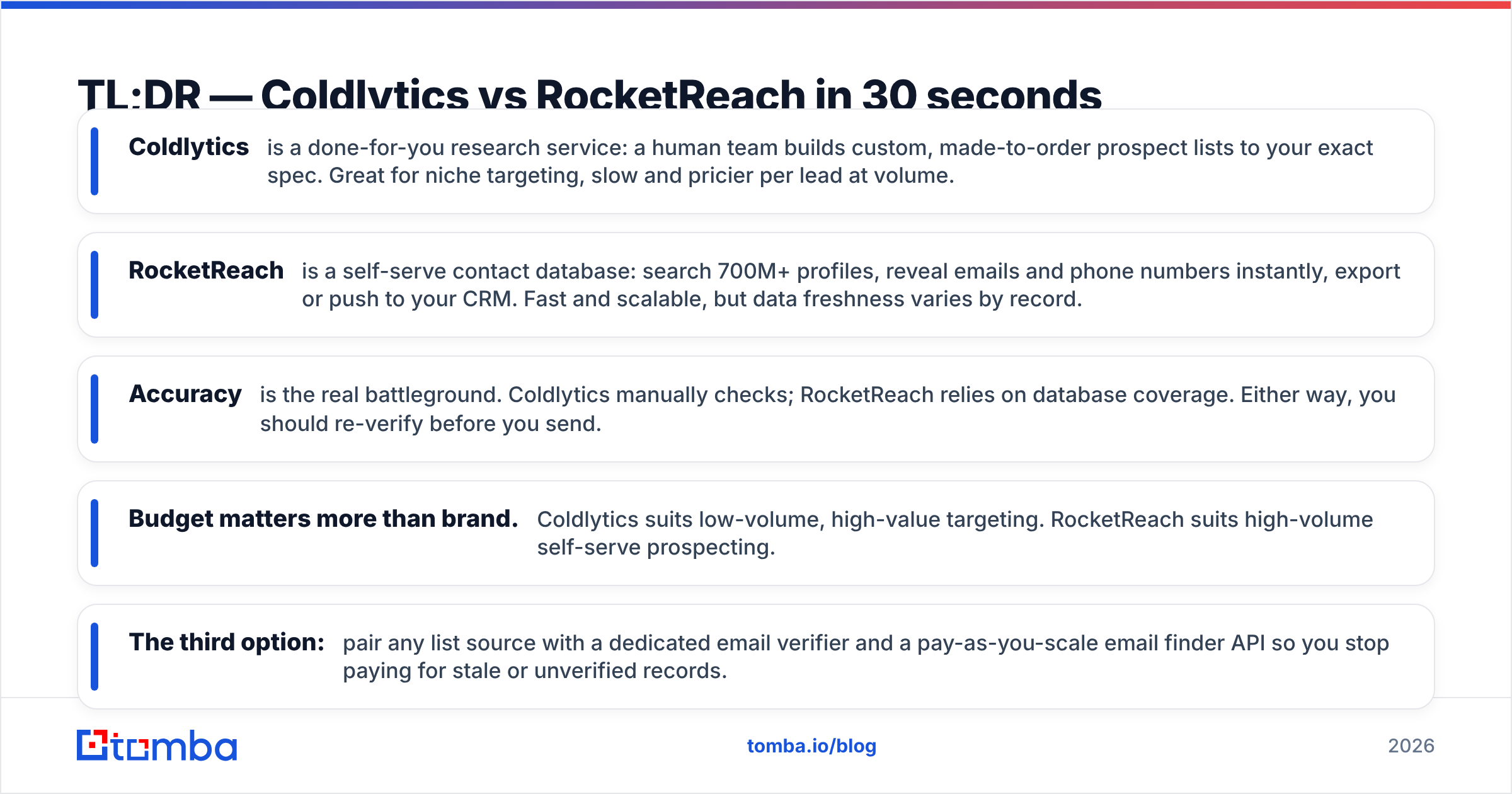
- Coldlytics is a done-for-you research service: a human team builds custom, made-to-order prospect lists to your exact spec. Great for niche targeting, slow and pricier per lead at volume.
- RocketReach is a self-serve contact database: search 700M+ profiles, reveal emails and phone numbers instantly, export or push to your CRM. Fast and scalable, but data freshness varies by record.
- Accuracy is the real battleground. Coldlytics manually checks; RocketReach relies on database coverage. Either way, you should re-verify before you send.
- Budget matters more than brand. Coldlytics suits low-volume, high-value targeting. RocketReach suits high-volume self-serve prospecting.
- The third option: pair any list source with a dedicated email verifier and a pay-as-you-scale email finder API so you stop paying for stale or unverified records.
What is Coldlytics?#
Coldlytics is a managed prospecting service. Instead of handing you a tool and login, you submit a target profile — job titles, industries, company size, geography, and any custom filters — and their research team builds the list by hand. You get back a spreadsheet of contacts that match your brief, typically with verified business emails.
The pitch is precision. Because a human interprets your request, Coldlytics can chase down targets that a database filter would miss: the "Head of Growth at a Series A fintech in the UK who posted about outbound last quarter" kind of prospect. That flexibility is the whole point.
The trade-offs are speed and unit economics. Turnaround takes time because people are doing the work, and cost-per-lead climbs as your volume grows. It's a research subscription, not an all-you-can-eat database. If you need 200 razor-targeted accounts a month, that's a fit. If you need 20,000 contacts by Friday, it isn't.
What is RocketReach?#
RocketReach is a self-serve contact-data platform. It claims access to hundreds of millions of professionals and tens of millions of companies, and you search it directly through a web app or Chrome extension. Find a person, click reveal, and you get their email and often a phone number. Credits are consumed per lookup.
The strength is immediacy and scale. You control the workflow, pull as many contacts as your plan allows, and there's no waiting on a research team. RocketReach also offers bulk lookups, an API, and integrations with CRMs and sequencers, so it slots into an existing tech stack without much friction. You can see current plan structures on the RocketReach site and independent reviews on G2.
The weakness is the weakness of every large database: coverage is uneven and freshness varies. A contact that was accurate 18 months ago may have changed jobs. That's not unique to RocketReach — it's physics for any static dataset — but it means the "reveal" isn't a guarantee, it's a best guess with good odds.
Coldlytics vs RocketReach: the core differences#
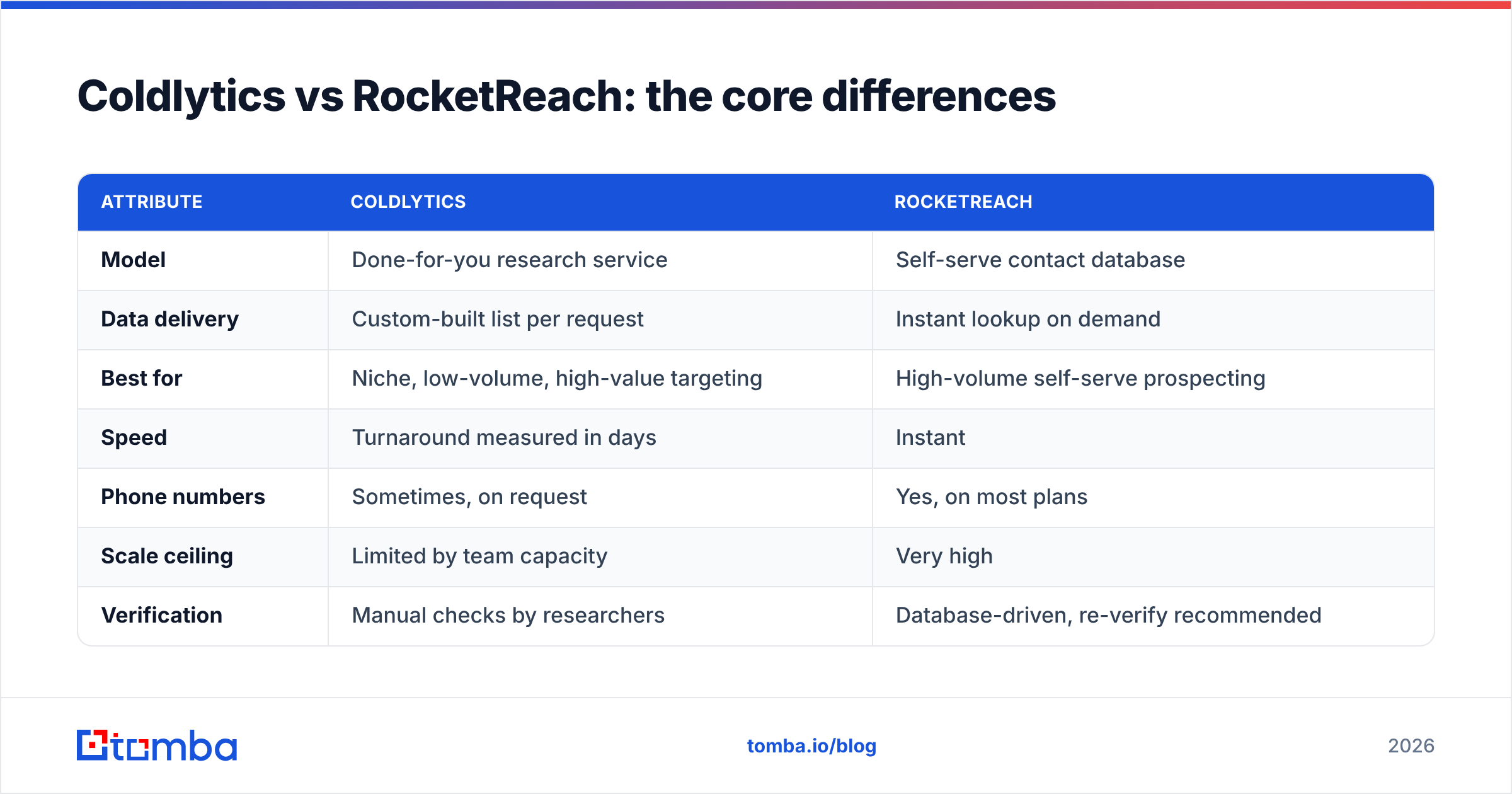
Here's the side-by-side that actually drives the decision. Notice these tools aren't really the same category — one is a service, one is software — which is exactly why the "winner" depends on your motion.
| Attribute | Coldlytics | RocketReach |
|---|---|---|
| Model | Done-for-you research service | Self-serve contact database |
| Data delivery | Custom-built list per request | Instant lookup on demand |
| Best for | Niche, low-volume, high-value targeting | High-volume self-serve prospecting |
| Speed | Turnaround measured in days | Instant |
| Phone numbers | Sometimes, on request | Yes, on most plans |
| Scale ceiling | Limited by team capacity | Very high |
| Verification | Manual checks by researchers | Database-driven, re-verify recommended |
| Pricing shape | Subscription per list volume | Credit-based tiers |
| CRM/API integrations | Limited | Extensive |
The pattern is clear: Coldlytics trades speed and scale for precision and human judgment. RocketReach trades hand-checked accuracy for instant, scalable access. Neither is objectively "better" — they're built for different buyers.
Which one is more accurate?#
Accuracy is where most buyers get burned, so be specific about what you're measuring. There are two failure modes: coverage (does the tool have the person at all?) and freshness (is the contact info still valid?).
Coldlytics leans on manual research, so within its delivered lists, hit rates tend to be high — a human confirmed the match. But coverage is bounded by how much a person can find in the time you're paying for. RocketReach has enormous coverage, so it almost always has a record, but that record's freshness depends on when the underlying data was last updated.
The uncomfortable truth: no list source is "send-ready" on arrival. Job changes, typos, and catch-all domains mean a slice of every list will bounce. That's why serious outbound teams run every list — no matter the source — through a verification step. A quick pass through an email verifier catches invalid and risky addresses before they hit your sequence, and a catch-all verifier resolves the ambiguous domains that break most tools. Skip this and you pay for it in bounce rate and sender reputation.

How much do Coldlytics and RocketReach cost?#
Pricing philosophies differ as much as the products. Coldlytics charges for research capacity — you're buying a volume of hand-built leads per period. RocketReach charges per lookup via credit tiers, with higher plans unlocking bulk and API access. Always check each vendor's current pricing page, since both revise tiers over time.
Here's the mental model for comparing them fairly, plus where a usage-based email-finder API fits as a third path:
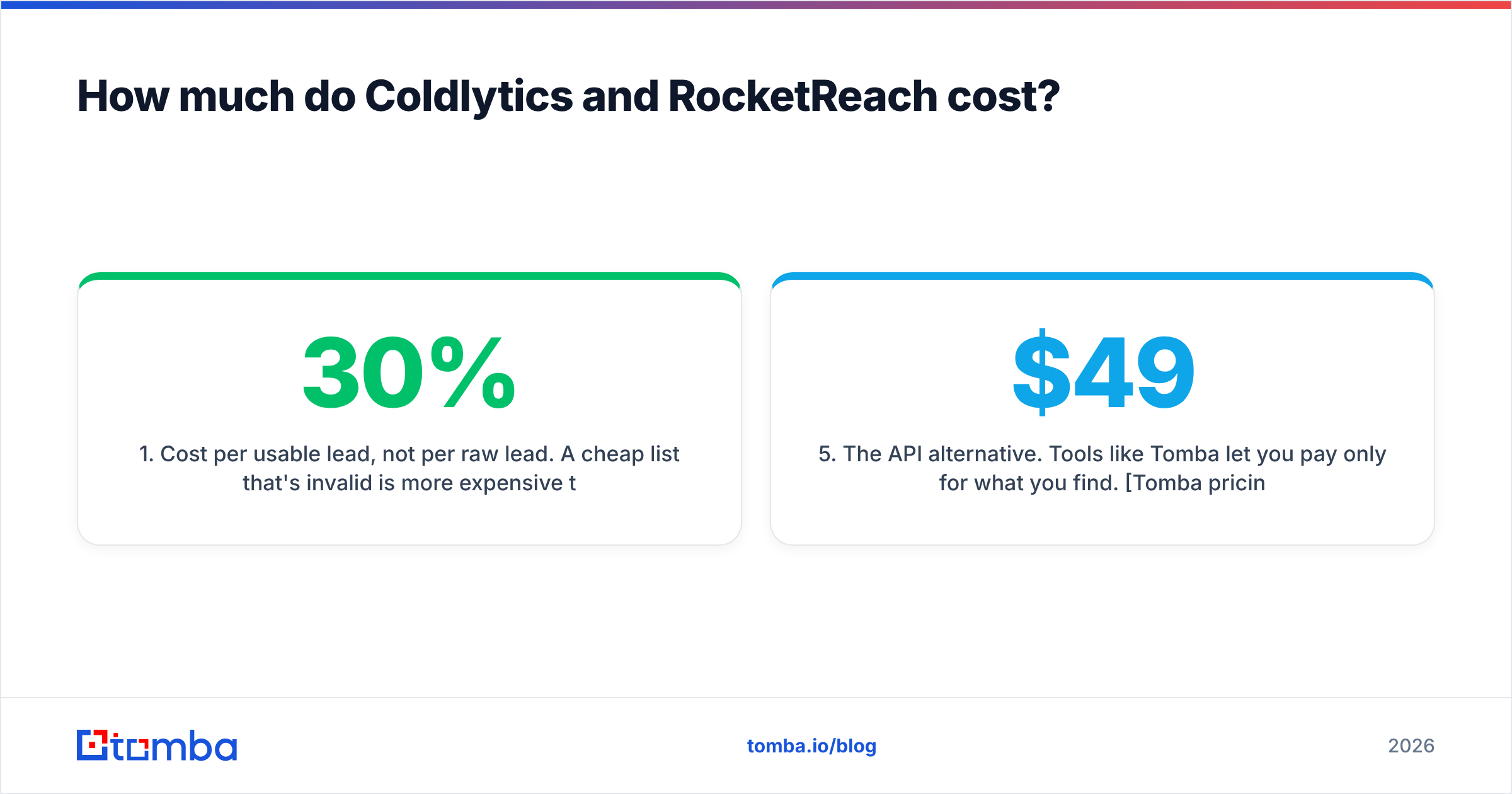
- Cost per usable lead, not per raw lead. A cheap list that's 30% invalid is more expensive than a pricier list that's 95% valid. Factor verification and bounce loss into every quote.
- Volume curve. Coldlytics gets relatively more expensive as you scale; database and API tools get cheaper per lead at volume. Map your monthly target before you commit.
- Speed cost. If a done-for-you list takes days and your reps sit idle, that lag has a real dollar cost. Instant tools remove it.
- Tooling overhead. RocketReach bundles CRM pushes and integrations; a service like Coldlytics hands you a file you route yourself.
- The API alternative. Tools like Tomba let you pay only for what you find. Tomba pricing runs a Free tier (25 searches/mo), Starter at $49/mo, Growth at $99/mo, and Pro at $249/mo — so you can bolt an email finder API onto whatever list source you already use.
When should you pick Coldlytics?#
Choose Coldlytics when precision beats volume. Specifically:
- Your ideal-customer profile is narrow enough that database filters return junk, and you need a human to interpret nuance.
- You run account-based outbound where 100 perfectly-matched contacts are worth more than 10,000 loose ones.
- You'd rather offload list-building entirely than train a rep to run search tools.
- Your deal sizes are large enough that a higher cost-per-lead is trivial next to one closed contract.
If that's you, the manual approach earns its premium. Just budget for turnaround time and confirm what verification is included so you're not double-paying downstream.
When should you pick RocketReach?#
Choose RocketReach when speed and scale beat hand-curation. Specifically:
- You prospect continuously and need contacts on demand, not on a delivery schedule.
- Your reps live in the browser and want a Chrome extension that reveals contacts as they research.
- You need phone numbers alongside emails for a multi-channel cadence — pair the data with a phone finder if coverage gaps show up.
- You already run a CRM and sequencer and want data flowing in through native integrations.
The caveat stays the same: treat every revealed email as a candidate, not a fact, and verify before you send at volume.
Is there a better-value alternative to both?#
Often, yes — and it's not an either/or. The most cost-efficient teams in 2026 decouple finding from verifying and pay usage-based rates for both, instead of locking into a single expensive subscription.
That's the gap Tomba fills. Rather than paying a premium for a managed service or a rigid credit tier, you can:
- Use domain search to pull every known email on a target company in one query.
- Run a bulk email finder over an account list you exported from anywhere — including Coldlytics or RocketReach.
- Verify the whole set with the email verifier so only valid addresses reach your sequencer.
- Automate all of it through the Tomba API or the Chrome extension, at pricing that starts free and scales predictably.
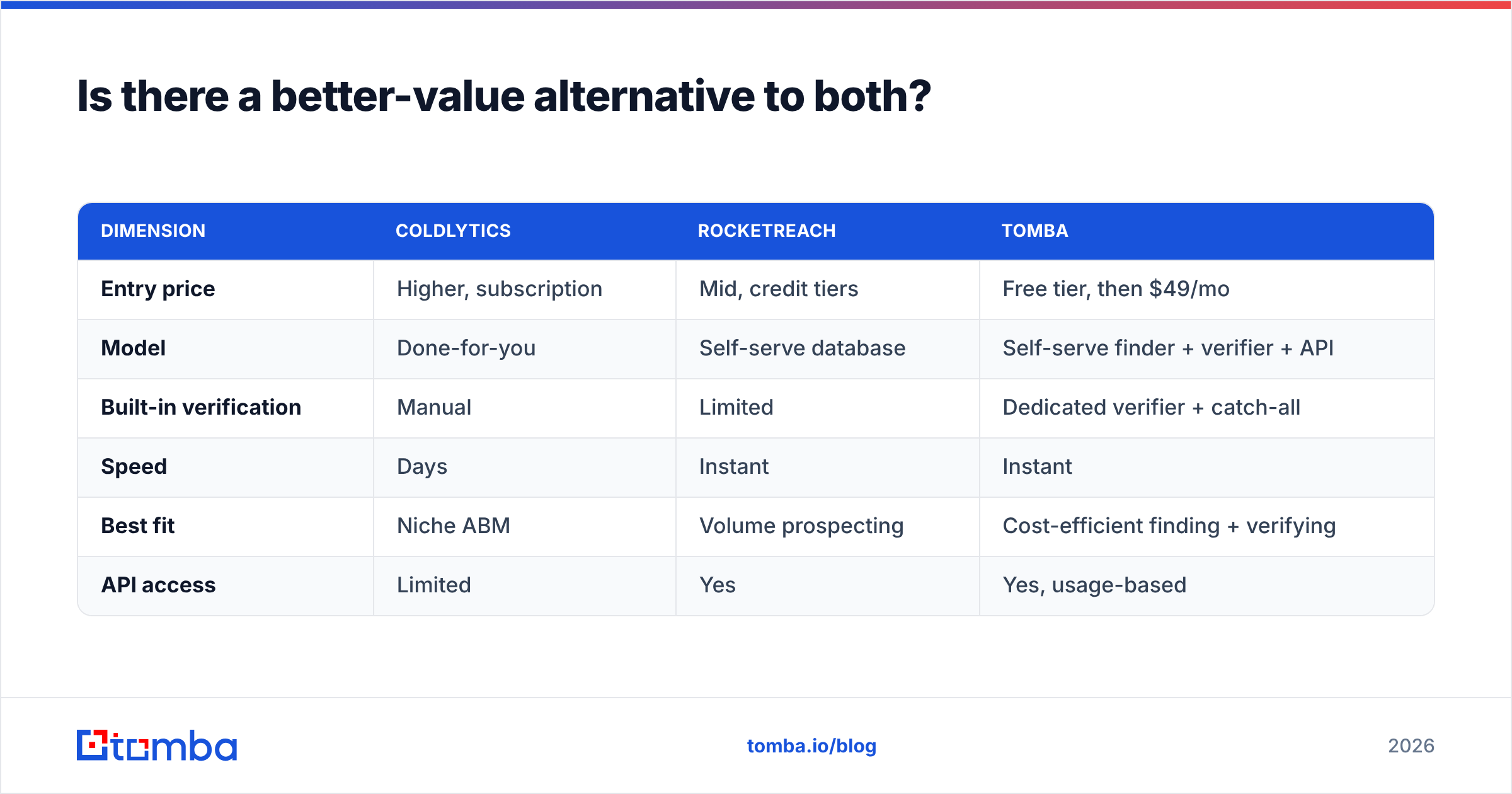
Here's how the three approaches stack up on the dimensions that decide outbound ROI:
| Dimension | Coldlytics | RocketReach | Tomba |
|---|---|---|---|
| Entry price | Higher, subscription | Mid, credit tiers | Free tier, then $49/mo |
| Model | Done-for-you | Self-serve database | Self-serve finder + verifier + API |
| Built-in verification | Manual | Limited | Dedicated verifier + catch-all |
| Speed | Days | Instant | Instant |
| Best fit | Niche ABM | Volume prospecting | Cost-efficient finding + verifying |
| API access | Limited | Yes | Yes, usage-based |
The point isn't that one tool crushes the others. It's that "Coldlytics vs RocketReach" is the wrong framing if you're optimizing for cost-per-usable-lead. A finder-plus-verifier layer can sit under either service and cut what you pay for stale or invalid records.
The verdict#
Pick Coldlytics if you need hand-built, niche lists and your deal sizes justify a premium. Pick RocketReach if you need instant, scalable self-serve data and you already have a stack to plug it into. Both are legitimate — they just serve opposite ends of the volume-vs-precision spectrum.
But before you sign either contract, price out the third path. Most outbound waste doesn't come from picking the "wrong" vendor — it comes from paying for leads you never verify and emails that bounce. Fix that first and the vendor choice gets a lot cheaper.
Ready to stop guessing which emails are real? Start with the Tomba Email Finder — find professional addresses by domain, name, or company, verify them in the same workflow, and only pay for what you actually use. Spin up the free tier, run it against your next list from any source, and watch your bounce rate drop before your first send.
Related guides#
Ready to find emails that actually work?
Join 150,000+ professionals who stopped guessing and started sending. Free credits on signup — no credit card required.
Get the Tomba newsletter
Practical outbound tactics and product updates — once every two weeks.
About the author