Coldlytics vs SMARTe (2026): B2B Data Tools Compared
Coldlytics builds custom prospect lists by hand; SMARTe sells enriched B2B contact data at scale. Here's how the two compare on accuracy, speed, pricing, and which one fits your outbound motion in 2026.
Choosing a B2B data source usually comes down to a trade-off you can feel in your pipeline: do you want someone to build a list for you, or do you want a platform that hands you data at scale and lets you self-serve? Coldlytics and SMARTe sit on opposite ends of that spectrum, which is exactly why teams keep pitting them against each other.
This comparison breaks down where each one wins, where each one frustrates, and how a self-serve email tool like Tomba fits when neither model quite matches your budget or volume.
TL;DR — Coldlytics vs SMARTe at a glance#
- Coldlytics is a done-for-you prospecting service: human researchers build bespoke, verified lists on demand. Great for niche targeting, slow and pricey at scale.
- SMARTe is a self-serve B2B data platform: a large contact database with a Chrome extension, mobile numbers, and enrichment. Great for volume, less bespoke.
- Accuracy: Coldlytics wins on hand-checked precision; SMARTe wins on coverage and freshness across large territories.
- Pricing: both are quote-based and opaque. Neither publishes transparent per-credit costs, which makes budgeting hard.
- The third option: if you mostly need verified emails on demand without a sales call or a minimum contract, a self-serve tool like the Tomba Email Finder fills that gap at a published price.

What is Coldlytics?#
Coldlytics is a managed prospecting service built around human research. You define your ideal customer profile — job titles, industries, company size, geography, technographics — and a team of researchers builds a custom list, verifies the contact data, and delivers it back to you. Think of it less like a database subscription and more like hiring a research desk on a retainer.
The appeal is precision. Because a person is interpreting your criteria, Coldlytics handles the messy, nuanced targeting that databases fumble: "founders of Shopify agencies with 5–20 staff who posted about hiring in the last 90 days." That kind of request is hard to express as a database filter, and Coldlytics leans into it.
The trade-offs are the ones you'd expect from anything human-powered:
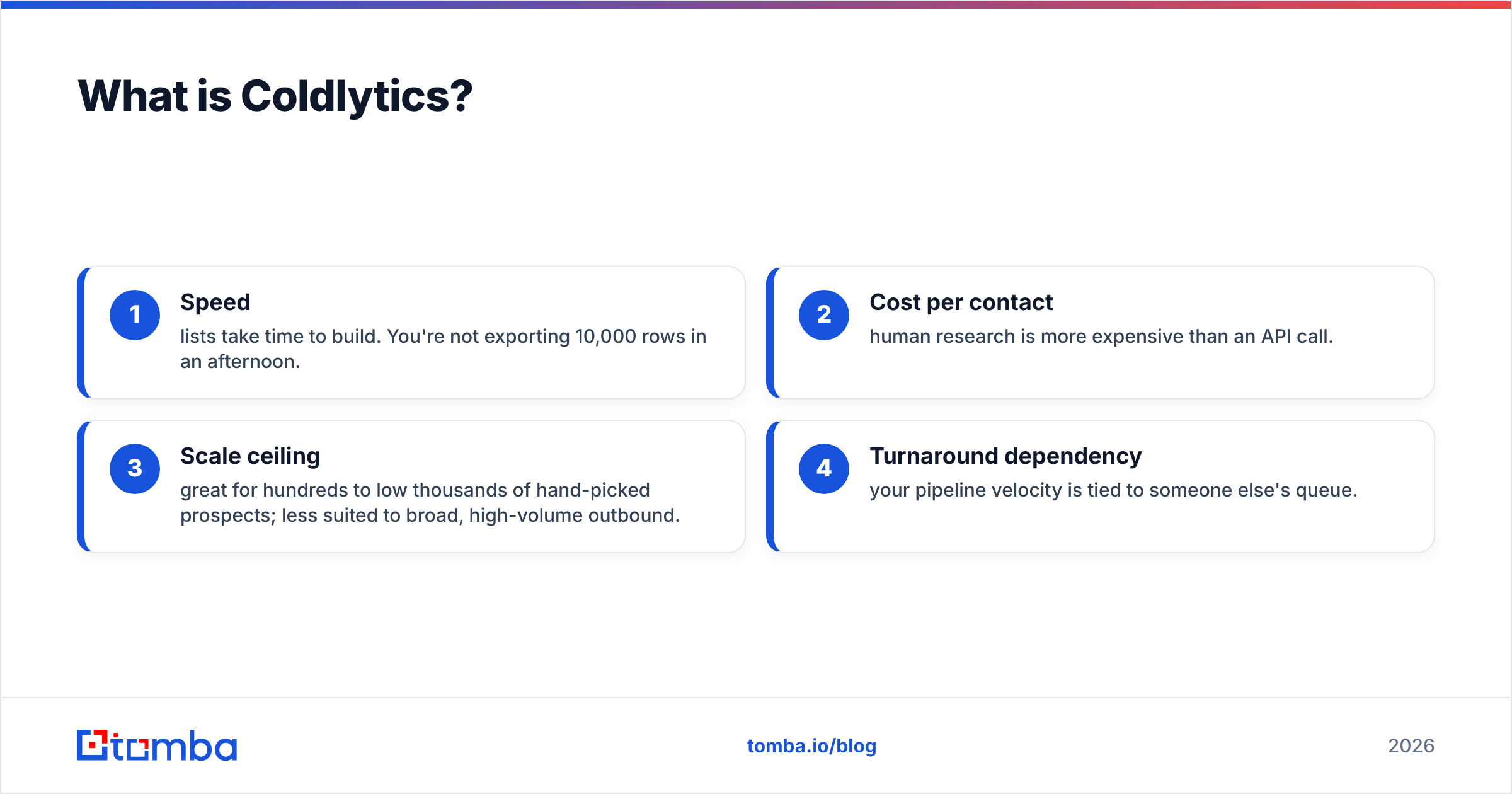
- Speed — lists take time to build. You're not exporting 10,000 rows in an afternoon.
- Cost per contact — human research is more expensive than an API call.
- Scale ceiling — great for hundreds to low thousands of hand-picked prospects; less suited to broad, high-volume outbound.
- Turnaround dependency — your pipeline velocity is tied to someone else's queue.
For account-based motions and tight niches, that's an acceptable trade. For teams that need to refill a list weekly, the model gets expensive fast.
What is SMARTe?#
SMARTe is a self-serve B2B contact and company data platform. It provides access to a large database of business contacts — emails, direct dials, and verified mobile numbers — plus a Chrome extension that pulls data while you browse LinkedIn or company sites, and enrichment to fill gaps in your CRM. It markets heavily on international coverage (strong APAC and EMEA data) and on compliance with GDPR and CCPA.
Where Coldlytics gives you a research team, SMARTe gives you a platform. You run the searches, apply the filters, and export the contacts yourself. That shifts the speed advantage decisively toward SMARTe for volume work — you're not waiting on a queue — but it also puts the burden of targeting precision back on you and your filters.
The common friction points teams report with platform-style providers like SMARTe:
- Data decay — any large static database ages; some records are stale by the time you reach out.
- Credit models — exports are metered, and heavy users hit ceilings.
- Opaque pricing — you talk to sales before you see a number, and contracts often carry annual minimums.
- Coverage gaps — broad databases are strong in some regions and thin in others.
None of that makes SMARTe a weak tool. It's a legitimate, widely-used data provider. It's just a fundamentally different purchase than Coldlytics.
Coldlytics vs SMARTe: the core differences#
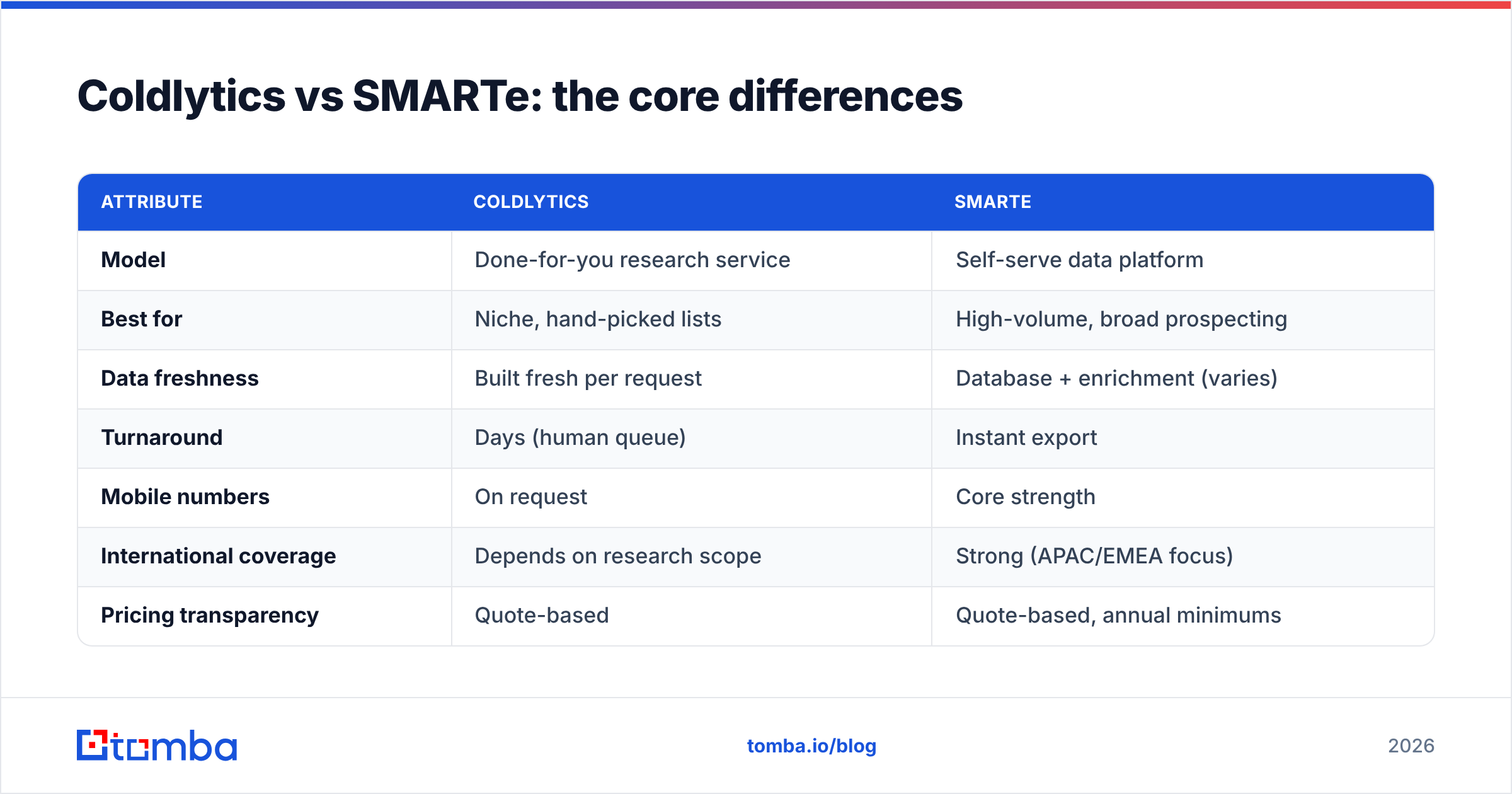
The cleanest way to think about it: Coldlytics sells labor, SMARTe sells access. One builds the list; the other gives you the raw material to build it yourself. Here's how that plays out across the attributes that actually affect your outbound.
| Attribute | Coldlytics | SMARTe |
|---|---|---|
| Model | Done-for-you research service | Self-serve data platform |
| Best for | Niche, hand-picked lists | High-volume, broad prospecting |
| Data freshness | Built fresh per request | Database + enrichment (varies) |
| Turnaround | Days (human queue) | Instant export |
| Mobile numbers | On request | Core strength |
| International coverage | Depends on research scope | Strong (APAC/EMEA focus) |
| Pricing transparency | Quote-based | Quote-based, annual minimums |
| Scale ceiling | Low–medium | High |
| Precision targeting | Very high (human interpreted) | Filter-dependent |
If your bottleneck is precision, Coldlytics has the edge. If your bottleneck is volume and speed, SMARTe does. The problem is that a lot of teams have a third bottleneck neither one solves cleanly: they need verified emails, on demand, at a predictable price, without a procurement cycle. That's where a self-serve finder-and-verifier stack changes the math.
Which one is more accurate?#
Accuracy is two different questions for these two tools, so compare them on the right axis.
For Coldlytics, accuracy means fit plus verification. Because humans build the list, the contacts genuinely match your brief, and each email is checked before delivery. You rarely get a "why is this person even here?" record. The weakness is that human verification at delivery is a snapshot — if you sit on the list for a month, decay still happens.
For SMARTe, accuracy means database correctness and coverage. A platform lives or dies on how current and complete its records are. SMARTe invests in refresh and verification, but like any large database, hit rates vary by region and seniority. You'll get more records faster; a slice of them will bounce.
The universal fix for both is the same: verify at send time, not at purchase time. No matter where a list comes from, run it through an email verifier right before you load it into your sequencer. A record that was valid when a researcher checked it in March can be dead by July. Verification is cheap insurance against a wrecked sender reputation.
For deeper reading on why data decay is the real enemy in outbound, G2's data on contact data accuracy is a useful neutral benchmark across the category.
How do they price, and what does it actually cost?#
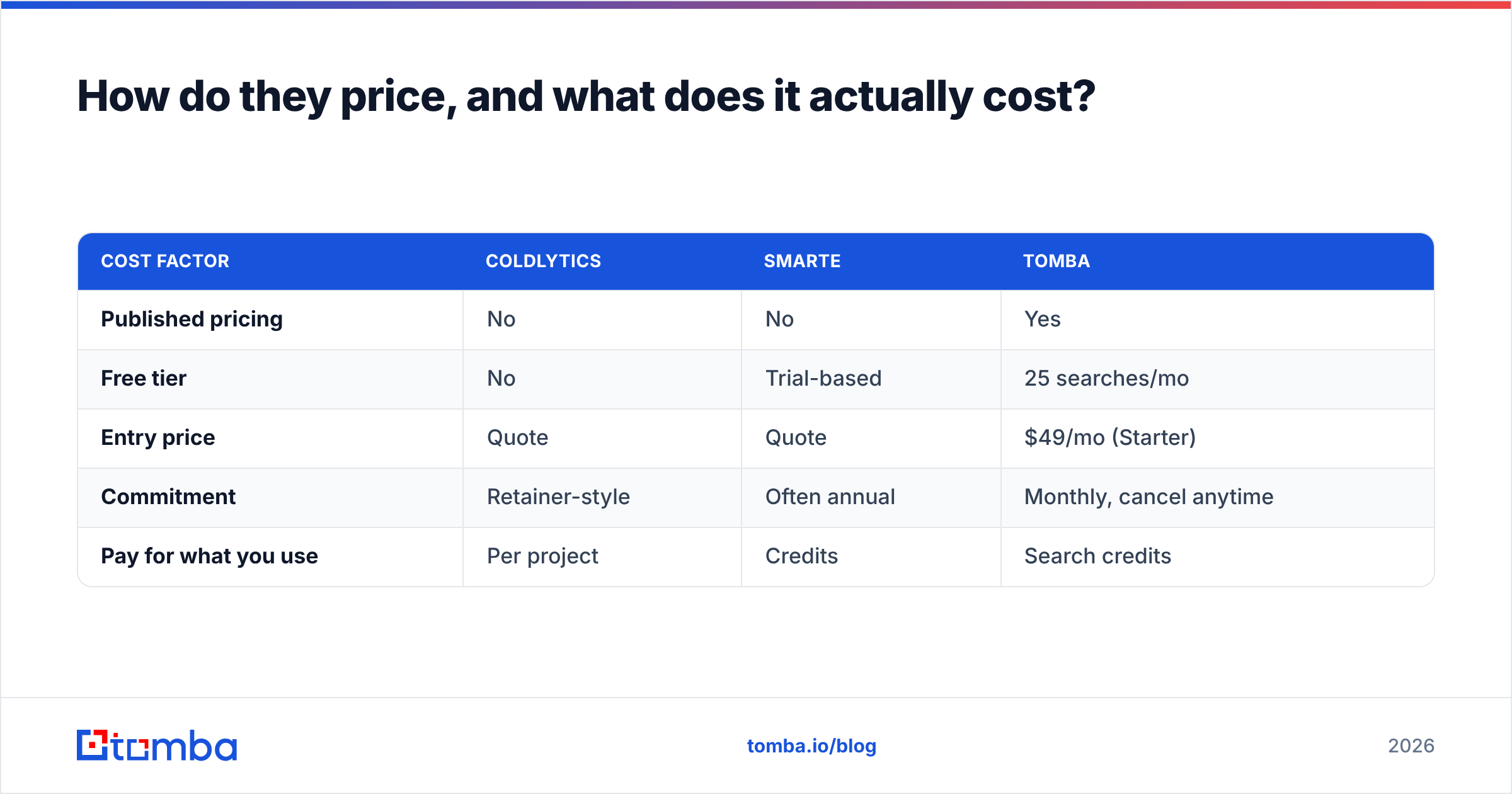
Here's the honest answer: neither publishes transparent pricing. Both Coldlytics and SMARTe route you through a conversation before you see a quote, and pricing scales with volume, contract length, and data type (mobile numbers cost more than emails almost everywhere).
That opacity is fine if you're a large team running a formal vendor evaluation. It's a real obstacle if you're a founder, a small SDR team, or anyone who just needs contacts this week without signing an annual deal.
| Cost factor | Coldlytics | SMARTe | Tomba |
|---|---|---|---|
| Published pricing | No | No | Yes |
| Free tier | No | Trial-based | 25 searches/mo |
| Entry price | Quote | Quote | $49/mo (Starter) |
| Commitment | Retainer-style | Often annual | Monthly, cancel anytime |
| Pay for what you use | Per project | Credits | Search credits |
For context, Tomba's pricing is public and monthly: a free tier with 25 searches, Starter at $49/mo, Growth at $99/mo, Pro at $249/mo, and custom Enterprise. You don't book a call to learn the number. That transparency is the single biggest practical difference between a self-serve tool and both providers in this comparison.

When should you pick Coldlytics?#
Pick Coldlytics when targeting precision matters more than volume or speed, and you'd rather pay a person than wrestle database filters. Specifically:
- You run account-based or highly-niche outbound where a wrong-fit contact is worse than no contact.
- Your ICP is defined by signals databases can't filter well (recent posts, hiring intent, tech stack nuance).
- You send low volumes to high-value accounts and can absorb a higher cost per contact.
- You don't have the internal time to build and verify lists yourself.
Skip it if you need to refill lists constantly, run broad territory coverage, or keep costs per contact low.
When should you pick SMARTe?#
Pick SMARTe when volume, mobile coverage, and international reach are the priority and you have the team to self-serve. Specifically:
- You run high-volume outbound across multiple territories, especially APAC and EMEA.
- You need verified mobile numbers for a calling motion, not just email.
- You want a Chrome extension and CRM data enrichment in one platform.
- You have the headcount and budget for an annual data contract.
Skip it if you want transparent per-use pricing, hate annual commitments, or your targeting is niche enough that broad database filters won't capture it.
Where does a self-serve email tool fit?#
Between "hire a research team" and "buy a big annual database contract," there's a large group of teams that just need to find and verify professional emails on demand, at a price they can see before they commit. Neither Coldlytics nor SMARTe is built for that buyer. Self-serve finders are.
This is the lane Tomba occupies. Instead of a project queue or a sales cycle, you search by name, company, or domain and get a verified email back — with a confidence score and the sources behind it. A few ways that plays out in practice:
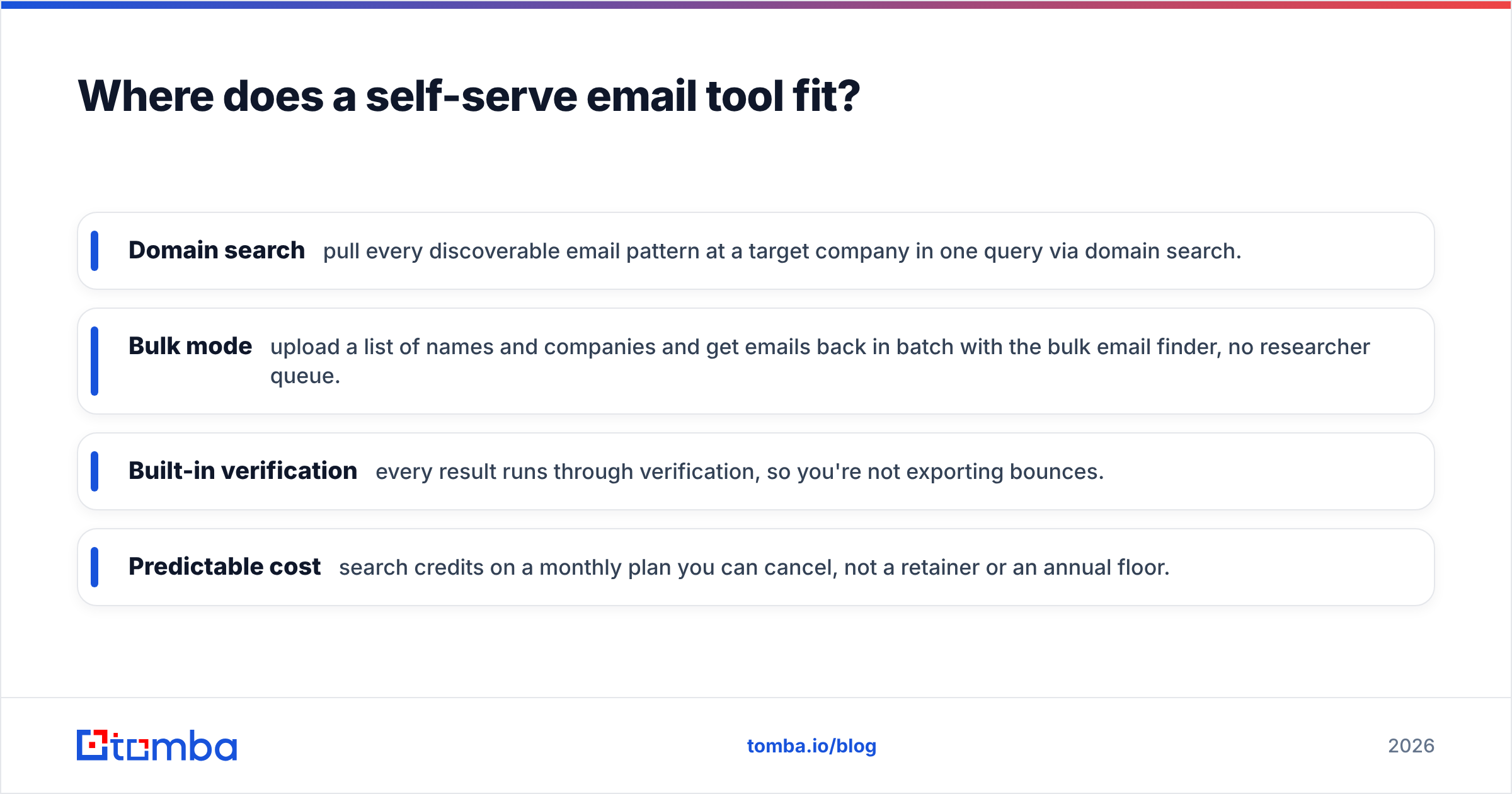
- Domain search — pull every discoverable email pattern at a target company in one query via domain search.
- Bulk mode — upload a list of names and companies and get emails back in batch with the bulk email finder, no researcher queue.
- Built-in verification — every result runs through verification, so you're not exporting bounces.
- Predictable cost — search credits on a monthly plan you can cancel, not a retainer or an annual floor.
It's not a replacement for a research desk when you need bespoke targeting, and it's not a giant static database. It's the middle path: self-serve like SMARTe, verified like Coldlytics, priced transparently like neither. For deliverability-minded teams, pairing a finder with real-time verification is the pattern that protects email deliverability far more than any single data source does. Sales teams evaluating the category can also cross-check options on Capterra's lead-generation software listings for third-party reviews.
Coldlytics vs SMARTe: the verdict#
There's no universal winner — there's a winner for your motion:
- Choose Coldlytics if precision and hands-off list building justify a premium and slower turnaround.
- Choose SMARTe if you need high-volume, international, mobile-heavy data and can commit to a platform contract.
- Choose a self-serve finder like Tomba if you want verified emails on demand, transparent pricing, and no procurement cycle — and you're happy to run the searches yourself.
Most teams don't actually need to pick just one. A common, sane setup: use a self-serve tool for the everyday "find this person's email" volume, and reserve a service like Coldlytics for the handful of high-value niche campaigns where human research pays for itself.
Try the self-serve alternative#
If the opaque pricing and sales calls in this comparison are the part that's stalling you, start with the option you can test in five minutes. The Tomba Email Finder gives you 25 free searches a month — no card, no call — so you can benchmark real hit rates on your own target accounts before you ever commit a budget. Find the emails, verify them on the spot, and load a clean list into your sequencer today instead of next quarter. When you're ready to scale, plans start at $49/mo with pricing you can read before you buy.
Related guides#
Ready to find emails that actually work?
Join 150,000+ professionals who stopped guessing and started sending. Free credits on signup — no credit card required.
Get the Tomba newsletter
Practical outbound tactics and product updates — once every two weeks.
About the author