Coldreach Reviews 2026: Signal-Based Prospecting Tested
An independent look at Coldreach: how its AI buying-signal engine actually performs, what it costs, where it falls short, and who should skip it.
Coldreach promises to end spray-and-pray prospecting by watching the web for buying signals and telling your reps exactly who to contact and why. That's a compelling pitch in 2026, when every inbox is drowning and generic outbound barely clears a 1% reply rate. But a good pitch and a good tool are different things, and the only question that matters is whether Coldreach actually helps you book more meetings than the workflow you already have.
This review is written from a neutral seat. Tomba builds prospecting data infrastructure, so we know this category well, but the goal here is an honest read on Coldreach — what it does, where it shines, where it frustrates, and who should look elsewhere.
TL;DR — Is Coldreach worth it?#
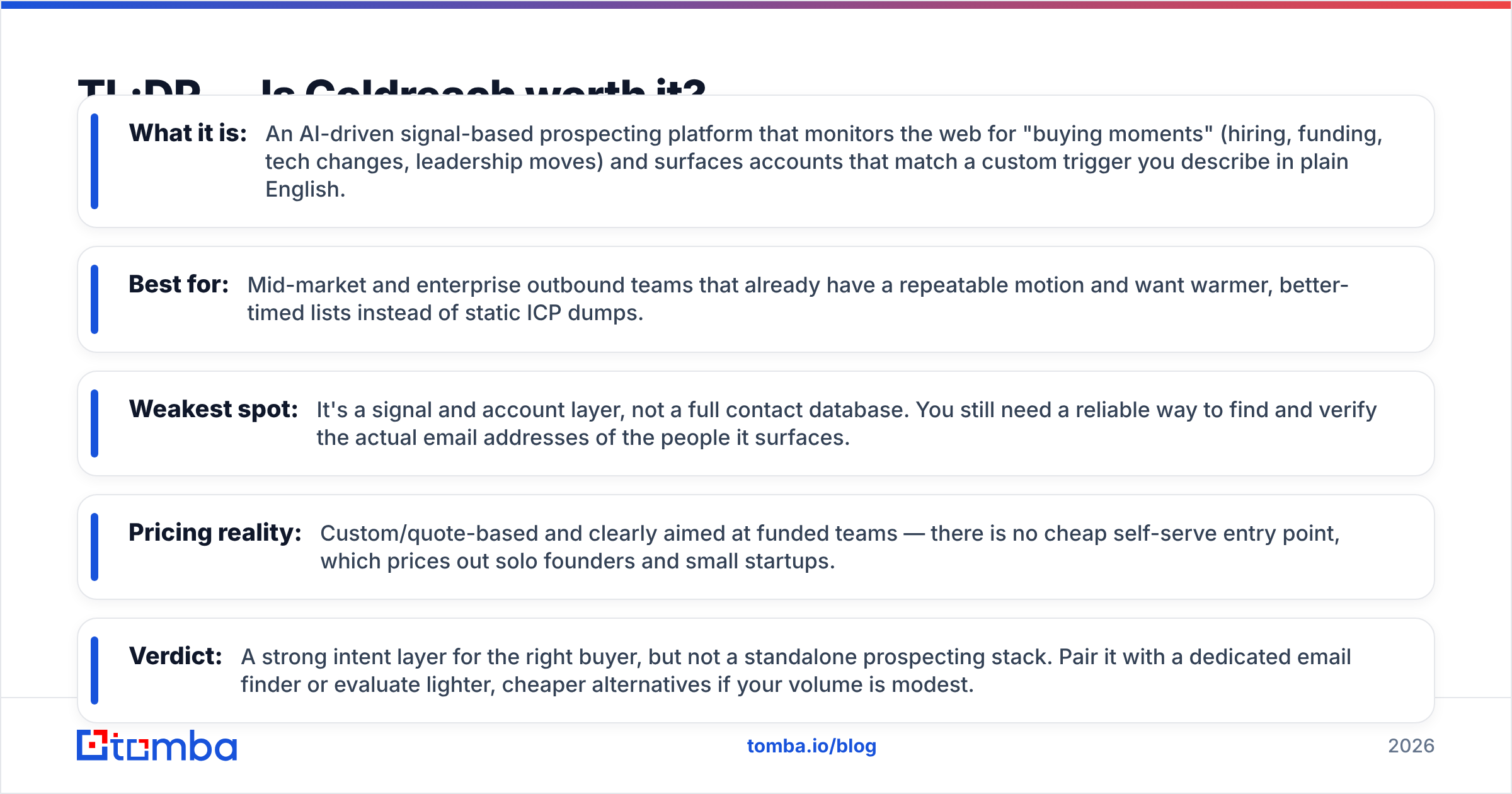
- What it is: An AI-driven signal-based prospecting platform that monitors the web for "buying moments" (hiring, funding, tech changes, leadership moves) and surfaces accounts that match a custom trigger you describe in plain English.
- Best for: Mid-market and enterprise outbound teams that already have a repeatable motion and want warmer, better-timed lists instead of static ICP dumps.
- Weakest spot: It's a signal and account layer, not a full contact database. You still need a reliable way to find and verify the actual email addresses of the people it surfaces.
- Pricing reality: Custom/quote-based and clearly aimed at funded teams — there is no cheap self-serve entry point, which prices out solo founders and small startups.
- Verdict: A strong intent layer for the right buyer, but not a standalone prospecting stack. Pair it with a dedicated email finder or evaluate lighter, cheaper alternatives if your volume is modest.
What is Coldreach and how does it work?#
Coldreach is a buying-signal engine. Instead of you building a list by filtering a database on industry, headcount, and title, you describe the situation that makes a company a good fit — for example, "companies hiring their first RevOps leader" or "SaaS teams that just migrated off a legacy billing tool." Coldreach then scans public sources continuously and returns accounts that match that trigger, along with a short explanation of why each one qualifies.
That "why" is the interesting part. The platform tries to hand your rep a ready-made reason to reach out, which is the difference between a cold email that reads like a mail-merge and one that references something real and current. When it works, a rep opens the account, sees the trigger ("just posted 6 SDR roles in 30 days"), and writes a relevant first line in seconds.
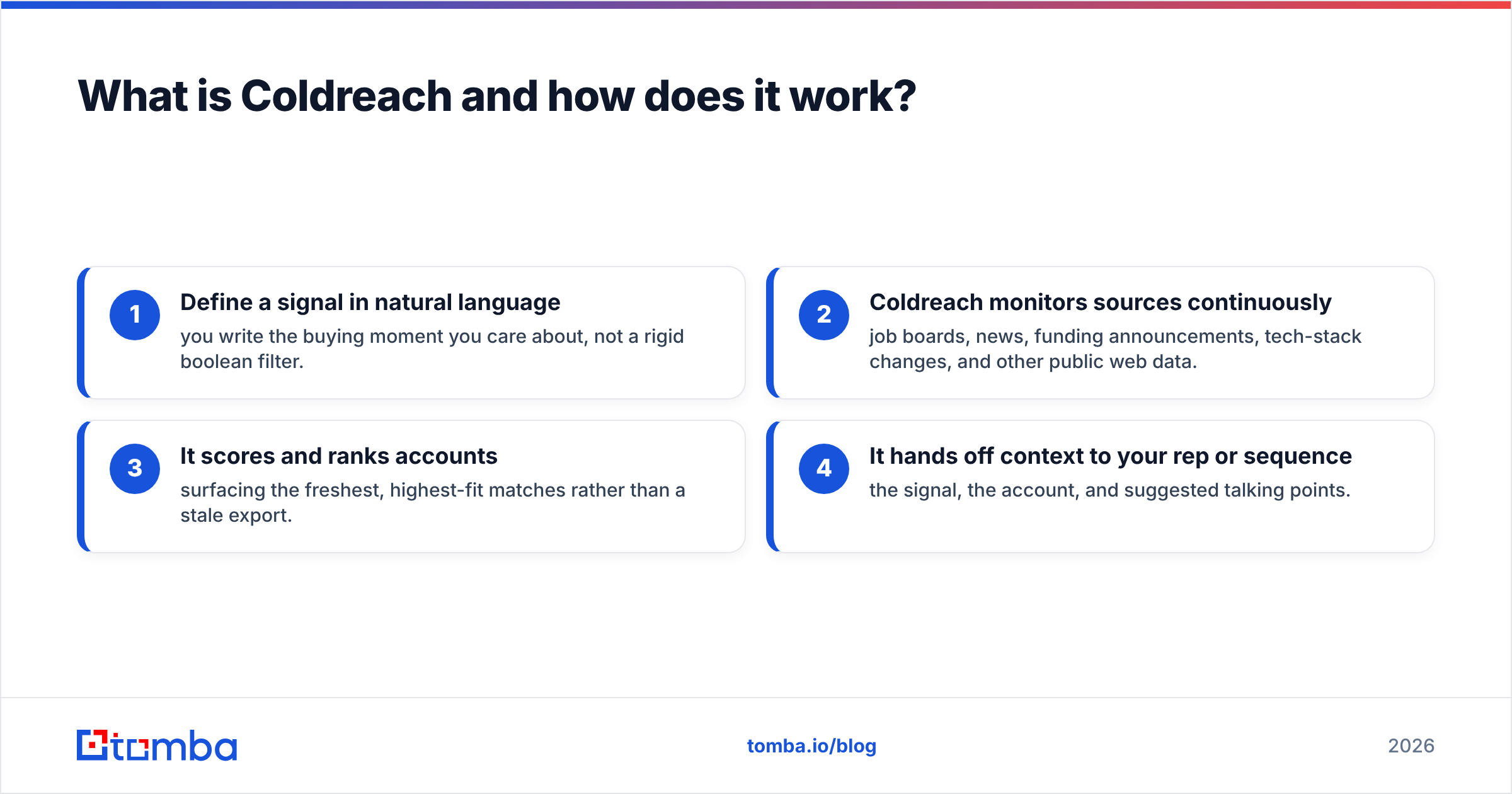
Under the hood, the workflow looks like this:
- Define a signal in natural language — you write the buying moment you care about, not a rigid boolean filter.
- Coldreach monitors sources continuously — job boards, news, funding announcements, tech-stack changes, and other public web data.
- It scores and ranks accounts — surfacing the freshest, highest-fit matches rather than a stale export.
- It hands off context to your rep or sequence — the signal, the account, and suggested talking points.
If you've read HubSpot's material on buying signals, the concept will be familiar; Coldreach's contribution is packaging that intent detection into a self-serve, English-prompt interface instead of a data-science project.
What are the strengths of Coldreach?#
Signal quality and freshness. The core engine is genuinely good at catching timely triggers. Because it monitors continuously rather than on a scheduled pull, the accounts it surfaces tend to be currently in a buying moment, not "was hiring three months ago." For teams whose entire thesis is timing, that's the whole ballgame.
Natural-language targeting. Describing an ICP in a sentence lowers the barrier dramatically. A sales leader can spin up a new signal without begging ops for a saved search or a SQL query. This is where the AI layer earns its keep — translating a fuzzy human idea of "good fit" into a monitored query.
Context, not just contacts. Most prospecting tools give you a name and a company. Coldreach gives you a reason. That reason is what lifts reply rates, because relevance beats volume in a saturated channel. Reps spend less time researching and more time writing.
Cleaner rep workflow. Instead of exporting a 5,000-row CSV and hoping 3% are in-market, reps get a prioritized queue. Less noise, less list fatigue, and a clearer sense of why this account, why now.
Where does Coldreach fall short?#
No tool is all upside, and the honest limitations matter more in a review than the highlight reel.
It is not a contact database. This is the single most important caveat. Coldreach tells you which accounts are in-market and why — but converting an account into an actual outbound touch requires the right person's email address, and a verified one at that. Signal without deliverable contact data is a car without wheels. You'll still need a dedicated email finder and an email verifier to turn a hot account into a sent message that lands.
Opaque, quote-based pricing. Coldreach is aimed squarely at funded teams. There's no visible cheap tier, no generous free plan, and pricing is handled through sales conversations. For a solo founder or a two-person startup, that alone is often a dealbreaker.
Signal volume depends on your niche. If your ICP is broad and your triggers are common (hiring, funding), you'll get plenty. If your ICP is narrow or your trigger is unusual, the well can run dry, and you'll be back to traditional list-building faster than you'd like.
Learning curve on trigger design. "Describe your signal in plain English" is easy to start and hard to master. Vague prompts return noisy accounts; over-specific ones return almost nothing. Getting consistent output takes iteration, and that iteration costs you time before the tool pays off.

How does Coldreach compare to other prospecting tools?#
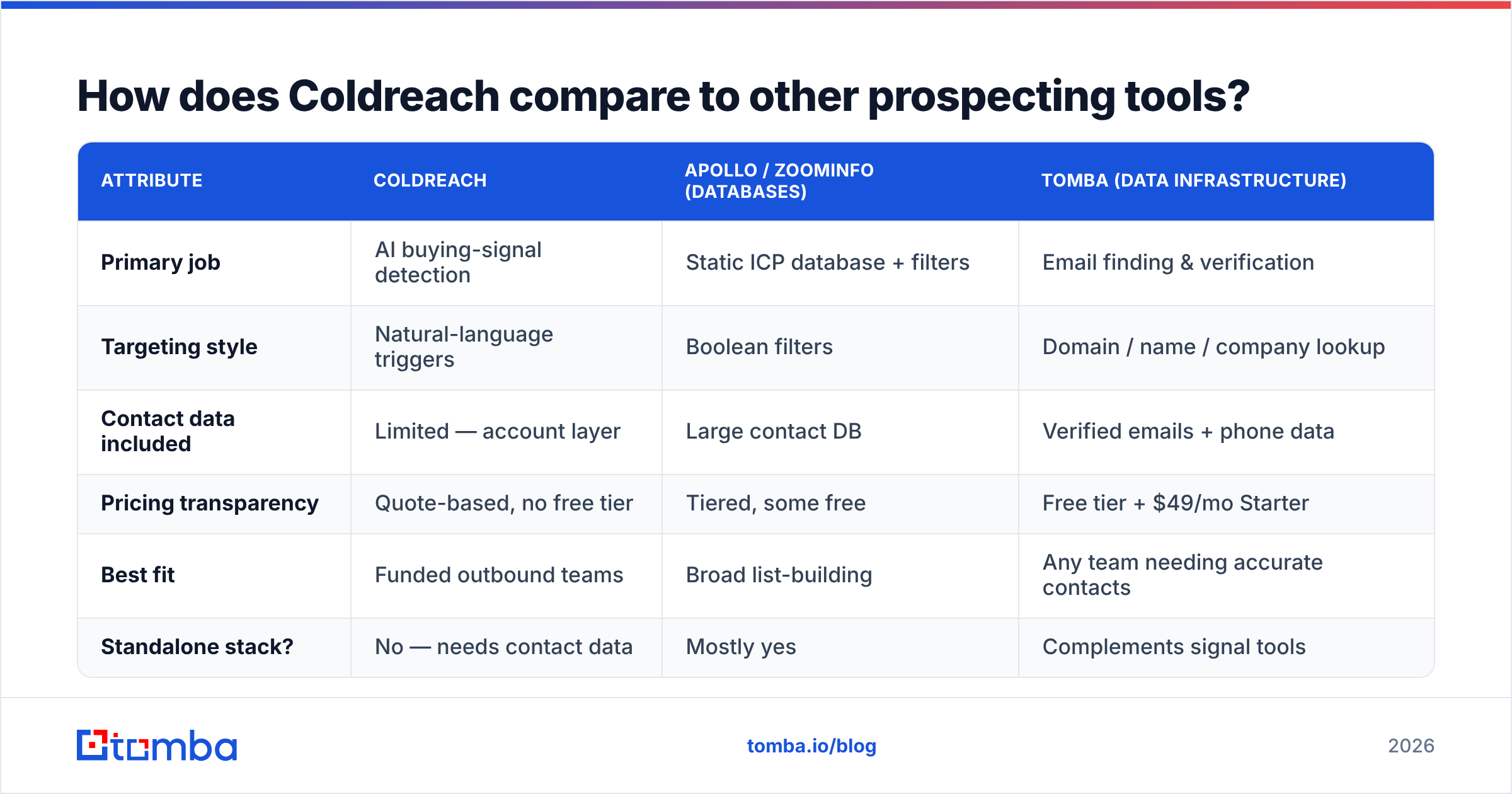
Coldreach sits in an interesting spot: more signal-focused than a raw database like Apollo, but narrower than a full sales-engagement suite. Here's how the categories stack up on the attributes buyers actually weigh.
| Attribute | Coldreach | Apollo / ZoomInfo (databases) | Tomba (data infrastructure) |
|---|---|---|---|
| Primary job | AI buying-signal detection | Static ICP database + filters | Email finding & verification |
| Targeting style | Natural-language triggers | Boolean filters | Domain / name / company lookup |
| Contact data included | Limited — account layer | Large contact DB | Verified emails + phone data |
| Pricing transparency | Quote-based, no free tier | Tiered, some free | Free tier + $49/mo Starter |
| Best fit | Funded outbound teams | Broad list-building | Any team needing accurate contacts |
| Standalone stack? | No — needs contact data | Mostly yes | Complements signal tools |
The takeaway isn't "one wins." It's that Coldreach and a data provider solve different problems. Coldreach answers "who should I contact right now and why." A tool like Tomba answers "what's the verified email for that exact person." You almost always need both, which is why teams that adopt a signal tool quickly bolt on a finder-and-verifier layer rather than replacing it.
If you're weighing broader database options too, our rundown of Apollo alternatives covers where the big list tools help and where they overspend your budget.
Who should actually buy Coldreach?#
Good fit:
- Mid-market and enterprise outbound teams with an existing, repeatable motion who want to feed it warmer accounts.
- Timing-driven sellers — anyone whose pitch depends on catching a company mid-change (post-funding, post-hire, post-migration).
- Teams with data already handled — if you have a solid contact and verification stack, Coldreach slots in as the intelligence layer on top.
Poor fit:
- Solo founders and bootstrapped startups — the pricing model and absence of a real free tier make it hard to justify at low volume.
- Teams without a contact-data plan — you'll surface hot accounts and then stall at the "how do I actually reach them" step.
- Very narrow niches — if your triggers are rare, signal volume may not sustain a full pipeline.
How do you get contact data for the accounts Coldreach finds?#
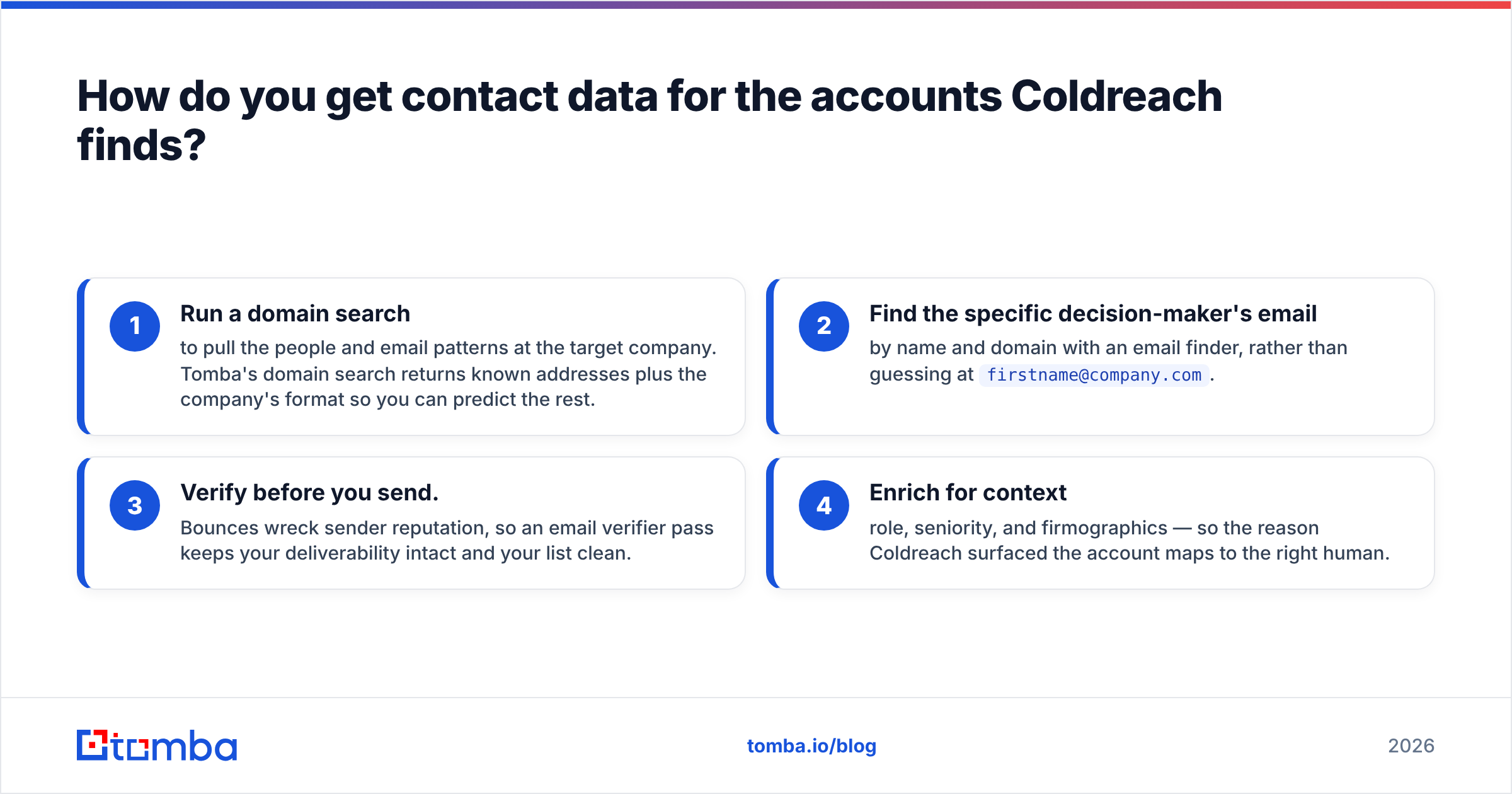
This is the practical gap most Coldreach reviews skip, so it's worth being concrete. Once you have an in-market account, you need to move from company to person to verified inbox:
- Run a domain search to pull the people and email patterns at the target company. Tomba's domain search returns known addresses plus the company's format so you can predict the rest.
- Find the specific decision-maker's email by name and domain with an email finder, rather than guessing at
firstname@company.com. - Verify before you send. Bounces wreck sender reputation, so an email verifier pass keeps your deliverability intact and your list clean.
- Enrich for context — role, seniority, and firmographics — so the reason Coldreach surfaced the account maps to the right human.
Handled well, this pipeline is cheap and fast. Tomba's pricing starts with a free tier at 25 searches per month and a $49/mo Starter plan, so the contact-data layer under a signal tool doesn't have to blow up your budget. For teams comparing enrichment vendors, cross-checking listings on G2 and Capterra before committing is a smart, low-effort due-diligence step.
Is Coldreach's pricing worth it?#
The honest answer: it depends on your deal size and your existing stack. Because Coldreach is quote-based and enterprise-leaning, the math only works when a single closed deal dwarfs the annual subscription. For a team selling $30k+ ACV contracts to mid-market accounts, one extra win pays for the year, and the timing edge is real. For a startup selling $50/mo self-serve software, the same spend is impossible to recover, and a cheaper database plus a good finder-and-verifier stack will out-ROI it every time.
The other cost people forget is the data cost underneath. Coldreach's price is not your total price if you still need contact data and verification on top. Budget for the full stack, not just the signal layer, when you compare it against alternatives.
Coldreach review: the verdict#
Coldreach is a genuinely strong buying-signal engine wrapped in an approachable natural-language interface. If you're a funded, mid-market-or-up outbound team with your contact data already sorted, it can meaningfully sharpen your timing and lift reply rates — the "why now" it hands each rep is the hardest part of relevance to fake. That's a real advantage in a saturated channel.
But it is an intelligence layer, not a complete prospecting stack, and its quote-based pricing quietly rules out the smaller teams who'd otherwise love the concept. Treat it as one component: signal detection at the top, verified contact data underneath. Buy it for what it's great at, and don't expect it to replace the finder-and-verifier work that turns a hot account into a delivered email.
If your gap right now is turning accounts into verified, reach-able contacts — the step Coldreach leaves to you — start with the Tomba Email Finder. Find the right person by domain, name, or company, verify before you send, and feed your signal-driven list a contact layer that actually lands in the inbox. Spin up the free tier, test it against your next batch of target accounts, and keep your outbound both well-timed and deliverable.
Related guides#
Ready to find emails that actually work?
Join 150,000+ professionals who stopped guessing and started sending. Free credits on signup — no credit card required.
Get the Tomba newsletter
Practical outbound tactics and product updates — once every two weeks.
About the author