Comintelli Pricing Reviews Pros and Cons (2026 Guide)
Comintelli sells enterprise market and competitive intelligence, but what does it actually cost? Here's an honest look at pricing, real user reviews, and the trade-offs before you sign a contract.
Comintelli Pricing Reviews Pros and Cons (2026 Guide)
If you are evaluating Comintelli, you have already hit the wall every buyer hits: there is no public price list. This guide gives you a straight, third-party read on Comintelli pricing reviews pros and cons in 2026. Use it to decide whether the tool belongs in your stack before you sit through a sales demo.
TL;DR#
- Comintelli is enterprise market and competitive intelligence software, sold as Intelligence2day. It gathers, tags, and shares external market signals with analyst and strategy teams.
- Pricing is quote-only. Comintelli does not publish rates. Deals are annual and priced by seats and content. Most land in the four- to five-figure-per-year range for mid-market and enterprise buyers.
- Reviews are mostly positive. Users praise the aggregation, AI tagging, and newsletters. The common gripes are setup effort, a learning curve, and cost.
- It is not a prospecting or lead-gen tool. If your real problem is finding and reaching contacts, a focused email finder does that job for far less.
- Best fit: competitive-intelligence and strategy teams at large firms. It is a poor fit for SMB sales teams who just need contact data.
What is Comintelli and what does it actually do?#
Comintelli is a Sweden-based software vendor, founded in 1999 near Stockholm. Its flagship platform, Intelligence2day, is a market and competitive intelligence hub. Think of it less like a sales tool and more like a newsroom for your strategy team. It pulls in articles, reports, patents, news, and internal documents. Then it uses AI to tag, categorize, and surface what matters.
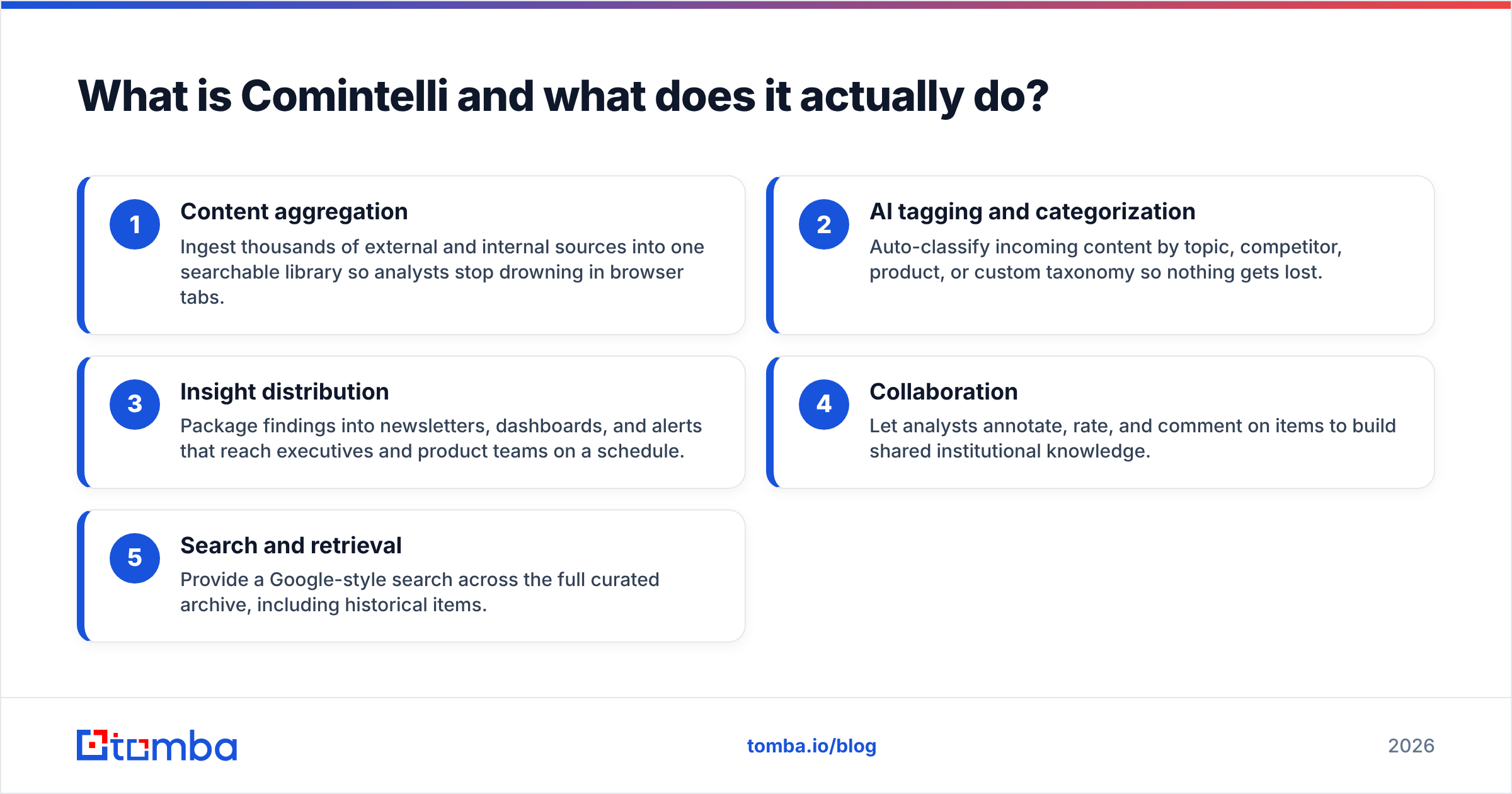
The platform is built around a few core jobs:
- Content aggregation — Ingest thousands of external and internal sources into one searchable library so analysts stop drowning in browser tabs.
- AI tagging and categorization — Auto-classify incoming content by topic, competitor, product, or custom taxonomy so nothing gets lost.
- Insight distribution — Package findings into newsletters, dashboards, and alerts that reach executives and product teams on a schedule.
- Collaboration — Let analysts annotate, rate, and comment on items to build shared institutional knowledge.
- Search and retrieval — Provide a Google-style search across the full curated archive, including historical items.
That is a very different problem from the one most sales and growth teams face. Comintelli helps you understand a market. It does not help you build a contact list and email the right people. That is where a dedicated B2B database and email finder come in. Keep this distinction in mind as we get to pricing. It explains a lot of the buyer confusion in this category.

How much does Comintelli cost in 2026?#
Short answer: you have to ask, and the number will be an annual enterprise figure. It is not a monthly SaaS subscription. Comintelli follows the classic enterprise playbook: no pricing page, custom quotes, and annual contracts. Deals are negotiated on seats, content volume, and modules.
Based on public review data on G2 and Capterra, and typical positioning for market-intelligence platforms of this class, deals generally scale with:
- Number of users/seats — analyst logins versus lighter "reader" access
- Content sources and volume — how many feeds, licensed sources, and internal repositories you connect
- Modules and configuration — custom taxonomies, integrations, and onboarding
- Support tier — standard versus dedicated success management
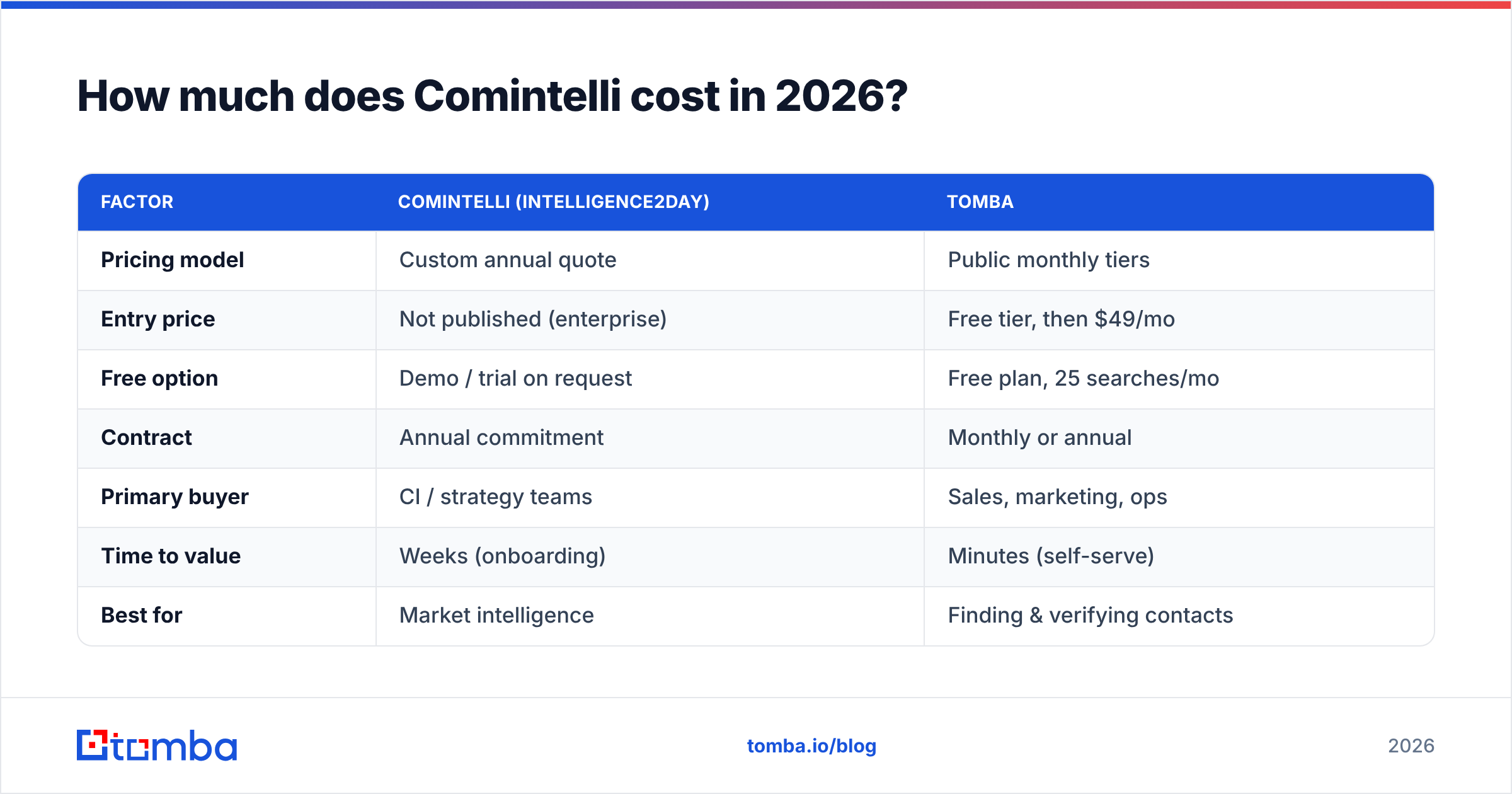
Here is how that pricing shape compares to a transparent, self-serve tool like Tomba. It lets you see the trade-off in structure, not just headline numbers:
| Factor | Comintelli (Intelligence2day) | Tomba |
|---|---|---|
| Pricing model | Custom annual quote | Public monthly tiers |
| Entry price | Not published (enterprise) | Free tier, then $49/mo |
| Free option | Demo / trial on request | Free plan, 25 searches/mo |
| Contract | Annual commitment | Monthly or annual |
| Primary buyer | CI / strategy teams | Sales, marketing, ops |
| Time to value | Weeks (onboarding) | Minutes (self-serve) |
| Best for | Market intelligence | Finding & verifying contacts |
The takeaway is not that Comintelli is overpriced. Enterprise intelligence platforms cost what they cost because they do heavy lifting. The real point is simpler: Comintelli and a prospecting tool are not substitutes. Do not buy one expecting the other's job. If your budget question is really "how do I reach more qualified accounts," you can see that cost on the Tomba pricing page without booking a call.
What do Comintelli reviews say?#
Comintelli has a solid but modest review footprint. Across G2 and Capterra, the feedback clusters around a few clear themes.
What reviewers praise:
- Aggregation that saves time. Analysts repeatedly call out the value of one searchable home for scattered sources.
- AI tagging quality. The auto-categorization is described as a real edge over manual tagging.
- Newsletters and distribution. Teams like how easily curated insight reaches stakeholders who never log into the tool.
- Responsive support. The vendor is small enough that customers feel heard.
What reviewers criticize:
- Learning curve. The taxonomy and configuration power that makes it flexible also makes onboarding non-trivial.
- Setup effort. Getting sources and taxonomies dialed in takes time and internal ownership.
- Cost and opacity. As with most quote-only tools, buyers wish pricing were clearer up front.
- Interface polish. Some reviewers describe the UI as functional rather than modern.
None of this is disqualifying. It is the standard profile of a specialized enterprise platform. Just weigh it honestly. You are buying capability and depth, not consumer-grade simplicity.
What are the pros and cons of Comintelli?#
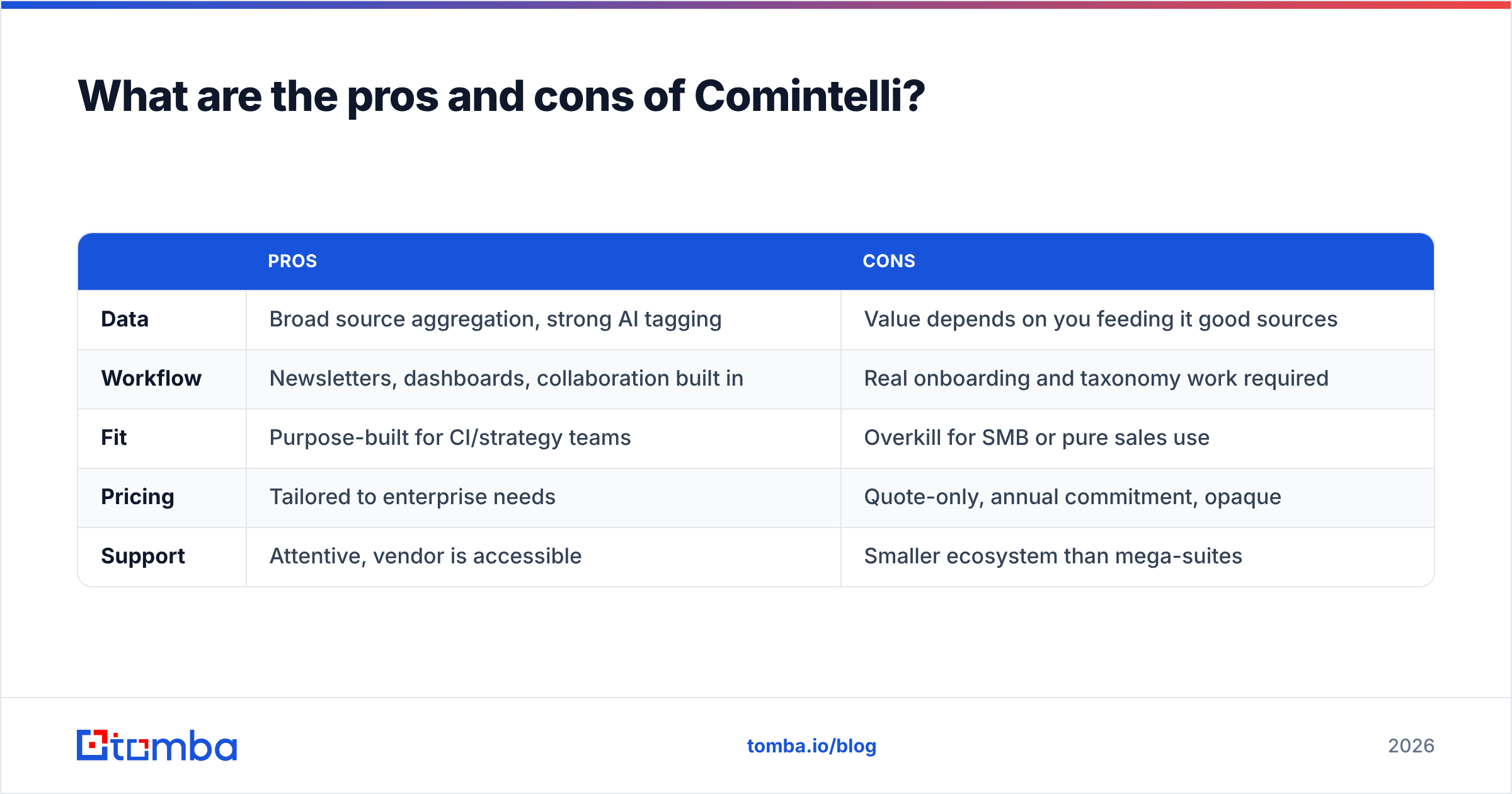
Here is the balanced scorecard, drawn from feature analysis and review patterns.
| Pros | Cons | |
|---|---|---|
| Data | Broad source aggregation, strong AI tagging | Value depends on you feeding it good sources |
| Workflow | Newsletters, dashboards, collaboration built in | Real onboarding and taxonomy work required |
| Fit | Purpose-built for CI/strategy teams | Overkill for SMB or pure sales use |
| Pricing | Tailored to enterprise needs | Quote-only, annual commitment, opaque |
| Support | Attentive, vendor is accessible | Smaller ecosystem than mega-suites |
Bottom line: Comintelli is a strong, focused tool for the job it was built for. The cons are mostly about fit and transparency, not quality. Problems appear only when a team buys it hoping it will double as a prospecting or contact-data engine. It will not.
Who is Comintelli best for?#
Comintelli fits you well if most of these are true:
- You have a dedicated competitive-intelligence, market-research, or strategy function (not just one person doing it on the side).
- You need to monitor competitors, markets, patents, and trends continuously, not run a one-off study.
- You want to distribute curated insight to executives and product teams on a schedule.
- You have budget approval for an annual enterprise contract and an internal owner to run the taxonomy.
It is a poor fit if you are an SMB sales team, a founder doing outbound, or a growth marketer. For those buyers the real bottleneck is reaching the right people. That job needs contact discovery and data enrichment, not a market-intelligence archive.

What are the best Comintelli alternatives?#
Depending on what you are trying to do, the alternatives split into two very different buckets.
If you want market or competitive intelligence (Comintelli's real category), look at Crayon, Klue, AlphaSense, or M-Brain. These compete on source coverage, battlecards, and analyst workflows. Judge them on taxonomy flexibility, integrations, and how insight gets shared.
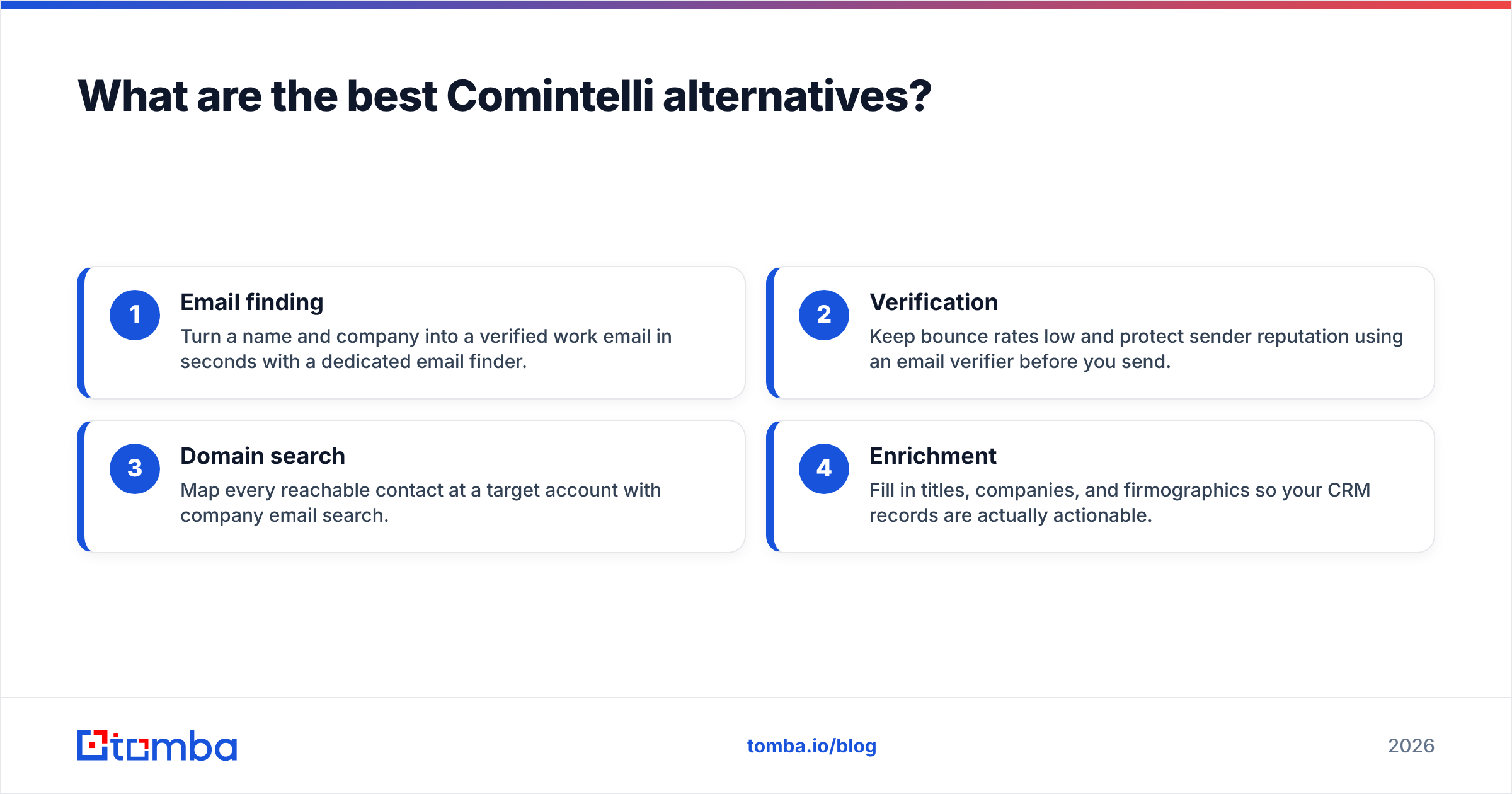
If your "intelligence" need is really contact and account data, the honest alternative is not another six-figure suite. It is a focused, transparent tool that finds and verifies the people you want to reach. That is a different budget line and a different outcome:
- Email finding — Turn a name and company into a verified work email in seconds with a dedicated email finder.
- Verification — Keep bounce rates low and protect sender reputation using an email verifier before you send.
- Domain search — Map every reachable contact at a target account with company email search.
- Enrichment — Fill in titles, companies, and firmographics so your CRM records are actually actionable.
The reason this matters is simple. Teams often overspend on a heavyweight intelligence platform when the metric they are graded on is pipeline. Match the tool to the outcome.
How does Comintelli compare to a lean prospecting stack?#
Different jobs, different math. Comintelli's strength is turning a firehose of market content into curated understanding. A prospecting stack turns that understanding into contacted, qualified accounts. You often want both. But you rarely want to pay enterprise-intelligence prices for the prospecting half.
A realistic split looks like this. Use a market-intelligence tool (Comintelli or a competitor) to decide which markets and accounts to pursue. Then use a transparent, pay-as-you-scale contact tool to actually reach them. The second half should be cheap, fast, and self-serve. There is no reason to gate email discovery behind an annual contract when a free email checker and a $49/mo plan cover most teams.
That separation also keeps your costs honest. You can measure intelligence spend against strategic decisions. You can measure prospecting spend against pipeline generated. Those are two different ROI conversations. They get muddy when you force one tool to do both.
Frequently asked questions#
Does Comintelli publish its pricing? No. Comintelli uses quote-based, annual enterprise pricing. You request a demo and receive a proposal scaled to seats, content volume, and modules.
Is Comintelli a lead generation tool? No. It is a market and competitive intelligence platform. To find and verify contacts, you need a dedicated email finder and verifier, not an intelligence archive.
Is Comintelli worth it? For a funded CI or strategy team that needs continuous market monitoring, yes. For SMB sales or solo outbound, it is overkill and the wrong shape of tool.
What is the cheapest way to start reaching the accounts I identify? A free-tier contact tool. You can find verified emails with Tomba's free plan and upgrade only when volume demands it. No annual commitment required.
Comintelli Pricing Reviews Pros and Cons: The Bottom Line for 2026#
Comintelli is a legitimate, well-reviewed market-intelligence platform. It comes with the usual enterprise trade-offs: real capability, real onboarding, and opaque annual pricing. If understanding your market is the job, it belongs on your shortlist next to the other CI suites.
But if the number you must hit is pipeline, the smarter money is a lean, transparent stack. It turns your target accounts into verified contacts. Skip the six-figure guesswork and start with the Tomba Email Finder. Find professional emails by name, domain, or company. Verify them before you send. Pay only for what you use. It is the fastest path from "we know who to target" to "we're in their inbox."
Related guides#
Ready to find emails that actually work?
Join 150,000+ professionals who stopped guessing and started sending. Free credits on signup — no credit card required.
Get the Tomba newsletter
Practical outbound tactics and product updates — once every two weeks.
About the author