Common Room vs 6sense (2026): Which GTM Platform Wins?
Common Room and 6sense both promise to turn buyer signals into pipeline, but they solve different problems. Here's an honest breakdown of pricing, data, fit, and a leaner stack option.
Choosing between Common Room and 6sense feels harder than it should, because the two tools get lumped into the same "GTM signal" bucket while actually solving different halves of the problem. One listens for people raising their hand; the other predicts accounts before they say anything. Pick wrong and you either pay enterprise money for a capability your team can't operationalize, or you underbuy and miss the accounts already circling your category.
This is a neutral, hands-on comparison — no vendor spin. We'll cover what each platform actually does, where the pricing lands, who each one fits, and how to fill the one gap both leave open: turning a hot account into a real, reachable contact.
TL;DR: Common Room vs 6sense#
- Common Room is a signal-capture and orchestration layer. It unifies first-party signals (product usage, community, social, website, CRM) into person and account timelines, then routes them to your team. Best for PLG and community-led motions.
- 6sense is a predictive intent and ABM platform. It uses third-party intent data and AI models to tell you which accounts are in-market before they engage, then powers advertising and orchestration. Best for enterprise account-based demand gen.
- They overlap less than the marketing implies. Common Room excels at "who is engaging us right now"; 6sense excels at "which accounts are researching our category anywhere."
- Both are expensive and neither finds contact data well. Signals get you to an account; you still need accurate emails and phone numbers to act. That's a job for a dedicated data enrichment layer.
- Verdict: PLG/community teams lean Common Room; enterprise ABM teams lean 6sense. Many mature GTM orgs run one of them plus a lightweight contact-data tool rather than paying for a single all-in-one.
What is Common Room?#
Common Room started as a community-intelligence platform and grew into a broader "signal-based go-to-market" tool. Its core promise: capture every meaningful interaction a prospect has with your company — a Slack community message, a GitHub star, a pricing-page visit, a LinkedIn comment, a support ticket, a product event — and stitch them into a single person-and-account timeline.
The value is context. Instead of a rep guessing why an account matters, Common Room shows the trail: "This champion posted in your community twice, three teammates signed up for the free tier this week, and the VP visited your enterprise page." That's a warm, evidence-backed reason to reach out.
Where it's strong:
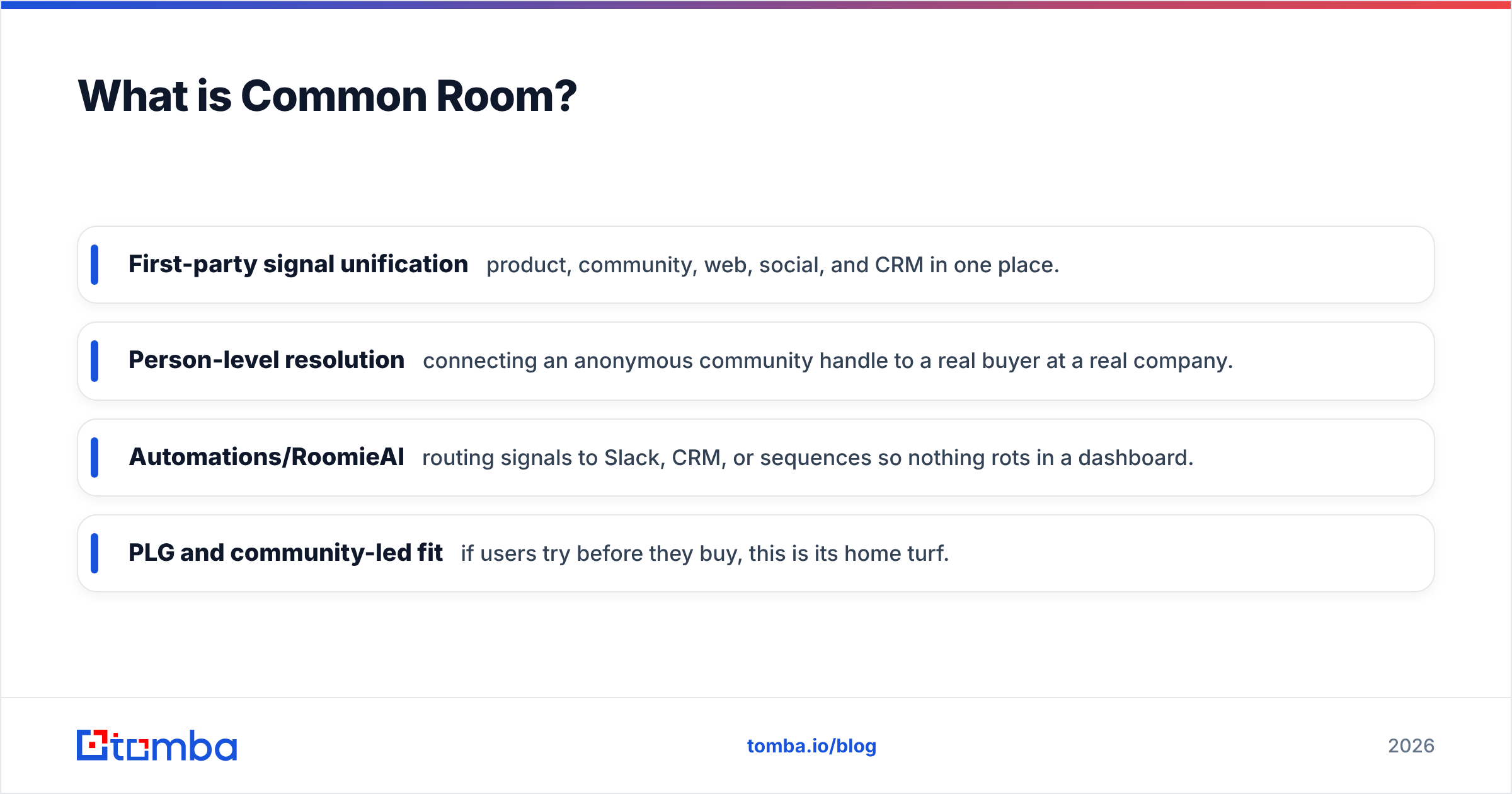
- First-party signal unification — product, community, web, social, and CRM in one place.
- Person-level resolution — connecting an anonymous community handle to a real buyer at a real company.
- Automations/RoomieAI — routing signals to Slack, CRM, or sequences so nothing rots in a dashboard.
- PLG and community-led fit — if users try before they buy, this is its home turf.
Where it's weaker: Common Room is only as good as the signals you already generate. If you have little product usage, a small community, and thin website traffic, there isn't much for it to capture. It's a listening tool, not a demand-discovery engine.
What is 6sense?#
6sense approaches the same "find in-market buyers" goal from the opposite direction. Rather than listening to your first-party signals, it leans heavily on third-party intent data — anonymized research activity across a large publisher network — plus predictive AI to score which accounts are entering a buying cycle.
The headline capability is de-anonymization and prediction. 6sense claims to identify accounts researching your category even when they've never touched your site, then place each account on a buying-stage timeline (target, awareness, consideration, decision). From there it powers programmatic advertising, orchestration, and prioritization for sales.
Where it's strong:
- Predictive intent — surfacing accounts before they self-identify.
- Account de-anonymization — matching anonymous web traffic and intent to specific companies.
- Native ABM advertising — running display campaigns against in-market accounts inside the platform.
- Enterprise orchestration — segmentation, scoring models, and workflow depth built for large teams.
Where it's weaker: it's an enterprise purchase in price, complexity, and onboarding. Intent data is probabilistic — you're buying a strong signal, not a certainty — and the platform rewards teams with the headcount and process maturity to act on it. Small teams often light up a fraction of the features.
Common Room vs 6sense: side-by-side comparison#
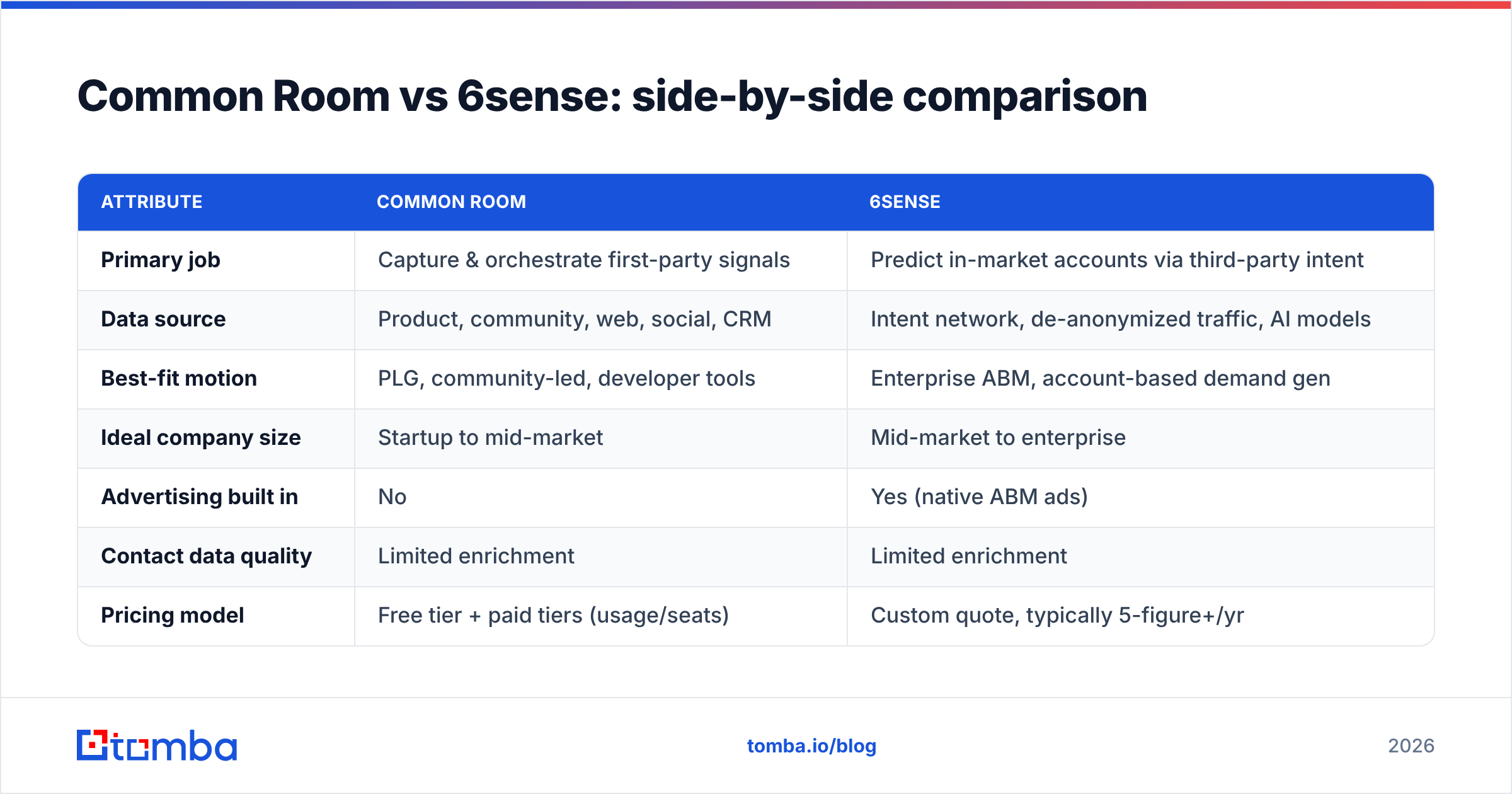
| Attribute | Common Room | 6sense |
|---|---|---|
| Primary job | Capture & orchestrate first-party signals | Predict in-market accounts via third-party intent |
| Data source | Product, community, web, social, CRM | Intent network, de-anonymized traffic, AI models |
| Best-fit motion | PLG, community-led, developer tools | Enterprise ABM, account-based demand gen |
| Ideal company size | Startup to mid-market | Mid-market to enterprise |
| Advertising built in | No | Yes (native ABM ads) |
| Contact data quality | Limited enrichment | Limited enrichment |
| Pricing model | Free tier + paid tiers (usage/seats) | Custom quote, typically 5-figure+/yr |
| Learning curve | Moderate | Steep |
| Time to value | Fast if you have signals | Slower; model ramp + onboarding |
The pattern is clear: Common Room reacts to demand you're already generating; 6sense discovers demand you can't see. They're complements as often as they're competitors.
Is Common Room better than 6sense?#
It depends entirely on where your pipeline comes from — there is no universal winner.
Choose Common Room if:
- You run a PLG or freemium motion. Signals like sign-ups, activation events, and seat expansion are your richest buying indicators, and Common Room was built to catch them.
- You have a community. Slack, Discord, GitHub, or forum activity is a first-class citizen here in a way it simply isn't in 6sense.
- You want fast time-to-value. If the signals already exist, you can wire routing and see plays within weeks.
- You're a startup or mid-market team. The pricing and free tier make it accessible before you have an enterprise budget.
Choose 6sense if:
- You sell a considered, high-ACV product where buyers research quietly for months before raising a hand.
- You run account-based advertising and want intent and ad delivery in one system.
- You have the team to operationalize it — RevOps, demand gen, and SDRs who can act on account scores daily.
- First-party signal is thin and you need to find demand rather than capture it.
For a fuller RevOps context on how these platforms slot into a modern stack, see our primer on revenue operations.
What do Common Room and 6sense both get wrong?#
Neither one reliably hands your reps a verified email and direct phone number for the specific human you need to reach.
This is the quiet gap in almost every signal/intent platform. They're brilliant at telling you which account is hot and roughly who is involved. They're mediocre at the last mile: the accurate, deliverable, right-now contact details that actually let a rep send an email or dial a number. Enrichment inside these tools tends to be shallow, stale on personal-vs-work email, and weak on phone coverage.
That gap costs you conversions. An intent score is worthless if the email bounces or the number is disconnected. This is exactly why many teams pair their signal platform with a dedicated contact-data tool — using the platform to prioritize and a purpose-built finder to reach.

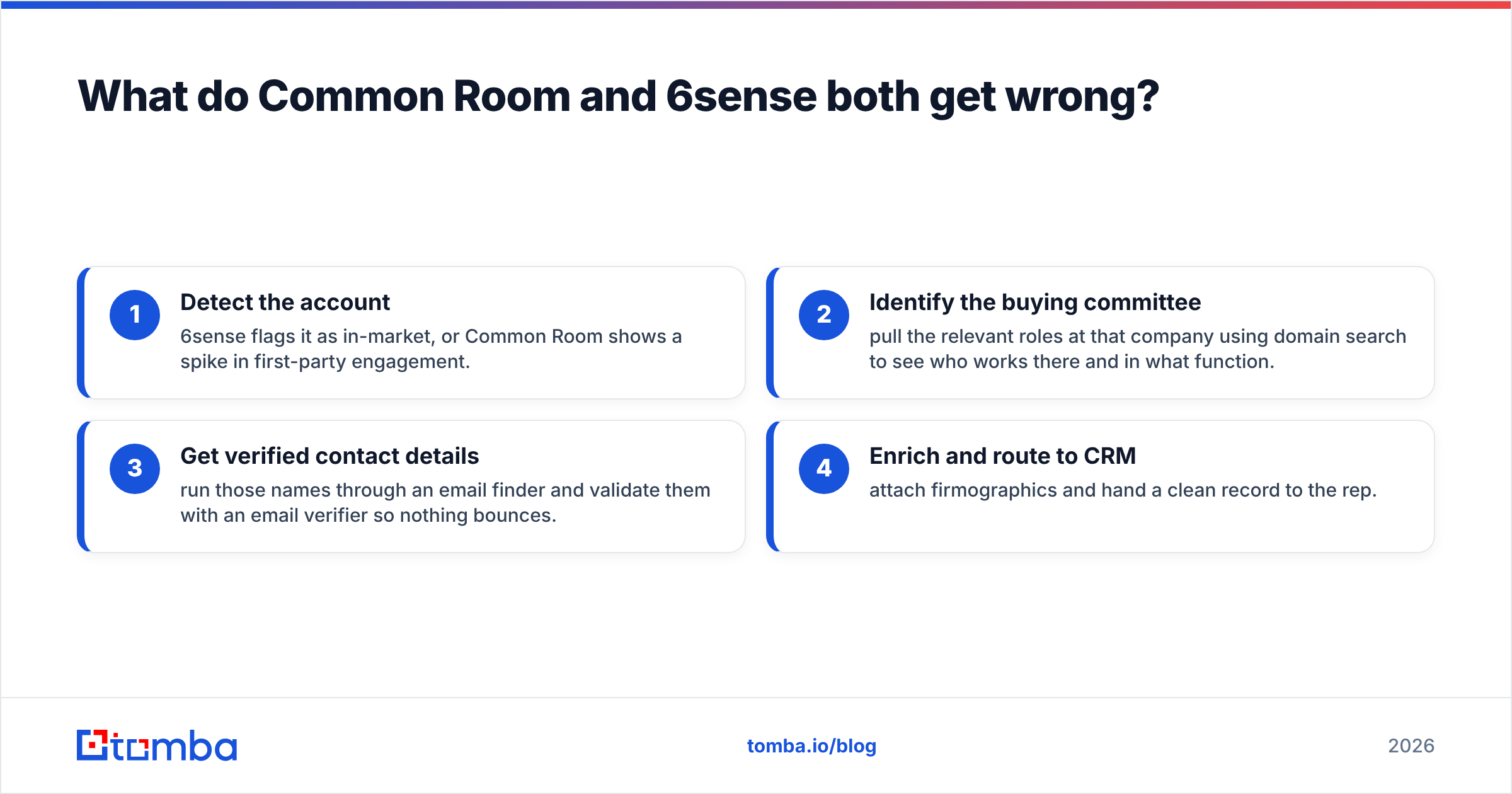
A practical last-mile stack looks like this:
- Detect the account — 6sense flags it as in-market, or Common Room shows a spike in first-party engagement.
- Identify the buying committee — pull the relevant roles at that company using domain search to see who works there and in what function.
- Get verified contact details — run those names through an email finder and validate them with an email verifier so nothing bounces.
- Enrich and route to CRM — attach firmographics and hand a clean record to the rep.
That's the difference between "this account is interested" and "here's the CMO's verified email, go."
How much do Common Room and 6sense cost?#
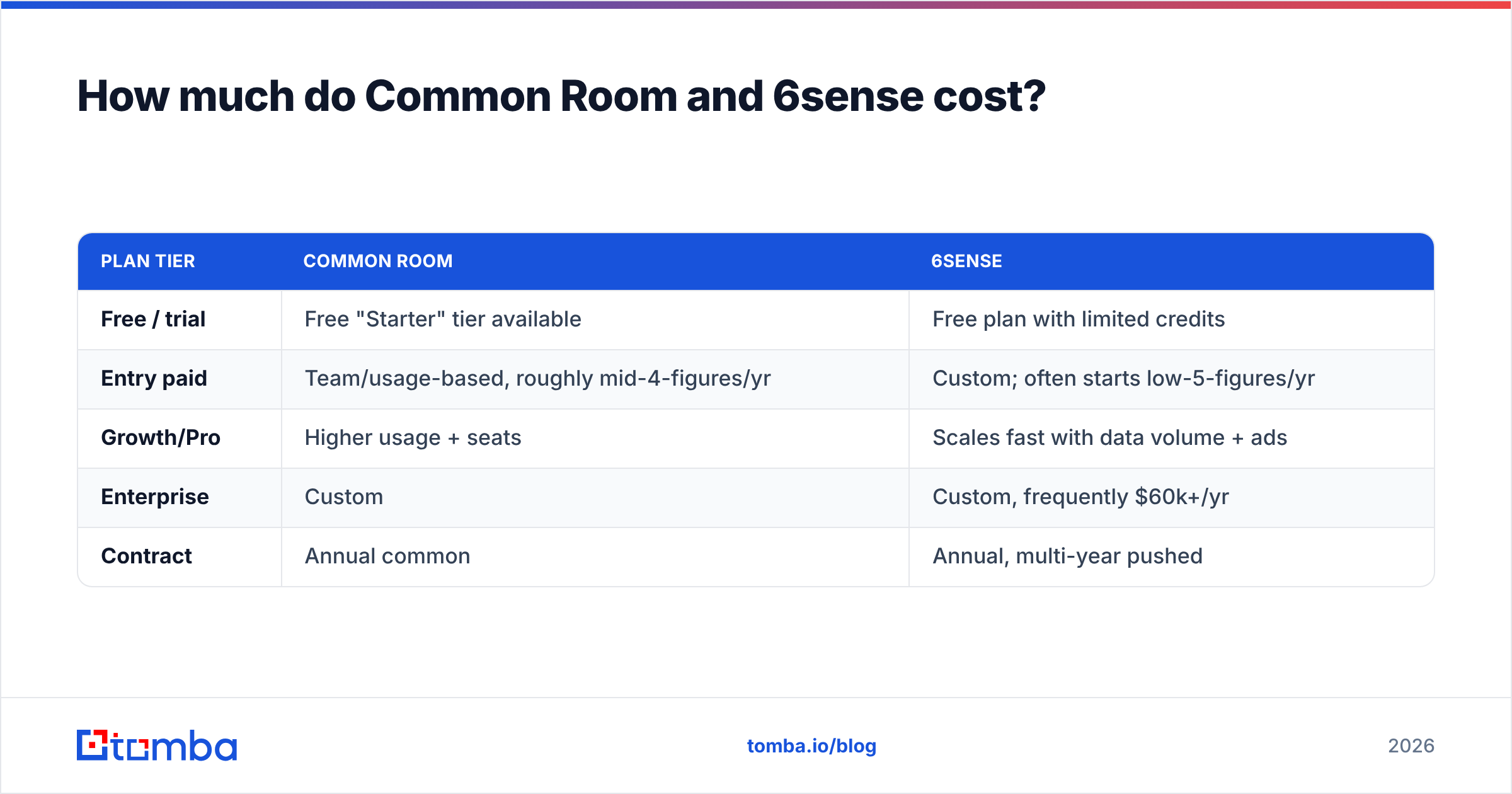
Neither vendor makes pricing simple, and both push most buyers toward a sales conversation. Here's the honest shape of it, based on publicly available information and typical buyer reports on sites like G2.
| Plan tier | Common Room | 6sense |
|---|---|---|
| Free / trial | Free "Starter" tier available | Free plan with limited credits |
| Entry paid | Team/usage-based, roughly mid-4-figures/yr | Custom; often starts low-5-figures/yr |
| Growth/Pro | Higher usage + seats | Scales fast with data volume + ads |
| Enterprise | Custom | Custom, frequently $60k+/yr |
| Contract | Annual common | Annual, multi-year pushed |
Two things to internalize. First, 6sense's real cost is usually higher than the sticker because intent data volume and advertising spend stack on top. Second, Common Room can stay affordable for smaller teams but grows with seats and signal volume. Either way, budget for the last-mile contact tool separately — it's a fraction of these prices and it's what makes the signals actionable. Compare that against transparent Tomba pricing, which starts free (25 searches/mo) and moves to $49/mo, versus five-figure annual commitments.
Can you replace either tool with a cheaper stack?#
Partially — and it's worth being honest about where you can and can't.
You cannot cheaply replicate 6sense's third-party intent network; that dataset is genuinely hard to build and is the core reason to buy it. You can, however, often replace the "enrichment and outreach" layer that both platforms bolt on with a focused, lower-cost tool, and you can approximate lightweight signal capture with website visitor identification and CRM triggers.
A lean alternative stack for a mid-market team:
- Signal/intent: keep one platform (Common Room for PLG, 6sense for enterprise intent) — or start with cheaper website visitor reveal if budget is tight.
- Contact data + enrichment: a dedicated finder/verifier instead of the platform's shallow enrichment.
- Sequencing: your existing sales-engagement tool.
If you're specifically evaluating 6sense and its price tag gives you pause, our breakdown of 6sense alternatives walks through where a lighter stack holds up and where it doesn't. The short version: you rarely replace the intent engine, but you almost always replace the enrichment.
Which should you actually pick?#
Match the tool to your demand source, not to the loudest feature list:
- Developer tool, PLG SaaS, or community-led business → Common Room. Your best signals are first-party, and that's its home.
- Enterprise sales of a high-consideration product with a long buying cycle → 6sense. You need to see demand you're not generating yet.
- Either way → add a dedicated contact-data layer, because both platforms leave the last mile weak.
Don't let a "platform" pitch talk you into paying for capabilities you can't staff. A precise, well-run stack of one signal tool plus accurate contact data beats an underused all-in-one every quarter.
The last mile matters more than the platform#
Signals point you at the account. They don't put a verified email in the sequence or a real number in the dialer — and that's where deals are won or lost. Whichever platform you choose, the moment an account turns hot you need the buying committee's contact details fast and clean.
That's what Tomba Email Finder is for. Feed it a company domain or a name, and get verified professional emails backed by transparent data sources — then validate before you send so your intent-driven outreach actually lands in the inbox. Start free with 25 searches, scale on a $49/mo plan when you're ready, and turn your Common Room or 6sense signals into pipeline instead of dashboards. Your intent data is only as good as the contact you can reach.
Related guides#
Ready to find emails that actually work?
Join 150,000+ professionals who stopped guessing and started sending. Free credits on signup — no credit card required.
Get the Tomba newsletter
Practical outbound tactics and product updates — once every two weeks.
About the author