Commsor Pricing, Reviews, Pros and Cons: An Honest 2026 Breakdown
A neutral look at Commsor pricing in 2026 — what the warm-intro platform actually costs, where the reviews land, the real pros and cons, and when a cheaper stack makes more sense.
Commsor sells a simple promise: your next customer is already one introduction away, and its platform finds that path through your team's collective network. That pitch resonates in a market tired of cold email. But before you route budget toward it, you need the numbers — and Commsor is one of those tools where the numbers take some digging. This is a neutral breakdown of Commsor pricing, what reviewers actually say, and the honest pros and cons for a 2026 buyer.
TL;DR: Is Commsor worth the price?#
- Commsor is a warm-intro / network-intelligence platform, not a lead database or email finder. It maps who on your team (or in your investor/advisor network) can introduce you to a target account.
- Pricing is quote-based and not fully public. Expect a sales conversation and a per-seat or platform fee rather than a self-serve credit card checkout, which makes budgeting harder than with transparent tools.
- Reviews are broadly positive on concept and support, more mixed on data coverage and the effort required to get value — you have to actually work your network.
- Best fit: funded startups and mid-market teams with a large, connected network (investors, advisors, employees) who will actively pursue intros.
- Weaker fit: solo founders, high-volume outbound teams, or anyone who needs verified contact data at the top of funnel — that job belongs to an email finder, and you can start for a fraction of the cost.
What is Commsor and what are you actually paying for?#
Think of Commsor less like a Rolodex and more like a shared map of everyone your company already knows. When you target an account, it scans the connections of your employees, investors, and advisors to surface the warmest path in, then helps you request and track that introduction.
You are paying for three things:
- Network aggregation — connecting the LinkedIn and email graphs of your team into one searchable layer.
- Warm-path scoring — ranking who has the strongest relationship with a target contact so you ask the right person.
- Intro workflow — the request, nudge, and tracking machinery so intros don't die in someone's inbox.
That is a genuinely different job from finding a stranger's email address. Commsor's value depends entirely on the size and quality of the network you feed it. Feed it a five-person team with thin connections and there is little to map. Feed it a 200-person company plus a deep investor bench and it becomes a real pipeline source. To understand where warm intros sit in a broader motion, it helps to frame them against your revenue operations — intros are a channel, not the whole engine.

How much does Commsor pricing cost in 2026?#
Here is the honest answer: Commsor does not publish a simple, self-serve price list the way transparent SaaS tools do. Pricing is generally arranged through a demo and quote, and it has historically shifted as the product itself pivoted (Commsor started in community management before repositioning around warm intros and network-led growth). Always confirm current numbers directly on commsor.com — treat any third-party figure, including estimates below, as directional.
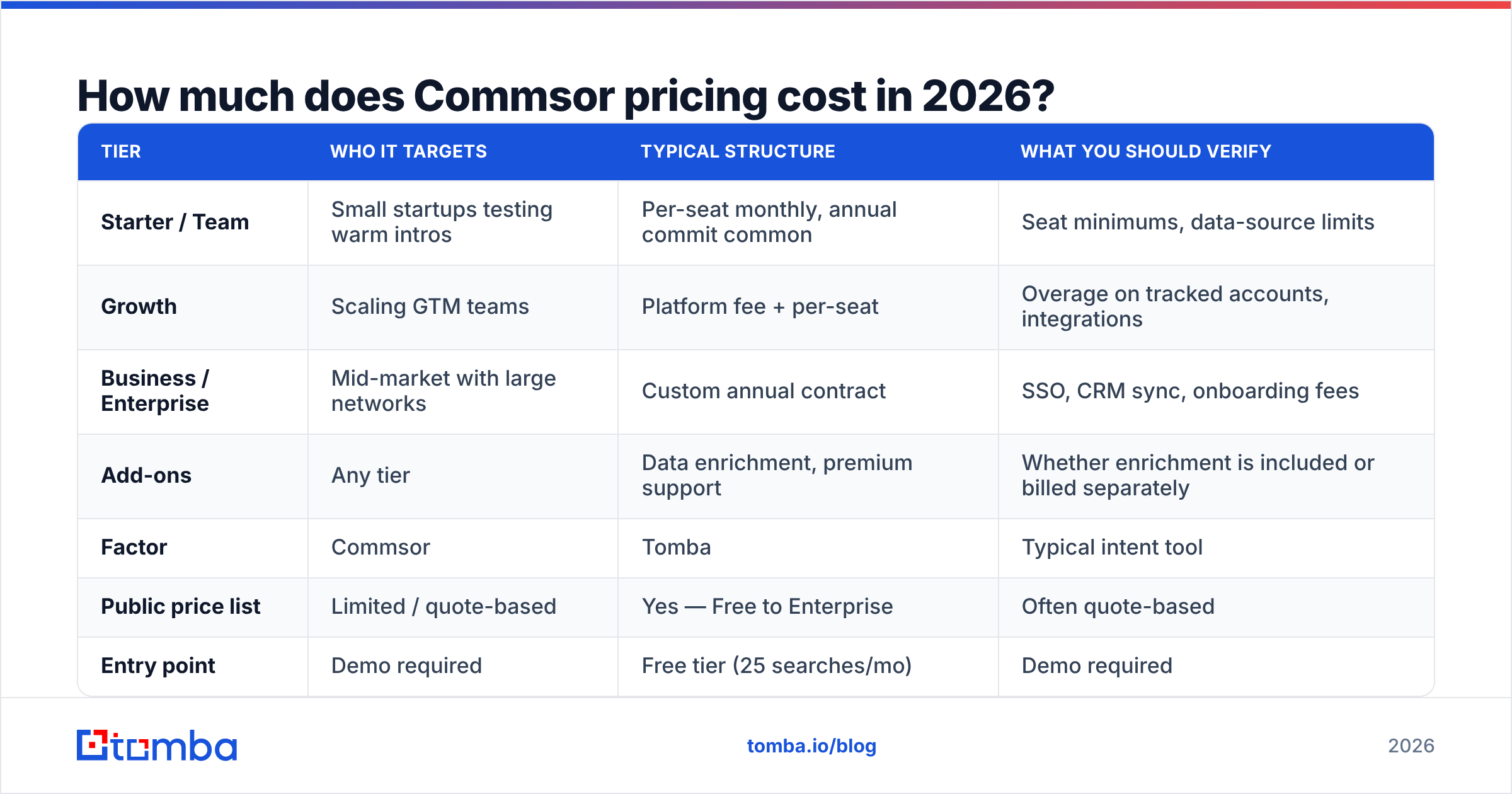
Because the vendor gates pricing, buyers typically encounter a structure like this:
| Tier | Who it targets | Typical structure | What you should verify |
|---|---|---|---|
| Starter / Team | Small startups testing warm intros | Per-seat monthly, annual commit common | Seat minimums, data-source limits |
| Growth | Scaling GTM teams | Platform fee + per-seat | Overage on tracked accounts, integrations |
| Business / Enterprise | Mid-market with large networks | Custom annual contract | SSO, CRM sync, onboarding fees |
| Add-ons | Any tier | Data enrichment, premium support | Whether enrichment is included or billed separately |
The takeaway is not a specific dollar figure — it is that you cannot budget Commsor from a pricing page alone. You will negotiate. That is fine for a funded team with a procurement process, but it is friction for anyone who wants to try, measure, and decide in an afternoon.
Commsor vs. transparent-pricing alternatives#
To see why opacity matters, compare the buying experience against tools that publish rates. This is not apples-to-apples on features — it is apples-to-apples on how easily you can start and forecast cost.
| Factor | Commsor | Tomba | Typical intent tool |
|---|---|---|---|
| Public price list | Limited / quote-based | Yes — Free to Enterprise | Often quote-based |
| Entry point | Demo required | Free tier (25 searches/mo) | Demo required |
| Lowest paid tier | Custom | $49/mo (Starter) | $$$ |
| Core job | Warm intros via network | Find & verify emails | Buyer intent signals |
| Time to first value | Days (network setup) | Minutes | Weeks |
| Best for | Connected teams | Any outbound/RevOps team | Enterprise demand-gen |
The point stands regardless of Commsor's exact tier prices: a warm-intro platform is a considered, contracted purchase, while a data tool like an email verifier is something you can switch on today for $49/mo and cancel next month.
What do Commsor reviews say?#
Aggregating public sentiment from directories like G2 and general B2B community discussion, a consistent pattern emerges. Reviews tend to praise the concept and the team more than the raw data breadth — which is exactly what you'd expect from a relationship-first product.
What reviewers like:
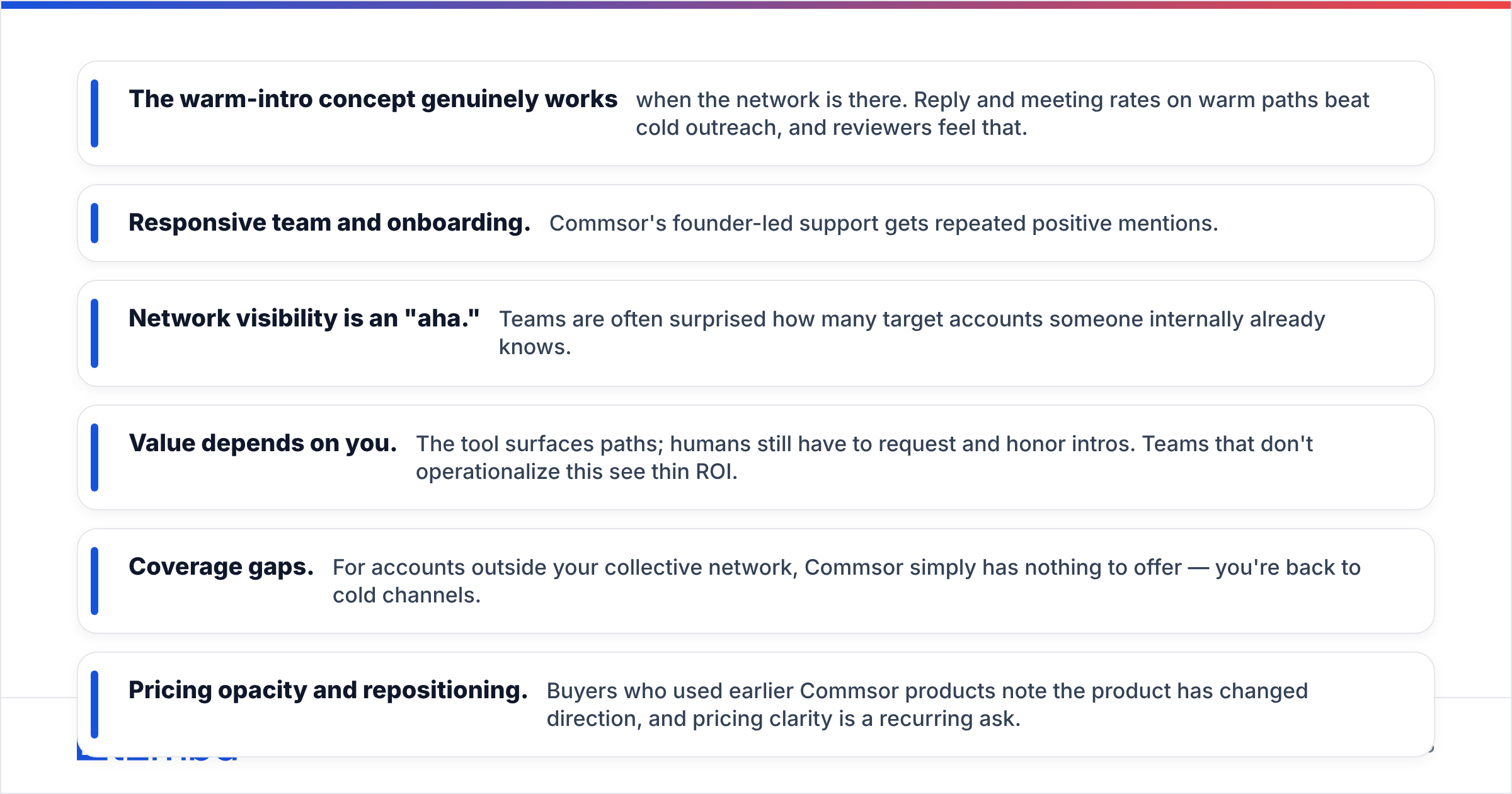
- The warm-intro concept genuinely works when the network is there. Reply and meeting rates on warm paths beat cold outreach, and reviewers feel that.
- Responsive team and onboarding. Commsor's founder-led support gets repeated positive mentions.
- Network visibility is an "aha." Teams are often surprised how many target accounts someone internally already knows.
What reviewers criticize:
- Value depends on you. The tool surfaces paths; humans still have to request and honor intros. Teams that don't operationalize this see thin ROI.
- Coverage gaps. For accounts outside your collective network, Commsor simply has nothing to offer — you're back to cold channels.
- Pricing opacity and repositioning. Buyers who used earlier Commsor products note the product has changed direction, and pricing clarity is a recurring ask.
The fairest summary: Commsor is well-liked by teams whose networks fit its model, and underwhelming for teams who expected a data tool. Reviews are a mirror of fit more than of quality.
What are the pros and cons of Commsor?#
Here is the balanced ledger. Weigh these against your team's actual network density, not against the demo's best-case story.
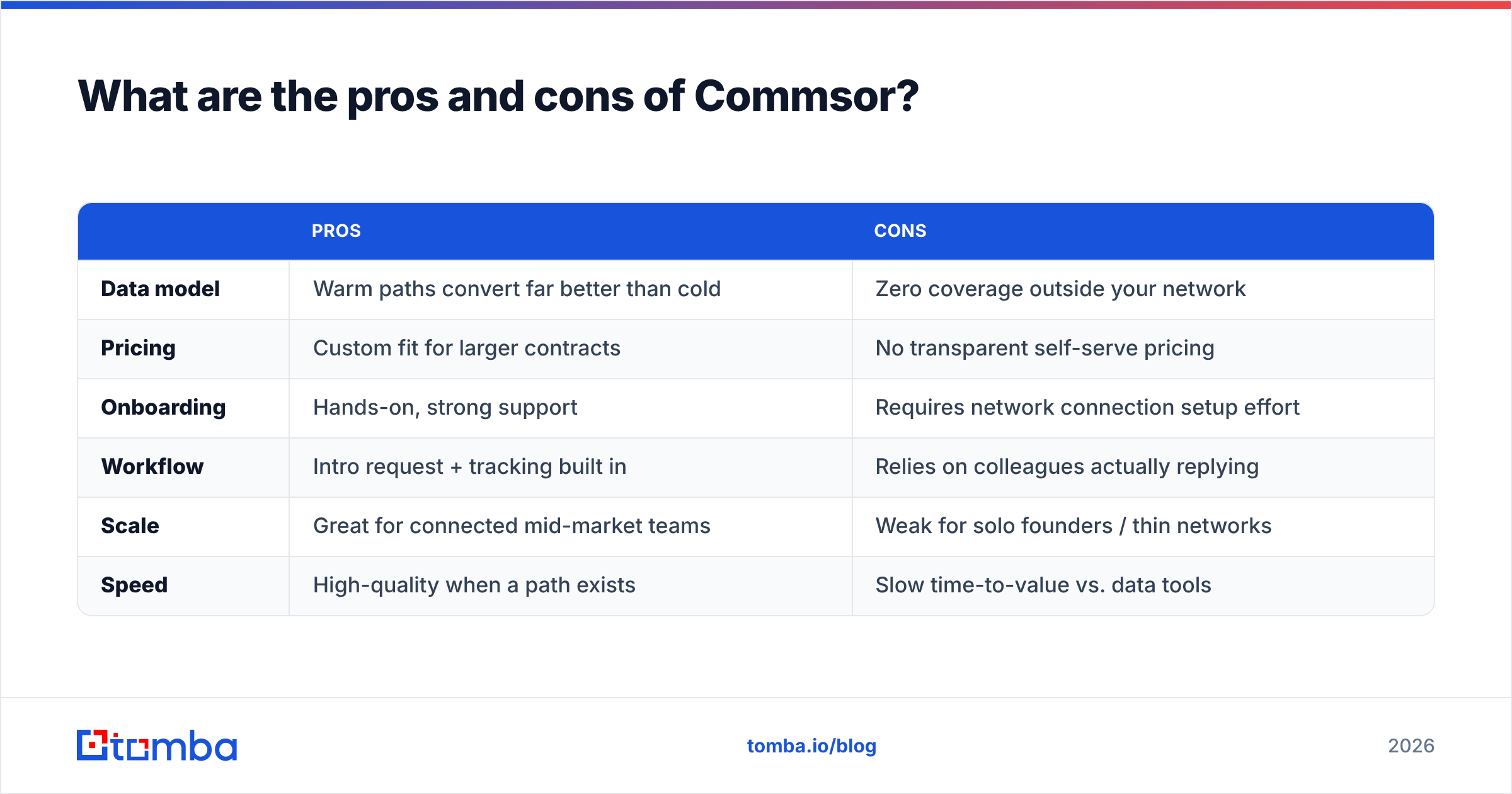
| Pros | Cons | |
|---|---|---|
| Data model | Warm paths convert far better than cold | Zero coverage outside your network |
| Pricing | Custom fit for larger contracts | No transparent self-serve pricing |
| Onboarding | Hands-on, strong support | Requires network connection setup effort |
| Workflow | Intro request + tracking built in | Relies on colleagues actually replying |
| Scale | Great for connected mid-market teams | Weak for solo founders / thin networks |
| Speed | High-quality when a path exists | Slow time-to-value vs. data tools |
Notice that most of Commsor's cons are not defects — they're structural to warm-intro software. The single biggest risk is buying it for a team that won't work the intros, in which case any price is too high.

Who should buy Commsor — and who shouldn't?#
Buy Commsor if:
- You have a connected network — dozens of employees, an active investor/advisor bench, or an alumni community.
- Your ACV is high enough that a handful of warm intros pays for the contract.
- Someone owns the motion and will chase intros weekly. Warm-intro tools reward operators, not spectators.
Skip or postpone Commsor if:
- You're early and under-networked. There's little graph to mine yet — spend on top-of-funnel data first.
- You run high-volume outbound where you need hundreds of verified contacts a week. Intros don't scale linearly; data does.
- You need transparent, cancel-anytime pricing to justify the experiment.
If you land in the second group, the smarter first move is to build a clean, verified contact base and layer relationship-selling on top once you have traction. That's where a data-first stack beats a network-first one on cost and speed.
What's a cheaper way to build pipeline before Commsor?#
Warm intros are the finish line, not the starting line. Before you can even ask "who knows this account?", you need to know which accounts and people to target — and you need their real, deliverable contact details. That's a data problem, and it's dramatically cheaper to solve than a warm-intro contract.
A pragmatic, transparent-cost stack looks like this:
- Find the right contacts — use an email finder to pull verified addresses by name and company, so you're not guessing formats.
- Verify before you send — run every address through an email verifier to protect sender reputation and keep bounce rates low.
- Enrich for context — add role, company, and firmographics with data enrichment so your outreach is relevant.
- Then find the warm path — once you know who matters, ask internally (or via a tool like Commsor) who can introduce you.
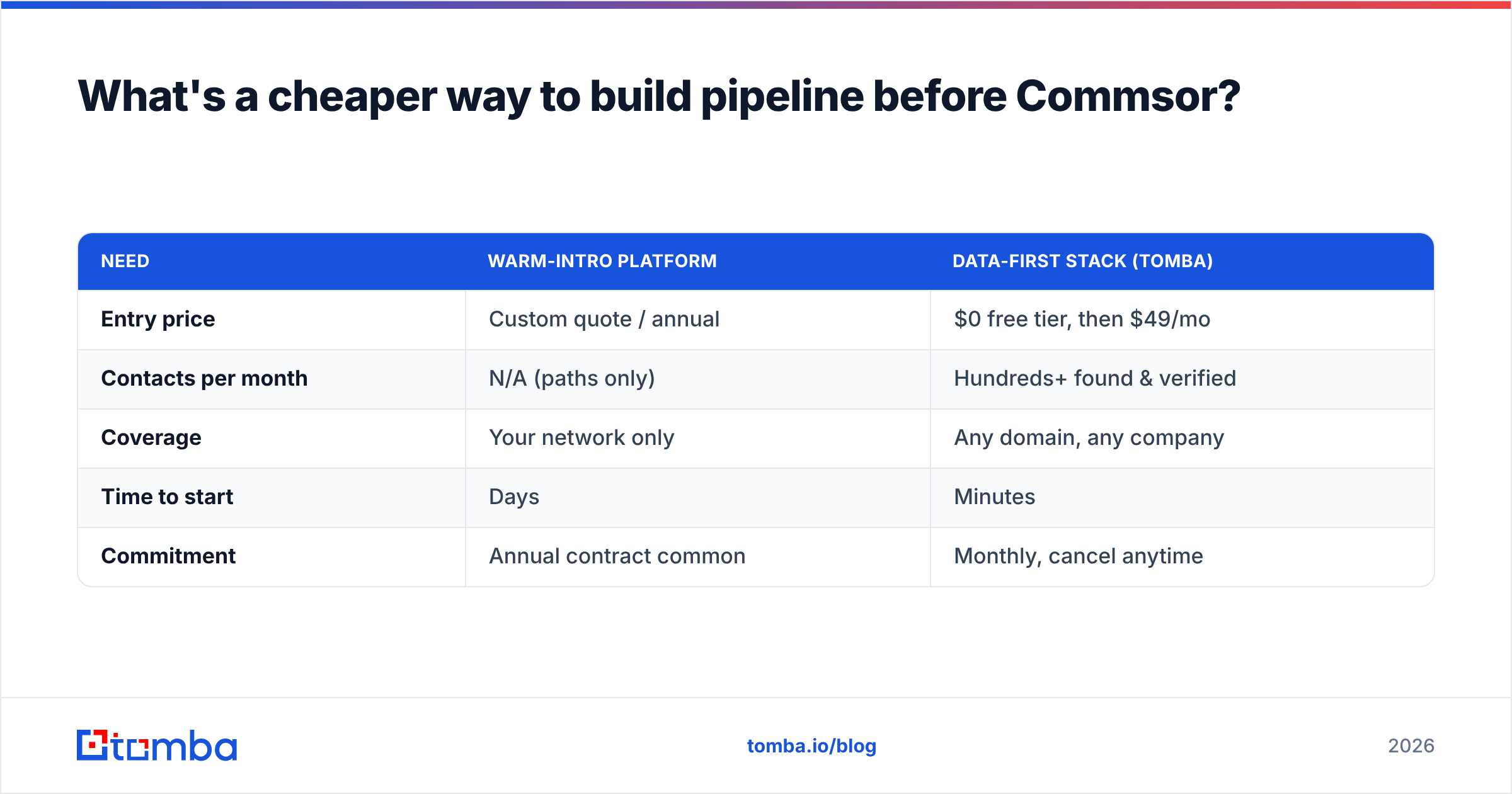
Here's how the cost math compares for a team just getting started:
| Need | Warm-intro platform | Data-first stack (Tomba) |
|---|---|---|
| Entry price | Custom quote / annual | $0 free tier, then $49/mo |
| Contacts per month | N/A (paths only) | Hundreds+ found & verified |
| Coverage | Your network only | Any domain, any company |
| Time to start | Days | Minutes |
| Commitment | Annual contract common | Monthly, cancel anytime |
Tomba's transparent pricing — Free (25 searches/mo), Starter $49/mo, Growth $99/mo, Pro $249/mo, and custom Enterprise — means you can validate a target list this week without a procurement cycle. Then, if warm intros prove to be your best channel, you graduate into a tool like Commsor with real data behind you instead of a blank map.
Is Commsor pricing worth it? The verdict.#
Commsor is worth it for the specific team it's built for: a funded, connected, mid-market GTM org that will actively operate an intro motion and whose deal sizes make a custom contract easy to justify. For that buyer, warm paths are gold and the pricing opacity is just standard enterprise procurement.
For almost everyone else — early-stage founders, lean outbound teams, or anyone who needs to move this week — the honest answer is that Commsor solves a late-stage problem before you've solved the early-stage one. Get your targeting and contact data right first, cheaply and transparently, and you'll get more from any warm-intro tool you buy later.
If you're at that data-first stage, start with the Tomba Email Finder. Find and verify the contacts that matter, prove which segments respond, and build real pipeline for $49/mo — no demo required, no annual lock-in. When your network is finally worth mapping, you'll come to warm intros with a list that's already working.
Related guides#
Ready to find emails that actually work?
Join 150,000+ professionals who stopped guessing and started sending. Free credits on signup — no credit card required.
Get the Tomba newsletter
Practical outbound tactics and product updates — once every two weeks.
About the author