Companies That Buy Data in 2026: Who, Why, and How It Works
A neutral 2026 breakdown of the companies that buy data, why they pay for it, what a clean record actually costs, and how to buy or sell B2B data without torching deliverability.
Data is the quiet product behind most modern revenue teams. Someone bought the record before the SDR ever dialed, before the ad ever served, before the "personalized" email ever landed. If you have ever wondered which companies that buy data are actually paying for it — and whether you should be buying (or selling) it yourself — this is the plain-English map.
TL;DR#
- Almost every growth-stage company buys data, but the big spenders cluster into five buckets: marketing/adtech, sales teams, financial services, retail, and data brokers who resell it.
- Two markets exist: consumer data (regulated hard by GDPR/CCPA) and B2B contact data (business emails, firmographics, intent). They have very different risk profiles.
- Price per record ranges wildly — from fractions of a cent for scraped junk to $0.10–$1+ for verified, enriched B2B contacts.
- Freshness beats volume. A verified 5,000-record list outperforms a stale 500,000-record dump on every deliverability metric that matters.
- You rarely need to "buy a database." On-demand tools like a Tomba Email Finder let you pull verified contacts per campaign instead of paying for a bloated file you can't trust.
What does "buying data" actually mean?#
Buying data means paying a third party for information you didn't collect yourself. Think of it like buying produce. You can grow tomatoes in your own garden (first-party data from your website and CRM), or you can buy them at the market (third-party data from a broker). The market is faster, but you're trusting someone else about how fresh the tomatoes are.
In practice, "data" splits into a few concrete product types:
- Contact data — names, business emails, phone numbers, job titles. The fuel for outreach.
- Firmographic data — company size, revenue, industry, tech stack, location.
- Intent data — signals that an account is researching a topic or category right now.
- Consumer/behavioral data — purchase history, demographics, browsing behavior (heavily regulated).
- Enrichment data — extra fields appended to records you already own, like a missing phone number or a corrected job title.
Most B2B teams live in the first three. The consumer side is where the headline-grabbing privacy fines happen.
Which companies buy data, and why?#
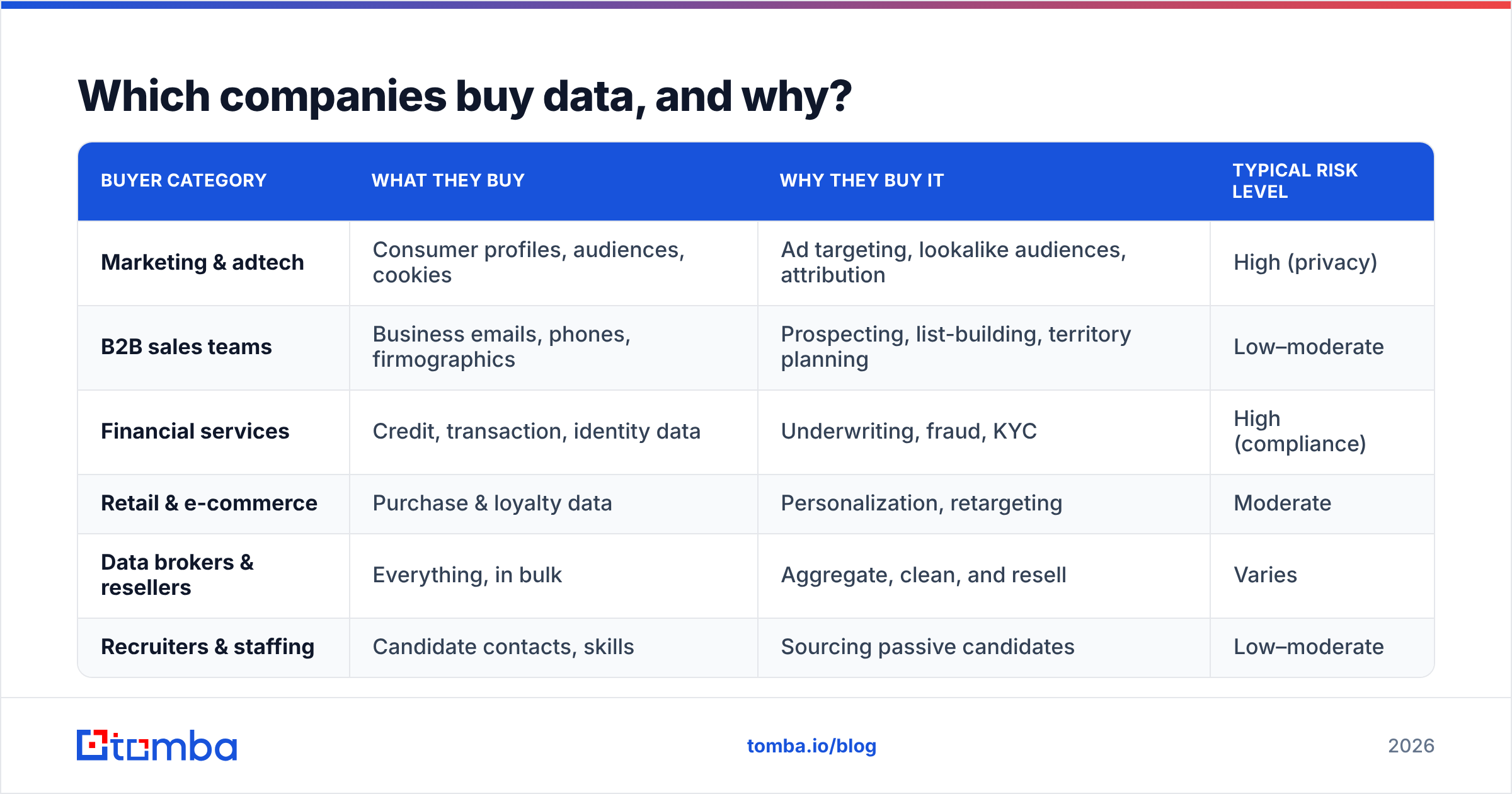
The short answer: any company whose growth depends on reaching people it doesn't already know. Here's the honest breakdown of the biggest buyer categories and what they're actually paying for.
| Buyer category | What they buy | Why they buy it | Typical risk level |
|---|---|---|---|
| Marketing & adtech | Consumer profiles, audiences, cookies | Ad targeting, lookalike audiences, attribution | High (privacy) |
| B2B sales teams | Business emails, phones, firmographics | Prospecting, list-building, territory planning | Low–moderate |
| Financial services | Credit, transaction, identity data | Underwriting, fraud, KYC | High (compliance) |
| Retail & e-commerce | Purchase & loyalty data | Personalization, retargeting | Moderate |
| Data brokers & resellers | Everything, in bulk | Aggregate, clean, and resell | Varies |
| Recruiters & staffing | Candidate contacts, skills | Sourcing passive candidates | Low–moderate |
Notice the pattern: the buyers taking on the most legal risk are the ones trading in consumer data. B2B contact data — a work email and a job title — sits in a much calmer regulatory zone in most markets, which is exactly why sales teams lean on it.
Marketing and advertising teams#
Adtech is the loudest data buyer. Ad platforms, DMPs (data management platforms), and CDPs (customer data platforms) ingest oceans of behavioral data to build audiences. This is the world of third-party cookies, and it's the same world getting squeezed hardest by browser changes and privacy law. If you're buying consumer audiences, assume the ground is moving under you.
B2B sales and prospecting teams#
This is probably why you're here. Sales teams buy contact and firmographic data to build target account lists and reach decision-makers. Instead of a full purchased database, most modern teams now blend a smaller data subscription with on-demand lookup — using domain search to pull every contact at a target company, then verifying before send. It's the difference between buying a whole warehouse and ordering exactly what you need.
Financial services and insurance#
Banks, lenders, and insurers buy identity, credit, and transaction data for underwriting and fraud detection. This is the most tightly regulated corner of the market (think GLBA, FCRA in the US). The data is expensive, audited, and not something you casually pick up from a list vendor.
Data brokers and resellers#
Some companies buy data purely to sell it again. They aggregate from many sources, clean and dedupe it, append fields, and license the result. Reputable B2B list providers like BookYourData sit here — offering pay-as-you-go, verified business contacts rather than mystery dumps. The quality gap between a compliant reseller and a scraped-list seller on a random forum is enormous.
How much does buying data cost in 2026?#
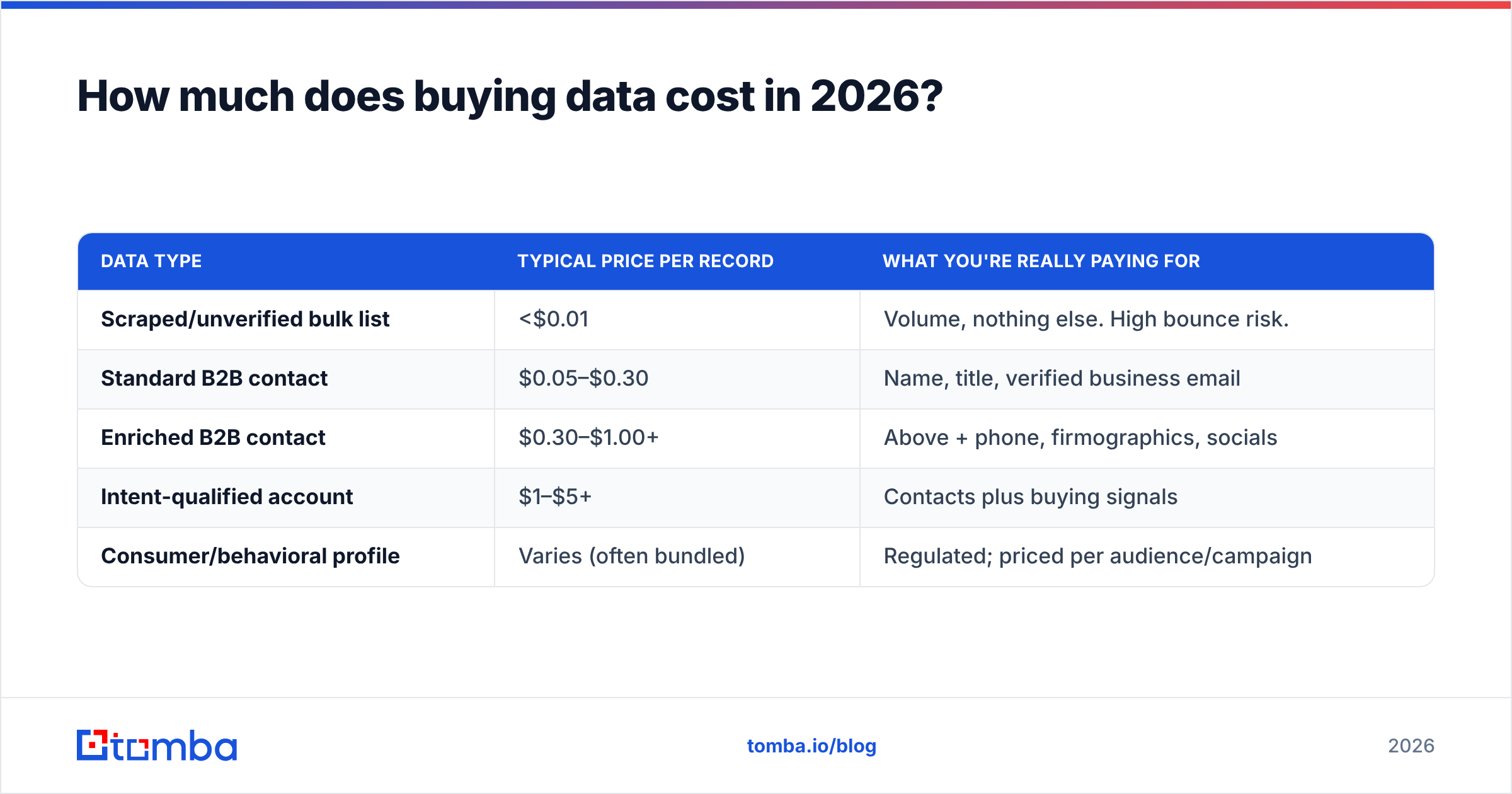
Cost depends almost entirely on freshness, verification, and enrichment depth — not raw volume. A giant unverified file is cheap for a reason.
| Data type | Typical price per record | What you're really paying for |
|---|---|---|
| Scraped/unverified bulk list | <$0.01 | Volume, nothing else. High bounce risk. |
| Standard B2B contact | $0.05–$0.30 | Name, title, verified business email |
| Enriched B2B contact | $0.30–$1.00+ | Above + phone, firmographics, socials |
| Intent-qualified account | $1–$5+ | Contacts plus buying signals |
| Consumer/behavioral profile | Varies (often bundled) | Regulated; priced per audience/campaign |
The trap is judging a purchase by cost-per-record. A $0.01 list where 40% of emails bounce isn't cheap — it's the most expensive thing you can do to your sender reputation. Every hard bounce chips away at your email deliverability, and inbox providers remember. According to inbox providers and reputation monitors, keeping your bounce rate under ~2% is the practical line before throttling begins.
Run the real math like this:
- Effective cost = list price ÷ (deliverable, correct records)
- A $500 list of 10,000 with 50% accuracy = $0.10 per usable record
- A $200 verified list of 2,000 at 95% accuracy = $0.105 per usable record — and none of the reputation damage
Suddenly the "expensive" list is the bargain.

Is buying data legal?#
Mostly yes for B2B, with real caveats — but "legal to buy" is not the same as "legal to blast." Two different questions.
Buying B2B contact data (business emails, job titles) is broadly permitted, because most privacy frameworks treat business contact info more leniently than personal consumer data. Using it is where rules bite:
- GDPR (EU/UK): You need a lawful basis to process personal data — even a work email of a named person. Legitimate interest can apply to B2B outreach, but you must be able to justify it and honor opt-outs.
- CAN-SPAM (US): Legal to cold-email B2B, but you must include a real physical address, a working unsubscribe, and no deceptive headers.
- CCPA/CPRA (California): Consumers can demand you delete or stop selling their data.
- CASL (Canada): Stricter — generally requires consent.
The safe posture: buy from vendors who document their sources and consent basis, keep suppression lists clean, and always give recipients a real way out. This is why where your data comes from matters as much as the data itself. A vendor that can't tell you their sources is a liability, not a bargain.
Should you buy a database or find contacts on demand?#
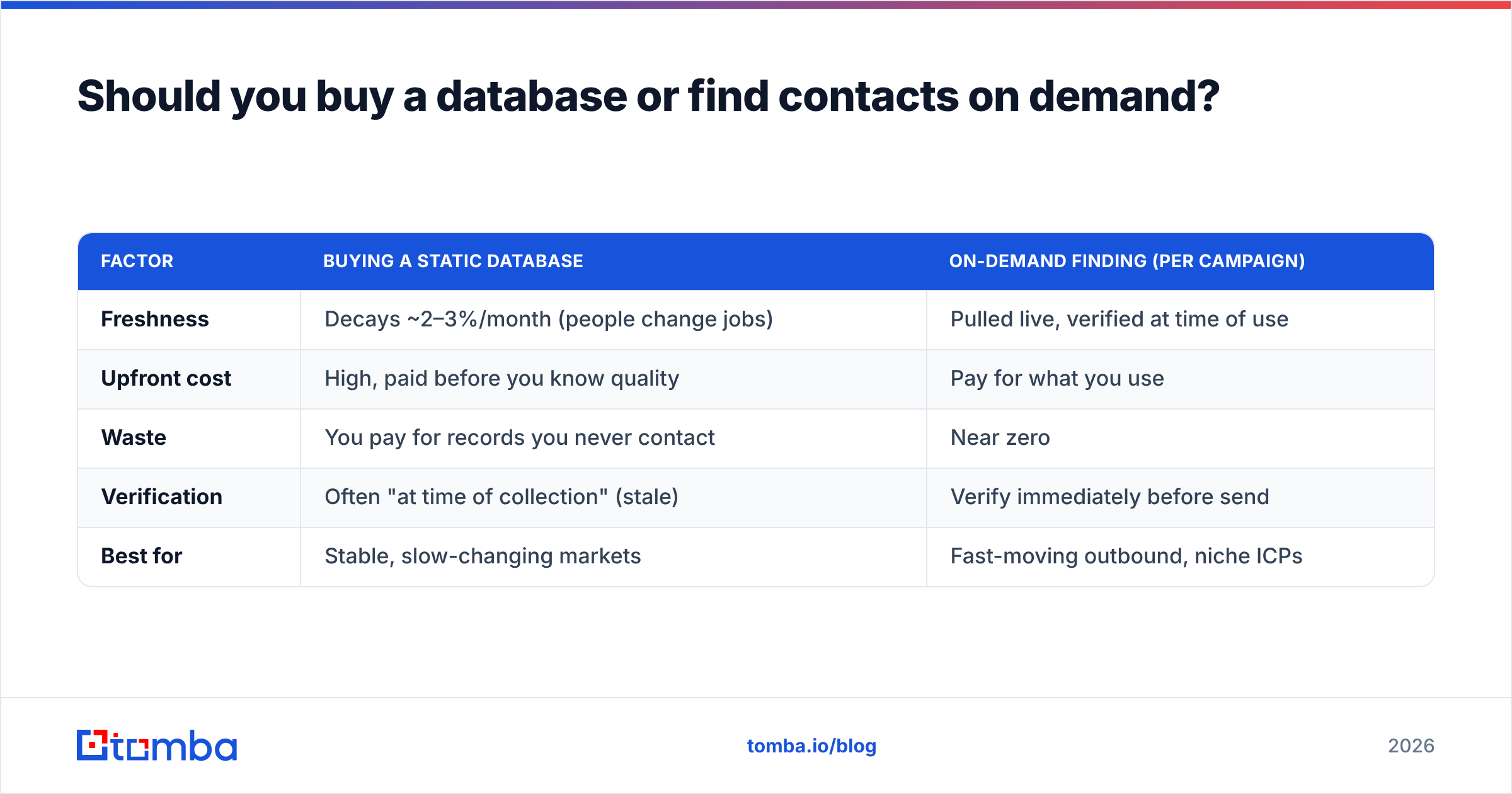
For most B2B teams in 2026, on-demand beats a static database — but both have a place. Here's the honest comparison.
| Factor | Buying a static database | On-demand finding (per campaign) |
|---|---|---|
| Freshness | Decays ~2–3%/month (people change jobs) | Pulled live, verified at time of use |
| Upfront cost | High, paid before you know quality | Pay for what you use |
| Waste | You pay for records you never contact | Near zero |
| Verification | Often "at time of collection" (stale) | Verify immediately before send |
| Best for | Stable, slow-changing markets | Fast-moving outbound, niche ICPs |
A purchased database starts rotting the day you get it. B2B data decays fast — people switch jobs, companies rebrand, domains change. That's why pairing any list with an email verifier before every send isn't optional; it's the thing standing between you and a spam-folder spiral.
The modern workflow most teams land on:
- Define the ICP — industry, size, role, geography.
- Pull contacts on demand by domain or company, rather than buying a bulk file.
- Verify every address before it enters a sequence.
- Enrich the keepers with phone and firmographics using data enrichment.
- Suppress and refresh — remove bounces, re-verify quarterly.
How do you buy data without wrecking deliverability?#
Freshness and verification are the whole game. Follow these rules and a purchased list won't tank your domain:
- Verify before you import, not after. Run the full list through verification and drop anything risky or catch-all before it touches your sending tool.
- Warm up gradually. Never blast a new list from a cold domain. Ramp volume over weeks.
- Segment by confidence. Send to your highest-confidence, verified records first.
- Watch catch-all domains. These accept everything at the server, so a "valid" result can still bounce. A dedicated catch-all verifier tells you which ones are safe.
- Honor unsubscribes instantly. One suppression miss can trigger complaints that outweigh a whole campaign's wins.
Think of your sending domain like a credit score. It takes months to build and one reckless purchase to trash. Vendors like G2 and buyer reviews on Capterra are useful for vetting a data provider's real-world accuracy claims before you spend a cent — don't trust the marketing page alone.
Who are the most common companies selling to these buyers?#
The supply side splits into three tiers, and knowing which you're dealing with saves you from the worst mistakes.
- Compliant B2B data platforms & resellers — document sources, verify records, offer pay-as-you-go. Lowest risk. (Tomba, BookYourData, and similar verified providers live here.)
- Large data brokers — aggregate consumer and business data at massive scale, license to enterprises. Powerful but expensive and compliance-heavy.
- Grey-market list sellers — cheap scraped dumps sold on forums and marketplaces. Almost always a deliverability and legal trap. Avoid.
If you want to understand how legitimate providers build accuracy, the reference point is transparency: verified sourcing, real-time checks, and clear pricing you can inspect. Compare that against Tomba's pricing — Free (25 searches/mo), Starter $49/mo, Growth $99/mo, Pro $249/mo — and you can see the pay-for-what-you-use model that's replaced the old "buy the whole database" habit. For deeper background on how the data brokerage industry works, Wikipedia's information broker entry is a neutral primer.
FAQ#
Do companies really buy my email address? In B2B, yes — your work email and job title are commonly aggregated and sold, which is legal in most markets. Consumer/personal data is far more restricted and increasingly protected by law.
Is it worth buying a lead list? Only if it's verified and fresh. An unverified list will bounce, hurt your sender reputation, and cost more in damage than it saves in time. On-demand finding plus verification usually wins.
How fast does purchased data go stale? B2B contact data typically decays 2–3% per month as people change jobs. A year-old list can be 25–30% wrong. Re-verify before every major send.
What's the safest way to source B2B contacts? Use a compliant provider that documents its sources, pull contacts on demand for your exact ICP, verify each one, and honor every opt-out.
The bottom line#
The companies that buy data aren't villains — they're marketers, sellers, lenders, and recruiters trying to reach people efficiently. The mistake isn't buying data; it's buying stale, unverified data and treating it like it's clean. In 2026 the smarter play is to stop hoarding giant databases and instead pull verified contacts exactly when you need them.
That's the whole idea behind the Tomba Email Finder: find professional email addresses by name, domain, or company, verified at the moment you pull them, so every record entering your sequence is one you can actually trust. Start on the free tier, test it against your real ICP, and let deliverability — not list size — be the metric you optimize.
Related guides#
Ready to find emails that actually work?
Join 150,000+ professionals who stopped guessing and started sending. Free credits on signup — no credit card required.
Get the Tomba newsletter
Practical outbound tactics and product updates — once every two weeks.
About the author