What Is Company Data? The 2026 Guide to B2B Data Sources
Company data powers every B2B sales and marketing motion — but most of it is stale within months. Here's what it is, where it comes from, and how to keep it accurate in 2026.
Company data is the raw material of every B2B pipeline. It decides who your reps call, which accounts your ABM campaigns target, and whether your CRM is a source of truth or a graveyard of dead records. Yet most teams treat it as an afterthought — buy a list, dump it in, and wonder why 30% of it bounces by Q2.
This guide breaks down what company data actually is, where providers get it, the categories that matter, and how to keep it accurate long enough to be worth paying for.
TL;DR#
- Company data is structured information about a business — firmographics, technographics, contacts, and intent signals — used to find, qualify, and reach buyers.
- It decays fast: roughly 2–3% of B2B records go stale every month, so a list is often 20–30% wrong within a year.
- The four core types are firmographic, technographic, contact/people, and intent data. Most tools sell a blend.
- Accuracy depends less on the brand and more on freshness, verification, and source diversity — always verify before you send.
- The cheapest data is the data you don't re-buy. Enrich and re-verify continuously instead of running one-time list dumps.
What is company data?#
Company data is any structured, machine-readable information that describes a business and the people inside it. Think of it like a nutrition label for an account: the name and domain are the product title, but the useful part is the breakdown — headcount, revenue, industry, tech stack, decision-makers, and buying signals.
In practice, "company data" is an umbrella term that covers several distinct layers stacked on top of a single business entity. A record for acme.com might tell you Acme is a 240-person SaaS firm in Austin, running HubSpot and Snowflake, whose VP of Marketing is Jane Doe at jane@acme.com, and that their traffic to pricing pages spiked last week. Each of those facts comes from a different source and decays at a different rate.
The reason this matters: your outreach is only as good as the weakest layer. A perfect firmographic profile is useless if the email attached to it bounces. That's why teams that rely on B2B data pair a data provider with an email verifier rather than trusting any single list at face value.
What are the main types of company data?#
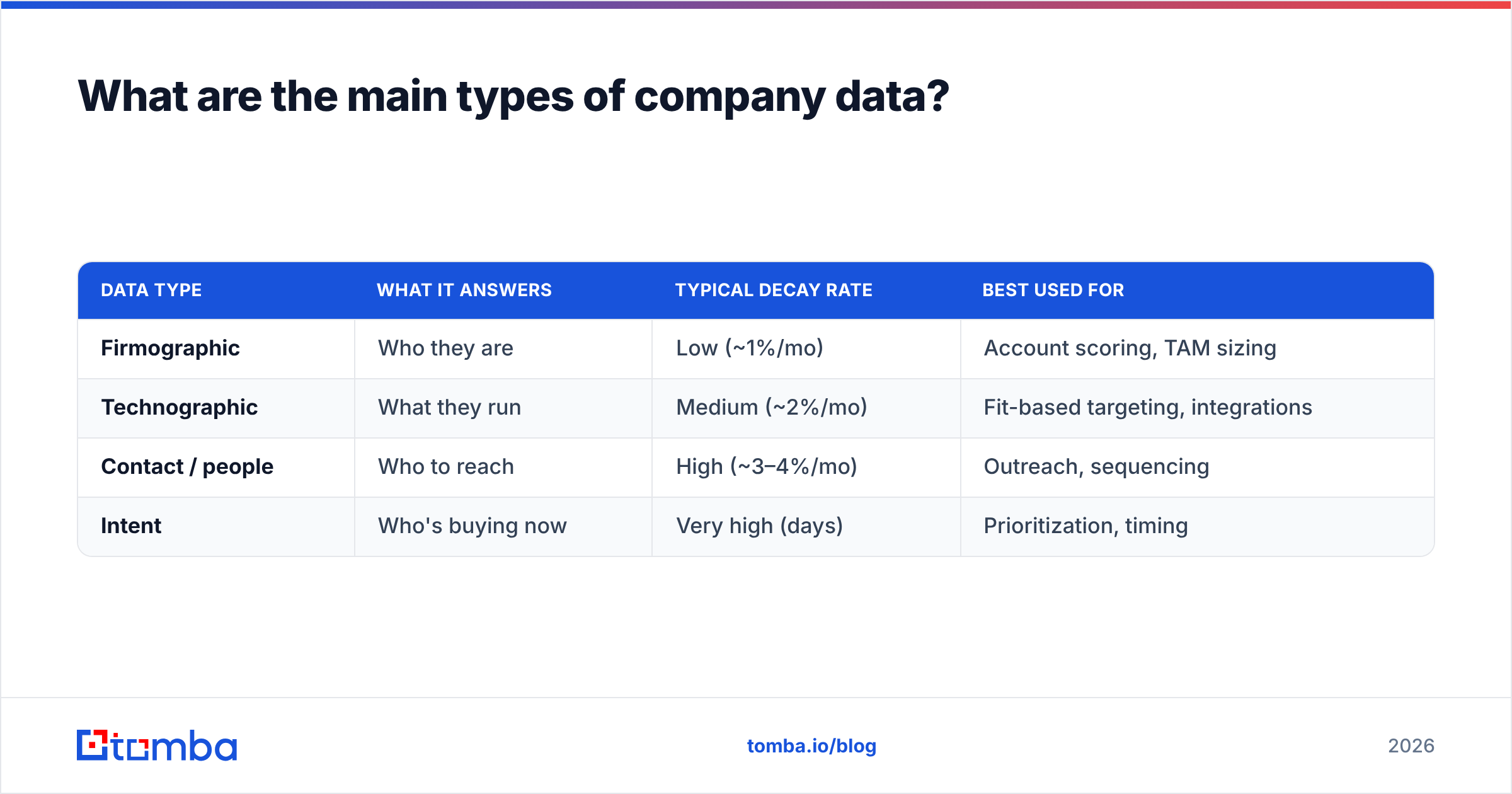
There are four categories worth knowing. Most vendors blend them, but they behave very differently.
- Firmographic data — the demographics of a business: company name, domain, industry (SIC/NAICS), employee count, revenue band, location, and founding year. This is the backbone of account scoring and territory planning.
- Technographic data — the tools a company runs: CRM, marketing automation, cloud provider, payment stack, analytics. Great for "sells-to" targeting (e.g., you integrate with Salesforce, so you want Salesforce users).
- Contact / people data — the humans: names, titles, seniority, department, work emails, and phone numbers. This is the layer that decays fastest because people change jobs constantly.
- Intent data — behavioral signals that a company is researching a category: content consumption, review-site activity, and web visits. It answers "who is in-market right now," not just "who fits."

Here's how the four types compare on the dimensions that actually affect your workflow:
| Data type | What it answers | Typical decay rate | Best used for |
|---|---|---|---|
| Firmographic | Who they are | Low (~1%/mo) | Account scoring, TAM sizing |
| Technographic | What they run | Medium (~2%/mo) | Fit-based targeting, integrations |
| Contact / people | Who to reach | High (~3–4%/mo) | Outreach, sequencing |
| Intent | Who's buying now | Very high (days) | Prioritization, timing |
Notice the pattern: the more actionable the data, the faster it rots. Intent signals are gold, but they're worthless a week late. Contact data is the workhorse of outbound, and it's also the layer most likely to be wrong on any given day.
Where does company data come from?#
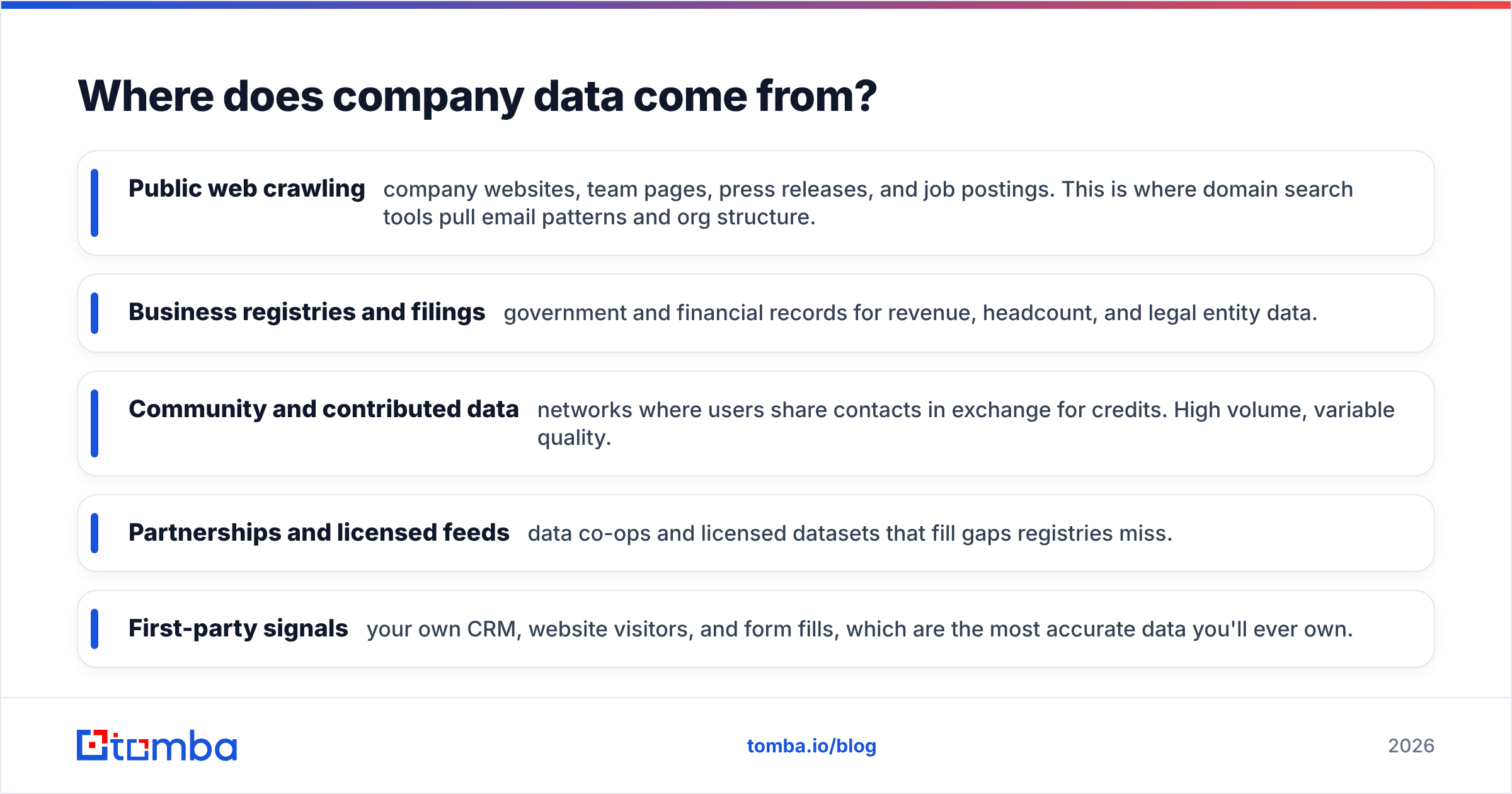
Providers assemble company data from a mix of sources, and the mix determines quality far more than the logo on the invoice. The main inputs:
- Public web crawling — company websites, team pages, press releases, and job postings. This is where domain search tools pull email patterns and org structure.
- Business registries and filings — government and financial records for revenue, headcount, and legal entity data.
- Community and contributed data — networks where users share contacts in exchange for credits. High volume, variable quality.
- Partnerships and licensed feeds — data co-ops and licensed datasets that fill gaps registries miss.
- First-party signals — your own CRM, website visitors, and form fills, which are the most accurate data you'll ever own.
The best providers don't rely on one source — they cross-reference several and score the confidence of each field. That's the difference between a record that says "email: verified across 3 sources" and one that says "email: guessed from pattern." If you want to see how this works in practice, Tomba documents its own data sources openly, which is a good habit to look for in any vendor.
Why does company data decay so fast?#
Because businesses are alive. People get promoted, laid off, or poached. Companies rebrand, merge, relocate, and swap their entire tech stack after a new VP arrives. Every one of those events breaks a field in your database.
Industry analysts have long pegged B2B data decay at roughly 30% per year — and for contact-level fields, it's worse. Gartner and other research firms consistently flag data quality as a top driver of failed go-to-market programs. A list you bought in January is meaningfully wrong by summer, not because the vendor cheated you, but because entropy is undefeated.
This is why "buy a list once" is the most expensive strategy disguised as the cheapest. The record looks fine the day it lands in your CRM. It's silently rotting the entire time it sits there.
The fix isn't better one-time data — it's continuous re-verification. Treat your database like fresh produce, not canned goods.
How do you keep company data accurate?#
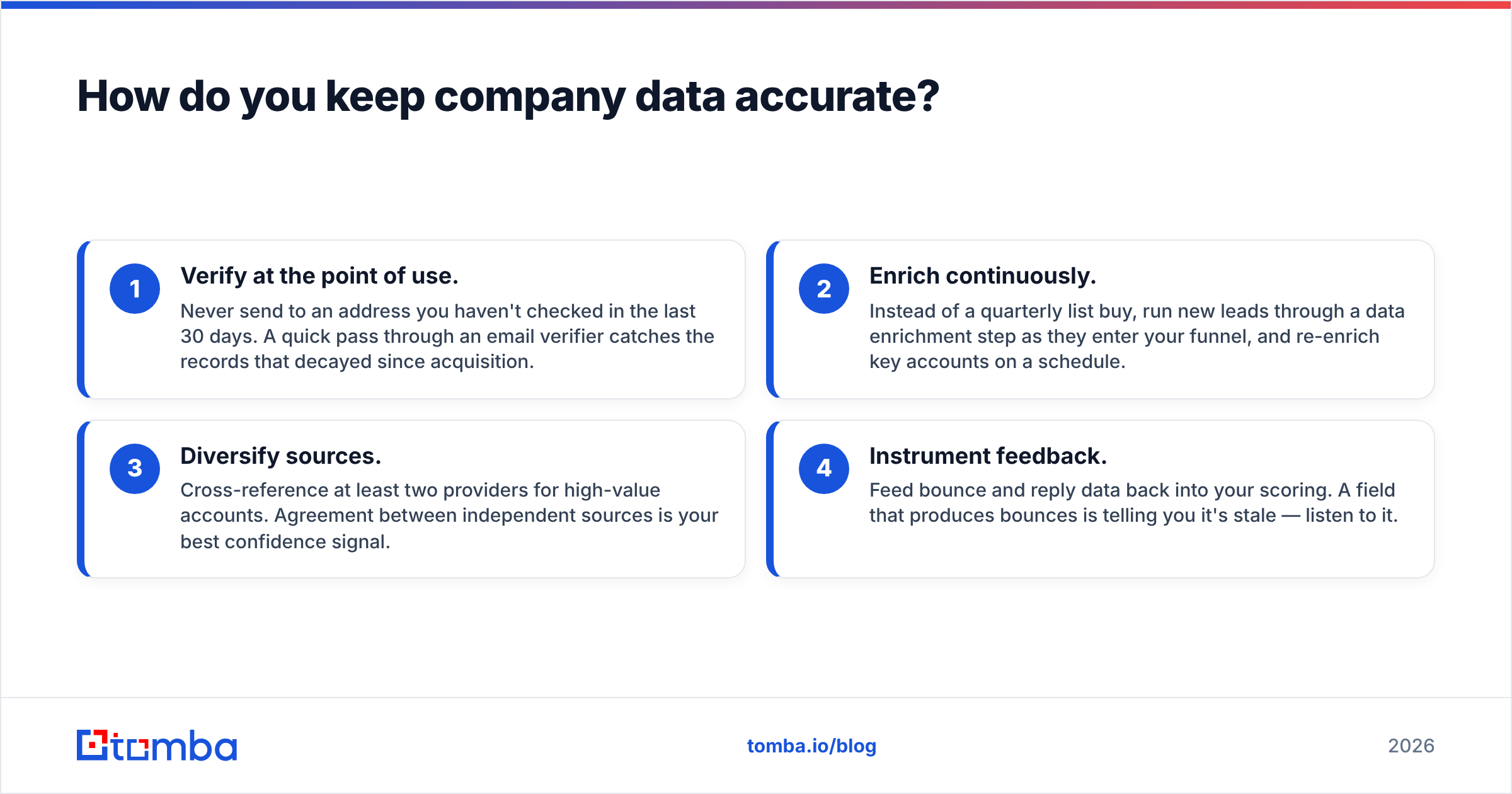
Accuracy is a process, not a purchase. Four habits separate teams with clean data from teams drowning in bounces:
- Verify at the point of use. Never send to an address you haven't checked in the last 30 days. A quick pass through an email verifier catches the records that decayed since acquisition.
- Enrich continuously. Instead of a quarterly list buy, run new leads through a data enrichment step as they enter your funnel, and re-enrich key accounts on a schedule.
- Diversify sources. Cross-reference at least two providers for high-value accounts. Agreement between independent sources is your best confidence signal.
- Instrument feedback. Feed bounce and reply data back into your scoring. A field that produces bounces is telling you it's stale — listen to it.
Teams that adopt these habits stop thinking about data as a line item and start treating it as infrastructure. The payoff is measured in reply rates and, ultimately, in deliverability — because mailbox providers punish senders who blast stale lists.
How do company data providers compare?#
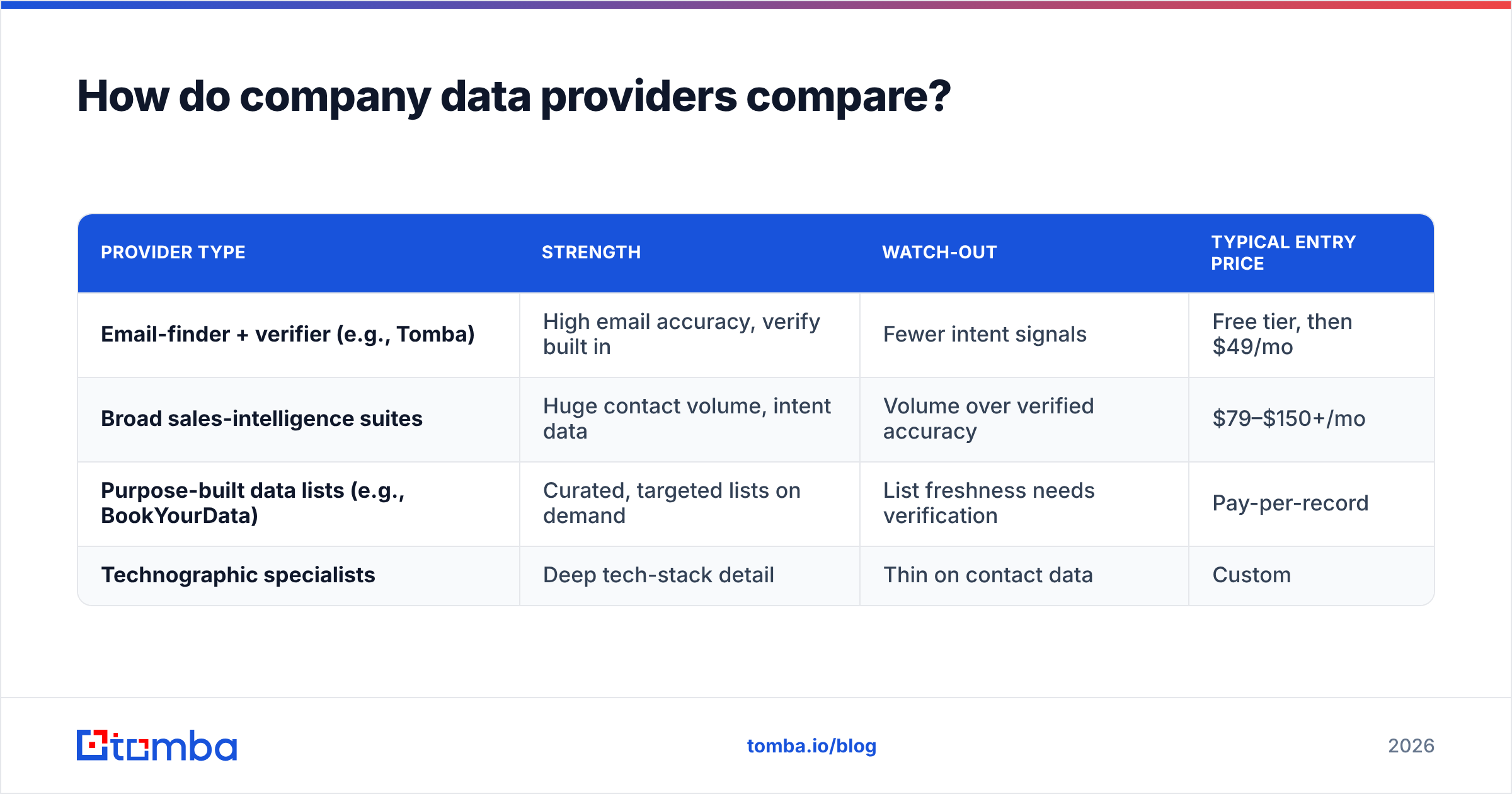
The market splits into a few archetypes. No single tool wins every category; the right pick depends on whether you optimize for coverage, accuracy, price, or a specific data layer. Here's an honest map of the landscape:
| Provider type | Strength | Watch-out | Typical entry price |
|---|---|---|---|
| Email-finder + verifier (e.g., Tomba) | High email accuracy, verify built in | Fewer intent signals | Free tier, then $49/mo |
| Broad sales-intelligence suites | Huge contact volume, intent data | Volume over verified accuracy | $79–$150+/mo |
| Purpose-built data lists (e.g., BookYourData) | Curated, targeted lists on demand | List freshness needs verification | Pay-per-record |
| Technographic specialists | Deep tech-stack detail | Thin on contact data | Custom |
A few honest takeaways from this table:
- If your bottleneck is reaching people, prioritize a tool that verifies emails natively. Volume means nothing if a third of it bounces.
- If your bottleneck is finding the right accounts, a firmographic/intent suite earns its higher price — but you'll still want to verify the contacts it hands you.
- BookYourData and similar curated-list providers are strong when you need a targeted list fast; just run the output through verification before your first send, the same as you would with any source.
- Tomba sits on the accuracy-first end: the email finder and verifier are one workflow, so you're not stitching two vendors together. See Tomba pricing for the full tier breakdown.
For third-party validation of any provider, check G2 category grids rather than vendor-supplied logos — real reviews surface the freshness complaints marketing pages hide.
What's the difference between company data and lead data?#
Short answer: company data describes the account; lead data describes a specific person you can act on.
Company data is the firmographic and technographic profile of a business — it's account-level. Lead data is a qualified individual: a named person, with a verified email or phone, who fits your ICP and (ideally) shows intent. You turn company data into lead data by adding a verified contact and a reason to reach out now.
The distinction matters for budgeting. You can license broad company data cheaply, but the moment you need a person to email, accuracy costs go up — because that's the layer that decays fastest and requires active verification. A B2B database that keeps both layers in sync saves you from paying twice.
How should a small team buy company data in 2026?#
Start narrow and verify everything. You don't need a six-figure data contract to run effective outbound. A practical starting stack:
- Define your ICP tightly — 2–3 firmographic filters (industry, size, region) beat a giant untargeted pull.
- Use a free tier to test accuracy before committing. Tomba's free plan gives you 25 searches a month, enough to spot-check a provider's real hit rate on your target accounts.
- Verify before every campaign, not just at import. Freshness is a use-time property.
- Automate the pipe — connect your data source to your CRM through the Tomba API or a no-code integration so enrichment happens on entry, not in a manual monthly batch.
The goal is a small, clean, continuously-refreshed dataset — not a massive stale one. Ten thousand verified records beat a hundred thousand rotting ones every quarter.
The bottom line#
Company data isn't a file you buy — it's a living asset you maintain. The four layers (firmographic, technographic, contact, and intent) each decay at their own pace, and the fastest-decaying layers are exactly the ones your reps depend on to book meetings. Winning teams verify at the point of use, enrich continuously, and diversify their sources instead of trusting a single one-time list.
If your priority in 2026 is reaching real people at the right accounts without eating a wall of bounces, start where accuracy is highest. The Tomba Email Finder pairs verified professional emails with domain search and enrichment in one workflow — so the contact data you act on is checked before it ever leaves your outbox. Try the free tier, run it against your own target accounts, and compare the hit rate to whatever you're using today. Clean data is cheaper than the deals you lose to dirty data.
Related guides#
Ready to find emails that actually work?
Join 150,000+ professionals who stopped guessing and started sending. Free credits on signup — no credit card required.
Get the Tomba newsletter
Practical outbound tactics and product updates — once every two weeks.
About the author