Company Data Enrichment From Domains: A 2026 Field Guide
A domain is the smallest input with the biggest payoff. Here's how company data enrichment from domains actually works in 2026—the fields you can pull, the accuracy trade-offs, and which tools earn their price.
You already have the one field that matters: the domain. Everything a go-to-market team wants to know about an account—headcount, industry, tech stack, location, revenue band, social profiles, and the people behind the inbox—can be unfolded from that single string. That process is company data enrichment from domains, and in 2026 it's the quiet engine behind routing, scoring, personalization, and clean CRM data.
This guide is the practical version: what a domain can actually tell you, where the accuracy cracks appear, how the tooling stacks up, and how to wire it into your stack without lighting your budget on fire.
TL;DR#
- A domain is a high-yield key. One
example.comstring can resolve into firmographics, technographics, socials, and contact-level data through company data enrichment from domains. - Coverage and accuracy are separate problems. A vendor can "match" 95% of domains and still be wrong on revenue or headcount—verify the fields you route and score on.
- Batch beats one-off for scale. Real-time API calls power forms; bulk enrichment cleans the 40,000-row list you inherited.
- Waterfall > single source. The most accurate results chain multiple providers and keep the first confident answer.
- Tools range from free lookups to $249/mo platforms. Match the tier to volume and the fields you'll actually act on.
What is company data enrichment from domains?#
Think of a domain like a house address. On its own it's just text, but hand it to the right directory and you get the residents, the square footage, the year it was built, and the neighborhood. Domain-based enrichment does the same for a company: you submit stripe.com and get back a structured profile instead of a blank row.
Technically, enrichment is the process of appending third-party attributes to a record you already hold, keyed on a stable identifier. The domain is the best identifier in B2B because it's unique, rarely changes, and maps cleanly to a legal entity—unlike company names, which are messy ("Meta" vs "Meta Platforms, Inc." vs "Facebook"). This is why most modern data enrichment pipelines normalize everything to a root domain before they do anything else.
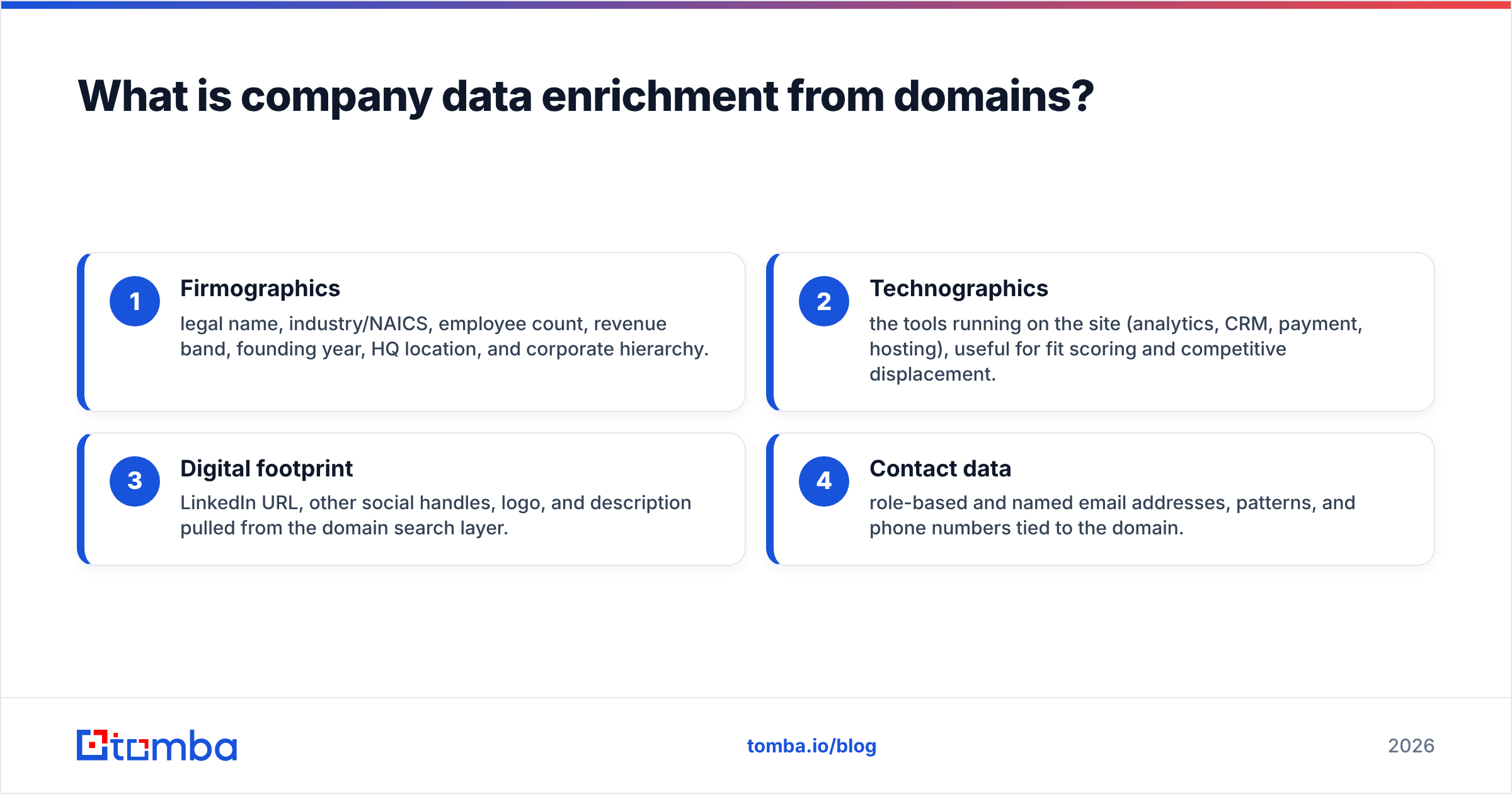
The typical output falls into four buckets:
- Firmographics — legal name, industry/NAICS, employee count, revenue band, founding year, HQ location, and corporate hierarchy.
- Technographics — the tools running on the site (analytics, CRM, payment, hosting), useful for fit scoring and competitive displacement.
- Digital footprint — LinkedIn URL, other social handles, logo, and description pulled from the domain search layer.
- Contact data — role-based and named email addresses, patterns, and phone numbers tied to the domain.
Why enrich from a domain instead of a company name?#
Because names lie and domains don't. A single company can appear under a dozen name variants across your CRM, your webinar tool, and that trade-show scanner. Match on name and you'll create duplicates, split accounts, and route the same buyer to three reps. Match on domain and every one of those records collapses to one canonical entity.
Domains also survive rebrands better than you'd expect. When a company changes its name, the primary domain usually redirects rather than disappears, so your historical records stay linked. And because email addresses are built on domains, you get a natural bridge from account-level data to person-level data—the thing that actually makes outreach possible.
Analyst coverage backs this up: firms like Gartner consistently tie revenue-operations maturity to data hygiene, and domain normalization is the cheapest hygiene win available. It costs nothing to standardize on and pays off across every downstream system.
What data points can you actually pull from a domain?#
Here's the honest inventory. Not every field is available for every domain, and coverage drops fast for tiny companies and personal-name domains.
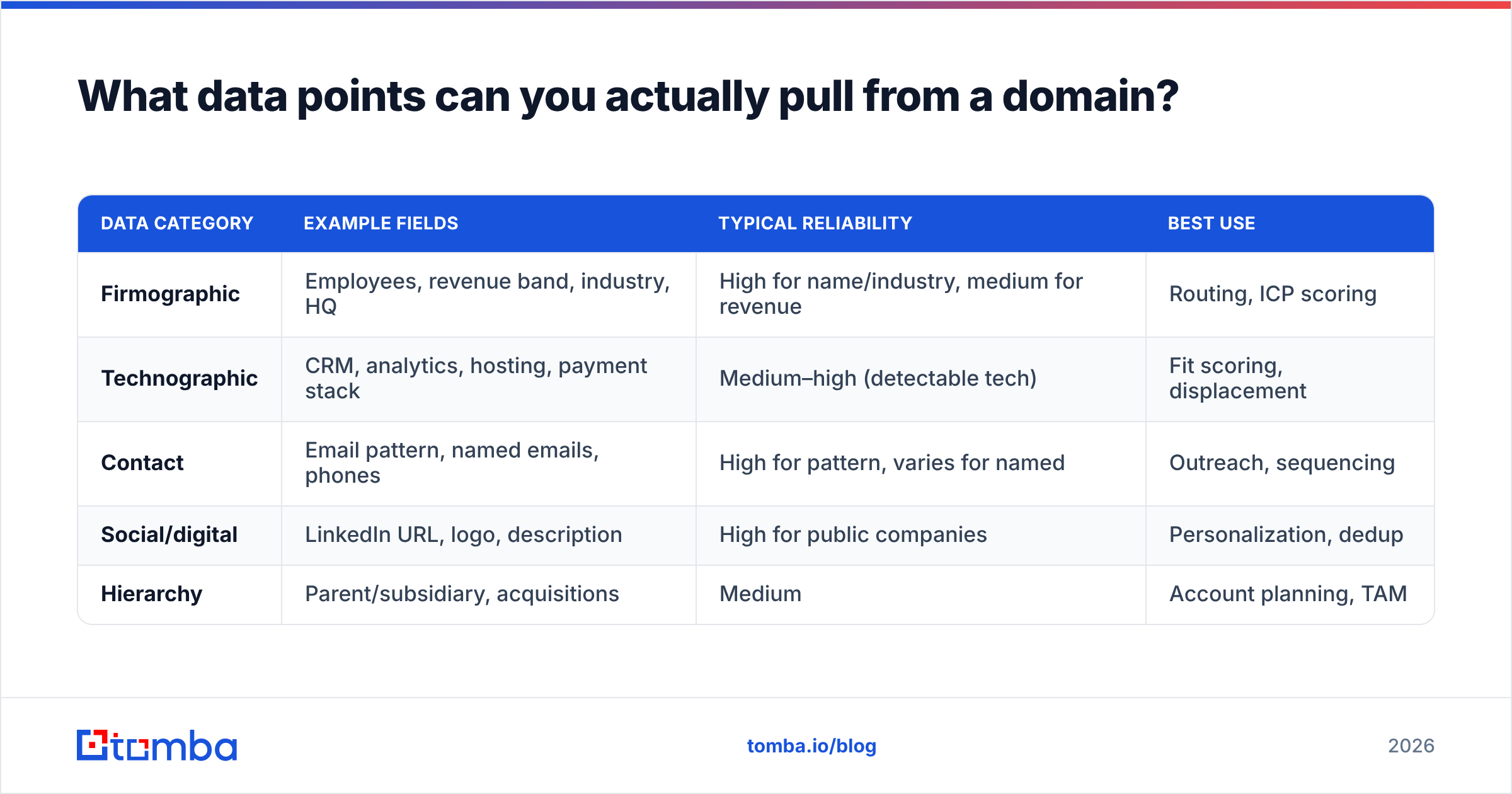
| Data category | Example fields | Typical reliability | Best use |
|---|---|---|---|
| Firmographic | Employees, revenue band, industry, HQ | High for name/industry, medium for revenue | Routing, ICP scoring |
| Technographic | CRM, analytics, hosting, payment stack | Medium–high (detectable tech) | Fit scoring, displacement |
| Contact | Email pattern, named emails, phones | High for pattern, varies for named | Outreach, sequencing |
| Social/digital | LinkedIn URL, logo, description | High for public companies | Personalization, dedup |
| Hierarchy | Parent/subsidiary, acquisitions | Medium | Account planning, TAM |
The pattern to notice: structural data (industry, tech, socials) is far more reliable than estimated data (revenue, exact headcount). Vendors infer revenue from proxies, so treat those numbers as bands, not facts. If a $2M ACV routing rule depends on a revenue estimate, you're building on sand—verify it against a primary source before you trust it.
How accurate is domain-based enrichment in 2026?#
Accuracy has two dimensions people constantly conflate: coverage (did we return anything?) and correctness (was it right?). A vendor advertising "98% match rate" is quoting coverage. That tells you nothing about whether the returned headcount is off by 300%.
Three factors move real accuracy:
- Data freshness. People change jobs every ~24 months and companies shift stacks constantly. A profile refreshed quarterly beats one scraped two years ago, regardless of source size.
- Source diversity. Single-source providers inherit that source's blind spots. Waterfall enrichment—querying several providers and keeping the first confident hit—measurably lifts both coverage and correctness.
- Verification. For contact data especially, enrichment without validation is a bounce waiting to happen. Pair enrichment with an email verifier so you're not shipping guesses into a sequence.
The practical test: pull 100 domains you know well, enrich them, and manually grade the fields you actually route and score on. Peer reviews on G2 are a useful sanity check on a vendor's reputation, but nothing replaces grading against your own ground truth.
What's the difference between real-time and bulk enrichment?#
Both matter; they solve different problems.
Real-time (API) enrichment fires when a single event happens—a form submit, a new CRM record, a website visit. It's low-latency, one domain at a time, and it's how you enrich a lead the instant it enters your funnel. This is where the Tomba API lives: a call goes out with the domain, structured JSON comes back, the record is complete before the rep ever sees it.
Bulk enrichment processes a list—the 40,000-row export you inherited, or a quarterly re-enrichment of stale accounts. Latency doesn't matter; throughput and cost-per-record do. A bulk email finder or batch enrichment job is the right tool here, ideally deduplicated by domain first so you're not paying to enrich acme.com fourteen times.
Most mature teams run both: API on the front door for new records, scheduled batch jobs to keep the existing database from decaying.
How do the main enrichment approaches compare?#
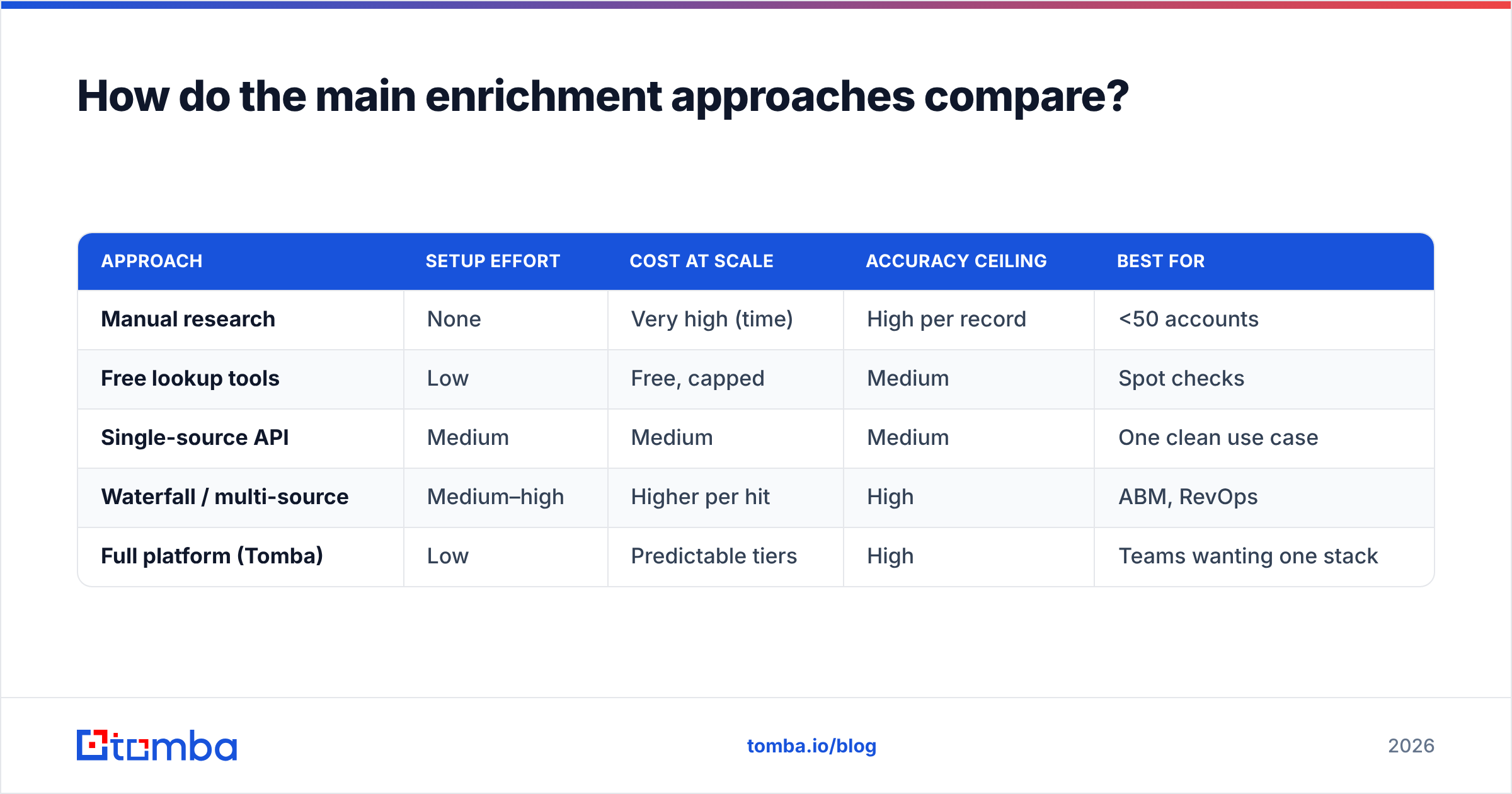
There's no single "best"—there's best-for-your-volume-and-fields. Here's how the common approaches line up.
| Approach | Setup effort | Cost at scale | Accuracy ceiling | Best for |
|---|---|---|---|---|
| Manual research | None | Very high (time) | High per record | <50 accounts |
| Free lookup tools | Low | Free, capped | Medium | Spot checks |
| Single-source API | Medium | Medium | Medium | One clean use case |
| Waterfall / multi-source | Medium–high | Higher per hit | High | ABM, RevOps |
| Full platform (Tomba) | Low | Predictable tiers | High | Teams wanting one stack |
The trap teams fall into is over-buying. If you enrich 500 domains a month for routing, you don't need an enterprise data cloud—you need a reliable API and a verifier. If you're running account-based motions across tens of thousands of accounts, a single source's blind spots will cost you more than the price gap to a waterfall.
How does Tomba handle enrichment from domains?#
Tomba treats the domain as the entry point to an entire contact graph. Submit a domain and you can move in every direction: firmographic profile, the email pattern the company uses, named contacts by role, phones, and social profiles—each piece verifiable in the same platform.
The pieces that matter for domain enrichment specifically:
- Domain search returns every discoverable email and the underlying pattern for a company, so you go from
example.comto a working contact list. - Email verifier validates each address (including catch-all handling) so enrichment output is deliverable, not just plausible.
- Enrichment + API append firmographic and contact attributes to your records programmatically, one call or in bulk.
- Data sourcing is documented openly—Tomba publishes where its data comes from on its data sources page, which matters for compliance reviews.
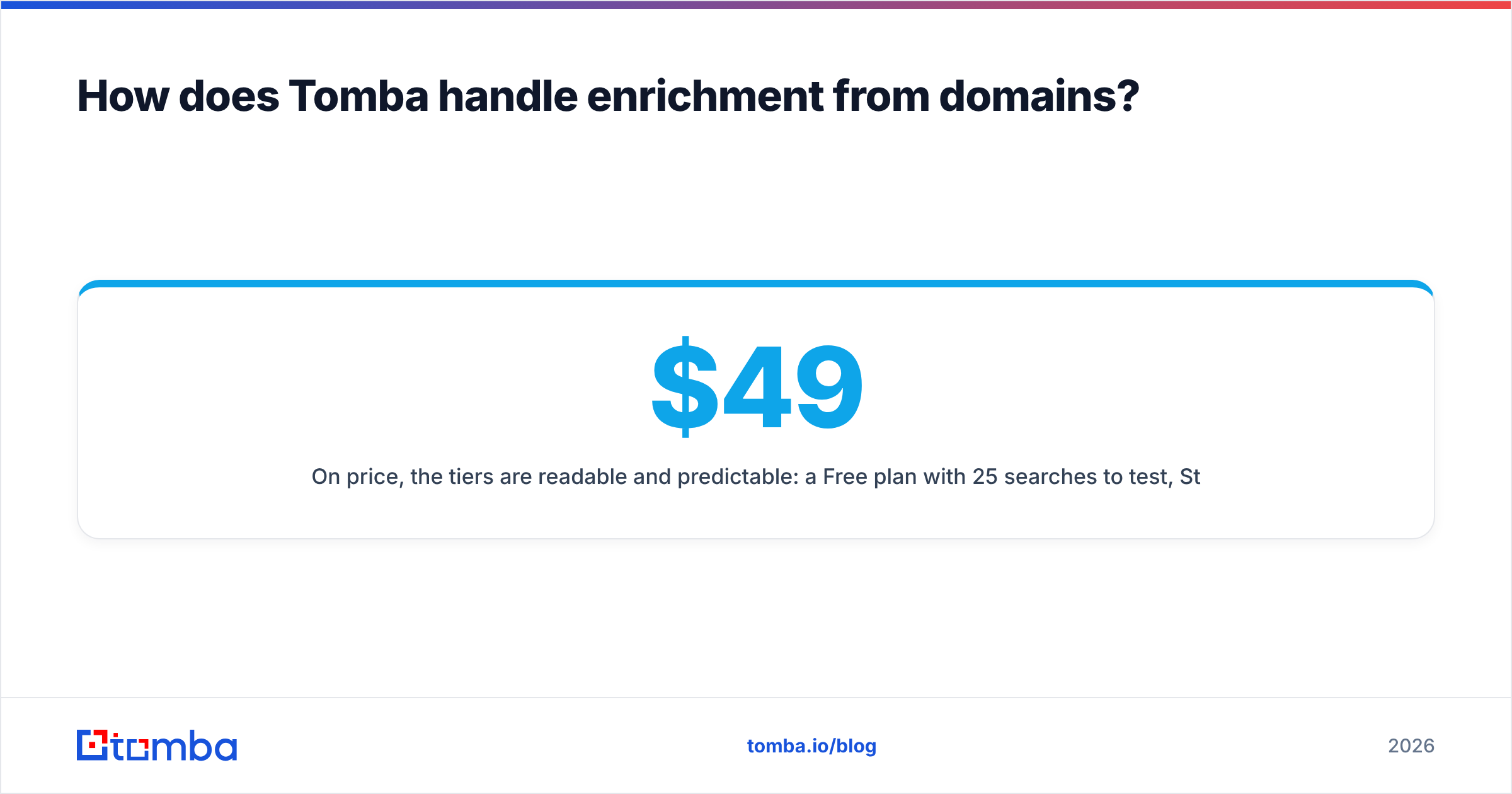
On price, the tiers are readable and predictable: a Free plan with 25 searches/month to test, Starter at $49/mo, Growth at $99/mo, and Pro at $249/mo, with custom Enterprise pricing above that. Full Tomba pricing is public, so you can size the plan to your monthly domain volume without a sales call. That predictability is the quiet advantage—usage-metered data clouds can surprise you on the invoice.
What are the common pitfalls to avoid?#
A few mistakes show up in nearly every stalled enrichment project:
- Trusting estimated fields. Revenue and exact headcount are inferences. Route on them and you'll misroute. Use bands and verify the edge cases.
- Skipping deduplication. Enriching before you collapse to unique domains wastes credits and creates conflicting records.
- Enriching without verifying contacts. An unverified email in a sequence hurts your sender reputation and your deliverability. Verification is not optional.
- Set-and-forget. Data decays ~2–3% per month. A one-time enrichment is stale within a year. Schedule re-enrichment.
- Ignoring provenance. In 2026, "where did this data come from?" is a compliance question, not a nice-to-have. Wikipedia's overview of data enrichment is a decent primer on why lineage matters.
How do you build a domain enrichment workflow?#
A workflow that holds up looks like this:
- Capture the domain at the earliest point—form, CRM create, or list import.
- Normalize to a root domain and dedupe. This is the single highest-leverage step.
- Enrich via API for new records, batch for backfills.
- Verify every contact-level output before it reaches a sequence.
- Score and route using the reliable structural fields, treating estimates as bands.
- Refresh on a schedule—quarterly for firmographics, more often for contacts.
Wire that once and enrichment stops being a project and becomes plumbing. New records arrive complete, old records stay current, and reps spend their time selling instead of Googling account details.
The bottom line#
Company data enrichment from domains is the highest-ROI data move in B2B because the input costs nothing and the output touches everything downstream. The winners in 2026 aren't the teams with the biggest data budget—they're the ones who normalize on the domain, verify what they act on, and refresh before the data rots.
If you want to turn domains into complete, verified company and contact profiles without stitching five vendors together, start with the Tomba Email Finder and its domain search. Run 25 free searches, grade the results against accounts you already know, and see how far a single domain gets you. That's the fastest way to find out whether domain-based enrichment belongs at the front of your funnel—and it almost certainly does.
Related guides#
Ready to find emails that actually work?
Join 150,000+ professionals who stopped guessing and started sending. Free credits on signup — no credit card required.
Get the Tomba newsletter
Practical outbound tactics and product updates — once every two weeks.
About the author