How to Write a Company Introduction Email (2026 Guide + Templates)
A company introduction email only works when it earns a reply. Here are the structures, subject lines, and copy-paste templates that get real responses in 2026 — plus the mistakes that kill them.
Most company introduction emails fail for a boring reason: they are about the sender, not the reader. You open with "We are excited to announce," the prospect's eyes glaze, and the message dies in the archive. A good introduction email flips that — it leads with something the recipient cares about and makes replying the easy next step.
This guide breaks down the exact structure, subject lines, and templates that get a company introduction email answered in 2026, whether you are reaching out to a cold prospect, a warm referral, a new client, or introducing two people to each other.
TL;DR#
- A company introduction email should be short (50–125 words), personalized, and built around the recipient's problem — not your origin story.
- The five parts that matter: a relevant subject line, a personalized opener, one line on who you are, one line of value, and a single soft call to action.
- Verify the address before you send. A perfect intro email bouncing off a dead inbox is wasted effort — clean your list with an email verifier first.
- Different scenarios need different templates: cold outreach, warm referral, new-client onboarding, and person-to-person introductions each have their own rhythm.
- Follow up. One polite nudge after 3–4 days roughly doubles reply rates on cold intros.
What is a company introduction email?#
A company introduction email is a message that introduces your business, yourself, or a mutual contact to a recipient who may not know you yet. Think of it like walking up to someone at a conference: you get about one sentence to explain why they should keep listening before they scan the room for an exit.
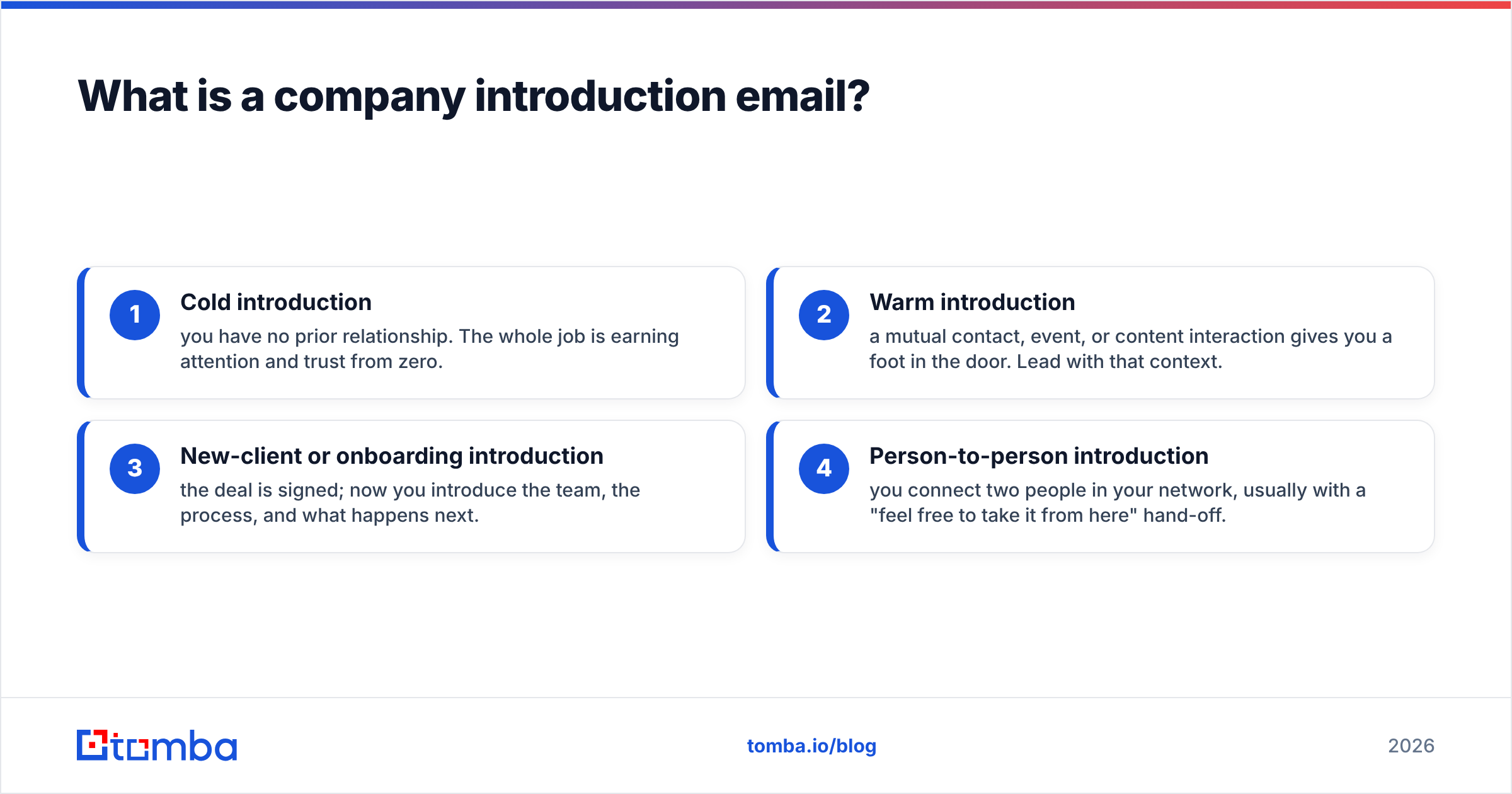
There are four common flavors, and mixing them up is the fastest way to sound off-key:
- Cold introduction — you have no prior relationship. The whole job is earning attention and trust from zero.
- Warm introduction — a mutual contact, event, or content interaction gives you a foot in the door. Lead with that context.
- New-client or onboarding introduction — the deal is signed; now you introduce the team, the process, and what happens next.
- Person-to-person introduction — you connect two people in your network, usually with a "feel free to take it from here" hand-off.
Each one changes your opening line, your tone, and your call to action. A cold intro that reads like an onboarding email feels presumptuous; an onboarding email that reads like a cold pitch feels cold.
What are the parts of a strong introduction email?#
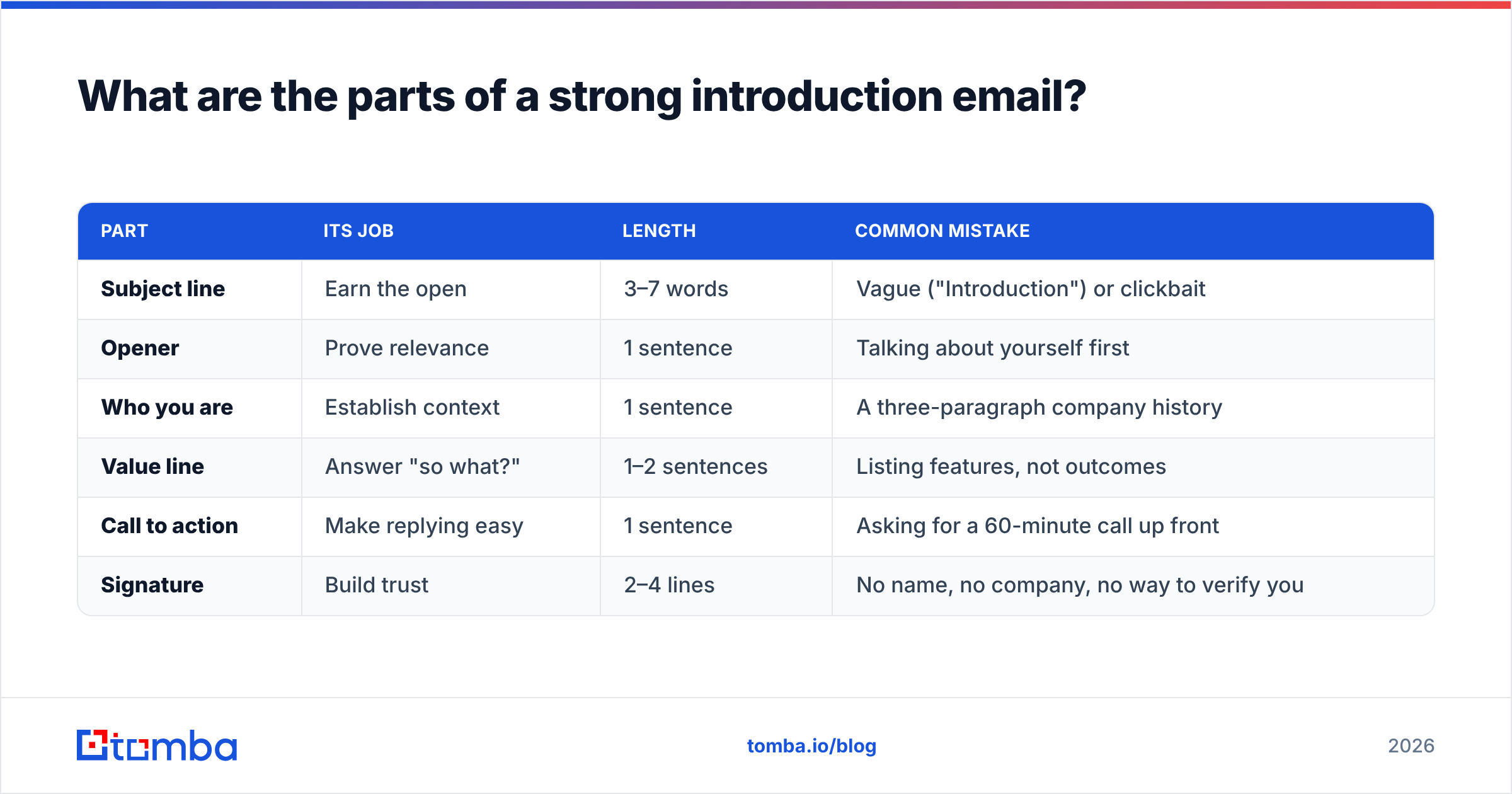
Every high-performing intro email — regardless of scenario — shares the same skeleton. Here is the breakdown, with the job each part does and how much room it should take.
| Part | Its job | Length | Common mistake |
|---|---|---|---|
| Subject line | Earn the open | 3–7 words | Vague ("Introduction") or clickbait |
| Opener | Prove relevance | 1 sentence | Talking about yourself first |
| Who you are | Establish context | 1 sentence | A three-paragraph company history |
| Value line | Answer "so what?" | 1–2 sentences | Listing features, not outcomes |
| Call to action | Make replying easy | 1 sentence | Asking for a 60-minute call up front |
| Signature | Build trust | 2–4 lines | No name, no company, no way to verify you |
Notice the ratio: the parts about them (opener, value, CTA) outweigh the parts about you (who you are, signature). That balance is the whole game.

How do you write a cold company introduction email?#
Lead with the recipient, keep it under 125 words, and ask for one small thing. A cold intro is not the place to close a deal — it is the place to earn a reply.
Here is a template you can adapt:
Subject: Quick question about {their company}'s {specific area}
Hi {First name},
I noticed {specific, recent trigger — a hire, a launch, a post they wrote}. That usually means {relevant challenge} lands on your desk.
I'm {your name} from {your company}. We help {similar companies} {achieve specific outcome} — for example, {one-line proof or number}.
Worth a quick look at whether we could do the same for {their company}? Happy to send a two-minute breakdown, no call required.
{Your name}
{Company} · {phone or link}
Why it works: the trigger line proves you did your homework, the value line is an outcome (not a feature dump), and the CTA asks for permission to share more — a much lower bar than "book a demo."
Before this email is worth sending, though, two things have to be true: the address has to be real, and the name has to be right. Getting the recipient's name wrong is the single most common own-goal in cold outreach.

You can find and confirm the right contact with a domain search to see who works at the company, then pull the exact address with an email finder. It is the difference between "Hi there" and "Hi Sarah" — and personalization at the name level measurably lifts reply rates.
What subject lines work for introduction emails?#
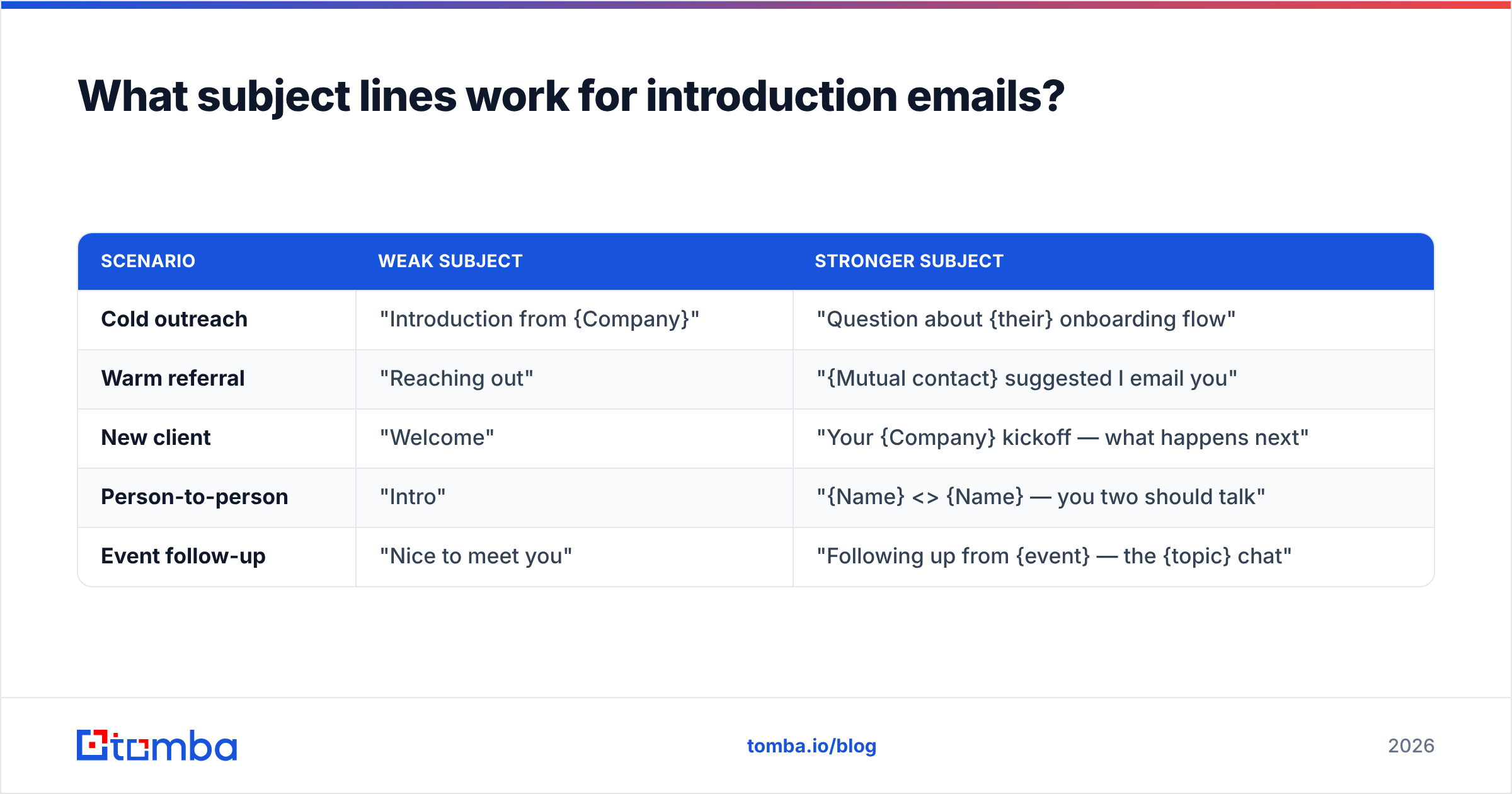
The subject line decides whether the rest of your work gets read. For introductions, specific and curious beats clever and generic. Data from outreach studies consistently shows short, lowercase-friendly, question-style lines outperform formal announcements.
| Scenario | Weak subject | Stronger subject |
|---|---|---|
| Cold outreach | "Introduction from {Company}" | "Question about {their} onboarding flow" |
| Warm referral | "Reaching out" | "{Mutual contact} suggested I email you" |
| New client | "Welcome" | "Your {Company} kickoff — what happens next" |
| Person-to-person | "Intro" | "{Name} <> {Name} — you two should talk" |
| Event follow-up | "Nice to meet you" | "Following up from {event} — the {topic} chat" |
Two rules hold across all of them. First, name the person or the shared context whenever you can. Second, avoid the word "introduction" alone — it is the email equivalent of a blank envelope. If you want to pressure-test options, a free subject line tester will score them before you commit.
How is a warm introduction different?#
A warm introduction spends its opening on the connection, not the pitch. The referral, shared event, or content interaction is your most valuable asset — use it in the first line and the subject.
Subject: {Mutual contact} suggested we connect
Hi {First name},
{Mutual contact} mentioned you're rethinking {area} at {their company} and thought we should talk.
I run {function} at {your company} — we helped {mutual contact's company or a peer} {specific result}. I suspect a few of those ideas would transfer to your situation.
Would a short call next week be useful? I can also just send notes if that's easier.
{Your name}
The tone shifts because the trust is partly borrowed. You can be a little more direct with the ask (a call is reasonable here) because the mutual contact has vouched for the relevance. Just make sure you actually have permission to name them — a fake referral is discovered fast and burns two relationships at once.
What does a new-client introduction email look like?#
Once someone signs, the introduction email changes jobs entirely: it now reduces anxiety and sets expectations. The customer has committed money and wants to know they made the right call. Reassure, orient, and give them one clear next step.
Subject: Welcome to {Company} — here's what happens next
Hi {First name},
Thrilled to have {their company} on board. I'll be your main point of contact, so consider me your shortcut whenever something comes up.
Here's the plan for week one:
- Kickoff call (30 min) — I'll send times.
- Account setup — my team handles this; nothing needed from you yet.
- First check-in — day 7, to make sure you're seeing value.
Any questions before we start? Just reply here.
{Your name}
The numbered list does a lot of quiet work — it turns a vague new relationship into a concrete, predictable sequence. That structure is what separates a confident onboarding from a "did they forget about us?" silence.
How do you introduce two people over email?#
The double opt-in is the polite standard: you ask both parties before you connect them, so neither feels ambushed. When you do send the intro, keep it tight and hand off control quickly.
Subject: {Name} <> {Name}
{Name A}, meet {Name B} — {one line on who B is and why they're relevant to A}.
{Name B}, {Name A} is {one line on who A is and the shared reason to connect}.
I'll let you two take it from here. {Optional: one sentence on why you think this matters.}
{Your name}
Move yourself out of the way. The best connectors write three sentences and then get out of the thread. Anything longer and you become the bottleneck instead of the bridge.
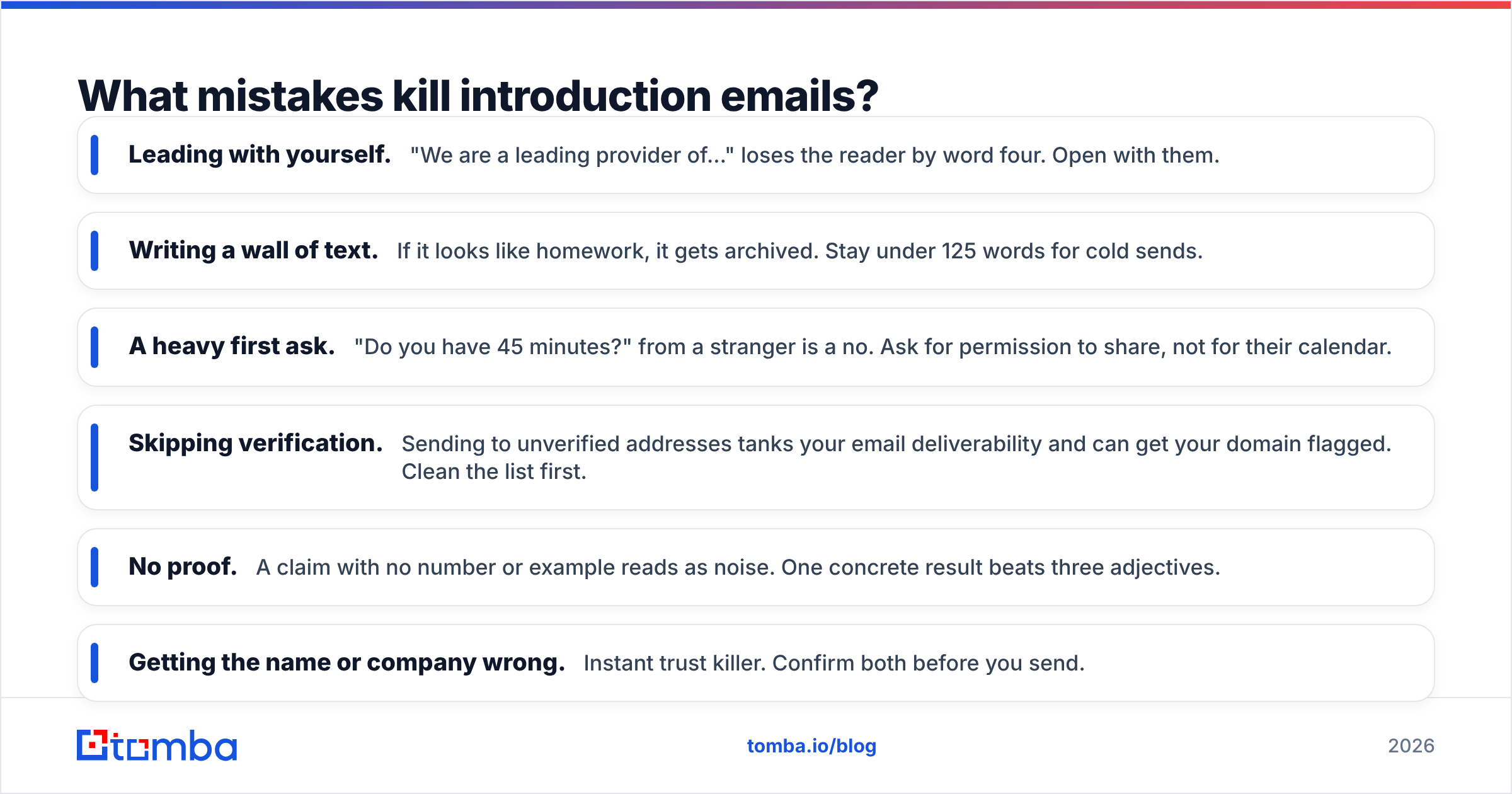
What mistakes kill introduction emails?#
Most failed intros share a short list of avoidable errors. Run your draft against this checklist before hitting send:
- Leading with yourself. "We are a leading provider of…" loses the reader by word four. Open with them.
- Writing a wall of text. If it looks like homework, it gets archived. Stay under 125 words for cold sends.
- A heavy first ask. "Do you have 45 minutes?" from a stranger is a no. Ask for permission to share, not for their calendar.
- Skipping verification. Sending to unverified addresses tanks your email deliverability and can get your domain flagged. Clean the list first.
- No proof. A claim with no number or example reads as noise. One concrete result beats three adjectives.
- Getting the name or company wrong. Instant trust killer. Confirm both before you send.
That fourth point matters more than most people realize. Every hard bounce chips away at your sender reputation, and once mailbox providers start distrusting your domain, even your good emails land in spam. Treat list hygiene as part of writing the email, not an afterthought.
Should you use AI to write introduction emails?#
AI is a strong first-draft tool and a weak final-draft tool. Use it to beat the blank page, then edit hard for specificity — because the one thing AI cannot invent is the true, researched detail that proves you actually know the recipient.
A practical workflow:
- Draft the skeleton with an assistant like a cold email AI writer.
- Replace every generic phrase with a real, researched detail — a recent launch, a specific role, a number.
- Verify the contact and the address so your personalized message actually arrives.
- Read it aloud. If it sounds like a press release, rewrite the opener.
The tools handle speed; you handle truth. That division of labor is what keeps AI-assisted outreach from sounding like every other AI-assisted outreach in the inbox.
How Tomba fits into your introduction email workflow#
An introduction email is only as good as the contact behind it. You can write the sharpest opener in the world, but if it goes to info@ instead of the actual decision-maker — or bounces entirely — none of the craft matters.
The Tomba Email Finder closes that gap: search by domain, name, or company to surface the right professional email, confirm it is deliverable, and enrich the contact with role and company data so your personalization is grounded in fact rather than guesswork. Plans start free with 25 searches a month and scale to $49/mo Starter and $99/mo Growth as your volume grows — see full Tomba pricing for the details.
Write the email like a human. Find and verify the contact like a professional. That combination is what turns a company introduction email from a shot in the dark into a conversation that starts.
For deeper reading on outreach mechanics, HubSpot's sales email guide and reviews on G2 are solid, vendor-neutral starting points.
Related guides#
Ready to find emails that actually work?
Join 150,000+ professionals who stopped guessing and started sending. Free credits on signup — no credit card required.
Get the Tomba newsletter
Practical outbound tactics and product updates — once every two weeks.
About the author