How to Write a Company Introduction Email to Client (+ Templates)
A company introduction email to client only works if it earns a reply. Here's the exact structure, subject lines, and 7 copy-ready templates that get responses in 2026.
You have one shot to introduce your company to a prospect, and most people waste it on a wall of text about themselves. A good company introduction email to client contacts does the opposite: it opens with them, proves you did your homework, and asks for one small next step. That's it.
This guide breaks down the exact structure, the subject lines that get opened, and seven templates you can copy and adapt today.
TL;DR#
- A company introduction email to client should be about the client, not your company history — lead with their problem, not your founding date.
- Keep it under 150 words, use one clear call to action, and never attach a 12-slide deck to a cold intro.
- Personalization beats volume: a targeted, verified send outperforms a generic blast every time.
- Your subject line decides whether the rest gets read — test short, specific, curiosity-driven lines.
- Reaching the right inbox matters as much as the copy; a wrong or dead email address kills your best sentence before anyone reads it.
What is a company introduction email to client?#
A company introduction email to client is the first message you send to a prospect, partner, or new account to open a relationship. Think of it like a handshake at a networking event: you have a few seconds to signal who you are, why you're relevant to them, and whether you're worth another minute.
There are two common flavors, and they are not the same:
- Cold introduction — the recipient has never heard of you. You need permission-to-continue in every line.
- Warm introduction — you were referred, met at an event, or the prospect downloaded something. You can skip more of the throat-clearing.
The mistake almost everyone makes is treating the intro as an "About Us" page. Nobody replies to a company biography. They reply when they see themselves in the first two sentences.
Why do most company introduction emails get ignored?#
Because they break the reader's trust in the first line. Here are the four failure patterns that show up in almost every ignored intro:
- It opens with "I". "I'm reaching out because our company was founded in 2011 and specializes in..." The reader's brain checks out. Open with you, not I.
- It asks for too much. A cold intro that ends in "Can we book a 45-minute demo Thursday?" is a marriage proposal on a first date.
- It's generic. If you could paste any company name into the email and it still makes sense, it's a mass blast, and it reads like one.
- It never reaches a real person. Even a perfect email fails if it lands in a catch-all, a former employee's mailbox, or the spam folder.
That last point is the quiet killer. You can obsess over copy for an hour and still get zero replies because the address bounced or the message never cleared the spam filter. Getting the fundamentals of email deliverability right is not optional — it's the price of entry.
What should a company introduction email to client include?#
Every strong intro has the same six ingredients, in roughly this order. Skip one and the email gets weaker.
- A specific subject line — short, relevant, and never clickbait you can't back up.
- A personalized opener — one sentence that proves this email was written for them.
- A one-line company positioning — who you help and the outcome you drive, not your feature list.
- Proof or relevance — a client result, a shared connection, or a trigger event (funding, hire, product launch).
- One clear call to action — a single, low-friction ask (a reply, a quick question, a resource).
- A clean signature — name, role, company, and one link. No banner overload.
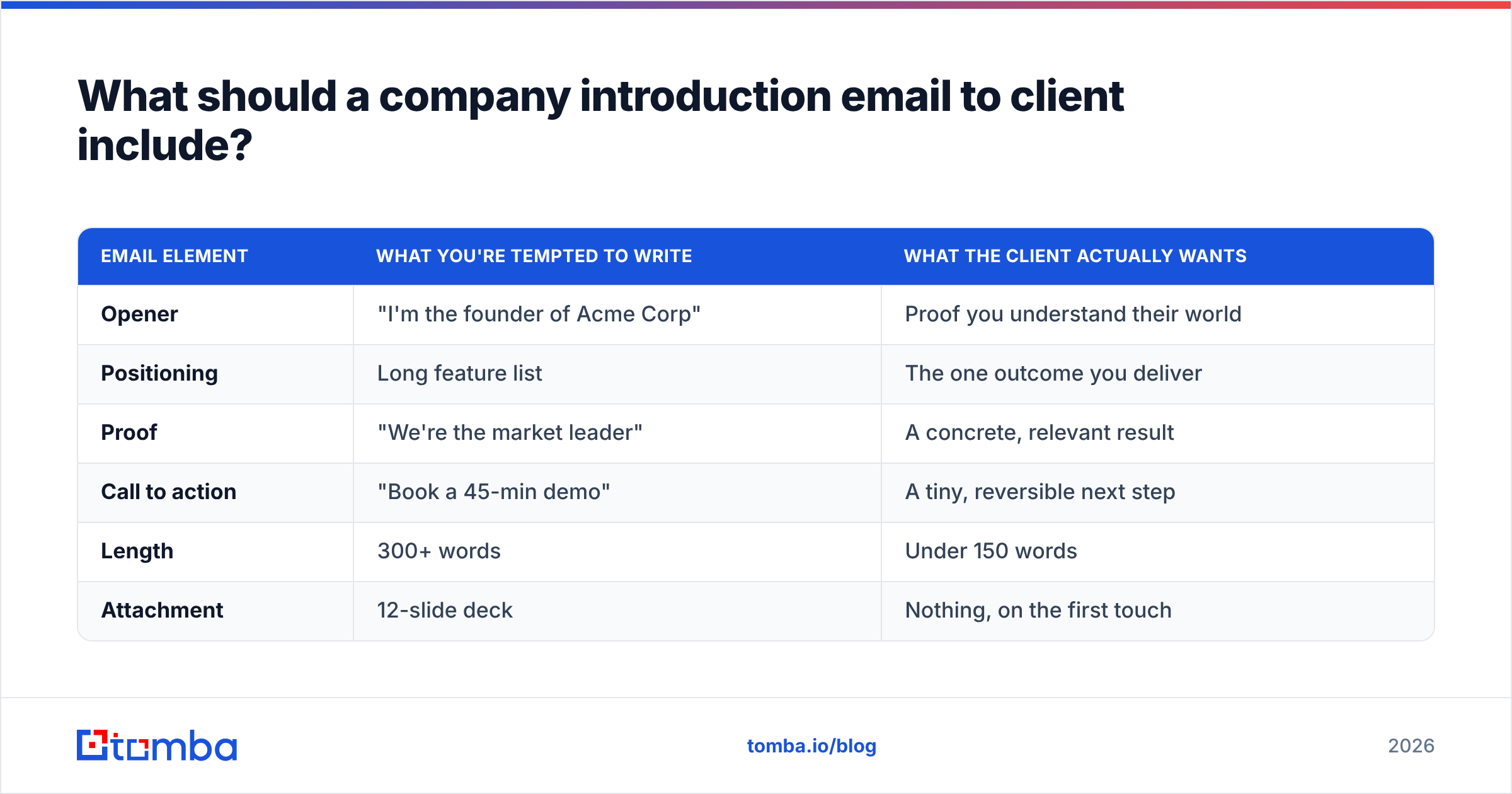
Here's how those pieces map to what the reader actually cares about:
| Email element | What you're tempted to write | What the client actually wants |
|---|---|---|
| Opener | "I'm the founder of Acme Corp" | Proof you understand their world |
| Positioning | Long feature list | The one outcome you deliver |
| Proof | "We're the market leader" | A concrete, relevant result |
| Call to action | "Book a 45-min demo" | A tiny, reversible next step |
| Length | 300+ words | Under 150 words |
| Attachment | 12-slide deck | Nothing, on the first touch |
Keep this table taped to your monitor. Most weak intros lose on three or more of these rows at once.
How do you structure the perfect company introduction email?#
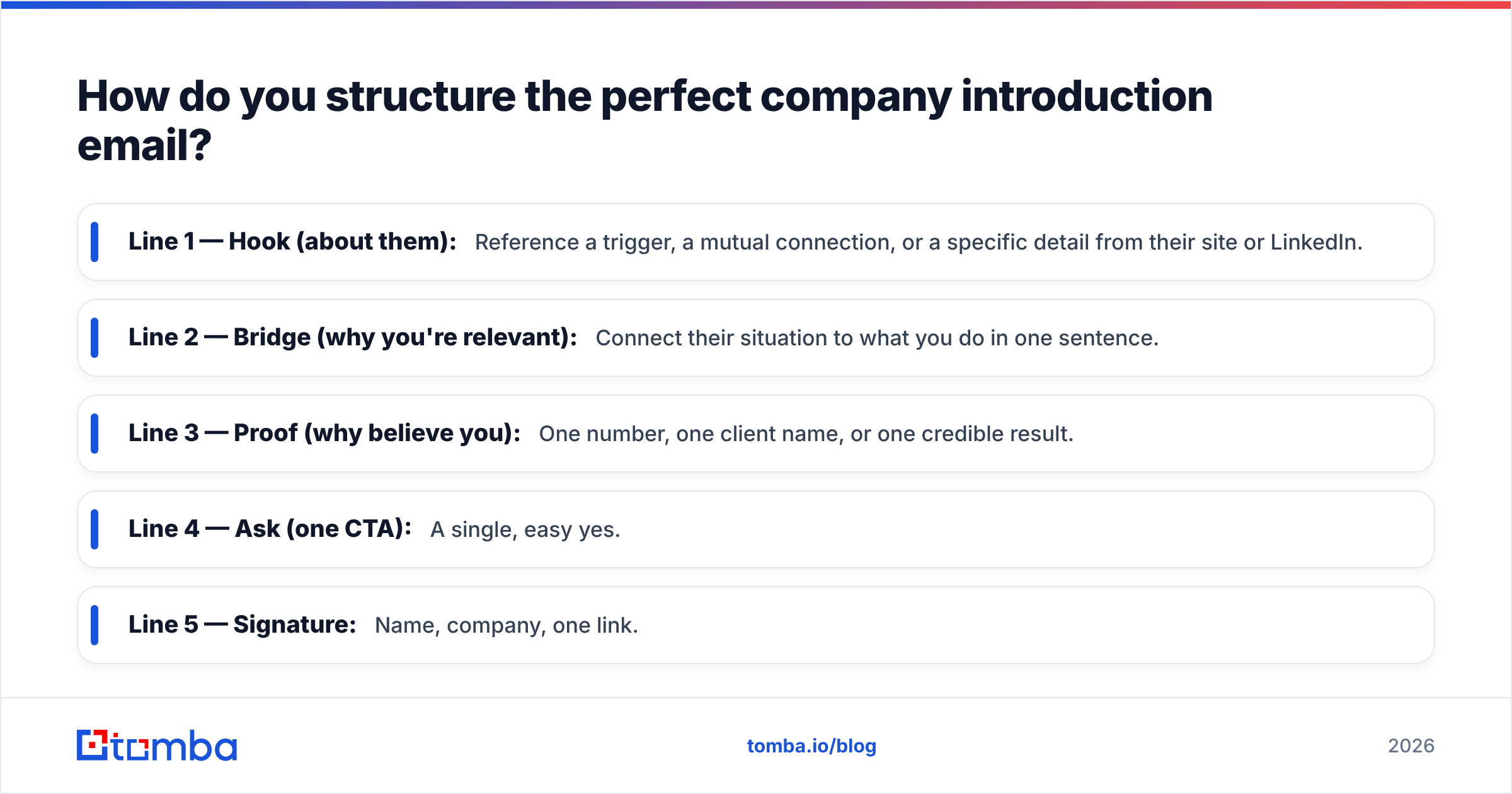
Use this five-line skeleton. It scales from cold outreach to a warm referral with minor edits.
- Line 1 — Hook (about them): Reference a trigger, a mutual connection, or a specific detail from their site or LinkedIn.
- Line 2 — Bridge (why you're relevant): Connect their situation to what you do in one sentence.
- Line 3 — Proof (why believe you): One number, one client name, or one credible result.
- Line 4 — Ask (one CTA): A single, easy yes.
- Line 5 — Signature: Name, company, one link.
Notice the ratio: four of five lines are about the reader or the value to them, and only one is a request. That balance is what separates a message that gets a reply from one that gets archived.
If you want to sharpen the wording before you hit send, tools like a subject line tester and a spam checker catch the obvious mistakes — trigger words, weak subjects, and formatting that flags filters — before your prospect ever sees them.
What are the best company introduction email templates?#
Here are seven templates. Swap the brackets, keep them short, and resist the urge to add a paragraph about your company's mission statement.
1. Cold intro (trigger-based)#
Subject: Congrats on the [Series B]
Hi [First name],
Saw [Company] just closed [Series B] — congrats. Teams at this stage usually hit a wall scaling [specific process].
We help [similar companies] cut that ramp time, e.g. [Client] shortened theirs by [X%].
Worth a quick reply to see if it's relevant to you?
[Your name], [Company]
2. Warm intro (referral)#
Subject: [Mutual contact] suggested I reach out
Hi [First name],
[Mutual contact] mentioned you're looking at [problem]. That's exactly what we do for [type of company].
Happy to share how [Client] handled the same thing — is that useful?
[Your name], [Company]
3. New-account welcome#
Subject: Welcome aboard — quick intro
Hi [First name],
I'll be your main point of contact at [Company]. My job is simple: make sure you hit [their goal] fast.
What's the one outcome you'd call a win in the first 30 days?
[Your name], [Company]
4. Event follow-up#
Subject: Following up from [Event]
Hi [First name],
Great chatting at [Event] about [topic]. You mentioned [specific challenge] — we've helped a few teams solve exactly that.
Want me to send the short case study?
[Your name], [Company]
5. Partnership intro#
Subject: Idea for [Company] + [Your company]
Hi [First name],
Our audiences overlap and don't compete. I think a [co-marketing / integration] play could work well for both sides.
Open to a 15-minute call to explore it?
[Your name], [Company]
6. Re-engagement intro#
Subject: Picking this back up
Hi [First name],
We spoke last year about [topic] and the timing wasn't right. Since then we've [new capability].
Is [problem] back on your radar for this quarter?
[Your name], [Company]
7. Value-first intro (no ask)#
Subject: A resource for your [team/goal]
Hi [First name],
No pitch — I put together [resource] on [topic] and thought your team might find it useful given [context].
Here it is: [link]. Reply if you'd like the extended version.
[Your name], [Company]
Want more ready-made copy? Browse a full library of cold email templates you can adapt to any stage of the funnel.

How do you personalize at scale without sounding like a robot?#
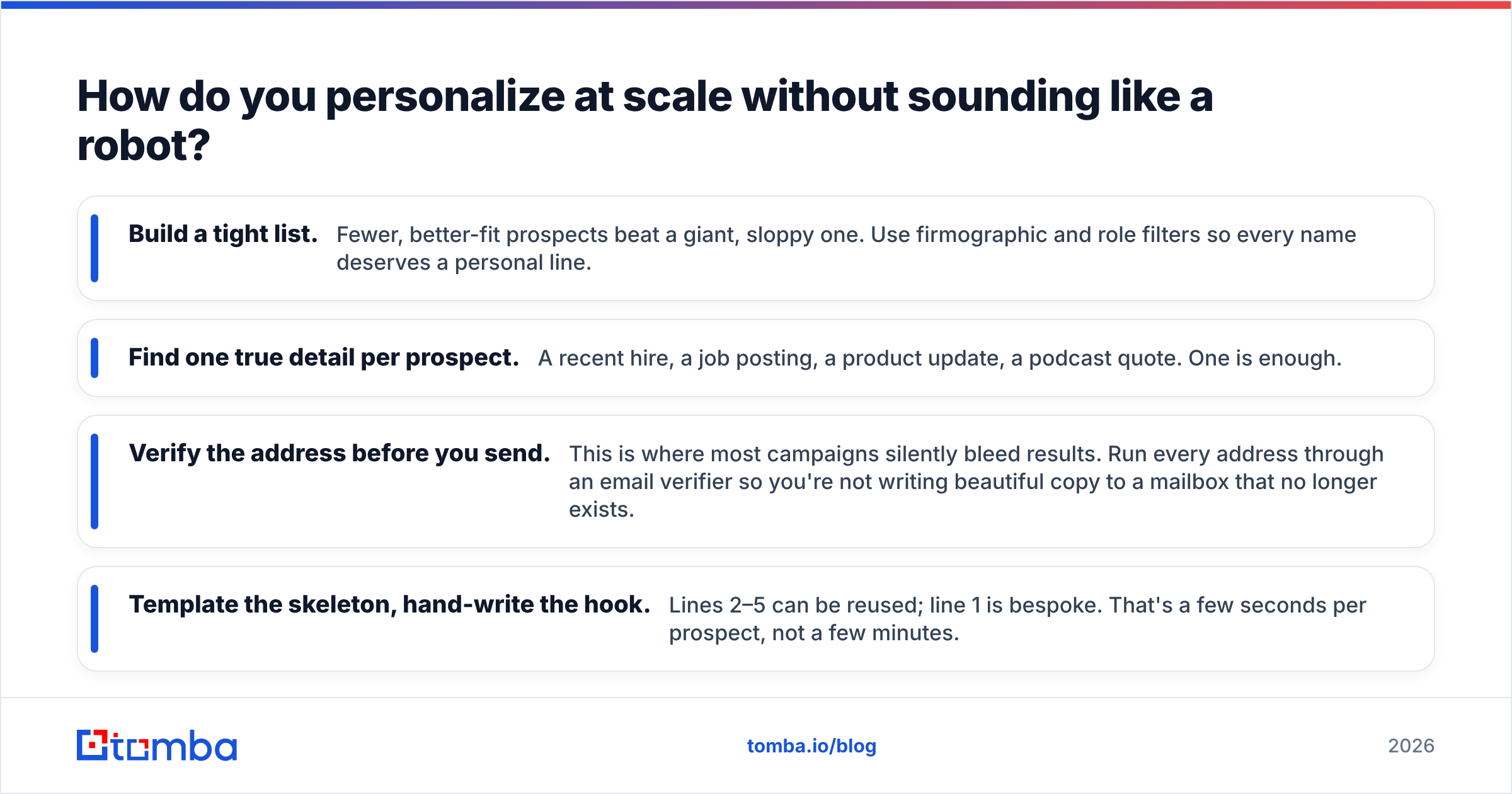
You batch the research, not the writing. The trick is to standardize your structure and vary only the two lines that need to be human: the hook and the proof.
A practical workflow looks like this:
- Build a tight list. Fewer, better-fit prospects beat a giant, sloppy one. Use firmographic and role filters so every name deserves a personal line.
- Find one true detail per prospect. A recent hire, a job posting, a product update, a podcast quote. One is enough.
- Verify the address before you send. This is where most campaigns silently bleed results. Run every address through an email verifier so you're not writing beautiful copy to a mailbox that no longer exists.
- Template the skeleton, hand-write the hook. Lines 2–5 can be reused; line 1 is bespoke. That's a few seconds per prospect, not a few minutes.
If you're sending in volume, source and confirm contacts in one pass with a bulk email finder rather than copy-pasting addresses one at a time. The goal is simple: a targeted list where the copy and the delivery both hold up.
Cold vs. warm intros: which performs better?#
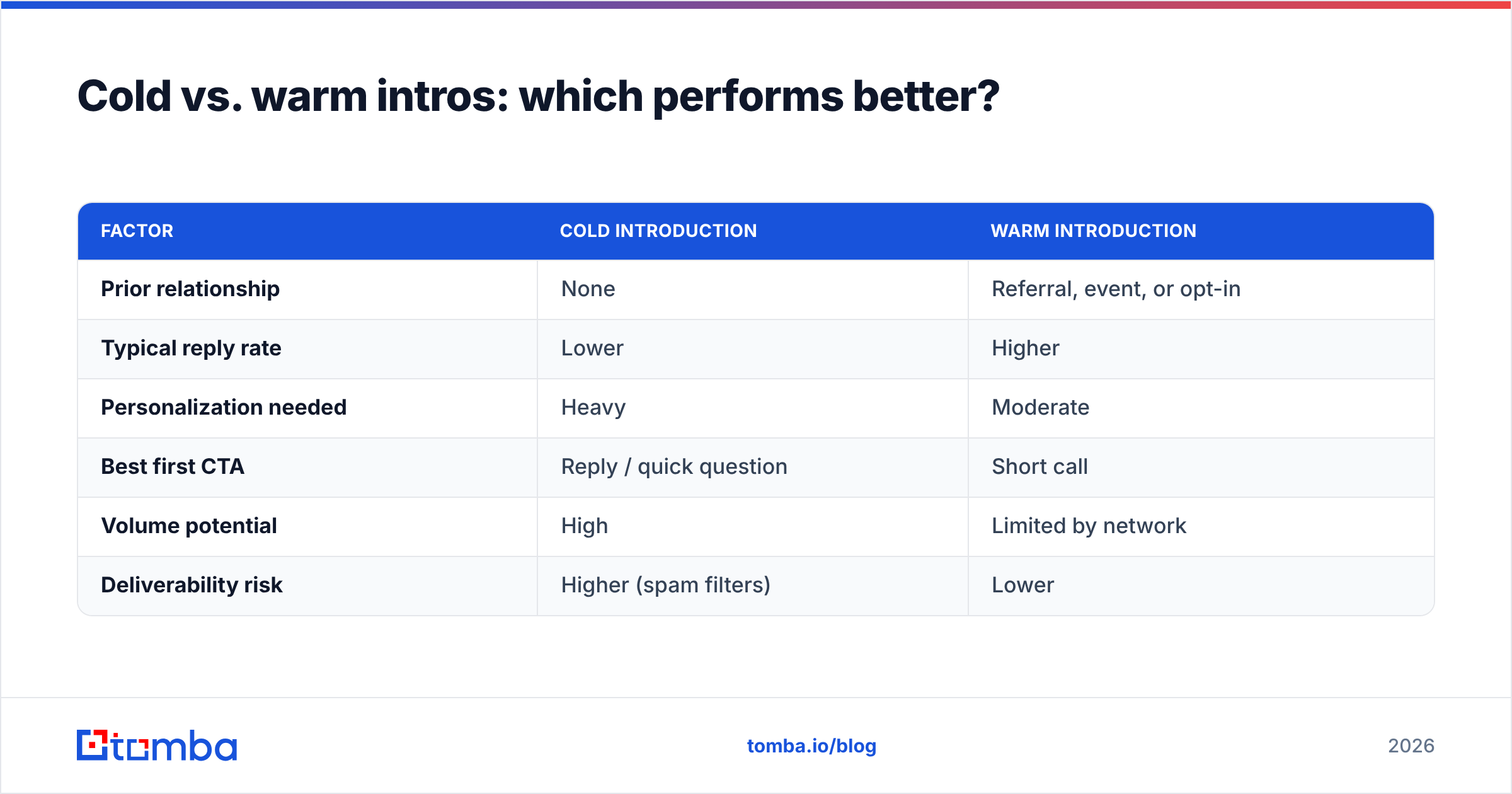
Warm wins on reply rate, cold wins on reach. You need both, and you should track them separately so you don't judge a cold campaign by warm-intro standards.
| Factor | Cold introduction | Warm introduction |
|---|---|---|
| Prior relationship | None | Referral, event, or opt-in |
| Typical reply rate | Lower | Higher |
| Personalization needed | Heavy | Moderate |
| Best first CTA | Reply / quick question | Short call |
| Volume potential | High | Limited by network |
| Deliverability risk | Higher (spam filters) | Lower |
The takeaway: don't copy a warm-intro CTA ("Grab time on my calendar") into a cold email. Cold audiences need a smaller ask because they owe you nothing yet. According to HubSpot's research on email outreach, personalization and relevance consistently move reply rates more than volume does — which is exactly why the list and the hook matter more than the send count.
What mistakes should you avoid?#
A quick checklist before you hit send:
- No unverified sends. Bounces wreck your sender reputation and drag future emails into spam. Clean the list first.
- No walls of text. If it doesn't fit on a phone screen without scrolling twice, cut it.
- No double CTA. "Reply, or book a call, or download this" gives the reader three reasons to do nothing.
- No attachments on cold touches. They trip spam filters and rarely get opened.
- No fake urgency. "Last chance" on a first email destroys trust instantly.
- No mismatched subject and body. The subject sets an expectation; the body has to pay it off. If you want independent benchmarks on what deliverability tooling costs and delivers, G2's category listings are a neutral place to compare.
Fix those six and you're already ahead of most of the intros sitting unread in your prospects' inboxes.
The bottom line#
A great company introduction email to client contacts is short, specific, and built around one small ask — and it only works if it actually lands in the right inbox. Nail the structure, personalize the hook, verify the address, and keep the CTA tiny.
Before you write your next intro, make sure you're reaching real, current contacts. Use the Tomba Email Finder to find verified professional email addresses by name, company, or domain, so the copy you worked hard on gets read by the person who can actually say yes. Check the Tomba pricing plans — including a free tier to test it — and turn your best-written intro into replies instead of bounces.
Related guides#
Ready to find emails that actually work?
Join 150,000+ professionals who stopped guessing and started sending. Free credits on signup — no credit card required.
Get the Tomba newsletter
Practical outbound tactics and product updates — once every two weeks.
About the author