Company Scoring in 2026: How to Rank Accounts by Real Fit
Company scoring ranks target accounts by fit and intent so your reps chase revenue, not noise. Here's how to build a model that actually works in 2026.
Company scoring is the difference between a sales team that works every account equally and one that spends its hours where revenue actually lives. If your reps still pick accounts by gut feel, alphabetical order, or whoever shouted loudest in the last pipeline meeting, you are leaving money on the table.
This guide breaks down what company scoring is, which signals matter in 2026, how to build a model without a data-science team, and where enrichment fits in.
TL;DR#
- Company scoring ranks target accounts by how well they fit your ideal customer profile (fit) and how likely they are to buy now (intent), so reps work the best accounts first.
- A good model blends firmographics, technographics, behavioral signals, and data quality — not just company size.
- You do not need machine learning to start. A weighted point system in a spreadsheet or CRM beats gut feel every time.
- Garbage in, garbage out: scores are only as good as the underlying company data. Enrichment and verification are non-negotiable.
- Start simple, validate against closed-won deals, and refine quarterly. A stale model is worse than none.
What is company scoring?#
Company scoring is a system for assigning a numeric value to each target account based on how closely it matches your best customers and how ready it looks to buy. Think of it like a credit score, but for revenue potential: instead of predicting whether someone will repay a loan, you are predicting whether an account will become a paying, profitable customer.
It is often confused with lead scoring, but the two operate at different levels. Lead scoring grades individual people; company scoring — sometimes called account scoring — grades the whole organization. In an account-based world, the company is the unit that matters, because you are selling to a buying committee, not a single inbox.
A company score usually combines two dimensions:
- Fit — Does this account look like your ideal customer? (industry, size, region, tech stack, budget)
- Intent — Is this account showing buying behavior right now? (site visits, content downloads, hiring signals, funding events)
Multiply or stack those two, and you get a single number that tells a rep where to spend the next hour.

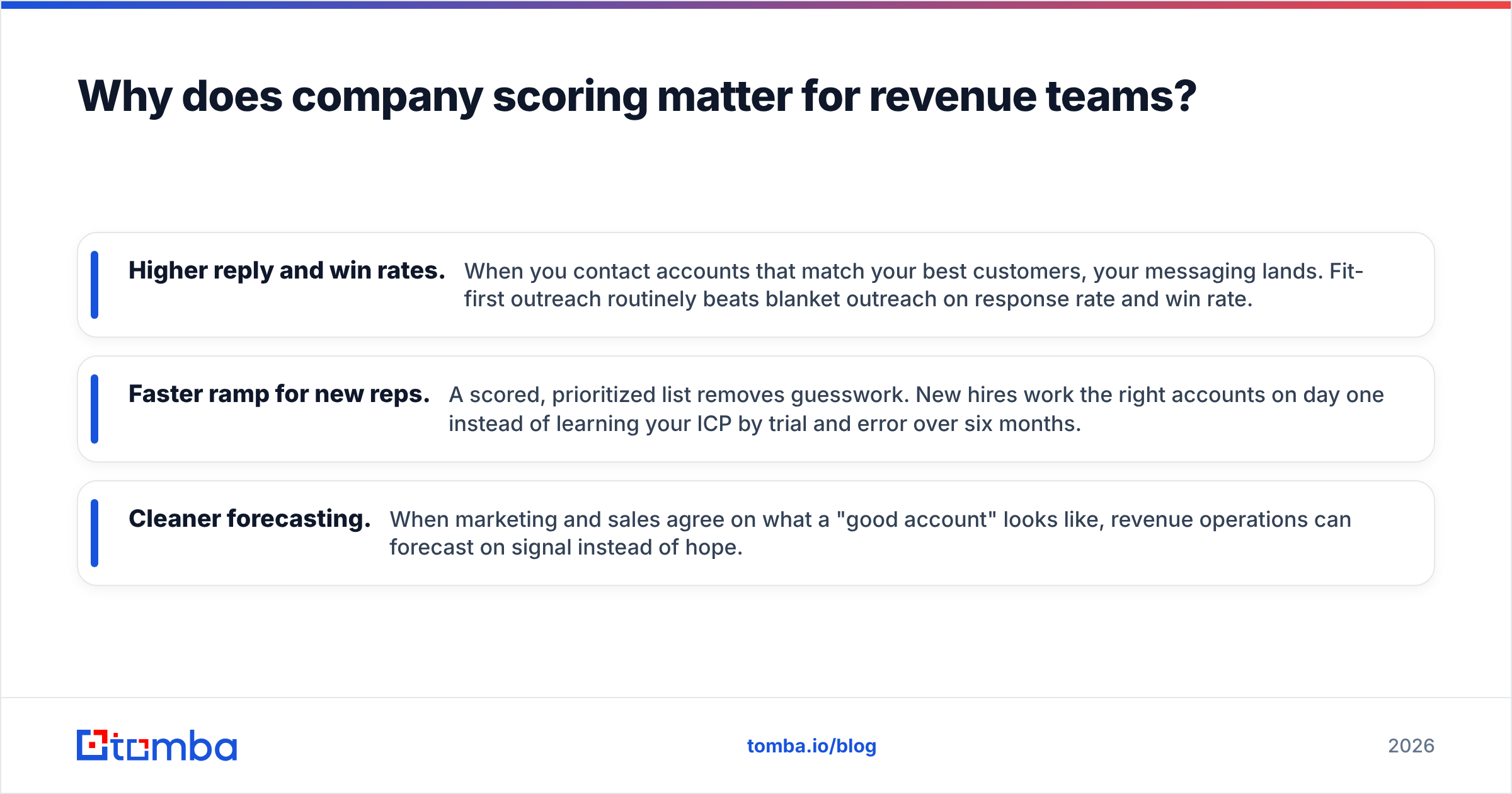
Why does company scoring matter for revenue teams?#
Because attention is your scarcest resource. A typical SDR can meaningfully work maybe 40–60 accounts a week. If 30% of your total addressable market will never buy — wrong size, wrong region, no budget — every hour spent there is pure waste.
The payoff shows up in three places:
- Higher reply and win rates. When you contact accounts that match your best customers, your messaging lands. Fit-first outreach routinely beats blanket outreach on response rate and win rate.
- Faster ramp for new reps. A scored, prioritized list removes guesswork. New hires work the right accounts on day one instead of learning your ICP by trial and error over six months.
- Cleaner forecasting. When marketing and sales agree on what a "good account" looks like, revenue operations can forecast on signal instead of hope.
According to research from Gartner, B2B buyers spend only a small fraction of their journey talking to any single vendor — which means the accounts you pick to pursue matter more than ever. Pick wrong, and you never even enter the consideration set.
What signals go into a company score?#
The best models blend four signal categories. Weight them by how predictive they are for your business, not by what a template says.
1. Firmographics (the baseline)#
These are the static facts about a company:
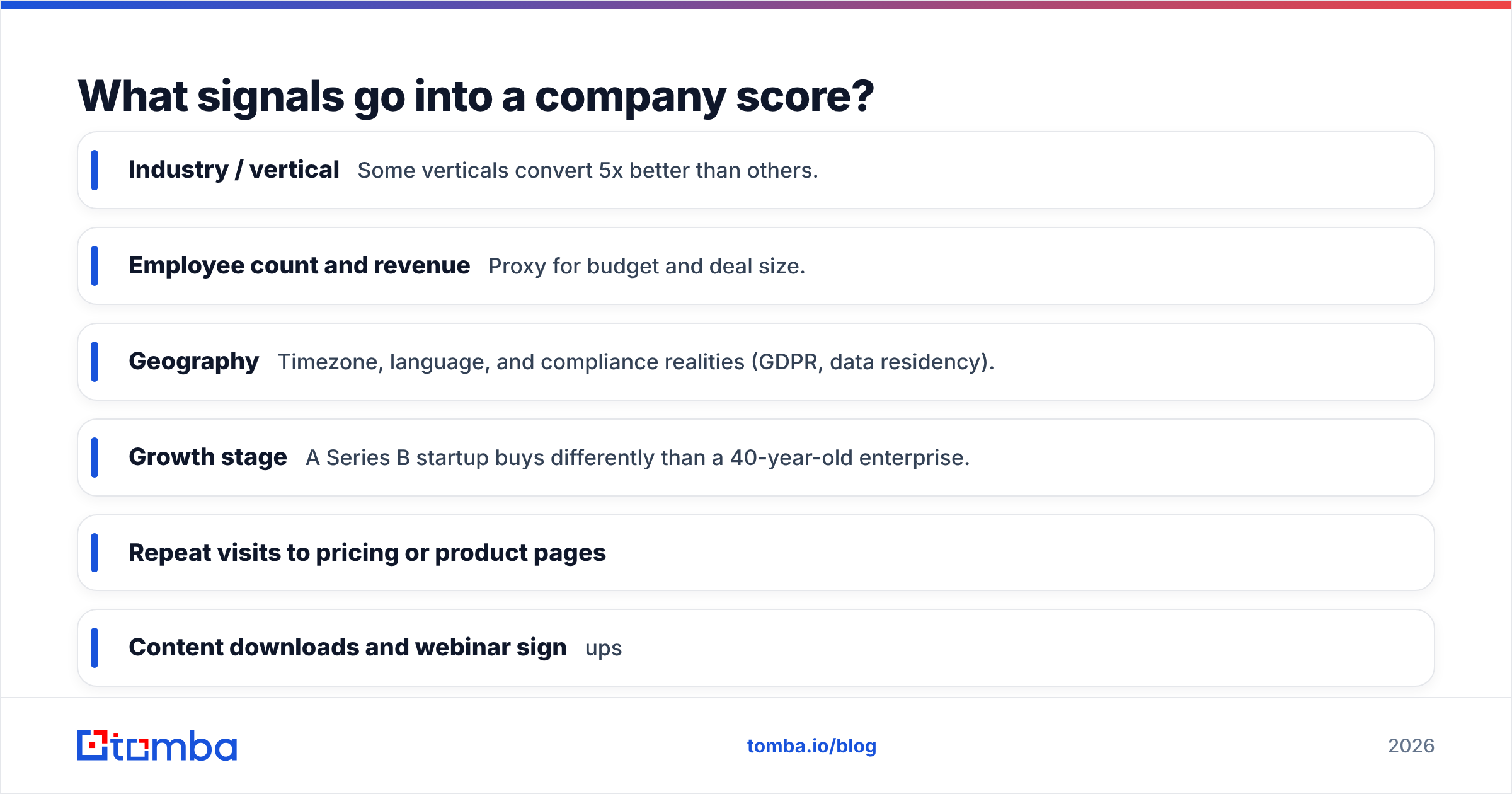
- Industry / vertical — Some verticals convert 5x better than others.
- Employee count and revenue — Proxy for budget and deal size.
- Geography — Timezone, language, and compliance realities (GDPR, data residency).
- Growth stage — A Series B startup buys differently than a 40-year-old enterprise.
2. Technographics (the fit multiplier)#
What a company runs tells you whether you can integrate — and whether they buy tools like yours at all. If you sell a Salesforce app, an account on HubSpot may score lower. A quick website tech stack check surfaces this cheaply.
3. Behavioral / intent signals (the timing layer)#
- Repeat visits to pricing or product pages
- Content downloads and webinar sign-ups
- Job postings that hint at a new initiative (hiring 5 data engineers = a data project)
- Funding rounds, leadership changes, expansion news
4. Data quality (the silent killer)#
An account can look perfect on paper and still be worthless if you cannot reach a real decision-maker. Coverage of verified emails, direct dials, and a mapped buying committee should factor into the score. This is where most homemade models quietly fail.
How do you build a company scoring model?#
You can ship a working model this week. Here is a five-step path that does not require a data scientist.
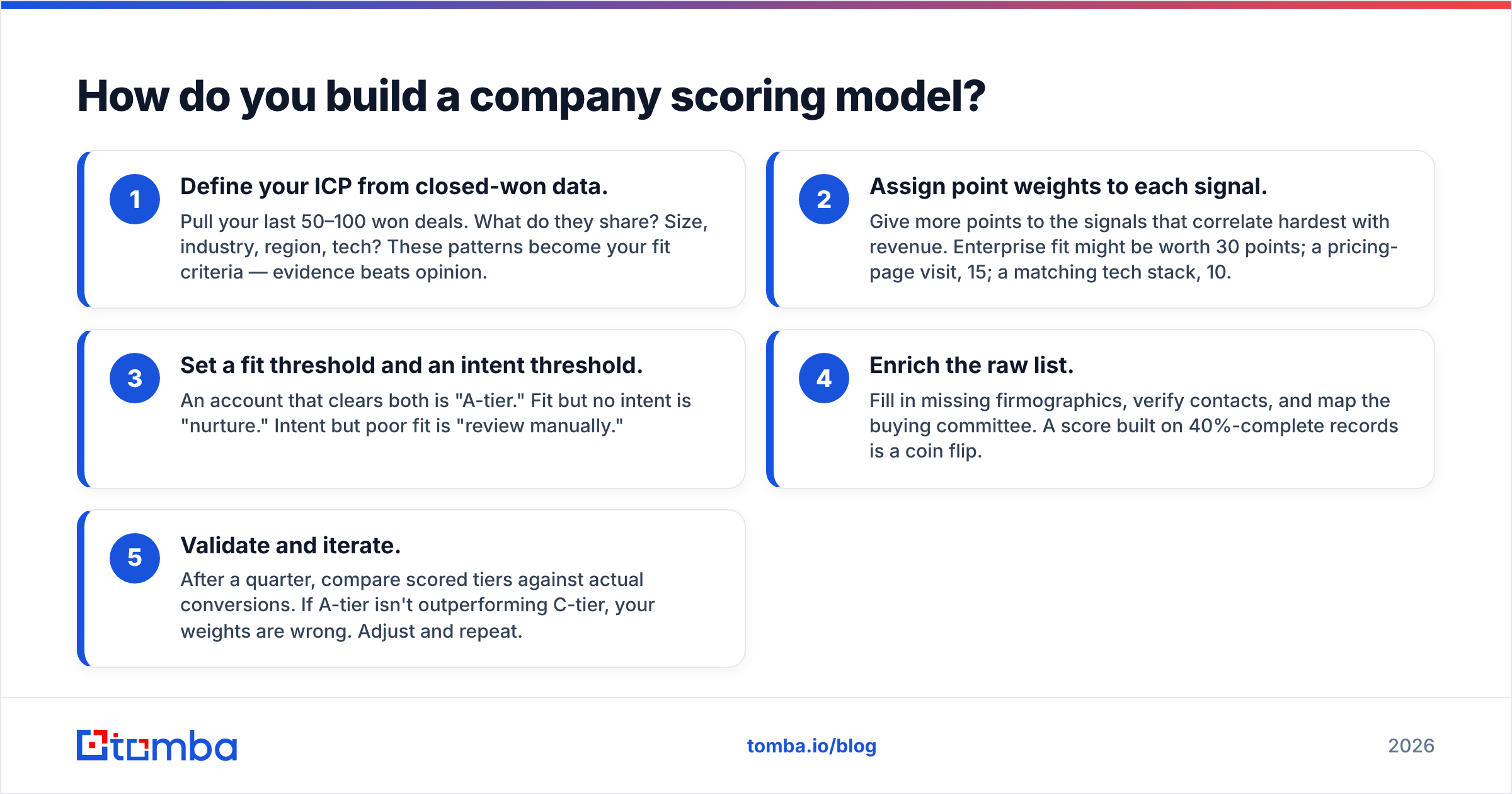
- Define your ICP from closed-won data. Pull your last 50–100 won deals. What do they share? Size, industry, region, tech? These patterns become your fit criteria — evidence beats opinion.
- Assign point weights to each signal. Give more points to the signals that correlate hardest with revenue. Enterprise fit might be worth 30 points; a pricing-page visit, 15; a matching tech stack, 10.
- Set a fit threshold and an intent threshold. An account that clears both is "A-tier." Fit but no intent is "nurture." Intent but poor fit is "review manually."
- Enrich the raw list. Fill in missing firmographics, verify contacts, and map the buying committee. A score built on 40%-complete records is a coin flip.
- Validate and iterate. After a quarter, compare scored tiers against actual conversions. If A-tier isn't outperforming C-tier, your weights are wrong. Adjust and repeat.

Manual scoring vs. automated scoring: which should you use?#
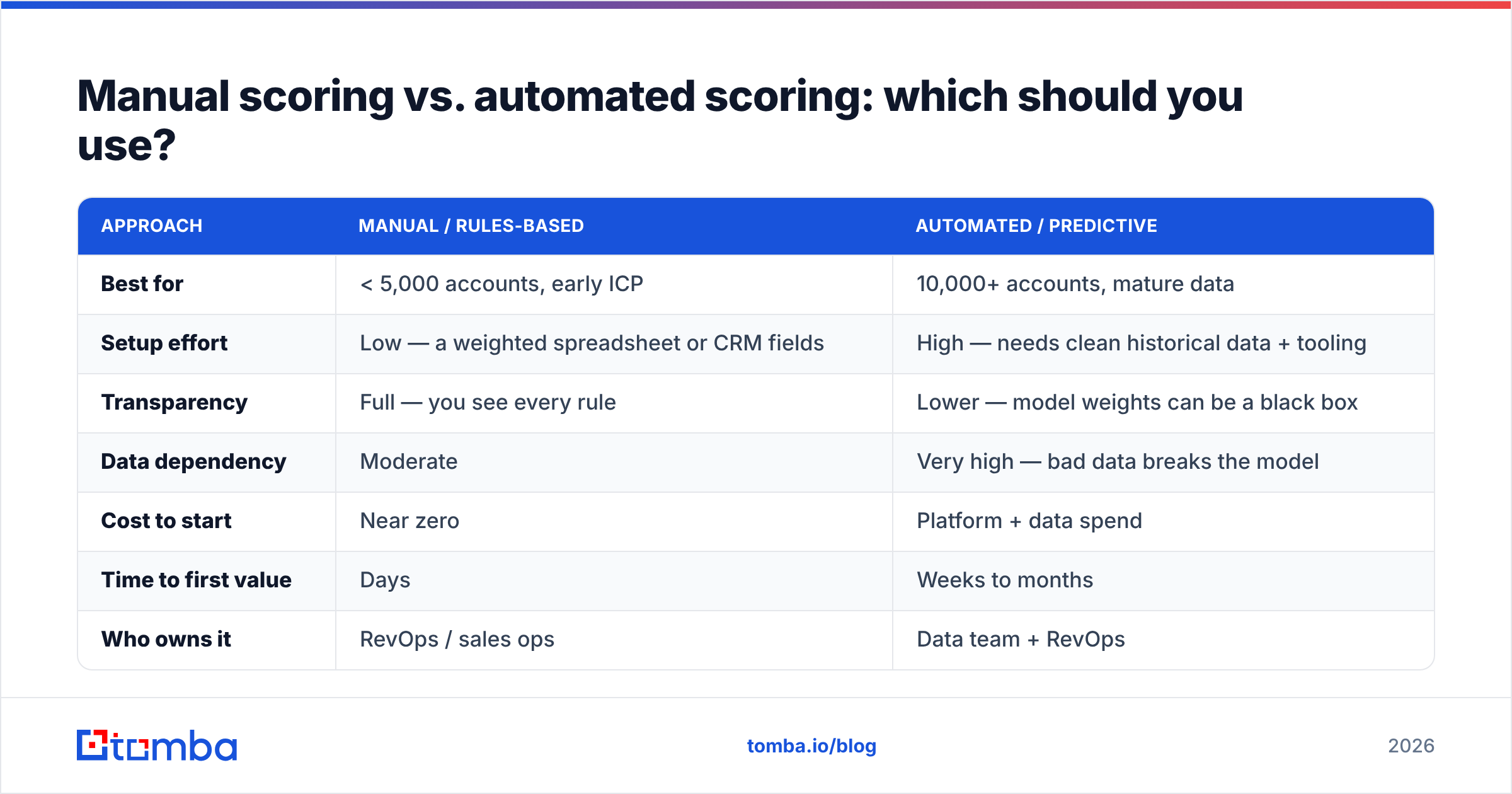
Most teams start manual and graduate to automation as volume grows. Neither is "right" — it depends on your list size, data maturity, and headcount.
| Approach | Manual / Rules-Based | Automated / Predictive |
|---|---|---|
| Best for | < 5,000 accounts, early ICP | 10,000+ accounts, mature data |
| Setup effort | Low — a weighted spreadsheet or CRM fields | High — needs clean historical data + tooling |
| Transparency | Full — you see every rule | Lower — model weights can be a black box |
| Data dependency | Moderate | Very high — bad data breaks the model |
| Cost to start | Near zero | Platform + data spend |
| Time to first value | Days | Weeks to months |
| Who owns it | RevOps / sales ops | Data team + RevOps |
The honest takeaway: a transparent rules-based model that everyone trusts and actually uses beats a fancy predictive model that reps ignore because they cannot explain the score to their manager.
How does data quality make or break your score?#
Your score is a math problem, and every input is a variable. If half the variables are blank, wrong, or stale, the output is noise dressed up as precision — and reps stop trusting it fast. Research summarized by outlets like HubSpot consistently shows B2B contact data decaying every year as people change jobs, companies rebrand, and domains shift.
Two failure modes dominate:
- Missing firmographics. You cannot score industry, size, or tech if the field is empty. Data enrichment fills these gaps automatically so every account carries the same attributes.
- Unreachable contacts. A high-scoring account you cannot email is a dead end. Running addresses through an email verifier before scoring keeps unreachable accounts from crowding out reachable ones.
This is where Tomba fits into a scoring workflow without any hard sell needed. Use domain search to pull every reachable contact at a target company, verify them, and enrich each account's firmographics — so the score reflects reality, not a half-filled CRM row. The B2B database and enrichment layer give the model complete, verified inputs to work with.
What tools support company scoring in 2026?#
You do not need a single monster platform. A practical stack has three layers:
- A data / enrichment layer to complete and verify account records (this is the foundation — score nothing until it is solid).
- A scoring engine, which can be your CRM's native scoring, a RevOps spreadsheet, or a dedicated predictive tool.
- An activation layer — the sequencer or dialer that turns scored accounts into outreach.
When you compare options on a review site like G2, weigh them on data coverage and integration depth, not just the scoring UI. The prettiest score dashboard is worthless if the data underneath is thin. If you are already running an ABM or enrichment platform, check what scoring it exposes natively before buying yet another tool — you may be able to consolidate.
What mistakes should you avoid?#
- Scoring on size alone. "Big = good" ignores fit. A 10,000-person company that will never use your product should not outrank a perfect-fit 200-person one.
- Never revisiting weights. Markets move. A model tuned in 2024 may be scoring for a buyer who no longer exists. Review quarterly.
- Ignoring negative signals. A competitor's tech in the stack, a recent layoff, or a compliance mismatch should subtract points. Most models only add.
- Scoring before enriching. The single most common failure. Complete the data first, then score.
- Building a black box. If reps cannot understand why an account scores high, they will override it. Keep it explainable.
Frequently asked questions#
Is company scoring the same as lead scoring? No. Lead scoring grades individual people; company scoring grades the whole account. In account-based selling, the company score usually drives prioritization, while lead scoring helps you find the right person inside a high-scoring account.
How many signals should a company score use? Start with 5–8 high-signal attributes. More is not better — extra low-predictive fields add noise and make the model harder to trust. Add complexity only after the simple version proves itself.
Do I need AI or machine learning for company scoring? No. A transparent, weighted rules model in your CRM or a spreadsheet works well up to several thousand accounts. Move to predictive models only when you have clean historical data and enough volume to train on.
How often should I refresh scores? Firmographic fit changes slowly (quarterly is fine), but intent signals and contact data decay fast — refresh those monthly, and re-verify contacts before any major campaign.
Put a real score behind every account#
Company scoring only works when the data underneath it is complete and verified — otherwise you are ranking accounts on guesses. Start by making sure every target account has full firmographics and reachable, validated contacts before a single point gets assigned.
Use the Tomba Email Finder to pull verified, reachable contacts at every account on your list, then enrich each record so your scoring model runs on facts instead of blanks. The free tier gives you 25 searches a month to test it against your own ICP — build the model, feed it clean data, and send your reps to the accounts that actually close.
Related guides#
Ready to find emails that actually work?
Join 150,000+ professionals who stopped guessing and started sending. Free credits on signup — no credit card required.
Get the Tomba newsletter
Practical outbound tactics and product updates — once every two weeks.
About the author