How to Write a Company Visit Request Email (2026 Guide)
A company visit request email only works if it respects the reader's time and makes saying yes easy. Here are six copy-paste templates, subject lines, and follow-ups that actually get scheduled.
You found the perfect company to tour, partner with, or learn from. Now one email stands between you and a calendar invite. Most people get this wrong: they write three paragraphs about themselves, bury the ask, and wonder why nobody replies.
A company visit request email is a small piece of writing with an outsized job. It has to explain who you are, why you want to visit, what the host gets out of it, and exactly when — all before the reader loses interest. Do it well and you get a "sure, how about Thursday?" Do it badly and you get silence.
This guide breaks down the structure, gives you six templates for the most common scenarios, and shows you how to make sure the message actually lands in the right inbox.
TL;DR#
- A company visit request email should state who you are, the specific reason for visiting, the value for the host, and two or three concrete date options — in under 150 words.
- Lead with the reader's benefit, not your own agenda. Vague asks ("I'd love to connect sometime") get ignored.
- Subject lines that name a purpose and a timeframe outperform generic ones by a wide margin.
- Always send to a verified, correct address — a polished email to a bounced inbox is wasted effort.
- Follow up once after 3–4 business days. One well-timed nudge recovers a large share of non-responses.
What is a company visit request email?#
A company visit request email is a short, purpose-driven message asking to meet a business in person — at their office, factory, showroom, or event booth. Think of it as knocking on a door: you would not walk into a stranger's building and start monologuing, so your email should introduce yourself, state your business, and get to the point quickly.
People send these for a lot of reasons: a student arranging an industry tour, a sales rep requesting an on-site demo, a journalist scheduling a facility walkthrough, a supplier proposing a partnership meeting, or a job seeker asking to shadow a team. The scenario changes, but the anatomy stays the same.
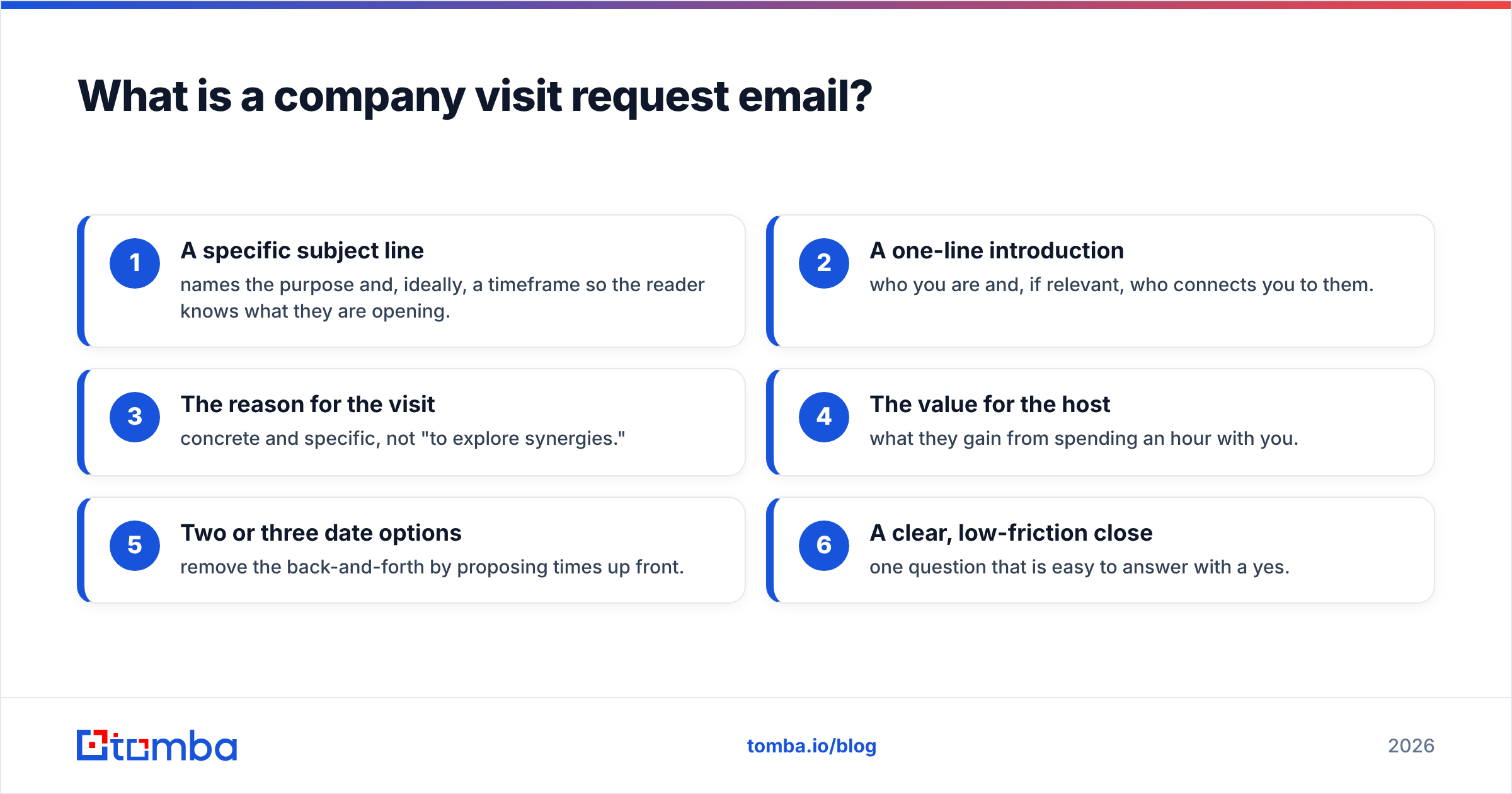
Here are the six building blocks every strong request contains:
- A specific subject line — names the purpose and, ideally, a timeframe so the reader knows what they are opening.
- A one-line introduction — who you are and, if relevant, who connects you to them.
- The reason for the visit — concrete and specific, not "to explore synergies."
- The value for the host — what they gain from spending an hour with you.
- Two or three date options — remove the back-and-forth by proposing times up front.
- A clear, low-friction close — one question that is easy to answer with a yes.
Miss any of these and the reader has to do extra work to reply, which usually means they do not.
Why do most company visit request emails get ignored?#
Most visit requests fail for one of three reasons, and all three are fixable.
The email is about you, not them. "I'm a final-year student and I've always admired your company and I would really appreciate the opportunity to learn more" tells the reader nothing about why they should say yes. Reframe every request around what the host gets: a chance to recruit sharp talent, showcase their facility, or build a supplier relationship.
The ask is buried or vague. If the recipient has to read four sentences to find out what you actually want, you have already lost them. State the request in the first two lines. And "sometime next month, if you're free" is not an ask — it's a chore, because now the reader has to invent the options for you.
It never reached a real person. You can write a perfect email and still get nothing back if it lands in a catch-all mailbox, an outdated address, or a role account nobody checks. This is the silent killer. Before you send anything, confirm the address belongs to a real, current employee — a step covered in the deliverability section below.
According to HubSpot's research on email engagement, personalization and relevance drive reply rates far more than volume. A single, well-targeted request beats ten generic blasts.
What does a good company visit request email look like?#
Short, specific, and structured. Below is the skeleton, followed by templates you can adapt. Keep the whole thing under 150 words — long emails read as high-effort requests, and high-effort requests get postponed.
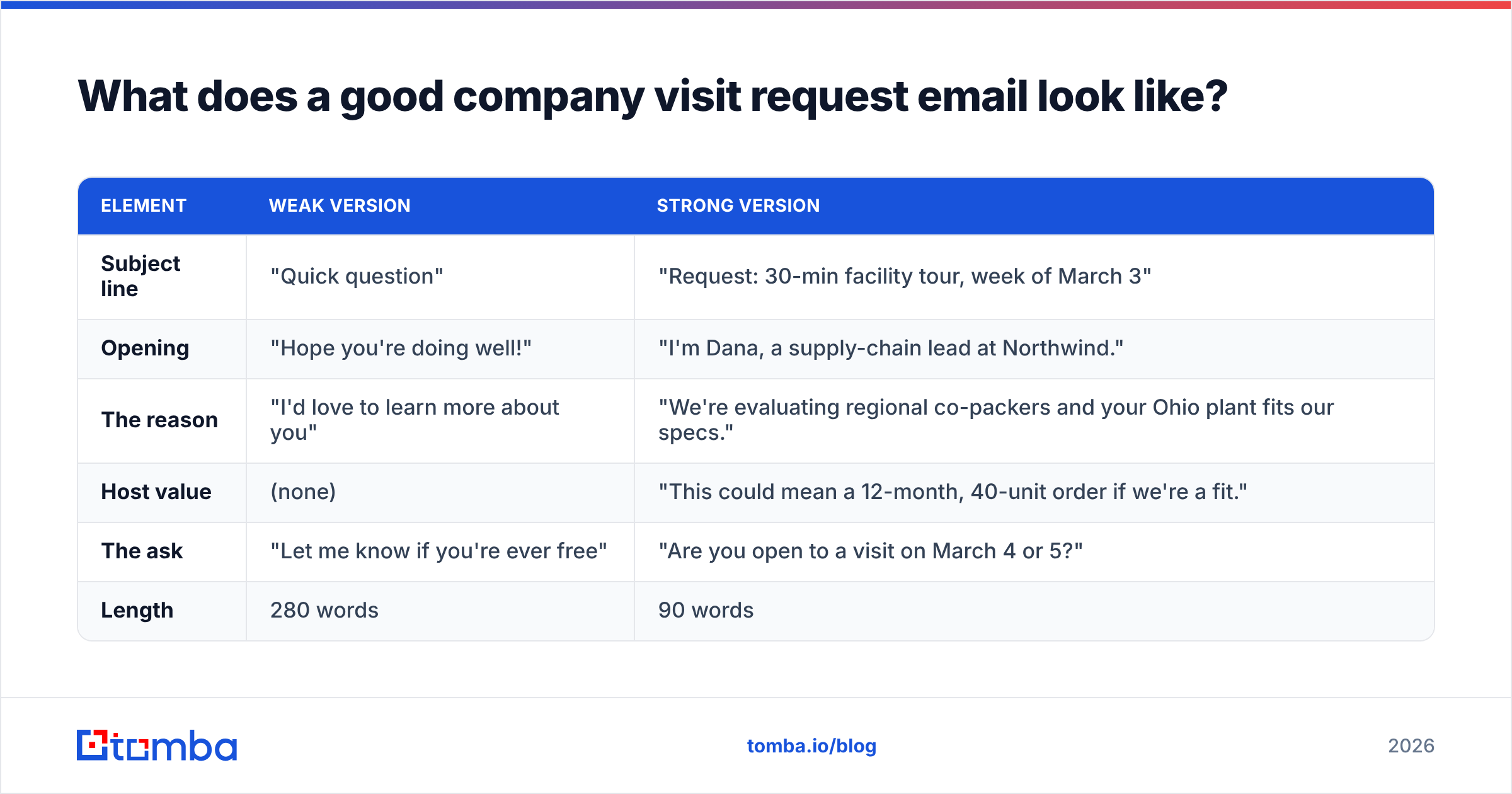
Here is how a weak request compares to a strong one, line by line:
| Element | Weak version | Strong version |
|---|---|---|
| Subject line | "Quick question" | "Request: 30-min facility tour, week of March 3" |
| Opening | "Hope you're doing well!" | "I'm Dana, a supply-chain lead at Northwind." |
| The reason | "I'd love to learn more about you" | "We're evaluating regional co-packers and your Ohio plant fits our specs." |
| Host value | (none) | "This could mean a 12-month, 40-unit order if we're a fit." |
| The ask | "Let me know if you're ever free" | "Are you open to a visit on March 4 or 5?" |
| Length | 280 words | 90 words |
The strong column works because every line does a job and the reader can say yes in one sentence. The weak column forces the reader to guess your intent and schedule the whole thing themselves.
If you want a head start, Tomba's free cold email templates library and subject line generator give you tested starting points you can tune for each scenario.
Which template should I use? (6 copy-paste examples)#
Pick the one that matches your situation and swap in your details.
1. Student or academic tour request#
Subject: Request: student group visit to [Company], week of [date]
Hi [Name],
I'm [Your Name], a [program] student at [University]. I'm coordinating a small group of [number] students studying [field], and your work in [specific area] is directly relevant to our coursework.
Would you be open to a 45-minute facility tour during the week of [date]? We're flexible and happy to work around your schedule. In return, our group is glad to share feedback or take part in any recruiting conversation you'd find useful.
Would [date A] or [date B] work?
Thank you,
[Your Name]
2. Sales or partnership visit#
Subject: [Your Company] × [Their Company]: on-site demo, week of [date]
Hi [Name],
I'm [Your Name] from [Your Company]. We help [their type of business] cut [specific problem], and [mutual connection / trigger event] made me think there's a strong fit.
I'd like to bring a short on-site demo to your team — 30 minutes, no slides, just the workflow relevant to [their goal]. If it's useful, we can talk pilot terms; if not, you keep the takeaways.
Are you open to [date A] or [date B]?
Best,
[Your Name]
3. Supplier or vendor meeting#
Subject: Supplier intro: [product], visit to your [location] site
Hi [Name],
I'm [Your Name] with [Your Company]. We supply [product/service] to [comparable clients], and we're expanding in [region]. Your [site] is a natural fit for a first conversation.
Could I visit for 30 minutes the week of [date] to walk through specs and pricing? This could support your [specific initiative] without adding vendor overhead.
Would [date A] or [date B] suit you?
Regards,
[Your Name]
4. Job shadow or informational visit#
Subject: 20-minute shadow request — [your name], [role]
Hi [Name],
I'm [Your Name], a [current role] moving toward [target role]. I read your piece on [specific topic] and it clarified exactly the path I'm on.
Would you allow a 20-minute shadow of your team's [activity] one morning this month? I'll keep it tight and out of the way, and I'm happy to help with any small task while I'm there.
Would [date A] or [date B] work for you?
Thanks so much,
[Your Name]
5. Press or facility walkthrough#
Subject: Media visit request: [publication], [facility] feature
Hi [Name],
I'm [Your Name], a reporter with [publication]. I'm writing a feature on [topic], and your [facility/process] is one of the strongest examples in the field.
Could I arrange a 45-minute walkthrough the week of [date]? The piece reaches [audience/size], so it's a chance to put your work in front of the right readers.
Would [date A] or [date B] work?
Best,
[Your Name]
6. The follow-up (send once, 3–4 days later)#
Subject: Re: Request: [original subject]
Hi [Name],
Circling back on my note about a visit the week of [date] — I know inboxes get busy. If a tour isn't the right fit, a quick 15-minute call works too.
Are either [date A] or [date B] still open?
Thanks,
[Your Name]
One follow-up is plenty. Send it, then move on if there's still no reply.
How do I make sure my email actually gets delivered and opened?#
Great copy is worthless if the message never reaches a real person. This is where most visit requests quietly die — not in the reply, but in the send.

Three things determine whether your email lands:
You have the right person's real address. Guessing "firstname@company.com" fails often, and generic role inboxes like info@ or contact@ rarely get a personal reply. Use a proper email finder to get the specific decision-maker's professional address by name and company domain, so your carefully written note reaches someone who can actually say yes.
The address is valid before you hit send. A single hard bounce dents your sender reputation and guarantees a non-answer. Run the address through an email verifier first — it checks that the mailbox exists and can receive mail, which keeps your bounce rate low and your deliverability healthy. For a deeper primer, the concept of email deliverability is worth understanding if you send visit requests regularly.
Your subject and timing respect the reader. Send during business hours in the recipient's timezone, keep the subject specific, and avoid spammy phrasing. Independent review sites like G2 track how verification tools affect real-world deliverability if you want to compare options.
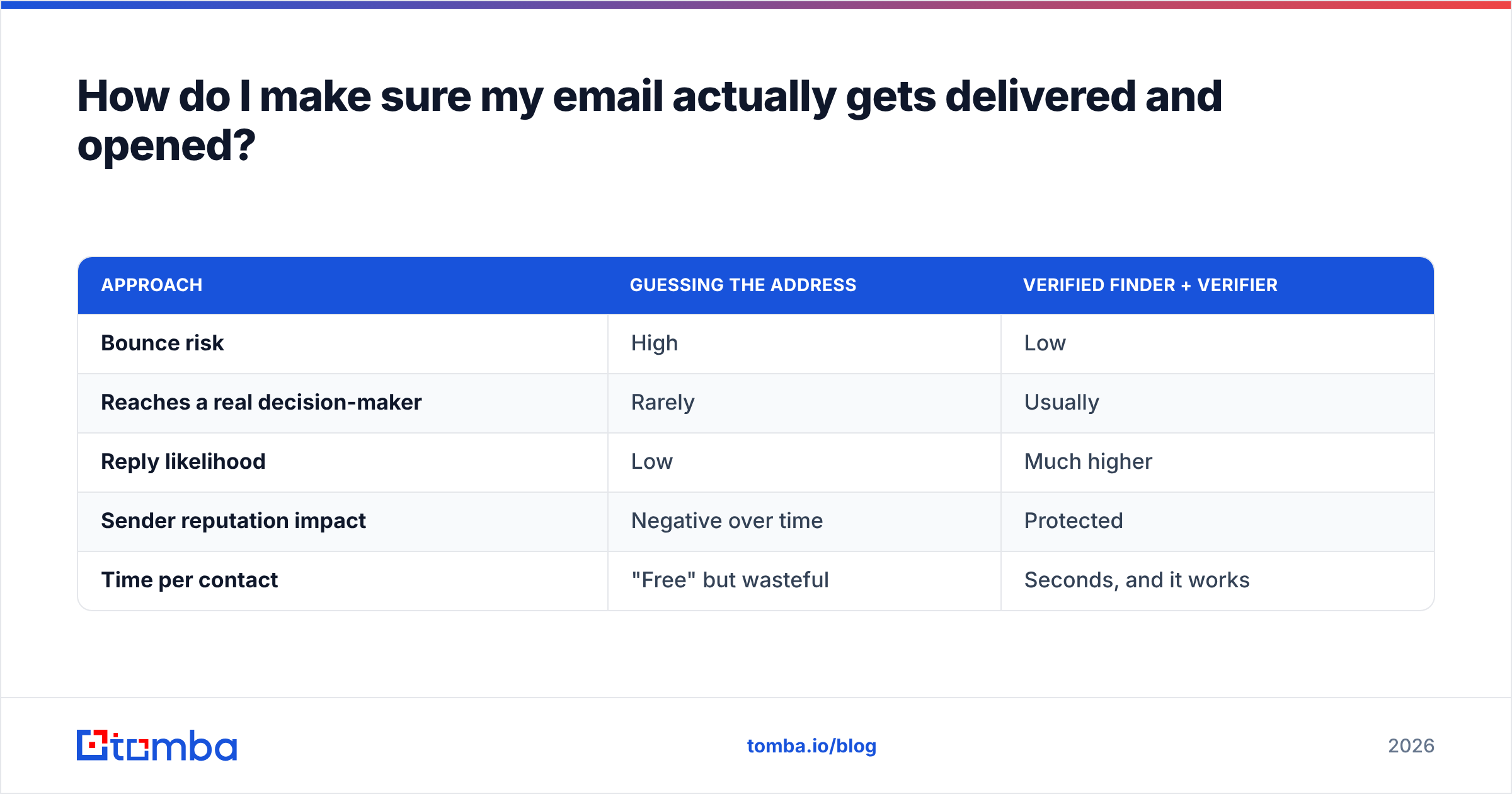
Here's how the two most common approaches to reaching a company stack up:
| Approach | Guessing the address | Verified finder + verifier |
|---|---|---|
| Bounce risk | High | Low |
| Reaches a real decision-maker | Rarely | Usually |
| Reply likelihood | Low | Much higher |
| Sender reputation impact | Negative over time | Protected |
| Time per contact | "Free" but wasteful | Seconds, and it works |
The second column costs a little effort up front and saves you every wasted send afterward.
How long should a company visit request email be?#
Under 150 words, and closer to 90 is better. The reader is deciding, in about eight seconds, whether replying is worth their time. A wall of text signals a big ask; a tight, three-paragraph note signals an easy yes.
A reliable rhythm: one line to introduce yourself, two lines for the reason and the value, one line with two date options, and a one-line sign-off. If a sentence does not help the reader decide, cut it. "I hope this email finds you well" and "I've always admired your organization" are the first to go — they add length without adding a reason to say yes.
If English is not the reader's first language, or vice versa, keep sentences short and plain. Simple beats clever in a request email every time.
What mistakes should I avoid?#
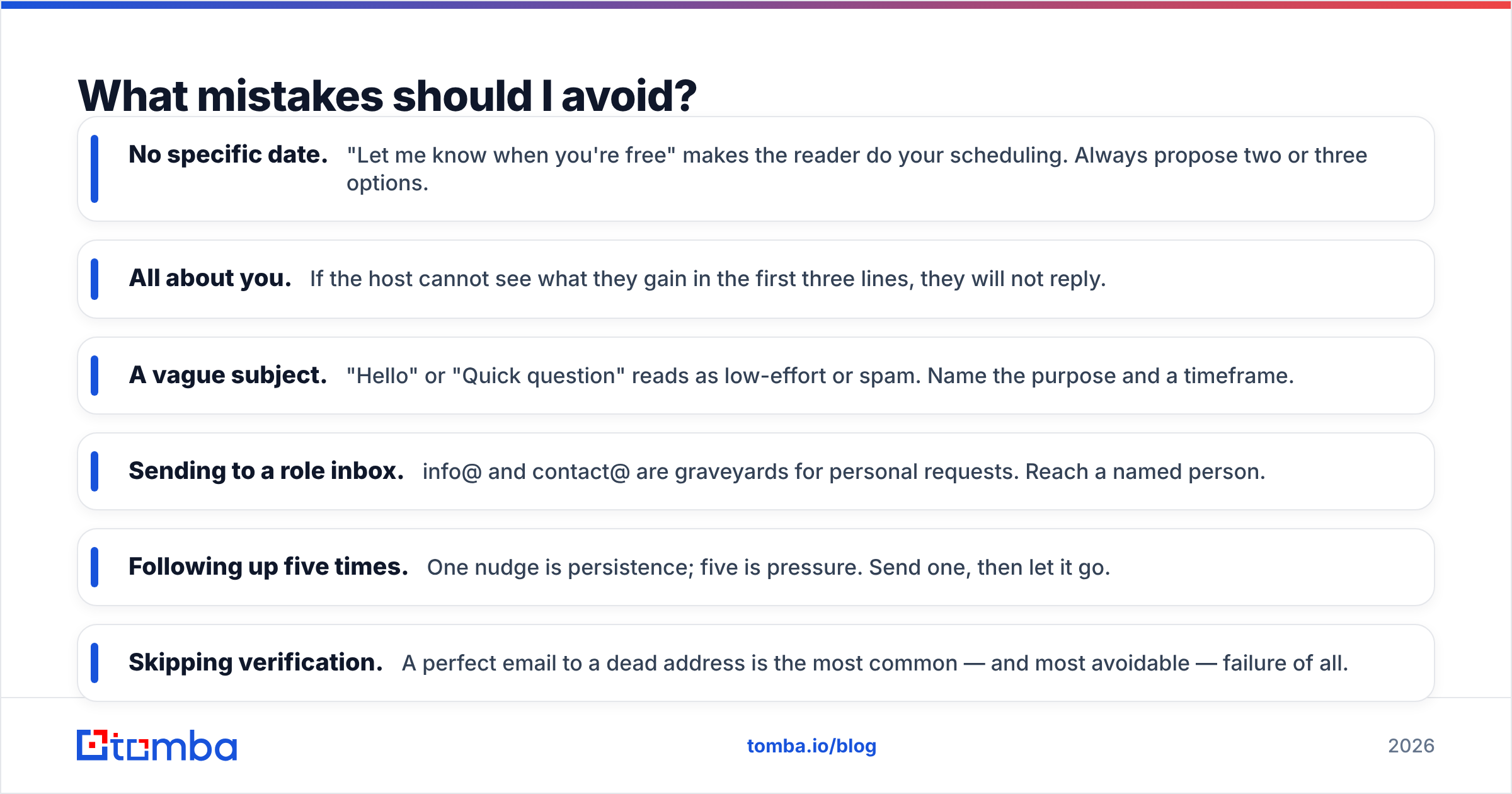
A few patterns kill visit requests faster than anything else:
- No specific date. "Let me know when you're free" makes the reader do your scheduling. Always propose two or three options.
- All about you. If the host cannot see what they gain in the first three lines, they will not reply.
- A vague subject. "Hello" or "Quick question" reads as low-effort or spam. Name the purpose and a timeframe.
- Sending to a role inbox. info@ and contact@ are graveyards for personal requests. Reach a named person.
- Following up five times. One nudge is persistence; five is pressure. Send one, then let it go.
- Skipping verification. A perfect email to a dead address is the most common — and most avoidable — failure of all.
Get these right and you are already ahead of most people asking for the same visit.
Send your next request to the right inbox#
A company visit request email is only as good as the address it reaches. You can nail the subject line, the value pitch, and the date options — but if the message lands in a catch-all or bounces off a stale mailbox, none of it matters.
Start by finding the exact person who can approve your visit. Tomba's Email Finder turns a name and company domain into a verified professional email in seconds, so your request reaches a real decision-maker instead of a dead inbox. Pair it with the email verifier to confirm the address before you send, and check Tomba pricing — the free tier includes 25 searches a month to get you started, with paid plans from $49/mo when you scale up.
Write the email once, send it to the right person, and let a "sure, how about Thursday?" do the rest.
Related guides#
Ready to find emails that actually work?
Join 150,000+ professionals who stopped guessing and started sending. Free credits on signup — no credit card required.
Get the Tomba newsletter
Practical outbound tactics and product updates — once every two weeks.
About the author