Competitive Analytics in 2026: A Practical B2B Playbook
Competitive analytics turns scattered rival signals into pipeline decisions. Here's the metric set, tool stack, and repeatable workflow B2B teams use to out-position competitors in 2026.
Competitive analytics is the discipline of turning what you know about rivals, markets, and buyers into decisions that win deals. Done well, it stops feeling like a slide deck nobody reads and starts feeding your pipeline, your pricing, and your messaging. Done badly, it's a folder of screenshots that goes stale in a week.
This guide is the practical version: what competitive analytics actually is, which metrics matter, how to build the workflow, and where the data comes from.
TL;DR#
- Competitive analytics is the systematic collection and analysis of competitor, market, and buyer signals to drive revenue decisions — not just a one-off SWOT slide.
- It splits into three layers: market intelligence (who plays and how big), competitor intelligence (what rivals do), and win/loss intelligence (why you win or lose).
- The metrics that move revenue are win rate vs. named competitors, competitive displacement rate, share of voice, and feature/pricing gaps — track these, ignore vanity dashboards.
- Your stack needs three parts: a signal source, an enrichment/data layer, and a routing layer that pushes insight to reps in real time.
- Clean contact and company data is the fuel. If your CRM records are wrong, your competitive analysis is confidently wrong.
What is competitive analytics?#
Competitive analytics is the ongoing process of gathering, structuring, and analyzing information about your competitors and market so your go-to-market team can act on it. Think of it like a sports team reviewing game film. You are not watching to admire the other team — you are watching to find the play that beats them next week.
The word "analytics" matters. A list of competitor features is research. Competitive analytics is what happens when you connect that research to an outcome: a higher win rate, a sharper battlecard, a repositioned landing page, or a pricing change that closes the gap on a deal you kept losing.
It sits inside the broader practice of revenue operations, because the whole point is to make revenue decisions repeatable instead of reactive. When a rep says "we always lose to Competitor X on procurement," competitive analytics is the system that proves whether that's true, quantifies the damage, and hands back a fix.
Why does competitive analytics matter more in 2026?#
Three shifts made this non-optional.
- Buyers self-educate before they talk to you. Gartner has long reported that B2B buyers spend the majority of their journey researching independently and comparing vendors in parallel. By the time a rep gets on a call, the prospect already has a shortlist — and your competitors are on it. You need to know what that comparison looks like before the meeting, not after the loss.
- Feature parity is faster than ever. AI tooling means a differentiator you ship in Q1 can be cloned by Q3. Static positioning decks age in weeks. Competitive analytics is how you notice the gap closing while you still have time to move.
- GTM teams are leaner. Fewer reps, higher quota. There's no room to lose winnable deals to bad intel. A single accurate battlecard insight — "they charge for onboarding, we don't" — can swing a quarter.
The teams that win aren't the ones with the most competitor data. They're the ones who route the right signal to the right rep at the right moment.
What are the three layers of competitive analytics?#
Break the discipline into three layers so you know what you're actually measuring.
- Market intelligence — the landscape. Total addressable market, category growth, new entrants, analyst positioning (think G2 grids and Gartner Magic Quadrants). This answers where is the game being played?
- Competitor intelligence — the players. Pricing, packaging, feature releases, hiring signals, messaging changes, funding, and org moves. This answers what are rivals doing right now?
- Win/loss intelligence — the scoreboard. Which competitors show up in your deals, when you win, when you lose, and the real reason why (not the reason the rep wrote in the CRM). This answers why do we win or lose against them?
Most teams over-invest in layer two (screenshotting competitor sites) and under-invest in layer three (structured win/loss). Layer three is where the revenue is, because it's the only layer tied directly to closed deals.
Which competitive analytics metrics actually matter?#
Skip the vanity dashboards. These four metrics tie competitive work to revenue.
- Competitive win rate — your close rate specifically on deals where a named competitor was present. If your overall win rate is 25% but drops to 9% against Competitor X, you have a targeted problem, not a general one.
- Displacement rate — the percentage of deals you win by replacing an incumbent (and the rate at which you get displaced). This is the truest measure of competitive strength.
- Share of voice (SOV) — your visibility in the category versus rivals across search, review sites, and social. A rising competitor SOV is an early warning that shows up months before it hits your win rate.
- Feature and pricing gap index — a maintained scorecard of where you're ahead, at parity, or behind on the attributes buyers actually weigh. Update it every release cycle, not once a year.
Pair these with qualitative win/loss interview themes. Numbers tell you what is happening; interviews tell you why.
What does a competitive analytics tech stack look like?#
You need three functional parts. Some tools cover more than one; the point is to make sure no layer is missing.
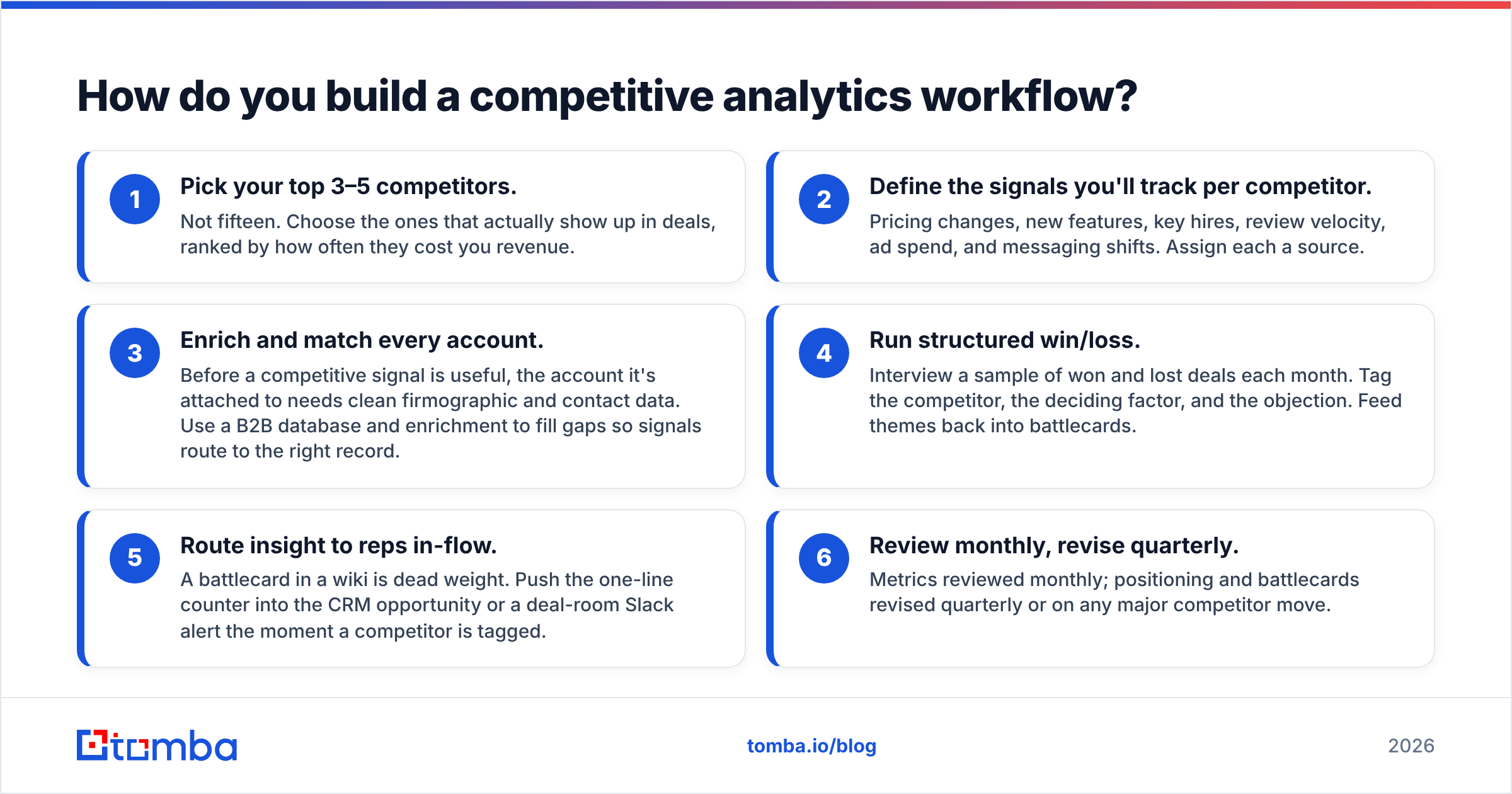
| Layer | Job | Example inputs | Failure mode if missing |
|---|---|---|---|
| Signal source | Detect what rivals and buyers do | Review sites, pricing pages, job posts, ad libraries, website visitors | You're always reacting late |
| Data & enrichment | Turn raw signals into clean, matched records | Company firmographics, contact data, data enrichment | Insights attach to the wrong account |
| Routing & activation | Get the insight to the rep in-flow | CRM fields, battlecards, Slack alerts | Great analysis nobody reads |
The mistake is buying a shiny "competitive intelligence platform" for the signal layer while ignoring the data layer underneath it. If your account records are incomplete — missing the decision-maker's email, the wrong company size, a stale job title — every downstream insight inherits that error. Clean, enriched data is the unglamorous foundation the whole stack stands on.
For the signal layer specifically, website visitor reveal is a high-leverage input most teams skip: knowing that a target account visited your pricing page three times this week is a competitive signal in its own right.
How do you build a competitive analytics workflow?#
Here's a repeatable loop you can stand up in a few weeks.
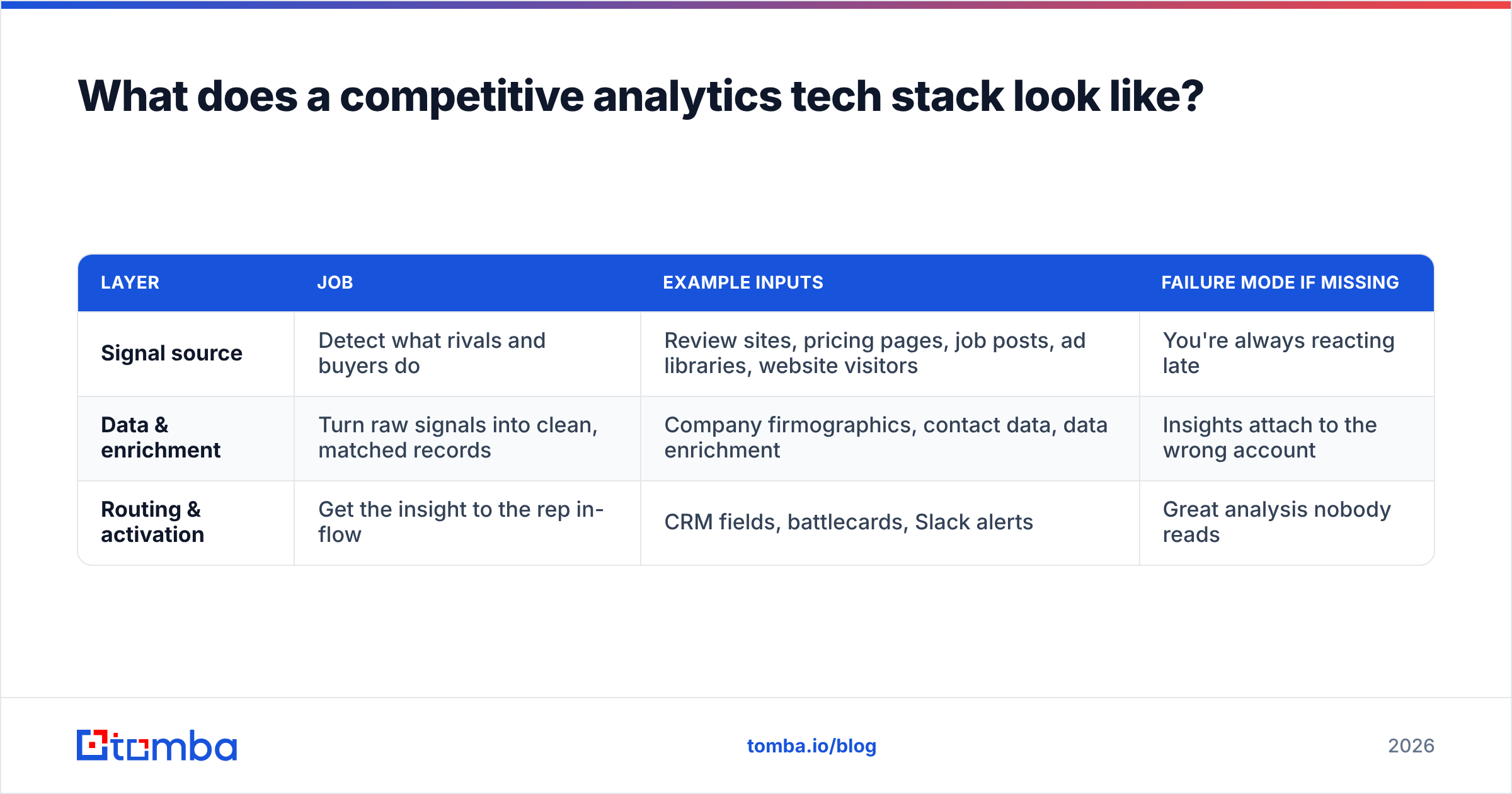
- Pick your top 3–5 competitors. Not fifteen. Choose the ones that actually show up in deals, ranked by how often they cost you revenue.
- Define the signals you'll track per competitor. Pricing changes, new features, key hires, review velocity, ad spend, and messaging shifts. Assign each a source.
- Enrich and match every account. Before a competitive signal is useful, the account it's attached to needs clean firmographic and contact data. Use a B2B database and enrichment to fill gaps so signals route to the right record.
- Run structured win/loss. Interview a sample of won and lost deals each month. Tag the competitor, the deciding factor, and the objection. Feed themes back into battlecards.
- Route insight to reps in-flow. A battlecard in a wiki is dead weight. Push the one-line counter into the CRM opportunity or a deal-room Slack alert the moment a competitor is tagged.
- Review monthly, revise quarterly. Metrics reviewed monthly; positioning and battlecards revised quarterly or on any major competitor move.
The loop only works if step 3 is solid. Skip enrichment and you'll spend step 5 arguing about whose data is right instead of acting on it.

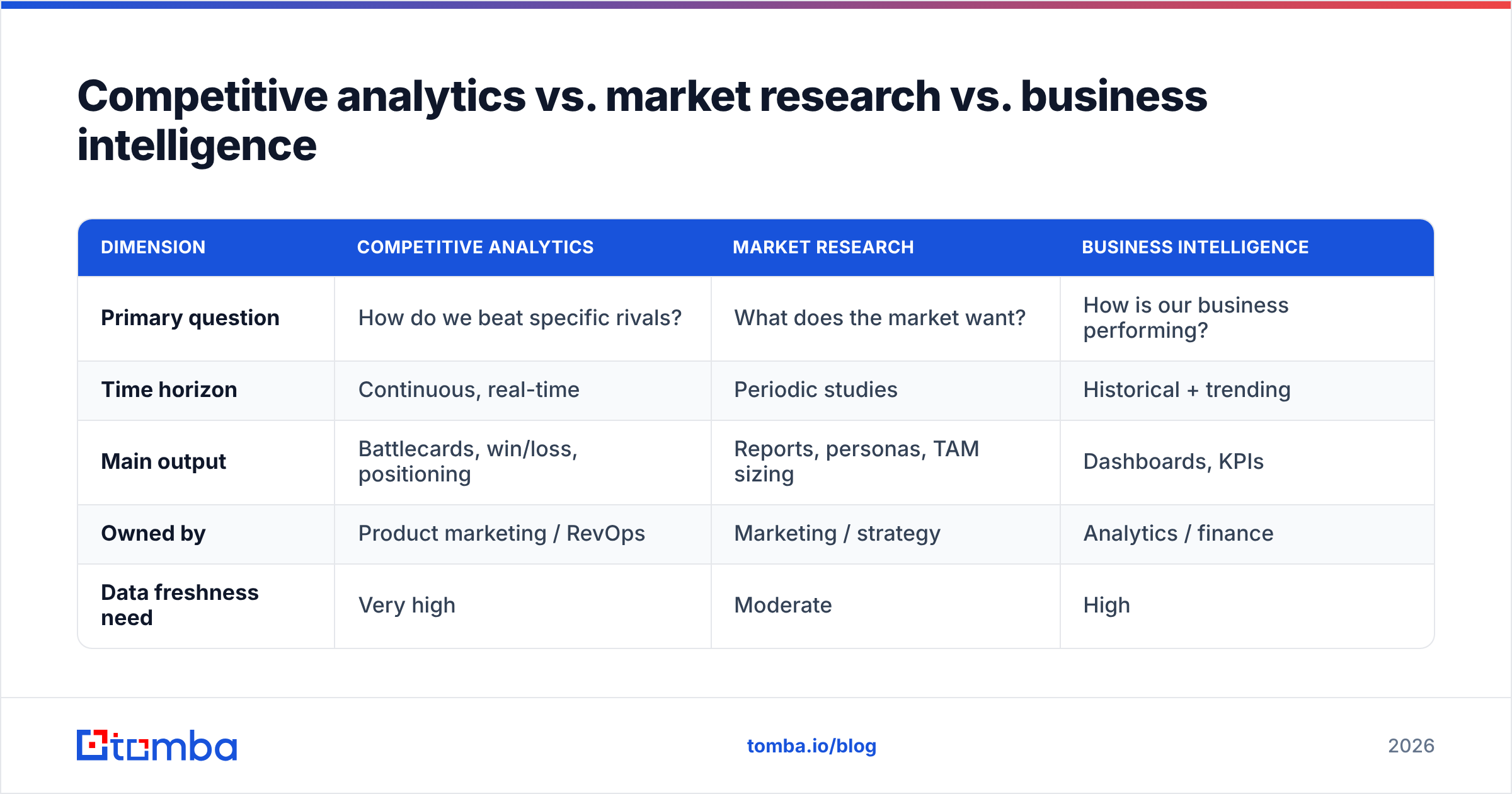
Competitive analytics vs. market research vs. business intelligence#
These get used interchangeably. They aren't the same, and confusing them leads to buying the wrong tool.
| Dimension | Competitive analytics | Market research | Business intelligence |
|---|---|---|---|
| Primary question | How do we beat specific rivals? | What does the market want? | How is our business performing? |
| Time horizon | Continuous, real-time | Periodic studies | Historical + trending |
| Main output | Battlecards, win/loss, positioning | Reports, personas, TAM sizing | Dashboards, KPIs |
| Owned by | Product marketing / RevOps | Marketing / strategy | Analytics / finance |
| Data freshness need | Very high | Moderate | High |
Competitive analytics is the fastest-moving of the three, which is why it's the one most likely to rot without an automated data foundation. A market research report is fine at six months old. A competitor pricing battlecard six months old will lose you deals.
Where does competitive analytics data come from?#
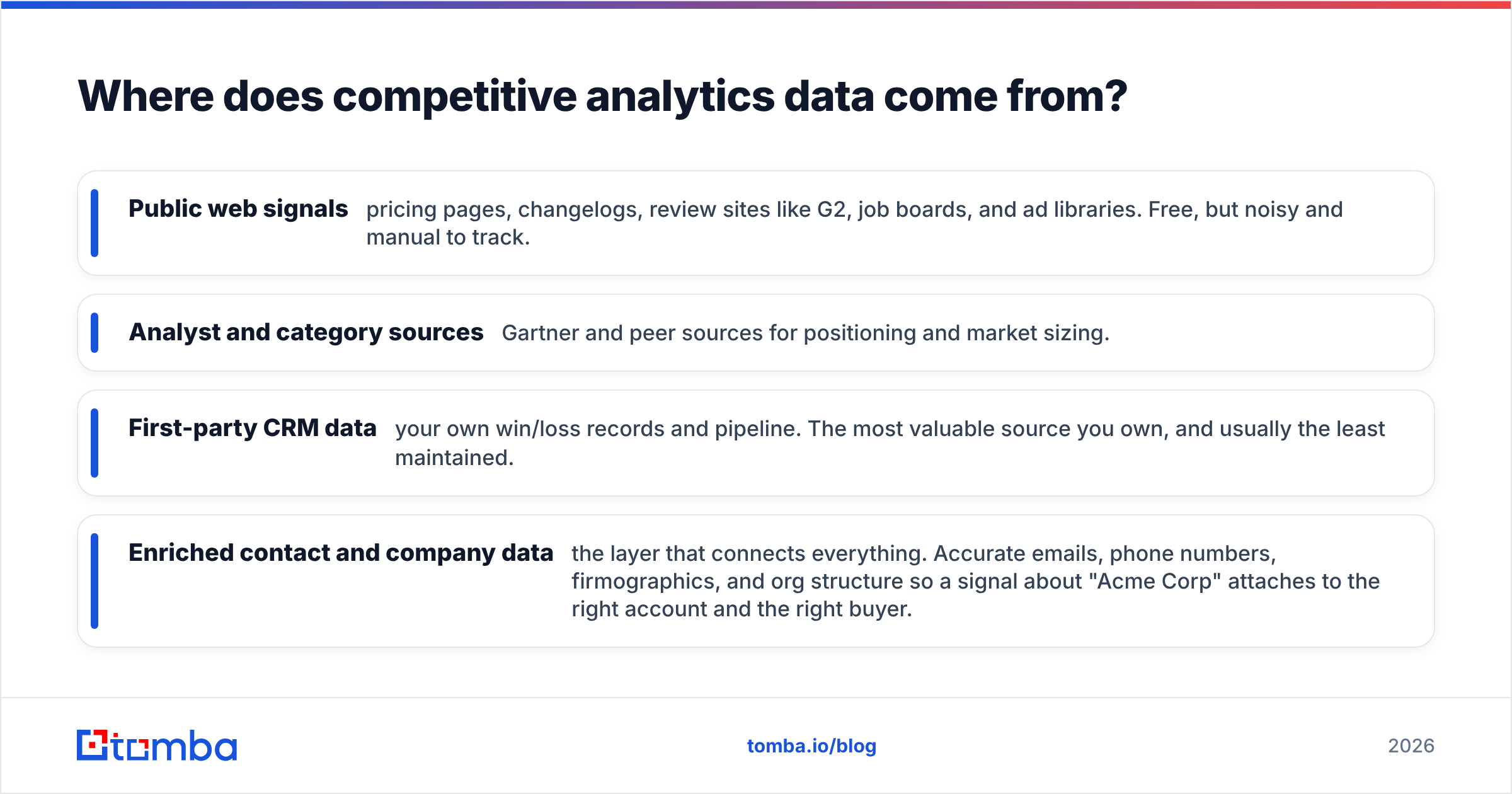
Good competitive analytics blends public signals with your own first-party data.
- Public web signals — pricing pages, changelogs, review sites like G2, job boards, and ad libraries. Free, but noisy and manual to track.
- Analyst and category sources — Gartner and peer sources for positioning and market sizing.
- First-party CRM data — your own win/loss records and pipeline. The most valuable source you own, and usually the least maintained.
- Enriched contact and company data — the layer that connects everything. Accurate emails, phone numbers, firmographics, and org structure so a signal about "Acme Corp" attaches to the right account and the right buyer.
That last layer is where a tool like Tomba fits. Whether you're building a target account list to monitor, filling in a decision-maker's contact details before a competitive deal, or enriching stale CRM records, you need reliable data underneath the analysis. You can find verified contacts by company using domain search, then keep records fresh with ongoing enrichment.
What are common competitive analytics mistakes?#
- Tracking too many competitors. Effort spreads thin and nothing gets tracked well. Ruthlessly cap the list.
- One-and-done SWOT. A single analysis in January is worthless by June. Competitive analytics is a subscription, not a purchase.
- Ignoring win/loss. Teams love scraping competitor sites and avoid the harder work of asking lost prospects why they left. The uncomfortable interviews hold the answers.
- Analysis with no activation. If the insight never reaches a rep mid-deal, it may as well not exist.
- Dirty underlying data. Confident analysis built on wrong company sizes and dead email addresses is worse than no analysis — it's misleading with a straight face.
Avoid these and you're ahead of most of your market, because most competitive programs die from neglect, not from a lack of tools.
How do you know your competitive analytics is working?#
You'll see it in the numbers that matter:
- Competitive win rate climbing against your named rivals, quarter over quarter.
- Reps referencing current battlecard points in call reviews without being told to.
- Fewer "we lost to price" losses that were actually "we lost to positioning we could have countered."
- Faster reaction time to competitor moves — days, not months.
If those aren't moving, the problem is usually activation (insight isn't reaching reps) or data (insight is attached to the wrong accounts). Fix the data layer first; it's the cheapest lever with the widest blast radius.
Get the data layer right first#
Competitive analytics lives or dies on the quality of the data underneath it. You can buy the best signal-tracking platform on the market, but if it's mapping competitor moves onto incomplete, out-of-date account records, you're optimizing noise.
Start with clean, verified contact and company data. Use Tomba's Email Finder to find and verify decision-maker emails at your target and competitive accounts, enrich stale CRM records, and build monitored account lists you can trust. Plans start free with 25 searches a month, and paid tiers begin at $49/mo — see full Tomba pricing for the tier that fits your team. Get the foundation right, and every competitive insight you build on top of it earns its keep.
Related guides#
Ready to find emails that actually work?
Join 150,000+ professionals who stopped guessing and started sending. Free credits on signup — no credit card required.
Get the Tomba newsletter
Practical outbound tactics and product updates — once every two weeks.
About the author