Competitive Intel for B2B Sales: The 2026 Playbook
Competitive intel only wins deals when it's fresh and in front of a rep at the right moment. Here's the 2026 workflow, the tools, and the data signals that turn rival research into closed pipeline.
TL;DR
- Competitive intel is only useful when it reaches a rep before the call, not in a quarterly slide deck nobody opens.
- The 2026 stack has three layers: monitoring (what rivals do), battlecards (what your team says back), and enrichment (who you're actually talking to).
- Most "competitive intelligence" failures are distribution failures — the data exists, it just never gets to the deal.
- Pair a monitoring tool with clean contact data so you can act on intent the moment it appears.
- Start free, wire intel into your CRM, and measure it by win rate against named competitors — not by report volume.
Competitive intel is the practice of collecting, analyzing, and distributing information about your competitors so your go-to-market team can win more deals. That's it. Everything else — the tools, the frameworks, the dashboards — is plumbing in service of one outcome: a rep saying the right thing at the right moment because they knew something the buyer assumed they didn't.
The problem is that most teams treat competitive intel like a library. They collect, they file, they forget. In 2026, the teams that win treat it like a nervous system: signals in, response out, fast.
What is competitive intel, really?#
Think of competitive intel like the scouting report a coach hands a team before a game. It's not a history book about the other team — it's a short, specific set of tendencies you can exploit tonight. "Their left tackle is slow off the snap." "They fold under pressure in the fourth quarter." Actionable, timed, and thrown away next week when it's stale.
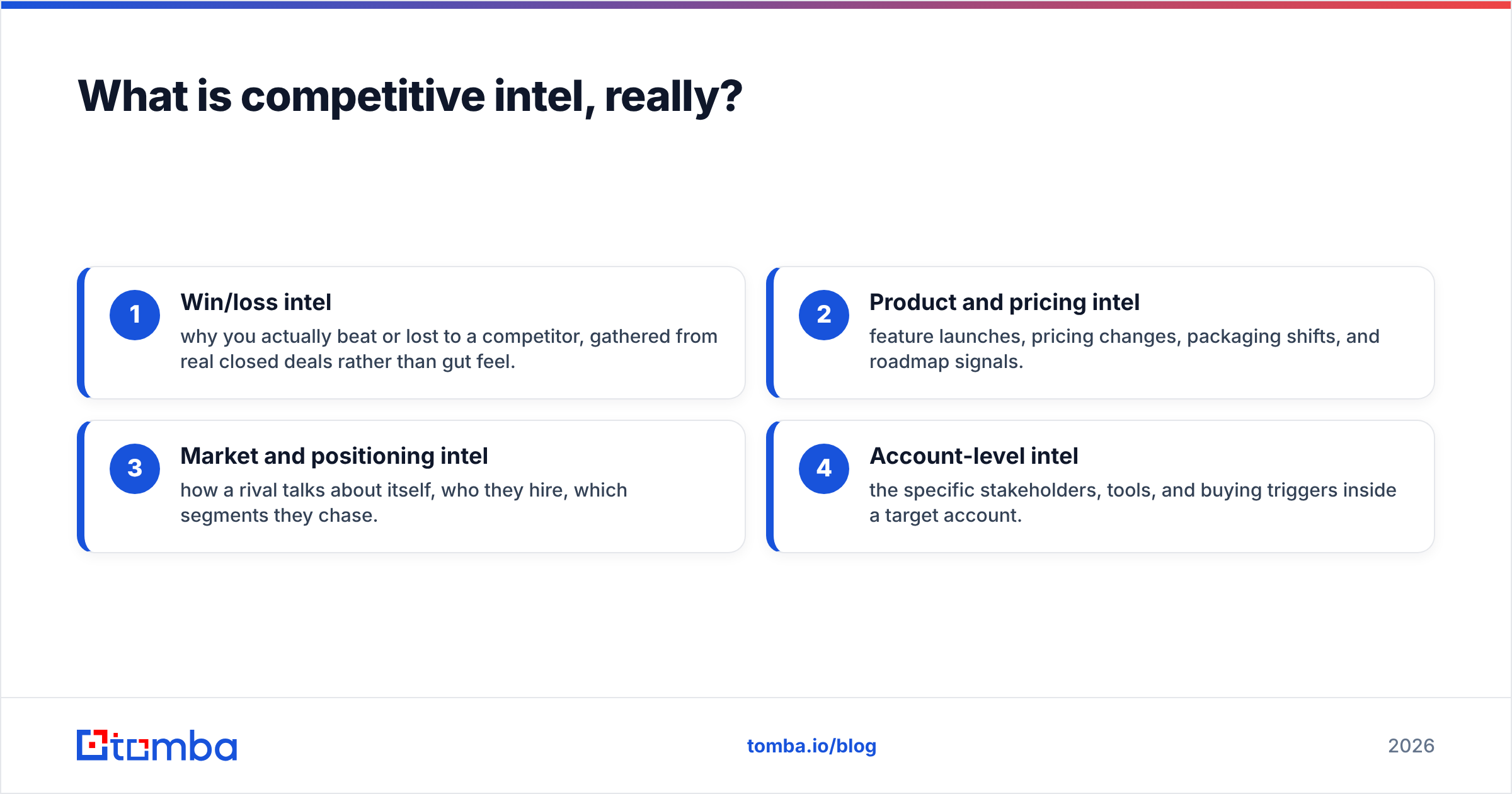
In a B2B context, competitive intelligence breaks into four practical buckets:
- Win/loss intel — why you actually beat or lost to a competitor, gathered from real closed deals rather than gut feel.
- Product and pricing intel — feature launches, pricing changes, packaging shifts, and roadmap signals.
- Market and positioning intel — how a rival talks about itself, who they hire, which segments they chase.
- Account-level intel — the specific stakeholders, tools, and buying triggers inside a target account.
Buckets one through three are about the competitor. Bucket four is about the deal — and it's the one most "competitive intel" programs ignore, even though it's where reps spend their day. You can know everything about a rival's pricing and still lose because you emailed the wrong person three weeks too late.
Why do most competitive intel programs fail?#
Because they optimize for collection, not distribution. A gorgeous 40-page competitor teardown that lives in a shared drive has a readership of roughly one: the analyst who wrote it.
Here's the pattern that kills these programs:
- Intel is centralized, but decisions are not. The person who needs the insight is the rep on a call at 2:47 p.m., not the RevOps lead running a monthly review.
- It's a document, not a signal. By the time intel becomes a PDF, the launch it describes is a month old.
- It's disconnected from the deal. The competitor teardown doesn't know that this account just hired a VP of Sales, switched CRMs, or downloaded your rival's pricing page.
Gartner has repeatedly flagged that sales enablement content goes unused when it isn't delivered in the seller's workflow — the same failure mode hits competitive intel. The fix isn't better reports. It's shorter loops and better routing. Intel has to arrive where the work happens: the CRM, the sequence, the deal record.
That's why the modern approach fuses two things people used to treat separately: competitor monitoring (what's changing in the market) and contact/account data (who to reach and what's true about them right now). One without the other is half a program.
What does a 2026 competitive intel stack look like?#
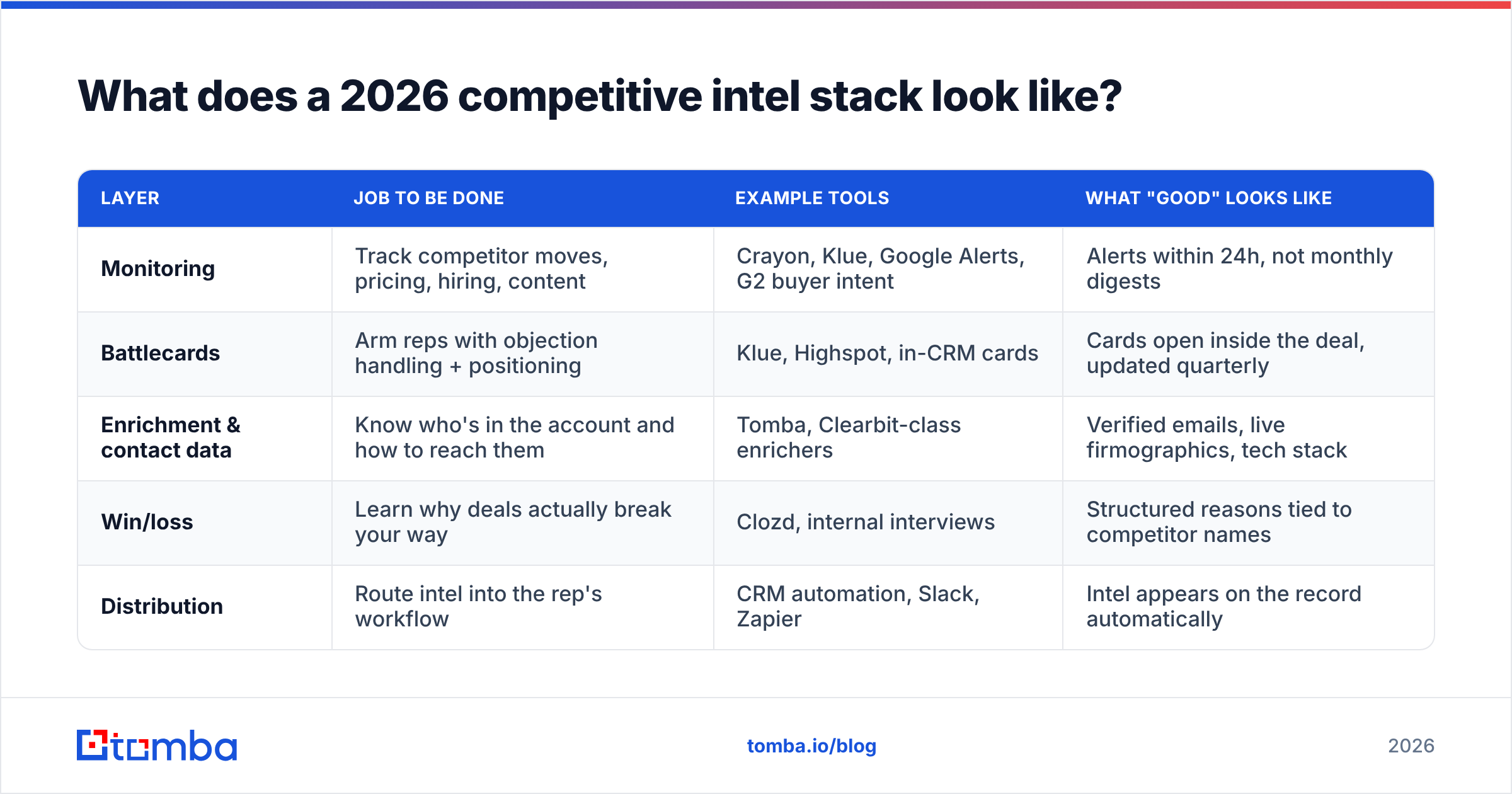
A working stack has three jobs, and you can staff each with a dedicated tool or a combined platform. The point isn't the logos — it's that all three jobs get done and the output lands in your CRM.
| Layer | Job to be done | Example tools | What "good" looks like |
|---|---|---|---|
| Monitoring | Track competitor moves, pricing, hiring, content | Crayon, Klue, Google Alerts, G2 buyer intent | Alerts within 24h, not monthly digests |
| Battlecards | Arm reps with objection handling + positioning | Klue, Highspot, in-CRM cards | Cards open inside the deal, updated quarterly |
| Enrichment & contact data | Know who's in the account and how to reach them | Tomba, Clearbit-class enrichers | Verified emails, live firmographics, tech stack |
| Win/loss | Learn why deals actually break your way | Clozd, internal interviews | Structured reasons tied to competitor names |
| Distribution | Route intel into the rep's workflow | CRM automation, Slack, Zapier | Intel appears on the record automatically |
The two layers teams most often skimp on are enrichment and distribution — and they're the ones that turn intel into revenue. Knowing a competitor raised prices is trivia until you can identify the 120 accounts using that competitor and email a decision-maker at each one this week.
That's where clean data does the heavy lifting. Tools like data enrichment fill in the firmographics, role, and contact details on an account so a monitoring signal ("competitor X had an outage") becomes an outreach list in minutes. Layer in website visitor reveal and you catch the accounts already researching your category — the warmest competitive-intel signal there is, because they're comparing you to a rival right now.
How do you turn a competitor signal into pipeline?#
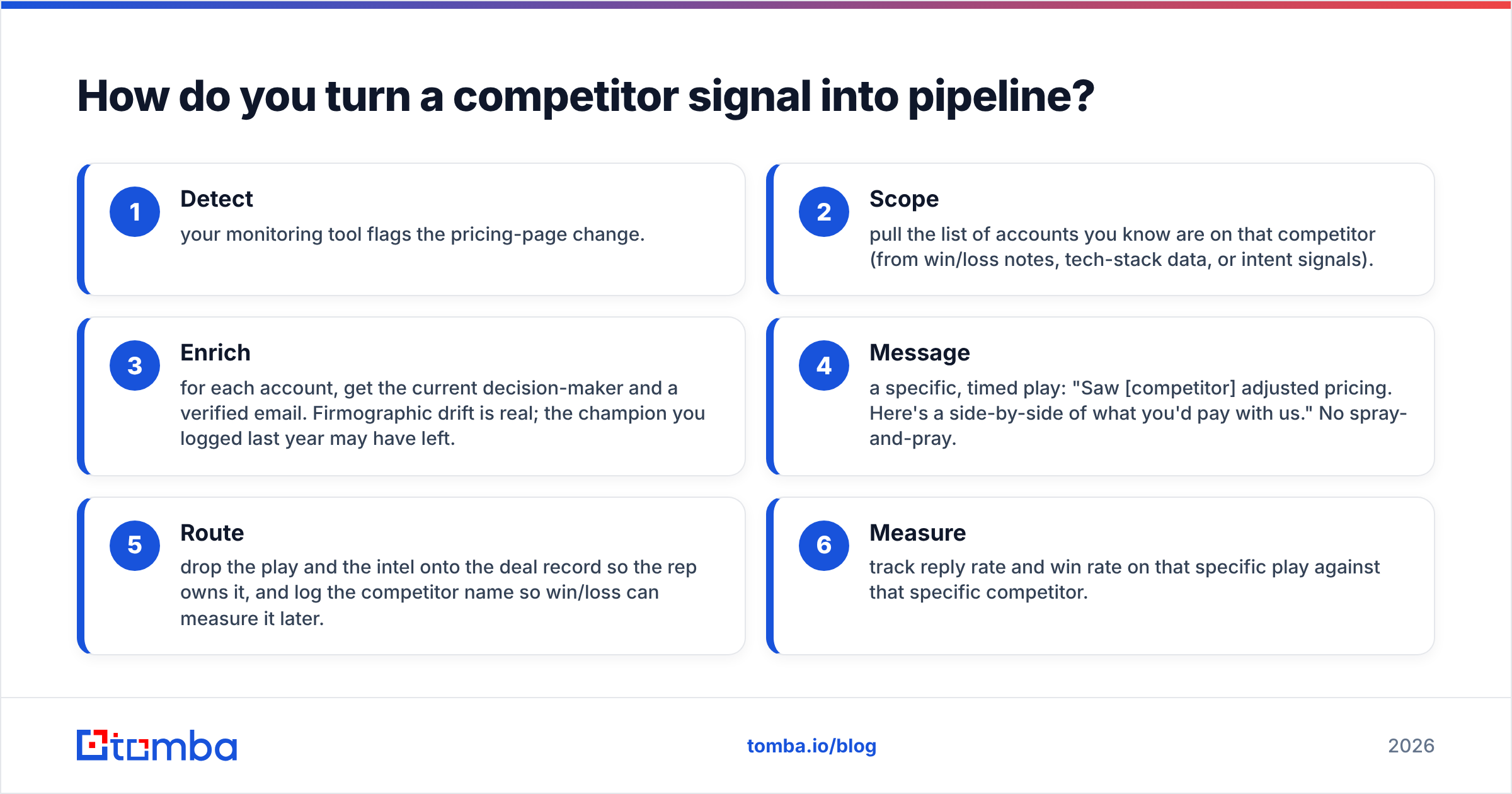
Here's the loop, start to finish, using a concrete example: a rival announces a price increase.
- Detect — your monitoring tool flags the pricing-page change.
- Scope — pull the list of accounts you know are on that competitor (from win/loss notes, tech-stack data, or intent signals).
- Enrich — for each account, get the current decision-maker and a verified email. Firmographic drift is real; the champion you logged last year may have left.
- Message — a specific, timed play: "Saw [competitor] adjusted pricing. Here's a side-by-side of what you'd pay with us." No spray-and-pray.
- Route — drop the play and the intel onto the deal record so the rep owns it, and log the competitor name so win/loss can measure it later.
- Measure — track reply rate and win rate on that specific play against that specific competitor.
Steps 3 and 4 are where most teams stall, because their contact data is stale. You can't run a timed competitive play on a list of bounced emails. This is the unglamorous truth of competitive intel: the insight is only as good as your ability to reach the person it applies to.
If you're building the account list from a competitor's customer base, a B2B database plus a bulk lookup gets you from "companies using rival X" to "verified contacts at companies using rival X" without manual research. Verify before you send — a competitive play that lands in spam because half the list bounced does more harm than no play at all.
Which competitive intel signals actually predict a deal?#
Not all signals are equal. Some are noise dressed up as insight. Rank your monitoring by how tightly a signal correlates with a buying window:
- High signal — Category research in-market. Someone at the account is actively comparing tools (visitor reveal, G2 intent, review-site activity). This is the strongest signal because the buying window is open now.
- High signal — Competitor churn triggers. Outages, price hikes, acquisitions, leadership exits, or a bad review cycle at your rival. These create switching intent you can catch.
- Medium signal — Hiring and org changes. A new VP of Sales or RevOps hire often means a tooling review within two quarters.
- Medium signal — Tech-stack changes. Adopting an adjacent tool can imply your category is next on the list.
- Low signal — Generic content and PR. A competitor's blog post or funding round is context, not a trigger. Useful for battlecards, weak for timing outreach.
The discipline is to wire your high-signal sources directly to enrichment and outreach, and let the low-signal stuff feed your quarterly battlecard refresh. Don't treat a funding announcement like a buying trigger — it isn't.
Build vs. buy: how much competitive intel tooling do you need?#
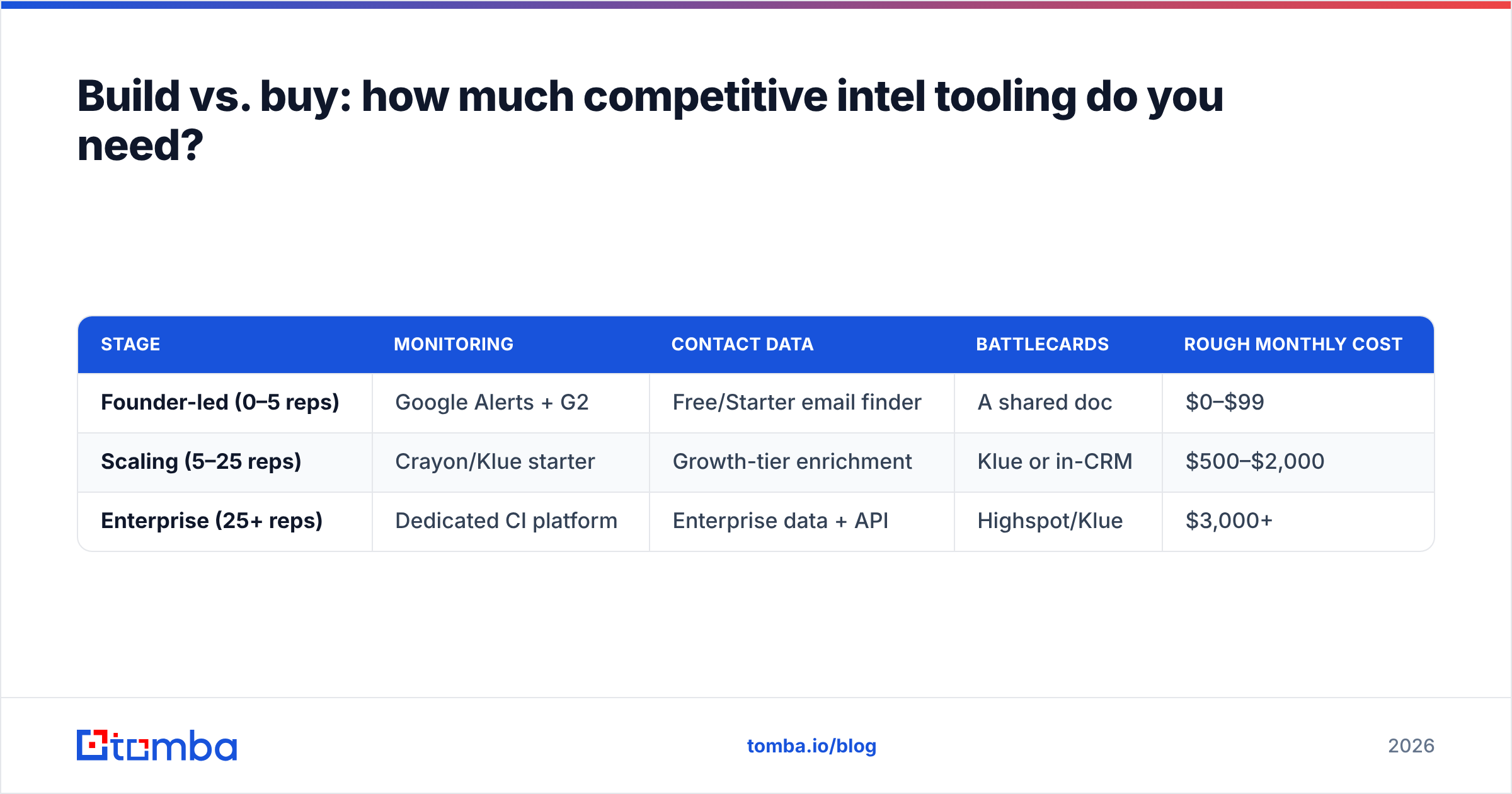
You do not need a five-figure competitive intelligence platform on day one. Match the spend to your motion.
| Stage | Monitoring | Contact data | Battlecards | Rough monthly cost |
|---|---|---|---|---|
| Founder-led (0–5 reps) | Google Alerts + G2 | Free/Starter email finder | A shared doc | $0–$99 |
| Scaling (5–25 reps) | Crayon/Klue starter | Growth-tier enrichment | Klue or in-CRM | $500–$2,000 |
| Enterprise (25+ reps) | Dedicated CI platform | Enterprise data + API | Highspot/Klue | $3,000+ |
The mistake is buying the enterprise monitoring suite while running on garbage contact data. Flip the priority: nail the data layer first, because every other layer depends on reaching real people. A cheap monitoring setup plus verified, enriched contacts beats an expensive dashboard feeding a bounced list.
For the data layer specifically, Tomba pricing runs a free tier at 25 searches a month, Starter at $49/mo, Growth at $99/mo, and Pro at $249/mo — so you can validate the "signal → enriched list → outreach" loop before committing to a heavier CI platform. Peers in the space like BookYourData are also solid options when you need pre-built, targeted B2B lists to seed an account universe; the right pick depends on whether you're building lists from scratch or enriching accounts you already track.
How do you measure whether competitive intel is working?#
Stop counting reports. Start counting outcomes. The only metrics that matter tie intel to revenue:
- Win rate vs. named competitors. Segment your closed-won and closed-lost by competitor. If your win rate against Rival X climbs after you ship a battlecard, the intel worked. If it doesn't move, the intel is decoration.
- Play adoption. What percentage of eligible deals actually used the competitive play? Low adoption means a distribution problem, not a content problem.
- Speed to signal. How long between a competitor's move and your first outbound response? Days, not weeks, is the target.
- Data freshness. What share of your competitive-account contacts are verified and current? Stale data quietly caps everything above it.
HubSpot's own research on sales content consistently shows that enablement material drives results only when reps use it in live deals — the measurement principle for competitive intel is identical. Track usage and outcomes, not production volume. A single one-page battlecard that reps actually open beats a quarterly report nobody reads.
What's the fastest way to start?#
Don't boil the ocean. Run this in a week:
- Pick your top three competitors by deal frequency — not your scariest rivals, your most frequent ones.
- Do five win/loss debriefs on recent deals against them. Write down the real objections in the buyer's words.
- Build one battlecard per competitor — three objections, three counters, one pricing comparison. One page each.
- Set up free monitoring (Google Alerts + G2 tracking) on those three names.
- Build a verified account list of companies using each competitor, with a decision-maker email for each, so you have a target universe the day a signal fires.
That last step is the one that converts intel into action, and it's the one you can stand up fastest with the right data tooling. Use a domain search to pull every reachable contact at a target company, then verify before you sequence. By the time your first real competitor signal hits, you'll already have a list to act on instead of a research project to start.
The bottom line#
Competitive intel isn't a document — it's a reflex. The teams that win in 2026 aren't the ones with the thickest competitor teardowns; they're the ones who can go from "a rival just changed something" to "we emailed 100 verified decision-makers a specific reason to switch" before the news gets cold.
That reflex runs on two things: a signal source and clean contact data. You can start the signal side for free today. And you can build the data side — verified emails, live firmographics, an account universe ready to fire — with the Tomba Email Finder. Grab the free tier, wire enrichment into your CRM, and turn your next competitor's misstep into your next quarter's pipeline.
Related guides#
Ready to find emails that actually work?
Join 150,000+ professionals who stopped guessing and started sending. Free credits on signup — no credit card required.
Get the Tomba newsletter
Practical outbound tactics and product updates — once every two weeks.
About the author