Competitive Intelligence Best Practices: A 2026 Field Guide
A no-fluff playbook for building a competitive intelligence program that actually moves win rates — sources, cadence, ethics, and the tooling that keeps your battlecards honest.
Competitive intelligence (CI) is how modern revenue teams stop guessing what rivals are doing and start acting on it. Done well, it shortens deal cycles, sharpens positioning, and stops you from losing to a competitor you didn't even know was in the room. Done badly, it's a stale slide deck nobody opens.
This guide gives you the competitive intelligence best practices that separate the two — the sources worth trusting, the cadence that keeps insight fresh, the ethics that keep you out of trouble, and the data hygiene that keeps your battlecards from lying to your reps.
TL;DR#
- Competitive intelligence is a process, not a report. The best programs run on a continuous collect → verify → distribute loop, not a once-a-quarter PDF.
- Verification beats volume. A single confirmed signal (a rival's new pricing page, a confirmed exec hire) is worth more than fifty unverified rumors.
- Distribution is where CI dies. If the insight doesn't reach the rep on the call, it never existed. Battlecards and CRM fields beat shared drives.
- Ethics and legality are non-negotiable. Use public and purchased data; never misrepresent yourself or touch trade secrets.
- Good CI runs on clean contact and company data. Enrichment tools like data enrichment keep your win/loss and account records accurate.
What Is Competitive Intelligence in B2B?#
Competitive intelligence is the systematic collection and analysis of information about your competitors, your market, and your buyers — used to make faster, better go-to-market decisions. Think of it as a weather service for your market: you're not predicting one storm, you're building a model that tells your team when to pack an umbrella.
In B2B specifically, CI usually answers three recurring questions:
- Who are we actually losing to, and why? Not who you think you compete with — who shows up in real deals.
- What is a competitor about to do? New products, pricing changes, funding, layoffs, leadership shuffles.
- How do we win the next deal against them? The tactical output: objection handling, traps to set, proof points.
CI is distinct from market research (broad and slow) and from plain old "checking a competitor's website." According to Gartner, the discipline that produces durable advantage is the operational kind — insight that changes what a rep says on a Tuesday afternoon call, not a strategy memo filed away for annual planning.
What Are the Core Types of Competitive Intelligence?#
Before you build a program, know which lane you're in. Most teams need a blend, weighted toward the tactical.
- Strategic CI — Long-horizon signals: market shifts, competitor funding rounds, M&A, category creation. Feeds leadership and product roadmap.
- Tactical CI — Deal-level ammunition: battlecards, pricing traps, feature gaps, objection handling. Feeds sales and directly touches win rate.
- Product CI — Feature-by-feature teardowns, release notes tracking, roadmap inference. Feeds product and product marketing.
- Win/Loss intelligence — Structured interviews and CRM analysis of why deals closed or slipped. The single highest-signal source most teams underuse.
- Customer & market CI — Voice-of-customer, review mining, and demand signals that reveal where the market is heading.
If you're just starting, prioritize tactical CI and win/loss — they attach to revenue fastest and prove the program's value to skeptical executives.
What Are the Best Practices for a Competitive Intelligence Program?#
Here's the operational core. These are the nine practices that consistently show up in CI programs that survive their second year.
1. Define a tight scope before you collect anything#
The fastest way to kill a CI program is to "track everyone." Pick your top three to five competitors based on real deal data — pull the closed-lost reasons from your CRM, not the names execs worry about. Add a "watch list" of two or three emerging threats you review monthly, not daily.
2. Build a repeatable collection cadence#
CI is a subscription, not a purchase. Set a rhythm:
- Daily: automated alerts (news, job postings, pricing-page changes).
- Weekly: review and triage what the alerts surfaced.
- Monthly: win/loss review and battlecard refresh.
- Quarterly: strategic teardown and roadmap inference.
3. Verify every signal before it becomes "intelligence"#
A rumor a rep heard on a call is a lead, not a fact. Confirm it against a second independent source before it enters a battlecard. Unverified CI is worse than no CI — it makes reps confidently wrong.

4. Centralize, then distribute to the point of use#
Store everything in one system of record, but push the tactical slice into wherever reps already work — the CRM, the sales-engagement tool, a Slack channel. A battlecard nobody can find during a live call is decoration.
5. Keep your underlying data clean#
CI decisions are only as good as the account and contact records behind them. When you're mapping a competitor's customer base or building a win/loss panel, stale titles and dead emails poison the analysis. This is where a B2B database and reliable enrichment matter — you want the org chart to reflect reality, not last year's LinkedIn.
6. Instrument win/loss properly#
Don't rely on the rep's one-line CRM note ("lost on price" is almost never the real reason). Run short structured interviews with a sample of won and lost buyers each quarter. The gap between what reps say lost the deal and what buyers say is where your best insight lives.
7. Make it two-way with the field#
Your reps are sensors. Give them a 30-second way to submit a competitive sighting ("saw Competitor X undercut us 20%") and close the loop by telling them what you did with it. A one-way CI team goes blind fast.
8. Measure CI against revenue, not activity#
Track competitive win rate over time, deal velocity in competitive situations, and battlecard usage. "We published 40 updates" is an activity metric; "win rate vs. Competitor X rose from 34% to 41%" is a business metric.
9. Stay ethical and legal, always#
Use public, purchased, or freely shared information. Never misrepresent who you are to extract information, and never solicit or use a competitor's trade secrets. The Strategic and Competitive Intelligence Professionals (SCIP) code of ethics is the standard reference — read it once, apply it always.
Where Should You Actually Source Competitive Intelligence?#
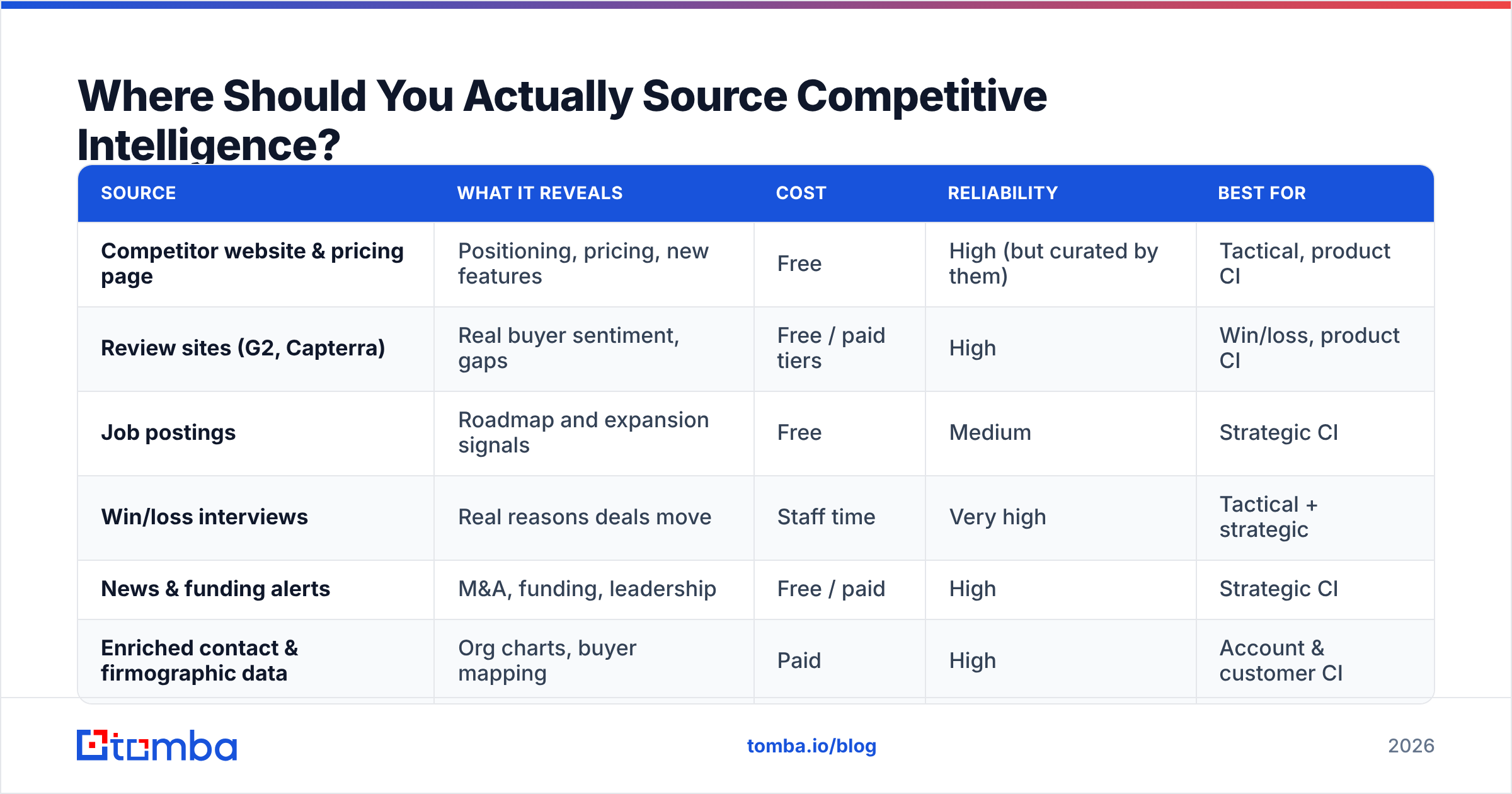
Sources fall on a spectrum from free-but-noisy to paid-but-precise. A healthy program blends several so no single blind spot sinks you. Here's how the common ones compare.
| Source | What it reveals | Cost | Reliability | Best for |
|---|---|---|---|---|
| Competitor website & pricing page | Positioning, pricing, new features | Free | High (but curated by them) | Tactical, product CI |
| Review sites (G2, Capterra) | Real buyer sentiment, gaps | Free / paid tiers | High | Win/loss, product CI |
| Job postings | Roadmap and expansion signals | Free | Medium | Strategic CI |
| Win/loss interviews | Real reasons deals move | Staff time | Very high | Tactical + strategic |
| News & funding alerts | M&A, funding, leadership | Free / paid | High | Strategic CI |
| Enriched contact & firmographic data | Org charts, buyer mapping | Paid | High | Account & customer CI |
Two notes on this table. First, review platforms like G2 are the single most honest free source you have — buyers say things in reviews they'd never say to your sales team. Mine them relentlessly. Second, the bottom row is the quiet multiplier: when you're mapping who buys from a competitor or building a win/loss sample, verified firmographic and contact data from a source like Tomba's domain search turns a vague target list into a real, reachable one.
What Tools Do You Need to Run Competitive Intelligence?#
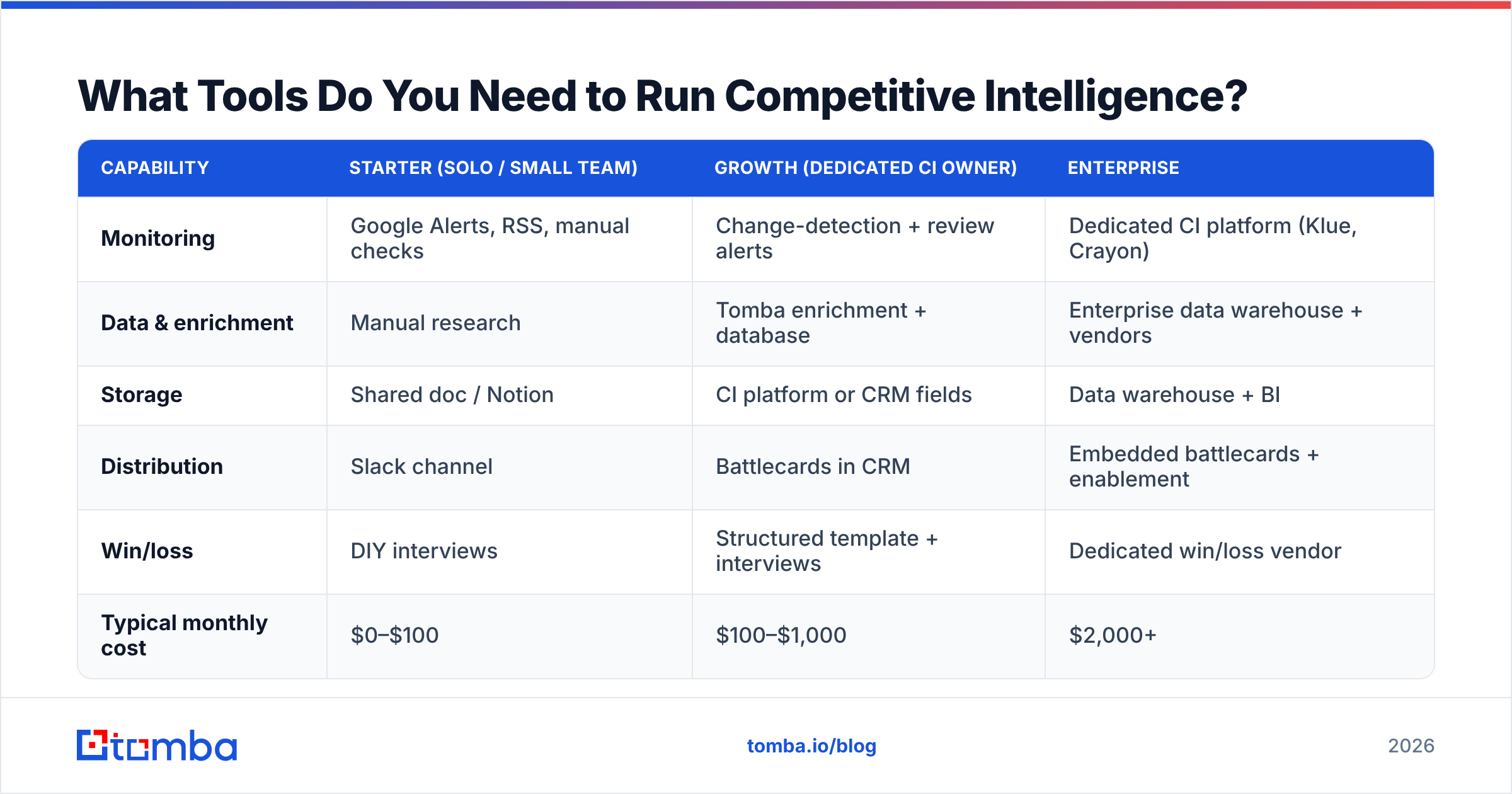
You don't need a 12-tool stack to start. You need coverage across four jobs: monitor, analyze, store, and distribute. Here's a lean, tiered view of what each maturity level actually uses.
| Capability | Starter (solo / small team) | Growth (dedicated CI owner) | Enterprise |
|---|---|---|---|
| Monitoring | Google Alerts, RSS, manual checks | Change-detection + review alerts | Dedicated CI platform (Klue, Crayon) |
| Data & enrichment | Manual research | Tomba enrichment + database | Enterprise data warehouse + vendors |
| Storage | Shared doc / Notion | CI platform or CRM fields | Data warehouse + BI |
| Distribution | Slack channel | Battlecards in CRM | Embedded battlecards + enablement |
| Win/loss | DIY interviews | Structured template + interviews | Dedicated win/loss vendor |
| Typical monthly cost | $0–$100 | $100–$1,000 | $2,000+ |
The mistake most teams make is buying an expensive CI platform before they've built the habit. Start in the Starter column, prove the win-rate lift, then upgrade. The habit is the asset; the software just scales it.
For the data layer specifically, keeping your competitor and prospect records accurate is where cheap wins hide. Tomba's pricing starts with a free tier (25 searches/month), then Starter at $49/month and Growth at $99/month — enough to enrich a competitive account list without an enterprise contract.
How Do You Turn Intelligence Into Battlecards Reps Actually Use?#
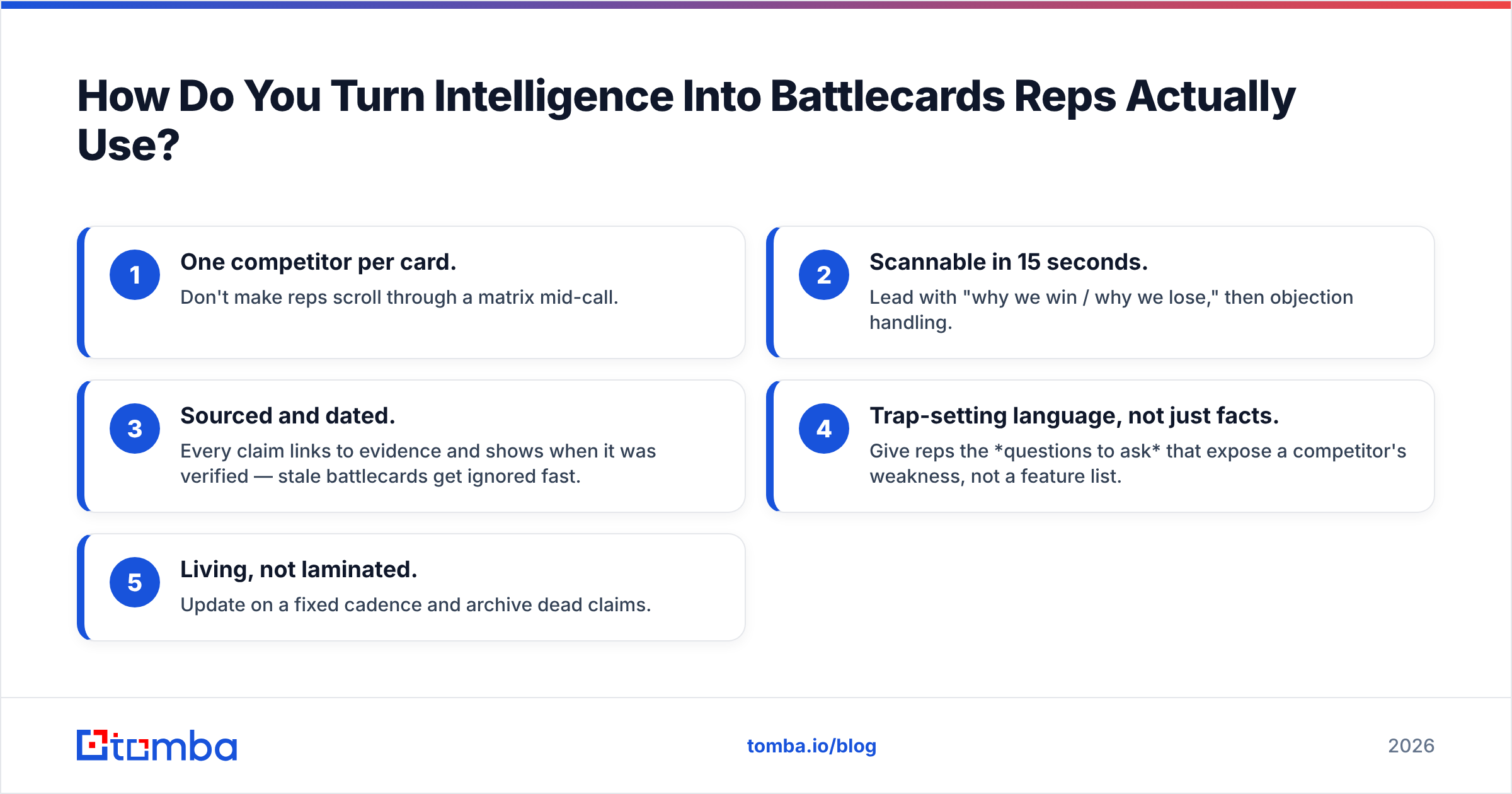
A battlecard is CI's last mile. If reps don't open it, none of the collection mattered. The best battlecards share five traits:
- One competitor per card. Don't make reps scroll through a matrix mid-call.
- Scannable in 15 seconds. Lead with "why we win / why we lose," then objection handling.
- Sourced and dated. Every claim links to evidence and shows when it was verified — stale battlecards get ignored fast.
- Trap-setting language, not just facts. Give reps the questions to ask that expose a competitor's weakness, not a feature list.
- Living, not laminated. Update on a fixed cadence and archive dead claims.
A practical test: hand a new rep the battlecard and a fake competitive objection. If they can respond confidently in under a minute using only the card, it works. If they hesitate, it's too dense.
What Are the Most Common Competitive Intelligence Mistakes?#
Even well-funded programs trip on the same rocks. Watch for these:
- Collecting without distributing. The insight sits in a doc the field never opens. Fix distribution before you add more sources.
- Chasing every competitor. Focus on the three to five that show up in real deals.
- Trusting a single unverified source. One rep's hallway rumor becomes "fact" and reps repeat it until a prospect corrects them.
- Treating CI as a project, not a program. A one-time teardown is stale in a quarter. Cadence is everything.
- Ignoring data quality. Building analysis on decayed contact and firmographic data — dead emails, wrong titles — quietly corrupts every downstream conclusion.
- Skipping the ethics conversation. One aggressive intern misrepresenting themselves can create a legal and reputational mess. Set the rules explicitly.
How Do You Measure Competitive Intelligence ROI?#
Tie CI to revenue metrics your executives already track, so the program defends its own budget:
- Competitive win rate — win rate specifically in deals where a tracked competitor is present. The headline number.
- Deal velocity in competitive deals — are competitive deals closing faster after battlecard rollout?
- Battlecard engagement — views and usage per rep. Low usage is an early warning.
- Influenced pipeline — pipeline touched by a CI asset or intervention.
- Loss-reason accuracy — the gap between rep-reported and buyer-reported loss reasons shrinking over time.
Report these quarterly against a baseline. A CI program that can show "competitive win rate up seven points" will never struggle for headcount.
Frequently Asked Questions#
Is competitive intelligence legal? Yes, when you use publicly available, purchased, or freely shared information and never misrepresent yourself or use trade secrets. Follow the SCIP ethics code and you're on firm ground.
How often should battlecards be updated? Refresh tactical battlecards at least monthly, and immediately when a competitor makes a major move (pricing change, acquisition, big launch). Date every card so reps can judge freshness.
Who should own competitive intelligence? In most B2B orgs, product marketing owns CI, with sales as the primary internal customer. Small teams often assign it to a single RevOps or PMM owner rather than a dedicated hire.
What's the difference between competitive intelligence and market research? Market research is broad and periodic (market sizing, trends). Competitive intelligence is narrow, continuous, and action-oriented — it changes what your reps do this week.
Put Your Competitive Intelligence on a Clean Data Foundation#
Great competitive intelligence lives or dies on the quality of the data underneath it — the accounts you map, the buyers you interview, the contacts you reach. If your win/loss list is full of dead emails and outdated titles, your best-designed program will draw the wrong conclusions.
That's the gap Tomba's Email Finder closes. Build and verify accurate contact lists for your competitive accounts, enrich your win/loss panel with real decision-makers, and keep your CRM firmographics honest — starting on the free tier and scaling as your program proves its win-rate lift. Clean data in, sharper intelligence out. Start finding verified contacts free and give your battlecards something true to stand on.
Related guides#
// get started
Find, verify and enrich your first contacts today
Start on the free plan with 25 searches a month, then scale when your team is ready.
Free plan · No credit card required · GDPR & CCPA
// about the author