Competitive Intelligence for B2B Sales: A 2026 Field Guide
Most B2B reps lose deals they never knew were competitive. This field guide shows how to build a competitive intelligence engine that feeds your pipeline with signals, battlecards, and data reps actually use.
TL;DR
- Competitive intelligence for B2B sales is the ongoing work of collecting, verifying, and distributing information about your rivals, your market, and your buyers — so reps walk into every deal already knowing the score.
- Most teams confuse "watching competitors" with intelligence. Real CI is a loop: collect signals, verify them, package them into battlecards, and measure whether win rates actually move.
- The biggest lever is not more data — it's fresh, accurate contact and account data that tells you who to reach and when a competitor is vulnerable.
- Battlecards, win/loss analysis, and trigger-event monitoring are the three programs that pay for themselves fastest.
- You can start lean: a spreadsheet, a verified prospect list, and a weekly review beat an expensive platform nobody updates.
What is competitive intelligence for B2B sales?#
Competitive intelligence for B2B sales is the discipline of turning scattered market signals into decisions your reps can act on inside a live deal. Think of it like a pit crew during a race: the driver (your rep) is focused on the road, while the crew feeds them tire data, weather, and rival lap times so they brake and accelerate at the right moment. Without that feed, the driver is guessing.
Technically, CI spans three overlapping layers:
- Competitor intelligence — pricing, positioning, product gaps, and how rivals actually sell in the room.
- Market intelligence — category trends, regulation, funding, and buyer sentiment shifts.
- Buyer / account intelligence — who the account is, what they use today, and what event just made them a buyer.
The mistake teams make is treating CI as a marketing research project that produces a PDF once a quarter. In B2B sales, intelligence has a short shelf life. A funding round, a leadership change, or a competitor's price hike is only useful if it reaches the rep this week, tied to a named account and a verified contact.
Why does competitive intelligence matter more in 2026?#
Because buyers now self-educate before they ever talk to you. Gartner has long reported that B2B buyers spend the majority of their journey researching independently and only a sliver of it with any single sales rep. That means by the time a prospect books a call, they have already shortlisted competitors, absorbed their messaging, and formed objections you have never heard.
CI closes that gap. It lets you:
- Anticipate the competitive set before the first call instead of discovering it at "we're also evaluating X."
- Neutralize objections that are really competitor talking points in disguise.
- Time outreach to trigger events — a rival's outage, a contract renewal window, a new VP with a mandate to change vendors.
- Protect existing accounts from competitors circling your own base.
The teams winning in 2026 are not the ones with the most dashboards. They are the ones who connect a real-time signal ("this account's competitor just raised prices 20%") to a verified decision-maker's inbox within days. That connection is only as good as your underlying data enrichment and contact accuracy.
What are the main types of competitive intelligence?#
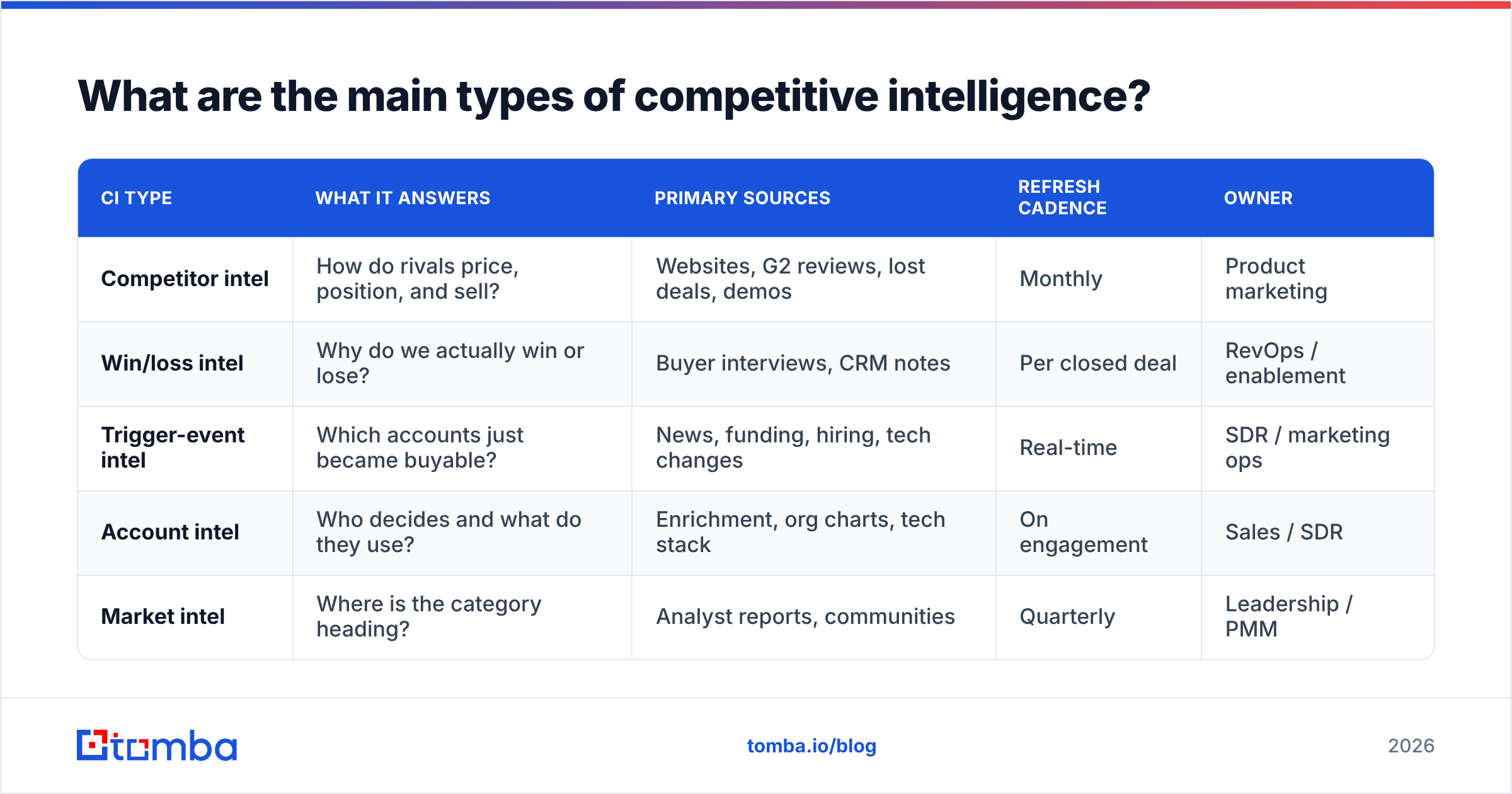
Not all CI is equal, and each type demands a different collection method and cadence. Here is how the core categories compare.
| CI type | What it answers | Primary sources | Refresh cadence | Owner |
|---|---|---|---|---|
| Competitor intel | How do rivals price, position, and sell? | Websites, G2 reviews, lost deals, demos | Monthly | Product marketing |
| Win/loss intel | Why do we actually win or lose? | Buyer interviews, CRM notes | Per closed deal | RevOps / enablement |
| Trigger-event intel | Which accounts just became buyable? | News, funding, hiring, tech changes | Real-time | SDR / marketing ops |
| Account intel | Who decides and what do they use? | Enrichment, org charts, tech stack | On engagement | Sales / SDR |
| Market intel | Where is the category heading? | Analyst reports, communities | Quarterly | Leadership / PMM |
The highest-ROI programs for a sales org are usually win/loss and trigger-event intelligence, because they map directly onto pipeline. Market intel is important but strategic — it changes your bets over quarters, not your calls this week.
How do you build a competitive intelligence program that reps actually use?#
Follow a five-step loop. The word loop matters — CI dies the moment it becomes a one-time project.
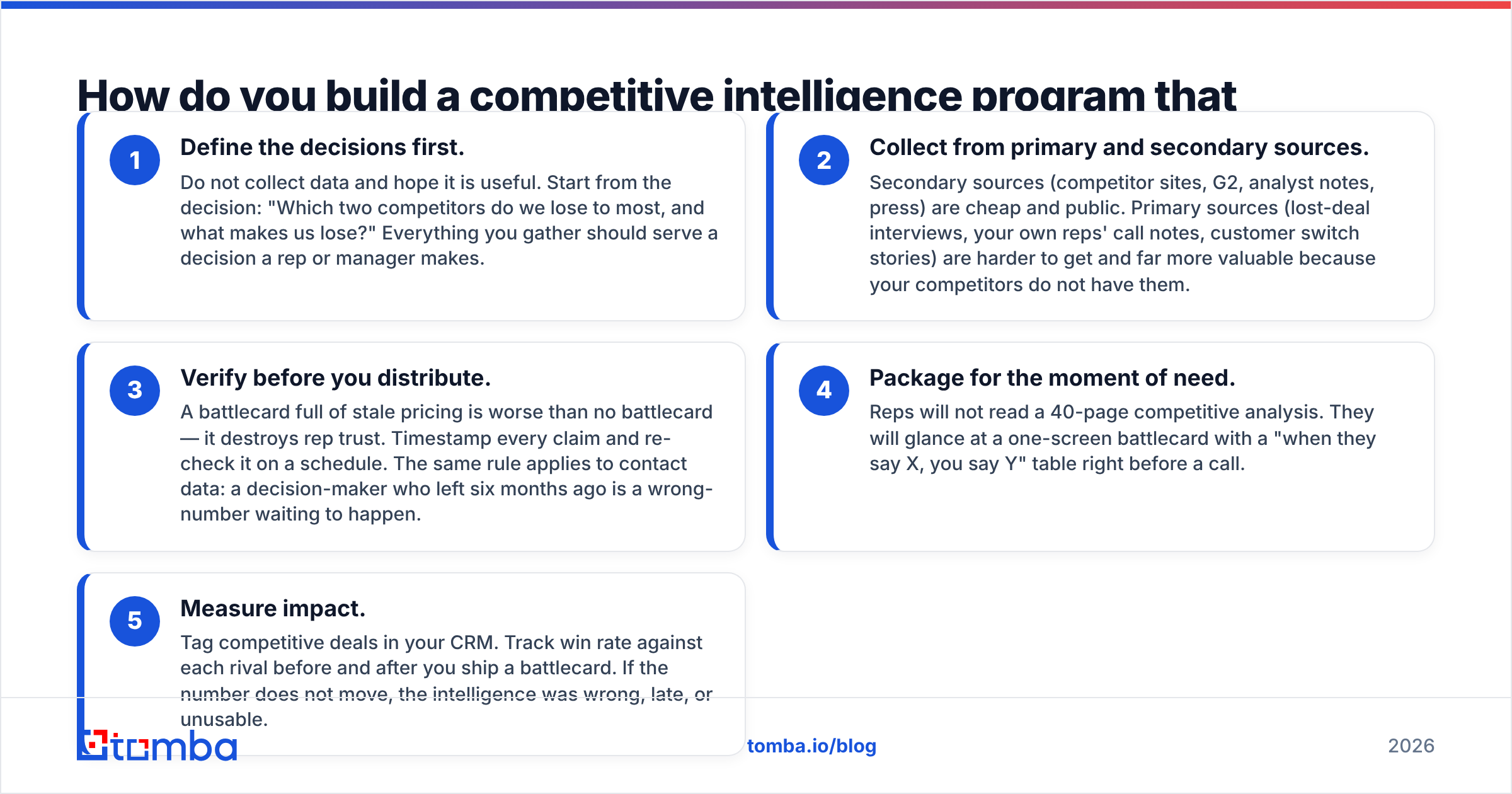
Define the decisions first. Do not collect data and hope it is useful. Start from the decision: "Which two competitors do we lose to most, and what makes us lose?" Everything you gather should serve a decision a rep or manager makes.
Collect from primary and secondary sources. Secondary sources (competitor sites, G2, analyst notes, press) are cheap and public. Primary sources (lost-deal interviews, your own reps' call notes, customer switch stories) are harder to get and far more valuable because your competitors do not have them.
Verify before you distribute. A battlecard full of stale pricing is worse than no battlecard — it destroys rep trust. Timestamp every claim and re-check it on a schedule. The same rule applies to contact data: a decision-maker who left six months ago is a wrong-number waiting to happen.
Package for the moment of need. Reps will not read a 40-page competitive analysis. They will glance at a one-screen battlecard with a "when they say X, you say Y" table right before a call.
Measure impact. Tag competitive deals in your CRM. Track win rate against each rival before and after you ship a battlecard. If the number does not move, the intelligence was wrong, late, or unusable.
The battlecard is the deliverable that matters most#
If you build one artifact, build the battlecard. A strong B2B sales battlecard fits on a single screen and contains:
- Competitor snapshot — one line on who they are and who they target.
- Where we win — three defensible advantages, each with proof.
- Where they win — honest weaknesses on your side, with a reframe.
- Landmines — questions your rep can plant that expose the competitor's gaps.
- Objection handling — the "they say / you say" table.
- Proof — a customer who switched, with a metric.
Keep it honest. Reps can smell spin, and so can buyers. A battlecard that admits "they have a better native reporting UI, but here's why our API wins for your use case" is far more credible than one that claims you win everywhere.
How does data quality decide whether CI works?#
Competitive intelligence is only as good as the data underneath it — and in B2B, the two data types that break most often are account data and contact data.
Here is the failure mode. Your CI team surfaces a perfect signal: a target account just churned from your biggest competitor. Great. Now a rep needs to reach the person who made that decision. If your CRM has the wrong title, an outdated email, or no direct line, the signal dies on the vine. You had the intelligence and still lost the window.
This is where a reliable B2B database and verified contact discovery turn intelligence into action. When a trigger fires, you want to:
- Identify the real decision-maker (not the gatekeeper) at the account.
- Pull a verified, deliverable email so your outreach lands.
- Enrich the record with role, seniority, and tech stack to personalize the pitch.
Tools like the Tomba Email Finder and account-level data enrichment exist for exactly this last mile. And when a competitor is quietly poaching visitors from your own site, website visitor reveal can tell you which anonymous accounts are in-market before they ever fill out a form.
Which competitive intelligence tools should B2B sales teams consider?#
There is a spectrum from dedicated CI platforms to the data layer that feeds them. Most teams need a mix: something to organize battlecards, and something to supply accurate contacts and account signals. Here is how common options compare.
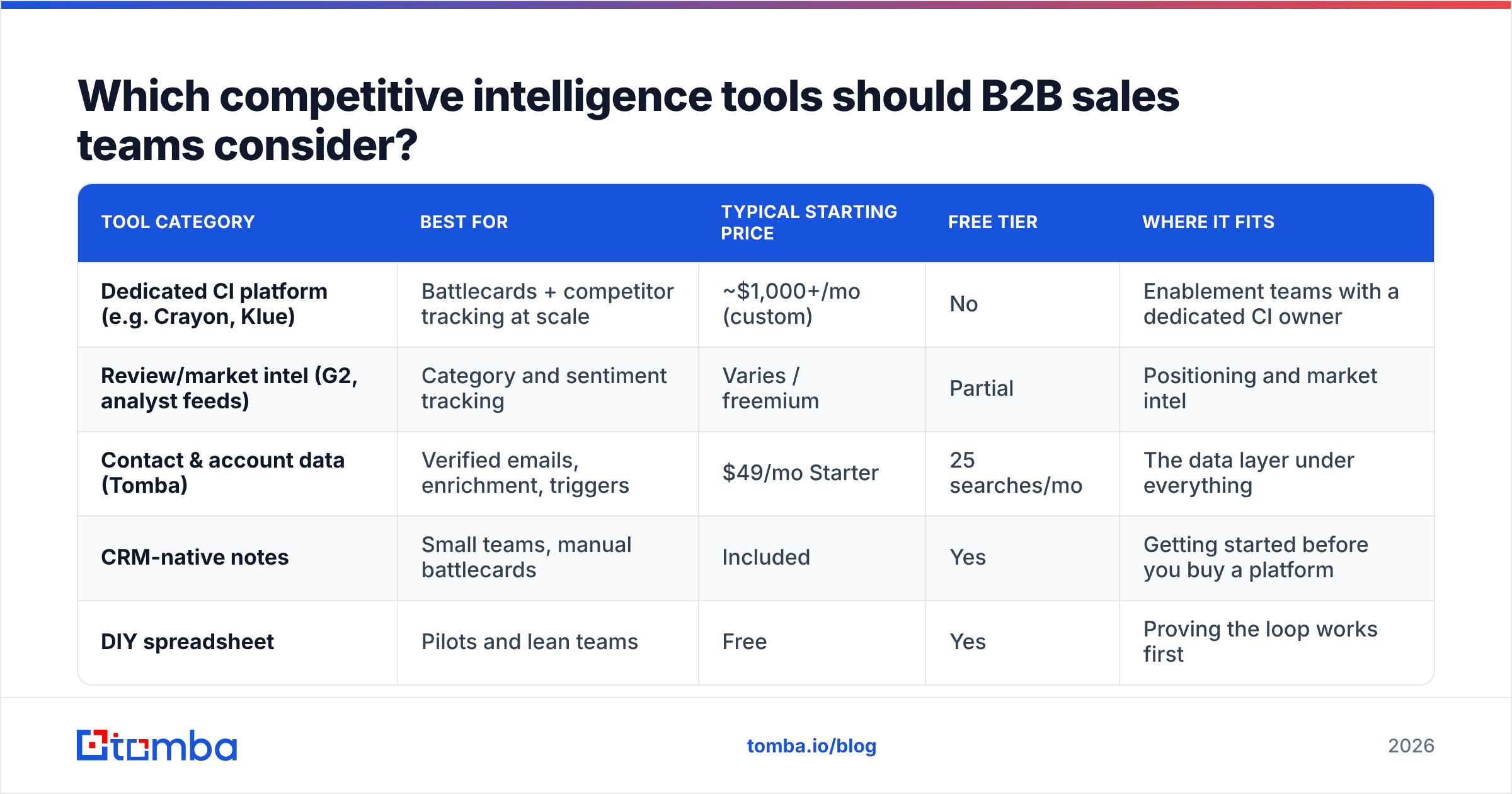
| Tool category | Best for | Typical starting price | Free tier | Where it fits |
|---|---|---|---|---|
| Dedicated CI platform (e.g. Crayon, Klue) | Battlecards + competitor tracking at scale | ~$1,000+/mo (custom) | No | Enablement teams with a dedicated CI owner |
| Review/market intel (G2, analyst feeds) | Category and sentiment tracking | Varies / freemium | Partial | Positioning and market intel |
| Contact & account data (Tomba) | Verified emails, enrichment, triggers | $49/mo Starter | 25 searches/mo | The data layer under everything |
| CRM-native notes | Small teams, manual battlecards | Included | Yes | Getting started before you buy a platform |
| DIY spreadsheet | Pilots and lean teams | Free | Yes | Proving the loop works first |
A quick note on platforms: dedicated CI tools like Crayon are excellent at organizing and distributing intelligence, but they do not find your prospects' contact details or verify deliverability — that is a separate data problem. Pairing a battlecard platform with an accurate contact source is the pattern most high-performing teams land on.
On pricing, resist the urge to buy the biggest platform first. Tomba's own tiers illustrate the "start lean" principle: a Free plan (25 searches/month), then Starter at $49/mo and Growth at $99/mo — see the full Tomba pricing breakdown. Prove the loop with cheap tools, then scale the budget once win rates move.
How do you turn competitive signals into pipeline?#
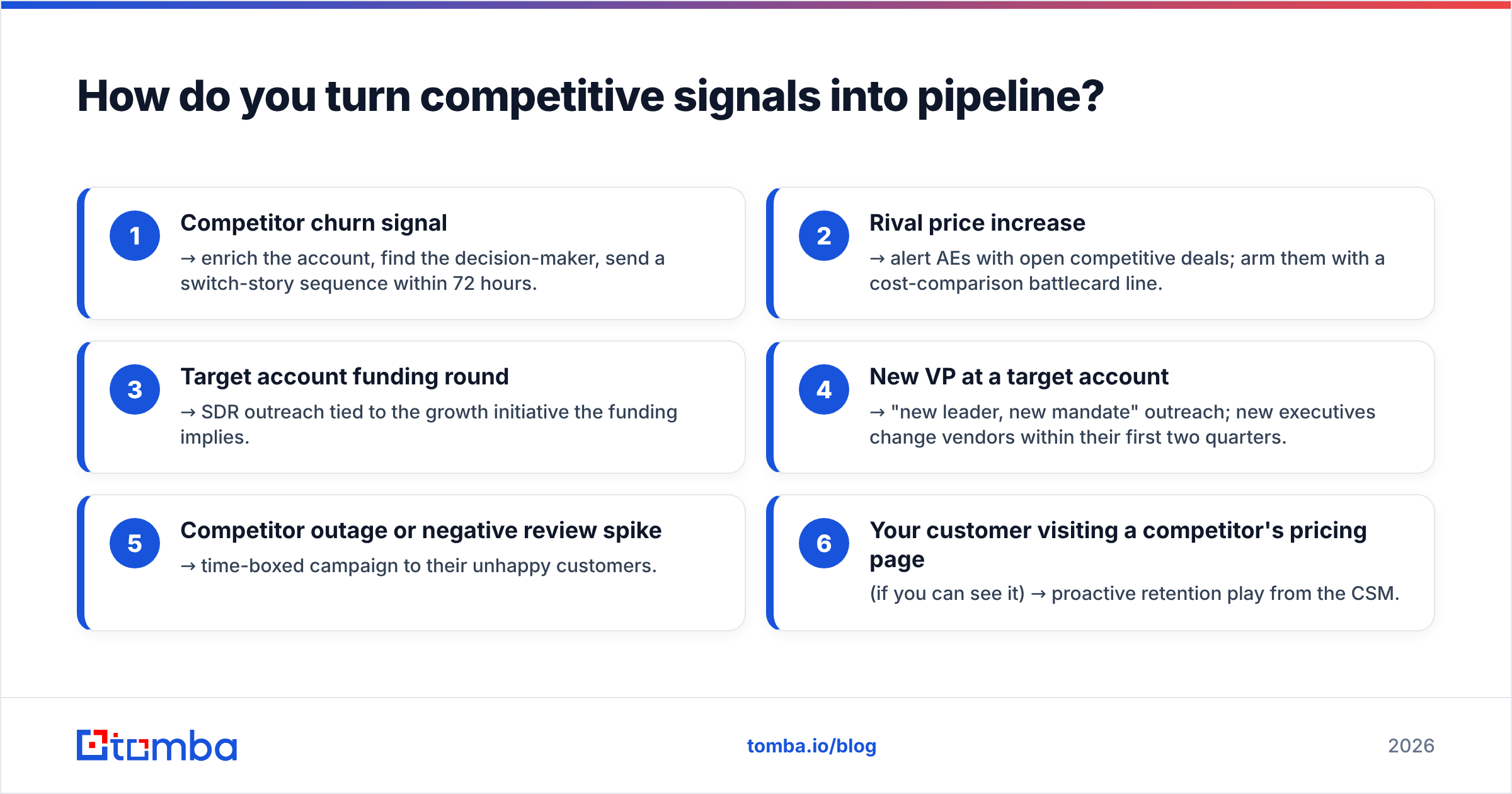
Signals are worthless until they are routed to a rep with a next action. Build a simple routing table so no signal falls through:
- Competitor churn signal → enrich the account, find the decision-maker, send a switch-story sequence within 72 hours.
- Rival price increase → alert AEs with open competitive deals; arm them with a cost-comparison battlecard line.
- Target account funding round → SDR outreach tied to the growth initiative the funding implies.
- New VP at a target account → "new leader, new mandate" outreach; new executives change vendors within their first two quarters.
- Competitor outage or negative review spike → time-boxed campaign to their unhappy customers.
- Your customer visiting a competitor's pricing page (if you can see it) → proactive retention play from the CSM.
Each of these depends on two things working together: a fresh signal and a verified way to reach the right human. HubSpot's own research on sales productivity keeps landing on the same point — reps waste enormous time on bad data and manual lookups; see HubSpot's sales resources for the recurring theme. CI removes the "who and when" guesswork; accurate data removes the "how do I reach them" friction.
What are the most common competitive intelligence mistakes?#
- Collecting without deciding. A dashboard nobody acts on is a cost, not an asset. Start from the decision.
- Letting battlecards rot. Stale intel is worse than none. Put a review date on every card and every data field.
- Spying instead of learning. The best CI comes from your own lost deals and switch stories, not from screenshotting a competitor's homepage.
- Ignoring data hygiene. The perfect signal routed to a bounced email is a wasted signal. Verify contacts as rigorously as you verify competitor claims.
- Buying the platform before proving the process. Teams routinely spend five figures on CI software before they have run a single win/loss interview. Do the manual version first.
- Treating protected peers as villains. Not every competitor is an enemy — many are partners or complementary. Framing every rival as the "bad guy" makes your battlecards feel dishonest and your reps look desperate.
How do you measure competitive intelligence ROI?#
Tie CI to numbers your CFO already tracks:
- Competitive win rate — win % on deals tagged competitive, trended monthly. This is the headline metric.
- Deal velocity in competitive deals — do reps advance stages faster when armed with a battlecard?
- Displacement rate — how often you win by replacing an incumbent competitor.
- Signal-to-action time — hours between a trigger firing and a rep taking action. Shrinking this is a direct CI win.
- Data accuracy — bounce rate and connect rate on outreach, since intelligence routed to bad contacts produces zero pipeline.
If competitive win rate climbs and signal-to-action time drops, your program is working. If they are flat after a quarter, your intelligence is late, wrong, or trapped in a document nobody opens.
Where should you start next week?#
Start small and prove the loop. Pick your top two competitors. Interview the last five deals you lost to them. Build one honest battlecard per competitor. Wire up three trigger events into a shared channel. And make sure that every signal ends with a verified contact and a next action, not a shrug.
The intelligence half of that equation is process. The execution half is data — knowing exactly who to reach the moment a competitor becomes vulnerable. That is where a verified contact source earns its keep. Use the Tomba Email Finder to turn every competitive signal into a real, deliverable conversation with the decision-maker who can switch. Intelligence tells you the window is open; accurate data lets you walk through it before your competitor even knows it's there.
Related guides#
Ready to find emails that actually work?
Join 150,000+ professionals who stopped guessing and started sending. Free credits on signup — no credit card required.
Get the Tomba newsletter
Practical outbound tactics and product updates — once every two weeks.
About the author