How to Build a Competitive Intelligence Report in 2026 (Template)
A competitive intelligence report is only useful if it changes a decision. Here's the exact structure, sourcing workflow, and free template to build one your GTM team will actually read.
Most competitive intelligence reports die in a shared drive. Someone spends two weeks assembling a beautiful deck on a rival, presents it once, and nobody opens it again. The problem is rarely the research — it's that the report was built to inform instead of to decide.
A competitive intelligence report is a structured document that turns scattered signals about your rivals — pricing moves, product launches, hiring, messaging, win/loss patterns — into decisions your go-to-market team can act on this quarter. This guide gives you the exact structure, the sourcing workflow, and a reusable template so your next report changes a roadmap, a pitch, or a pricing page instead of gathering dust.
TL;DR#
- A competitive intelligence report should map to a decision. If no one can name the decision it supports, you built a research artifact, not a CI report.
- Use a fixed structure: executive summary, battlecard-ready takeaways, deep dives per competitor, and a "so what / now what" action list.
- Source from three tiers — public signals (pricing pages, job posts, changelogs), first-party signals (win/loss, sales-call notes), and enriched contact data on their team and customers.
- Update it on a cadence (monthly or per-launch), not once a year. Stale CI is worse than none because people trust it.
- Distribution beats depth. A one-page battlecard that reps actually use outperforms a 40-slide deck no one opens.
What is a competitive intelligence report?#
Think of a competitive intelligence report as the scouting report a pro sports team hands its players before a game. It doesn't list every fact about the opponent — it highlights the three plays they run, the weakness to exploit, and exactly what to do when you're on the field. Technically, it's a synthesized document that collects, verifies, and interprets competitor signals so that sales, marketing, product, and leadership can make faster, better decisions.
The key word is synthesized. Raw data — a screenshot of a rival's pricing page, a LinkedIn post about a new hire — is not intelligence. Intelligence is the interpretation: "They just hired three enterprise AEs and moved their cheapest plan behind a 'contact sales' wall, which signals a move upmarket and an opening for us in the self-serve SMB segment."
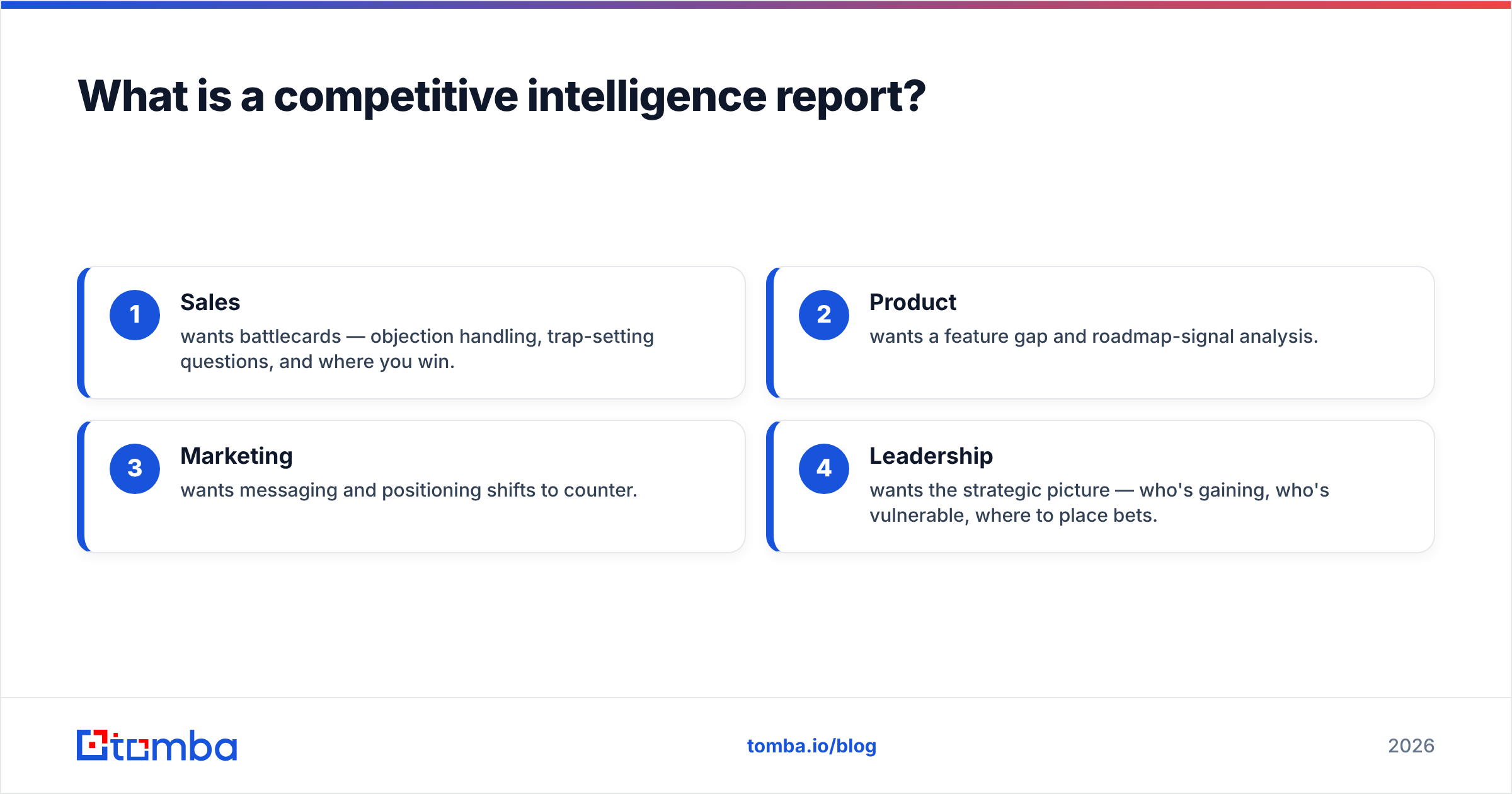
Good CI reports serve four audiences, and each wants something different:
- Sales wants battlecards — objection handling, trap-setting questions, and where you win.
- Product wants a feature gap and roadmap-signal analysis.
- Marketing wants messaging and positioning shifts to counter.
- Leadership wants the strategic picture — who's gaining, who's vulnerable, where to place bets.
If your report tries to serve all four with the same undifferentiated wall of text, it serves none of them.
What should a competitive intelligence report include?#
Structure is what separates a report people use from a document people skim. Every effective competitive intelligence report contains the same core sections, in roughly this order:
- Executive summary (one page max). The three to five decisions this report supports, up top. Write it last, read it first.
- Competitor profiles. For each rival: positioning, target segment, pricing, recent moves, and a one-line "threat level" verdict.
- Head-to-head comparison. A table your reps can lift directly into deals (see the example below).
- Win/loss themes. Why you're winning and losing against each competitor, sourced from real deal data — not vibes.
- Signals and predictions. What their recent hiring, funding, changelog, and messaging changes suggest is coming next.
- Action list ("now what"). Specific owners and dates. This is the section that justifies the whole report.
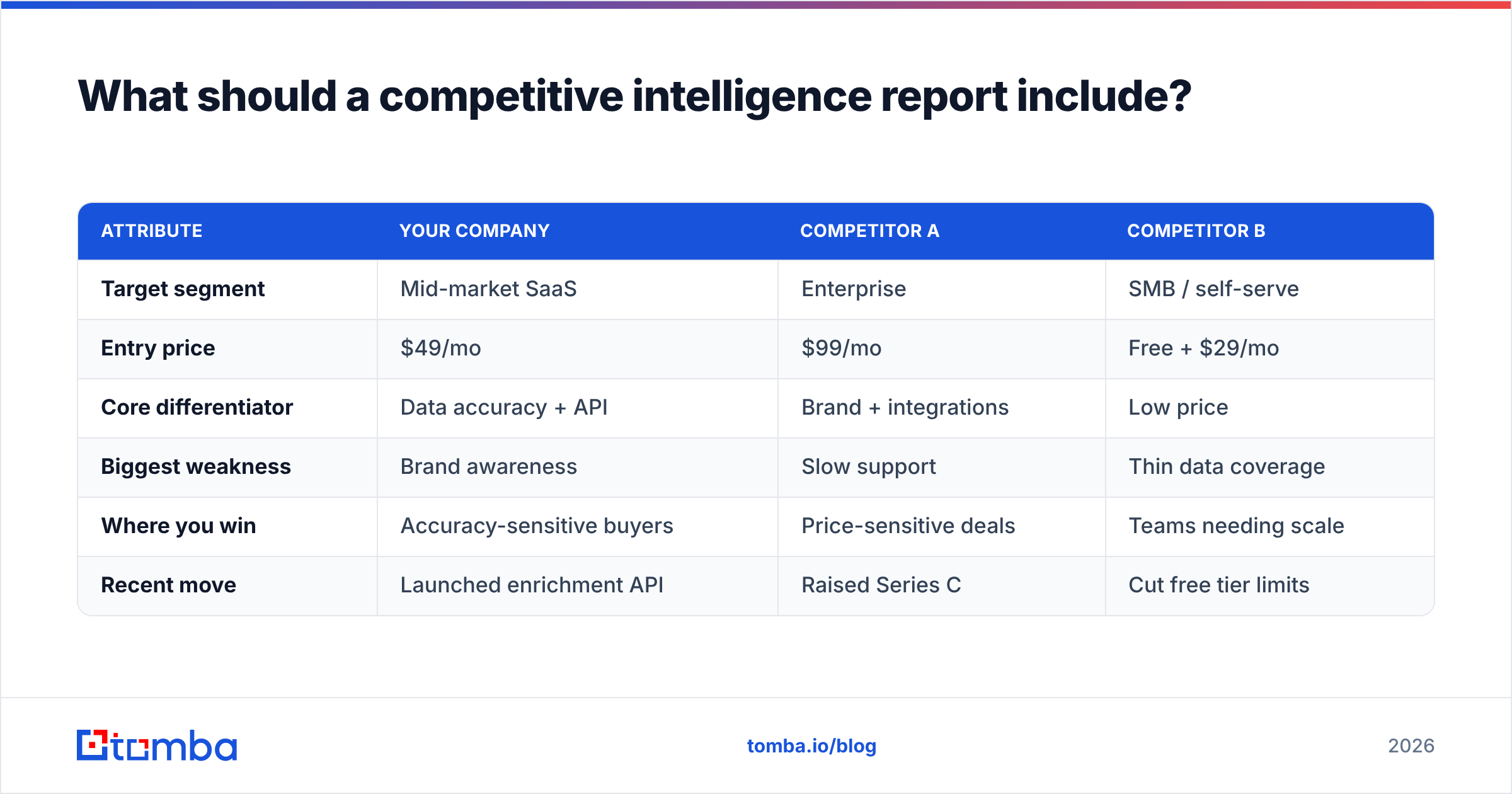
The comparison table is the workhorse. Here's the shape it should take:
| Attribute | Your Company | Competitor A | Competitor B |
|---|---|---|---|
| Target segment | Mid-market SaaS | Enterprise | SMB / self-serve |
| Entry price | $49/mo | $99/mo | Free + $29/mo |
| Core differentiator | Data accuracy + API | Brand + integrations | Low price |
| Biggest weakness | Brand awareness | Slow support | Thin data coverage |
| Where you win | Accuracy-sensitive buyers | Price-sensitive deals | Teams needing scale |
| Recent move | Launched enrichment API | Raised Series C | Cut free tier limits |
Notice that every row is actionable in a sales conversation. "Where you win" and "biggest weakness" aren't neutral facts — they're the ammunition a rep needs when a prospect says "we're also looking at Competitor A."
Where do you get the data for a CI report?#
Sourcing is where most reports either become gold or become guesswork. Organize your inputs into three tiers, from easiest to hardest to obtain but roughly increasing in value.
Tier 1 — Public signals (free, always-on). These are the breadcrumbs competitors leave in the open:
- Pricing and product pages — track changes over time; a removed free tier or a new "Enterprise" plan is a strategy signal.
- Job postings — the fastest leading indicator of strategy. Hiring five security engineers? They're chasing SOC 2 and enterprise deals.
- Changelogs, release notes, and status pages — reveal roadmap velocity and reliability.
- Review sites — G2 and Capterra surface unfiltered customer complaints you can exploit.
- Funding and news — a raise tells you where the money — and the aggression — is about to go.
Tier 2 — First-party signals (private, high-trust). This is intelligence only your company has, and it's the most defensible:
- Win/loss interviews and CRM
Closed Lostreasons. - Sales call recordings — reps hear competitor claims in real time.
- Support tickets — churned-in customers tell you exactly why they left a rival.
Tier 3 — Enriched contact and org data. To go from "Competitor A exists" to "here are the 40 accounts they just poached and the buyer who signed off," you need real contact data. This is where an email finder and data enrichment workflow pays off — mapping a rival's org chart, identifying their key hires, or building a target list of their customers you can win back. A domain search across a competitor's domain surfaces their team structure faster than manual LinkedIn scrolling, and enrichment fills in the roles, seniority, and reachable contacts.
Always verify before you rely on Tier 3 data — a report built on stale contacts erodes trust fast. Running lists through an email verifier keeps your outreach targets clean and your report credible.
How is a competitive intelligence report different from market research?#
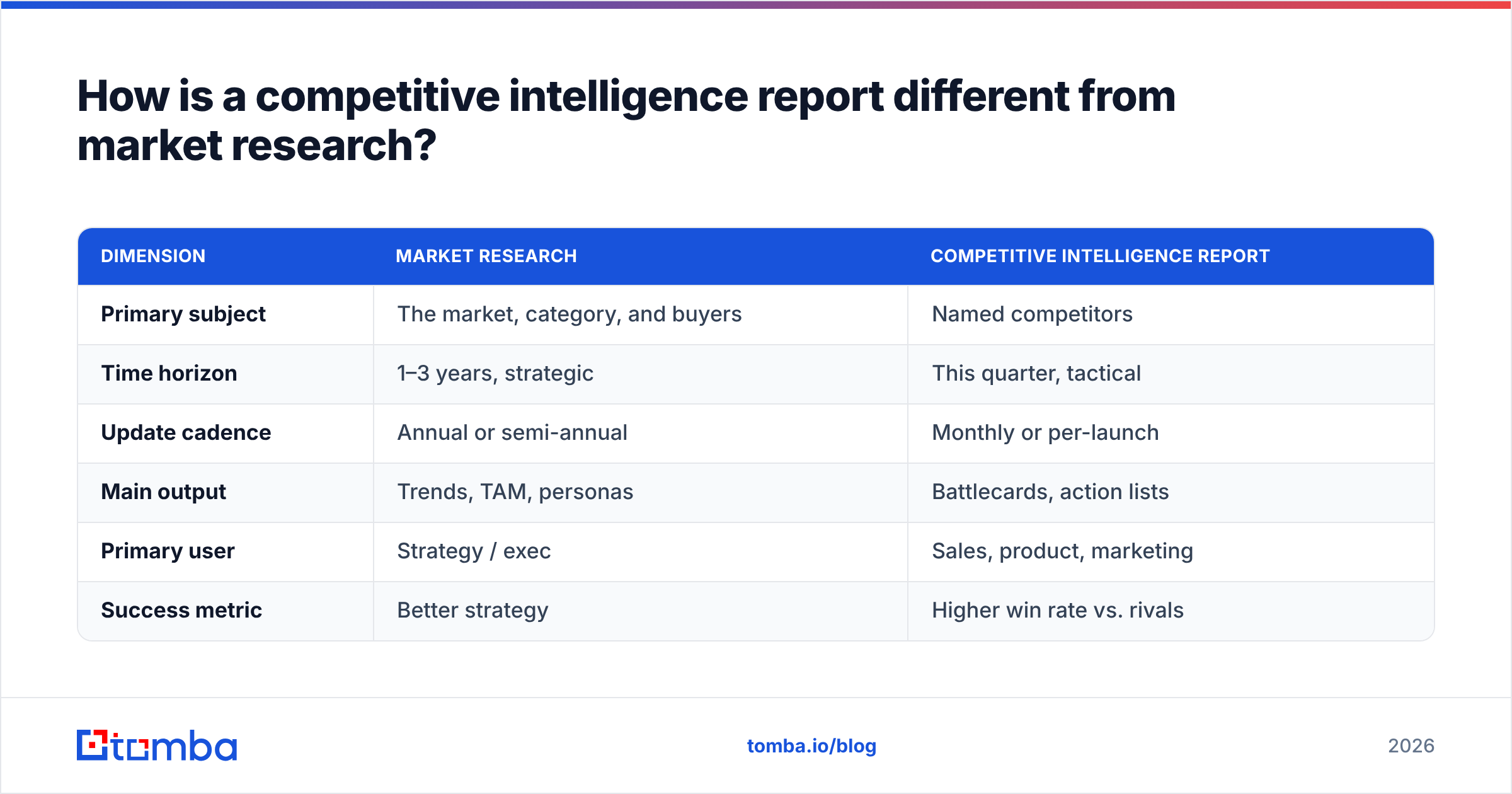
They overlap, but conflating them produces reports that are too broad to act on. The simplest distinction: market research studies the whole field and the buyer; competitive intelligence studies specific rivals and what to do about them.
| Dimension | Market Research | Competitive Intelligence Report |
|---|---|---|
| Primary subject | The market, category, and buyers | Named competitors |
| Time horizon | 1–3 years, strategic | This quarter, tactical |
| Update cadence | Annual or semi-annual | Monthly or per-launch |
| Main output | Trends, TAM, personas | Battlecards, action lists |
| Primary user | Strategy / exec | Sales, product, marketing |
| Success metric | Better strategy | Higher win rate vs. rivals |
You need both, but don't let a CI report drift into market-research territory. The moment your competitor deep-dive becomes a 30-page essay on "the future of the industry," you've lost the plot. Keep it about rivals and about decisions. For more on how CI feeds broader go-to-market planning, see how teams structure revenue operations around these inputs.
How often should you update it?#
Cadence is a feature, not an afterthought. A CI report is a living asset with a decay curve — pricing changes, people move, messaging shifts. Match your update rhythm to how fast your market moves:
- Monthly rollups for fast-moving categories (SaaS, martech, anything VC-funded and land-grabbing).
- Per-launch triggers — whenever a tracked competitor ships a major release or changes pricing, update within 48 hours while it's still fresh and useful.
- Quarterly deep dives — the full strategic re-assessment, threat re-ranking, and win/loss review.
- Real-time alerts for the highest-priority signals: funding, exec departures, and pricing-page changes. Automate these with monitoring tools so nothing critical slips.
The failure mode to avoid: the annual "big report" that's already stale by the time it's presented. Frequency and freshness beat depth. A team that trusts the CI report because it's always current will actually use it — and usage is the only metric that matters.
What tools do you need to build one?#
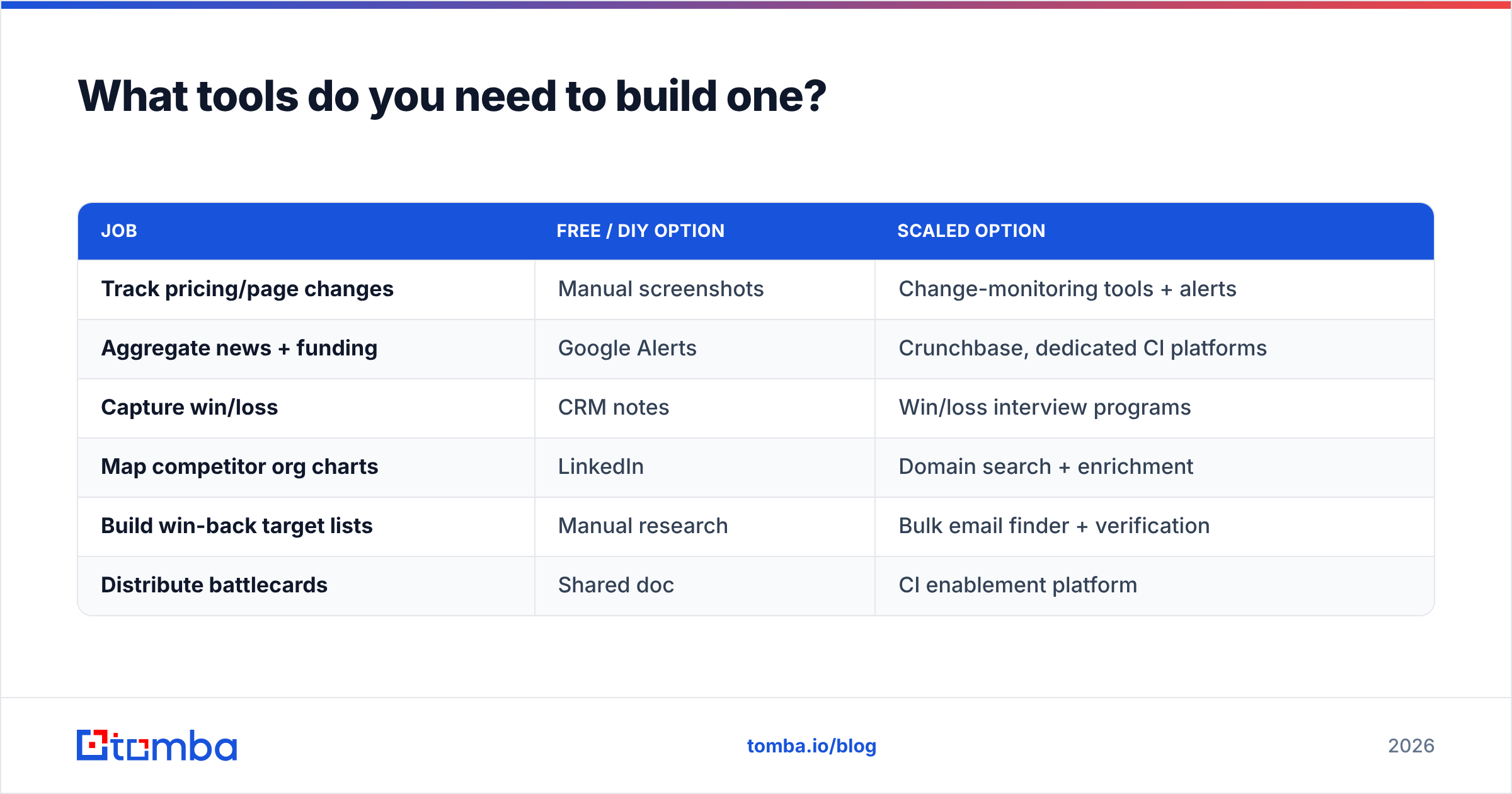
You can start with a spreadsheet and public signals, then layer in automation as the program matures. Here's a practical stack, mapped to the three sourcing tiers:
| Job | Free / DIY option | Scaled option |
|---|---|---|
| Track pricing/page changes | Manual screenshots | Change-monitoring tools + alerts |
| Aggregate news + funding | Google Alerts | Crunchbase, dedicated CI platforms |
| Capture win/loss | CRM notes | Win/loss interview programs |
| Map competitor org charts | Domain search + enrichment | |
| Build win-back target lists | Manual research | Bulk email finder + verification |
| Distribute battlecards | Shared doc | CI enablement platform |
You don't need to buy a $40k/year competitive-intelligence platform to start. Most teams get 80% of the value from disciplined public-signal tracking, a rigorous win/loss habit, and a reliable data layer for Tier 3. The tooling matters far less than the discipline of tying every finding to a decision. Vendors like HubSpot publish useful frameworks for operationalizing this inside a CRM if you want a starting template.
What are the most common mistakes?#
Even well-resourced teams botch CI in predictable ways. Watch for these:
- No decision attached. If a section doesn't change what someone does, cut it. "Interesting" is not "actionable."
- Recency bias. One loud competitor move gets over-weighted while a quiet, structural threat gets ignored.
- Single-source claims. "Their sales rep said X" is a hypothesis, not a fact. Verify against a second source before it goes in the report.
- Death by completeness. Trying to cover every competitor equally. Rank them; spend 80% of your effort on the two rivals that actually show up in deals.
- No distribution plan. The best report no one reads loses to a mediocre one-pager every rep keeps open in a browser tab.
The through-line: treat CI as a product with users, not a research project with a deadline. Ship small, ship often, and measure whether win rates against tracked competitors actually improve. That's the only scoreboard.
Build the data layer your CI report stands on#
A competitive intelligence report is only as credible as the data underneath it — and the hardest data to get is accurate, verified contact information on your rivals' teams and customers. That's the layer that turns a generic "they're moving upmarket" into a named, reachable, win-back-ready target list.
Tomba's Email Finder helps you map competitor org charts, identify their key hires, and build clean prospect lists from any domain — with a free tier of 25 searches/month to start and paid plans from $49/mo when you scale. Pair it with the email verifier so every contact in your report is real, and your next competitive intelligence report won't just inform your team — it'll change what they do on Monday.
Related guides#
Ready to find emails that actually work?
Join 150,000+ professionals who stopped guessing and started sending. Free credits on signup — no credit card required.
Get the Tomba newsletter
Practical outbound tactics and product updates — once every two weeks.
About the author