Competitive Intelligence Research: A 2026 Field Guide
Competitive intelligence research is how modern GTM teams turn scattered market signals into a real, defensible edge. Here's the framework, the tools, and a repeatable workflow you can run this quarter.
Competitive intelligence research used to be a quarterly slide deck nobody read. In 2026 it's a live operating system for go-to-market teams — the difference between reacting to a competitor's price cut three weeks late and knowing it's coming before your reps hear it on a call. This guide breaks down what competitive intelligence research actually is, how to run it without a six-figure vendor, and how to turn raw signals into decisions your revenue team can act on.
TL;DR#
- Competitive intelligence research is the systematic collection, analysis, and distribution of information about competitors, buyers, and market shifts — so your team decides faster than the other side.
- It splits into three buckets: strategic (market direction), tactical (deal-level battlecards), and counter-intelligence (protecting your own signals).
- The workflow is a loop: define questions → collect signals → verify → analyze → distribute → act. Skipping verification is where most programs quietly fail.
- You don't need a $60k platform to start. A disciplined stack of free sources, enrichment tools, and a shared doc beats an expensive tool nobody feeds.
- The hard part isn't gathering data — it's turning it into a one-line recommendation a rep or PM will actually use.
What is competitive intelligence research?#
Competitive intelligence (CI) research is the ethical, legal practice of gathering and analyzing information about your competitors, your market, and your buyers to inform decisions. Think of it like a chess player studying an opponent's past games: you're not cheating, you're just refusing to play blind.
The keyword is ethical. CI is not corporate espionage. It draws on public and semi-public sources — pricing pages, job postings, product changelogs, earnings calls, review sites, LinkedIn activity, and buyer conversations — and turns them into structured insight. According to Gartner's research on competitive intelligence, the teams that win consistently aren't the ones with more data; they're the ones who convert data into a decision fastest.
There are three distinct flavors of CI research, and confusing them is the most common early mistake:
- Strategic intelligence — Where is the market going? Which competitor is raising a round, entering a new segment, or sunsetting a product line? This feeds your annual planning and roadmap.
- Tactical intelligence — How do we win this deal against this competitor? This produces battlecards, objection handlers, and pricing counters your reps use live.
- Win/loss and counter-intelligence — Why did we win or lose the last 20 deals, and what signals are we leaking that competitors can read?
Most teams over-invest in strategic decks and under-invest in tactical battlecards — which is backwards, because tactical intelligence is what actually moves win rate this quarter.
Why does competitive intelligence research matter in 2026?#
Because the cost of being wrong went up. Buying cycles are longer, budgets are scrutinized harder, and a single competitor's feature launch can reset a category's expectations overnight. When your rep walks into a renewal call unaware that the incumbent just shipped the exact feature your customer asked for, you don't lose gracefully — you lose blindsided.
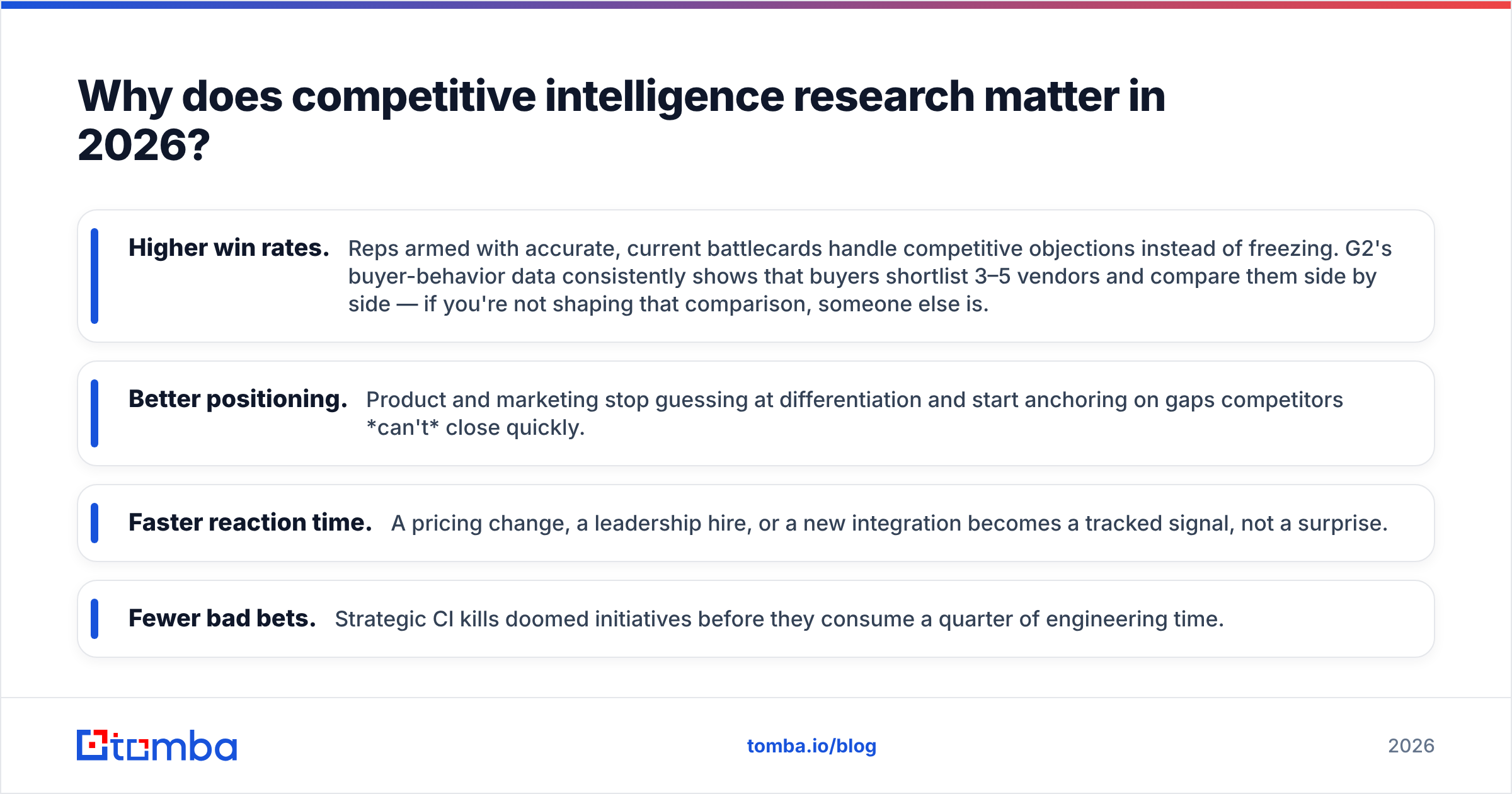
Here's what a functioning CI research program changes:
- Higher win rates. Reps armed with accurate, current battlecards handle competitive objections instead of freezing. G2's buyer-behavior data consistently shows that buyers shortlist 3–5 vendors and compare them side by side — if you're not shaping that comparison, someone else is.
- Better positioning. Product and marketing stop guessing at differentiation and start anchoring on gaps competitors can't close quickly.
- Faster reaction time. A pricing change, a leadership hire, or a new integration becomes a tracked signal, not a surprise.
- Fewer bad bets. Strategic CI kills doomed initiatives before they consume a quarter of engineering time.
The teams that treat this as an ongoing discipline — not a once-a-year audit — compound the advantage. Every loop through the cycle makes the next decision sharper.
How do you run a competitive intelligence research process?#
Run it as a loop, not a project. A project ends; a loop improves. Here is the six-stage cycle, with the failure mode that kills each stage.
1. Define the questions. Start with decisions, not data. "Should we match Competitor X's new $29 tier?" is a question. "Learn everything about Competitor X" is a black hole. Write down the 5–10 decisions your leadership actually faces this quarter and reverse-engineer the intelligence you need.
2. Identify and collect signals. Map each question to sources. Pricing questions → their pricing page + sales calls. Roadmap questions → changelog, job postings, conference talks. Buyer questions → review sites and win/loss interviews. This is where data enrichment earns its keep: a raw list of competitor employees becomes a map of who they're hiring, in which function, and how fast they're scaling a team.
3. Verify before you trust. This is the stage everyone skips and everyone regrets. A screenshot from a Reddit thread is a rumor, not intelligence. Cross-check every material claim against a second source. A competitor's job posting for "VP of Healthcare Sales" is a strong signal of vertical expansion — but confirm it against their content, their hires, and their partner announcements before you brief the CEO.
4. Analyze into a recommendation. Data isn't intelligence until it has a "so what." Every insight should compress to one line: "Competitor X is moving upmarket — expect them to deprioritize SMB, which is our opening." If you can't write that sentence, you haven't analyzed yet.
5. Distribute to the point of decision. A battlecard buried in a wiki nobody opens is worthless. Push intelligence into the tools where decisions happen — the CRM, the deal room, the Slack channel. Meet the rep where the deal is.
6. Act and measure. Tie CI to an outcome: competitive win rate, deal cycle length, or roadmap decisions influenced. What you don't measure, leadership will eventually defund.
What sources and tools should a CI research stack include?#
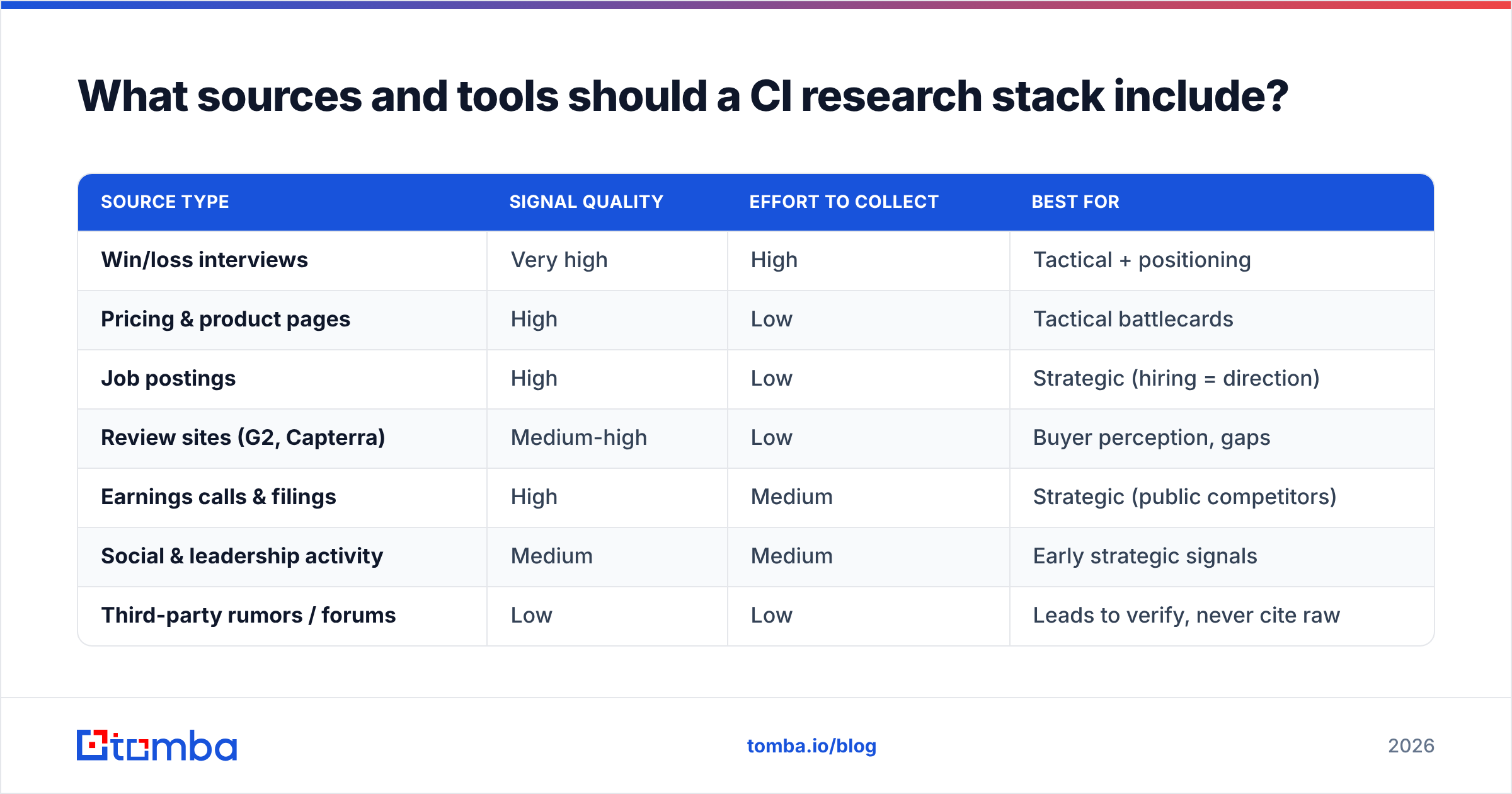
Your stack has two layers: sources (where signals come from) and tooling (how you collect, enrich, and distribute them). Below is a practical comparison of the source types most CI programs rely on, ranked by signal quality and effort.
| Source type | Signal quality | Effort to collect | Best for |
|---|---|---|---|
| Win/loss interviews | Very high | High | Tactical + positioning |
| Pricing & product pages | High | Low | Tactical battlecards |
| Job postings | High | Low | Strategic (hiring = direction) |
| Review sites (G2, Capterra) | Medium-high | Low | Buyer perception, gaps |
| Earnings calls & filings | High | Medium | Strategic (public competitors) |
| Social & leadership activity | Medium | Medium | Early strategic signals |
| Third-party rumors / forums | Low | Low | Leads to verify, never cite raw |
On the tooling side, resist the urge to buy a monolithic CI platform on day one. Most teams get further with a composable stack:
- Collection: browser extensions, alert tools, and scrapers to watch pricing pages and changelogs.
- Enrichment: a source of accurate contact and firmographic data so a name becomes a full profile. Tomba's B2B database and the Tomba API let you enrich competitor org charts, map decision-makers at target accounts, and feed structured records into your CI system programmatically.
- Storage & distribution: a shared doc or wiki to start, graduating to CRM-embedded battlecards as the program matures.
The point isn't to own every tool. It's to own the loop — and enrichment is the connective tissue that turns a flat list into a living map of who moved where.
What separates a DIY CI stack from an enterprise platform?#
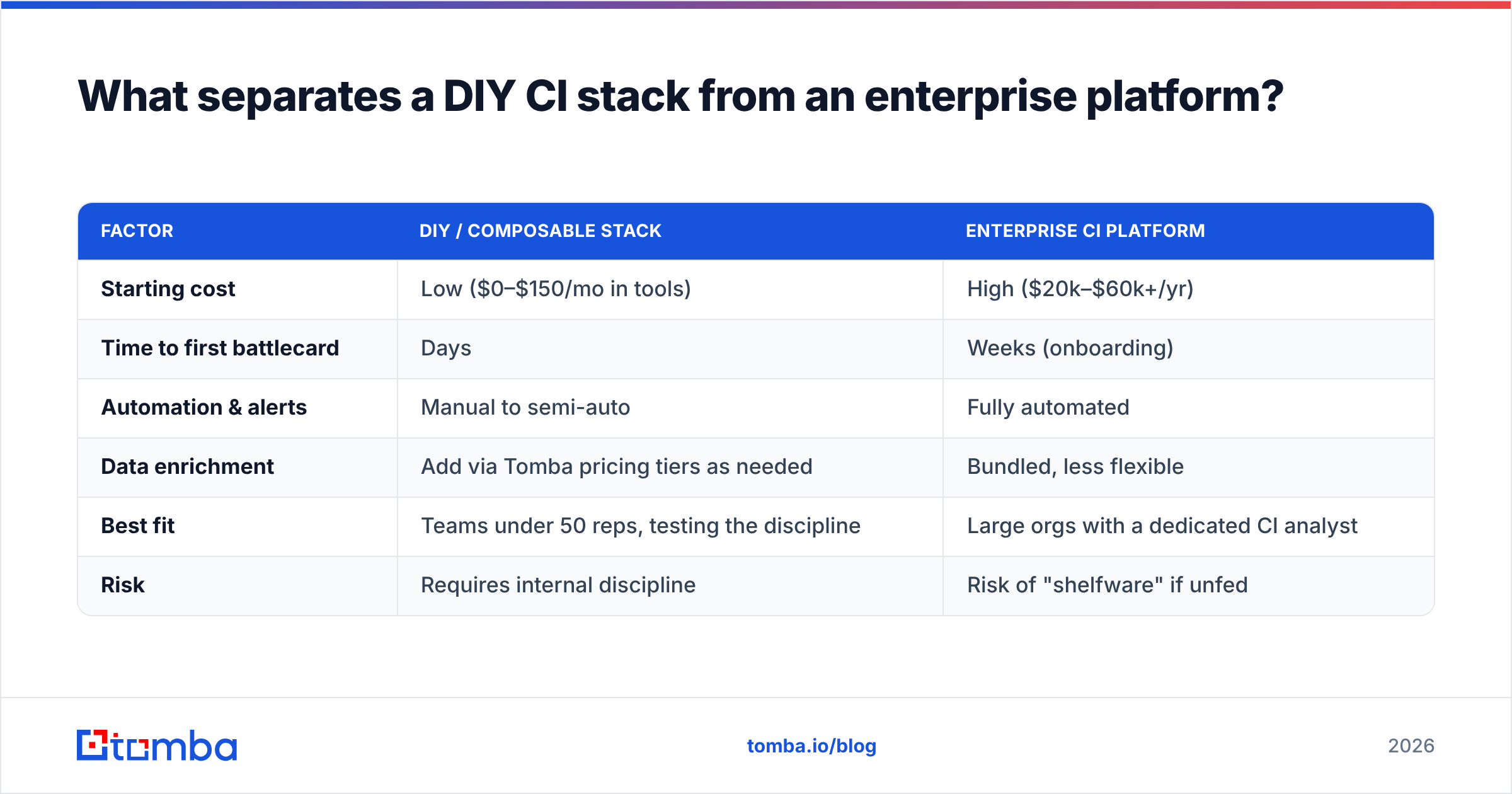
Buyers usually agonize over whether to buy a dedicated platform like Klue or Crayon or build their own. The honest answer: it depends on maturity, not budget. Here's the tradeoff laid out.
| Factor | DIY / composable stack | Enterprise CI platform |
|---|---|---|
| Starting cost | Low ($0–$150/mo in tools) | High ($20k–$60k+/yr) |
| Time to first battlecard | Days | Weeks (onboarding) |
| Automation & alerts | Manual to semi-auto | Fully automated |
| Data enrichment | Add via Tomba pricing tiers as needed | Bundled, less flexible |
| Best fit | Teams under 50 reps, testing the discipline | Large orgs with a dedicated CI analyst |
| Risk | Requires internal discipline | Risk of "shelfware" if unfed |
The failure mode of the enterprise platform is the same as the DIY stack: a system nobody feeds produces nothing. A $60k tool with stale battlecards loses to a free Google Doc that a rep updated after every competitive loss. Start composable, prove the loop delivers wins, then buy automation once you've earned the right to.
How do you keep competitive intelligence research ethical and legal?#
Stay on the public side of the line, and document it. The distinction between CI and espionage is well established — Wikipedia's overview of competitive intelligence is a reasonable primer, and industry bodies like SCIP publish formal codes of conduct. The practical rules:
- Only collect information the source made public or shared willingly. Pricing pages, job posts, and public reviews are fair game. Pretexting — lying about who you are to extract information — is not.
- Never misrepresent your identity to get a demo, a document, or a quote.
- Respect NDAs and confidential data, including anything an employee of yours brought from a former employer.
- Handle buyer data responsibly. When you enrich or store contact records, follow the same privacy standards you'd expect applied to your own data — see how Tomba documents its data sources for a model of transparency.
Ethical CI isn't a constraint on good research; it's what makes the research defensible when leadership asks, "Where did this come from?"
What are the most common CI research mistakes?#
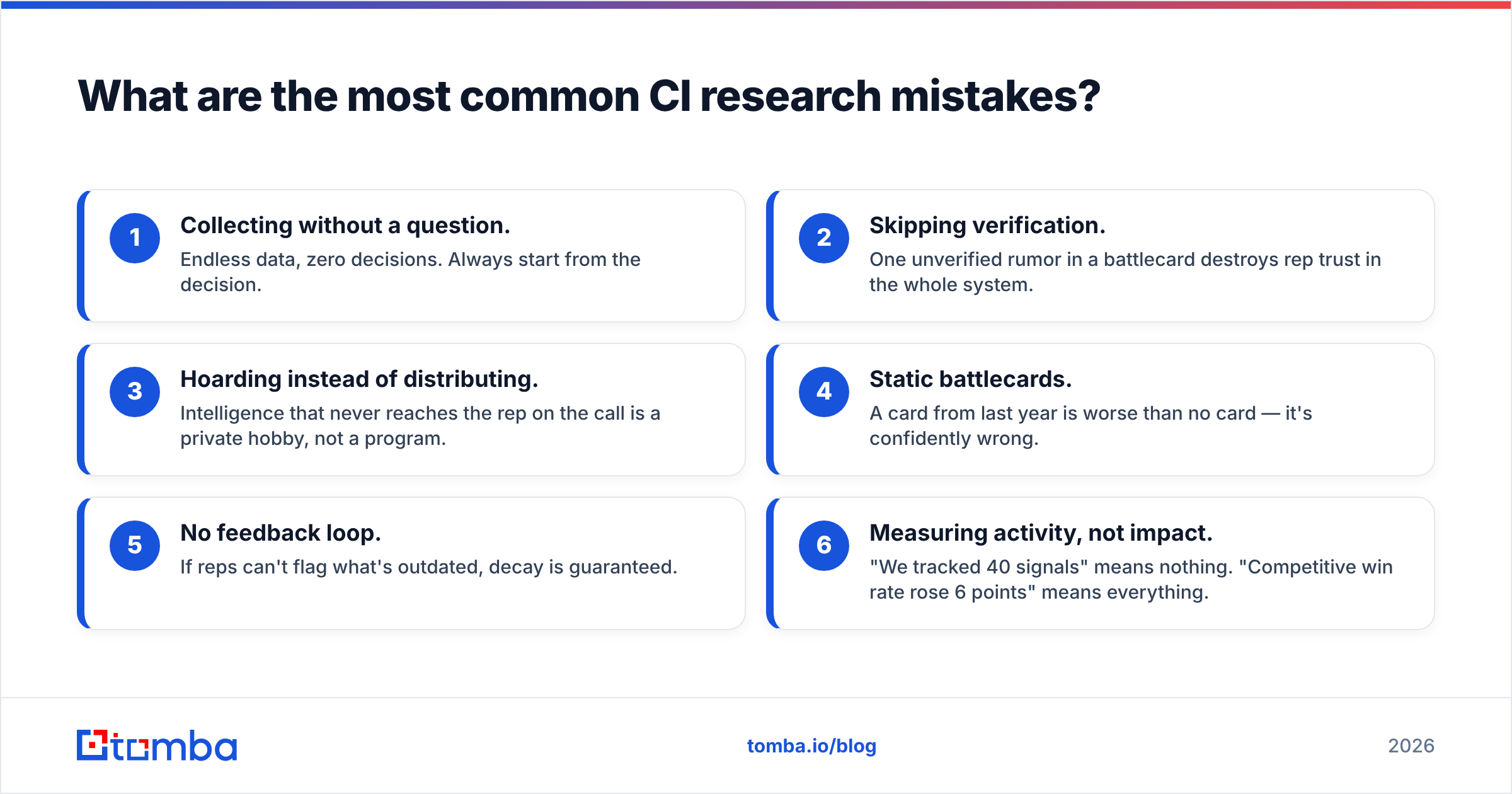
Even well-funded programs stumble on the same handful of errors:
- Collecting without a question. Endless data, zero decisions. Always start from the decision.
- Skipping verification. One unverified rumor in a battlecard destroys rep trust in the whole system.
- Hoarding instead of distributing. Intelligence that never reaches the rep on the call is a private hobby, not a program.
- Static battlecards. A card from last year is worse than no card — it's confidently wrong.
- No feedback loop. If reps can't flag what's outdated, decay is guaranteed.
- Measuring activity, not impact. "We tracked 40 signals" means nothing. "Competitive win rate rose 6 points" means everything.
Fix these in order and you'll outperform teams spending ten times your budget.
Frequently asked questions#
How often should competitive intelligence research be updated? Tactical intelligence (battlecards, pricing) should be reviewed monthly and updated within days of any competitor change. Strategic intelligence fits a quarterly cadence. The trigger, not the calendar, should drive updates — a competitor's funding round or product launch resets the clock immediately.
Who should own the CI research function? In smaller teams, product marketing usually owns it. As you scale past ~50 reps, a dedicated competitive intelligence analyst pays for themselves. Either way, ownership must be explicit — CI that's "everyone's job" is nobody's job.
Can you do competitive intelligence research without buying a platform? Yes. A disciplined loop using free public sources plus an enrichment layer beats an expensive platform that nobody maintains. Buy automation once the manual loop is proven, not before.
Turn competitive signals into a real map#
Competitive intelligence research lives or dies on the quality of the data underneath it. A competitor's org chart, the decision-makers at your target accounts, the people they just hired away from you — those are only useful when they're accurate, current, and structured.
That's where Tomba Email Finder fits your CI stack. Turn a company domain or a name into verified contact and firmographic data, enrich competitor and account maps at scale through the API, and start with the free tier (25 searches/month) before scaling to Starter at $49/month as your program proves its value. Feed your intelligence loop with data you can actually trust — and stop making competitive decisions in the dark.
Related guides#
Ready to find emails that actually work?
Join 150,000+ professionals who stopped guessing and started sending. Free credits on signup — no credit card required.
Get the Tomba newsletter
Practical outbound tactics and product updates — once every two weeks.
About the author