Competitive Intelligence Services: A 2026 Buyer's Guide
Competitive intelligence services promise to turn scattered market signals into a decisive edge. Here's what they actually deliver, what they cost, and how to build your own stack for a fraction of the price.
Competitive intelligence used to mean a junior analyst with a spreadsheet and a Google Alert. In 2026 it's a category — a mix of managed research firms, SaaS platforms, and data vendors all promising to tell you what your rivals will do before they do it. The pitch is seductive. The invoices are not.
This guide breaks down what competitive intelligence services actually are, what the different tiers cost, where they earn their fee, and where you're better off assembling the raw data yourself.
TL;DR#
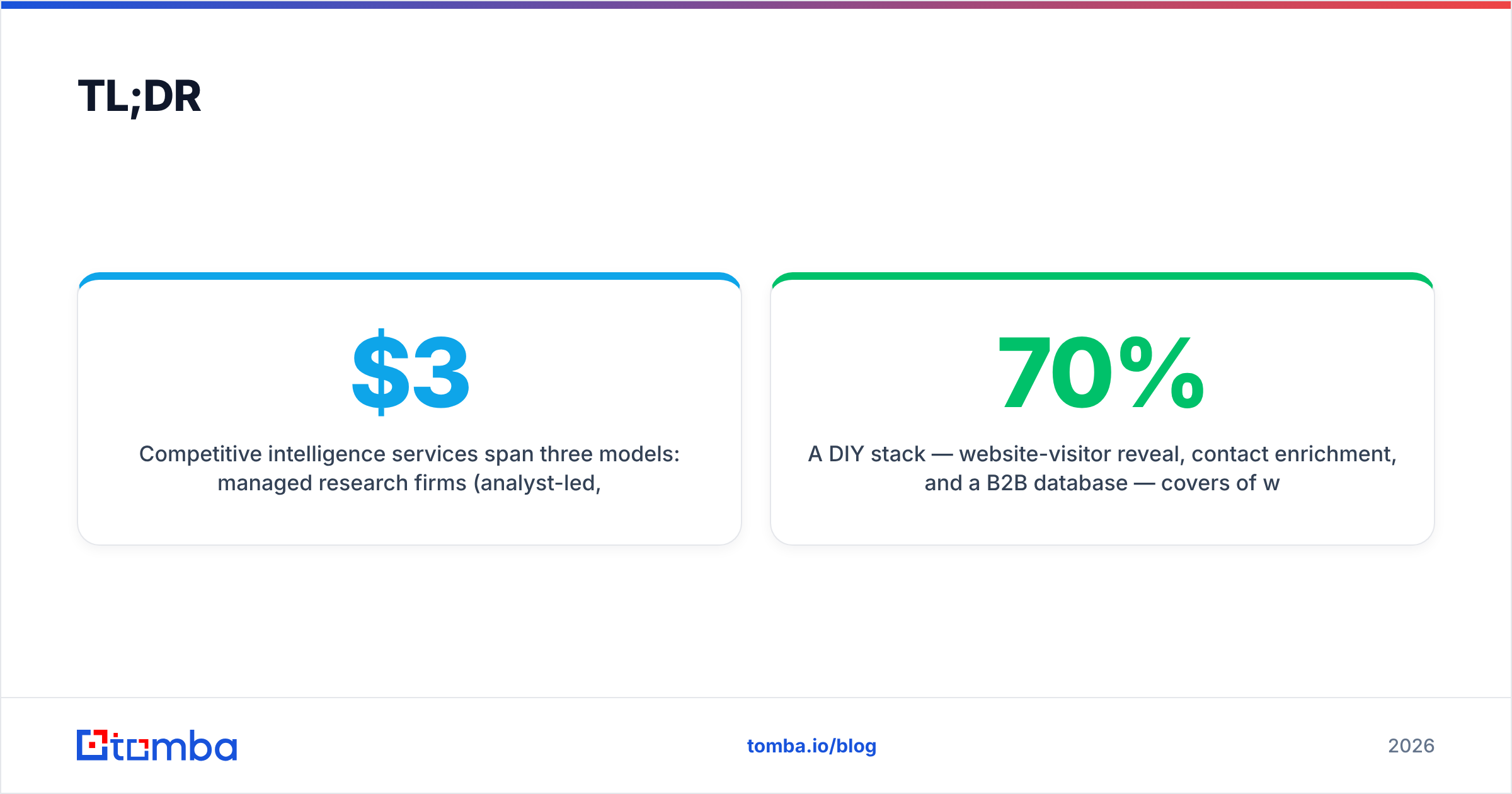
- Competitive intelligence services span three models: managed research firms (analyst-led, $3,000–$25,000+/mo), self-serve CI platforms ($500–$5,000/mo), and raw data vendors you wire together yourself.
- The expensive tier sells synthesis and narrative. The cheaper tiers sell signals — you do the synthesis. Most teams overpay for the former before they've exhausted the latter.
- Win/loss analysis, pricing intelligence, and buyer-committee mapping are where CI pays back fastest. Generic "market monitoring" rarely does.
- A DIY stack — website-visitor reveal, contact enrichment, and a B2B database — covers 70% of what a mid-tier CI subscription delivers, at a fraction of the cost.
- Buy the service for the analyst hours and the framework. Buy the data separately, and keep it.
What are competitive intelligence services?#
Competitive intelligence (CI) services gather, analyze, and package information about your competitors, market, and buyers so your go-to-market team can make sharper decisions. Think of it like weather forecasting for your market: raw sensors (data) feed a model (analysis) that produces a forecast (a recommendation you can act on). The value isn't the sensor readings — it's the forecast you trust enough to change plans over.
According to Gartner, the discipline formally sits under "market and competitive intelligence," and the tooling around it has splintered into distinct categories. In practice, a "service" today means one of three things:
- Managed research firms — human analysts produce battlecards, win/loss reports, and market briefings on retainer.
- CI software platforms — self-serve tools that scrape competitor sites, track pricing changes, aggregate review sentiment, and auto-build battlecards.
- Data-as-a-service vendors — they sell the underlying signals (firmographics, technographics, intent, contact data) and leave the analysis to you.
Most buyers conflate these three and end up paying managed-firm prices for what a platform-plus-data stack would deliver. The rest of this guide keeps them separate on purpose.

What do competitive intelligence services actually deliver?#
Strip away the branding and every CI engagement produces some subset of these deliverables. Rank them by how directly they move revenue:
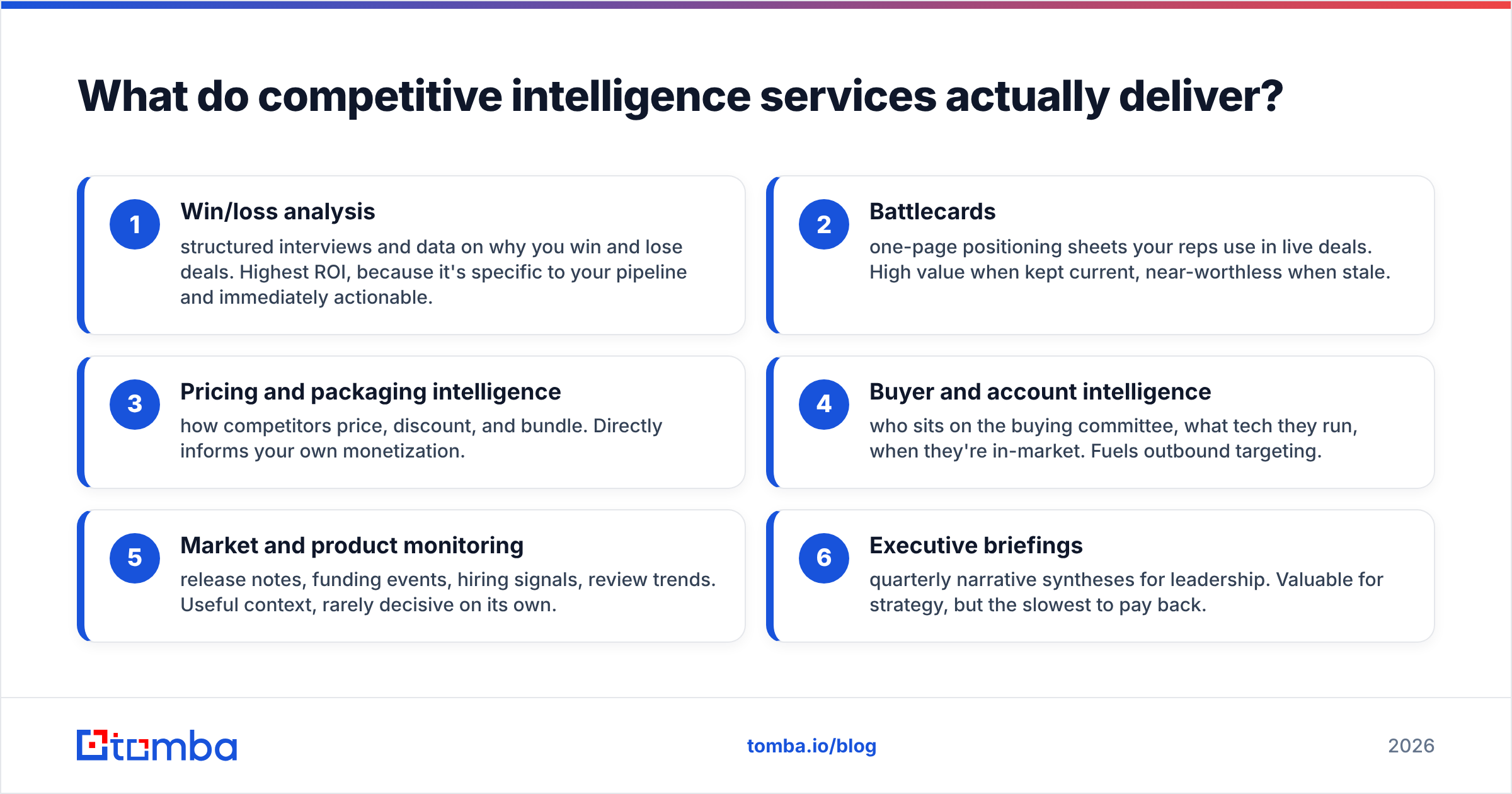
- Win/loss analysis — structured interviews and data on why you win and lose deals. Highest ROI, because it's specific to your pipeline and immediately actionable.
- Battlecards — one-page positioning sheets your reps use in live deals. High value when kept current, near-worthless when stale.
- Pricing and packaging intelligence — how competitors price, discount, and bundle. Directly informs your own monetization.
- Buyer and account intelligence — who sits on the buying committee, what tech they run, when they're in-market. Fuels outbound targeting.
- Market and product monitoring — release notes, funding events, hiring signals, review trends. Useful context, rarely decisive on its own.
- Executive briefings — quarterly narrative syntheses for leadership. Valuable for strategy, but the slowest to pay back.
Notice the pattern: the deliverables that pay back fastest (win/loss, pricing, buyer intel) are the ones grounded in your data and your accounts. The ones that pay back slowest are generic market monitoring you could largely automate. That gap is where DIY beats a subscription.
How much do competitive intelligence services cost in 2026?#
Pricing varies wildly because the three models sell fundamentally different things. Here's a realistic 2026 snapshot.
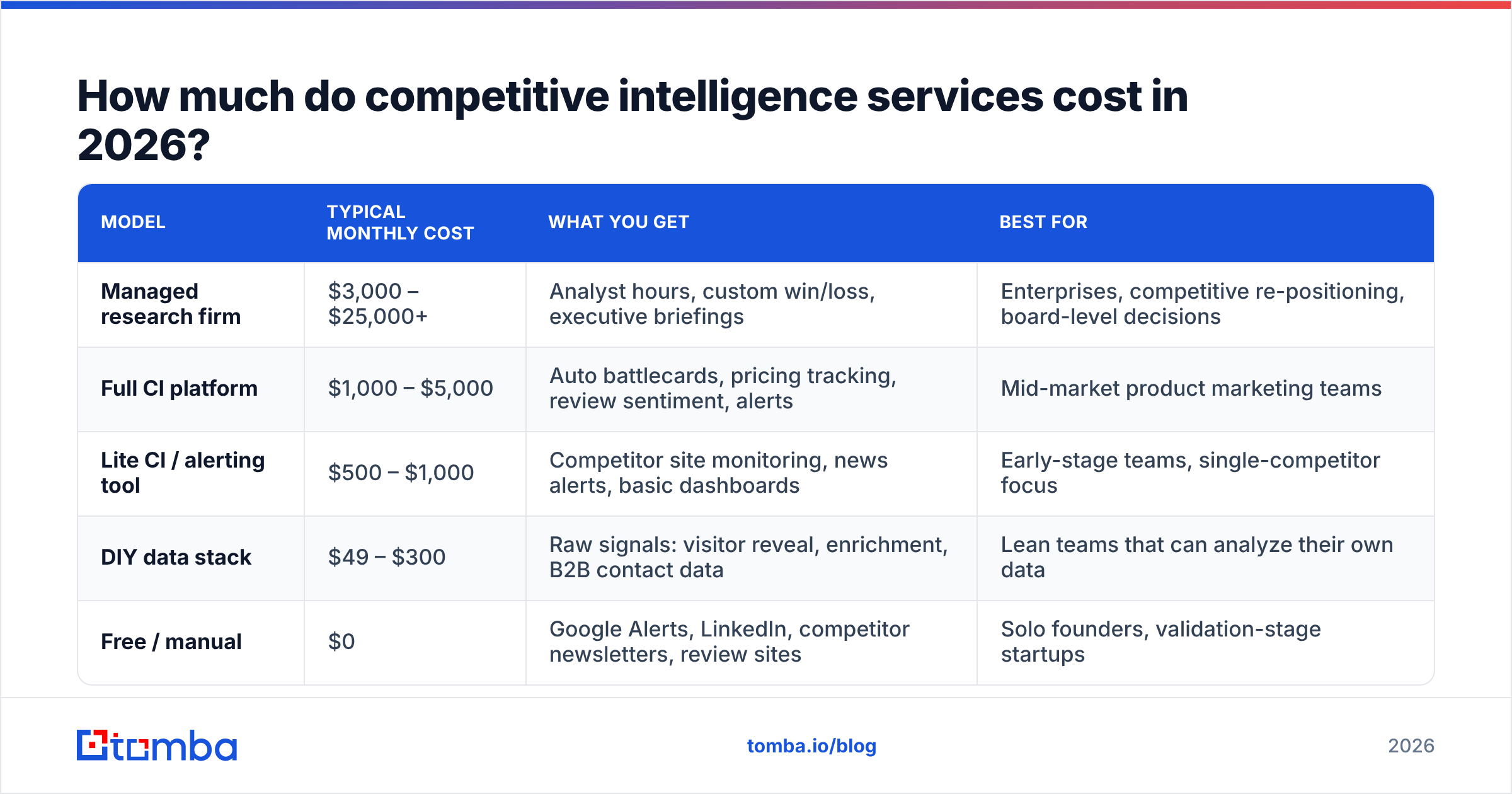
| Model | Typical monthly cost | What you get | Best for |
|---|---|---|---|
| Managed research firm | $3,000 – $25,000+ | Analyst hours, custom win/loss, executive briefings | Enterprises, competitive re-positioning, board-level decisions |
| Full CI platform | $1,000 – $5,000 | Auto battlecards, pricing tracking, review sentiment, alerts | Mid-market product marketing teams |
| Lite CI / alerting tool | $500 – $1,000 | Competitor site monitoring, news alerts, basic dashboards | Early-stage teams, single-competitor focus |
| DIY data stack | $49 – $300 | Raw signals: visitor reveal, enrichment, B2B contact data | Lean teams that can analyze their own data |
| Free / manual | $0 | Google Alerts, LinkedIn, competitor newsletters, review sites | Solo founders, validation-stage startups |
The jump from the DIY row to the platform row is roughly 10x, and from platform to managed firm another 3–5x. Each jump buys you synthesis and human judgment, not more raw signal. Before you climb the ladder, be honest about whether your bottleneck is data or analysis. For most teams under $20M ARR, it's analysis — and a $99/mo data stack plus one part-time analyst outperforms a $3,000/mo subscription nobody reads.
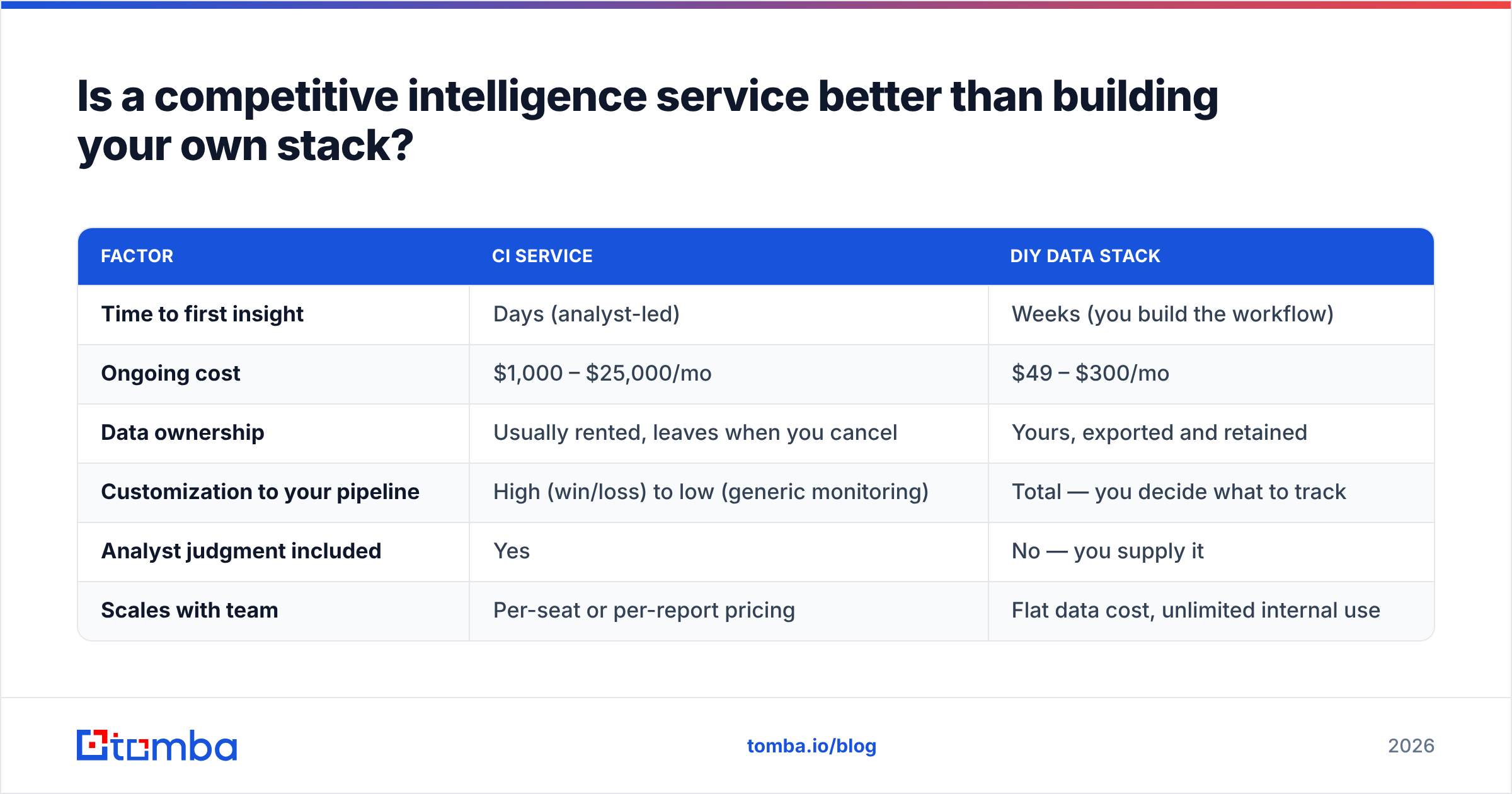
Is a competitive intelligence service better than building your own stack?#
It depends on one question: do you have someone who will actually turn signals into decisions?
If yes, build. If no, the service is buying you that person's judgment, and that's a legitimate reason to pay. Here's the honest trade-off.
| Factor | CI service | DIY data stack |
|---|---|---|
| Time to first insight | Days (analyst-led) | Weeks (you build the workflow) |
| Ongoing cost | $1,000 – $25,000/mo | $49 – $300/mo |
| Data ownership | Usually rented, leaves when you cancel | Yours, exported and retained |
| Customization to your pipeline | High (win/loss) to low (generic monitoring) | Total — you decide what to track |
| Analyst judgment included | Yes | No — you supply it |
| Scales with team | Per-seat or per-report pricing | Flat data cost, unlimited internal use |
The strongest setup for most scaling companies is a hybrid: keep a managed firm for the once-a-quarter win/loss study (the part that genuinely needs neutral human interviewers), and run everything else — account mapping, buyer enrichment, in-market signals — on data you own. You stop renting the commodity layer and pay only for the judgment layer.

What data powers competitive intelligence — and can you source it yourself?#
Almost every CI deliverable is built from four data primitives. The interesting part: all four are available directly, without a managed firm marking them up.
- Firmographics and technographics — company size, industry, and the tools an account runs. A B2B database gives you the account list; a website tech checker tells you their stack.
- Buyer contact data — the named people on a competitor's target accounts or your own. This is where an email finder and contact enrichment replace hours of manual LinkedIn digging.
- Intent and visitor signals — who's researching your category right now. Website visitor reveal de-anonymizes traffic so you can see which competitor-shopping accounts land on your pricing page.
- Public monitoring — pricing pages, release notes, funding, hiring, and review sentiment on sites like G2. Free to watch, cheap to automate with alerts.
Put those together and you've reconstructed the raw material of a mid-tier CI platform. What you're not getting is the pre-built battlecard template and the analyst who fills it in — and for many teams, an internal product marketer already does that better because they know the product.
The point isn't that CI services are a scam. It's that you should know exactly which layer you're paying a premium for, and refuse to pay it for the commodity layers underneath.
When should you actually buy a managed CI service?#
Buy the expensive tier when one of these is true:
- You're re-positioning against a specific competitor and need neutral, third-party win/loss interviews your prospects will speak candidly to. Buyers won't tell your own reps the real reason they churned; they'll tell an outside analyst.
- Leadership needs a defensible narrative, not a dashboard — a board deck on market shifts carries more weight when an outside firm authored it.
- You have zero internal analyst capacity and CI is urgent. Buying hours is faster than hiring.
- Regulatory or IP-sensitive research requires a firm with compliance guardrails and clean-room sourcing.
Skip it — and build instead — when your need is ongoing account targeting, buyer enrichment, or "which competitor-shopping companies visited us this week." Those are data problems, not analyst problems, and you'll get fresher answers running them in-house. Forrester and other analysts have long noted that the half-life of a competitive battlecard is measured in weeks; a quarterly managed report can be stale before your reps open it, which is exactly why the live, data-driven layer belongs in your own stack.
How to build a lean competitive intelligence stack#
A practical starting stack for a team that wants CI outcomes without the enterprise invoice:
- Account layer — pull your target and competitor account lists from a B2B database, segmented by industry and size.
- Buyer layer — enrich each account with named decision-makers and verified contact data so outreach lands. Check Tomba pricing to size this against your volume — the Free tier covers 25 searches to test the workflow before you commit.
- Signal layer — turn on visitor reveal and category alerts so in-market accounts surface automatically.
- Analysis layer — one owner (product marketing or a founder) reviews signals weekly and updates a living battlecard. This is the human judgment you were tempted to outsource.
- Feedback layer — run a structured win/loss survey every quarter; escalate to a managed firm only if the stakes justify neutral interviewers.
This stack costs less than a single seat of most CI platforms and keeps every byte of data inside your walls. You can always graduate to a managed service later — but you'll do it knowing precisely what incremental value you're buying.
The bottom line#
Competitive intelligence services are worth it when you're paying for judgment, framework, and neutral third-party research — and overpriced when you're paying them to resell data you could own outright. Separate the two layers, buy the analyst hours only where they're irreplaceable, and build the data layer yourself.
Ready to build the data layer? Start with the part every competitive intelligence workflow depends on: knowing exactly who to reach at the accounts you're tracking. The Tomba Email Finder turns a company or domain into verified, decision-maker contact data in seconds — so your competitive intelligence turns into competitive action, not just another dashboard. Try it free with 25 searches and see how much of that CI subscription you actually needed.
Related guides#
Ready to find emails that actually work?
Join 150,000+ professionals who stopped guessing and started sending. Free credits on signup — no credit card required.
Get the Tomba newsletter
Practical outbound tactics and product updates — once every two weeks.
About the author