Competitive Intelligence Tools: The 2026 Guide for GTM Teams
A neutral, no-fluff breakdown of the competitive intelligence tools that actually move win rates in 2026 — what each does well, where they overlap, and how to pick without overpaying.
Competitive Intelligence Tools: The 2026 Guide for GTM Teams
TL;DR
- Competitive intelligence (CI) tools collect, organize, and distribute what your buyers, rivals, and market are actually doing — so sales, product, and marketing stop guessing.
- The 2026 market splits into four buckets: dedicated CI platforms (Crayon, Klue), market/consumer research (Similarweb, SEMrush), sales-facing battlecards, and the raw data layer (enrichment, firmographics, buyer signals).
- No single tool covers everything. Most teams pair a CI platform with a data/enrichment source and a delivery channel like Slack or their CRM.
- Price ranges from free browser tools to five-figure annual contracts. The expensive part is rarely the software — it's keeping the intel current.
- The best "tool" is a repeatable workflow: capture signals, verify them, turn them into battlecards, and get them in front of reps before the call.
Competitive intelligence used to mean a spreadsheet someone updated once a quarter and nobody opened. In 2026 it's a live discipline, and the tools reflect that. This guide breaks down what competitive intelligence tools do, which categories exist, how the leaders compare, and how to assemble a stack that fits your budget instead of chasing logos.
What are competitive intelligence tools?#
Competitive intelligence tools are software that gathers and structures information about your competitors, your market, and your buyers, then delivers it to the people who need it to win deals. Think of it like a sports team's film room: raw footage (web pages, pricing changes, job posts, review sites) is useless until someone cuts it into a scouting report the players actually watch before the game.
A modern CI tool typically does three jobs:
- Capture — monitor competitor websites, pricing pages, ad spend, hiring, funding, product releases, and review-site sentiment.
- Synthesize — turn scattered signals into digestible artifacts: battlecards, win/loss summaries, market maps, and alerts.
- Distribute — push the right insight to the right team at the right moment, usually inside Slack, the CRM, or a sales enablement platform.
The category overlaps with B2B data and intelligence more broadly, because good CI depends on accurate underlying data — company firmographics, contact records, and buyer signals. A battlecard is only as trustworthy as the data feeding it.
Why do GTM teams need dedicated CI tools in 2026?#
Because the alternative is intel that's stale, siloed, or invented on the fly during a call. Reps improvising competitor answers is the single most common cause of lost late-stage deals.
Three shifts made dedicated tooling non-optional:
- Buyers self-educate. By the time a prospect books a demo, they've already compared you on G2 and read three rival landing pages. Your reps need to know what the buyer already saw.
- Competitors move faster. Pricing changes, positioning pivots, and feature launches ship weekly. Quarterly reviews can't keep up.
- Signal volume exploded. Ad libraries, review sites, hiring boards, funding databases, and web-traffic estimators all publish constantly. A human can't watch it all; software can.
Gartner and Forrester both track a rising line item for "competitive and market intelligence" inside GTM budgets — it's no longer a nice-to-have folder in the sales wiki. If you want a primer on the surrounding discipline, Wikipedia's competitive intelligence entry is a solid neutral starting point.
What are the categories of competitive intelligence tools?#
Not every "CI tool" solves the same problem. Sorting them by job keeps you from buying a battlecard platform when what you actually needed was a data source.
- Dedicated CI platforms — capture, battlecards, alerts, and enablement in one place. Best for teams that want a single system of record. Examples: Crayon, Klue.
- Market & digital research — traffic estimates, keyword footprints, ad spend, and share-of-voice. Best for marketing and strategy. Examples: Similarweb, SEMrush.
- Sales battlecard & enablement — turn intel into rep-facing collateral surfaced in the flow of a deal. Sometimes standalone, often a module inside the platforms above.
- Buyer & account signals — intent data, technographics, hiring signals, and website-visitor identification. This is where CI meets data enrichment and prospecting.
- Data & contact layer — the firmographic and contact foundation everything else sits on, including website visitor reveal and B2B contact data.
Most mature stacks use one tool from two or three of these buckets, not five tools from one.
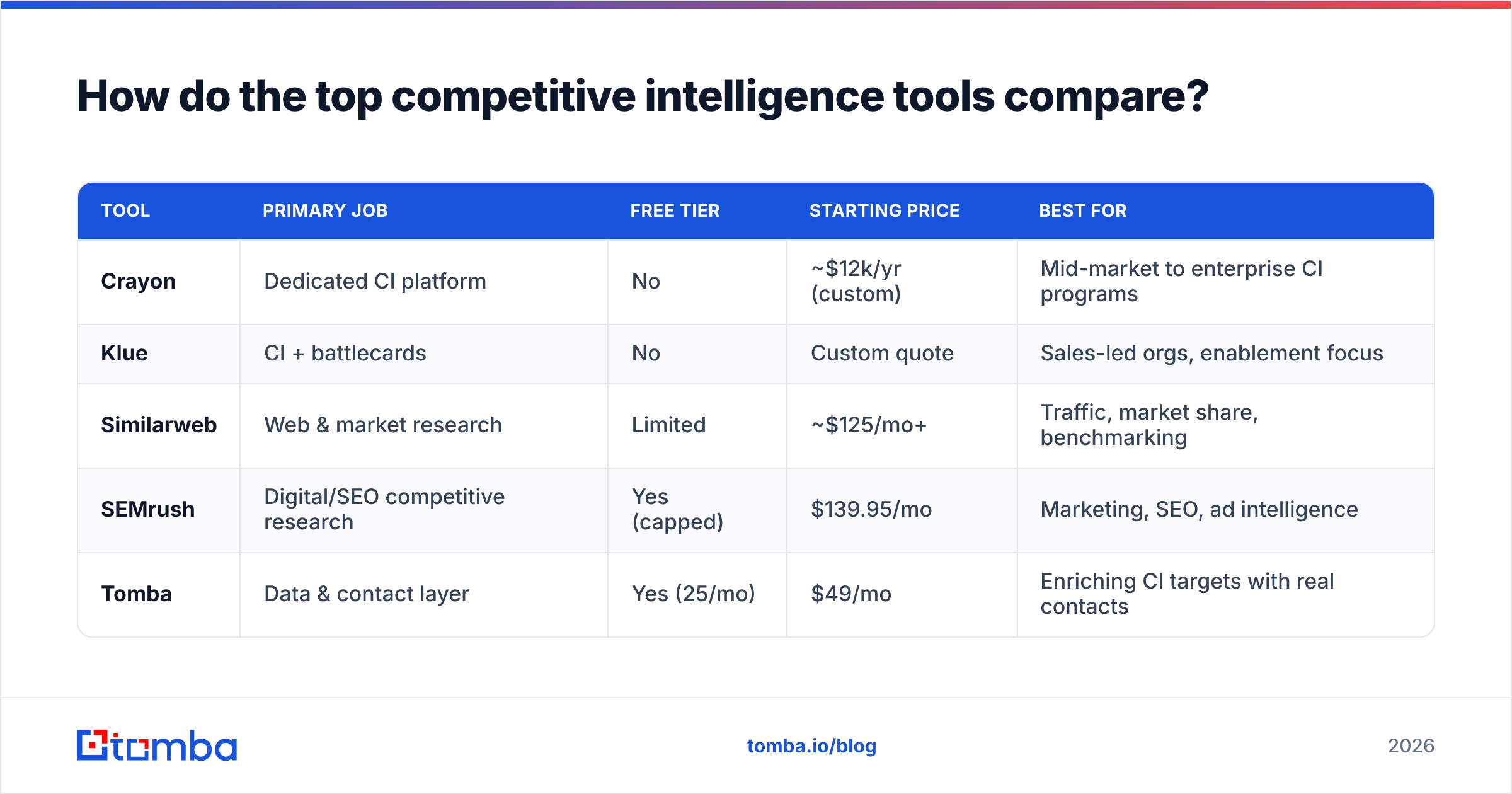
How do the top competitive intelligence tools compare?#
Here's a neutral side-by-side of representative options across the categories. Prices are approximate 2026 list positioning and change often — always confirm on the vendor's own pricing page.
| Tool | Primary job | Free tier | Starting price | Best for |
|---|---|---|---|---|
| Crayon | Dedicated CI platform | No | ~$12k/yr (custom) | Mid-market to enterprise CI programs |
| Klue | CI + battlecards | No | Custom quote | Sales-led orgs, enablement focus |
| Similarweb | Web & market research | Limited | ~$125/mo+ | Traffic, market share, benchmarking |
| SEMrush | Digital/SEO competitive research | Yes (capped) | $139.95/mo | Marketing, SEO, ad intelligence |
| Tomba | Data & contact layer | Yes (25/mo) | $49/mo | Enriching CI targets with real contacts |
A few honest caveats:
- Crayon and Klue are strong but rarely cheap. They're built for teams running a formal CI function with a dedicated analyst. If that's not you yet, you may overpay for capacity you can't fill.
- Similarweb and SEMrush answer "what's happening," not "who do I contact." They're research, not outreach. You still need a contact and data layer to act.
- Tomba isn't a CI platform — it's the data foundation. When your CI work surfaces a target account or a decision-maker, Tomba is how you turn "Acme is hiring 12 SDRs" into a verified email you can actually reach.
What features actually matter in a competitive intelligence tool?#
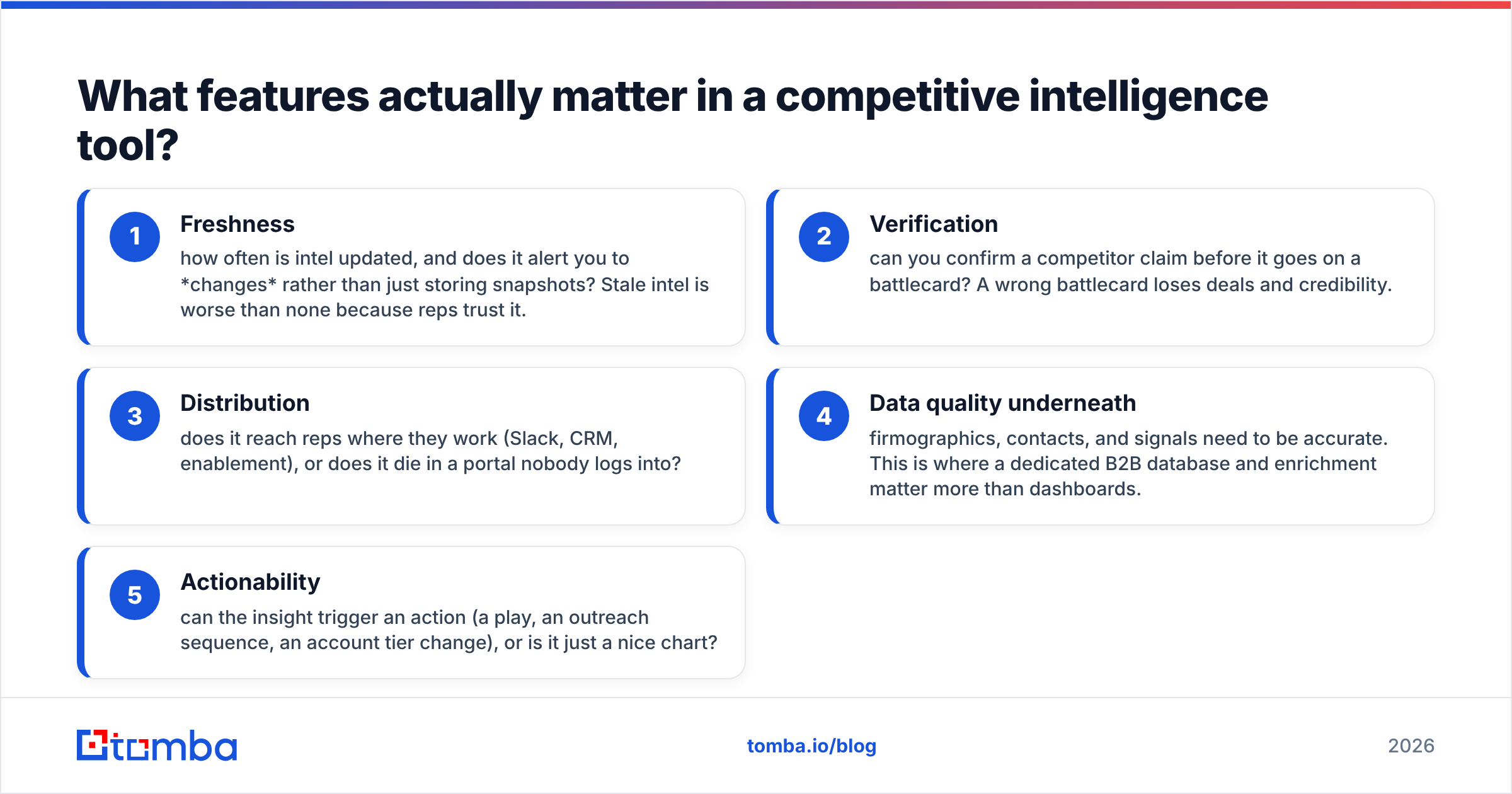
Ignore the feature-count arms race and grade on these five. Each maps to a real failure mode.
- Freshness — how often is intel updated, and does it alert you to changes rather than just storing snapshots? Stale intel is worse than none because reps trust it.
- Verification — can you confirm a competitor claim before it goes on a battlecard? A wrong battlecard loses deals and credibility.
- Distribution — does it reach reps where they work (Slack, CRM, enablement), or does it die in a portal nobody logs into?
- Data quality underneath — firmographics, contacts, and signals need to be accurate. This is where a dedicated B2B database and enrichment matter more than dashboards.
- Actionability — can the insight trigger an action (a play, an outreach sequence, an account tier change), or is it just a nice chart?
If a tool nails dashboards but fails distribution and data quality, your win rate won't move.
Is a dedicated CI platform better than a DIY stack?#
It depends on your team's maturity — and that answer is honest, not a hedge.
Choose a dedicated platform (Crayon, Klue) when:
- You have someone who owns CI at least half-time.
- Sales asks for competitor answers weekly and improvisation is costing deals.
- You need battlecards, win/loss, and alerts governed in one system.
Build a DIY stack when:
- You're pre-scale and can't justify a five-figure contract.
- Your CI needs are concentrated (e.g., mostly "who's beating us on pricing").
- You already own the pieces: a research tool, a Slack channel, and a data/enrichment source.
A capable DIY stack in 2026 often looks like: SEMrush or Similarweb for market signals, a shared battlecard doc, review-site monitoring, and a contact layer like Tomba to enrich and reach the accounts your intel surfaces. It's not glamorous, but it ships value in a week instead of a quarter.
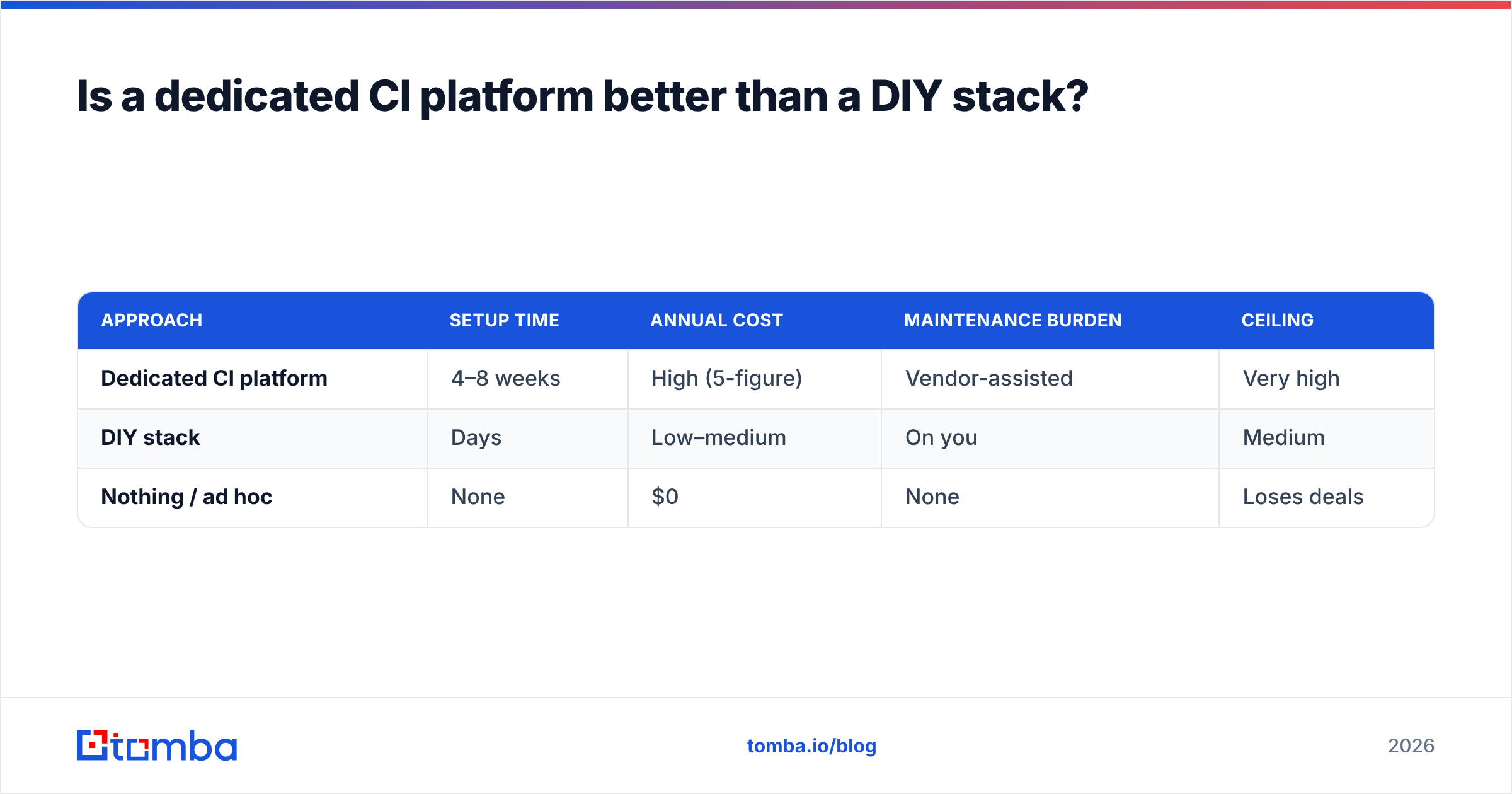
| Approach | Setup time | Annual cost | Maintenance burden | Ceiling |
|---|---|---|---|---|
| Dedicated CI platform | 4–8 weeks | High (5-figure) | Vendor-assisted | Very high |
| DIY stack | Days | Low–medium | On you | Medium |
| Nothing / ad hoc | None | $0 | None | Loses deals |
How does CI connect to prospecting and outreach?#
This is the step most guides skip. Competitive intelligence that never turns into a contact is just trivia.
The handoff looks like this: your CI tool flags a signal — a competitor raised prices, an account is hiring for a role your product serves, a rival churned a logo. That signal names a company. To act, you need the people: the economic buyer, the champion, the person feeling the pain. That's a data problem, and it's exactly where an email finder and enrichment close the loop.
A practical sequence:
- CI signal: "Competitor X just deprecated a feature that Acme relies on."
- Target: Acme Corp, plus 6 similar accounts on the same competitor.
- Contacts: Use domain search and enrichment to find and verify decision-maker emails.
- Outreach: A timely, specific message referencing the exact gap — the highest-converting cold email there is.
Without the contact layer, that whole chain stalls at "interesting." With it, CI becomes pipeline.
What does a competitive intelligence tool cost in 2026?#
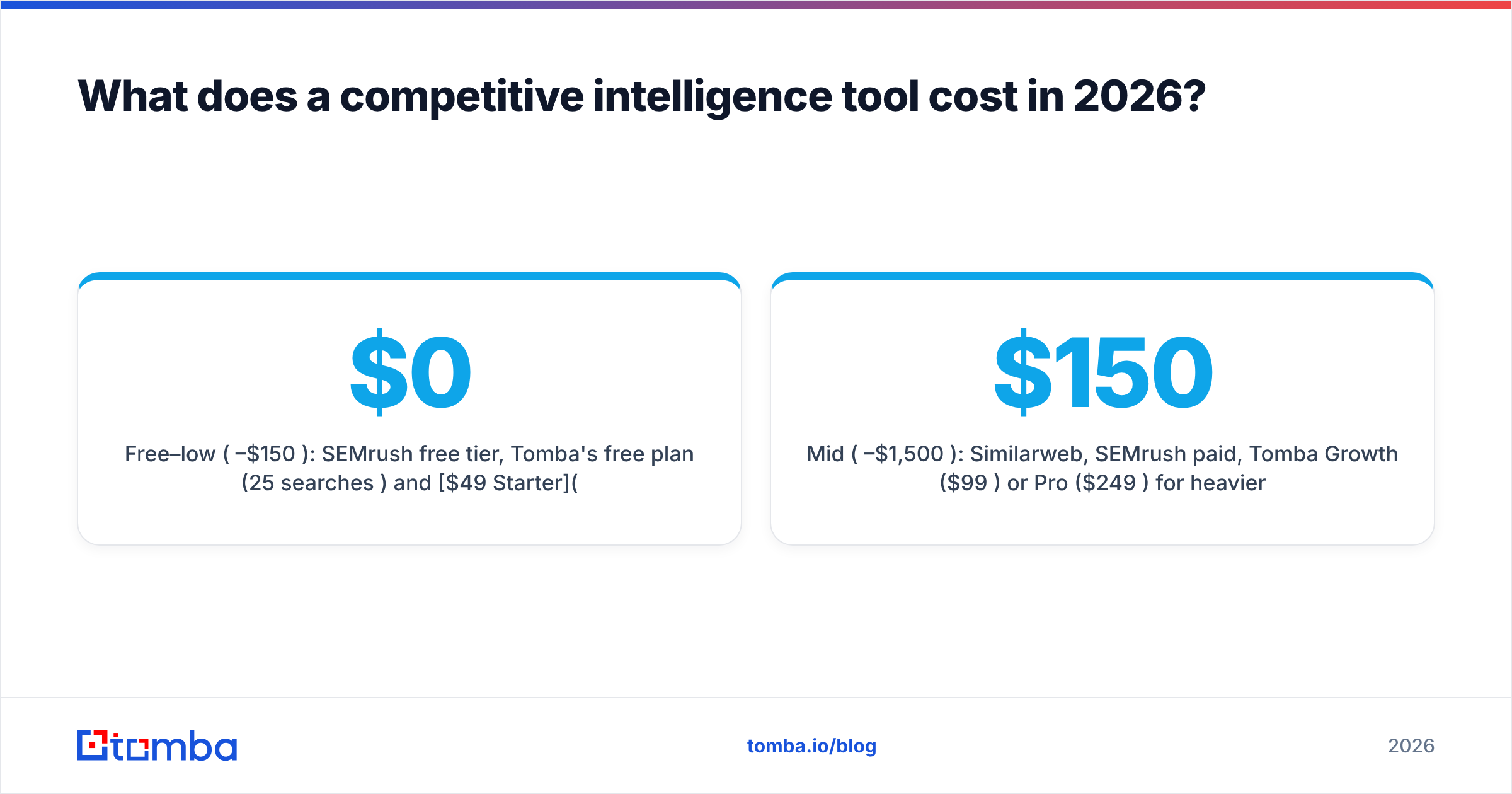
Budget in three tiers, and know where the real cost hides.
- Free–low ($0–$150/mo): SEMrush free tier, Tomba's free plan (25 searches/mo) and $49/mo Starter, review-site alerts, manual battlecards. Enough for a focused team.
- Mid ($150–$1,500/mo): Similarweb, SEMrush paid, Tomba Growth ($99/mo) or Pro ($249/mo) for heavier enrichment volume, plus a lightweight battlecard tool.
- Enterprise (5-figure/yr): Crayon, Klue, and full CI programs with a dedicated analyst.
The hidden cost is never the license — it's the labor to keep intel current and trusted. A cheap tool with a disciplined weekly workflow beats an expensive one nobody maintains. Compare vendor pricing directly (see SEMrush and others' own pages) rather than trusting third-party roundups, since tiers shift constantly.
How do you choose the right competitive intelligence tools?#
Work backward from the decision your intel needs to change.
- Name the deal-losing question. "Why are we losing to X?" needs win/loss and battlecards. "Which accounts should we target?" needs signals and data.
- Match the tool to that job, not to the longest feature list.
- Check the data underneath. Dashboards on bad data are confident lies. Insist on a verifiable contact and firmographic layer.
- Solve distribution first. If reps won't see it, don't buy it.
- Start small and prove it. Run one competitor, one battlecard, one Slack alert for a month. Expand only when it's already working.
Most teams over-buy on platforms and under-invest in the data and distribution that make CI actually land. Flip that ratio.
The bottom line#
Competitive intelligence tools in 2026 are no longer optional for serious GTM teams — but the right answer is a stack fitted to your maturity, not the most expensive logo. Pair a research or CI platform with a solid data foundation and a distribution channel your reps actually use, and you'll turn scattered signals into won deals.
And when your intel surfaces the accounts worth chasing, don't let the trail go cold at the company name. Tomba's Email Finder turns a target account into verified, reachable decision-makers — with a free tier to start and plans from $49/mo — so every competitive insight becomes a conversation instead of a note in a doc. Start free, enrich your CI targets, and get your message in front of the buyer before your competitor does.
Related guides#
Ready to find emails that actually work?
Join 150,000+ professionals who stopped guessing and started sending. Free credits on signup — no credit card required.
Get the Tomba newsletter
Practical outbound tactics and product updates — once every two weeks.
About the author