How to Build a Competitive Landscape Framework in 2026
A competitive landscape framework turns scattered rival intel into a repeatable system. Here's the step-by-step model, a comparison of the top frameworks, and how to keep the data current.
TL;DR
- A competitive landscape framework is a repeatable system for mapping who you compete with, on what dimensions, and where the open gaps are — not a one-off slide deck that rots in a shared drive.
- The strongest frameworks combine a structured model (Porter's Five Forces, a feature matrix, or a positioning map) with a live data layer so the analysis stays current.
- You need three inputs to do this well: a clear scope, a scoring rubric, and fresh contact-and-firmographic data on the players in your market.
- Most teams fail not at the framework but at maintenance — the map is accurate for one quarter and stale by the next.
- This guide walks the full build, compares the four frameworks worth knowing, and shows how to keep the underlying data honest.
What is a competitive landscape framework?#
A competitive landscape framework is a structured method for identifying, categorizing, and comparing the companies you compete with — so that go-to-market decisions rest on evidence instead of hallway opinion.
Think of it like a nautical chart. Anyone can glance at the ocean and say "there's water everywhere." A chart tells you where the reefs are, where the deep channels run, and which route gets your ship through safely. A competitive landscape framework does the same for a market: it converts a vague sense of "we have a lot of competitors" into a labeled map you can actually navigate.
Technically, the framework has three moving parts. First, a scope that defines which competitors count (direct, indirect, and emerging). Second, a set of dimensions you score each player on — pricing, feature depth, target segment, funding, review sentiment. Third, a cadence that says how often the map gets refreshed and who owns it. Skip any one of the three and you get a poster, not a system.
Why do most competitive analyses fail?#
They fail because they treat competitive intelligence as a project instead of a product. A junior marketer spends two weeks building a beautiful matrix, presents it once, and the file is never opened again. Six months later a rival has re-priced, shipped two features, and raised a round — and your "current" map describes a company that no longer exists.
The second failure mode is scope creep in reverse: teams only track the two or three competitors that come up in lost deals, ignoring the emerging players quietly eating the low end of the market. According to Gartner's research on competitive strategy, the companies that disrupt you are rarely the ones already on your radar.
The fix is boring but effective: pick one framework, wire it to data that updates itself, and assign an owner in revenue operations who reviews it on a fixed schedule. The framework is only as good as the discipline behind it.
Which competitive landscape framework should you use?#
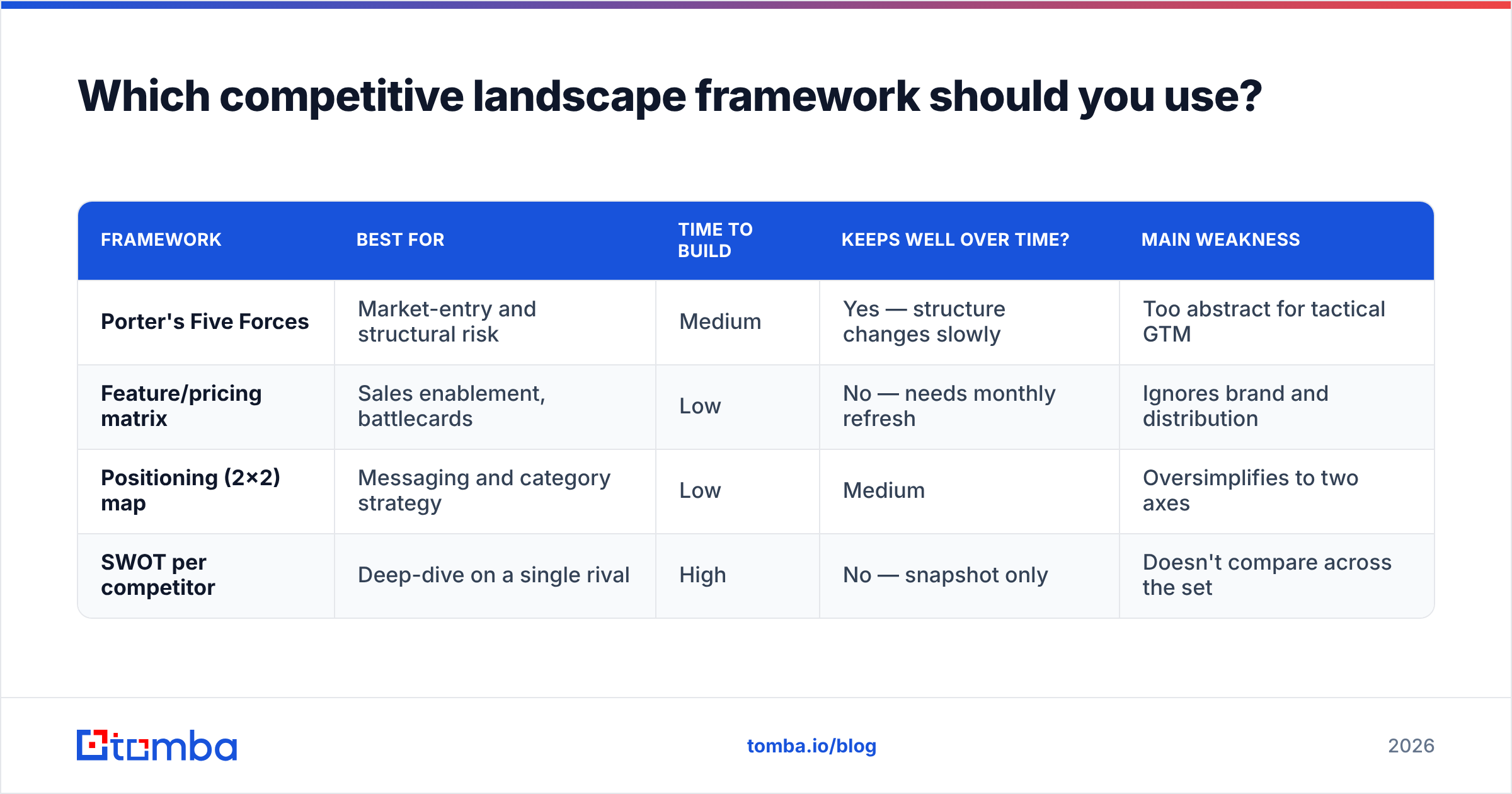
There is no single "best" framework — there is a best fit for the decision you are trying to make. Below are the four that earn their place, with the job each one does well.
| Framework | Best for | Time to build | Keeps well over time? | Main weakness |
|---|---|---|---|---|
| Porter's Five Forces | Market-entry and structural risk | Medium | Yes — structure changes slowly | Too abstract for tactical GTM |
| Feature/pricing matrix | Sales enablement, battlecards | Low | No — needs monthly refresh | Ignores brand and distribution |
| Positioning (2x2) map | Messaging and category strategy | Low | Medium | Oversimplifies to two axes |
| SWOT per competitor | Deep-dive on a single rival | High | No — snapshot only | Doesn't compare across the set |
A quick rule of thumb: use Five Forces when you are deciding whether to enter or exit a market, a feature/pricing matrix when your reps need to win head-to-head deals this quarter, a positioning map when marketing is arguing about how to describe the category, and per-competitor SWOT when one specific rival is showing up in every lost deal.
The best-run teams don't pick one. They keep a Five Forces view for the board, a positioning map for marketing, and a living feature matrix for sales — all fed by the same underlying dataset.
How do you build a competitive landscape framework step by step?#
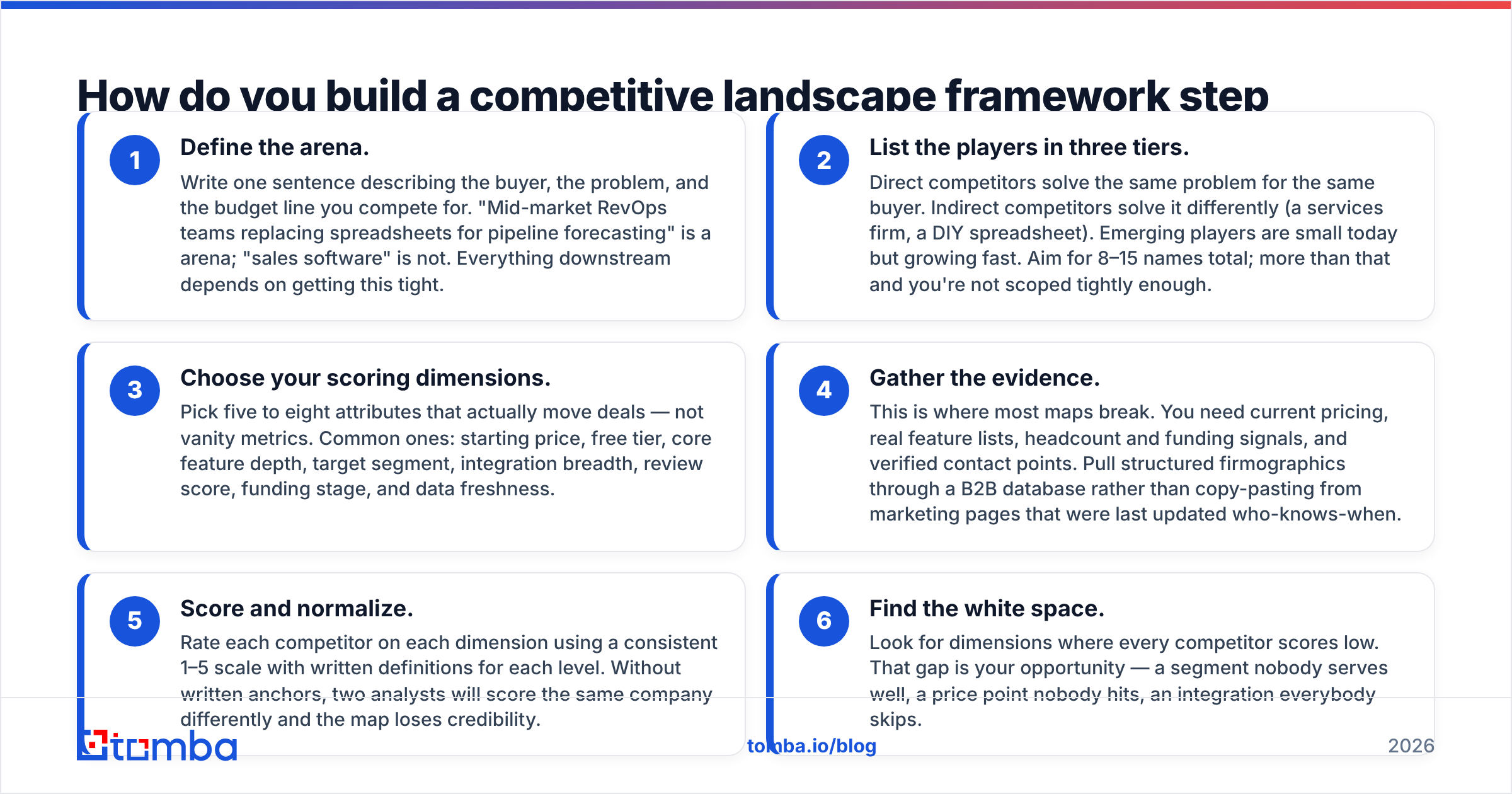
Here is the full build. Each step is a decision, and each decision narrows the map until it's useful.
Define the arena. Write one sentence describing the buyer, the problem, and the budget line you compete for. "Mid-market RevOps teams replacing spreadsheets for pipeline forecasting" is a arena; "sales software" is not. Everything downstream depends on getting this tight.
List the players in three tiers. Direct competitors solve the same problem for the same buyer. Indirect competitors solve it differently (a services firm, a DIY spreadsheet). Emerging players are small today but growing fast. Aim for 8–15 names total; more than that and you're not scoped tightly enough.
Choose your scoring dimensions. Pick five to eight attributes that actually move deals — not vanity metrics. Common ones: starting price, free tier, core feature depth, target segment, integration breadth, review score, funding stage, and data freshness.
Gather the evidence. This is where most maps break. You need current pricing, real feature lists, headcount and funding signals, and verified contact points. Pull structured firmographics through a B2B database rather than copy-pasting from marketing pages that were last updated who-knows-when.
Score and normalize. Rate each competitor on each dimension using a consistent 1–5 scale with written definitions for each level. Without written anchors, two analysts will score the same company differently and the map loses credibility.
Find the white space. Look for dimensions where every competitor scores low. That gap is your opportunity — a segment nobody serves well, a price point nobody hits, an integration everybody skips.

Once the map exists, the work shifts from building to maintaining. The next section is the part teams skip.
How do you keep the competitive landscape current?#
You automate the inputs and calendar the review. A competitive landscape framework decays at the speed of your market, and in B2B software that's fast — pricing pages change, funding lands, teams reorganize.
Start by separating slow-moving facts from fast-moving ones. Market structure (Five Forces) shifts over years and needs a quarterly glance. Pricing, headcount, and feature sets shift monthly and need automated monitoring. Contact and org data — who runs product, who runs sales, how to reach them — shifts weekly and benefits from continuous data enrichment so your records don't silently go stale.
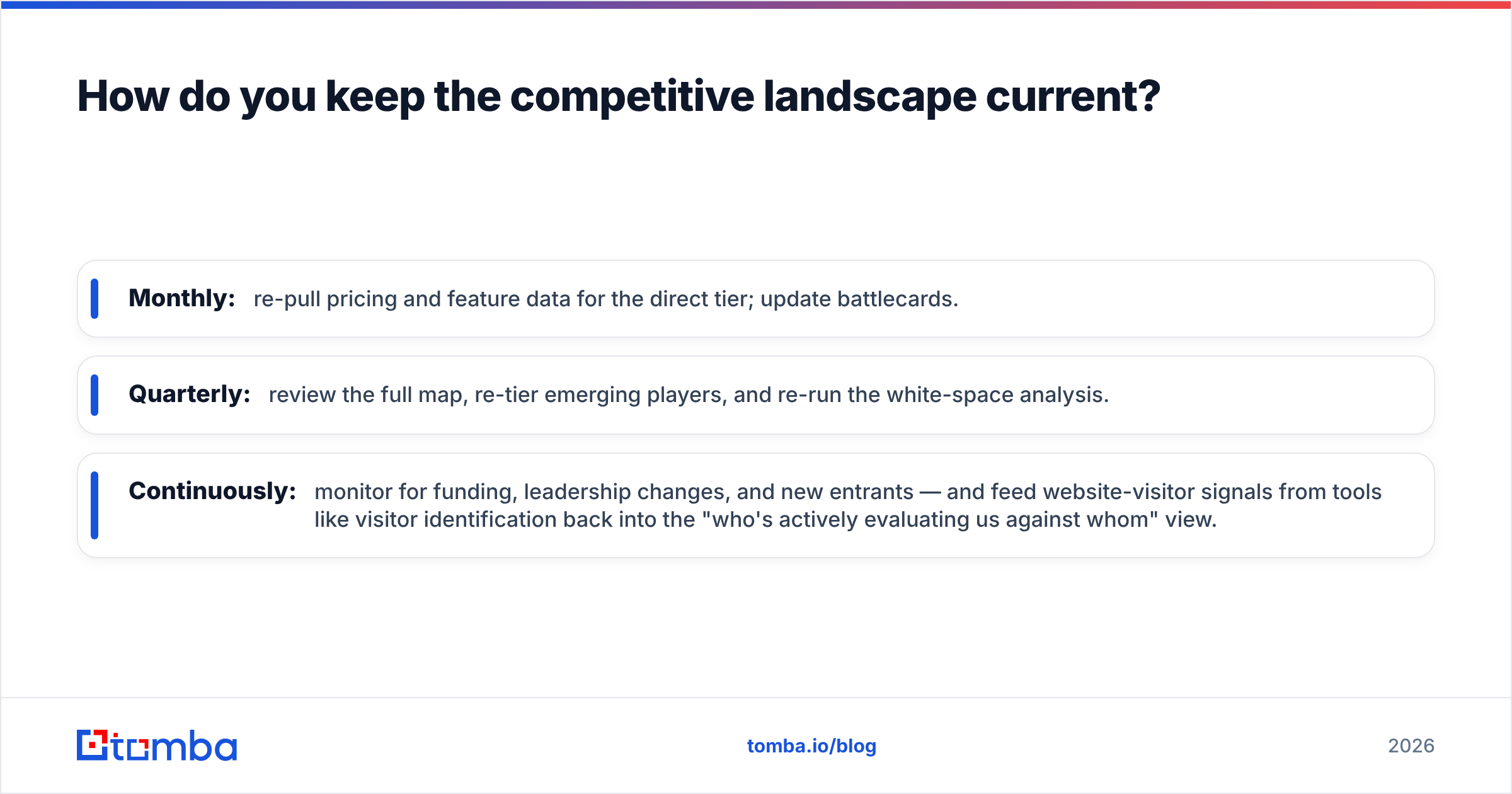
A practical maintenance loop looks like this:
- Monthly: re-pull pricing and feature data for the direct tier; update battlecards.
- Quarterly: review the full map, re-tier emerging players, and re-run the white-space analysis.
- Continuously: monitor for funding, leadership changes, and new entrants — and feed website-visitor signals from tools like visitor identification back into the "who's actively evaluating us against whom" view.
The teams that win here treat the map like a dashboard, not a document. If you can open it on any given Tuesday and trust what it says, the framework is doing its job.
What data do you actually need — and where does it come from?#
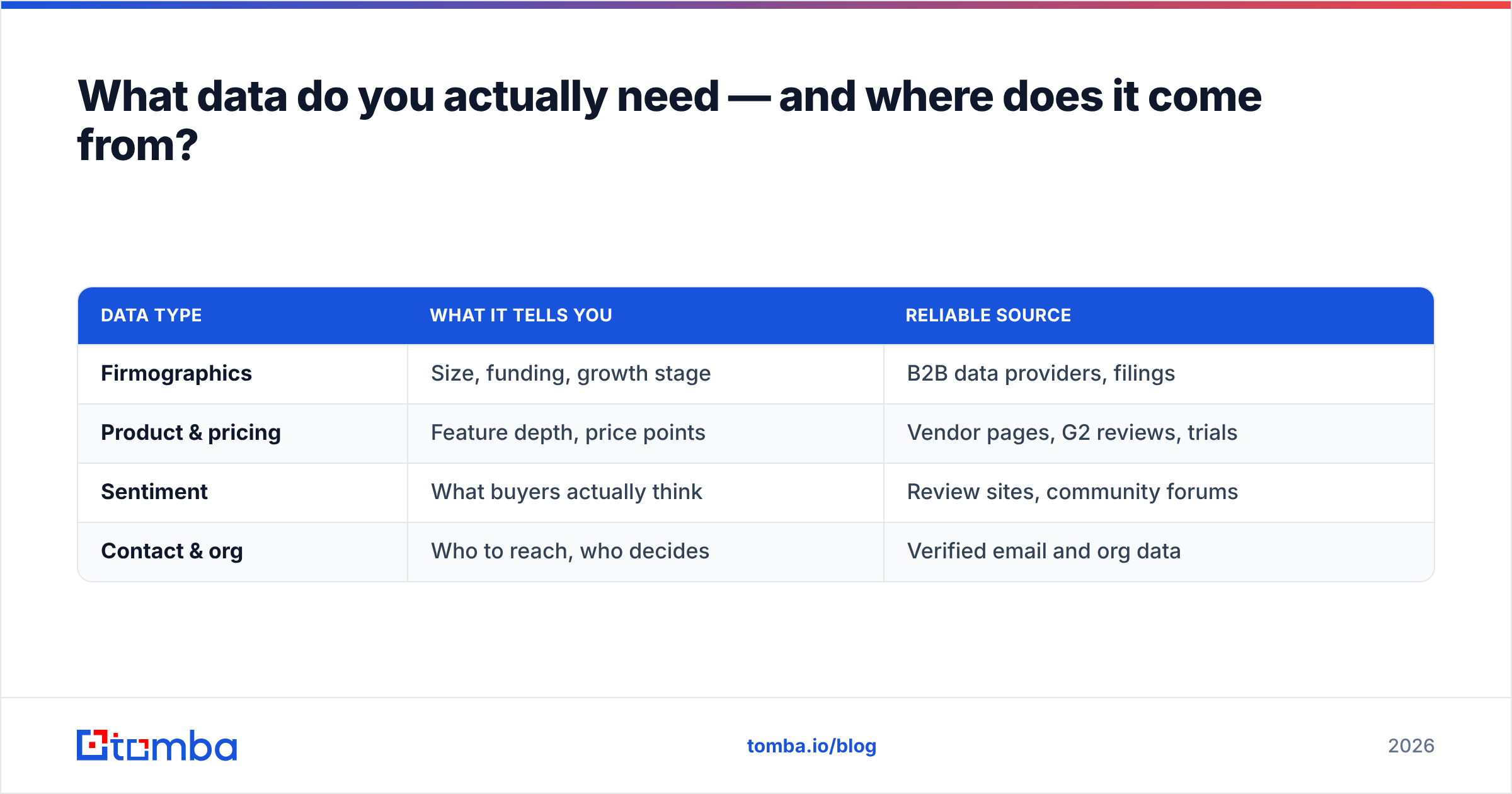
You need four data types, and each has a reliable source. The mistake is sourcing all four from the same place (usually a competitor's own website), which bakes in their spin.
| Data type | What it tells you | Reliable source |
|---|---|---|
| Firmographics | Size, funding, growth stage | B2B data providers, filings |
| Product & pricing | Feature depth, price points | Vendor pages, G2 reviews, trials |
| Sentiment | What buyers actually think | Review sites, community forums |
| Contact & org | Who to reach, who decides | Verified email and org data |
For the firmographic and contact layers, accuracy matters more than volume. A map built on bounced emails and three-year-old headcounts leads you to wrong conclusions with false confidence. This is where a verification-first workflow pays off: enrich your competitor and prospect records, then confirm the contact data is deliverable before you act on it. Compare providers on transparency about their sources — HubSpot's own guidance on competitive analysis makes the same point: cite where each data point came from so the map can be audited.
If you're standing up this data layer, look at Tomba pricing as a reference point for what a verification-first stack costs: a free tier at 25 searches a month, Starter at $49/mo, Growth at $99/mo, and Pro at $249/mo. The point isn't the specific numbers — it's that the data feeding your framework should be something you can budget, refresh, and trust on a schedule.
How is a competitive landscape framework different from a battlecard?#
They serve different altitudes. A battlecard is tactical — one page a rep opens mid-deal to handle "why you over Competitor X." A competitive landscape framework is strategic — the whole-market view that decides which battlecards are even worth building.
Think of the framework as the map and the battlecard as the turn-by-turn directions for one specific route. You derive battlecards from the framework, not the other way around. When your framework surfaces that three competitors all cluster in the enterprise tier while the mid-market is underserved, that insight shapes positioning, pricing, and which battlecards your enablement team writes first.
Keeping the two connected is the discipline. When the landscape shifts — a competitor drops its price, a new entrant appears — the framework flags it, and the affected battlecards get updated the same week. Disconnect them and your reps end up arguing against a competitor's last-year pricing.
Putting it into practice#
Start small and honest. Pick one framework that matches your most pressing decision, scope the arena to a single sentence, list 8–15 players, and score them on the handful of dimensions that actually move your deals. Then wire the inputs to data that refreshes itself so the map is still true next quarter.
The framework is the easy part. The data underneath it — accurate firmographics, verified contacts, current org charts — is what separates a map you trust from a slide nobody reopens. If your competitive intelligence keeps going stale between refreshes, the problem usually isn't the model; it's the pipes feeding it.
That's where clean contact data earns its keep. Use the Tomba Email Finder to find and verify the decision-makers at the companies on your map — so when your framework tells you where the white space is, you can actually reach the buyers sitting in it. Start on the free tier, wire it into your enrichment loop, and keep your competitive landscape framework honest quarter after quarter.
Related guides#
Ready to find emails that actually work?
Join 150,000+ professionals who stopped guessing and started sending. Free credits on signup — no credit card required.
Get the Tomba newsletter
Practical outbound tactics and product updates — once every two weeks.
About the author