Competitive Marketing Intelligence: A Practical 2026 Guide
Competitive marketing intelligence is how modern teams turn rival signals into pipeline. Here are the frameworks, sources, and workflows that actually work in 2026.
Most marketing teams collect competitor data. Very few turn it into decisions. That gap — between watching rivals and actually acting on what you see — is what competitive marketing intelligence is built to close.
This guide is a working manual, not a definitions dump. You'll get the sources, the frameworks, the tooling, and the exact workflow to run so the intel you gather changes a campaign, a page, or a pitch this quarter.
TL;DR#
- Competitive marketing intelligence (CMI) is the ongoing practice of collecting, verifying, and acting on data about your competitors' positioning, pricing, channels, and demand — so your own go-to-market gets sharper.
- It's different from generic "market research." CMI is continuous, decision-oriented, and tied to specific plays (ad copy, landing pages, sales objections, pricing).
- The winning setup blends automated signal collection (ads, SEO, hiring, funding) with human synthesis (a battlecard, a narrative, a play).
- Data quality is the whole game. Stale or unverified contact and firmographic data quietly poisons every downstream decision.
- Start small: pick three competitors, three channels, and one weekly ritual. Expand only after the ritual sticks.
What is competitive marketing intelligence?#
Competitive marketing intelligence is the disciplined process of turning what your rivals do in market into an advantage for your own team. Think of it like a sports scouting department: you're not copying the other team's playbook, you're studying their tendencies so you can call better plays of your own.
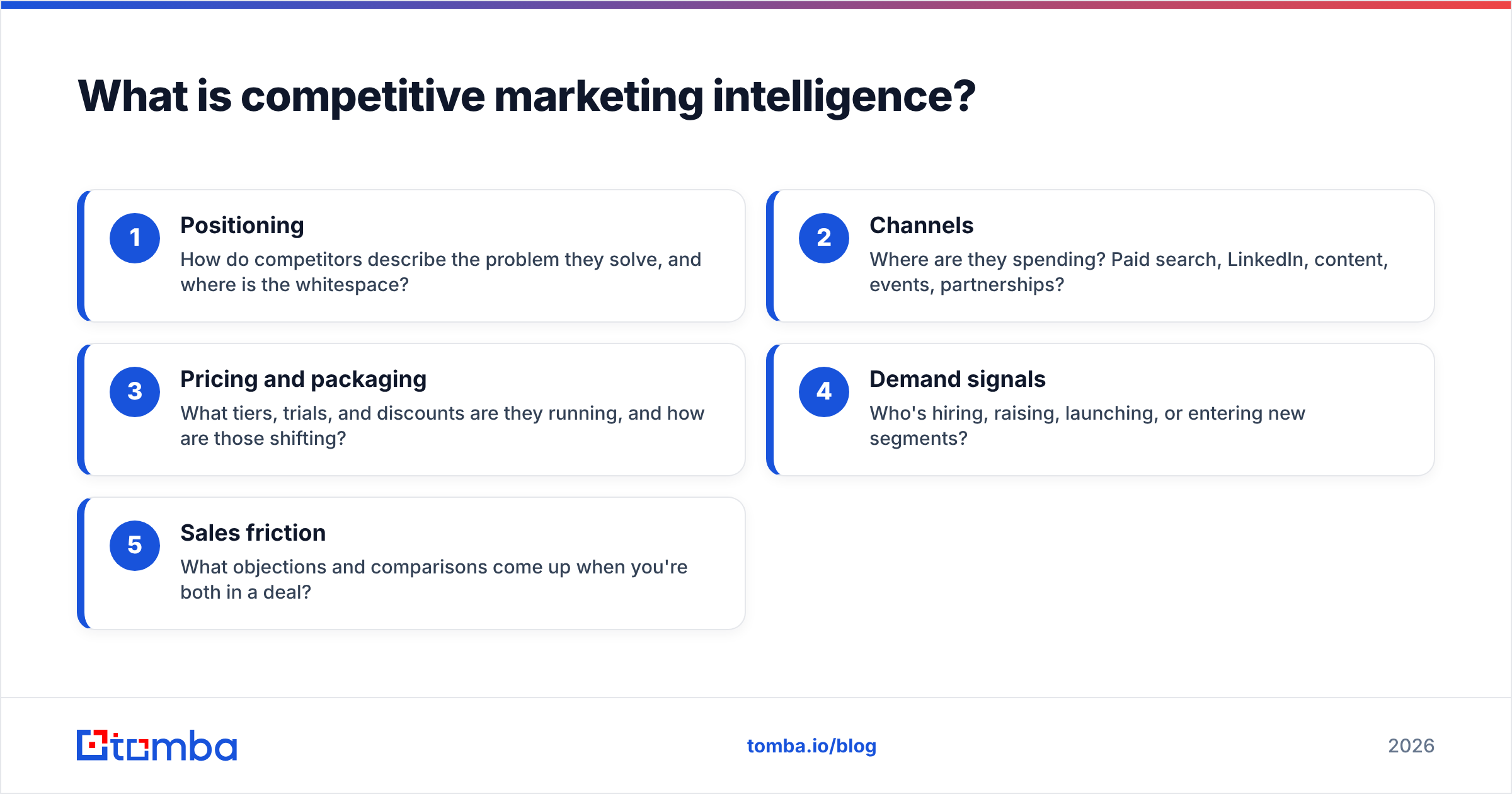
Concretely, CMI answers questions like:
- Positioning — How do competitors describe the problem they solve, and where is the whitespace?
- Channels — Where are they spending? Paid search, LinkedIn, content, events, partnerships?
- Pricing and packaging — What tiers, trials, and discounts are they running, and how are those shifting?
- Demand signals — Who's hiring, raising, launching, or entering new segments?
- Sales friction — What objections and comparisons come up when you're both in a deal?
The distinction that matters: market research tells you about the market, while competitive marketing intelligence tells you what to do next week. Gartner's research on competitive and market intelligence draws the same line — intelligence is only valuable when it's operationalized into a decision, not filed in a slide deck. You can read more on how analysts frame the category at Gartner.

Why does competitive marketing intelligence matter in 2026?#
Because the cost of guessing went up. Buyers self-educate across a dozen touchpoints before they ever talk to sales, and they compare you against named rivals whether you're in the room or not. If you don't know how a competitor frames the category, you're negotiating against a story you can't see.
Three shifts make CMI non-optional this year:
- Signal abundance. Ad libraries, job boards, review sites, and funding trackers are all public. The bottleneck is no longer access — it's synthesis.
- Faster GTM cycles. Competitors reposition, re-price, and re-launch in weeks, not years. A once-a-quarter teardown is already stale.
- Data decay. B2B contact and company data degrades fast — a meaningful share of records go out of date within a year. Intelligence built on rotten data is worse than no intelligence, because it feels authoritative while being wrong.
That last point is where most programs quietly fail. You can have a beautiful battlecard and still lose if the account list feeding it is full of dead contacts and wrong firmographics. Clean, verified inputs are the foundation everything else sits on — which is why data enrichment and verification belong inside your intelligence stack, not off to the side.
What are the core sources of competitive intelligence?#
You don't need exotic tools to start. Most high-value signals are hiding in public data you can collect systematically. Here's the core-source map:
- Ad transparency libraries — Meta and Google/LinkedIn ad libraries show live creative, messaging, and (roughly) spend intensity. Great for reading positioning shifts in real time.
- SEO and content footprints — Which keywords rank, which pages get built, and how fast the content library grows tells you where a rival is placing bets.
- Pricing and packaging pages — Snapshot them monthly. Changes in tier names, trial length, or "contact sales" gates are strategy tells.
- Hiring signals — A surge in enterprise AE or partner-marketing roles predicts a segment move months before it's public.
- Funding and financial events — New rounds, acquisitions, and earnings calls reset a competitor's aggression and budget.
- Review platforms — Sites like G2 surface unfiltered strengths, weaknesses, and the exact language buyers use to compare you.
- Contact and firmographic data — To act on any of the above (partner outreach, account targeting, analyst mapping), you need accurate people-level data behind the company-level signal.
That last layer is where a tool like Tomba fits. Once your intelligence flags a target account, a partner to court, or a decision-maker to reach, you still have to contact the right human. Pulling verified addresses with an email finder or running a domain search across a competitor's customer or partner ecosystem turns an abstract signal into an actionable contact list.
How do you build a competitive marketing intelligence workflow?#
Conclusion first: pick a small scope, run a weekly ritual, and route every insight to an owner who can act. The workflow matters more than the tooling.
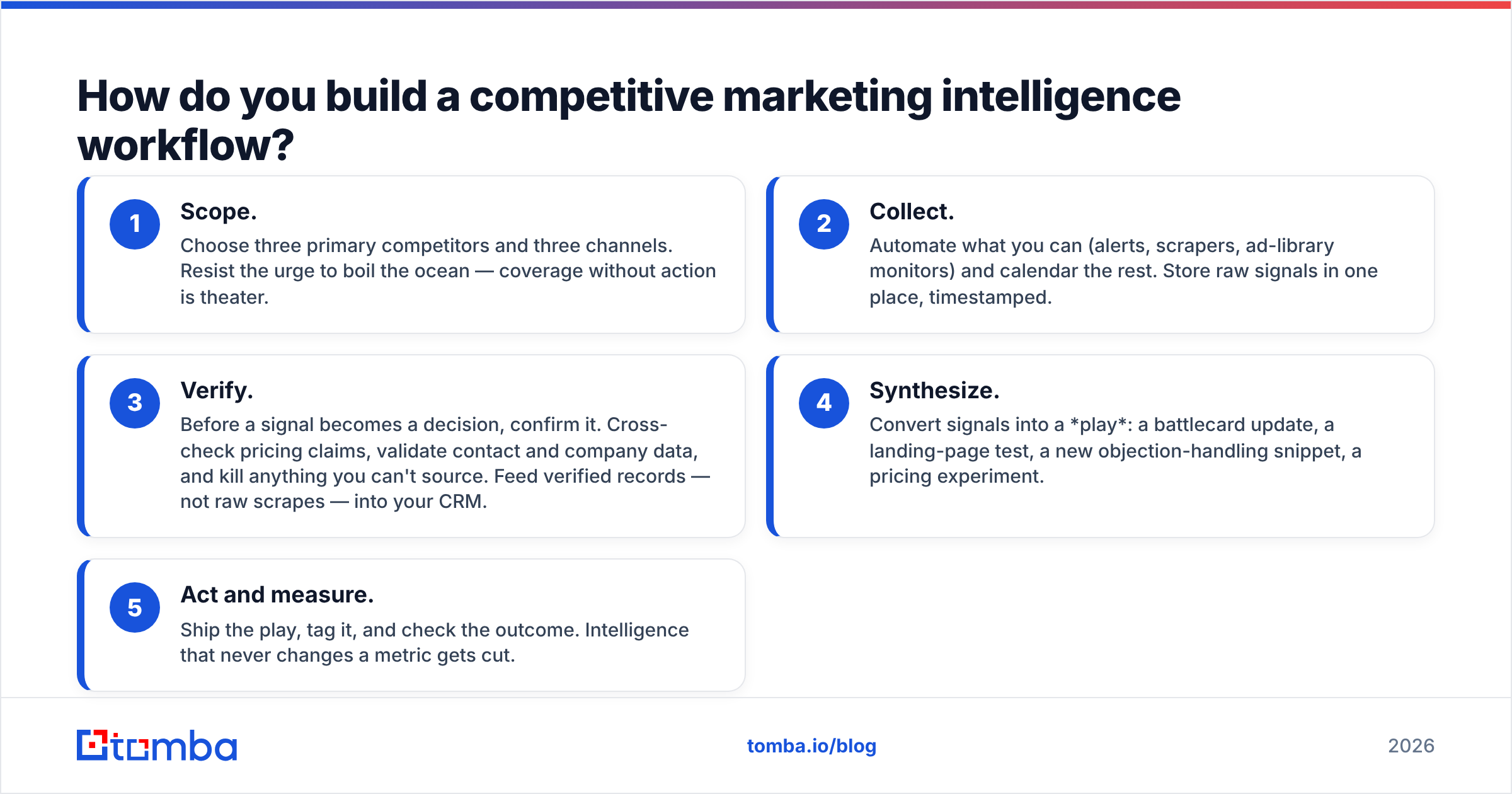
Here's a five-step loop that scales from a solo marketer to a full RevOps function:
- Scope. Choose three primary competitors and three channels. Resist the urge to boil the ocean — coverage without action is theater.
- Collect. Automate what you can (alerts, scrapers, ad-library monitors) and calendar the rest. Store raw signals in one place, timestamped.
- Verify. Before a signal becomes a decision, confirm it. Cross-check pricing claims, validate contact and company data, and kill anything you can't source. Feed verified records — not raw scrapes — into your CRM.
- Synthesize. Convert signals into a play: a battlecard update, a landing-page test, a new objection-handling snippet, a pricing experiment.
- Act and measure. Ship the play, tag it, and check the outcome. Intelligence that never changes a metric gets cut.
This loop connects naturally to broader revenue operations practice, because the same clean data pipeline that powers your intelligence also powers your forecasting and routing.

Competitive marketing intelligence tools compared#
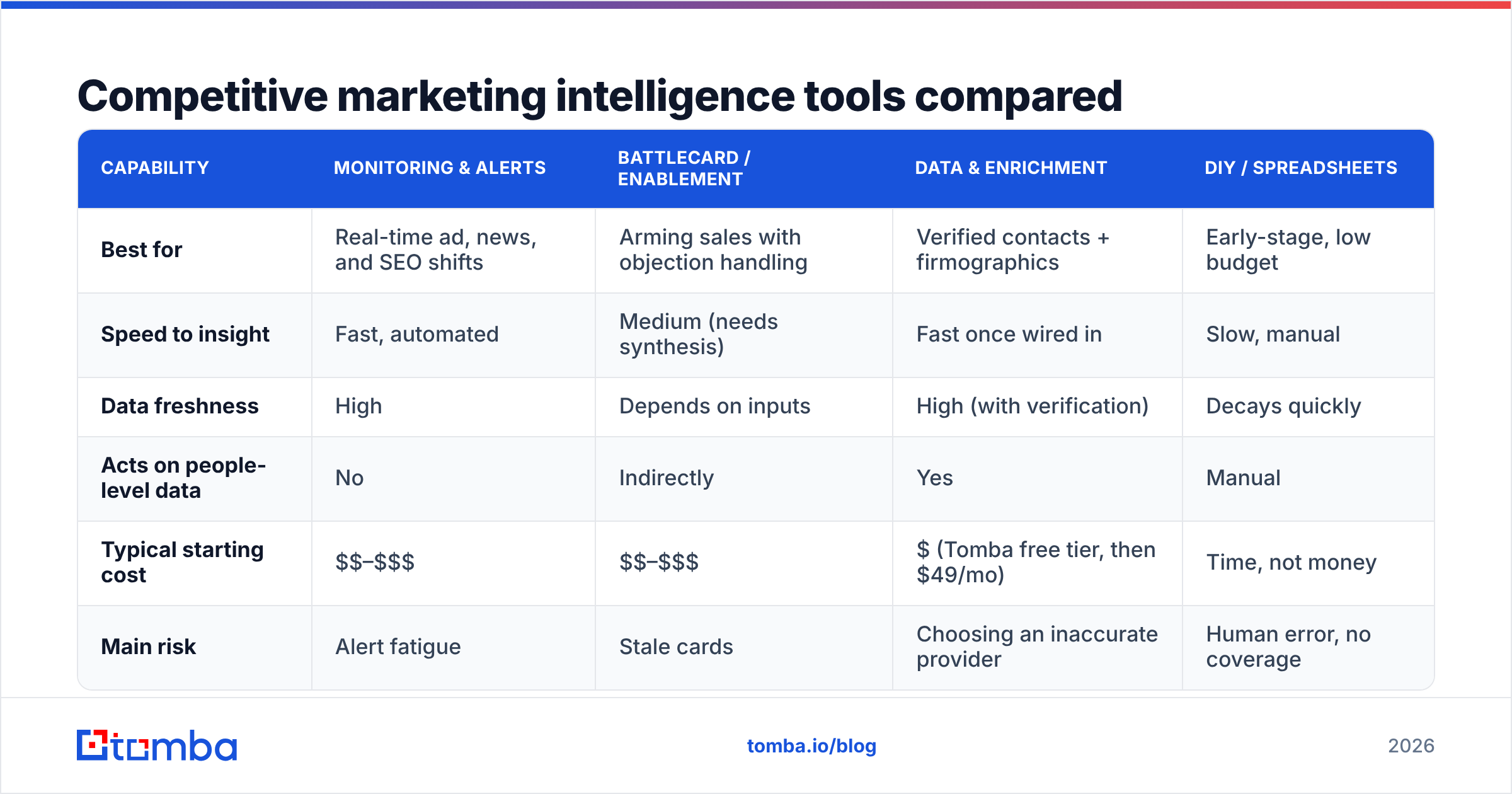
There's no single "CMI platform" — most teams assemble a stack across four jobs: monitoring, teardown/battlecards, data enrichment, and analysis. Here's how the categories compare on what actually matters.
| Capability | Monitoring & alerts | Battlecard / enablement | Data & enrichment | DIY / spreadsheets |
|---|---|---|---|---|
| Best for | Real-time ad, news, and SEO shifts | Arming sales with objection handling | Verified contacts + firmographics | Early-stage, low budget |
| Speed to insight | Fast, automated | Medium (needs synthesis) | Fast once wired in | Slow, manual |
| Data freshness | High | Depends on inputs | High (with verification) | Decays quickly |
| Acts on people-level data | No | Indirectly | Yes | Manual |
| Typical starting cost | $$–$$$ | $$–$$$ | $ (Tomba free tier, then $49/mo) | Time, not money |
| Main risk | Alert fatigue | Stale cards | Choosing an inaccurate provider | Human error, no coverage |
A few honest notes on this table:
- Monitoring tools are the flashiest but produce the most noise. Without a synthesis step they generate alert fatigue and little else.
- Battlecard platforms are only as good as the intelligence — and the underlying account data — you pour into them.
- Data and enrichment is the layer most teams underinvest in, then wonder why outreach built on their intelligence bounces. This is where verified B2B data earns its keep, and where accuracy differences between providers show up as real pipeline differences.
- Spreadsheets are a legitimate starting point. Don't let anyone shame you out of a well-run manual process while you prove the value.
For a broader vendor landscape, review-aggregation sites like HubSpot's marketing resources and peer-review platforms are useful sanity checks before you commit budget.
What does a competitive marketing intelligence framework look like?#
Use a simple four-quadrant model so intelligence maps to action instead of piling up:
- Defend — Where a competitor is stronger and attacking your base. Action: retention plays, objection handling, proactive win-back.
- Attack — Where you're stronger and they're exposed. Action: targeted campaigns and comparison content aimed at their weak segment.
- Differentiate — Where you're both credible but the market sees you as similar. Action: sharpen positioning and proof.
- Ignore — Where the fight isn't worth it. Action: deliberately underinvest and document why.
The discipline is forcing every signal into one quadrant with a named owner and a due date. A funding announcement isn't intelligence until someone decides it means "Attack their mid-market before they staff up" and books the work.
How do you keep competitive intelligence ethical and accurate?#
Two rules keep a program out of trouble.
First, stay on the right side of the line. Use public and permissibly sourced data. Ad libraries, published pricing, review sites, job posts, and press releases are fair game. Impersonation, credential sharing, and scraping behind logins are not. Ethical intelligence is also more durable — it doesn't collapse the moment a rival changes a password.
Second, verify before you act. Accuracy is the difference between intelligence and rumor. Before a contact list built from competitive research goes into a campaign, run it through an email verifier so you're not burning sender reputation on dead addresses. The same principle applies to firmographics and pricing claims: confirm from a second source, or label it as unverified. A signal you can't source is a liability, not an asset.
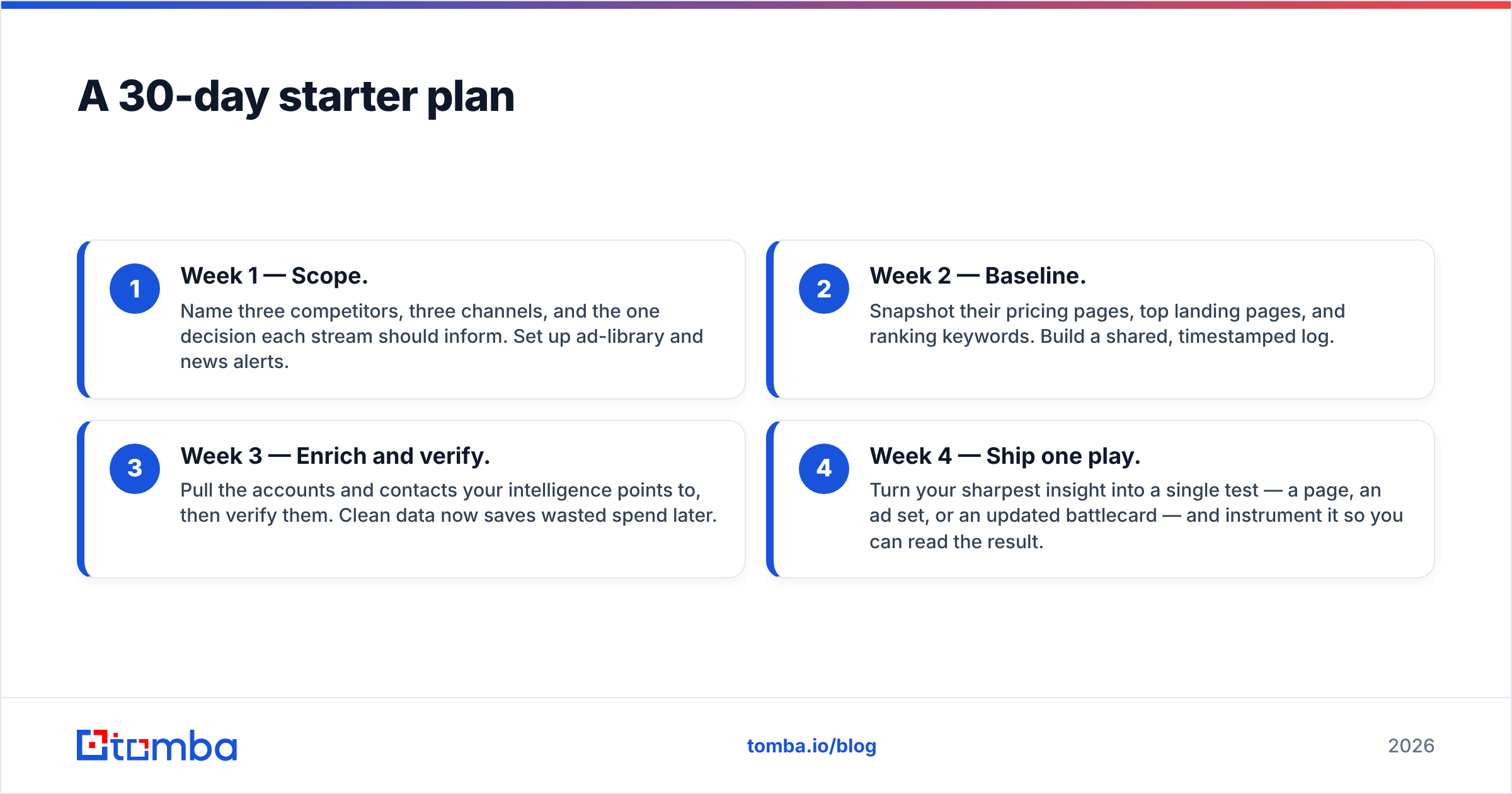
A 30-day starter plan#
You don't need a quarter to see value. Here's a concrete ramp:
- Week 1 — Scope. Name three competitors, three channels, and the one decision each stream should inform. Set up ad-library and news alerts.
- Week 2 — Baseline. Snapshot their pricing pages, top landing pages, and ranking keywords. Build a shared, timestamped log.
- Week 3 — Enrich and verify. Pull the accounts and contacts your intelligence points to, then verify them. Clean data now saves wasted spend later.
- Week 4 — Ship one play. Turn your sharpest insight into a single test — a page, an ad set, or an updated battlecard — and instrument it so you can read the result.
Repeat the loop, add competitors and channels only after the weekly ritual is genuinely habitual, and cut any stream that hasn't changed a decision in a month.
The bottom line#
Competitive marketing intelligence isn't about knowing more than your rivals — it's about acting on the right things faster. The teams that win aren't the ones with the biggest dashboards; they're the ones with a tight loop from signal to verified data to shipped play.
That loop lives or dies on data quality. Before you invest in another monitoring subscription, make sure the contacts and firmographics feeding your intelligence are actually accurate. Tomba's Email Finder helps you turn competitive signals into verified, reachable contacts — start on the free tier (25 searches/month), then scale on the Starter plan at $49/mo when the workflow proves itself. See full Tomba pricing to match a plan to your team's volume.
Find the right people behind every signal, verify before you send, and let your intelligence do what it's supposed to: move pipeline.
Related guides#
Ready to find emails that actually work?
Join 150,000+ professionals who stopped guessing and started sending. Free credits on signup — no credit card required.
Get the Tomba newsletter
Practical outbound tactics and product updates — once every two weeks.
About the author