Competitive Tracking in 2026: A Practical B2B Playbook
Competitive tracking is how modern GTM teams turn scattered rival signals into pipeline. Here's the framework, the metrics, and the tools that actually move win rates in 2026.
Competitive tracking used to mean a stale slide deck someone updated once a quarter. In 2026 it is a live discipline: a continuous feed of signals about who your rivals are hiring, pricing, targeting, and beating you with. Do it well and your sales, product, and marketing teams stop guessing. Do it badly and you find out you lost a deal only when the "closed-lost: competitor" note lands in the CRM.
This guide breaks down what competitive tracking actually is, the signals worth watching, how to build a lightweight system, and how the right data layer turns raw intel into pipeline.
TL;DR#
- Competitive tracking is the ongoing collection and analysis of rival signals — pricing, hiring, product, positioning, and win/loss — so your team can react before the market does.
- The highest-ROI signals are win/loss reasons, pricing changes, hiring patterns, and messaging shifts, not vanity metrics like follower counts.
- You do not need a $50k tool. A tight stack of alerts, a battle-card doc, and a clean contact and company data layer covers 80% of the value.
- Data quality is the bottleneck. Tracking a competitor's new VP of Sales is useless if you can't reach the accounts they're chasing — that's where enrichment and email data close the loop.
- Review cadence beats tool count: a 30-minute weekly sync that updates battle cards outperforms a dashboard nobody opens.
What is competitive tracking?#
Competitive tracking is the practice of continuously monitoring your competitors' moves and translating them into actions your team can take this week. Think of it like a car's rear-view and side mirrors: you're not staring at them the whole drive, but glancing at the right moment stops you from getting sideswiped when a rival changes lanes.
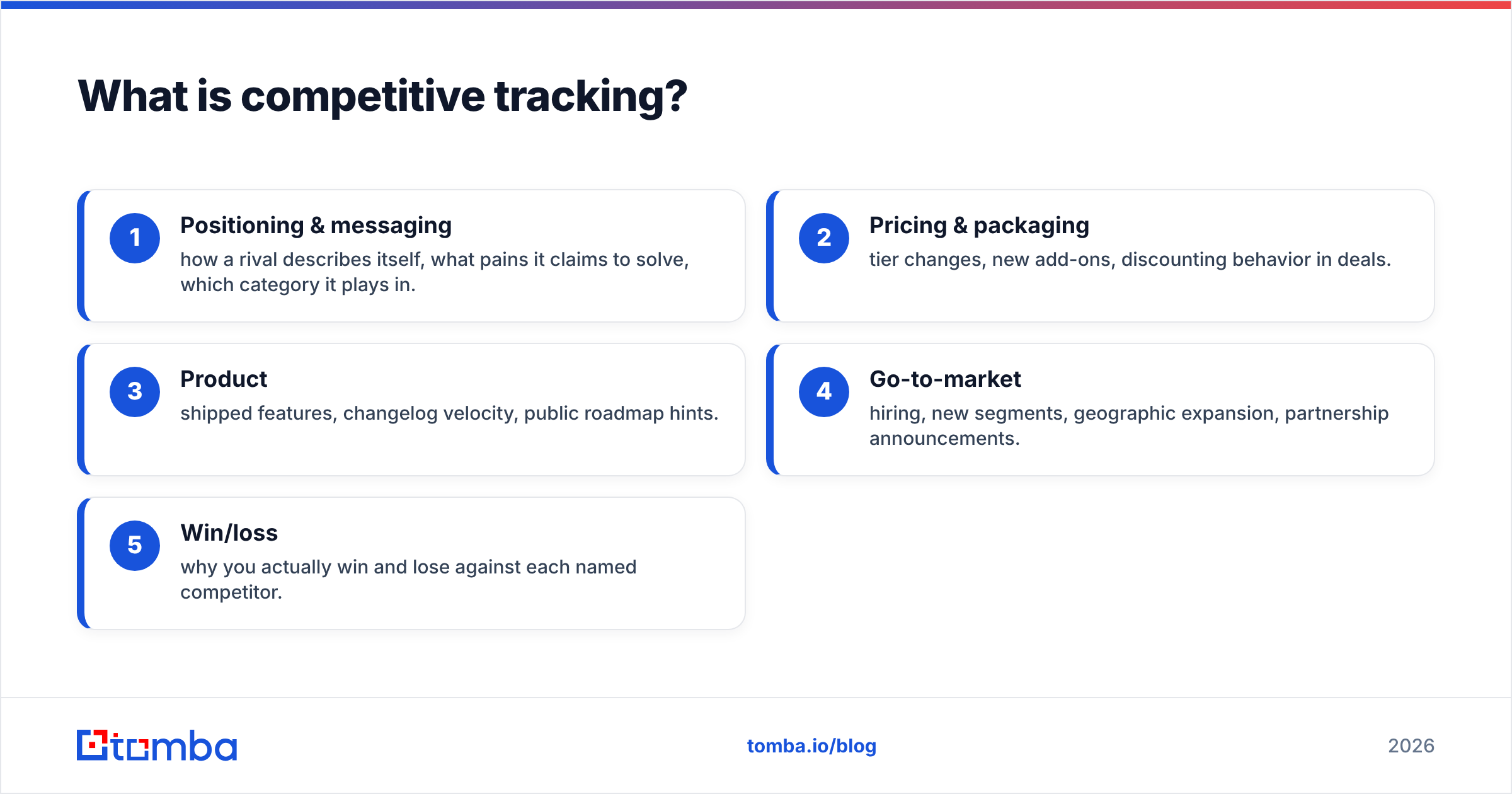
It sits next to, but is broader than, classic competitive intelligence. Intelligence is the analysis; tracking is the always-on collection engine that feeds it. A healthy program covers five layers:
- Positioning & messaging — how a rival describes itself, what pains it claims to solve, which category it plays in.
- Pricing & packaging — tier changes, new add-ons, discounting behavior in deals.
- Product — shipped features, changelog velocity, public roadmap hints.
- Go-to-market — hiring, new segments, geographic expansion, partnership announcements.
- Win/loss — why you actually win and lose against each named competitor.
Most teams over-invest in layer 1 (it's the easiest to see) and under-invest in layers 4 and 5 (which predict revenue). The goal of a tracking system is to rebalance that.
Why does competitive tracking matter in 2026?#
Because buying cycles got noisier and switching costs got lower. Buyers now shortlist tools in an afternoon using G2 and peer communities, and they expect your rep to know exactly how you stack up. When your seller fumbles the "how are you different from X?" question, the deal cools.
Three concrete payoffs:
- Higher win rates. Teams with maintained battle cards close competitive deals at a measurably better clip because reps stop improvising objections handling.
- Faster GTM reaction. If a competitor quietly drops its entry price, you want to know in days, not at the next QBR.
- Sharper targeting. A rival hiring ten enterprise AEs in Germany is telling you where the next fight is. Tracking that lets your outbound team get to those accounts first.
According to Gartner research on B2B buying, most of a purchase decision happens before a vendor conversation. Competitive tracking is how you influence that pre-sales window instead of reacting after it.
What signals should you actually track?#
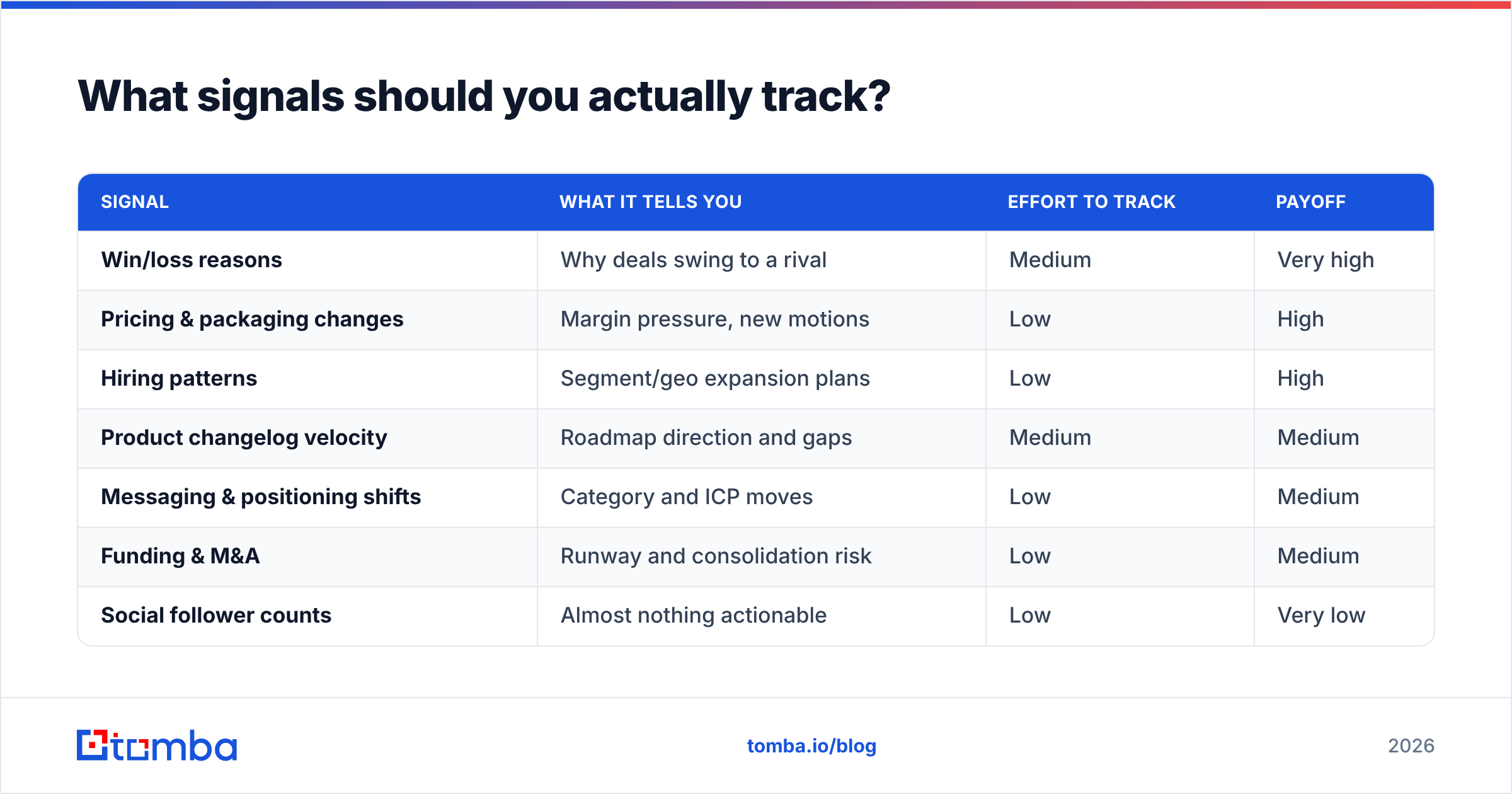
Not everything is worth watching. Here's how the common signals rank by effort versus payoff.
| Signal | What it tells you | Effort to track | Payoff |
|---|---|---|---|
| Win/loss reasons | Why deals swing to a rival | Medium | Very high |
| Pricing & packaging changes | Margin pressure, new motions | Low | High |
| Hiring patterns | Segment/geo expansion plans | Low | High |
| Product changelog velocity | Roadmap direction and gaps | Medium | Medium |
| Messaging & positioning shifts | Category and ICP moves | Low | Medium |
| Funding & M&A | Runway and consolidation risk | Low | Medium |
| Social follower counts | Almost nothing actionable | Low | Very low |
The pattern: the cheapest signal (social metrics) is also the least useful, while the two highest-payoff signals — win/loss and hiring — take a bit more discipline. Prioritize accordingly.
Hiring deserves a special mention. Job postings are a free, public leading indicator. A competitor posting "Enterprise Account Executive, Financial Services" tells you the vertical, the seniority, and often the exact ICP they're chasing next. Pair that with a clean B2B database and you can build the target account list before their new hire even starts.
How do you build a competitive tracking system?#
You can stand up a functional program in a week. The trick is to separate collection, analysis, and distribution so no single person becomes the bottleneck.
- Collection — Set up automated alerts (Google Alerts, changelog RSS, job-board watches, review-site notifications) and a single inbox or channel where they land.
- Enrichment — Turn raw mentions into structured records: which company, which decision-makers, which accounts are affected. This is where data enrichment matters — a name in a press release is noise until you attach the firmographics and the reachable contacts.
- Analysis — A weekly 30-minute review where one owner sorts signals into "act now," "watch," and "ignore."
- Distribution — Living battle cards in your CRM or wiki, plus a short Slack digest. If reps have to hunt for intel, they won't use it.
The failure mode is treating tracking as a solo research project. It's a team sport with a clear owner and a fixed cadence.
Which competitive tracking tools should you use?#
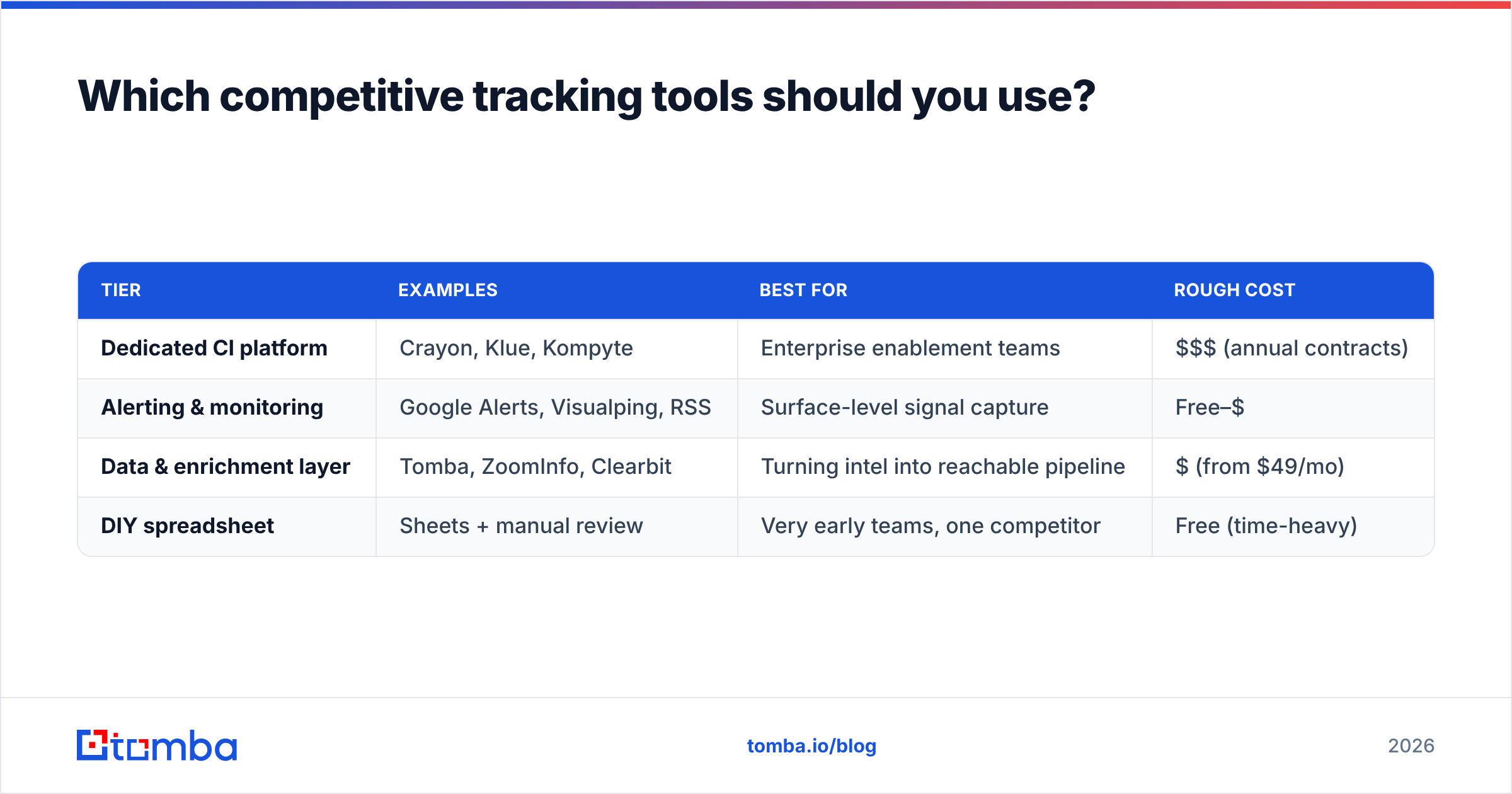
There are three tiers, and most teams mix them. Dedicated platforms (Crayon, Klue, Kompyte) automate collection and battle-card management. General alerting (Google Alerts, Visualping, changelog watchers) is free and covers surface signals. And a data layer — enrichment, contact, and company intelligence — is what makes any of it actionable for outbound.
| Tier | Examples | Best for | Rough cost |
|---|---|---|---|
| Dedicated CI platform | Crayon, Klue, Kompyte | Enterprise enablement teams | $$$ (annual contracts) |
| Alerting & monitoring | Google Alerts, Visualping, RSS | Surface-level signal capture | Free–$ |
| Data & enrichment layer | Tomba, ZoomInfo, Clearbit | Turning intel into reachable pipeline | $ (from $49/mo) |
| DIY spreadsheet | Sheets + manual review | Very early teams, one competitor | Free (time-heavy) |
Here's the honest take: a dedicated CI platform is overkill until you have a full-time product-marketing or enablement function. Most Series A–B teams get further with strong alerting plus a real data layer, because the constraint isn't knowing a competitor is expanding — it's reaching the accounts they're expanding into.
That's the gap Tomba fills. Once tracking surfaces a target segment, you use the domain search to pull the right contacts at those accounts and the email verifier to keep your outreach list clean. Tracking tells you where to fight; the data layer lets you actually show up.

How is competitive tracking different from competitive intelligence?#
They're often used interchangeably, but the distinction is practical. Competitive intelligence is the strategic output — the analysis, the positioning decisions, the board slide. Competitive tracking is the operational input — the continuous, structured feed that keeps the intelligence current.
Analogy: intelligence is the weather forecast; tracking is the network of sensors and stations feeding it data every minute. A forecast built on last quarter's readings is worthless. Most CI programs fail not because the analysis is weak but because the tracking underneath it went stale.
The implication for buyers: don't buy a big "intelligence" platform hoping it fixes your process. Fix the collection cadence and data hygiene first, then decide whether you need heavier tooling on top.
What metrics prove competitive tracking is working?#
If you can't measure it, leadership will cut it. Track these:
- Competitive win rate — your close rate on deals where a named rival was in the mix. This is the headline number.
- Battle-card freshness — percentage of cards updated in the last 30 days. Stale cards are worse than none.
- Time-to-alert — how fast the team knows about a material rival move (target: under 48 hours).
- Intel-to-action rate — how many tracked signals produced a concrete play (an outbound campaign, a pricing tweak, a new objection handler).
- Rep adoption — are sellers actually opening the cards before competitive calls? CRM usage data tells you.
A quick reality check: if your competitive win rate isn't moving after a quarter of tracking, the problem is almost always distribution (reps don't use the intel) or data (you can't reach the accounts), not collection.
How does data quality make or break competitive tracking?#
Every tracking signal eventually points at a set of accounts and people you need to reach — and that's where most programs quietly break. You learn a competitor just landed a marquee logo in fintech. Great. Can you name the other twenty fintech accounts in that ICP and reach their VPs this week? If your contact data is stale or your emails bounce, the intel dies on the vine.
This is the unglamorous half of competitive tracking. Clean, verified contact data turns a signal ("rival expanding into fintech") into a pipeline play ("here are 40 verified decision-makers to open before they do"). Tools like the Tomba Email Finder exist to close exactly this loop — find the right people at the accounts your tracking surfaces, verify the addresses, and hand a ready list to sales.
Skip this layer and competitive tracking becomes an interesting newsletter nobody acts on. Nail it and it becomes a demand engine.
A simple weekly tracking workflow#
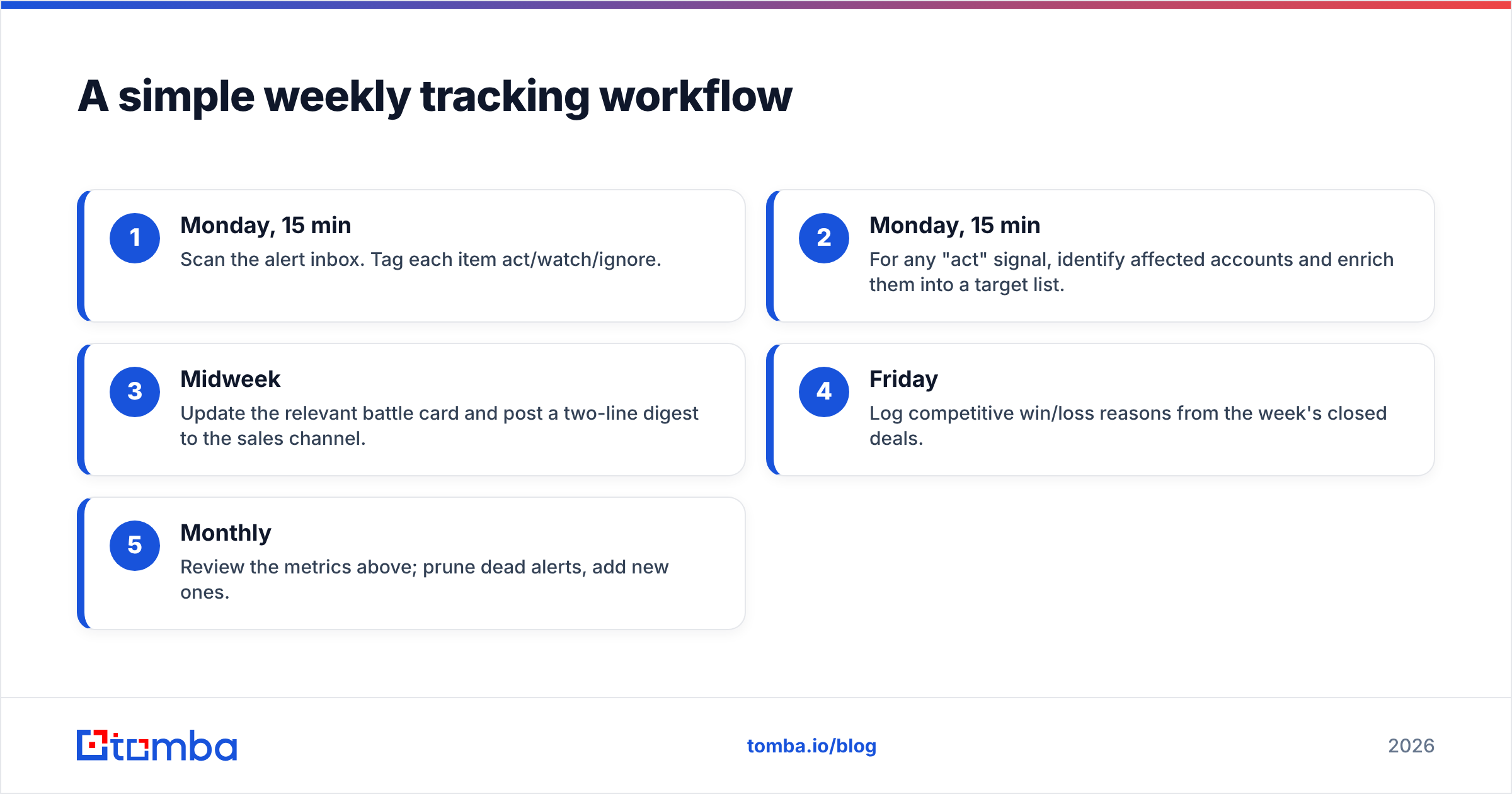
Put it together and a lean program looks like this:
- Monday, 15 min — Scan the alert inbox. Tag each item act/watch/ignore.
- Monday, 15 min — For any "act" signal, identify affected accounts and enrich them into a target list.
- Midweek — Update the relevant battle card and post a two-line digest to the sales channel.
- Friday — Log competitive win/loss reasons from the week's closed deals.
- Monthly — Review the metrics above; prune dead alerts, add new ones.
Total: about an hour a week for the owner, plus a few minutes from reps logging losses. That's the whole cost of staying ahead.
The bottom line#
Competitive tracking in 2026 is less about buying an expensive platform and more about building a disciplined loop: collect the right signals, enrich them into reachable accounts, act within days, and measure competitive win rate. The teams that win competitive deals aren't the ones with the fanciest dashboard — they're the ones who reliably turn a rival's move into a targeted play before the market reacts.
Start where the leverage is: get your data layer clean so every signal you track can become outreach. When your competitive tracking surfaces the next segment your rivals are chasing, use the Tomba Email Finder to find and verify the decision-makers at those accounts — and get there first. Spin up a free tier with 25 searches a month and turn your competitive intel into pipeline this week.
Related guides#
Ready to find emails that actually work?
Join 150,000+ professionals who stopped guessing and started sending. Free credits on signup — no credit card required.
Get the Tomba newsletter
Practical outbound tactics and product updates — once every two weeks.
About the author