How to Measure and Improve Your Competitive Win Rate in 2026
Competitive win rate is the percentage of contested deals you actually win against a named rival. Here's how to measure it correctly and lift it in 2026.
Most teams track "win rate" as one blurry number and call it a day. That number hides the deals that actually decide whether you grow: the ones where a prospect had you and a named competitor on the shortlist and picked one. That subset is your competitive win rate, and it's the single metric that tells you whether your positioning, pricing, and process hold up under real pressure.
This guide breaks down what competitive win rate is, how it differs from overall win rate, how to calculate it without fooling yourself, and the concrete levers that move it.
TL;DR#
- Competitive win rate = deals won ÷ (deals won + deals lost) only in opportunities where a known competitor was in the deal. It ignores no-decision and non-contested wins.
- It's almost always lower than your overall win rate — and that gap is where your revenue leaks hide.
- Track it per competitor. A blended competitive number tells you nothing you can act on.
- The biggest lever isn't discounting — it's reaching the right buyer earlier with accurate contact data and a sharper discovery process.
- Feed losses back into battlecards, and re-measure every quarter. This is a loop, not a report.
What is competitive win rate?#
Competitive win rate is the percentage of contested deals you win — deals where the buyer seriously evaluated you against at least one identified competitor before deciding.
Think of it like a boxing record versus a "games played" stat. Total win rate counts every match, including the walkovers where nobody showed up on the other side. Competitive win rate only counts the fights where someone was actually swinging back. It's a harder, more honest number.
The formula is deliberately narrow:
Competitive Win Rate = Contested Deals Won
                       ------------------------------------------
                       Contested Deals Won + Contested Deals Lost
Notice what's excluded:
- Non-contested wins — deals where you were the only vendor. Counting these inflates your ego, not your insight.
- No-decision losses — the buyer chose "do nothing" or lost budget. That's a different problem (usually urgency or ROI), not a competitive one.
- Disqualified/unworked leads — never entered a real evaluation.
If you don't strip those out, you're not measuring your ability to beat rivals. You're measuring pipeline hygiene.
Why does competitive win rate matter more than overall win rate?#
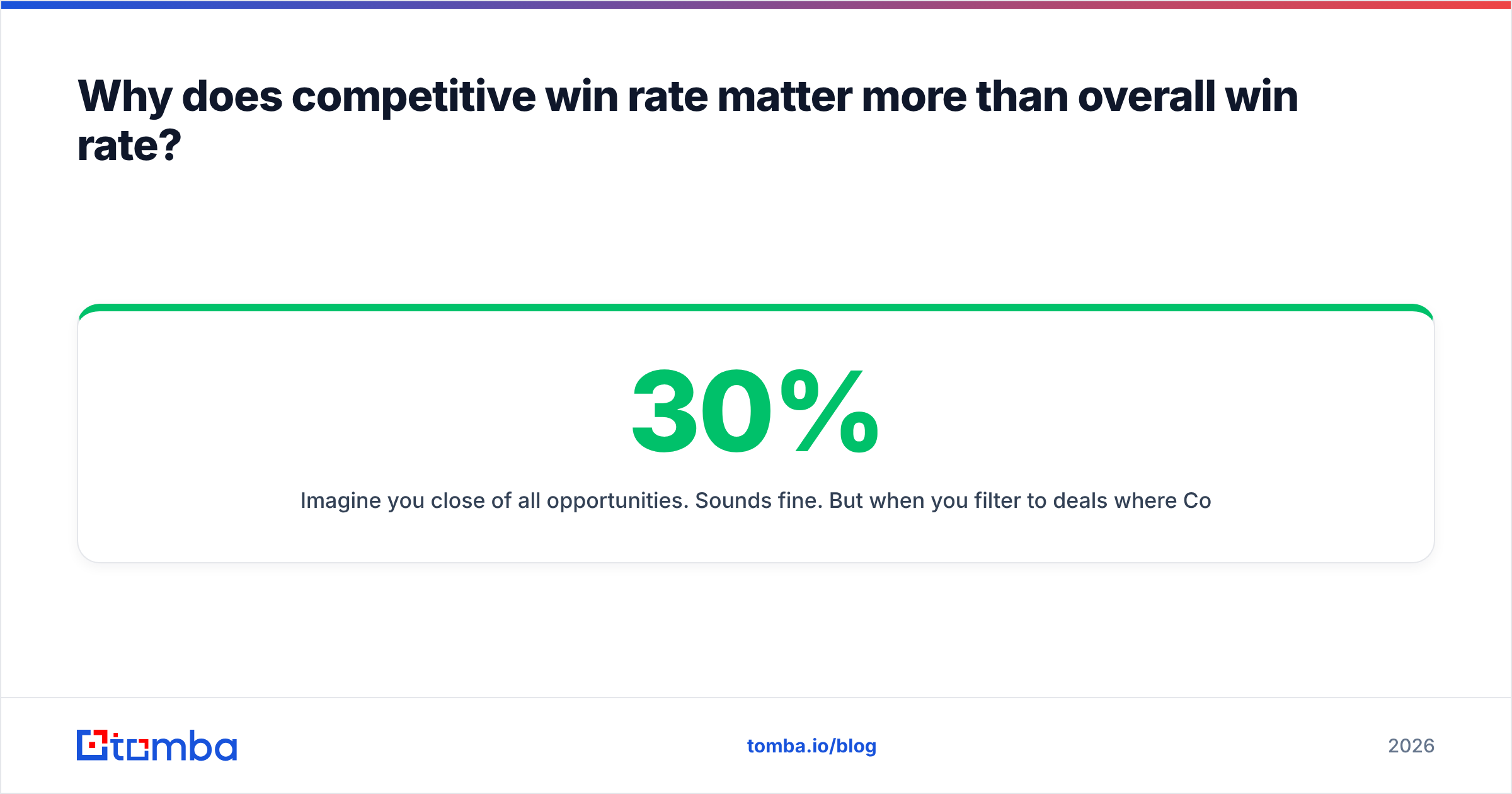
Because overall win rate can look healthy while you're quietly losing every real fight.
Imagine you close 30% of all opportunities. Sounds fine. But when you filter to deals where Competitor X was present, you win 12%. That means your 30% is propped up by uncontested deals — inbound demand, existing-customer expansions, and prospects who never shopped around. The moment a buyer runs a genuine bake-off, you lose two out of three.
Gartner's research on B2B buying has repeatedly shown that buyers spend the majority of their journey doing independent research and comparison before they ever talk to a rep. By the time they're in a contested deal, most of the evaluation is already framed — often by whichever vendor got there first and shaped the criteria. Competitive win rate is the scoreboard for that reality.
It also gives you a diagnostic that overall win rate can't:
- A low competitive win rate but high overall win rate → you're winning on demand, losing on merit. Positioning and enablement problem.
- A high competitive win rate but low overall win rate → you win when you're in the ring, but you're not getting into enough rings. A pipeline and prospecting problem.
- Both low → start with qualification; you're likely working the wrong deals entirely.
For a broader refresher on how this fits with your other pipeline metrics, the win rate glossary entry is a good primer.
How do you calculate competitive win rate correctly?#
Getting the math right depends less on the formula and more on clean data and consistent tagging. Here's the process that survives an audit.
- Add a "Competitor" field to your CRM opportunity record. Not free text — a controlled picklist. Free text becomes "Acme," "acme inc," and "ACME" within a week.
- Make it required at Stage 2+ (or whatever stage means "real evaluation"). Reps skip optional fields. Gate stage progression on it.
- Capture the competitor at loss time, not deal creation. The rival that shows up at negotiation is often not the one you assumed at the start.
- Segment by competitor, segment, and deal size. Blended numbers hide the signal.
- Re-run the calculation on a rolling 90-day window. Quarterly snapshots swing wildly on small deal counts.
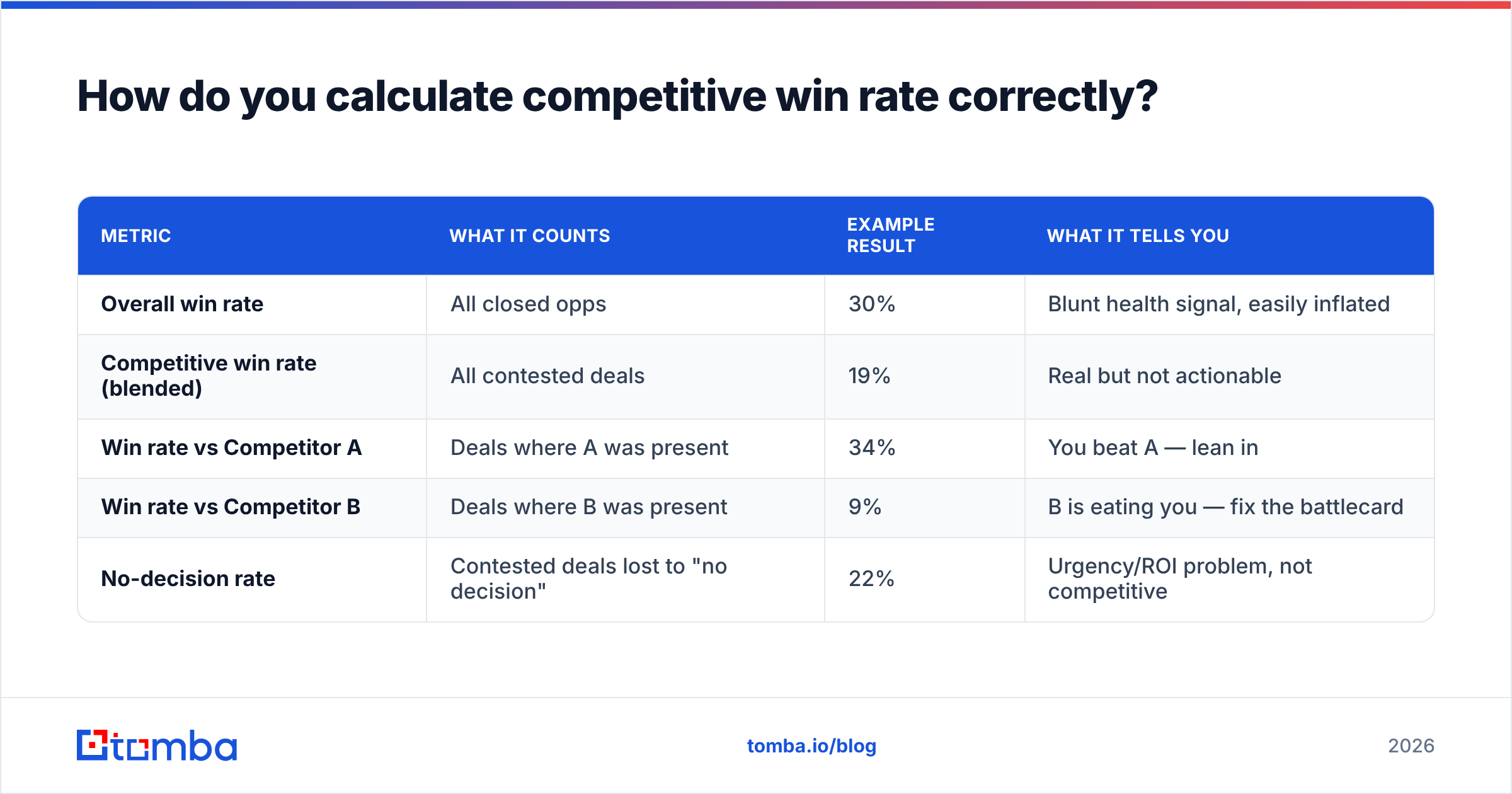
Here's how the same pipeline looks through different lenses:
| Metric | What it counts | Example result | What it tells you |
|---|---|---|---|
| Overall win rate | All closed opps | 30% | Blunt health signal, easily inflated |
| Competitive win rate (blended) | All contested deals | 19% | Real but not actionable |
| Win rate vs Competitor A | Deals where A was present | 34% | You beat A — lean in |
| Win rate vs Competitor B | Deals where B was present | 9% | B is eating you — fix the battlecard |
| No-decision rate | Contested deals lost to "no decision" | 22% | Urgency/ROI problem, not competitive |
The row that should get your attention is Competitor B. A blended 19% would never have surfaced a 9% bleed against a single rival. That's the entire argument for per-competitor tracking.
What actually moves competitive win rate?#
Discounting is the reflex, and it's usually the wrong one — it trains buyers to wait for the drop and compresses your margin without fixing the underlying reason you're losing. The durable levers are earlier and further up the funnel.
1. Get to the buyer before the criteria are set. The vendor who shapes the evaluation criteria wins disproportionately. That means reaching economic buyers and champions early — which requires accurate contact data, not guesswork. If your reps are burning the first week of a deal hunting for a valid email or a direct line, the competitor who already had it is three conversations ahead. A reliable email finder and B2B phone numbers collapse that lag.
2. Multi-thread deliberately. Single-threaded deals lose to competitors who've built consensus across the buying committee. HubSpot's sales research consistently ties multi-stakeholder engagement to higher close rates. Map the committee, then enrich each contact so you're not stalled waiting on one champion.
3. Build battlecards from real loss data. Every contested loss is a free lesson. Log why — feature gap, price, incumbent inertia, better champion. Feed patterns into per-competitor battlecards. Read verified user comparisons on G2 to pressure-test how buyers actually describe the trade-offs, not how your marketing does.
4. Enrich before you engage. Walking into discovery already knowing the account's tech stack, headcount, and org chart changes the quality of the conversation. Data enrichment turns a cold name into a contextualized one, so discovery is about their problem, not your fact-finding.
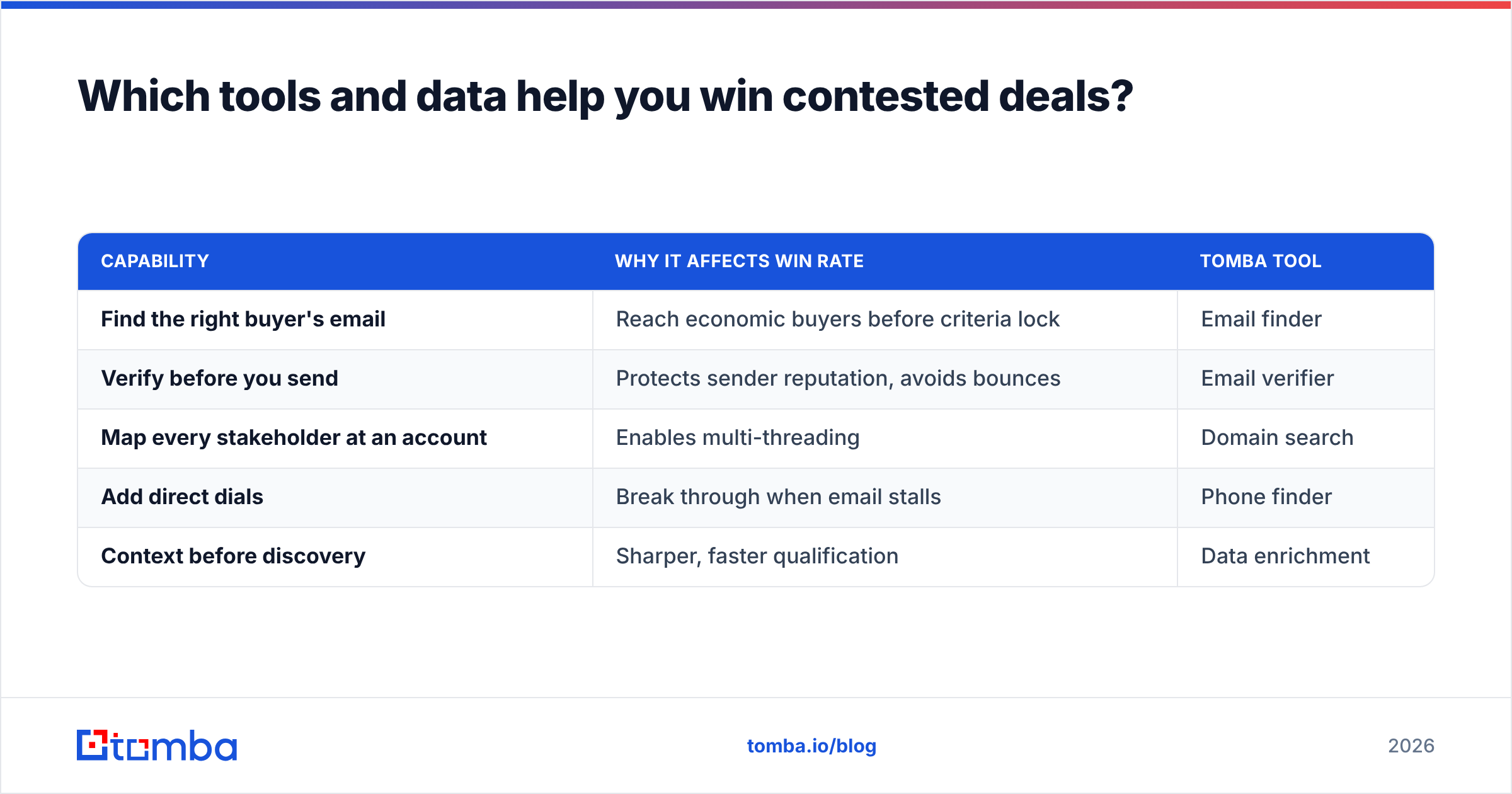
Which tools and data help you win contested deals?#
You can't out-position a competitor you reach late with the wrong contact. The competitive edge starts with data quality — accurate, verified, and available before the buyer has framed their shortlist.
| Capability | Why it affects win rate | Tomba tool |
|---|---|---|
| Find the right buyer's email | Reach economic buyers before criteria lock | Email finder |
| Verify before you send | Protects sender reputation, avoids bounces | Email verifier |
| Map every stakeholder at an account | Enables multi-threading | Domain search |
| Add direct dials | Break through when email stalls | Phone finder |
| Context before discovery | Sharper, faster qualification | Data enrichment |
The point isn't the tool count — it's that each capability shrinks the head start a competitor gets when they simply reach the buyer first. A team that spends deal week one selling instead of researching contacts is compounding an advantage on every contested opportunity.
Pricing that scales with contested-deal volume#
If reaching more buyers earlier is the lever, your data spend should map to how many contested deals you're working. Tomba's pricing is structured for exactly that ramp:
- Free — 25 searches/month, for testing the workflow
- Starter — $49/mo — for individual reps and small teams
- Growth — $99/mo — for scaling outbound and multi-threading
- Pro — $249/mo — for full-team prospecting volume
- Enterprise — custom, for org-wide data operations
Start free, validate that faster buyer contact lifts your contested-deal engagement, then scale the plan to match.
How often should you review competitive win rate?#
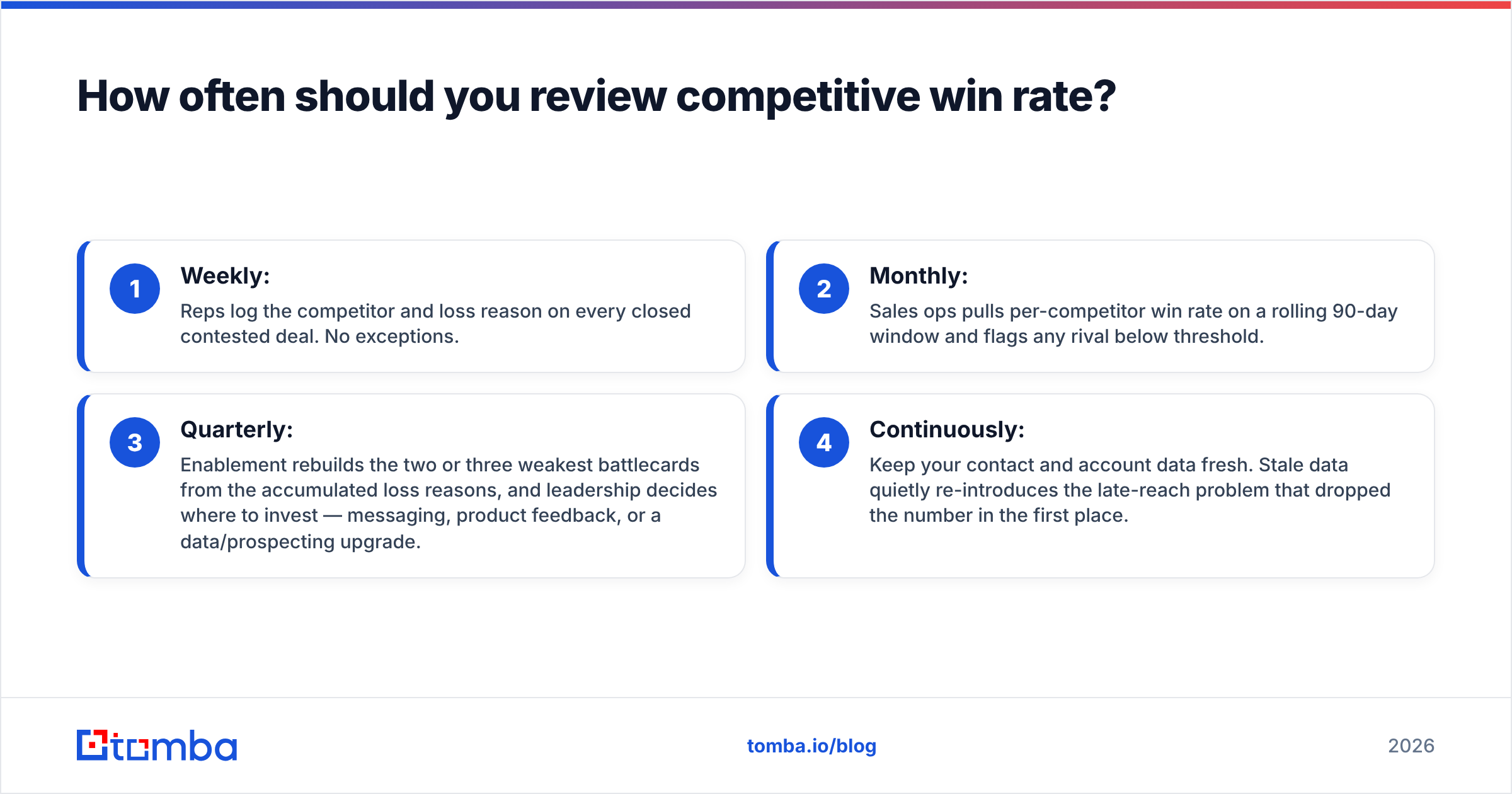
Quarterly for strategy, monthly for early warning — and always per competitor.
Treat it like a closing routine at a restaurant: nightly you do a quick check (are we bleeding on any single rival this month?), and at the end of the quarter you do the deep inventory (which competitors are structurally beating us and why?). The rhythm matters more than the precision.
A practical cadence:
- Weekly: Reps log the competitor and loss reason on every closed contested deal. No exceptions.
- Monthly: Sales ops pulls per-competitor win rate on a rolling 90-day window and flags any rival below threshold.
- Quarterly: Enablement rebuilds the two or three weakest battlecards from the accumulated loss reasons, and leadership decides where to invest — messaging, product feedback, or a data/prospecting upgrade.
- Continuously: Keep your contact and account data fresh. Stale data quietly re-introduces the late-reach problem that dropped the number in the first place.
The teams that improve are the ones that close this loop. The teams that stay flat treat competitive win rate as a slide in the QBR deck instead of a weekly operating input.
The bottom line#
Competitive win rate is the honest version of your win rate — it strips out the uncontested wins and the no-decisions and tells you, deal by deal, whether you beat the rivals who were actually in the room. Measure it per competitor, feed losses back into your enablement, and attack the root cause: reaching the right buyer, early, with data you can trust.
Most competitive losses trace back to the same quiet failure — the other vendor got to the decision-maker first while your rep was still hunting for a working email. Close that gap. Start finding verified buyer contacts in seconds with the Tomba Email Finder, reach the committee before your competitor frames the criteria, and turn more contested deals into wins. Try it free with 25 searches a month, then scale as your contested pipeline grows.
Related guides#
Ready to find emails that actually work?
Join 150,000+ professionals who stopped guessing and started sending. Free credits on signup — no credit card required.
Get the Tomba newsletter
Practical outbound tactics and product updates — once every two weeks.
About the author