Competitor Benchmarking: The 2026 B2B Playbook (With Examples)
Competitor benchmarking turns vague hunches about rivals into hard numbers you can act on. Here's the 2026 framework, the metrics that matter, and the data sources that make it honest.
Most "competitive analysis" decks are a graveyard of screenshots and gut feelings. Competitor benchmarking is the opposite discipline: you pick metrics, gather comparable data, and score yourself against named rivals on a repeatable cadence. Done right, it tells you where to invest next quarter with far less argument.
This guide is the no-fluff version. You'll get a working definition, the metrics that actually move revenue, a step-by-step process, and an honest look at where the data comes from — including where automated enrichment saves you weeks of manual research.
TL;DR#
- Competitor benchmarking = measuring your performance against specific rivals on defined metrics, on a repeating schedule — not a one-time slide.
- The four benchmarking types that matter for B2B: product, go-to-market, pricing, and operational. Most teams only do the first and wonder why they lose deals.
- Pick 5–8 metrics you can actually source reliably. Twenty vanity metrics you update once is worse than five you track quarterly.
- The bottleneck is almost always data, not analysis. Firmographic and contact data from tools like Tomba, Clearbit, or a curated B2B database is what separates a real benchmark from a guess.
- Benchmark to decide, not to admire. Every score should map to an owner and a next action.
What is competitor benchmarking?#
Competitor benchmarking is the practice of comparing your company's performance against named competitors using a fixed set of metrics, repeated on a schedule so you can see movement over time.
Think of it like a fitness tracker for your go-to-market. A one-time weigh-in tells you almost nothing. The same measurement every month, next to a training partner's numbers, tells you whether your plan is working. The value isn't the single snapshot — it's the trend line and the direct comparison.
That distinction matters because "competitive analysis" and "benchmarking" get used interchangeably, and they shouldn't. Analysis is qualitative and open-ended: what is this competitor doing? Benchmarking is quantitative and bounded: how do we score against them on these eight things, this quarter? You need both, but only one gives you a dashboard.

What are the main types of competitor benchmarking?#
Not all benchmarking answers the same question. In B2B, four types cover the ground that actually affects pipeline and retention:
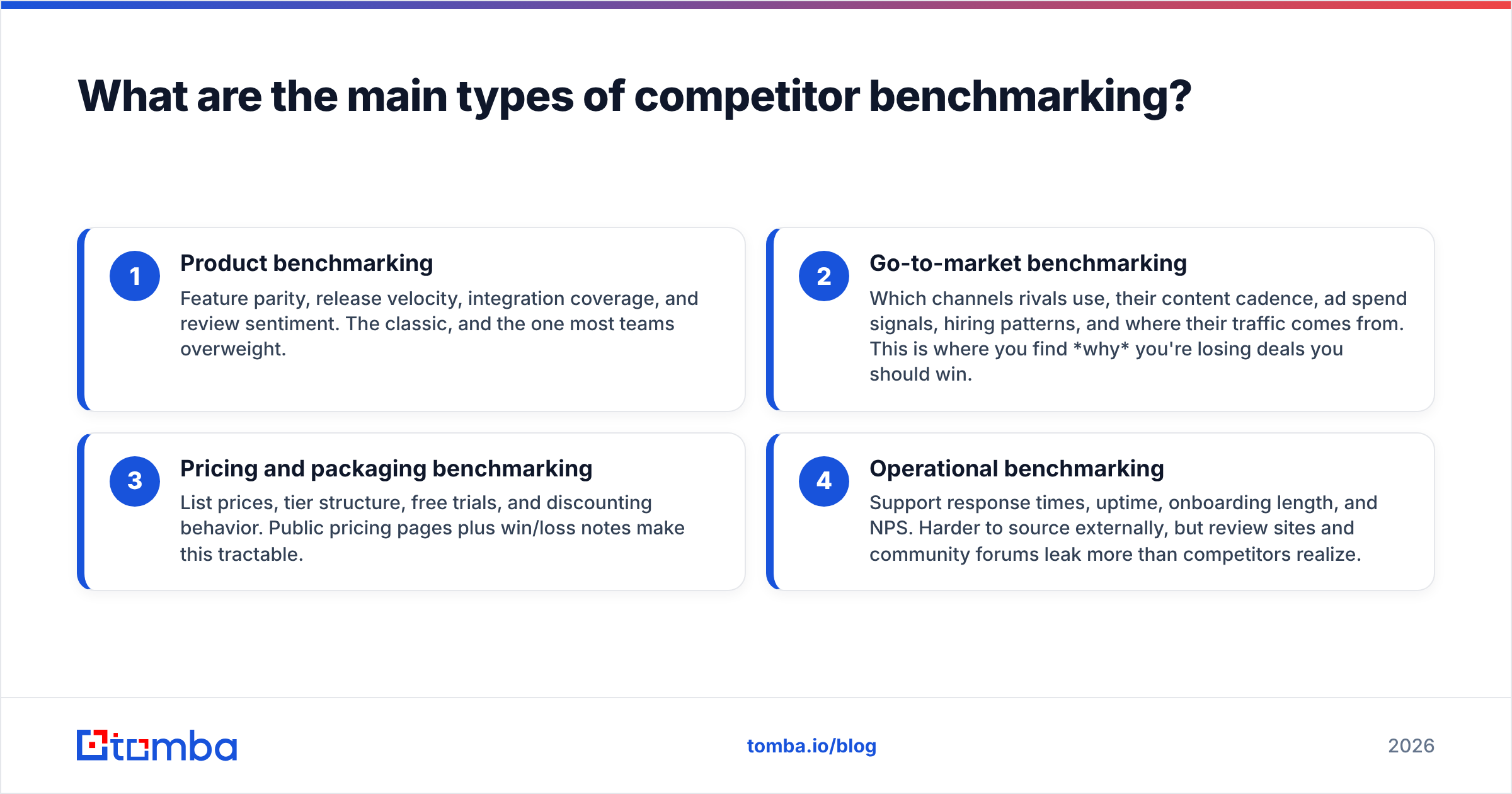
- Product benchmarking — Feature parity, release velocity, integration coverage, and review sentiment. The classic, and the one most teams overweight.
- Go-to-market benchmarking — Which channels rivals use, their content cadence, ad spend signals, hiring patterns, and where their traffic comes from. This is where you find why you're losing deals you should win.
- Pricing and packaging benchmarking — List prices, tier structure, free trials, and discounting behavior. Public pricing pages plus win/loss notes make this tractable.
- Operational benchmarking — Support response times, uptime, onboarding length, and NPS. Harder to source externally, but review sites and community forums leak more than competitors realize.
A useful rule: if you only run product benchmarking, you'll build a great feature list and still miss why a rival with a worse product outsells you. The go-to-market and pricing layers explain the gap.
Why does competitor benchmarking matter in 2026?#
Because buyers now self-educate before they ever talk to you, and they compare you against rivals you may not even be watching. According to Gartner research on B2B buying, buyers spend the majority of their journey in independent research — reading G2 reviews, comparison posts, and peer communities — long before a sales conversation.
That changes the stakes. If a competitor is winning the comparison-content game or has quietly repriced, you feel it as slower pipeline months later, with no obvious cause. Benchmarking on a cadence catches those shifts while they're still cheap to respond to.
It also settles internal arguments. "Everyone says the competition is cheaper" becomes "Competitor B is 18% cheaper at the mid-tier but has no free plan" — a claim someone can act on. Turning opinions into scored, sourced numbers is the whole point of a mature revenue operations practice.
How do you run a competitor benchmarking process?#
Here's the sequence that survives contact with a real quarter. Six steps, each with an owner.
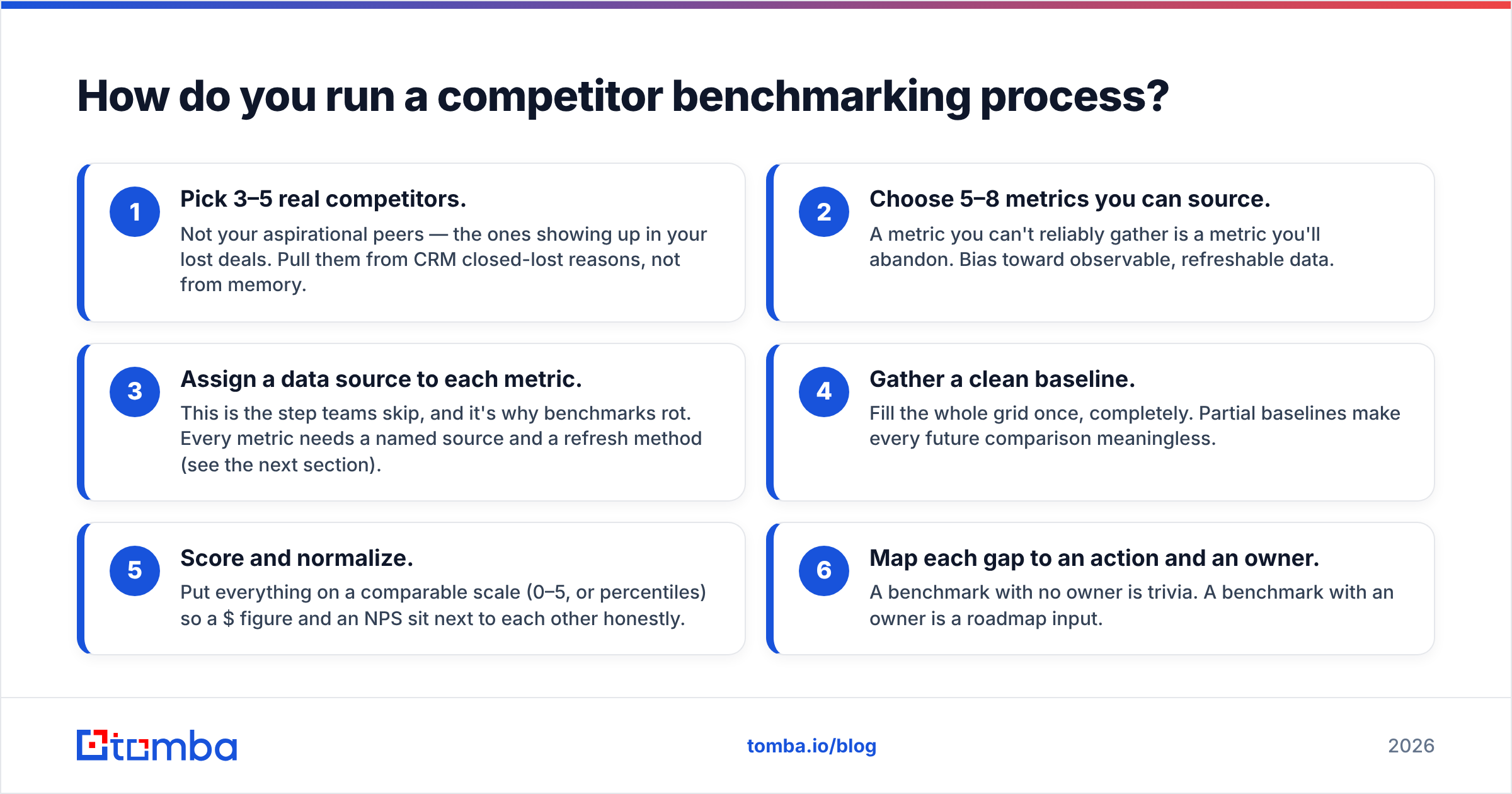
- Pick 3–5 real competitors. Not your aspirational peers — the ones showing up in your lost deals. Pull them from CRM closed-lost reasons, not from memory.
- Choose 5–8 metrics you can source. A metric you can't reliably gather is a metric you'll abandon. Bias toward observable, refreshable data.
- Assign a data source to each metric. This is the step teams skip, and it's why benchmarks rot. Every metric needs a named source and a refresh method (see the next section).
- Gather a clean baseline. Fill the whole grid once, completely. Partial baselines make every future comparison meaningless.
- Score and normalize. Put everything on a comparable scale (0–5, or percentiles) so a $ figure and an NPS sit next to each other honestly.
- Map each gap to an action and an owner. A benchmark with no owner is trivia. A benchmark with an owner is a roadmap input.
Run steps 4–6 quarterly. The baseline work in steps 1–3 you do once and only revise when the market shifts.
What metrics should you actually track?#
Fewer than you think, and more sourceable than you'd like. Here's a starting scorecard you can adapt — notice that the hardest column is usually "where does this come from," not "what's the number."
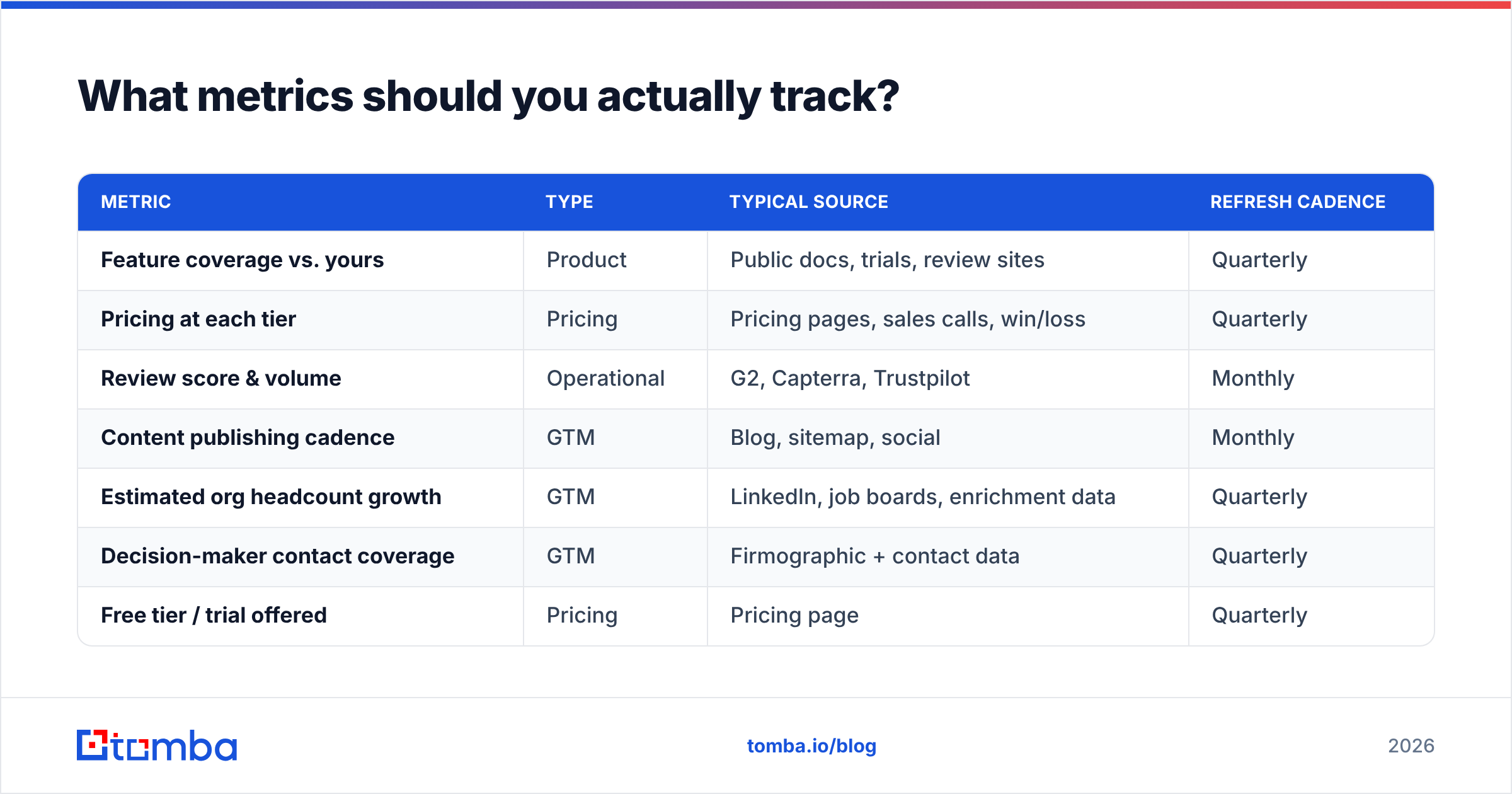
| Metric | Type | Typical source | Refresh cadence |
|---|---|---|---|
| Feature coverage vs. yours | Product | Public docs, trials, review sites | Quarterly |
| Pricing at each tier | Pricing | Pricing pages, sales calls, win/loss | Quarterly |
| Review score & volume | Operational | G2, Capterra, Trustpilot | Monthly |
| Content publishing cadence | GTM | Blog, sitemap, social | Monthly |
| Estimated org headcount growth | GTM | LinkedIn, job boards, enrichment data | Quarterly |
| Decision-maker contact coverage | GTM | Firmographic + contact data | Quarterly |
| Free tier / trial offered | Pricing | Pricing page | Quarterly |
| Support response time | Operational | Test tickets, community forums | Quarterly |
Eight rows is plenty. If a stakeholder demands a ninth, ask them who owns the action it triggers. If nobody does, it's a vanity metric.
Where does competitor benchmarking data actually come from?#
This is the part nobody puts in the deck, and it's where most benchmarking projects quietly die. You can design a beautiful scorecard, but if half the cells require a week of manual digging each quarter, you'll fill them once and never again.
Data sources break into three tiers:
- Public and free — Pricing pages, review sites, sitemaps, job postings, press. High trust, but slow to gather by hand and easy to let go stale.
- Structured and enriched — Firmographic, technographic, and contact data pulled programmatically. This is what makes headcount, tech stack, and decision-maker coverage benchmarks feasible at all. Tools like Tomba's enrichment, Clearbit, and vendors such as BookYourData supply this layer, and a good B2B database with transparent data sources removes weeks of manual research.
- First-party signals — Win/loss interviews, your own website visitor identification, and sales-call notes. The most honest source you have, because it reflects real buyers choosing between you and a rival.
The trap is treating benchmarking as a pure analysis problem. It's mostly a data-logistics problem. Automate the sourcing and the analysis takes an afternoon; do it by hand and you'll be out of date before you present.

How is benchmarking different from a competitive teardown?#
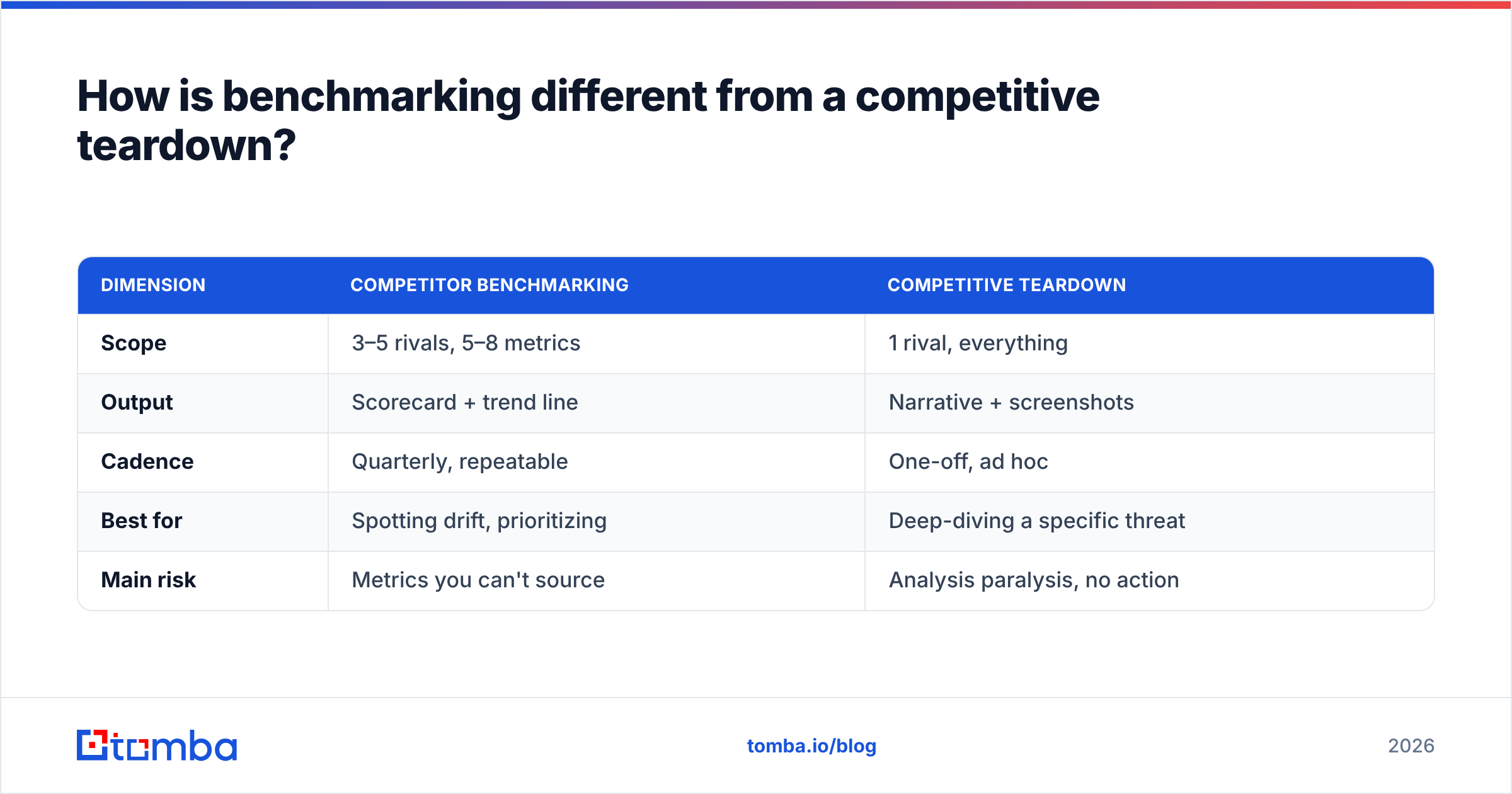
A teardown is deep and narrow; benchmarking is shallow and wide. Both are useful, and confusing them wastes time. Here's the honest comparison:
| Dimension | Competitor benchmarking | Competitive teardown |
|---|---|---|
| Scope | 3–5 rivals, 5–8 metrics | 1 rival, everything |
| Output | Scorecard + trend line | Narrative + screenshots |
| Cadence | Quarterly, repeatable | One-off, ad hoc |
| Best for | Spotting drift, prioritizing | Deep-diving a specific threat |
| Main risk | Metrics you can't source | Analysis paralysis, no action |
Use a teardown when one competitor suddenly threatens a key segment. Use benchmarking as the standing radar that tells you which competitor deserves the teardown in the first place. They feed each other.
What are the common mistakes to avoid?#
The failure modes are predictable, which is good news — you can design around them.
- Metric sprawl. Twenty metrics you update once beat nothing, but lose to five you actually maintain. Cut ruthlessly.
- No named source. If a cell doesn't have a source and a refresh method, it will be a guess within two quarters.
- Benchmarking to admire, not decide. If your scorecard doesn't produce actions with owners, it's a hobby.
- Cherry-picking rivals. Benchmarking against companies you already beat feels great and teaches you nothing. Include the ones winning your lost deals.
- Stale contact and firmographic data. People change roles constantly. A benchmark built on last year's org data is fiction — which is exactly why the enrichment layer has to be automated, not hand-maintained.
Avoid those five and you're ahead of most teams, who ship one gorgeous benchmarking deck and never update it.
How often should you refresh your benchmarks?#
Quarterly for strategic metrics, monthly for fast-moving ones — and never "whenever someone remembers." The cadence is the product. A benchmark without a schedule is a screenshot.
Set calendar owners for each refresh cadence in the scorecard above. The monthly items (reviews, content cadence) are cheap and catch momentum shifts early. The quarterly items (pricing, headcount, contact coverage) are heavier but stable enough that monthly would be noise. Match effort to volatility.
If a metric feels too expensive to refresh on schedule, that's your signal to either automate its data source or drop it. There's no third option that ends well.
The bottom line: benchmark to act, source to last#
Competitor benchmarking is worth it when it's a habit, not an event. The framework is simple — pick real rivals, choose sourceable metrics, score on a cadence, map every gap to an owner. What makes or breaks it is the data underneath: keep it automated and honest, and the whole exercise pays for itself in one saved quarter of misdirected roadmap.
The recurring cost is contact and firmographic freshness, and that's the part you should automate first. If your benchmark depends on knowing who the decision-makers are at rival-adjacent accounts — and most useful ones do — start by making that data reliable. Tomba's Email Finder and enrichment tools let you pull verified, current contact and company data by domain in seconds, so the hardest columns of your scorecard stay accurate instead of rotting between quarters. Spin up a free plan (25 searches a month), wire it into your benchmarking grid, and see how much of your "we don't have that data" list disappears. Check the full Tomba pricing when you're ready to scale the sourcing.
Related guides#
Ready to find emails that actually work?
Join 150,000+ professionals who stopped guessing and started sending. Free credits on signup — no credit card required.
Get the Tomba newsletter
Practical outbound tactics and product updates — once every two weeks.
About the author