Competitor Landscape Analysis: A 2026 B2B Playbook
Mapping your competitor landscape is how you stop reacting to threats and start out-positioning them. Here's a repeatable 2026 framework, a scoring matrix, and the data signals that separate real rivals from noise.
TL;DR
- A competitor landscape is a structured map of every company competing for your buyer's budget, ranked by how much of a threat they actually pose — not an alphabetized logo wall.
- Most teams over-index on direct rivals and miss the substitutes, "do nothing," and adjacent platforms that quietly steal deals.
- Build it in four moves: define the arena, source signals, score each player, and turn the map into positioning and battlecards.
- The map decays fast. Refresh it quarterly with fresh contact, hiring, and funding data instead of letting a stale slide deck rot in a shared drive.
- Good competitive intelligence is a data problem first. Clean firmographic and contact data is what makes the analysis trustworthy.
What is a competitor landscape?#
A competitor landscape is a structured view of everyone fighting for the same buyer, dollar, and problem you are — organized so you can see who matters, why, and what to do about it.
Think of it like a nautical chart. A tourist map shows you the pretty coastline. A nautical chart shows you the depth, the rocks, and the currents — the things that actually sink you. A logo slide is a tourist map. A real competitor landscape marks the shallow reefs (a scrappy startup undercutting you on price) and the shipping lanes (the incumbent every RFP defaults to).
Technically, it's a living dataset. Each competitor is a row with attributes: category, target segment, pricing posture, funding, headcount trajectory, win/loss record against you, and the wedge they use to enter accounts. When you treat it as data rather than a static deck, you can sort it, score it, and act on it.
The mistake nearly every go-to-market team makes is confusing awareness with analysis. Naming your five obvious rivals is awareness. Ranking them by threat, mapping where they overlap your ICP, and knowing which three deals you lost to each one last quarter — that's analysis. Only the second one changes what you do on Monday.
Why does mapping the competitor landscape matter in 2026?#
Because buyers now run their own competitive analysis before you ever get a meeting, and if your positioning doesn't account for the full field, you lose the deal in a spreadsheet you never saw.
Three shifts make this sharper than it was even two years ago:
- Buying committees got bigger and more skeptical. Gartner has documented that B2B purchases now involve six to ten stakeholders, each arriving with independent research. Every one of them is comparing you to alternatives you may not have on your radar.
- Category lines blurred. A CRM now ships email sequencing. An email tool now ships a CRM. Your "adjacent" competitor is one feature release away from being a direct one.
- "Do nothing" is the quiet winner. In most enterprise deals, the biggest competitor isn't a vendor — it's the status quo, a homegrown script, or a budget freeze. If your map only contains vendors, you're blind to the option that wins most often.
Getting this right pays off in concrete places: tighter positioning, sharper sales battlecards, smarter revenue operations planning, and a product roadmap that defends the flanks competitors are probing. Getting it wrong means you build for a fight that already moved.

What are the four types of competitors you must map?#
Map all four or your landscape has holes a rival will drive a deal through. Most teams document the first type and forget the other three.
- Direct competitors — same product, same buyer, same problem. These are the logos your reps already name. Easy to spot, dangerous to over-weight.
- Indirect / substitute competitors — a different product that solves the same job. A prospect who "just uses LinkedIn manually" instead of buying your prospecting tool is choosing a substitute.
- Adjacent-platform competitors — a company in a neighboring category expanding toward you. They arrive with an existing customer base and cross-sell leverage, which makes them the fastest-growing threat class.
- The null option ("do nothing") — the internal build, the spreadsheet, the deferred decision. Track it like a vendor: how often you lose to it, and why.
A useful exercise: for your last 20 closed-lost deals, tag which of these four you lost to. Teams that do this are almost always surprised — the split rarely matches the mental model they walked in with.
How do you build a competitor landscape step by step?#
Four steps: define the arena, gather signals, score every player, and convert the map into assets your team uses. Here's each one in practice.
Step 1 — Define the arena#
Write one sentence: "We compete for [buyer role] at [company type] who are trying to [job to be done]." Anyone who shows up in that sentence's search results, RFPs, or "vs" pages is in your arena. This keeps you from boiling the ocean or, worse, only listing the three brands you personally dislike.
Step 2 — Gather signals from real sources#
This is where most landscapes fall apart — they're built on vibes. Pull from sources you can cite:
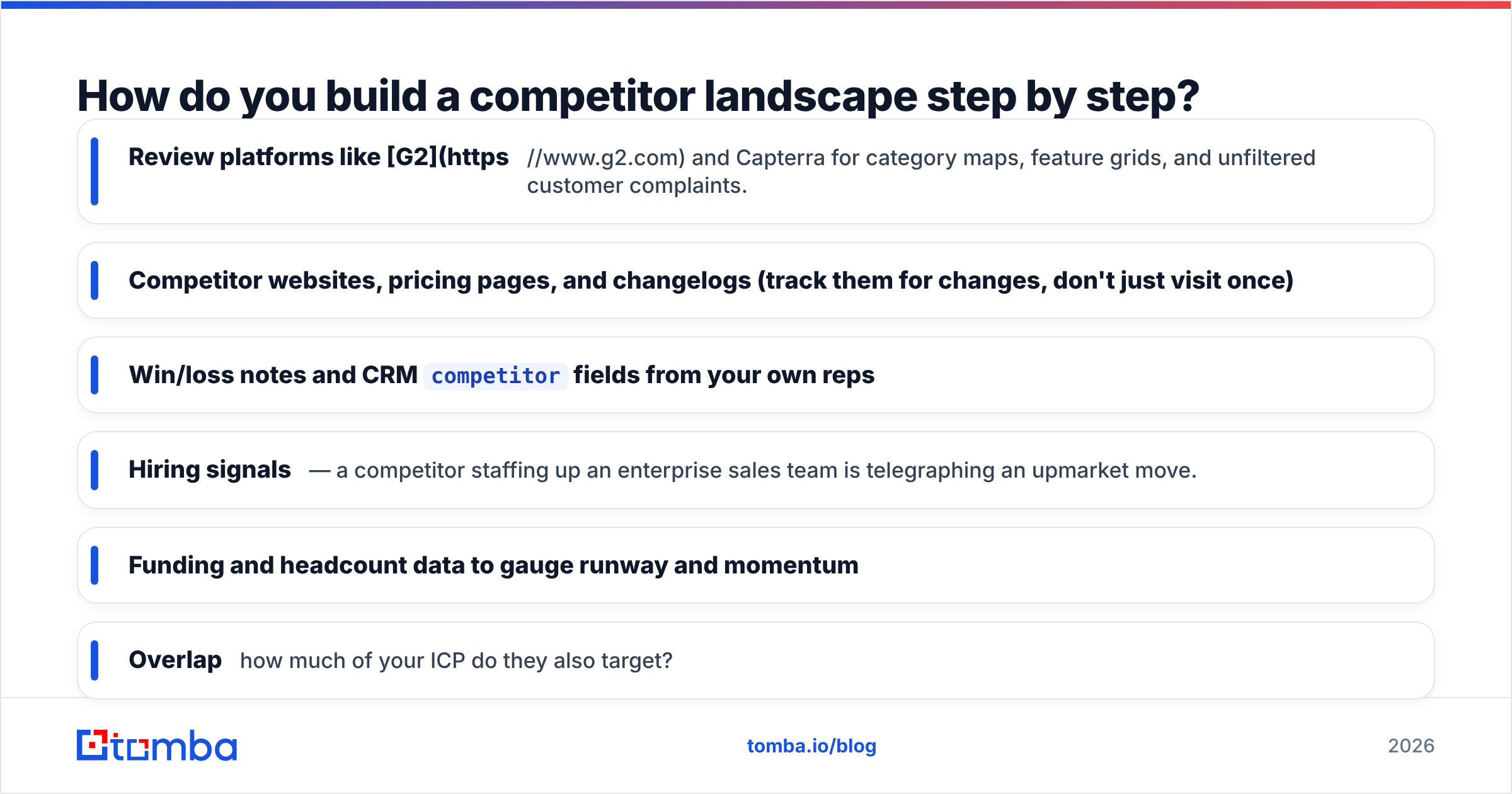
- Review platforms like G2 and Capterra for category maps, feature grids, and unfiltered customer complaints.
- Competitor websites, pricing pages, and changelogs (track them for changes, don't just visit once).
- Win/loss notes and CRM
competitorfields from your own reps. - Hiring signals — a competitor staffing up an enterprise sales team is telegraphing an upmarket move.
- Funding and headcount data to gauge runway and momentum.
To act on any of these, you need to reach the right people at those companies — analysts, partners, churned customers. That's a contact-data problem, and it's where a B2B database and reliable data enrichment turn a static list into a research pipeline you can actually work.
Step 3 — Score every player#
Don't rank by gut. Score each competitor on a few weighted dimensions so the map sorts itself. A simple 1–5 model works:
- Overlap — how much of your ICP do they also target?
- Momentum — funding, hiring, and release velocity.
- Win-rate impact — how often you lose to them head-to-head.
- Differentiation gap — how easily a buyer can tell you apart.
Multiply, sort descending, and your top five threats surface without argument.
Step 4 — Turn the map into assets#
A landscape that lives in one analyst's head is worthless. Ship it as battlecards for sales, a positioning brief for marketing, and a threat list for product. Each asset answers one question: when we meet this competitor, what do we say and do?
What does a competitor landscape matrix look like?#
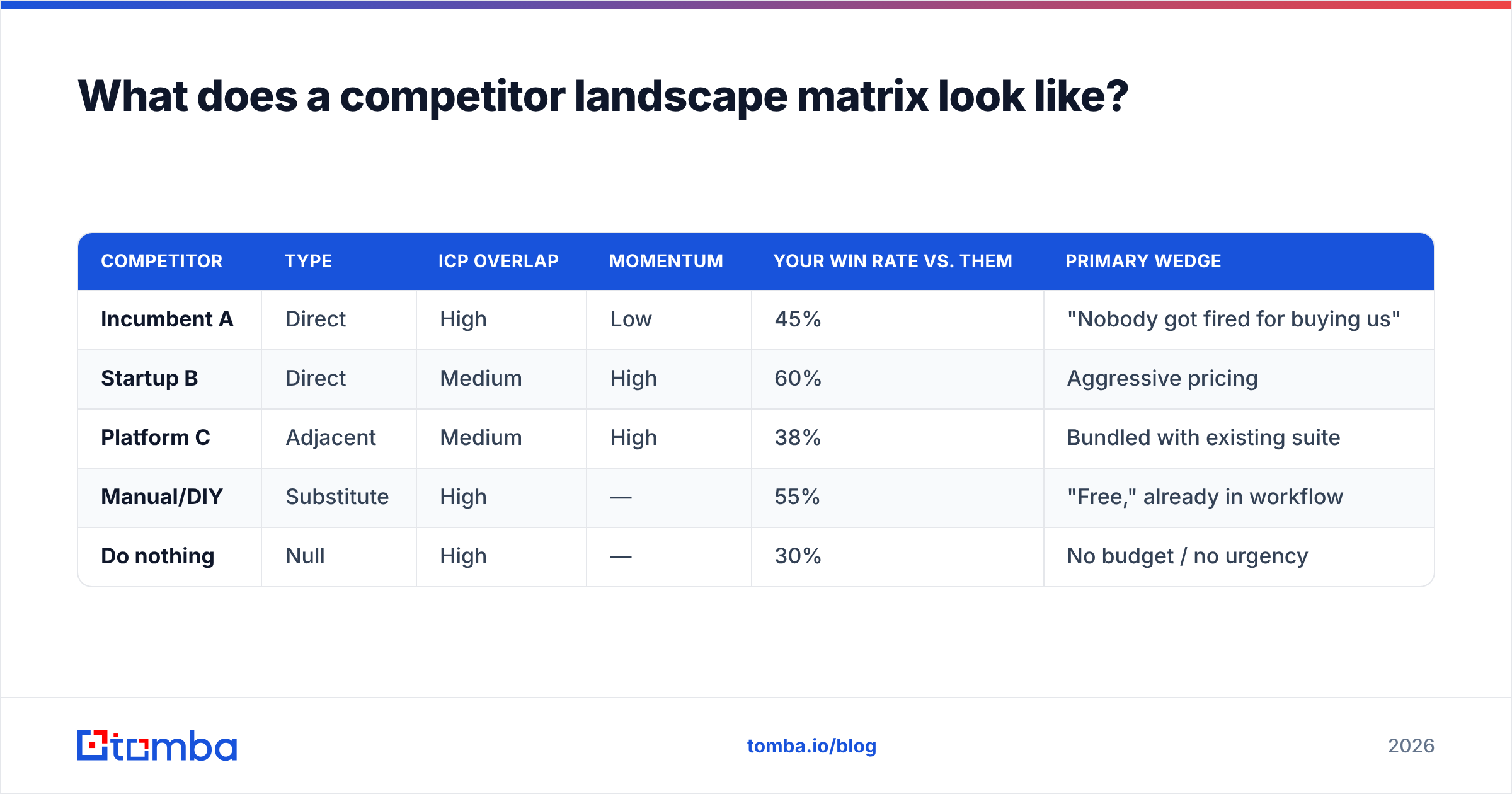
Here's a stripped-down matrix showing how the scoring comes together. Real ones carry more rows, but the shape is the point — every column is a decision input, not decoration.
| Competitor | Type | ICP overlap | Momentum | Your win rate vs. them | Primary wedge |
|---|---|---|---|---|---|
| Incumbent A | Direct | High | Low | 45% | "Nobody got fired for buying us" |
| Startup B | Direct | Medium | High | 60% | Aggressive pricing |
| Platform C | Adjacent | Medium | High | 38% | Bundled with existing suite |
| Manual/DIY | Substitute | High | — | 55% | "Free," already in workflow |
| Do nothing | Null | High | — | 30% | No budget / no urgency |
Read it as a to-do list. The lowest win-rate rows (Platform C, Do nothing) are where you're bleeding — that's where positioning and enablement dollars go first. The high-momentum rows (Startup B, Platform C) are where you watch for the next move. Notice the substitutes and the null option score high on overlap and low on your win rate. Ignore them and you've mapped the easy fights while losing the common ones.

How is a competitor landscape different from a competitive analysis?#
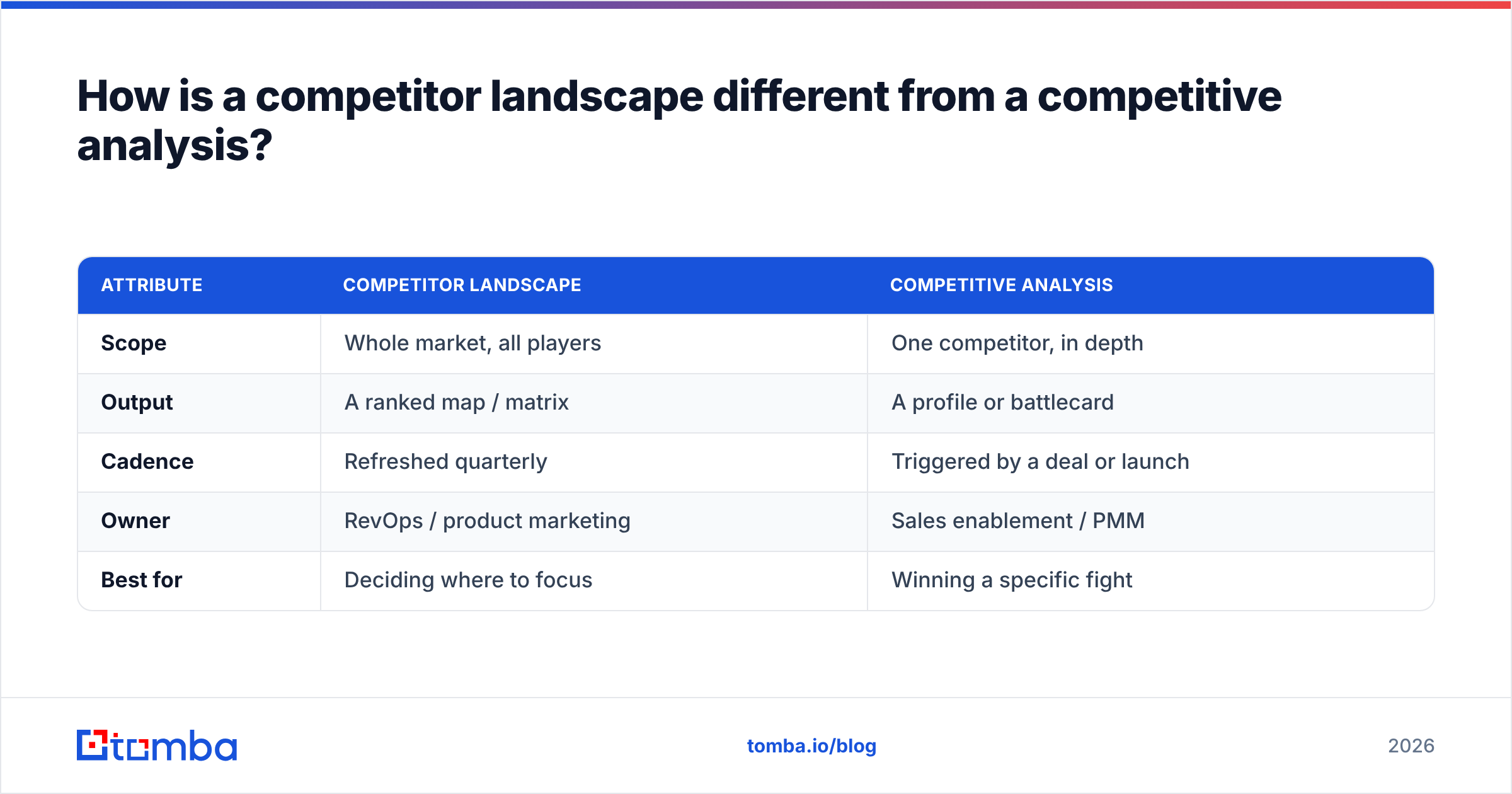
A landscape is the map; a competitive analysis is the deep dive on one location. You need both, and confusing them wastes weeks.
| Attribute | Competitor landscape | Competitive analysis |
|---|---|---|
| Scope | Whole market, all players | One competitor, in depth |
| Output | A ranked map / matrix | A profile or battlecard |
| Cadence | Refreshed quarterly | Triggered by a deal or launch |
| Owner | RevOps / product marketing | Sales enablement / PMM |
| Best for | Deciding where to focus | Winning a specific fight |
The workflow is: the landscape tells you which three competitors deserve a full analysis this quarter, and the analysis tells you how to beat each one. Skip the landscape and you'll pour research into a rival who was never a real threat. HubSpot's guide to competitive analysis is a solid template for that second, deeper layer once your map has prioritized where to point it.
How often should you refresh your competitor landscape?#
Quarterly at minimum, plus event triggers — because the data underneath it goes stale faster than most teams admit.
A landscape built in January is meaningfully wrong by April. Competitors raise rounds, ship features, poach your champions, and reposition. The two failure modes are equally common: refreshing too rarely (a dusty deck nobody trusts) and refreshing constantly by hand (a burned-out analyst and no time for actual analysis).
The fix is to separate the slow layer from the fast layer:
- Slow layer (quarterly): the strategic map — who's in the arena, the scoring, the positioning implications. This is human judgment work.
- Fast layer (continuous): the underlying signals — new contacts, hires, funding, site changes. Automate this.
For the fast layer, wire your enrichment into the pipeline so records stay current on their own. Tools that surface website visitor identification can even tell you when a competitor's customers are shopping you, and keeping contact records fresh with an email finder means your outreach to analysts, partners, and switchers doesn't bounce. When the plumbing is automated, the quarterly review becomes thinking, not data entry.
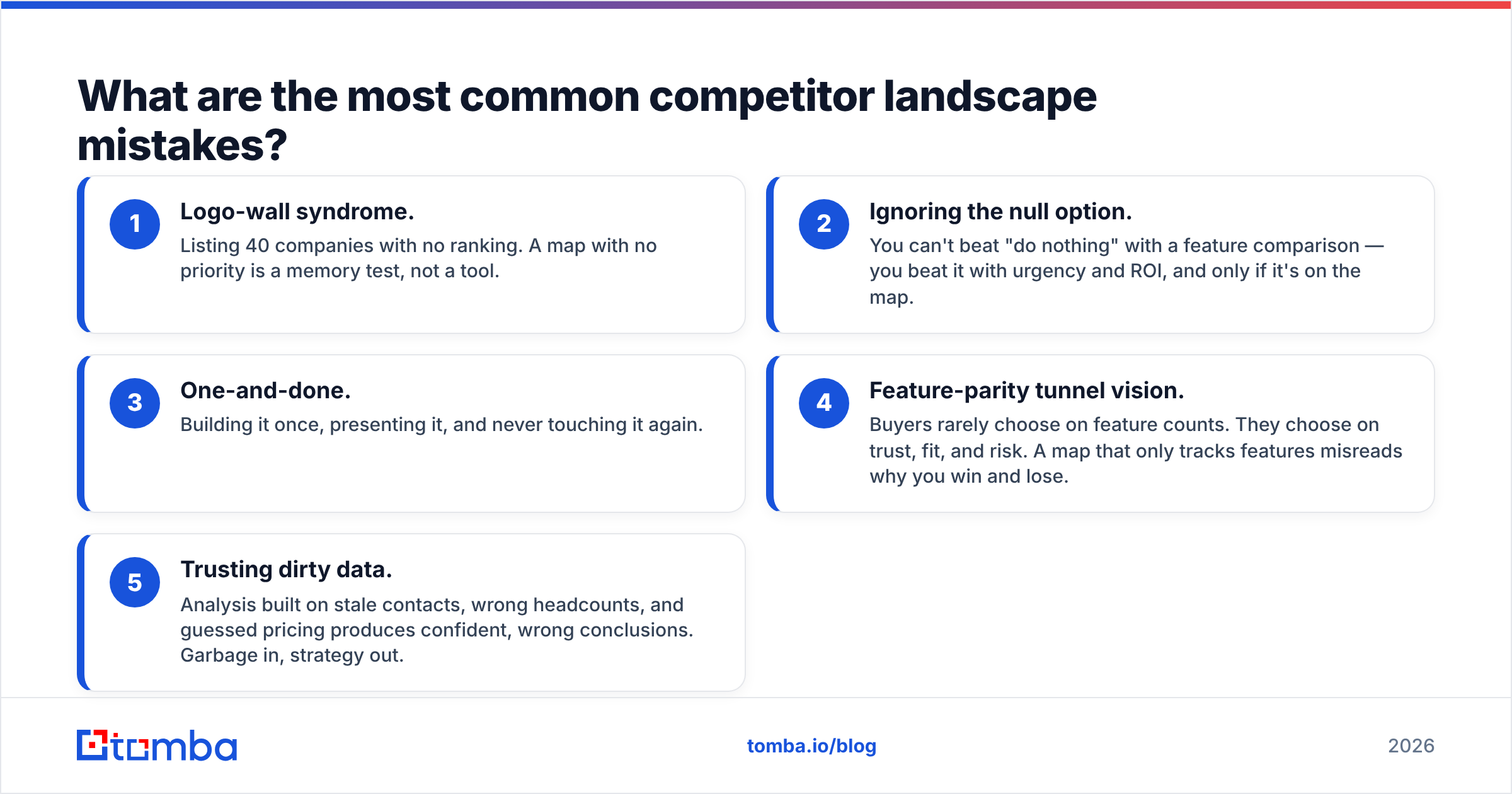
What are the most common competitor landscape mistakes?#
The five that quietly sink otherwise-good maps:
- Logo-wall syndrome. Listing 40 companies with no ranking. A map with no priority is a memory test, not a tool.
- Ignoring the null option. You can't beat "do nothing" with a feature comparison — you beat it with urgency and ROI, and only if it's on the map.
- One-and-done. Building it once, presenting it, and never touching it again.
- Feature-parity tunnel vision. Buyers rarely choose on feature counts. They choose on trust, fit, and risk. A map that only tracks features misreads why you win and lose.
- Trusting dirty data. Analysis built on stale contacts, wrong headcounts, and guessed pricing produces confident, wrong conclusions. Garbage in, strategy out.
That last one is the quiet killer. Every other mistake is a process fix. Bad data is a foundation crack — it undermines the map no matter how good your framework is. This is why competitive intelligence is a data-quality discipline before it's a strategy discipline.
Where does clean data fit into competitive intelligence?#
Underneath everything. Your landscape is only as trustworthy as the firmographic and contact data feeding it — momentum scores, ICP overlap, and win/loss context all depend on knowing who's who and reaching them.
To research a competitor properly you need to talk to people: their churned customers, their partners, industry analysts, and prospects who evaluated both of you. Finding and verifying those contacts at scale is the difference between a landscape built on three anecdotes and one built on thirty interviews. That's the gap the Tomba Email Finder is built to close — find accurate, verified professional emails by name, company, or domain, then enrich each record so your competitive research reaches real inboxes instead of bouncing into the void.
Start free with 25 searches, and if the research cadence proves its worth, Tomba pricing scales from a $49/mo Starter plan up through Growth and Pro without locking your competitive intelligence behind an enterprise contract. Map the landscape, source the signals, and keep the whole thing current — the teams that out-position their rivals are usually just the ones who saw the field more clearly.
Related guides#
Ready to find emails that actually work?
Join 150,000+ professionals who stopped guessing and started sending. Free credits on signup — no credit card required.
Get the Tomba newsletter
Practical outbound tactics and product updates — once every two weeks.
About the author