Complex Sales in 2026: How to Win Long, Multi-Stakeholder B2B Deals
Complex sales means long cycles, big committees, and high stakes. Here's a practical 2026 playbook for mapping buyers, building consensus, and closing without stalling.
Complex sales is the discipline of closing high-value B2B deals that involve multiple decision-makers, long evaluation cycles, and real financial risk for the buyer. If you sell software above $25,000 in annual contract value, hardware, professional services, or anything that requires a committee sign-off, you are already living in complex-sales territory — whether your process is built for it or not.
The problem is that most reps still run complex deals with tactics designed for simple, one-call closes. That mismatch is why forecasts slip, "no-decision" losses pile up, and pipeline looks healthy right up until the quarter ends.
This guide breaks down what complex sales actually is, how it differs from transactional selling, and the concrete 2026 playbook for winning long, multi-stakeholder deals without burning six months on a prospect who was never going to buy.
TL;DR#
- Complex sales = high-value B2B deals with 3+ decision-makers, multi-month cycles, and formal evaluation. Gartner puts the typical B2B buying group at 6 to 10 stakeholders.
- The top killer isn't a competitor — it's "no decision." Roughly half of forecasted complex deals stall out because the buying committee never reaches internal consensus.
- Winning requires stakeholder mapping, multi-threading, and a mutual action plan — not more demos.
- Clean contact data is the unglamorous foundation. You can't multi-thread a 9-person committee if you only have one email and a guessed phone number.
- Tools like a reliable email finder and CRM hygiene matter more in complex sales than in any other motion, because one wrong contact can cost you a month.
What is complex sales?#
Complex sales — sometimes called enterprise selling or complex B2B sales — is any deal where the purchase decision is made by a group rather than a single person, over an extended period, with meaningful consequences if the choice goes wrong.
Think of it like getting a major renovation approved for a shared apartment building. You can't just convince one enthusiastic tenant. You need the board, the budget committee, the skeptical neighbor who hates change, and the property manager who has to live with the result. Everyone has a veto, nobody has full authority, and the whole thing dies if any one of them feels unheard.
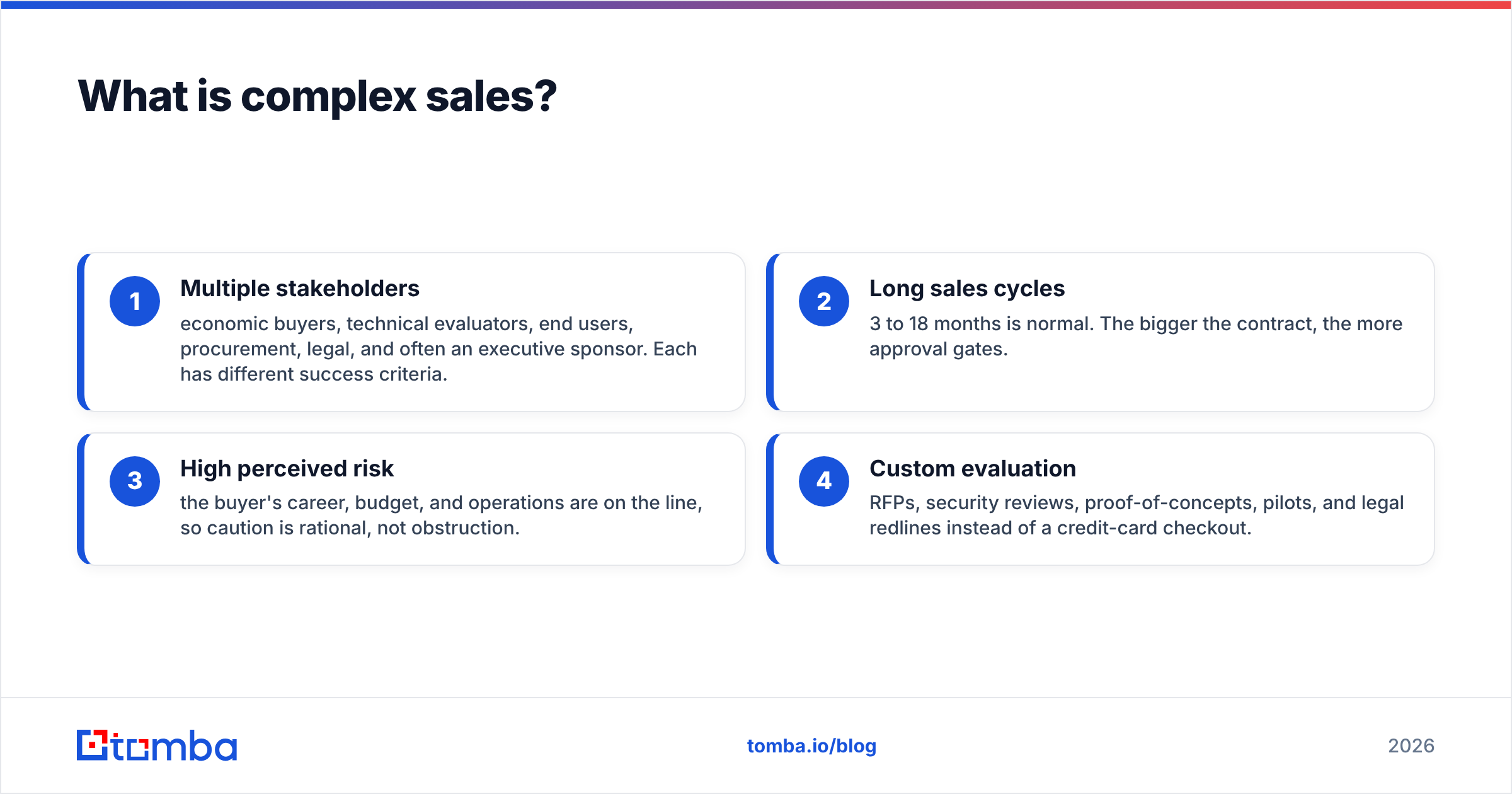
Four traits define a complex sale:
- Multiple stakeholders — economic buyers, technical evaluators, end users, procurement, legal, and often an executive sponsor. Each has different success criteria.
- Long sales cycles — 3 to 18 months is normal. The bigger the contract, the more approval gates.
- High perceived risk — the buyer's career, budget, and operations are on the line, so caution is rational, not obstruction.
- Custom evaluation — RFPs, security reviews, proof-of-concepts, pilots, and legal redlines instead of a credit-card checkout.
If your deal has even two of these, you should be running a complex-sales motion.
How is complex sales different from transactional sales?#
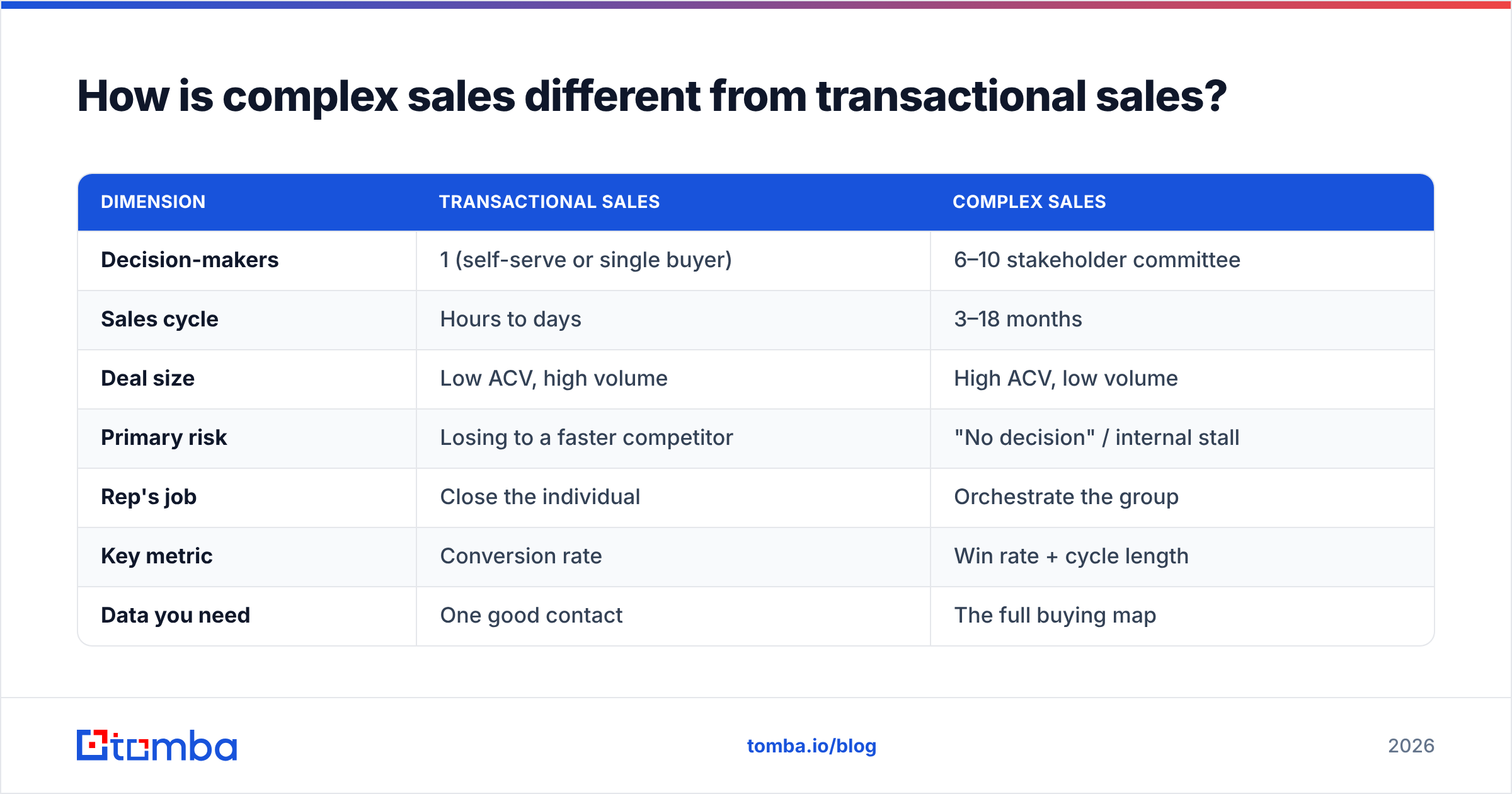
The fastest way to lose a complex deal is to sell it like a simple one. The two motions optimize for opposite things: transactional selling optimizes for speed and volume, complex selling optimizes for consensus and de-risking.
| Dimension | Transactional sales | Complex sales |
|---|---|---|
| Decision-makers | 1 (self-serve or single buyer) | 6–10 stakeholder committee |
| Sales cycle | Hours to days | 3–18 months |
| Deal size | Low ACV, high volume | High ACV, low volume |
| Primary risk | Losing to a faster competitor | "No decision" / internal stall |
| Rep's job | Close the individual | Orchestrate the group |
| Key metric | Conversion rate | Win rate + cycle length |
| Data you need | One good contact | The full buying map |
Notice the risk row. In transactional deals you mostly lose to a rival. In complex deals, your biggest competitor is the buyer's own inertia. According to long-running research from Gartner, the sheer size of the buying group is what makes consensus so hard — more people means more ways for a deal to stall.
That's why "just send another demo" is rarely the answer. The demo isn't the blocker; the missing sixth stakeholder is.
Who are the stakeholders in a complex sale?#
You cannot influence a committee you haven't mapped. Before you optimize a single email, list every role and who fills it.
- Economic buyer — controls the budget and signs. Often an executive you never demo to directly.
- Champion — your internal advocate who sells for you when you're not in the room. The single most important relationship in the deal.
- Technical buyer / gatekeeper — IT, security, or a specialist who can veto on compliance or integration grounds.
- End users — the people who'll use the product daily. Their enthusiasm (or resistance) leaks upward.
- Procurement — negotiates price and terms, usually late, always focused on risk and cost.
- Blockers / detractors — someone tied to the status quo or a competing vendor. Ignore them and they'll sink you quietly.
Each role needs a different message. The economic buyer wants ROI and risk reduction. The end user wants their day to get easier. Procurement wants defensible terms. Sending the same deck to all six is how deals go silent.
To reach roles beyond your first contact, you'll need accurate contact details for people who never opted into your funnel. A domain search that returns every verified email pattern at the target company is often the difference between a single-threaded deal and a real multi-threaded one.
What is multi-threading and why does it decide complex deals?#
Multi-threading means building relationships with several stakeholders in parallel instead of routing everything through one contact. It's the highest-leverage habit in complex sales.
Single-threaded deals are fragile. Your one champion goes on leave, changes roles, or simply stops replying — and the deal dies with no warning. Multi-threaded deals survive because momentum doesn't depend on any single person.
A practical multi-threading sequence:
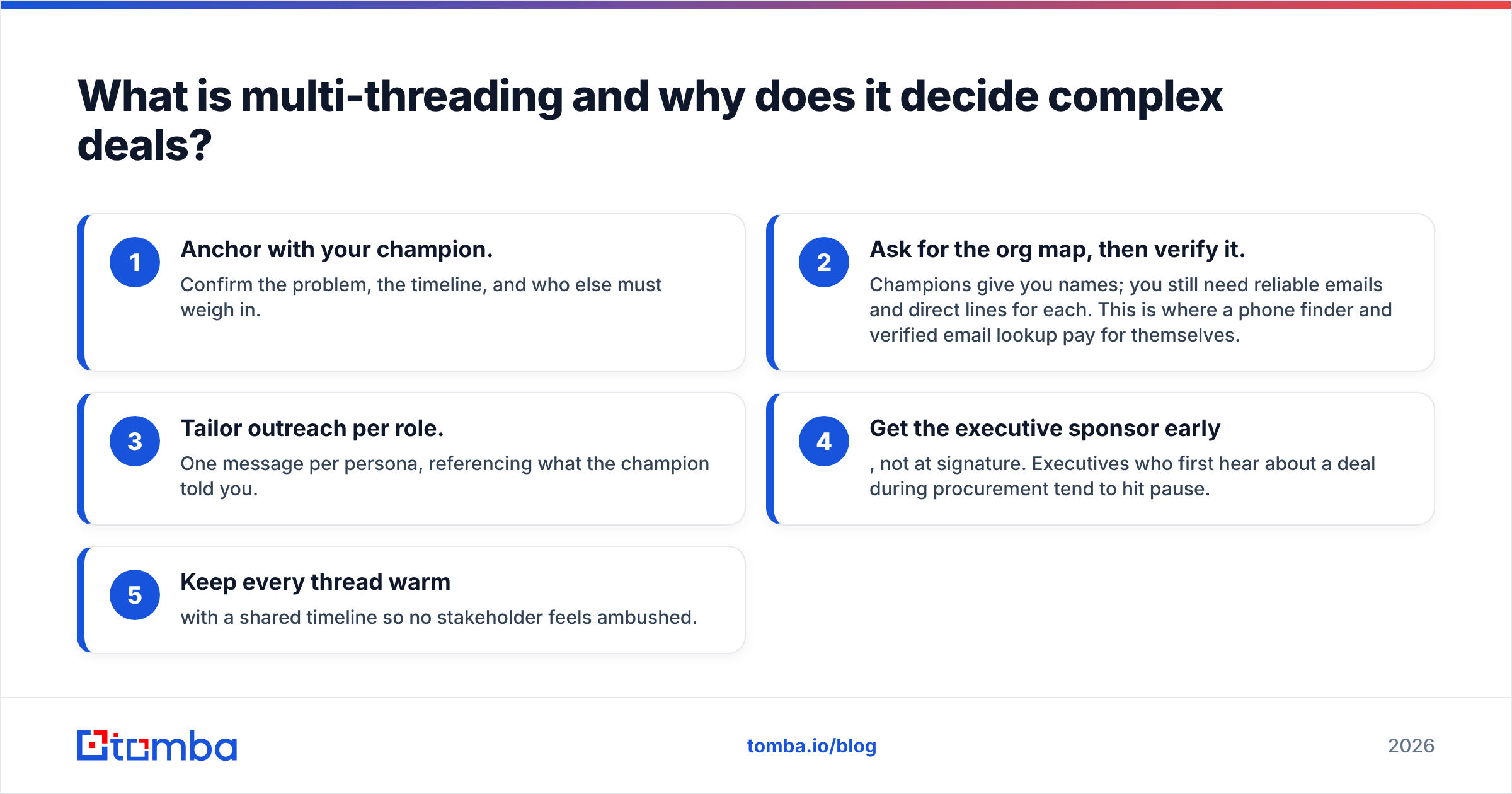
- Anchor with your champion. Confirm the problem, the timeline, and who else must weigh in.
- Ask for the org map, then verify it. Champions give you names; you still need reliable emails and direct lines for each. This is where a phone finder and verified email lookup pay for themselves.
- Tailor outreach per role. One message per persona, referencing what the champion told you.
- Get the executive sponsor early, not at signature. Executives who first hear about a deal during procurement tend to hit pause.
- Keep every thread warm with a shared timeline so no stakeholder feels ambushed.
The data foundation here is not optional. If you enrich your account with a full contact set up front — every stakeholder's verified email and role — you can multi-thread from week one instead of scrambling in month three. Bulk workflows like contact enrichment turn a list of names into a working buying map fast.
How do you build a complex sales process that closes?#
A repeatable complex-sales process turns heroic individual effort into a system your whole team can run. The framework below borrows from proven methodologies (MEDDICC, Challenger, and mutual action plans) without the jargon.
Stage 1 — Qualify hard. Use a checklist: Is there budget? A named economic buyer? A compelling event with a real deadline? If you can't answer these, you have a project, not a deal. Disqualifying early is the cheapest way to protect your quarter.
Stage 2 — Map and multi-thread. Build the stakeholder map, confirm contact data, and open at least three threads. Deals with a single contact should be flagged as at-risk automatically.
Stage 3 — Diagnose, don't pitch. Run discovery that uncovers the cost of inaction. The strongest complex-sales reps quantify the pain in the buyer's own numbers so the internal business case writes itself.
Stage 4 — Build a mutual action plan (MAP). A shared, dated document listing every step to go-live: security review, pilot, legal, sign-off. A MAP does two things — it exposes hidden approval gates and it commits the buyer to a timeline. It's the single best antidote to "no decision."
Stage 5 — Manage the paper process. Procurement, legal, and security are where deals die in the last mile. Introduce them early and treat their requirements as part of the sale, not an afterthought.
The reps who consistently hit quota aren't smoother talkers. They're better orchestrators — and orchestration runs on accurate information about who's involved and what each person needs.
What tools and data do complex sales teams need in 2026?#
The 2026 complex-sales stack has three layers: a CRM as the source of truth, engagement tools for outreach and sequencing, and data providers that keep contact records accurate. Most teams over-invest in the first two and under-invest in the third — then wonder why their multi-threading stalls on bounced emails.
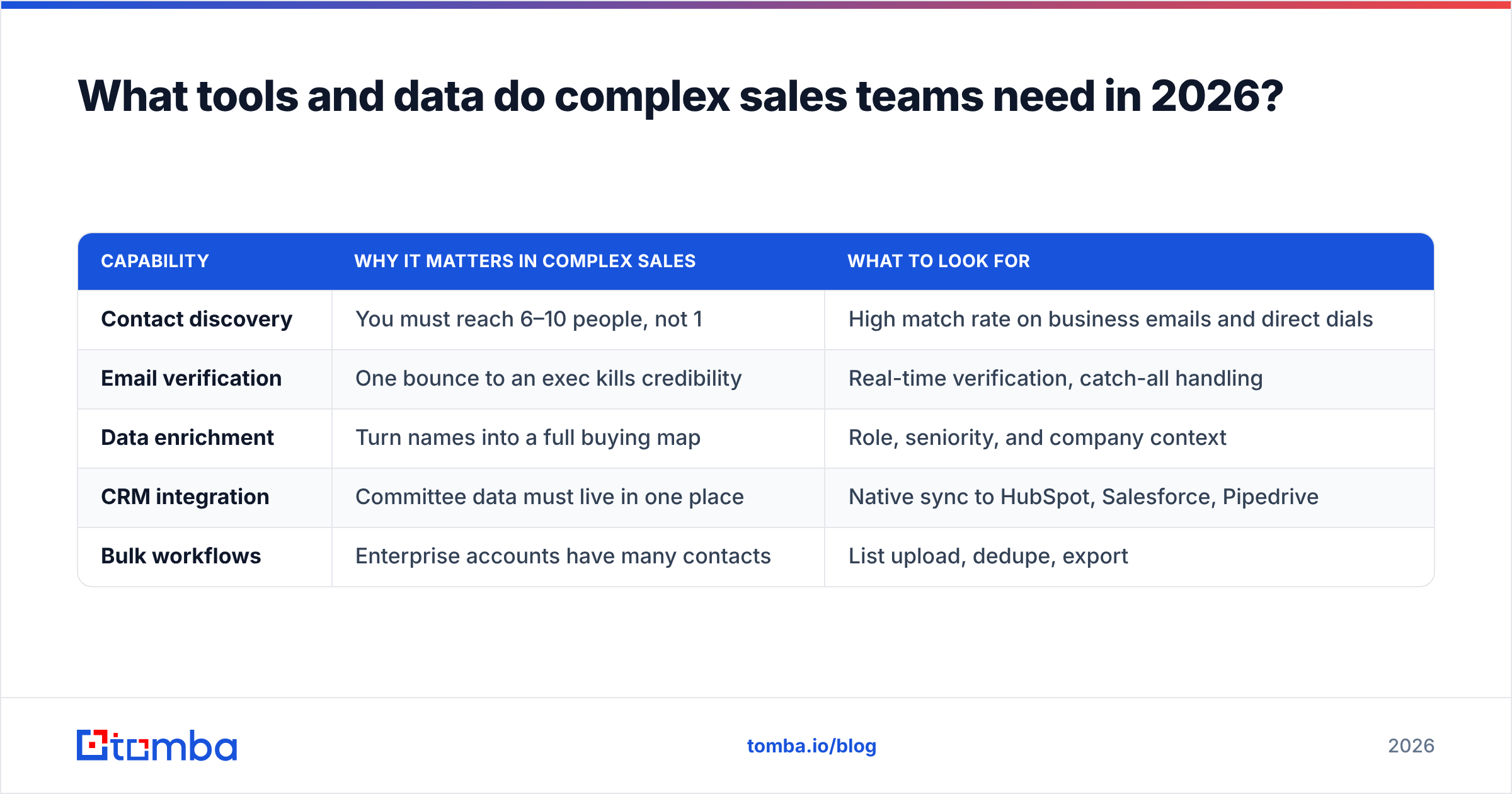
Here's how the core categories compare for a complex, committee-driven motion:
| Capability | Why it matters in complex sales | What to look for |
|---|---|---|
| Contact discovery | You must reach 6–10 people, not 1 | High match rate on business emails and direct dials |
| Email verification | One bounce to an exec kills credibility | Real-time verification, catch-all handling |
| Data enrichment | Turn names into a full buying map | Role, seniority, and company context |
| CRM integration | Committee data must live in one place | Native sync to HubSpot, Salesforce, Pipedrive |
| Bulk workflows | Enterprise accounts have many contacts | List upload, dedupe, export |
For the discovery and verification layer specifically, accuracy beats database size. A provider with 500 million contacts is worthless if the eight you need for this deal bounce. This is exactly where a focused tool earns its keep — Tomba's email verifier confirms a contact is deliverable before you spend a personalized message on them, and its Salesforce integration keeps the committee map synced where your reps actually work.
If you're weighing platforms, industry review sites like G2 are useful for filtering on real-world match rates and support quality rather than marketing claims. And for methodology, HubSpot's sales resources remain a solid free reference for MEDDICC and mutual-action-plan templates.
Where Tomba fits in the stack#
Tomba isn't a full CRM or a sequencing engine — and it doesn't pretend to be. It's the data layer that keeps everything above it honest. Pricing is straightforward: a free tier with 25 searches per month, then Starter at $49/mo, Growth at $99/mo, and Pro at $249/mo, with Enterprise custom (full Tomba pricing on the site). For a complex-sales team, the value is simple: fewer bounced emails to executives, faster stakeholder mapping, and CRM records you can trust when the deal reaches procurement.
How long should a complex sale take — and how do you speed it up?#
Most complex sales run 3 to 12 months, and you can't shortcut trust — but you can remove friction. The two biggest time-wasters are chasing wrong contacts and discovering approval gates late.
Practical accelerants:
- Front-load the buying map. Every day spent finding the next stakeholder is a day the deal isn't progressing. Enrich the full committee in week one.
- Use a mutual action plan to set the pace. A dated MAP creates gentle deadline pressure the buyer agreed to.
- Verify before you send. A bounced email to a CFO doesn't just fail — it makes you look careless at the worst moment.
- Bring procurement in early. Security and legal reviews are the most common last-mile delays; start them in parallel, not at the end.
Speed in complex sales comes from removing dead time, not from pushing harder. Clean data removes more dead time than any other single change.
The bottom line#
Complex sales is won or lost on orchestration: mapping the whole committee, multi-threading in parallel, and guiding a nervous group to consensus with a shared plan. Every one of those moves depends on knowing exactly who's involved and being able to reach them reliably.
That's the unglamorous edge. While competitors guess at contacts and single-thread their way into "no decision," you can build the full buying map in week one and keep every thread warm.
Start with the foundation. Use the Tomba Email Finder to turn a list of committee names into verified, ready-to-reach contacts — then spend your energy on the part that actually closes complex deals: the relationships. Grab the free tier, map your next enterprise account, and see how much faster a fully-threaded deal moves.
Related guides#
Ready to find emails that actually work?
Join 150,000+ professionals who stopped guessing and started sending. Free credits on signup — no credit card required.
Get the Tomba newsletter
Practical outbound tactics and product updates — once every two weeks.
About the author